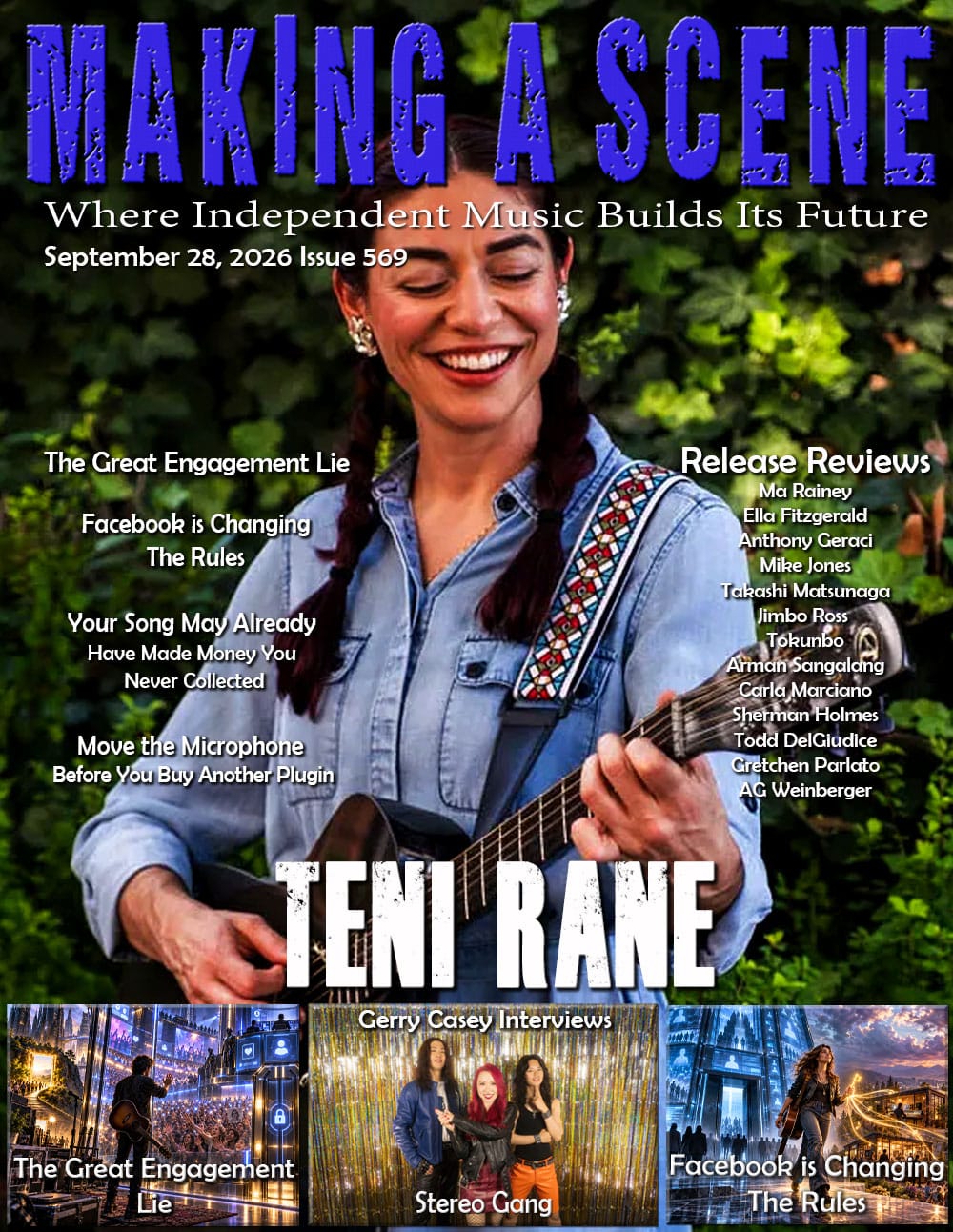

Smart Media Albums Enter the U.S. Billboard Charts Today




Making a Scene Presents – Smart Media Albums Enter the U.S. Billboard Charts Today
Listen to the Podcast Discussion
The Bigger Opportunity Starts After the Sale
For the past several weeks, we have been watching the Smart Media Album story with the kind of cautious enthusiasm that years in the music business eventually teaches you to develop. The idea has always been interesting because it combines something fans can physically own with a digital experience that can continue growing after the sale, which fits neatly into a future where independent artists need stronger direct relationships with the people who support them. What we were not willing to do was repeat early promotional claims about Billboard eligibility simply because the companies selling the technology said those claims were true. The music business already has enough press releases announcing revolutions before anyone bothers to check whether the revolution remembered to bring shoes, so we wanted independent confirmation before telling artists that the rules had actually changed.
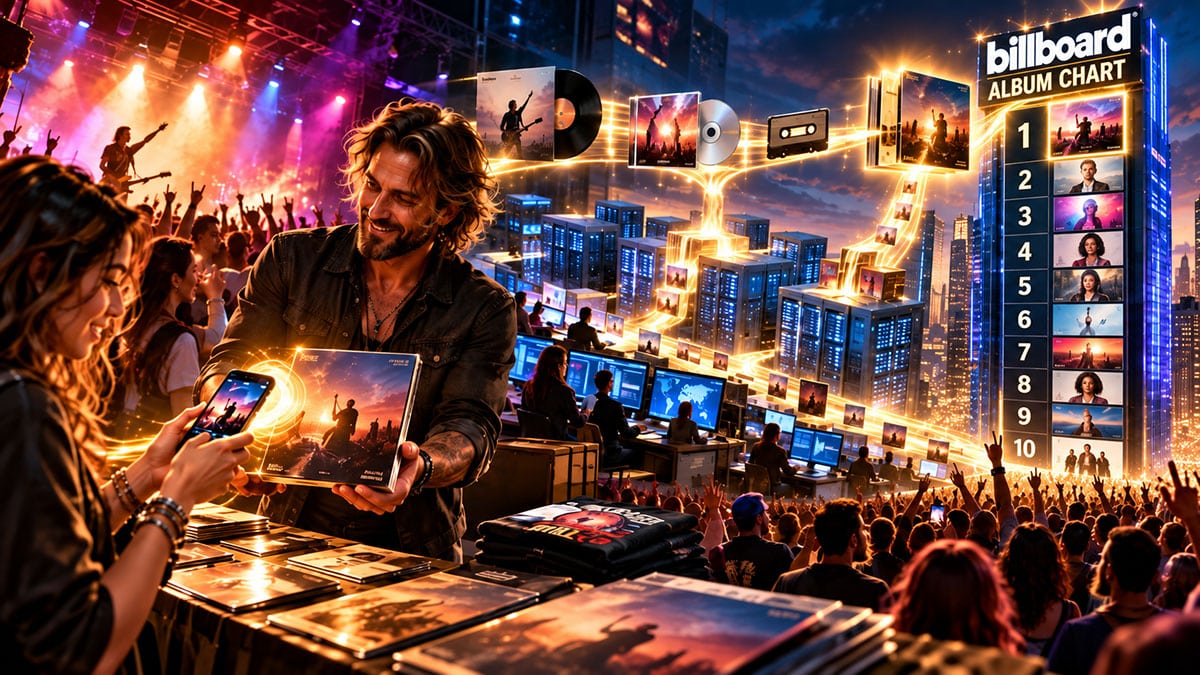
We have that confirmation now, and today the change becomes real. Luminate begins tracking Smart Media Albums as a distinct physical music category in the United States and Canada, placing them alongside established physical formats such as vinyl, CDs and cassettes inside its measurement systems. Qualifying Smart Media Album sales can also participate in the data used for official Billboard chart calculations, making this more than another clever merchandise idea looking for a catchy name. Luminate describes Smart Media as the first new physical music format it has added since CDs, which is a remarkable milestone considering how many technologies have marched through the music industry since the compact disc was introduced.
That does not mean every object containing an NFC chip has suddenly become a Billboard album, and this is where the story becomes much more useful for independent artists than the headline alone suggests. Smart Media now has a formal place inside the music industry’s measurement system, but chart eligibility comes with specific product, provider, registration and reporting requirements. At the same time, artists who have no reason to chase chart eligibility can use similar technology to create less expensive direct-to-fan products that may actually produce more useful long-term business results. Understanding the difference between those two paths may be more important than understanding the technology itself.
The bigger opportunity is not really about NFC, QR codes or any other method used to make a phone react when it meets a physical object. Those technologies are merely doors, and doors are only valuable when there is something worth entering on the other side. What makes Smart Media interesting is the possibility of turning a physical music purchase into an ongoing relationship in which the fan can return for music, videos, stories, rewards, ticket offers, merchandise, membership opportunities and future releases. For independent artists trying to build a music industry middle class based on owned assets and repeat customers rather than waiting for algorithms to smile upon them, that is where today’s announcement becomes much more interesting.
What Actually Changes Today
Luminate’s new category recognizes physical products that connect buyers to a dedicated digital album experience through technologies such as NFC chips, QR codes, ultrasonic signatures or similar activation methods. The important word there is “dedicated,” because Luminate’s current guidance says the album must be hosted in an app, website or platform that becomes available through activation of the Smart Media product. Simply tapping a card and being redirected to an outside streaming service does not satisfy that definition. The physical object and the digital experience are meant to operate together as the album product rather than using the object as a decorative shortcut to somewhere the fan could already visit without buying anything.
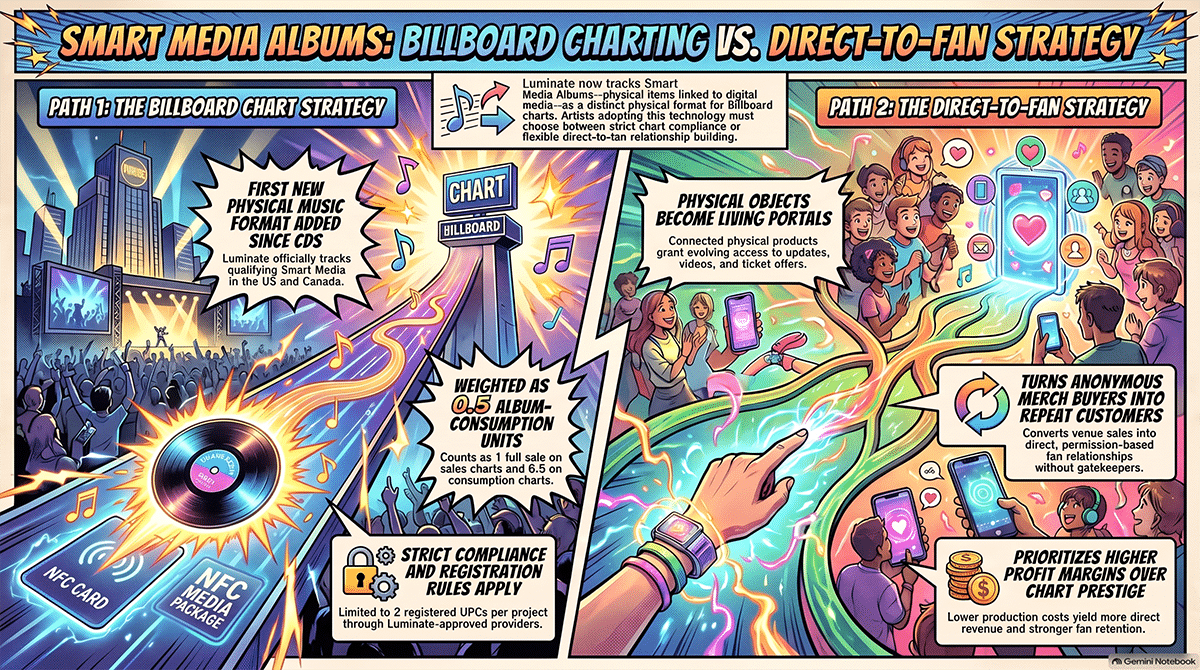
Billboard’s introductory treatment also shows that the industry is approaching the category cautiously rather than pretending a new format is identical to every product that came before it. During the initial phase, an eligible Smart Media Album transaction counts as one full album sale on Billboard’s album-sales charts while contributing 0.5 equivalent album units toward album-consumption chart calculations. That weighting gives the format meaningful chart value while allowing Billboard and Luminate to observe how consumers actually use these products before making assumptions about how Smart Media should sit beside conventional physical sales and other forms of consumption.
Luminate’s registration rules add another important layer that artists need to understand before they start designing twelve collectible editions at two in the morning because somebody discovered another color of holographic foil. Chart eligibility is limited to two Smart Media UPCs for each album project across approved providers, and the artist or label must designate which products are intended to be chart eligible during registration. Once two qualifying UPCs have been registered, Luminate says substitutions are not allowed, even if somebody later decides that Version Three with the glow-in-the-dark goat would clearly have been the superior commercial strategy. Products also need to be registered in advance, and Luminate recommends registering releases at least a week before street date so tracking can begin properly.
These details matter because Smart Media is entering an existing measurement system rather than being allowed to make up its own rules. Luminate and Billboard maintain eligibility requirements that cover products, transactions and reporting, and Luminate explicitly warns that products or promotional tactics not covered by those rules should not simply be assumed to qualify. Those requirements are reviewed and updated throughout the year, which means artists planning chart campaigns need to consult the current rules rather than relying on a screenshot from somebody’s conference presentation six months earlier. The official Luminate chart eligibility information is available through https://support.luminatedata.com/portal/en/kb/articles/eligibility, while registration guidance is maintained at https://support.luminatedata.com/portal/en/kb/articles/music-registration.
For independent artists, the practical lesson is not that chart rules are frighteningly complicated. The lesson is that chart eligibility should be treated as a business decision made before manufacturing begins. If chart participation has a real purpose inside the release campaign, the artist needs to choose the correct provider, register the correct products and understand how the sales will be reported. If chart participation does not have a clear business purpose, there is no good reason to let those requirements determine the design or cost of the product simply because having the word “Billboard” somewhere in the conversation makes everybody at the rehearsal studio sit up straighter.
The Approved Provider List Is Important, but It Is Not a Shopping List
Luminate’s approved Smart Media list currently includes KiTbetter, Serenade, Totem, IYK, Weverse, Yoto and ZATAP. That provider requirement is important for chart eligibility, but artists should resist treating these companies as interchangeable manufacturers producing different colors of the same object. Their products, technologies and existing audiences vary considerably, and that variety gives us an early glimpse of how broad Smart Media may eventually become. Luminate’s announcement establishes the category and approved-provider requirement, while current industry reporting confirms the seven companies included as the category launches.
KiTbetter, at https://kitbetter.com/, has been developing its KiTalbum as a complete physical-digital music format rather than simply attaching an NFC tag to conventional merchandise. Its current product experience can include high-quality music, videos, photographs, album credits and community features tied to a collectible physical package. That approach is useful for artists who still want an album to feel recognizably like an album while giving the fan a richer digital environment behind the physical object. KiTbetter’s own product information emphasizes both physical collectibility and the digital experience, which illustrates why Smart Media should be thought of as a connected product rather than an unusually complicated download card.
Serenade, available at https://serenade.co/us, approaches the idea through what it calls Smart Formats, with products that can include miniature CDs, miniature cassettes, miniature vinyl, trading cards, keychains and other connected objects. Its system allows fans to tap a product, sign in and unlock digital music and additional material, while different physical formats can be designed around the creative identity of a release. Serenade currently identifies several of its formats as U.S. chart eligible and describes the digital side as capable of holding audio, video, photographs and files related to the release. That flexibility matters because an independent artist may want the physical product to feel like a collectible from the artist’s world rather than another plastic rectangle that looks as though it came free with a hotel-room key.
IYK Music, at https://www.iyk.app/music/, pushes the concept further toward connected merchandise and fan identity. Its current music products include TapCards, chipped stickers, lanyards and apparel, while the broader system is designed to make real-world fan interactions visible and useful to the artist or team. That approach starts to blur the old boundary between “album,” “merchandise” and “fan pass,” which could become one of the more interesting consequences of Smart Media. When a physical item can prove that somebody owns the release, attended an event or belongs to a certain fan group, the value of that product can extend beyond simply delivering audio.
Weverse Albums, at https://en.weverse.co/weversealbums, provides another useful model because QR-connected digital albums are already familiar to large numbers of K-pop fans. Its album experience can combine music with digital photo books, photocards and animated album content inside the Weverse Albums environment, demonstrating that fans can accept a physical purchase whose main media experience lives digitally when the product is presented as a collectible rather than an apology for not pressing a CD. Yoto, at https://us.yotoplay.com/, comes from the connected-audio world with physical cards used to unlock audio experiences, showing that the Smart Media category is not tied to one particular shape or interaction model.
ZATAP, at https://zatap.io/, offers another glimpse of where the category can go because its connected-product work extends across music, merchandise and live fan engagement. ZATAP describes Smart Media experiences that can include the album, high-quality downloads, backstage content, alternate versions, artwork, lyrics, rewards and material that can be updated after purchase. Its system also emphasizes first-party audience information, proof of attendance and repeat interaction, which begins moving Smart Media away from the old idea of “a format that contains music” and toward the much more useful idea of “a product that maintains a relationship.”
The provider currently identified by Luminate as Totem is an interesting example of how quickly this space is already changing. The former https://totem.info/ address now redirects to AudioPhysical, which describes its product as a physical-digital album object designed around ownership, active listening and ongoing album experiences. That does not change the importance of checking Luminate’s current approved-provider list before committing to a chart campaign, but it does illustrate why artists should expect names, products and business models in this emerging category to evolve. New technology markets have a habit of changing their furniture while everyone is still deciding where the couch belongs.

There Are Really Two Smart Media Businesses
Once the chart rules and provider list are understood, the most important decision for an independent artist becomes surprisingly simple: does this particular product need to participate in the Billboard chart system, or is its primary job to generate direct revenue and strengthen the relationship with fans? Those objectives can overlap, but they should not be treated as identical. A chart campaign may justify particular providers, registration rules, production schedules and reporting requirements, while a direct-to-fan campaign may benefit from lower costs, more technical flexibility or stronger control over the customer experience.
For an artist with a genuine chart strategy, the new category can be meaningful. A label-backed release, a well-organized independent campaign or an artist with a concentrated fanbase may be able to convert Smart Media sales into measurable first-week activity that supports publicity, retail conversations or other parts of a release plan. The physical product can also give fans something more interesting than a conventional download while still allowing those purchases to contribute to album-sales measurements. When those pieces fit together, paying for the approved route can be a sensible investment rather than an act of vanity.
The problem begins when artists assume that chart eligibility automatically makes a product more valuable. Independent musicians have been trained for decades to buy pieces of the traditional industry because those pieces looked like evidence of success, even when nobody could explain how they were supposed to make money. Artists have paid for oversized radio campaigns in markets where they never intended to tour, ordered vinyl inventories large enough to qualify as household furniture and purchased publicity packages that generated links but no durable fan relationships. Adding an NFC chip to that old habit would not make the business model smarter; it would simply give the bad decision wireless connectivity.
A direct-to-fan Smart Media product can pursue a very different goal. Imagine an artist selling a connected album for $30 at the merch table, with the product unlocking the music, lyrics, credits, studio footage, a tour diary and future updates. The fan who activates it might also receive early access to the next local show, a discount on merchandise or an invitation to join a membership. If the experience allows the fan to give permission for continued communication, the artist has created both immediate merchandise revenue and the possibility of later ticket, membership and merchandise revenue from somebody who has already demonstrated willingness to spend money.
The product does not become less valuable because Billboard never sees the transaction. For a working artist, the financial question is whether the product generates enough margin and future business to justify its cost. If an inexpensive non-chart Smart Media product turns a $30 merch buyer into a repeat customer who later purchases another ticket, a shirt and the next album, that may be far more important to the artist’s career than adding one eligible unit to a chart calculation. Prestige has its place, but prestige does not pay the van insurance unless somebody figures out how to convert it into revenue.
This is why Smart Media should force artists to begin with the business goal rather than the technology. If the campaign needs chart reporting, choose the chart-eligible route and follow the rules carefully. If the campaign needs profitable merchandise and better fan retention, choose the most economical system that preserves the experience and the relationship. If both goals matter, design for both from the beginning rather than assuming one product must magically satisfy every possible purpose.
The Album Can Become Something That Keeps Growing
The most interesting thing about Smart Media is not that the fan can tap a phone against something. We have been tapping phones against payment terminals, hotel locks and other objects for years, and civilization somehow survived without calling each interaction a revolution. What changes the music business is the possibility that the physical album can now act as proof of access to an experience that continues changing after the day of purchase.
A traditional CD is essentially finished when it leaves manufacturing. The artist can create another edition later, but the original disc will continue containing exactly the music pressed onto it when it was made. Vinyl works the same way, with the added advantage that everyone can argue about pressing weight, mastering chains and whether your turntable cartridge is spiritually compatible with the snare drum. These physical formats are wonderful precisely because they are permanent, but permanence also means the product itself cannot easily continue developing.
Smart Media allows the physical object to become an entitlement rather than merely a container. The fan may buy the album today and initially receive the record, artwork, lyrics, credits and videos, but the same object can continue granting access as the artist adds material later. A live recording from the tour could appear next month, followed by rehearsal footage, an acoustic version, a studio breakdown or a holiday message. When tickets go on sale for the next tour, owners of the album could receive early access, and when a new merchandise line arrives, those same owners could be offered a private discount.
That changes the economics of physical music because the original sale can create additional moments when the artist has something meaningful to offer. The artist is not repeatedly begging the same customer to buy another version of the same record simply because the cover is now purple. Instead, ownership can become part of an ongoing relationship in which the fan continues receiving value and the artist continues earning opportunities to sell tickets, merchandise, memberships, future music and other experiences. The album becomes less like dead inventory and more like a doorway that remains useful after somebody leaves the merch table.
This approach also gives artists room to create different kinds of products for different kinds of supporters. A basic edition might unlock the core album experience, while a premium physical edition could provide additional material or longer access. A touring edition could connect the album with show-specific recordings, while another product might be designed around membership or educational content. The artist is no longer limited to thinking about the album as a fixed group of songs sealed inside one object; the album can become the center of a small economic world built around those songs.
For independent musicians, that matters because the strongest businesses rarely depend on one transaction. A sustainable career usually grows from several connected sources of income, with recordings leading toward shows, shows leading toward merchandise, merchandise leading toward direct fan contact, fan contact leading toward memberships or future sales, and the artist’s catalog creating opportunities for publishing and licensing over time. Smart Media is valuable when it helps those parts of the business talk to each other instead of becoming one more isolated product sitting in another dashboard.
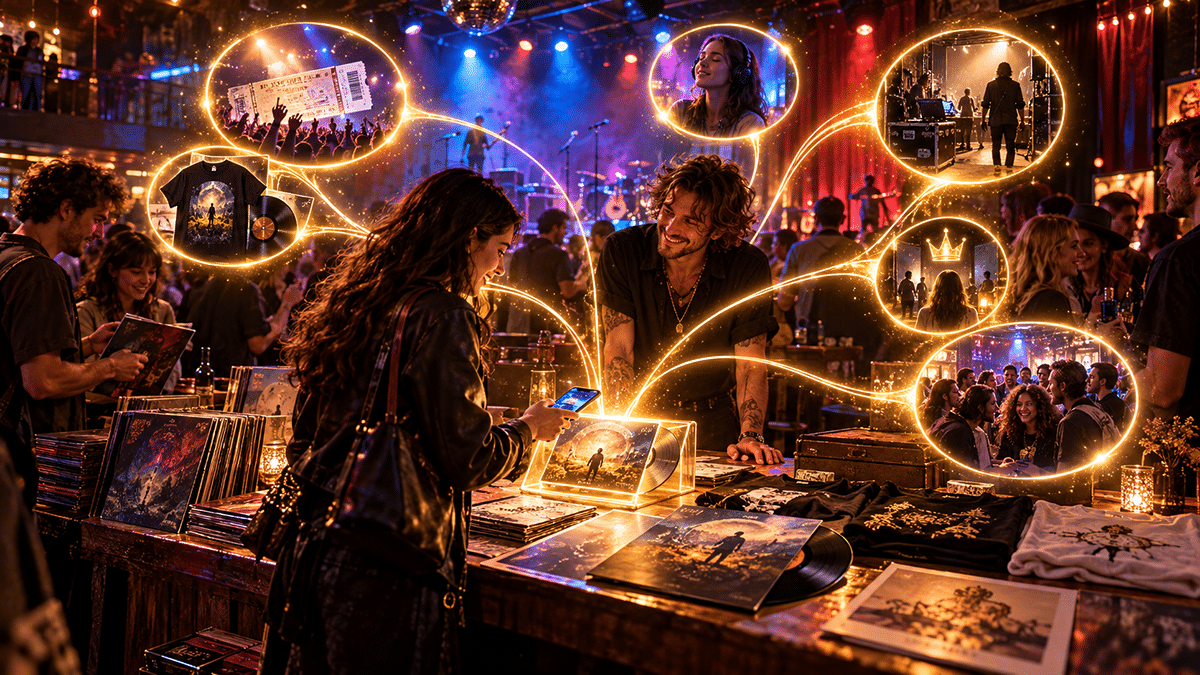
The Merch Table Can Finally Remember Who Bought Something
The merch table has always been one of the most powerful places in an independent artist’s business because it compresses emotion and commerce into the same moment. The fan has just watched the artist perform, the relationship is warm, and buying a record or shirt feels like an extension of the experience rather than another piece of advertising. There are relatively few gatekeepers standing between the fan and the artist, which is why a good merch table can produce more meaningful revenue in one evening than a surprisingly large number of streams.
The weakness comes after the purchase. A fan can buy an album, a shirt and a poster, hand the artist a substantial amount of money and then walk out of the venue without the artist knowing who that person is. Unless the fan separately joins an email list, follows a direct link or signs up for something else, the artist has completed a valuable sale without creating a durable customer relationship. Most other businesses would consider that a rather strange way to treat a customer, yet music has normalized it because labels, retailers, ticket companies, streaming platforms and social networks have traditionally owned different pieces of the relationship.
Smart Media gives the merch table a chance to become the beginning of the next interaction rather than the end of the current one. When the fan activates the product, the experience can invite them to establish a direct connection with the artist and explain what they will receive in return. That might include future album updates, an unreleased recording, special ticket access, a fan reward or a discount on another purchase. The important point is that the fan is choosing to continue the relationship because there is a clear benefit, rather than being tricked into another marketing database while trying to hear the album they already bought.
Consent needs to remain central to this model because direct fan data becomes valuable only when the relationship is trustworthy. Artists should know what a provider collects, what information they can access and what permission the fan has actually granted. A fan who bought an album should not mysteriously discover that the purchase enrolled them in every promotional channel known to modern civilization. The goal is to create a relationship valuable enough that the fan wants to remain connected, because that relationship is far more durable than data acquired through clever fine print.
When that system works properly, the merch transaction becomes part of a larger Fan Journey. The artist can understand that a particular person purchased the album at a particular show, later returned to access bonus content and then purchased another ticket when the artist came back to town. The financial value of the original product now includes both the first sale and the future transactions that grew from the relationship. That is exactly the kind of compounding revenue independent artists need if we expect a real music industry middle class to exist.
Fan Data Is Where the Real Fight Will Be
The shiny physical object will probably dominate much of the early Smart Media marketing because it looks wonderful in photographs and is easy to demonstrate. Someone taps a beautiful collectible with a phone, the screen lights up, and everyone understands that a little technological magic has occurred. The less glamorous question is what happens to the information created by that interaction, and that question may ultimately determine whether Smart Media becomes an artist-empowerment technology or merely produces another generation of companies that know more about the artist’s fans than the artist does.
Artists need to understand whether activation creates an account with the provider, with the artist or with both. They need to know whether permission-based contact information can be accessed and exported, whether engagement information can be connected to another customer-management system, and whether the artist can continue communicating with those fans if they later change providers. They should also understand what happens to the purchased experience if the provider changes its business model or disappears, because a physical object promising long-term digital access is not very impressive if the digital half stops answering the phone three years later.
These questions should feel painfully familiar because streaming and social media already taught independent artists what happens when audience and ownership become confused. An artist can have enormous follower or listener numbers without possessing a practical way to reach those people outside the platform that created the number. The platform understands the audience, sells access to the audience and decides when the artist gets to reach the audience, while the musician celebrates a follower count that can disappear behind an algorithm adjustment before breakfast.
Smart Media can reverse that structure if artists insist on keeping the fan relationship portable. The provider can handle manufacturing, authentication, hosting or technical delivery while the artist retains meaningful access to the people who chose to connect. This does not mean every provider needs to perform every business function, nor does it mean musicians should suddenly become database engineers. It means the artist should understand what is being built and avoid mistaking another closed dashboard for ownership.
ZATAP provides one concrete example of why this discussion matters because its current Smart Media materials explicitly connect physical products with first-party audience information and repeat engagement. Its system describes NFC products capable of linking music experiences, attendance activity, rewards and fan data, demonstrating how quickly the connected album can expand into a broader relationship system. IYK’s emphasis on making real-world fan activity visible points in a similar direction, suggesting that Smart Media may ultimately compete as much on customer intelligence and fan continuity as on the design of the physical object.
For independent artists, that means the most valuable Smart Media provider may not necessarily be the one that manufactures the fanciest object. The better partner may be the one that allows the artist to turn the object into a durable customer relationship without trapping that relationship inside a private system. The physical product can always be redesigned for the next release, but rebuilding years of fan history after discovering that it belonged to somebody else’s platform is a much less entertaining project.
AI Gets More Useful When the Artist Owns the Information
Smart Media also creates an interesting role for artificial intelligence, although it has very little to do with asking a machine to write another song. As artists begin collecting permission-based information about album owners, show attendance, merchandise purchases and engagement with connected content, the amount of information can quickly become more than one person can comfortably understand. A major label can hire analysts and marketing departments to study those patterns, while a working independent musician is usually trying to answer emails from the van while wondering who left the charger at the last venue.
An AI assistant working for the artist could make that information useful without requiring the artist to become a data scientist. It could identify groups of fans who repeatedly attend shows, notice album owners who regularly return for bonus material, help identify people likely to be interested in a new membership or explain which content is producing the strongest engagement. It could also help create personalized but human-approved email campaigns, summarize what happened after a tour stop or show the artist which fan activities appear to lead most often toward another purchase.
The difference between this kind of AI and the AI systems artists have every reason to worry about is control. The artist’s own assistant would be working on information generated by the artist’s business and used to strengthen relationships with people who have chosen to participate. The musician remains the person making the decisions and communicating with fans, while the technology reduces the clerical and analytical burden that normally makes sophisticated marketing difficult for small teams.
That can translate directly into revenue because better information allows the artist to make better offers. A fan who bought the Smart Media Album and attended three shows does not need the same message as somebody who discovered the artist yesterday. A person who watches every studio video might be interested in a production workshop or deluxe recording package, while a fan who repeatedly checks tour information may be far more interested in early tickets. AI becomes useful when it helps the artist recognize those differences without turning human relationships into a robotic sales funnel.
This is another reason artist-owned data matters. If the information remains scattered across closed platforms, artificial intelligence mostly makes those platforms better at understanding the audience. If the artist can bring permission-based information into an artist-controlled system, AI can help the musician understand the audience instead. That may sound like a subtle difference, but economically it is the difference between renting intelligence about your own customers and building intelligence inside your own business.
Web3 Can Help, but Only After We Stop Making It Weird
Smart Media will inevitably bump into Web3 because physical ownership, digital access and identity are exactly the kinds of problems decentralized technology has been trying to solve. That does not mean a Smart Media Album needs a blockchain, token or digital wallet, and artists should be immediately suspicious of anyone claiming the format is incomplete until somebody attaches a speculative asset to it. The first wave of music-industry Web3 enthusiasm taught us that useful infrastructure becomes difficult to see when everyone is busy trying to sell the infrastructure itself.
The genuinely useful Web3 idea is portability. If a fan buys a limited connected album, there may eventually be value in giving that fan a durable proof of ownership that can move between the artist’s website, ticketing environment, membership system and future digital experiences. That proof could potentially survive a change in Smart Media providers, which would help keep the fan’s entitlement attached to the purchase instead of attached forever to one company’s private database.
Authentication could also become important for collectible physical music. A limited edition signed object might carry a secure identity that helps establish that it is genuine years after the original campaign ends. If ownership later changes hands, a portable digital record could potentially help transfer access rights or distinguish legitimate products from copies. Those are practical applications because they protect value that already exists instead of creating a token first and then holding a three-day conference to figure out what it is supposed to do.
The important principle is that fans should not need to understand the technical machinery. If decentralized identity, secure tokens or some other future technology helps preserve ownership and access, that technology should sit quietly underneath the experience. A fan should be able to tap the product and enjoy what they bought without preparing for a cryptocurrency exam, and an artist should be able to manage the relationship without learning a vocabulary invented primarily to impress investors.
When Web3 is used that way, it supports the same larger goal as Smart Media itself: reducing dependence on centralized gatekeepers while increasing the artist’s ability to maintain a direct relationship with supporters. That goal is much less glamorous than announcing a “music ownership revolution,” but it is also much more likely to pay somebody’s rent.
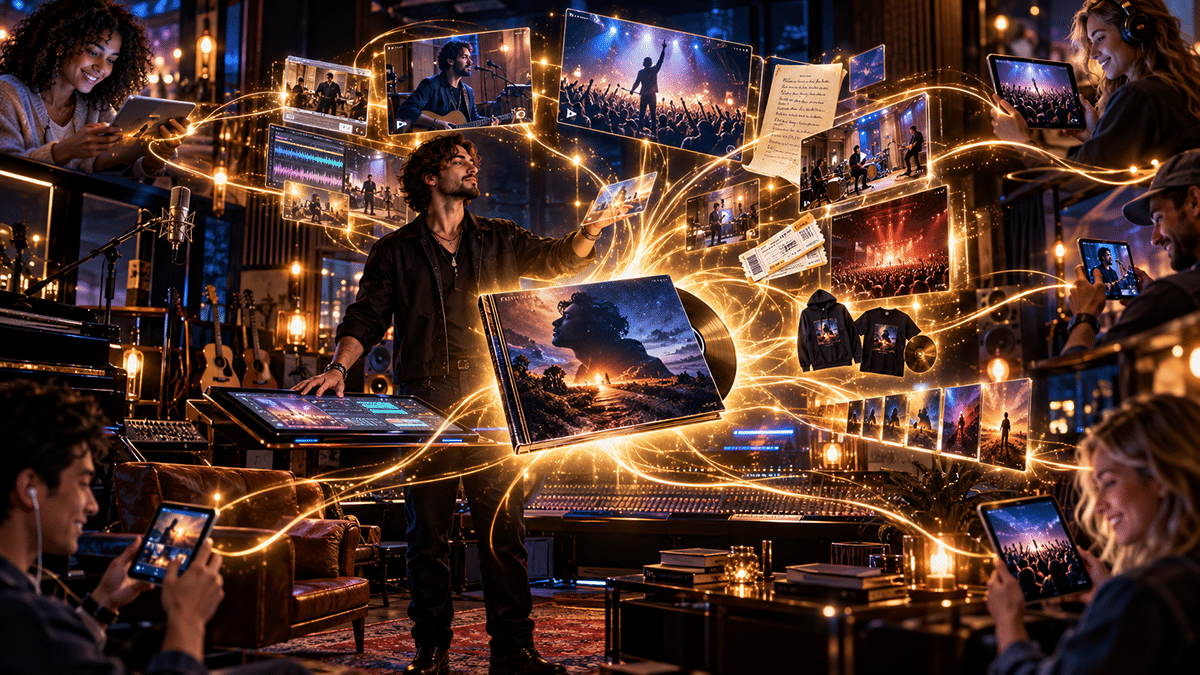
Smart Media Fits a Much Larger Artist Business
The reason Making a Scene has followed this development so closely is that Smart Media fits naturally into a much broader way of thinking about an independent music career. We do not believe the future belongs to artists who discover one magical revenue source that replaces everything else. A sustainable artist business is more likely to combine live performances, merchandise, direct music sales, publishing, licensing, memberships, fan support, production work and other income streams that reinforce one another rather than operating as isolated side hustles.
Smart Media can become connective tissue between several of those businesses. A connected album sold at a show generates merchandise revenue immediately, while activation can establish a direct fan relationship. That relationship can later support ticket sales, memberships or another merchandise purchase, while the music itself continues producing publishing and licensing opportunities independently of the Smart Media product. If the artist has properly organized rights and metadata, the same album can exist simultaneously as a streaming release, sync catalog asset, direct-sale product and gateway into a fan community.
This is particularly important because independent artists do not need millions of customers for the economics to become meaningful. A regional touring artist with several hundred committed supporters can build a real business if those supporters attend shows, purchase physical products and remain connected between releases. Smart Media can increase the lifetime value of those fans by giving them more reasons to return, but it only works when the artist thinks beyond the original transaction.
Consider an artist playing sixty shows during a year and selling eight connected albums per night at $30 each. That would produce $14,400 in gross sales before manufacturing, payment processing and other costs, which is already meaningful for a working musician. If even a portion of those buyers later purchase another ticket, another piece of merchandise or a membership because the connected album kept the relationship alive, the value of the product becomes much larger than the money collected at the original merch table.
That is how a music industry middle class gets built. It does not require pretending every artist will become a global superstar, nor does it depend on squeezing another microscopic fraction of a cent from a stream. It depends on artists owning enough of their catalog, customer relationships and business infrastructure to create several ways for committed fans to support the work.
Where the Making a Scene Artist Ecosystem Fits
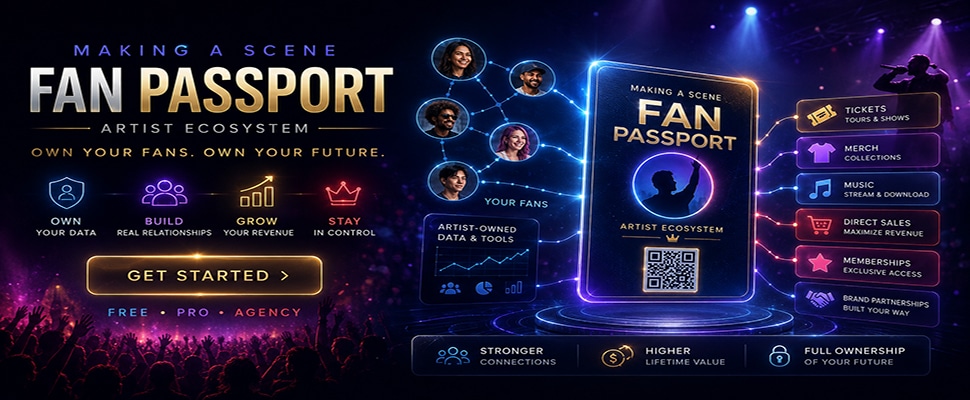
This is also why the Making a Scene Artist Ecosystem and Fan Passport have been moving toward Smart Media as a business workflow rather than trying to become another manufacturing or media-hosting company. There are already companies capable of manufacturing connected products, and artists should remain free to choose the providers and hosting arrangements that fit their needs. The useful role for an artist operating system is helping musicians decide which route makes sense, manage the products they create and connect those products to the rest of the artist’s business.
The first question should therefore be about the artist’s objective rather than the hardware. If the release needs Billboard reporting, the system can guide the artist toward current approved providers and registration requirements. If the artist primarily wants a profitable merch-table product with direct fan engagement, the workflow can support a lower-cost non-chart route without forcing unnecessary infrastructure into the campaign. If the artist wants both, the system can keep the purposes clear so the chart product and direct-to-fan product do not become tangled together simply because both happen to contain NFC.
That same system also needs to recognize that an artist may eventually have many connected products rather than one permanent Smart Media Album. One release may have a standard edition and a premium edition, while another product could be tied to a tour, membership or special fan experience. Each product may unlock different content, last for different periods of time and carry different rewards, while the fan who owns several of those products should still appear to the artist as one human being rather than three mysterious account records scattered across separate databases.
This is where Fan Passport becomes especially important because physical interactions can become part of the same history as digital ones. A fan might purchase the Smart Media Album at a show, activate it afterward, return to the digital experience several times, attend another concert, receive a Fan Passport stamp and later buy merchandise. Instead of those actions disappearing into unrelated systems, the artist can begin to understand the complete relationship and respond appropriately.
The Making a Scene system is being developed so that the complexity stays behind the curtain rather than landing on the musician’s desk. Artists should be able to decide which fans receive new content, rewards or offers without understanding how signed access tokens, entitlement databases or protected media links work underneath. The technology should make the artist’s business simpler even when the infrastructure behind that simplicity is complicated, because musicians already have enough trouble remembering where they put the capo without asking them to become cloud-security specialists.
The public information about the Artist Ecosystem and Fan Passport is available through https://masfanpassport.com/, while the hosted Fan Passport environment is at https://masfanpassport.app/. The goal is not to lock Smart Media into one hosting system but to give artists a central control layer where products, fan relationships, entitlements and business activity can remain connected even when outside companies provide manufacturing or media delivery.
The Experience After the Tap Has to Be Worth Coming Back To
There is one final practical issue that could determine whether Smart Media becomes an important music format or merely a clever novelty that everyone demonstrates once. The digital experience has to be good enough that the fan actually wants to return. A beautifully manufactured connected album that opens a cluttered web page full of login screens, tiny buttons and generic links has managed to combine the production cost of physical merchandise with the charm of renewing automobile registration online.
The tap should feel like entering the world of the album. The artwork, music, video and additional material should be presented as one coherent experience rather than a collection of files somebody remembered to upload before lunch. Artists should be able to create a visual opening based on the album artwork, allow fans to move naturally between songs and video, and make new material obvious when they return later.
That experience is also where the artist can create reasons for repeat engagement. A fan who knows that new tour recordings, unreleased demos or behind-the-scenes material will appear over time has a reason to return to the product. Each return strengthens the connection and creates another opportunity for the artist to communicate something useful, whether that is a new show, another release or a special offer.
The experience does not need to become a miniature social network, and in most cases it probably should not. The purpose is to deepen the relationship around the artist and the music rather than recreate every feature of the internet inside an NFC card. Simplicity becomes particularly important for independent musicians because every feature eventually creates another thing somebody has to maintain.
This is where Smart Media design should borrow a lesson from good recording. Complexity can happen behind the scenes, but the listener should receive something that feels natural. Nobody buys a record because the routing matrix was impressive, and nobody will love a Smart Media Album because its authentication layer contains excellent code. Fans will care because the music feels important and the product makes them feel closer to the artist who created it.
Today’s Chart Change Is the Beginning of the Story, Not the End
The official arrival of Smart Media inside Luminate’s U.S. and Canadian physical-product infrastructure is important because it gives the format institutional legitimacy that it did not have before. Eligible sales can now enter the same measurement world occupied by established physical formats, and artists pursuing Billboard campaigns have a defined route for incorporating certain Smart Media products into those campaigns. Luminate calling this the first new physical music format it has added since CDs gives the moment historical weight, but history will eventually care much more about what musicians and fans do with the format than what somebody called it on launch day.
The chart recognition will almost certainly encourage more labels, manufacturers and technology companies to enter the market, which should create more product choices and eventually more competition around price and capabilities. Independent artists should welcome that development while remaining skeptical of any argument that says the most expensive or most elaborate option is automatically the professional choice. A Smart Media product should earn its place in an artist’s budget by creating revenue, strengthening relationships or supporting a clearly defined campaign objective.
For some artists, that objective will include Billboard chart activity, and today’s change gives them a legitimate new physical format with which to pursue it. For many others, the more valuable opportunity may be far less visible: selling a connected product directly to a few hundred supporters and using that purchase to build relationships that last for years. Those artists may never care whether the product enters a chart database, but they will care deeply if a $30 sale becomes a $150 customer relationship over time.
That possibility is what separates Smart Media from another technology story. Streaming made music extraordinarily easy to access but weakened the connection between listening and customer ownership. Social platforms gave artists enormous discovery opportunities while keeping control over much of the audience relationship, and traditional physical merchandise produced direct revenue while often leaving the customer anonymous. Smart Media has the potential to connect physical ownership, digital engagement and direct fan relationships in the same product, but only when artists deliberately build for those outcomes.
Independent musicians should therefore look at today’s announcement without either worshipping the technology or dismissing it as another gadget. The useful question is what a connected album can do inside the larger artist business. If it can generate a profitable direct sale, turn an anonymous buyer into a permission-based fan, create repeated engagement and lead naturally toward shows, merchandise, memberships or future releases, it has already accomplished something important whether a chart ever notices.
The smartest use of Smart Media will probably look less like a revolution than a well-run business. A fan buys something meaningful, the artist earns money, the fan receives continuing value, and both sides have a way to remain connected without depending entirely on somebody else’s algorithm. AI can help the artist understand that relationship, portable digital identity may eventually help preserve ownership across systems, and artist-controlled infrastructure can make those technologies work together without turning the musician into a full-time technologist.
That is why the most important part of today’s Smart Media announcement happens after the sale. Chart eligibility gives the format credibility, but the continuing fan relationship gives it economic value. If independent artists approach Smart Media as a tool for owning more of their audience, strengthening direct revenue and making the album a living part of the fan experience, this new category could become much more significant than another way to count first-week units. It could help turn the physical album back into the center of an artist’s world while finally giving that world a direct connection to the people who keep the music alive.
 |  Spotify |  Deezer |  Breaker |
 Pocket Cast |  Radio Public |  Stitcher |  TuneIn |
 IHeart Radio |  Mixcloud |  PlayerFM |  Amazon |
 Jiosaavn |  Gaana |  Vurbl |  Audius |
 Reason.Fm | |||
Find our Podcasts on these outlets
Subscribe to Our Newsletter
Discover more from Making A Scene!
Subscribe to get the latest posts sent to your email.


