
The Music Industry Wants a Piece of Everything You Create





Making a Scene Presents – The Music Industry Wants a Piece of Everything You Create. It’s Time to Build a Business That Belongs to You.
Making a Scene Weekly Music Industry Wrap-Up
Listen to the Podcast Discussion
Publishing royalties, artificial intelligence lawsuits, Ableton Live 13, independent streaming platforms, the return of YouTube to the Billboard charts, and the growing business of turning music discovery into revenue.
There was a time when the music industry’s business model was relatively easy to understand. Musicians made records, record companies sold them, radio stations played them, and somewhere along the way, everybody argued about who was supposed to get paid. Today, we have streaming platforms, digital distributors, publishing administrators, artificial intelligence companies, social media networks, music discovery apps, and an expanding collection of technology companies that would very much like to become involved in your relationship with your fans. The business has become considerably more sophisticated, although getting a musician paid appears to remain one of its more challenging technical problems.
This past week, November 9 through November 15, 2026, provided an interesting look at how the different pieces of this new music economy are coming together. DistroKid officially launched a publishing administration service powered by Kobalt, opening another route for independent songwriters to collect royalties. Copyright owners associated with Elvis Presley and Eminem filed new lawsuits against AI music company Suno. Ableton announced a major upgrade to its recording software, YouTube announced its return to the Billboard charts, and new music discovery and independent streaming services are challenging some of the industry’s established business models.
Taken individually, these announcements represent new products, legal disputes, and changes in how the music industry operates. Taken together, however, they reveal something much more important. The companies that once specialized in one part of the music business are increasingly trying to become involved in every part of it. Distributors are moving into publishing, streaming companies are developing fan communities, artificial intelligence companies want access to music catalogs, and music discovery platforms are finding new ways to package songs, lyrics, artwork, and artist information.
Independent musicians need to understand what is happening because there is a tremendous opportunity hiding inside this increasingly complicated business environment. The same technology that allows corporations to expand their businesses can help musicians build businesses of their own. The difference is whether artists use these services as tools to support assets they control or allow those services to become the owners of everything they depend on. Considering how much time musicians already spend building everybody else’s business, perhaps it is time they devoted a little more attention to building their own.
DistroKid Gets Into Publishing: You May Have Been Leaving Money on the Table
On November 11, DistroKid formally launched DistroKid Publishing, a publishing administration service powered by a partnership with Kobalt Music. The service had been introduced earlier through a gradual rollout, but this week’s launch brings the offering into broader industry attention and gives eligible independent songwriters another option for collecting income generated by their compositions.
According to reporting from Music Business Worldwide and Music Week, the service charges a one-time setup fee of $75 per songwriter and pays the songwriter 80 percent of the publishing royalties it collects. Reported eligibility requirements include at least one release distributed through DistroKid and more than $50 in streaming revenue during the previous twelve months. Original compositions and co-written songs qualify, while covers, remixes, mash-ups, and fully AI-generated tracks are excluded. The company says artists retain ownership of their compositions and are not required to make a long-term commitment. Artists should review the current agreement and eligibility requirements before enrolling.
For independent musicians who have been releasing original music without paying much attention to publishing, this announcement should serve as a reminder that distributing a recording and collecting songwriter royalties are two very different business activities. Unfortunately, the music industry has managed to make this distinction sound like something that requires an advanced degree, when the basic idea is actually fairly simple. When you write a song and then record that song, you have potentially created two separate pieces of intellectual property. The first is the composition, which includes the music and lyrics you wrote. The second is the sound recording, commonly called the master. If you wrote the song yourself and paid for the recording without signing away your rights, you may own both.
ONE SONG. TWO COPYRIGHTS.
| THE COMPOSITION Music and Lyrics |
THE MASTER Sound Recording |
| ↓ | ↓ |
| Mechanical Royalties
Public Performance Royalties Composition Licensing |
Recording Revenue
Direct Music Sales Master Licensing |
Simplified illustration. Actual collection pathways depend on ownership, territory, licensing and contractual agreements.
Imagine you write a blues song in your living room, record it in your home studio, and release it through a digital distributor. When somebody listens to your recording through an interactive streaming service, that activity can generate money associated with both the recording and the composition. Your digital distributor generally handles the recording side of that transaction. Publishing royalties, however, travel through a different collection system. This is where many independent artists get into trouble. They see money appearing in their distribution account and assume the entire music royalty system has done its job. In reality, that payment may represent only part of the money generated by their music.
Should You Give a Publishing Administrator 20 Percent?
There is nothing inherently unreasonable about paying a company to perform a service that helps you collect money. Publishing administration involves registering compositions, monitoring usage, dealing with international collection systems, and resolving ownership or identification problems. For a musician who would rather spend Saturday afternoon writing songs than researching royalty administration, hiring somebody to handle that work can make sense. The important question is how much additional money the service actually helps you collect. Giving away 20 percent of money you would never have collected on your own is very different from giving away 20 percent of money you were already receiving without difficulty.
American songwriters can already access certain royalty collection services directly. The Mechanical Licensing Collective administers eligible digital mechanical royalties in the United States, while performing rights organizations handle certain public performance royalties. SoundExchange deals with qualifying digital performance royalties associated with sound recordings, which is another category entirely. A publishing administrator can help with broader collection and international administration, but signing up for several administrators to collect the same rights is not a clever way to multiply your income. It can create competing ownership claims, delayed payments, and administrative disputes.
The larger significance of this announcement is that digital distribution companies are no longer satisfied with simply distributing music. They want to become involved in the entire business surrounding the independent artist. That can be convenient, but convenience should never become an excuse for losing track of your assets. Keep your own copies of your songwriter splits, copyright registrations, recording identifiers, agreements, and royalty statements. Your distributor should be a service provider, not the only place where the history of your music business exists.
Elvis and Eminem Copyright Owners Sue Suno: The AI Music Licensing Battle Is Far From Over
Just when the music industry appeared to be settling into a future where artificial intelligence companies and copyright owners would negotiate licensing agreements and learn to coexist, another pair of lawsuits arrived to remind everyone that the legal questions are far from resolved. On November 9, Reuters reported that Elvis Presley Enterprises and Eight Mile Style, a company associated with Eminem’s music copyrights, had filed separate lawsuits against AI music generator Suno in federal court in Northern California. The plaintiffs allege that copyrighted material from their catalogs was improperly used to train Suno’s artificial intelligence technology. These are allegations, not findings of infringement, and the filing of the lawsuits does not establish that the plaintiffs will prevail.
The importance of these lawsuits extends beyond the well-known names involved. They demonstrate that agreements negotiated with some participants in the music industry do not necessarily resolve claims involving every copyright owner. Music ownership is a complicated collection of separate rights, and authorization to use one catalog does not automatically grant permission to use another. For independent musicians, that distinction matters because you may control exactly the same categories of intellectual property that are involved in these disputes. Your catalog may not have the commercial value of Elvis Presley’s recordings or Eminem’s compositions, but the underlying principle of intellectual property ownership still matters.
Your Back Catalog Is More Than a Collection of Old Songs
Most independent musicians think of their older recordings as the albums they used to sell at shows, the tracks that continue generating a few streams, or the songs they occasionally bring back into the set list when somebody in the audience requests them. What they may not realize is that these recordings are also potential assets in an emerging technology licensing market. AI developers have commercial reasons to obtain access to musical performances, compositions, lyrics, instrumental sounds, production techniques, and related information. As the legal environment develops, some companies may obtain those materials through negotiated licenses rather than relying on disputed interpretations of copyright law.
An independent recording containing a beautifully performed Hammond organ part, an unusual drum groove, or a distinctive arrangement could potentially have value beyond traditional listening. That does not mean an AI company is going to knock on your studio door next Tuesday with a large check. It means that organized, properly documented music catalogs may be better positioned to participate if a suitable licensing opportunity becomes available. The first step is knowing what you can legally license. If you own a sound recording but wrote the composition with three other people, you cannot simply assume you control every right associated with that song. Session musician agreements and sample licenses may also affect the permissions you can grant.
The AI business introduces questions that traditional music contracts did not always address. A license to train an artificial intelligence model is not necessarily the same as permission to create a digital replica of your singing voice. Permission to use your recordings in a research dataset does not automatically mean permission to market generated music using your name, image, or identity. These should be treated as separate commercial decisions, not thrown together into a contract that gives a technology company everything short of the keys to your rehearsal space.
THE ARTIST-CONTROLLED AI LICENSING PROCESS
Masters, compositions, performances and stems
Copyrights, splits, samples and contributor agreements
Scope, duration, compensation and restrictions
Only the rights expressly granted in the agreement
Payments to participating rights holders
Conceptual licensing workflow, not a representation of a particular AI company’s current program.
AI Revenue Should Be Another Income Stream, Not a Surrender of Rights
Independent artists should approach AI licensing with the same expectations they would bring to any other commercial use of their music. They should know what is being licensed, who is getting permission, how long that permission lasts, whether it can be transferred to another company, and how compensation will be calculated. Particular attention should be paid to what happens when an agreement ends. Depending on the technology and contract, withdrawing your recordings from future training may not remove their influence from a model that has already been trained. An agreement that appears easy to cancel may have consequences that continue after cancellation.
There is no reason independent musicians cannot participate in responsible AI licensing while opposing unauthorized commercial exploitation of their work. These positions are entirely compatible. A musician who earns money licensing a song for a television commercial is not surrendering the right to object when another advertiser uses that same song without permission. The lawsuits reported this week are another reminder that artists should preserve original recording sessions, dated exports, songwriting notes, split sheets, and contracts. These materials help establish the history of a work and may become valuable when questions about ownership arise.
Ableton Live 13: The Home Recording Studio Is Becoming an Even More Powerful Business Asset
On November 10, Ableton announced Live 13, the next major version of its digital audio workstation. The software is expected to arrive in early 2027, with development builds already documented in the company’s public beta release notes. The announcement includes new sequencing tools, expanded audio editing capabilities, redesigned production workflows, additional sound-design instruments, and new mixing processors. This is an announcement and a beta-stage development, not the release of a finished commercial product. Nevertheless, several of the announced features are particularly interesting for independent musicians because they could reduce the amount of time required to create recordings and prepare music for different commercial uses.
ARA Support Is More Important Than It Sounds
Among the useful additions is support for ARA 2, a technology that allows compatible audio editing plugins to communicate more directly with the recording software. If you have ever worked on a vocal performance that needed a little pitch correction, timing adjustment, or other detailed editing, you understand that the process can interrupt the flow of a recording session. Depending on the software involved, you may have to transfer audio into a plugin, play the recording through the plugin, or manage edited versions separately from the original tracks.
ARA integration can simplify this process by allowing compatible editing software to work more directly with audio stored in the recording session. For musicians recording themselves at home, this can make detailed vocal and instrumental editing considerably more convenient. Ableton’s beta documentation specifies that ARA support is being implemented in Arrangement View rather than Session View, a distinction that matters for performers who use Ableton primarily as a live performance environment rather than a conventional recording workstation.
The economic benefit comes from reducing the time spent performing repetitive technical operations. If a recording engineer can finish a vocal editing job faster without compromising quality, that time can be used to improve the production, work with another client, or simply finish the project before the drummer calls to ask whether anybody has listened to the tambourine overdub yet. Faster production workflows do not automatically make a studio profitable, but they can improve the economics of delivering professional services.
The Step Sequencer and the Business of Creating More From Less
Live 13 also introduces a dedicated step sequencer for developing rhythmic and melodic patterns. This gives musicians another way to create arrangements from individual musical events, rather than having to record every part as a continuous performance. Ableton has also announced Looplet, a new instrument for experimental manipulation of recorded sounds, along with a dedicated Drum Synth. For electronic musicians, producers, and composers preparing music for games or other interactive projects, these tools expand the possibilities for creating variations from existing musical material.
An independent recording studio could use some of these capabilities to offer more than conventional recording and mixing. A studio might help a songwriter develop an electronic version of an existing song, create rhythmic material for an advertising project, or prepare instrumental variations for a game developer. Original musical parts could be reorganized into different arrangements without requiring a completely new recording session. The opportunity is not simply to make more music faster. It is to produce more commercially useful assets from music that has already been created.
Stop Thinking About the Stereo Master as the End of the Recording Process
Traditional recording projects often end with a finished stereo master. The artist sends it to a distributor, prepares the artwork, and hopefully remembers to pay the mastering engineer. The original recording session may then disappear onto a storage drive that will not be connected to a computer again until somebody desperately needs an instrumental version three years later. Modern music businesses can benefit from treating the original session as a reusable collection of audio assets. A song may be prepared with a full mix, instrumental mix, alternate vocal mix, clean version, backing tracks, and groups of related instruments called stems.
ONE RECORDING SESSION. MULTIPLE REVENUE OPPORTUNITIES.
| Stereo Master | Instrumental Mix |
| Vocal and Instrument Stems | Backing Tracks |
| Alternate Versions | Loopable Music Sections |
| Direct Music Sales | Film and TV Licensing |
| Live Performance | Video Game Licensing |
| Fan Exclusives | Authorized Remixes |
Potential commercial uses require appropriate rights and customer demand. Revenue is not guaranteed.
This creates another service opportunity for independent recording engineers. Instead of selling only recording time, a studio can sell a complete package of professionally prepared music assets that gives the artist more ways to earn money from the completed production. AI-assisted separation and automated editing may help prepare some of these materials, especially when original sessions are unavailable, although an experienced engineer still needs to check the results for unwanted sounds, artifacts, and other technical problems.
Ableton Live 13 is one example of how recording technology continues moving toward faster editing and more flexible creative workflows. That does not mean every musician needs to purchase the upgrade when it arrives. Before upgrading, determine whether the new capabilities solve an actual problem in your workflow, whether your computer and plugins will remain compatible, and whether the cost can be justified by the work you can accomplish. Beta software belongs in a testing environment with backed-up projects, not in the only copy of an album that has to be delivered tomorrow.
YouTube Returns to the Billboard Charts, and Free Listeners Become More Valuable
On November 9, YouTube announced that its music streaming data would return to the United States Billboard charts beginning in 2027. The decision reverses YouTube’s withdrawal from the chart reporting system earlier in 2026 following a disagreement about how paid and advertising-supported streams were valued. Under the revised methodology reported by Pitchfork, 1.5 qualifying advertising-supported streams will have the same relative chart weight as one qualifying paid subscription stream, rather than the previous ratio of 2.5 to one. The change is scheduled to take effect January 16, 2027.
For independent artists, this announcement offers an opportunity to reconsider the role of video in their music businesses. YouTube has long provided musicians with a place to share performances, official music videos, interviews, educational content, and behind-the-scenes material. The return of its eligible streaming data to Billboard adds another potential benefit for artists who are already developing an audience through video. It is important, however, not to confuse chart recognition with revenue. Changing the weight assigned to a stream on a chart does not automatically change the amount of money an artist receives. Billboard’s charts measure commercial activity according to established rules; they are not royalty payment systems.
Your Music Video Should Have a Business Plan
Independent musicians often spend considerable money producing a music video and then measure its success entirely by the number of views it receives. A video with ten thousand views certainly looks more impressive than a video with five hundred views, but what did those people do after watching it? Did they visit the artist’s website, purchase the album, join the mailing list, buy tickets to a performance, or discover another recording? A beautifully produced video is a marketing asset, and its value should be measured partly by what it helps the artist accomplish beyond the video platform itself.
Instead of sending everyone who watches a performance to another streaming platform, musicians should consider directing interested viewers to a page they control. That page might offer tickets, merchandise, an exclusive acoustic recording, an invitation to join a fan community, or information about upcoming performances. The goal should not be to abandon YouTube or other useful discovery platforms. The goal is to create a pathway from discovery to a direct relationship. Otherwise, artists risk spending their own money attracting viewers who become more valuable to the platform than they are to the musician.
Drops: The Next Music Discovery Revolution May Happen in Less Than Thirty Seconds
On November 9, HARMAN announced the launch of a new mobile music discovery platform called Drops. Available for iOS and Android in the United States, the service introduces listeners to songs through short musical excerpts combined with lyrics, licensed artist photographs, album artwork, and commentary or other personal recommendations. The excerpts generally run between ten and thirty seconds. The idea is to recreate the experience of a friend sharing a favorite part of a song rather than asking listeners to search through enormous music libraries hoping that something interesting will eventually reveal itself.
The announcement raises an interesting question for independent musicians. In an industry where millions of recordings compete for attention, what happens when discovery increasingly depends on the most compelling twenty seconds of a song? The answer is not that musicians should start writing nothing but twenty-second songs. It is that artists should think more carefully about how their existing music can be presented in different ways. A beautiful guitar solo, an unusual opening rhythm, a memorable lyric, or a powerful instrumental break could introduce a potential fan to the artist’s larger body of work.
Music Discovery Is Becoming a Rights and Metadata Business
Drops is particularly interesting because the experience is built around more than audio. It also involves lyrics, photographs, album artwork, and other material associated with a recording. Each of those assets may have its own ownership and licensing requirements. An artist may own a master recording but not own the promotional photograph a photographer provided. Album artwork may have been licensed only for a particular physical release, while a co-written song may have several owners whose permissions are relevant to commercial lyric usage.
Metadata is simply information about your music. It includes the name of a recording, who performed on it, who wrote it, who owns it, and the identifiers used to track it through the music industry. More complete records can also describe versions, lyrics, artwork, licensing permissions, and the relationship between different pieces of content. This information should be maintained by the artist, not reconstructed from scratch every time a new commercial opportunity appears. AI can help organize these assets and identify incomplete records, but legal ownership and permissions still need to be verified by people with access to the actual agreements.
Imagine that an independent blues artist has a catalog of forty recordings. Each recording has an organized master file, an instrumental version where available, confirmed songwriter information, approved photographs, accurate credits, and appropriately cleared promotional clips. That artist is better prepared to respond when a music supervisor, promotional partner, documentary filmmaker, or discovery platform needs material. The existence of a new discovery app does not mean every independent artist will automatically have access to it or receive new income, but organizing your catalog before an opportunity arrives is considerably easier than discovering that the photographer who owns your album cover moved to Costa Rica and nobody has his email address.
Vocana and CodaLive: Independent Streaming Is Experimenting With Better Ways to Get Artists Paid
One of the more encouraging areas of this week’s music business reporting involves companies experimenting with streaming models that place more emphasis on independent musicians and direct fan support. Industry reporting on November 11 covered the launch of Vocana, an independent music streaming platform that promotes a user-centric royalty approach. Hypebot’s November 6–12 industry roundup also reported the addition of CodaLive, a livestreaming feature from Coda Music intended to help artists earn income through engagement with supporters.
These services are entering a difficult market. Large streaming companies have enormous catalogs, established customer relationships, sophisticated recommendation systems, and years of investment in consumer technology. Convincing listeners to change their habits is not easy, particularly when those listeners are already paying for a music subscription. However, independent streaming companies do not necessarily have to replace the largest services to become useful. They may be able to develop smaller communities of listeners who care more deeply about discovering and supporting independent artists.
What Is User-Centric Streaming?
Under a common pooled streaming royalty model, eligible revenue is grouped together and distributed according to the share of qualifying listening activity associated with different rights holders. That means a particular subscriber’s contribution does not necessarily go only to the musicians that subscriber listens to. A user-centric approach attempts to connect more of an individual listener’s eligible subscription revenue to the music that individual actually consumes. This distinction could benefit some independent musicians with dedicated audiences, although it does not guarantee higher income for every artist.
TWO VERY DIFFERENT STREAMING MODELS
TRADITIONAL POOLED MODEL
| Fan 1 | Fan 2 | Fan 3 |
Distribution based on qualifying overall listening share
| Artist A | Artist B | Artist C |
USER-CENTRIC MODEL
| Fan 1 | Fan 2 | Fan 3 |
| ↓ | ↓ | ↓ |
| Artist C | Artist A | Artist B |
Eligible listener revenue follows individual listening activity.
Simplified conceptual comparison. Actual payouts depend on contracts, deductions, listening activity and each service’s accounting method. A listener may support multiple artists.
Coda Music is also promoting a model that combines streaming with recurring fan support. Its artist portal advertises a program in which participating supporters can generate $1 per month for an artist through the service’s subscription structure. These are the company’s stated program terms, not independently audited evidence of average artist earnings. The interesting part of these experiments is that they recognize something the mainstream music industry frequently overlooks. A dedicated fan and a casual listener are not necessarily worth the same amount to an independent musician.
A listener who plays one song while driving to work may generate a small amount of streaming revenue. A dedicated fan may purchase several albums, attend multiple concerts, buy merchandise, invite friends to shows, and support the artist through a recurring membership. The value of that relationship can extend far beyond the original stream. Unfortunately, somewhere along the way, the industry’s fascination with counting streams seems to have distracted it from the rather useful business practice of developing customers who actually want to come back.
The Danger of Building Another Rented Audience
Independent streaming platforms may offer attractive business arrangements, but musicians should still ask whether the customer relationship is portable. Can the artist communicate directly with supporters who have granted permission? Can relevant information be exported? What happens if the service closes, is acquired, or changes its business model? These are not reasons to avoid promising new platforms. They are reasons to use them as part of a larger business strategy rather than making any single service the foundation of an entire career.
An independent musician might use a streaming platform to attract new listeners, a livestream to introduce those listeners to the live performance, and an artist-owned website to offer merchandise, recordings, and memberships. The more of that business the artist can maintain independently, the less damaging a change in platform policy becomes. Artificial intelligence can help organize permission-based fan data, prepare newsletters, and analyze buying patterns, but the artist should retain control over communications and respect the privacy of supporters.
Live Music Is Still Big Business, but Your Tour Needs to Make Money Too
The live music industry’s recent financial reports provide useful background for this week’s business discussions, although the dates need to be kept straight. Live Nation released its third-quarter results on November 5, outside this week’s reporting window, and scheduled a follow-up investor presentation for November 10. The earlier report disclosed quarterly revenue of approximately $10.1 billion, representing 19 percent year-over-year growth. The company also reported substantial growth in international concert attendance. Those are Live Nation’s corporate results, not a measurement of the financial health of every independent musician or performance venue.
The strength of the large concert business is encouraging, but an independent band should not use the financial performance of stadium tours to decide whether it can afford to spend three weeks driving across the country. The economics of independent touring are significantly different. Musicians have to consider transportation, lodging, meals, equipment, advertising, personnel, and the uncertainties that come with performing in unfamiliar markets. A show that looks profitable when the booking is confirmed can produce a very different result when the expenses are finally calculated.
Build a Regional Music Business Before You Build a National Tour
One of the most practical strategies for independent artists is to develop a strong local and regional audience before attempting expensive long-distance touring. A successful show within driving distance can provide income, new fan relationships, and opportunities for repeat performances without many of the costs associated with overnight travel. Consider a hypothetical five-piece independent band playing a regional show that generates a $1,000 guarantee and $300 in merchandise sales. That looks like $1,300 in revenue, which may sound fairly respectable until the business expenses start arriving.
THE REAL ECONOMICS OF AN INDEPENDENT GIG
| Income / Expense | Regional Show | Overnight Show |
|---|---|---|
| Guarantee | $1,000 | $1,000 |
| Merchandise Sales | $300 | $300 |
| Gross Revenue | $1,300 | $1,300 |
| Fuel, Merchandise Costs and Other Expenses | -$250 | -$250 |
| Overnight Expenses | $0 | -$500 |
| Net Band Income | $1,050 | $550 |
| Per Musician (5) | $210 | $110 |
Take-home income per musician
Regional show
Overnight show
Hypothetical example before taxes, reserves, management commissions and unlisted expenses. Actual touring costs will vary.
A local show can also be more valuable than a distant show if it helps the band develop an audience that can attend future performances. Instead of introducing the music to a completely new collection of people every night and hoping some of them remember the band’s name, regional artists have an opportunity to create relationships that grow over time. When people voluntarily join your mailing list and provide information about where they live, you gain a better understanding of where future performances may be commercially viable. A hundred genuine supporters in a town two hours away may represent a better booking opportunity than ten thousand unidentified streaming listeners scattered around the country.
This is where AI-assisted business planning could become particularly useful. An artist could analyze previous show revenue, transportation costs, merchandise sales, and permission-based information about where fans live. That information could help the artist identify promising markets and avoid financially questionable bookings. The computer cannot guarantee that people will show up, but it can help musicians make decisions using something more reliable than a promoter’s enthusiastic promise that the place is always packed on a Tuesday.
Web3 and Artist Ownership: The Technology Matters Less Than Whether You Can Leave
There was no major new Web3 music announcement within this week’s researched sources that met the same verification standard as the publishing, recording technology, and AI copyright stories. Rather than manufacture another blockchain revolution simply because the subject appears in our weekly coverage, it is worth examining how this week’s developments connect to the underlying principles that made Web3 interesting to independent musicians in the first place. Those principles include ownership, portability, direct transactions, and the ability to maintain relationships without placing an entire business under the control of one company.
Consider what happens when a music distributor shuts down, a social media account disappears, or an online merchandise company changes its financial arrangements. If an artist cannot move their essential business information somewhere else, that artist may have to rebuild years of work simply because a service provider made a decision. This is not a theoretical problem limited to conventional technology companies. Earlier this year, the blockchain-based independent music platform Nina Protocol announced its closure after being unable to establish a sustainable business model. The May announcement and planned July shutdown are historical context, not news from this week, but they demonstrate that decentralized technology does not automatically guarantee a permanent business.
The lesson for independent artists is that the important question is not whether a service calls itself decentralized. The important question is whether the artist retains enough control over their music, financial records, and permission-based fan relationships to continue doing business when the service is no longer available. If the company operating your supposedly decentralized music business disappears and takes your entire customer relationship with it, the distinction between centralized and decentralized technology probably isn’t going to provide much comfort while you’re trying to pay the rent.
Physical Merchandise Can Become a Gateway to Digital Experiences
One particularly practical application involves connecting physical music products to digital experiences using technologies such as near-field communication, commonly called NFC. An independent artist could sell a physical album collectible containing an NFC chip that opens a digital music experience when a fan taps it with a compatible smartphone. That experience might include music, photos, a video about the recording process, bonus tracks, or an invitation to participate in future events. With appropriate permissions and clear terms, these products could also connect supporters to a loyalty program that rewards repeat attendance, merchandise purchases, or membership participation.
FROM MERCHANDISE TO A LASTING FAN RELATIONSHIP
Opens an artist-branded digital experience
Permission-based communication and membership
Future shows, merchandise, memberships and music sales
THE RELATIONSHIP GROWS WITH EACH NEW EXPERIENCE
None of this requires fans to become cryptocurrency traders. Blockchain technology may provide certain options for portable digital entitlements or verifying transactions, but many useful fan experiences can also be delivered through conventional web technology. The artist’s business decision should come first. If a technology helps create an interesting product, improves the relationship with supporters, and produces a reasonable profit, it may be worth using. If the product requires forty-five minutes of technical explanation before a fan can listen to an album, the technology may have become more important than the music.
What This Week’s News Reveals About the Future of the Independent Music Business
The most important development this week may not be any individual product announcement. It may be the growing connection between services that once operated in separate parts of the industry. A digital distribution company is expanding into publishing administration. A consumer technology company is entering music discovery with an experience built around licensed music and promotional assets. Recording software is becoming more flexible, independent streaming platforms are experimenting with direct fan revenue, and artificial intelligence companies remain interested in accessing the intellectual property that musicians create.
All of these companies are pursuing ways to increase the value of their businesses by becoming involved in additional parts of the music economy. Independent artists should be thinking about doing exactly the same thing. Instead of viewing a music career as a collection of unrelated activities, artists can develop connected sources of revenue that support one another. A recording can introduce people to the music and generate royalty income, while a live performance can generate ticket revenue and create new fan relationships. Merchandise can become a product that extends the experience beyond the show, publishing administration can help collect income from uses of the composition, and licensing can create opportunities that do not depend on the artist traveling to another town to perform.
THE ARTIST-OWNED MUSIC REVENUE ECOSYSTEM
| MASTER RECORDINGS Direct Sales and Streaming |
PUBLISHING Songwriter Royalties |
||
| ↘ | ↙ | ||
| THE ARTIST
Owned Music |
|||
| ↙ | ↓ | ↓ | ↘ |
| LIVE SHOWS Tickets and Performance Fees |
MERCHANDISE Physical and Digital Products |
||
| LICENSING Film, Games and Authorized AI |
FAN SUPPORT Memberships and Experiences |
||
THE ARTIST OWNS THE BUSINESS.
A conceptual model for connecting multiple independent music revenue sources.
The advantage of this model is that no single revenue source has to carry the entire financial burden. An artist who depends exclusively on streaming may need an enormous number of listeners to earn a meaningful income. An artist who depends entirely on live performances may experience financial problems when health, transportation, venue closures, or other circumstances interfere with touring. Developing several income sources does not eliminate risk, but it creates more opportunities to build a sustainable business around the music.
Imagine an independent artist who develops a community of 300 dedicated supporters. Those supporters do not necessarily have to spend large amounts of money for their combined activity to become financially meaningful. A modest annual combination of concerts, merchandise purchases, direct music sales, and memberships could contribute substantially more to that artist’s career than a larger collection of casual listeners who never develop a relationship beyond streaming.
THE FINANCIAL POWER OF DEDICATED FANS
Illustrative annual revenue at $100 average spending per supporting fan
100 Supporting Fans
200 Supporting Fans
300 Supporting Fans
400 Supporting Fans
500 Supporting Fans
A Closer Look at 300 Supporting Fans
| Annual Gross Revenue | $30,000 |
| Illustrative Variable Costs (35%) | -$10,500 |
$19,500
Hypothetical business planning example, not an earnings forecast. Fixed costs, taxes and other expenses must still be deducted.
This does not mean fans should be treated as walking revenue opportunities. The relationship works precisely because people care about the music and want to support the musicians who make it. The artist needs to provide products, performances, and experiences that justify that support. When those relationships are managed responsibly, the artist can make better decisions about where to perform, what merchandise to produce, when to release music, and which new technologies are worth investing in. That is considerably more useful than spending every morning checking whether an algorithm has decided to be generous.
The Making a Scene Perspective: Building the Infrastructure for a Music Industry Middle Class
For decades, independent musicians have been encouraged to believe that the ultimate measure of success is attracting the attention of somebody more powerful. Get discovered by a record company, attract a booking agent, find a major publisher, convince an influential radio programmer to play your recording, or somehow persuade a streaming algorithm to introduce your music to millions of people. There is nothing wrong with developing professional partnerships or reaching large audiences. The problem is that this approach can leave artists waiting for somebody else to decide whether they are entitled to have a career.
The technology available today provides a different possibility. Independent musicians can own their recordings, maintain information about their compositions, communicate directly with fans, sell products, organize performances, and evaluate the performance of their businesses without depending entirely on traditional gatekeepers. Artificial intelligence can help reduce some of the administrative work that makes running an independent music business difficult. It can help organize catalog information, prepare promotional materials, analyze business expenses, draft communications with venues, and identify possible inconsistencies in royalty registrations.
These tools should be used with appropriate human review. An AI assistant can help identify a missing songwriter credit, but it cannot establish the legal ownership of a composition merely by producing a convincing answer. It can prepare a booking email, but it cannot guarantee that a venue will be profitable. It can help develop a marketing campaign, but the experience that convinces fans to support the artist still needs to be real. Artificial intelligence is a potentially valuable employee in the independent music business, although you probably shouldn’t give it the combination to the safe.
Web3 technologies can contribute to this vision when they provide useful methods for managing digital assets, portable access rights, and transparent transactions. Conventional technology can achieve many of the same practical objectives when it is designed around user control and portability. Independent musicians should avoid becoming trapped in arguments about which technology is fashionable and concentrate instead on whether the tools help them build a healthier business.
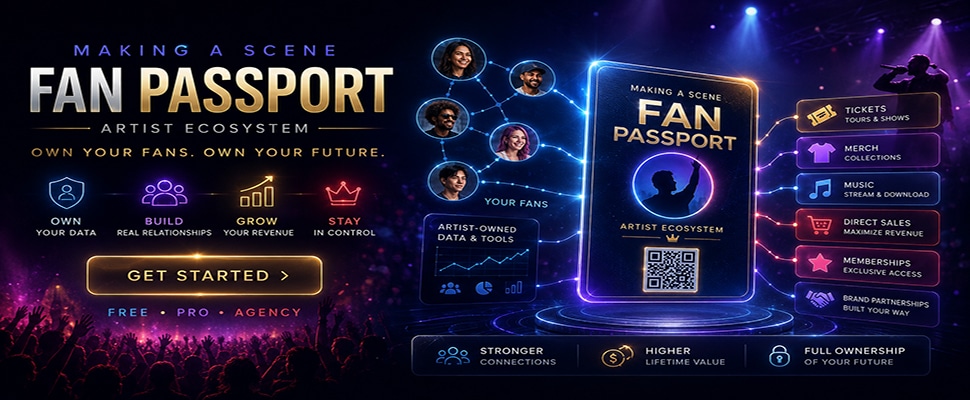
These principles are also behind the development of the Making a Scene Fan Passport Artist Ecosystem, an artist-centered approach to connecting music catalog information, business management, fan relationships, commerce, and live performance. The idea is not to replace every service in the music business but to give independent artists a foundation for managing the business activities that belong to them. Musicians can begin exploring the ecosystem by signing up for a free artist account.
STOP BUILDING EVERYBODY ELSE’S MUSIC BUSINESS
Own your music. Build direct relationships with your fans. Take control of your independent music business.
Making a Scene Fan Passport Artist Ecosystem
Start building your artist-owned business with a free account.
A genuine music industry middle class will not emerge simply because another company introduces a music application. It will emerge when a greater number of musicians can create valuable work, retain meaningful ownership, collect the income associated with their rights, and develop sustainable relationships with the people who support them. The industry is already demonstrating how powerful it can be when businesses connect recording, publishing, commerce, discovery, and audience engagement. Independent artists have an opportunity to apply those same principles on a scale that makes sense for their own careers.
The Bottom Line: Stop Building Everybody Else’s Music Business
This week’s announcements demonstrate that the music industry is becoming more connected, more technologically advanced, and increasingly interested in the independent artist’s entire business. Publishing administration is becoming easier to access, music production tools continue to expand, new platforms want to improve music discovery, and artificial intelligence is opening both licensing opportunities and complicated legal disputes. These developments offer genuine reasons for optimism, although they also provide plenty of reasons to read the fine print.
The companies developing these technologies understand the importance of owning assets, controlling information, building customer relationships, and maintaining several sources of revenue. They spend enormous amounts of money developing systems that help them accomplish those objectives. Independent musicians should borrow that particular page from the corporate playbook. Instead of allowing your distributor to become the only place where your catalog information exists, maintain your own records. Instead of treating your streaming audience as a substitute for direct fan relationships, develop ways for interested people to connect with you independently. Instead of assuming your recording has completed its commercial journey when the stereo master is uploaded, consider other authorized uses that may generate additional income.
The objective is not to eliminate the companies that provide useful services to musicians. It is to establish a business relationship in which the artist remains the owner of the business and those companies remain the providers of services. A good distributor, publishing administrator, recording software developer, or ticketing company can provide excellent value to an independent musician. The problem begins when the artist can no longer operate the business without the permission of the company hired to provide one particular service.
Imagine a music industry in which thousands more musicians could earn respectable incomes without needing a viral hit, a stadium tour, or a recording contract with an international corporation. Imagine regional music communities supported by profitable local venues, independent recording studios offering valuable specialized services, and artists whose audiences continue to support them regardless of what happens to the latest social media platform. That is the music industry middle class Making a Scene has been advocating for, and the tools needed to build it are becoming increasingly accessible.
The industry will undoubtedly continue discovering exciting new ways to make money from music, and there will be no shortage of enthusiastic press releases explaining why each of those developments is going to revolutionize the lives of musicians. Independent artists need to become equally enthusiastic about discovering ways to make money from the music they actually own. After all, if everybody else in the music business has figured out that your music, your creativity, and your audience are valuable assets, perhaps it’s time you started treating them that way too.
Making a Scene — Empowering Independent Artists and Building a Music Industry Middle Class.
 |  Spotify |  Deezer |  Breaker |
 Pocket Cast |  Radio Public |  Stitcher |  TuneIn |
 IHeart Radio |  Mixcloud |  PlayerFM |  Amazon |
 Jiosaavn |  Gaana |  Vurbl |  Audius |
 Reason.Fm | |||
Find our Podcasts on these outlets