
Global Creator Royalties Reach $17.52 Billion, but the Numbers Tell a More Complicated Story




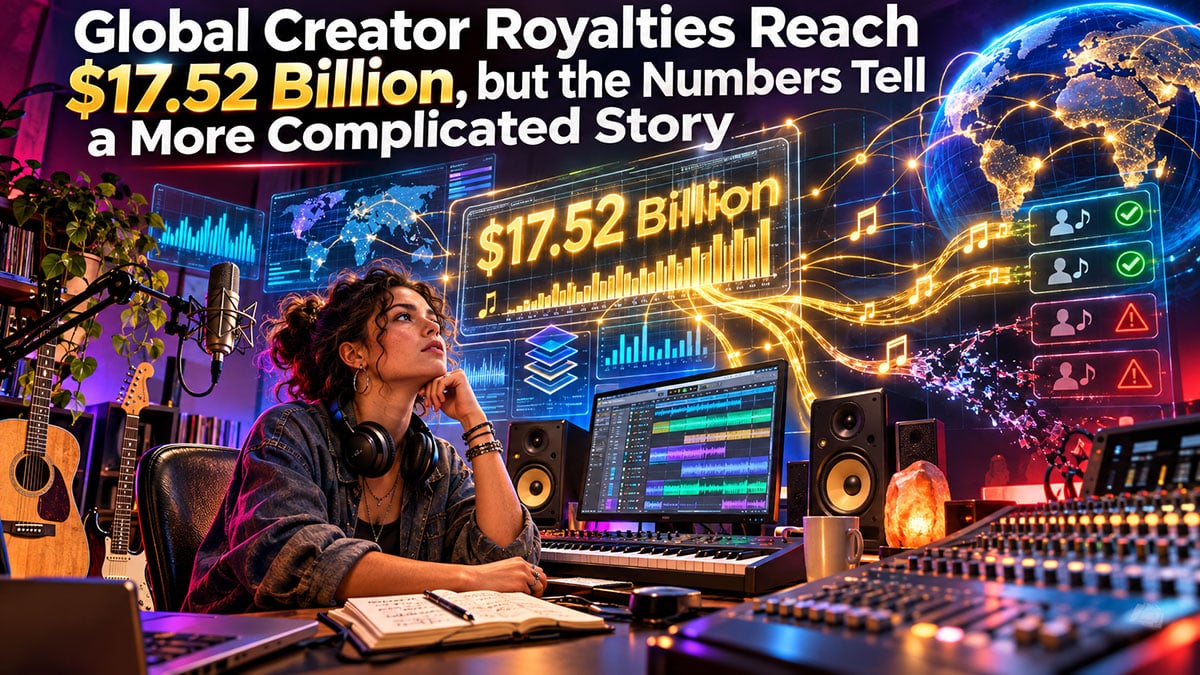
Making a Scene Presents – Global Creator Royalties Reach $17.52 Billion, but the Numbers Tell a More Complicated Story
Listen to the Podcast Discussion
The music industry is collecting more money than ever before, yet independent songwriters are still fighting to understand what they are owed, where their royalties are going, and why so much of the business remains hidden behind complicated reporting systems. A new global report reveals both the remarkable value of music and the growing importance of ownership, accurate data, and financial independence.
There is something almost magical about the music industry’s ability to announce record-breaking financial success while the musicians responsible for creating that success are still trying to figure out how to pay their bills. Every year seems to bring another celebration of growing streaming revenue, expanding music catalogs, or record royalty collections. Executives appear at conferences to discuss the tremendous value of music, investors pour money into companies built around that value, and technology businesses continue finding new ways to turn songs into profitable products. Meanwhile, somewhere in a small recording studio, an independent songwriter is staring at a royalty statement that barely covers the cost of a decent dinner, wondering whether the rest of the industry is working with a completely different definition of success.
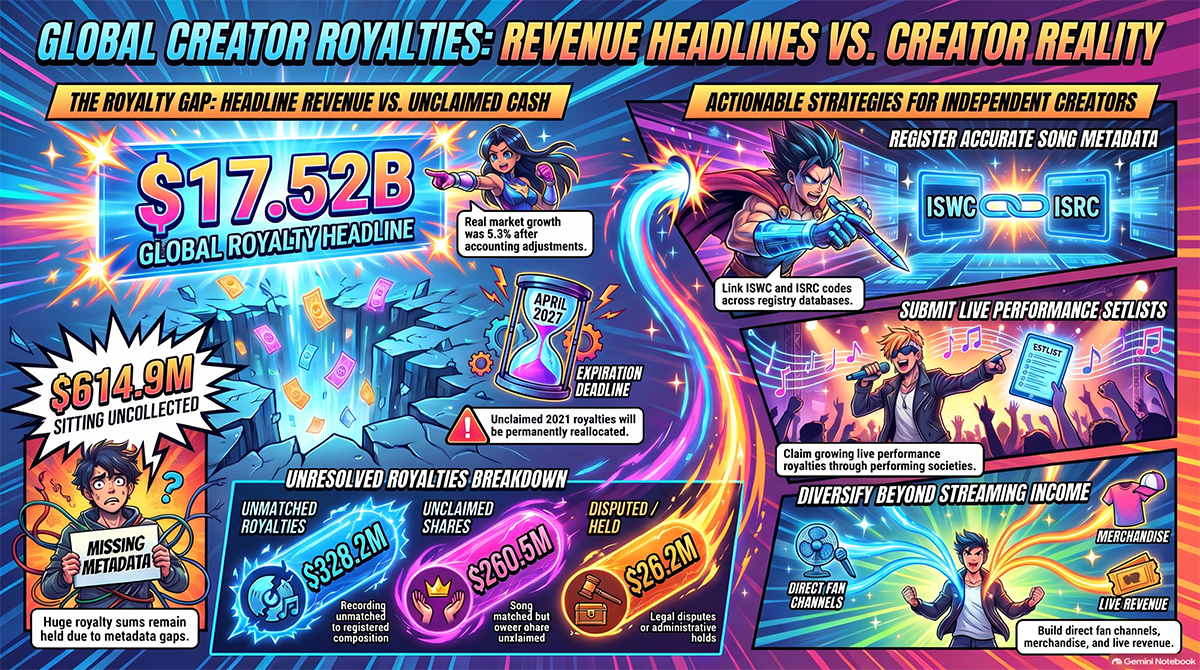
The latest example arrived on November 4, 2026, when the International Confederation of Societies of Authors and Composers, better known as CISAC, released its annual Global Collections Report. According to the organization, royalties collected for creators around the world reached the equivalent of approximately $17.52 billion during 2025, an increase of 11.3% over the previous year. Music accounted for approximately $15.90 billion of those collections, while digital licensing continued expanding and royalties associated with live performances reached new records. On the surface, this appears to be wonderful news for the people who write songs, compose music, and create the intellectual property that fuels an enormous international entertainment business.
But financial headlines have a habit of telling us how much money is moving through an industry without explaining where that money eventually lands. The $17.52 billion figure represents royalties collected by organizations working on behalf of creators, not necessarily money deposited into the personal accounts of songwriters during the same year. More importantly, a significant portion of the reported increase came from adding an American royalty organization to CISAC’s reporting system for the first time. Once that accounting change is separated from the underlying growth, the financial picture becomes considerably more interesting and far more relevant to the independent musicians who are trying to build sustainable careers.
For Making a Scene, the importance of this report goes well beyond a collection of impressive financial statistics. It reveals how valuable music copyrights have become, how complicated the business of collecting royalties remains, and why independent artists need to understand the difference between owning a valuable asset and actually receiving the income it produces. It also raises a larger question about the future of the music industry: if copyrighted music can generate billions of dollars every year, why is building a dependable middle-class income still such a challenge for so many working musicians?
The Accounting Change Hidden Behind the Record-Breaking Headline
The most revealing information in the CISAC Global Collections Report 2026 is not the $17.52 billion total itself. It is the explanation of how that total was calculated and why the reported increase should not be mistaken for an equivalent rise in the underlying royalty market. CISAC examined information from 228 collective management societies operating across 111 countries and territories, representing more than five million creators working in music, television, film, visual arts, literature, and theater. Its global collections increased by 11.3%, but approximately 52% of that reported increase came from including financial information from The Mechanical Licensing Collective, an American organization whose figures were being incorporated into CISAC’s reporting for the first time.
This is an important distinction because adding an existing organization to a financial report can make the overall numbers grow without representing an equivalent increase in business activity. Imagine that a promoter has operated three successful concert venues for several years but has only reported ticket revenue from two of them. When the third venue is finally included in the annual accounting, the combined total suddenly increases, even though that additional venue has been selling tickets all along. The newly reported revenue is legitimate, and its inclusion produces a more complete picture of the business. However, comparing the expanded total against the previous year’s smaller reporting base can create a misleading impression of how quickly the market itself has grown.
That is essentially what happened with CISAC’s latest report. The Mechanical Licensing Collective, commonly called The MLC, collects and distributes legitimate royalties associated with the use of musical compositions by eligible digital music services in the United States. Its activities are an important part of the music publishing economy, and incorporating its information makes CISAC’s worldwide reporting more comprehensive. Nevertheless, the additional figures change the basis of comparison, which means the headline percentage should not be interpreted as a straightforward measurement of market growth.
CISAC openly acknowledges this issue in its report and accompanying announcement. When The MLC’s newly included figures are excluded, global collections increased by 5.3% rather than 11.3%. That adjusted number still represents growth, but it suggests a more moderate expansion than the headline figure might lead readers to believe. It also reminds us that financial statistics are only meaningful when we understand what they measure, what has changed in the reporting, and whether the numbers being compared actually represent the same things.
None of this means CISAC has manipulated its findings or that the royalty industry is failing to grow. The organization disclosed the accounting change, and its willingness to provide an adjusted comparison helps readers understand what happened. The larger problem arises when industry coverage celebrates the biggest available number while ignoring the explanation that gives it meaning. Independent musicians deserve better than financial reporting that leaves them believing their earnings should be growing at double-digit rates simply because an international collection report has expanded its accounting.
What $17.52 Billion in Collections Actually Means
To understand the report, it helps to understand what collecting societies actually do. Organizations such as ASCAP, BMI, PRS for Music, SACEM, and many others administer certain music rights on behalf of songwriters, composers, publishers, and other rights holders. Depending on the country and organization, they negotiate or administer licenses, collect payments from businesses that use copyrighted works, identify the creators entitled to compensation, and distribute the money under their applicable rules. Similar collective management systems operate in other creative fields, which explains why CISAC’s worldwide figures cover more than music alone.
When a radio station broadcasts copyrighted songs, a television network uses music, or a licensed venue presents a concert, various rights and payment obligations may be involved. Digital music services also operate under licensing systems that generate payments for compositions and sound recordings, although those payments do not all travel through the same organizations. CISAC’s report concentrates on collections handled by its network of societies rather than attempting to measure every transaction that takes place across the entire music industry. Its figures therefore represent an important part of the creative economy, but they should not be confused with the total revenue generated by record companies, distributors, artists, promoters, and other businesses.
Music represented the largest category in the 2025 report, accounting for approximately $15.90 billion in collections and showing a reported increase of 11.9%. That growth figure, like the overall total, includes the effect of adding The MLC’s data. The result confirms the continuing financial importance of music publishing and collective licensing, but it does not establish how much income reached the average independent songwriter. A global collection total cannot tell us whether a musician who writes original songs and performs at regional festivals earned more than the previous year, whether their publishing payments arrived on time, or whether all the relevant uses of their compositions were properly identified.
There is also a fundamental accounting difference between collecting money and distributing it. A collecting society can receive payment from a music user before completing the work required to identify every entitled rights holder. Some money may remain pending because usage reports are incomplete, ownership shares have not been claimed, or conflicting information requires investigation. Other payments may be held because of legal disputes or administrative issues that need to be resolved. The fact that royalties have entered a collecting organization’s accounts does not automatically establish that those royalties have reached the individual creators who earned them.
This distinction becomes even more important when we discuss the economic health of independent musicians. A market can generate record collections while distributing the benefits unevenly among participants. Large publishers with substantial catalogs, established songwriters whose works are used extensively, and independent creators with limited audiences may all participate in the same overall system while experiencing very different financial outcomes. Without reliable information about distribution patterns, creator earnings, and the costs involved in administering rights, the headline collection total cannot answer the question that working musicians care about most: whether their music is producing enough income to support a sustainable career.

The Mechanical Licensing Collective and the Money Behind the Music
The inclusion of The MLC in CISAC’s report deserves attention for reasons that extend well beyond the accounting change. The organization was established under the United States Music Modernization Act and began administering the blanket mechanical license for eligible digital music services in 2021. Its primary responsibility is to collect and distribute certain mechanical royalties generated when musical compositions are used by digital services operating under that license. These royalties concern the underlying songs rather than the ownership of specific master recordings, a distinction that many independent musicians encounter only after they discover that their distributor is not collecting every category of income associated with their music.
Consider a songwriter who writes, records, and releases an original song independently. The recording might generate revenue through a digital distributor because listeners are streaming the master recording, while separate publishing royalties arise from the use of the underlying composition. Depending on the specific rights and services involved, performance royalties may be administered through a performing rights organization, while American digital mechanical royalties may flow through The MLC. If the songwriter is also the recording owner, they may control both copyrights, but that does not mean one organization automatically collects every payment associated with them.
The MLC maintains a public song ownership database and provides tools that allow eligible rights holders to register compositions, review ownership information, investigate unmatched recordings, and claim the shares they are entitled to administer. Membership is free for those who qualify, and self-administered songwriters can learn how to participate through The MLC’s official membership information. Writers who already work with a publishing company or administrator should confirm which rights that company handles before attempting to establish additional claims. The MLC also offers songwriter access that can improve visibility into catalog records even when a separate administrator is responsible for collecting the royalties.
The organization’s published financial information makes it particularly valuable to an investigation of music royalty administration. In its 2025 Annual Royalty Recap, The MLC reported processing $943.1 million across twelve monthly royalty distributions during 2025. It directly distributed approximately $742.3 million in royalties and processed an additional $33.2 million associated with usage covered by voluntary licenses maintained by digital services, bringing its reported combined distribution-related total to $775.5 million. These figures were originally reported in U.S. dollars and describe specific American mechanical royalty operations. They should not be treated as additional money outside the worldwide collections already discussed by CISAC.
The figures also reveal the enormous amount of information that must be processed before royalties can reach their rightful recipients. Digital music services report the recordings they have used, and The MLC attempts to connect those recordings to the appropriate registered musical compositions. Once a connection has been established, the organization must determine which members are entitled to the relevant ownership shares and calculate the money owed under the applicable licensing arrangements. The process is more complicated than simply matching a song title, especially when multiple recordings use the same composition, different songs share similar titles, or the ownership information has changed over time.
The Difference Between Money Collected and Money Waiting for Its Owner
The most revealing numbers in The MLC’s annual recap may be the figures describing royalties that remained pending distribution. As of its February 2026 distribution, the organization reported holding approximately $614.9 million in blanket mechanical royalties that had not yet been distributed after its initial processing and subsequent reprocessing efforts. The total covered multiple usage periods beginning in 2021, rather than representing a single year’s missing income. It included several different categories of unresolved payments, each with its own explanation and potential path toward resolution.
Approximately $328.2 million was classified as unmatched royalties, meaning The MLC had not yet been able to connect the reported sound recording uses to registered compositions in its database. Another $260.5 million involved royalties associated with recordings that had been matched to compositions but where one or more ownership shares remained unclaimed. The remaining $26.2 million consisted of royalties being held for reasons such as ownership disputes, legal restrictions, or other administrative issues. These categories reveal why the term “unpaid royalties” can describe several very different situations, and why resolving them requires something more useful than simply demanding that the organization send out checks.
It would be irresponsible to describe all this pending money as stolen income or to suggest that collecting societies have intentionally withheld payments from creators. The MLC has continued reprocessing usage information as new registrations and ownership claims become available, and its annual recap documents additional royalties distributed from earlier periods because of those improvements. The organization also publishes information about unmatched recordings and provides tools to help rights holders investigate possible connections. Nevertheless, the existence of substantial pending royalty balances demonstrates a very real challenge: money can be collected for the use of music while the system still lacks the information needed to determine who should receive it.
For independent musicians, this is where the conversation about metadata becomes a conversation about actual income. A songwriter who has never registered a composition properly, or whose publishing administrator has failed to claim the correct share, may have a harder time receiving royalties that are legitimately owed. The same problem can arise when a distributor supplies incomplete recording information or when the relationship between a specific recording and its underlying composition cannot be established with sufficient confidence. These failures do not mean every incomplete record represents missing money, but they create unnecessary obstacles when money is available to be distributed.
The broader lesson is that owning music is only the beginning of protecting its value. The owner also needs accurate records, clear agreements, appropriate registrations, and enough knowledge to recognize when income may be missing. The royalty system has become too complicated for independent artists to rely entirely on assumptions about what a distributor, publisher, or collecting society is handling. When a musician does not understand which organization is responsible for a particular payment, it becomes difficult to know whether that payment is late, incomplete, or simply outside the scope of the services they are using.
An Important Royalty Deadline Is Approaching in 2027
The issue of unmatched and unclaimed royalties is becoming particularly important because The MLC has announced a significant change scheduled for April 2027. Under the Music Modernization Act, the organization must continue trying to match and distribute unclaimed accrued royalties for a minimum holding period before distributing eligible remaining funds through a market-share process established by federal law. The MLC announced on September 30, 2026, that it intends to begin those distributions in April 2027, starting with eligible royalties associated with January 2021 usage and continuing through subsequent usage months.
This process is not a sudden decision to stop looking for songwriters, nor is it a blanket transfer of every unpaid royalty to the largest music publishers. The MLC has explained that the remaining eligible royalties will be allocated using actual reported usage and historical distribution information for individual digital services and offerings. The organization will include applicable statutory interest and calculate allocations according to the rules governing the process. It has also continued attempting to identify and pay entitled rights holders during the years leading up to the first planned market-share distribution.
There is nevertheless a serious reason for independent songwriters to pay attention. The MLC explains that once a particular period’s remaining unclaimed royalties have been distributed through the market-share process, a later ownership claim generally cannot recover the royalties that were already included in that distribution. Rightful claimants can continue registering works and claiming shares, and royalties held for unresolved disputes are treated differently, but the approaching process places greater importance on completing accurate registrations and claims before the relevant processing dates.
The organization recommends that rights holders who may be entitled to royalties from January 2021 usage review their information and submit necessary registrations, claims, or proposed matches well before its February 2027 database snapshot. Processing can take time, particularly when records are incomplete or require additional review. The MLC’s market-share information and frequently asked questions explain the planned distribution process, its treatment of ownership claims, and the steps that rights holders can take.
For artists who released original music during the early years of the streaming mechanical licensing system, this announcement provides a practical reason to investigate their publishing records now. It does not mean that every songwriter has a forgotten account waiting to be discovered, and nobody should pay a company promising to recover money without first checking the underlying facts. It does mean that a musician who has never reviewed their compositions in The MLC’s database may be overlooking an opportunity to identify and correct information before the announced distribution process begins.
Digital Royalties Are Growing, but Streaming Revenue Is Not the Same as Artist Income
One of the strongest growth areas in CISAC’s report is digital licensing, which reached approximately $7.43 billion across the creative repertoires covered by the organization during 2025. That represented an increase of 27.9% and accounted for 42.4% of total collections. Within music specifically, digital collections reached approximately $7.25 billion, representing 45.6% of music’s worldwide collection total. These numbers confirm that digital uses have become an increasingly important source of income for creators whose works are represented through collective management systems.
The growth also reflects how deeply digital services have become integrated into everyday entertainment. People listen to music through subscription services, encounter songs in online content, and use digital platforms to discover artists from virtually anywhere in the world. For songwriters and publishers, those activities can generate licensing income that would have been difficult to imagine during the era when most music consumption depended on physical recordings and traditional broadcast radio. The expansion of digital music has created new opportunities to reach listeners, but it has also increased the amount of usage information that royalty administrators must collect, interpret, and match to copyright records.
The caution is that CISAC’s digital collection numbers should not be confused with the entire global streaming market. The figures measure money collected through its member societies for relevant rights, not every payment that digital music services make to record labels, distributors, or master owners. The reported digital growth is also influenced by the first-time inclusion of The MLC’s information, making it especially important not to apply the headline percentage directly to expectations about a particular artist’s streaming income.
There is another reason why worldwide growth does not guarantee better results for the average independent musician. The amount earned by a specific creator depends on the actual use of their work, the rights they control, the contracts governing those rights, and the applicable collection and payment systems. An established songwriter with a large catalog of frequently used compositions may benefit from a growing market while a new artist with a small audience receives very modest payments. The overall industry can become more valuable without automatically improving the financial situation of every participant.
This is why Making a Scene has consistently argued that streaming platforms should be treated as important tools for discovery rather than the complete foundation of an independent music career. A streaming service can introduce a listener to an artist, but the financial value of that introduction may be much greater if the listener eventually attends a concert, purchases merchandise, buys music directly, or chooses to remain connected through an artist-controlled website. The royalty income generated by streaming remains important, but its greatest business value may sometimes be its ability to help create relationships that produce additional revenue over time.
Live Music Is Becoming an Increasingly Valuable Royalty Business
While digital licensing attracts most of the technology industry’s attention, CISAC’s report contains another development that should interest every independent songwriter who performs original music. The organization reports that live music royalty collections reached a record equivalent of approximately $1.58 billion during 2025, increasing 14.9% over the previous year. Its analysis indicates that live music collections have grown nearly three times as quickly as background music royalties since 2017, suggesting that concerts and other live performances have become an increasingly important part of the publishing royalty economy.
The broader category combining live performances and background music also posted substantial results. Across the creative repertoires measured by CISAC, Live & Background collections increased 7.7% to approximately $4.38 billion, moving ahead of television and radio as the second-largest collection category. Within music, the combined category reached approximately $4.09 billion, an increase of 7.3%. Background music refers to licensed uses in businesses such as stores, restaurants, and hotels, while live music concerns performances at concerts and other eligible events. These are distinct activities, and the $1.58 billion live music figure represents a more specific portion of the broader category.
For working musicians, live performance royalties are especially interesting because they involve the same songs that artists are already performing to earn concert fees and build audiences. A songwriter who performs original compositions at a licensed venue may be generating a public performance royalty in addition to the money received for appearing onstage. The circumstances vary by country, event, license, and collecting society, so performing an original song does not automatically guarantee an individual royalty payment. Nevertheless, the potential income is real and deserves a place in an artist’s financial planning.
Consider a regional blues artist who spends a weekend traveling to two clubs and a festival. The musician may receive performance fees, sell merchandise after each show, and introduce new listeners to recordings available through an online store. If the original compositions performed at eligible events are properly registered and the required performance information reaches the appropriate collecting society, those shows may also generate publishing royalties. Even when the individual royalty amounts are relatively modest, they represent another possible source of income arising from work the musician has already performed.
The practical opportunity is not to imagine that live performance royalties will replace concert fees or transform a small local show into a financial windfall. It is to recognize that a concert can create several kinds of economic value, including direct payment, merchandise sales, fan acquisition, and potential publishing income. A musician who understands those connections can make better decisions about which performances are worth pursuing and how to capture the full business value of each event.
Why a Setlist Should Be Treated as a Business Record
Most working musicians have spent enough nights staring at a setlist taped to the floor to understand how important it can be during a performance. It keeps the band organized, helps avoid awkward pauses, and occasionally prevents someone from launching into the wrong song while the rest of the group looks around in confusion. What many musicians do not realize is that the same setlist can also become a useful financial record when it is connected to the date, venue, performer, and songs actually played.
Collecting societies need reliable information about performances to determine which copyrighted compositions were used and which songwriters or publishers may be entitled to payment. Depending on the organization, that information may come from venues, promoters, monitoring systems, performers, or other approved reporting sources. When performance records are incomplete, the process of identifying the correct works can become more difficult. A song title that has been shortened for a printed setlist, for example, may need additional information before it can be confidently connected to the registered composition.
In the United States, BMI operates its BMI Live program, allowing qualifying performing songwriters to submit concert details and setlists for consideration for royalty payments. The organization publishes rules regarding eligible performances, reporting windows, and payment procedures. ASCAP offers its OnStage reporting program for eligible writer members, providing another means of reporting live performances that may not be captured through the organization’s usual methods. The programs differ, and musicians need to follow the particular requirements of the society that represents their works.
These procedures matter because not every performance qualifies for payment through every reporting program. BMI, for example, identifies various exclusions and requirements, including limitations on certain private events and other performance categories. An artist should not assume that every show at every venue automatically creates a collectible royalty. Checking the applicable rules is much more useful than submitting information indiscriminately and expecting payment simply because a concert took place.
For a touring songwriter, the most dependable approach is to make performance documentation part of the normal routine of completing a show. The date, venue, location, actual setlist, and relevant event information should be preserved alongside the artist’s financial records. If songs are added or removed during the performance, the records should reflect what actually happened rather than relying on the original running order. Those details can help with royalty reporting while also supporting future tour planning, booking decisions, and comparisons between markets.
The same information has value beyond publishing administration. An artist who knows which songs were performed at each venue can connect that history to fan engagement, merchandise activity, and repeat attendance. Over time, those records can help explain which songs are building audiences and which locations are producing the strongest business results. The combination of accurate show records and an artist-controlled customer database can turn a collection of individual performances into a more informed touring strategy.
The Hidden Complexity of Owning a Song and Owning a Recording
One of the biggest sources of confusion in the royalty business comes from the fact that a musical composition and a sound recording are separate copyrighted works. The United States Copyright Office explains that a composition consists of the music and any accompanying lyrics, while a sound recording concerns a particular recorded performance of sounds. Those two copyrights can belong to the same person, but they do not have to, and the rights associated with each can generate different kinds of income.
Imagine an independent songwriter creates an original blues composition, records it with a band, and releases the recording independently. The songwriter may own the underlying composition, while ownership of the master recording depends on the agreements and circumstances surrounding the session. If another performer later records a cover version, the new recording will have its own sound recording copyright, but the underlying composition remains connected to the songwriter who created it. Different recordings can therefore generate income associated with the same composition, even though their master recording ownership may be entirely different.
This distinction becomes financially important whenever music is distributed, licensed, performed, or used in other media. A film producer who wants to use an existing recording in a movie may need permission covering both the musical composition and the master recording. A digital service may have separate obligations involving the sound recording and the underlying song. A concert performance may generate composition royalties even though the original studio master is never played. Understanding these differences helps independent musicians recognize which rights they own and which activities may generate payments.
It also explains why receiving money from a digital distributor does not necessarily mean an artist has collected everything earned by the music. A distributor primarily concerned with delivering and monetizing master recordings may not administer every publishing right, while a publishing administrator may have no responsibility for collecting revenue owed to the master owner. SoundExchange, performing rights organizations, and The MLC each address different categories of rights and should not be treated as interchangeable services. Artists who fail to distinguish these revenue paths may spend years assuming that someone else is collecting income that falls outside their existing agreements.
For independent musicians seeking financial control, the starting point is understanding the assets they actually own. Their catalog may contain musical compositions, master recordings, artwork, lyrics, performances, and contractual rights that have value in different commercial situations. When those assets are properly documented and administered, they become easier to license, protect, and manage as part of a long-term business. Without that information, an artist can own valuable intellectual property while remaining poorly equipped to benefit from it.
Metadata Is the Connection Between a Copyright and a Payment
The word metadata is unlikely to inspire an audience to rush toward a concert stage, but it has become one of the most important concepts in modern music administration. Metadata is the information used to describe and identify a musical work, a recording, or the people and organizations associated with them. It includes song titles, recording titles, writer names, contributor roles, identifiers, ownership shares, and other details needed to connect music usage with the correct rights holders. Because the modern royalty system depends heavily on exchanging this information between organizations, errors can create problems long after a recording has been released.
Two identifiers are particularly important because they serve different purposes. An International Standard Recording Code, or ISRC, identifies a particular sound or music video recording. An International Standard Musical Work Code, or ISWC, identifies an underlying musical work. The United States ISRC Agency explains that an ISRC identifies the recording rather than its copyright owner, while the international ISWC system makes clear that an ISWC identifies the composition without establishing its ownership shares.
Consider a song that exists as an original studio recording, a live concert recording, and a newly recorded acoustic version. Those recordings may require different ISRCs because they represent different recorded performances, even though they use the same underlying composition. The composition may be associated with an ISWC that helps organizations recognize it across the different recordings. Accurate information connecting those recordings to the underlying work can make royalty administration more efficient, particularly when the same song appears in different albums, markets, or licensing arrangements.
The problem becomes more complicated when the information is inconsistent. A songwriter might use a professional name on one recording, a legal name on another, and a slightly different spelling in an older registration. A distributor might list a recording title differently from the title registered with a publishing society. A collaborator’s ownership share might be missing, or a publisher might continue appearing in one database after an administration agreement has changed. None of these examples proves that money has been misdirected, but each illustrates how incomplete or conflicting records can interfere with an otherwise legitimate royalty process.
Technology can help identify these inconsistencies, but it cannot eliminate the need for accurate source information. Matching systems can compare titles, writers, recording identifiers, and other details to propose connections between works. They can also flag records that appear duplicated or incomplete. Yet a system that encounters two similar titles or conflicting ownership claims still needs trustworthy evidence before deciding which relationship is correct. The underlying records remain more important than the sophistication of the software used to process them.
For an independent artist, maintaining a reliable catalog should therefore involve more than saving audio files and artwork in a folder. The business record needs to connect compositions, recordings, contributors, agreements, registrations, and relevant ownership information in a way that can be reviewed and updated over time. A musician who maintains that information is better prepared to identify possible royalty problems, answer licensing inquiries, and make changes to distribution or publishing arrangements without losing track of the underlying rights.
Songwriting Partnerships Need More Than Good Intentions
The importance of accurate ownership information becomes especially clear when songs are written by multiple people. Independent musicians often create music in informal settings where the last thing anyone wants to discuss is paperwork. A guitar player brings in a chord progression, the singer contributes lyrics, and another musician helps shape the melody. By the end of the evening, everyone is excited about the song, and the question of who owns which portion of the composition is quietly postponed until some future date when the band has more important things to worry about.
Unfortunately, that future date has a habit of arriving when the song begins generating money. A composition may be recorded, distributed, licensed, or performed before the writers have documented their ownership arrangements. If the parties later disagree about their respective contributions or shares, the resulting dispute can complicate registrations and royalty payments. The problem becomes even more difficult when one collaborator works through a publisher while another administers their own rights.
Written split agreements help establish what the participants agreed to and provide useful supporting documentation when compositions are registered or ownership claims are reviewed. They should identify the appropriate collaborators, the agreed shares, and any relevant publishing arrangements, with professional advice when circumstances require it. A clear agreement does not guarantee that every future dispute will disappear, but it reduces uncertainty and provides a documented basis for resolving questions.
For working musicians, this should be viewed as ordinary business practice rather than an intrusion into the creative process. Bands already make decisions about how performance fees are divided, who owns equipment, and how recording expenses will be paid. Songwriting ownership deserves the same attention because a composition can continue generating income long after the group that created it has stopped performing together. Protecting those rights early makes it easier to preserve both the business value of the music and the relationships between the people who created it.
International Music Royalties Add Another Layer of Complexity
One of the remarkable achievements of the modern music industry is that a recording produced in a small home studio can become available to listeners across much of the world. An independent artist in Georgia can release a song and discover that people are listening in Germany, France, Japan, or Brazil. That international reach creates possibilities that earlier generations of musicians could rarely achieve without substantial record company support. It also introduces an administrative challenge because music rights are governed by different legal systems and managed through organizations with different responsibilities.
Collecting societies have established international relationships that help administer certain royalties when music is used outside the creator’s home territory. Depending on the rights involved, money may be collected by an organization in one country and passed through arrangements that allow an affiliated society or administrator to distribute it to the appropriate rights holder. Those processes can involve different reporting schedules, administrative deductions, local rules, and requirements for identifying compositions and ownership shares. The international network is valuable, but its existence does not mean every artist automatically collects every possible foreign royalty.
This is particularly important for independent musicians who distribute their recordings internationally without a traditional publisher. Making a recording available through a worldwide digital distributor is not the same thing as confirming that all applicable publishing rights are registered and administered in every territory. An artist may need to work with the appropriate collecting societies or a publishing administrator whose services cover particular categories of income. The correct arrangement depends on the artist’s rights, contracts, territories, and actual commercial activity.
The goal should be informed administration rather than signing up for as many services as possible. Some organizations collect rights that others do not, while certain publishing agreements may already cover income an artist is considering registering elsewhere. Duplicate or conflicting claims can create additional delays instead of solving the original problem. Independent musicians should understand the scope of their existing arrangements before paying for new administration services, particularly when a provider promises worldwide coverage without clearly explaining which rights, territories, and payment sources are included.

Artificial Intelligence Could Help Artists Become Better Royalty Investigators
The growing complexity of music rights administration is one reason artificial intelligence may become particularly useful to independent musicians. Most discussions of AI in music focus on the creation of songs, synthetic voices, or the legal questions surrounding training data. Those issues are important, but there is another application that may produce more immediate business value for working artists. AI-assisted tools can help organize large amounts of information, compare records, identify possible inconsistencies, and prepare material for human review.
Imagine a songwriter who has released several albums over the course of twenty years. Their business records may include old distribution agreements, registration confirmations, royalty statements, performance reports, recording credits, and correspondence with former collaborators. Some information may be stored in spreadsheets, some in emails, and some in documents that have not been opened for years. Reviewing that material manually can become a substantial undertaking, especially for an artist who is also responsible for performing, recording, marketing, and managing the everyday business.
An appropriately designed AI system could help compare these records and identify questions worth investigating. It might flag a recording whose identifier is missing from an important catalog entry, locate two documents that contain different writer names, or recognize that the ownership information in one report does not agree with the artist’s documented agreements. It could also help organize royalty statements by period and source, making it easier to investigate unusual changes or missing reports. These are examples of possible applications of AI-assisted information processing, not evidence that automated software can recover every missing royalty without human intervention.
The distinction matters because an AI system can recognize patterns without understanding every legal or contractual circumstance behind them. Two compositions with similar titles may be entirely different songs, while two records that appear to conflict may represent legitimate territorial or administrative arrangements. A recording-to-composition match that looks convincing to software may still require confirmation from the appropriate rights holder. If the underlying source records are incorrect, AI may simply reproduce those errors with greater speed and confidence.
A responsible royalty investigation should therefore use AI to identify possible problems and organize supporting evidence while leaving ownership decisions, claims, and disputes to the people and organizations legally responsible for them. The technology can reduce the time spent searching through documents, but it cannot replace clear contracts, reliable registrations, or professional judgment. Its strongest contribution may be helping independent musicians recognize issues that would otherwise remain buried in disconnected records.
AI Music Licensing Creates New Opportunities and New Questions
Artificial intelligence is also changing the wider conversation about how copyrighted music is used and compensated. AI developers, music rights organizations, publishers, and creators are debating the legal and commercial treatment of works used in training and other AI-related activities. Some arrangements involve negotiated licenses, while other uses remain controversial or subject to disputes over copyright law and authorization. These issues are not resolved by a single international declaration, and the rules can differ substantially between jurisdictions.
CISAC has placed the protection of human creativity at the center of its public position. In June 2026, the organization adopted the Paris Commitment on AI, calling for technological progress to respect creators’ rights through transparency, licensing, and fair remuneration. The commitment reflects a policy position intended to guide industry and government decisions rather than an already established worldwide system for compensating every artist whose work may be used by AI technology.
For independent musicians, the emerging market raises practical questions about the rights they own and the conditions under which they might be willing to license them. A songwriter could potentially negotiate authorized uses of compositions or lyrics, while a master owner might consider defined uses of recordings or stems. Voice and likeness arrangements can introduce additional legal and contractual considerations that should not be treated as identical to ordinary composition or master licenses. Any opportunity needs to be evaluated according to the specific material involved, the proposed use, the applicable law, and the agreement offered.
The important business principle is that a creator cannot negotiate effectively without understanding what rights are being licensed and what value the other party expects to obtain. A vaguely worded agreement granting broad or permanent permissions may have consequences that extend well beyond an attractive initial payment. An artist who maintains accurate ownership records, preserves agreements, and documents previous licenses is better equipped to evaluate new offers and avoid granting rights they do not control. AI may eventually become another meaningful licensing market, but that opportunity should strengthen the artist’s business rather than create a new generation of intermediaries collecting value from creators who do not understand what they have surrendered.
Can Web3 Help Solve the Ownership and Payment Problem?
Web3 technologies have been promoted as possible solutions to music industry ownership and royalty problems, although their practical value requires a more careful explanation than the marketing language often suggests. Blockchain systems can maintain records of transactions and changes, while programmable contracts can automate certain activities under defined conditions. These capabilities may become useful in specific rights administration and licensing workflows, particularly when participants need a shared record of agreed information. However, placing a song or ownership statement on a blockchain does not establish legal copyright ownership, prove that an agreement is valid, or guarantee that a musician will receive royalties.
The distinction between recording information and verifying its truth is fundamental. A blockchain may preserve evidence that a particular ownership claim was entered at a certain time, but it cannot independently determine whether the person making the claim actually wrote the composition or has the legal authority to license it. If inaccurate information enters the system, preserving it permanently does not make it correct. The same principle applies to automated royalty distribution, which can become more efficient only when the underlying ownership information and payment obligations have been properly established.
Where Web3 may eventually offer value is in supporting portable records, auditable agreements, and carefully designed direct licensing arrangements. For example, a group of collaborators could maintain a record of the ownership agreement they approved, along with subsequent authorized changes. An automated payment arrangement might then use verified shares to divide income from a particular direct license. Such systems would still need proper legal agreements, accurate data, privacy protections, and workable procedures for correcting mistakes or resolving disputes.
Independent artists should evaluate these technologies according to the practical results they deliver rather than their fashionable terminology. If a service helps preserve an ownership history, reduce administration costs, or make licensing easier without forcing musicians to surrender their rights, it may offer genuine value. If it requires artists to purchase speculative tokens, accept unnecessary fees, or trust unsupported promises of guaranteed royalties, it is unlikely to solve the business problems identified in CISAC’s report. The purpose of using technology should be to strengthen control over music assets and income, not simply to replace one complicated system with another.
The Case for an Artist-Owned Source of Truth
The common thread connecting royalty collection, metadata, licensing, and new technology is the need for reliable information that the artist can control. Independent musicians often operate through several different services, each holding a piece of their business. A distributor may maintain recording information, a performing rights organization holds composition registrations, a publishing administrator manages certain royalty claims, and a separate system tracks live performances. Merchandise sales, fan relationships, contracts, and financial records may be scattered across still more platforms.
This arrangement creates unnecessary complexity because the artist’s business is divided among companies that do not necessarily communicate with one another. A musician who changes distributors should not have to reconstruct the history of every recording or lose the ability to identify the correct ISRCs. A songwriter who changes publishing administrators should be able to preserve records of ownership, registrations, and prior agreements. When a licensing opportunity arrives, the artist should be able to locate the relevant information without spending days searching through old messages and forgotten accounts.
An artist-owned source of truth offers a practical approach to managing those problems. Rather than depending on one company to define the entire business, the musician maintains authoritative records of compositions, recordings, contributors, ownership arrangements, permissions, and relevant commercial activity. The information can then be used to prepare registrations, answer licensing inquiries, review statements, and communicate with other authorized services. A well-designed system should also preserve the history of changes and allow the artist to export important records when needed.
This philosophy is central to the development of the Making a Scene Artist Ecosystem, which brings artist business information, rights management, live performance activity, and fan relationships into a connected environment. Its broader purpose is to help independent musicians reduce dependence on disconnected platforms while keeping control of their creative and commercial information. The system does not replace collecting societies or guarantee recovery of unpaid royalties, but maintaining organized rights and business records can give artists a stronger foundation for working with those organizations.
There is also an opportunity to connect music rights administration with the daily activities that generate income. A show calendar can preserve performance information that may be useful for royalty reporting. A release catalog can maintain the relationship between compositions and recordings, while business records can help artists compare income sources and investigate inconsistencies. Fan information collected with appropriate permission can support future concerts, merchandise sales, and direct communication. When these records are connected, the musician gains a more complete picture of how creative work becomes a functioning business.
Building a Music Industry Middle Class Requires More Than Royalty Checks
The most important lesson in CISAC’s report is not that independent musicians should abandon royalty collection or treat the publishing business with suspicion. Collecting societies perform essential functions, particularly when music is used across many platforms, businesses, and countries. Individual songwriters could not realistically negotiate every public performance or digital use of their works on their own. Collective licensing makes it possible for many of those uses to generate compensation, and the continued growth in collections demonstrates the financial importance of those arrangements.
The problem arises when musicians treat royalties as the only meaningful measure of success or depend on platforms and administrators to build their careers for them. A sustainable independent music business is more likely to draw income from several related activities, including live performances, direct music sales, merchandise, publishing royalties, master recording revenue, licensing, teaching, recording services, and fan support. Different artists will develop different combinations according to their audiences, skills, resources, and opportunities. None of these activities guarantees financial stability by itself, but together they can create a business that is less vulnerable to changes in one market or platform.
Consider a regional independent band that has developed a loyal audience within a manageable driving distance of home. The members earn performance fees, sell merchandise, and encourage listeners to purchase recordings directly through their website. They maintain accurate publishing registrations and preserve their setlists so qualifying performances can be reported. They also collect email addresses from fans who voluntarily request updates, making it possible to announce future shows and releases without relying entirely on social media recommendations.
Over time, this combination of activities may produce a stronger business than streaming royalties alone. A listener who discovers the band through a playlist may purchase a concert ticket, bring a friend, buy a shirt, and return for another performance. A fan who supports the band directly may provide more valuable recurring income than someone who listens occasionally through a streaming service. Meanwhile, the recordings and compositions remain assets capable of generating additional income through legitimate distribution, performance, and licensing arrangements.
The financial value of this approach depends on actual costs and margins, which musicians need to understand as carefully as gross revenue. Merchandise sales are not pure profit, and touring can become expensive when travel, lodging, personnel, and equipment costs are ignored. Memberships require ongoing value and administration, while direct sales involve payment processing and customer service. Independent ownership does not eliminate business responsibilities, but it gives artists greater influence over the decisions that determine whether those activities become profitable.
This is what building a music industry middle class should mean in practical terms. Musicians need dependable opportunities to earn money from their work, retain ownership of valuable assets, develop repeat customers, and make informed decisions about the services they use. The goal is not necessarily to become a celebrity or generate millions of streams. It is to create a business that can support continued artistic work without requiring the musician to surrender every important relationship and revenue opportunity to someone else.
The Fan Relationship Is an Asset That Royalty Reports Cannot Measure
One of the most important forms of value in an independent artist’s career is not represented in CISAC’s collection totals. A direct relationship with an audience can produce future business opportunities that are not captured by publishing statistics or streaming royalty reports. When a person attends a concert, purchases an album, or voluntarily joins an artist’s mailing list, the musician has an opportunity to build a relationship that extends beyond a single use of copyrighted music. That connection may support future ticket sales, merchandise purchases, special releases, or other direct transactions.
The distinction matters because digital platforms often control access to the audiences they help artists attract. A musician can accumulate followers on social media without obtaining a dependable way to reach those people when a new album is released or a concert is announced. Platform rules, recommendation systems, and commercial priorities can change, sometimes dramatically altering how many followers see an artist’s posts. An email list or other permission-based direct communication channel provides a more durable way to maintain contact with supporters, although it also creates responsibilities involving privacy, consent, and data security.
An artist-controlled website can serve as the destination for those relationships rather than simply functioning as another promotional page. It can connect recordings, concert schedules, merchandise, fan memberships, and other offerings in one place where the musician helps define the experience. Streaming services and social media can continue providing discovery, while direct communication and commerce create opportunities for the artist to retain a larger share of the value generated by their audience. This does not make every direct sale more profitable than every platform transaction, but it gives musicians greater control over customer relationships and business decisions.
For Making a Scene, this relationship between ownership and income is the foundation of artist independence. A composition is a long-term creative asset, a recording is a separate commercial asset, and an engaged audience represents the possibility of future business built around both. When musicians protect those assets and maintain accurate records, they are in a stronger position to negotiate, adapt, and continue earning as technology and consumer habits change.
How Independent Musicians Can Start Taking Control of Their Royalties
The practical response to CISAC’s findings does not require every musician to become an international copyright attorney or spend months studying the details of royalty accounting. It begins with developing a reliable understanding of the music they own and the organizations responsible for administering it. An artist should be able to identify the writers of each original composition, locate relevant ownership agreements, understand who administers the publishing rights, and determine which recordings are associated with each song. Those records provide the starting point for investigating possible missing income and responding accurately when a collecting society requests additional information.
Once that information has been organized, the musician can compare it with the registrations maintained by their performing rights organization and other relevant services. Self-administered American songwriters should determine whether they are entitled to collect digital mechanical royalties through The MLC and whether the necessary compositions and shares have been registered. Writers who use publishers or administrators should verify what those companies have agreed to handle and review the information available through applicable songwriter tools. The objective is to identify actual gaps rather than creating duplicate claims that could complicate the collection process.
Recording artists and master owners should also consider whether they have relevant sound recording royalties administered through SoundExchange. The organization collects and distributes certain digital performance royalties for sound recordings, including eligible uses involving noninteractive digital services. These payments are separate from the composition mechanical royalties administered by The MLC and from many of the payments that digital distributors receive for interactive streaming. Understanding those distinctions helps musicians recognize why several different royalty accounts or administration arrangements may be necessary.
Live performers can strengthen the process by maintaining accurate records of their concerts and following the reporting rules of their respective performing rights organizations. Royalty statements should be preserved and reviewed over time, particularly when an artist changes administrators or receives payments from several sources. An unexpected difference between statements may have a legitimate explanation involving payment timing, usage periods, deductions, or other administrative factors, but it deserves investigation when the artist cannot reconcile it with the available information.
Technology can help make this work manageable, especially when records are scattered across documents and services. AI-assisted organization tools, searchable databases, and standardized catalog information can reduce the effort required to maintain a clear picture of the business. The most useful systems will be those that preserve accurate information, explain possible discrepancies, and help artists prepare reliable evidence for the organizations authorized to correct them. Musicians should approach any service promising to recover royalties with care, examining its fees, contractual rights, and actual capabilities before providing access to their catalog or financial information.
The Industry Needs to Measure Distribution as Carefully as Collection
CISAC’s annual report demonstrates that global royalty collection is a substantial and growing business, but the industry’s long-term credibility depends on more than increasing the amount of money entering collection systems. Creators also need to understand how efficiently those systems identify the correct rights holders, how long payments take to arrive, what proportion remains unresolved, and how administrative costs affect the final amounts distributed. These questions are difficult because the worldwide royalty system includes many organizations operating under different legal and commercial arrangements, but that complexity makes transparency more important rather than less.
The MLC’s public disclosure of unmatched, unclaimed, and held royalties provides a useful example of information that helps rights holders understand the collection process. Its published figures do not eliminate the problems, but they allow songwriters to see why money may remain pending and what actions could help resolve particular categories of missing information. CISAC’s continuing attention to improving performance reporting and international cooperation also reflects the need for more efficient identification and payment systems. Better data standards, clearer royalty statements, and practical tools for correcting errors can improve the experience of creators even when the underlying business remains complicated.
At the same time, the industry should resist the temptation to equate larger collection totals with universal economic progress. A record financial year does not necessarily mean independent artists are earning enough to support themselves, nor does it establish that the benefits of growth are reaching creators evenly. Meaningful analysis requires distinguishing changes in market activity from changes in reporting coverage, recognizing the difference between gross collections and final distributions, and examining how individual rights holders experience the system.
Independent musicians have a responsibility in this process as well. They need to maintain accurate information, review their contracts, complete necessary registrations, and pursue legitimate questions about their income. But those responsibilities should be matched by royalty organizations and service providers that make information understandable, provide practical ways to correct mistakes, and communicate clearly about payments. A music economy that depends on millions of creators should not require those creators to become full-time investigators simply to understand what happened to the money generated by their songs.

The Real Measure of Success Is Whether Musicians Can Earn a Living
The CISAC Global Collections Report 2026 offers genuine reasons for optimism about the financial value of creative work. Worldwide collections reached the equivalent of approximately $17.52 billion, music remained the dominant category, digital licensing continued expanding, and royalties associated with live music achieved another record year. These developments demonstrate that copyrighted music remains an important economic resource even as technology changes how people discover, consume, and use it. They also show why strong rights administration and international cooperation remain essential to the people who create that music.
At the same time, the accounting change involving The MLC reminds us that the most impressive headline is not always the most useful measure of progress. The reported 11.3% increase includes the first-time addition of an organization whose collections were not previously represented in the same way, while growth excluding that addition was 5.3%. The distinction does not diminish the value of the royalties being collected, but it changes how the results should be interpreted. It also reinforces the need to ask whether financial reports are describing money collected, money distributed, or money actually received by individual creators.
The MLC’s separate disclosures about pending royalties demonstrate another important limitation of headline financial statistics. Collecting money for copyrighted music is not the same thing as identifying every entitled rights holder and completing the appropriate payment. Accurate metadata, ownership records, registration information, and contractual clarity remain essential to that process, and the planned 2027 market-share distributions give certain American songwriters an additional reason to review their records. These are not abstract administrative concerns when an artist’s ability to earn a living may depend on whether their music has been properly identified and claimed.
For independent musicians, the response should be to strengthen every part of the business they can control. That means understanding the rights associated with their recordings and compositions, preserving reliable records, maintaining appropriate royalty registrations, and investigating financial discrepancies when the evidence supports doing so. It also means developing income sources beyond streaming, including live performances, direct sales, merchandise, licensing, production services, and meaningful relationships with fans. AI and emerging technologies may help artists manage those activities more efficiently, but the value of those tools should be measured by the practical control and income they provide.
The music industry has spent decades building systems that can collect billions of dollars from the commercial use of creative work. The challenge now is to make those systems more transparent, more accurate, and more useful to the people whose work makes the entire business possible. Independent musicians also need the tools, information, and ownership structures that allow them to build careers without depending entirely on traditional gatekeepers or the changing priorities of technology platforms.
That is the larger meaning of this report and the reason it deserves attention beyond the usual celebration of record revenue. A financially successful music industry should create more opportunities for working musicians to earn dependable incomes, protect their creative assets, and participate in the long-term value of the businesses they help create. Building that kind of music industry middle class will require better royalty administration, stronger artist ownership, and a commitment to connecting financial growth with real economic opportunity for creators.
The approximately $17.52 billion headline confirms that music and other creative works continue generating extraordinary value. Whether that value translates into a better future for independent musicians will depend on much more than the amount collected by royalty organizations. It will depend on the accuracy of the information connecting works to their owners, the fairness and transparency of the systems handling payments, and the ability of artists to build independent businesses around their copyrights, performances, and relationships with fans. Those are the measures that will determine whether the next generation of musicians can turn their creative work into sustainable careers.
 |  Spotify |  Deezer |  Breaker |
 Pocket Cast |  Radio Public |  Stitcher |  TuneIn |
 IHeart Radio |  Mixcloud |  PlayerFM |  Amazon |
 Jiosaavn |  Gaana |  Vurbl |  Audius |
 Reason.Fm | |||
Find our Podcasts on these outlets