

Your Song Is Registered. But Is It Getting Paid? AI Uncovers a Hidden Problem in Music Royalties




Making a Scene Presents – Your Song Is Registered. But Is It Getting Paid? AI Uncovers a Hidden Problem in Music Royalties
Listen to the Podcast Discussion
An AI investigation found recordings by Fleetwood Mac, Michael Jackson, and other legendary artists connected to the wrong musical compositions. If some of the biggest catalogs in music have questionable data, what does that mean for independent musicians who have no army of lawyers watching their royalties?
The Music Industry Has a Problem Hiding Behind a Green Checkmark
Imagine spending months writing, recording, mixing, and releasing a song. You paid the musicians, covered the studio costs, hired someone to create the artwork, and probably spent more money promoting the release than you care to admit. You did everything the music business experts told you to do. You registered the song, obtained the proper identification numbers, entered your songwriting information, and delivered everything to your distributor. Your music is available around the world, and your royalty dashboard shows that the song is generating activity. Life is good, or at least as good as it gets when you’re an independent musician trying to pay the electric bill.
Now imagine discovering that somewhere inside the giant computer system responsible for tracking your royalties, your recording has been connected to a completely different song. Perhaps that other song has a similar title. Maybe it was written by another artist with a similar name. Perhaps some software made a connection that looked reasonable to a computer but would be ridiculous to anyone who actually listened to the music. Either way, your registration exists, your ownership information looks complete, and the system appears to be working. The only problem is that the recording and the composition may not belong together.
For years, the music industry has focused much of its attention on songs that were never properly registered. That is a real problem, especially for independent musicians who may not understand the complicated collection of organizations responsible for music royalties. But a new investigation suggests there is another problem worth examining. What happens when the song is registered, the information appears complete, and the computer has connected the recording to the wrong musical work?
On October 29, 2026, AIMi Labs released findings from an AI-assisted investigation into music-rights information held by the Mechanical Licensing Collective, commonly known as the MLC. The researchers found examples of famous recordings connected to musical-work records that appeared to represent different songs. Their investigation raises an uncomfortable question about a system that moves enormous amounts of money: How can we be confident that a royalty payment is reaching the correct songwriter if the underlying information is wrong?
Here at Making a Scene, we have been arguing for years that independent musicians must take control of their music, their data, and their relationship with their fans. This investigation adds another piece to that argument. Owning your music is essential, but ownership alone does not guarantee that every organization responsible for collecting your money has the correct information about what you own. An artist who wants to build a sustainable business must understand the difference between having the paperwork and knowing that the paperwork is actually doing its job.
When Even Michael Jackson and Fleetwood Mac Have Metadata Problems
The AIMi Labs investigation examined 111 tracks from ten of the best-selling albums in music history. The selected albums included Michael Jackson’s Thriller, Fleetwood Mac’s Rumours, and the Eagles’ Hotel California. These were hardly unknown recordings released by someone working out of a spare bedroom. These albums have been part of the music industry’s financial foundation for decades, backed by major publishers, experienced administrators, and some of the most valuable catalogs in the world.
According to the October 29 announcement published by Record of the Day, all 111 tracks examined had registrations in the MLC database. The associated musical-work records showed an average ownership-share coverage of 99.3 percent. In ordinary language, the ownership information appeared remarkably complete. If you were only checking whether the music had been registered and whether its ownership percentages had been accounted for, these recordings might have looked like examples of a system working correctly.
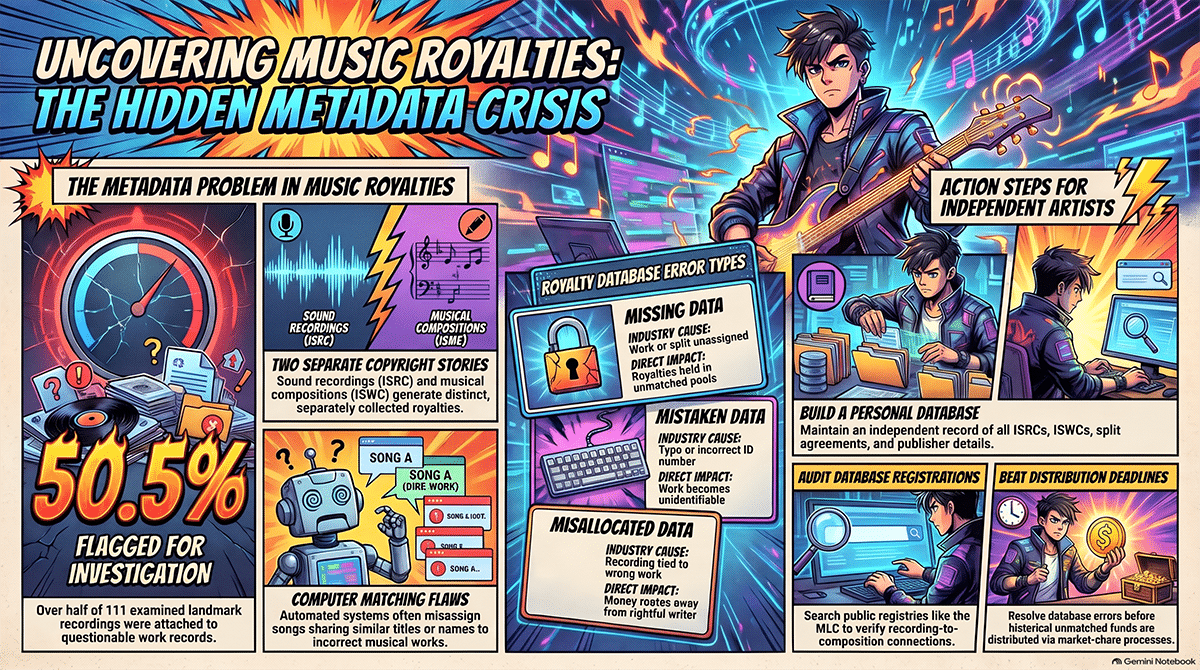
But the researchers discovered that 56 of those tracks, or 50.5 percent of the sample, were associated with more than one musical-work record that warranted further investigation. Some of those connections appeared to involve entirely different compositions. The researchers were looking beyond the existence of a registration and examining the relationship between the particular recording and the underlying song.
Before anyone announces that half the royalties in the music industry are disappearing, we need to put the brakes on that runaway train. The study did not find that 50.5 percent of music royalties were incorrectly paid. It did not establish that every track with multiple work records contained an error. It did not calculate how much money, if any, was sent to the wrong people. The MLC’s public information does not reveal the individual payment transactions that would be needed to answer those questions.
The researchers examined a small, deliberately selected group of famous recordings, not a random sample of the entire music business. Multiple work records can also have perfectly legitimate explanations, including different versions, adaptations, and complicated publishing histories. The 50.5 percent figure is a screening result showing how many tracks needed a closer look. It is not an industry-wide error rate, and treating it as one would turn an important investigation into another misleading internet headline.
Nevertheless, some of the examples deserve serious attention because they illustrate the precise weakness the researchers were investigating. The question is not whether computers can find a song title in a database. The question is whether they can identify the correct musical composition behind a specific recording, even when many similar titles, names, and versions exist.
When “Don’t Stop” Becomes Three Different Songs
One of the investigation’s most striking examples involved Fleetwood Mac’s “Don’t Stop,” a song written by Christine McVie. According to the AIMi researchers, recordings associated with that song were connected not only to the appropriate musical work but also to records associated with Queen’s “Don’t Stop Me Now” and Journey’s “Don’t Stop Believin’.” All three songs share a few words in their titles, but they are completely different compositions written by different people.
Anyone who has spent more than five minutes listening to classic rock understands that these are not interchangeable songs. They have different melodies, different lyrics, different writers, and different publishing rights. Yet an automated system that places too much weight on matching words might see those titles as being related. That does not prove this is exactly how the reported links arose, but it illustrates the kind of confusion music databases must be built to avoid.
The researchers also reported that recordings of Fleetwood Mac’s “Dreams” were connected to eight additional work records beyond the properly registered composition written by Stevie Nicks. Michael Jackson’s “The Lady in My Life” was reportedly associated with the musical-work record for “Thriller,” as well as its own. Interestingly, both compositions were written by Rod Temperton. That shared songwriter might make the information appear less suspicious to a computer than a connection between songs by unrelated writers, even though the works remain separate.
Another example involved AC/DC’s “Hells Bells,” which researchers found connected to a much older composition titled “Hell’s Bells” by bandleader Art Kassel. Similar titles, different compositions, and a connection that deserves investigation. Again, the existence of the association is not proof that an incorrect payment was made. It is evidence that the recording-to-work relationship may need correction.
These examples matter because popular music has never been particularly creative when it comes to song titles. There are countless songs called “Home,” “Stay,” “Tonight,” “Forever,” and “I Love You.” An independent songwriter can easily release a completely original composition with the same title as hundreds of other songs. That is perfectly legal because song titles alone generally do not receive copyright protection, but it creates an identification problem for organizations handling millions of recordings.
Now consider a working blues musician who records a song called “Sweet Home.” The artist writes the music, records the master, and distributes the recording. Somewhere in the reporting process, the song’s recording identifier becomes associated with another composition that has a similar title. The artist may still receive the money paid by the distributor for use of the master recording while some composition-related information needs investigation elsewhere. From the musician’s point of view, everything appears normal until someone takes the time to compare the actual recording with the musical work it has been assigned to.
That example is hypothetical, but it shows why the AIMi findings deserve attention. Music databases should not treat two songs as the same work simply because their titles look familiar. That might be acceptable when organizing a playlist for your next backyard barbecue. It is a considerably bigger problem when the information may influence how somebody gets paid.
Every Recording Has Two Different Copyright Stories
To understand why these findings matter, we need to explain something the traditional music industry has done a remarkably poor job of teaching independent musicians. A recorded song normally involves two separate copyright-protected works. One is the musical composition, which includes the underlying music and lyrics. The other is the sound recording, which captures a particular performance of that composition. These rights may belong to the same person, but they are legally separate and can earn different kinds of income.
The United States Copyright Office explains this distinction because it affects ownership, licensing, and payments. When you write a song, you create the composition. When you record yourself performing that song, you create a particular sound recording. If another singer records your composition, that singer has created a different recording of the same underlying work, assuming the recording was properly authorized. The new recording can have different performers, producers, and owners without changing who wrote the original composition.
Think about Dolly Parton’s “I Will Always Love You” and Whitney Houston’s famous recording of the song. Those are distinct sound recordings associated with the same underlying composition. The person who owns a particular master recording does not automatically own the songwriting copyright, and the songwriter does not automatically own every recording made of the song. The distinction is important because different rights generate different royalties that may be collected and paid through different organizations.
Each distinct sound recording should have an International Standard Recording Code, known as an ISRC. The code identifies the recording, not the musical composition. Musical works may also have an International Standard Musical Work Code, known as an ISWC. According to the international ISRC authority, these identifiers serve different purposes. An ISRC helps identify a specific recording, while an ISWC identifies the underlying composition. The MLC also assigns its own song codes to musical works in its database.
If that sounds confusing, imagine a house with a street address and a separate record identifying the property owner. The address tells the delivery driver where the house is. The ownership record identifies who has the legal rights to the property. Both pieces of information matter, but one cannot replace the other. In the music business, the ISRC helps identify the recording, while the composition registration and its associated information help identify the song and the people entitled to the songwriting income.
A musician who writes and records everything might own both copyrights, which is a wonderful position for an independent artist. But the digital music business still needs to identify those two works and connect them correctly. That connection is part of the foundation for digital mechanical royalty payments, which are generated when compositions are reproduced through eligible streaming and download uses. If the recording is associated with the wrong composition, the data needed to allocate those royalties may be unreliable even when the recording itself has been properly identified.
This is also why a distributor’s royalty dashboard cannot tell the whole story. A distributor generally handles revenue related to the master recording under its agreements with digital services. Songwriting royalties may move through publishers, administrators, performance rights organizations, and the MLC. Seeing money arrive from one source does not prove that every other source has the correct information or that all available royalties have been collected.
The Four Ways Music Rights Information Can Go Wrong
The AIMi investigation organized the problems it examined into four broad categories: missing, mistaken, misdirected, and misallocated information. These descriptions may sound like something created by an accountant who enjoys making life difficult for musicians, but they are useful because they show that not every royalty problem has the same cause or requires the same solution.
Missing information is the problem most musicians already know about. A composition may never have been registered with the proper organization, a songwriter might be missing from the ownership records, or an ownership share may not have been claimed. When information is missing, a royalty collection system can have trouble identifying who should receive the money. This is one reason independent songwriters must understand publishing administration, especially when they are releasing music without a traditional publisher.
Mistaken information exists when something has been entered incorrectly. It might be a misspelled songwriter name, an incorrect identification number, a wrong title, or another detail that causes a work to be difficult to identify. Some mistakes are easy to notice, while others can follow a song through several databases. Once an incorrect detail is copied into another company’s system, the error can take on a life of its own. Anyone who has ever tried to fix an incorrect address with a bank understands how exhausting that can become.
Misdirected information concerns authorship or ownership details that point toward the wrong person or organization. This is potentially serious because the music business relies on those records to decide who should receive money. A songwriter might find that an unfamiliar publisher appears in the information associated with a song, or that a legitimate ownership share has been attached to an incorrect party. Such a situation calls for careful investigation because conflicting claims can arise from honest mistakes, outdated agreements, competing registrations, or genuine disputes.
Misallocated information is the issue at the center of this investigation. The musical work may be registered, its ownership information may be complete, and the writers may be correctly identified. Yet a particular recording can still be associated with the wrong underlying composition. Fixing that problem requires more than adding missing information. Someone must examine the relationship between the recording and the work, determine whether the connection is valid, and correct it where necessary.
The important lesson is that the quality of a music catalog cannot be judged by counting registrations alone. A thousand registered songs are not necessarily a healthy catalog if their ownership records conflict, their recording identifiers are missing, or the wrong recordings are attached to the works. A useful catalog audit must examine the relationships between those pieces of information because that is where a seemingly complete registration can hide a problem.
The MLC Is Not the Villain in This Story
Whenever an investigation reveals questionable information in the music business, there is a temptation to identify one organization as the villain and start handing out pitchforks. That might make for entertaining television, but it would miss something important about this particular investigation. AIMi researchers were able to examine these connections because the MLC makes a significant amount of its musical-work information available for public review.
Created under the Music Modernization Act, the MLC began administering the United States blanket mechanical licensing system for eligible digital music services in 2021. Its responsibilities include collecting digital audio mechanical royalties, matching reported recording uses to registered compositions, and distributing the money to the appropriate rightsholders. The organization provides free access to public work information and tools that allow songwriters and publishers to investigate and manage their catalogs.
The MLC also performs both automated and manual matching. Its official tools page explains that members can search for songs, register works, claim ownership shares, suggest matches for unmatched recordings, and export catalog information. That level of access matters because it gives independent musicians a way to look at information that once might have remained buried in private industry systems.
The organization has also published guidance recognizing that incorrect recording-to-work matches can occur. Its Guidelines for Adjustments specifically address situations in which a recording was matched to an incorrect musical work. Depending on the circumstances, the MLC may investigate, hold affected royalties while it reviews an issue, and make adjustments when it determines that money was incorrectly paid. Those procedures are conditional, and they do not guarantee that every suspected error will result in a payment adjustment.
This is precisely why transparency should be encouraged. An imperfect database that can be examined and corrected gives creators more opportunity to protect their rights than a database that offers no meaningful way to challenge its contents. The MLC’s public information made this investigation possible, and that deserves recognition. At the same time, the ability to inspect information should lead to stronger methods for verifying the connections that have already been accepted as correct.
The real issue is larger than any one organization. Music data travels between distributors, streaming services, labels, publishers, administrators, collection societies, and other businesses. Each organization may use different databases and procedures. A piece of incorrect information can pass through several hands before someone notices it. Fixing the system requires cooperation among the organizations supplying, matching, correcting, and distributing that information.

Why Independent Musicians Have More at Stake Than They Realize
Major recording artists and publishers often have people whose entire job is to examine catalogs, track royalties, and investigate suspicious information. They may employ publishing administrators, royalty accountants, attorneys, and data specialists. Those services cost money, but they provide a level of oversight that most working independent musicians cannot afford.
The average independent artist is operating a much smaller business. The songwriter may also be the recording artist, producer, label owner, booking agent, merchandise manager, website administrator, and the person who remembers to put gas in the van. After a weekend of shows, the artist is more likely to be thinking about the next booking than examining whether every ISRC is correctly connected to its composition in a licensing database.
That lack of time creates a serious disadvantage. A major catalog can justify professional attention because the potential royalties are substantial. A musician earning a few thousand dollars annually from recordings and publishing may have trouble justifying the cost of a professional audit. Yet smaller artists are exactly the people who can least afford to lose money because of preventable administrative errors.
Consider an independent songwriter who earns money from live performances, direct music sales, merchandise, streaming, licensing, and occasional session work. Publishing royalties may represent only one part of that income, but they can continue arriving long after the original recording was released. A song that appears financially insignificant today could become more valuable if it is covered by another artist, used in a film, placed in a television program, or discovered by a new audience.
If that songwriter has incorrect ownership information or missing recording connections, future royalty collection and licensing work may become harder. The problem can also affect the artist’s ability to show what they own when negotiating with a music supervisor, publisher, or potential business partner. Clean information is more than a bookkeeping convenience. It helps establish that the person offering a piece of music actually controls the rights needed to license it.
This is where the Making a Scene philosophy becomes especially relevant. We believe independent musicians can build a real music industry middle class by owning their music, their business information, and their direct fan relationships. That ownership must include the ability to keep accurate records, examine royalty activity, and move information between service providers without losing control of the catalog.
The goal is not to turn every guitar player into a full-time accountant. The goal is to make the business side of music simple enough that a working artist can protect the value of the songs they have created.
Your Royalty Audit Begins With Knowing What You Actually Own
The first step toward protecting a music catalog is creating a reliable record of every composition and every recording. That record should belong to the artist, not exist only inside a distributor’s account or a publishing administrator’s dashboard. The information should be portable, backed up, and easy to update whenever a new recording, collaboration, or license is created.
For every original composition, an artist should know the title, the names of the writers, the agreed ownership percentages, the publisher or administrator responsible for each share, and any available musical-work identification numbers. The records should include written split agreements whenever multiple people contributed to a composition. A split agreement documents how the writers agreed to divide their rights and income, which can be especially important when memories fade or a song becomes more valuable than anyone expected.
For each sound recording, the artist should retain the recording title, performing artist, ISRC, release date, master owner, distributor, and the composition or compositions embodied in that recording. Different legitimate versions may need separate recording identifiers. A live performance, a newly recorded acoustic version, and an original studio master can all be distinct recordings of the same song. The artist’s records should make those relationships clear without requiring someone to search through years of email messages.
This information also needs to remain consistent as music travels between services. An artist who changes distributors should preserve the existing ISRC for an unchanged recording when appropriate, rather than casually assigning a new code and creating another identity for the same master. The international ISRC authority provides guidance on identification and assignment because recording codes are intended to remain useful across ownership changes, formats, and business arrangements.
The next step is comparing the artist’s own records with the information visible to royalty organizations. The MLC’s Public Work Search allows anyone to examine registered musical works. A songwriter can search for a composition, review its writers and ownership information, and investigate the recordings shown as associated with that work.
Finding a registration is only the beginning. The artist should examine whether the work has the correct writers, whether the ownership shares agree with the written agreements, and whether the recordings associated with it are actually recordings of that composition. A work that shows complete ownership percentages may still deserve attention if one of its linked recordings appears unrelated.
This process should become part of regular catalog maintenance. Checking newly released music after the reporting systems have had time to receive usage data is sensible, but older songs deserve occasional attention as well. A catalog is not a finished document that can be locked away forever. New recordings, cover versions, ownership changes, and corrected information can alter what needs to be tracked.
How to Investigate a Song That May Be Connected to the Wrong Recording
The MLC provides several different tools, and understanding what each one does is important. Its Public Work Search is a place to examine registered composition information. Its registration and claiming tools help rightsholders add works or claim legitimate ownership shares. Its Matching Tool primarily helps connect previously unmatched recording uses with the correct musical works.
That last distinction is especially important in light of the AIMi investigation. The MLC Matching Tool is designed to help identify recordings that have not yet been matched through the organization’s automated and manual processes. It can help a songwriter discover a missed connection, including a recording of their composition that the system has not yet assigned to the appropriate musical work.
But the AIMi investigation focuses on a different possibility: a recording that already appears matched, except that the match may be wrong. An artist cannot assume that a search of the unmatched recordings will uncover every incorrect connection. If the system has already accepted a match, the recording may no longer appear among the unmatched results, even if someone later finds evidence that it belongs to a different work.
The MLC’s editing guidance explains that some changes can be made directly by members, while removing recording information that is already matched requires contacting the MLC. That means a songwriter who suspects an incorrect existing connection should gather evidence and ask the organization to investigate rather than trying to force a new match or create another registration without understanding the consequences.
A useful investigation begins with the recording’s ISRC, the correct composition title, the songwriter names, and the MLC song code for the appropriate work. The artist should compare that information with the questionable work record and document why the connection appears incorrect. If a recording of an original song is attached to a composition with completely different writers, that difference deserves examination, but it should not automatically be treated as proof of wrongdoing.
The artist can then contact the MLC Support Team, explain the suspected discrepancy, and provide the relevant identification numbers and supporting documents. If the music is administered by a publisher or publishing administrator, that organization should be involved because it may control the registrations and claims. The purpose is to establish the correct relationship, allow the MLC to review the information, and create a documented record of the request.
It is also important to resist the urge to claim ownership of every recording or work that appears connected to your name. A recording may involve a cover song, an adaptation, or an authorized use that requires a more careful examination of the rights. False ownership claims can create disputes and delay payments to legitimate rightsholders. The proper response to an apparent error is to investigate it, preserve the evidence, and use the appropriate correction process.
Finding Money That Has Never Been Matched
While the AIMi research concentrates on questionable existing matches, traditional unmatched royalties remain an important concern. The MLC receives recording-use reports from eligible digital music services and attempts to connect those recordings to registered compositions. When it cannot establish a match, the related digital mechanical royalties may remain unmatched while the organization continues its identification and distribution work.
The MLC’s Distributor Unmatched Recordings Portal Artist Lookup provides a free way to investigate whether recordings associated with an artist’s name may have unmatched royalties. The tool can help songwriters discover recordings that deserve attention and learn how to take the next steps toward registering or identifying the relevant compositions.
The service is especially useful for independent musicians who have released recordings but never fully understood the difference between distributing a master and registering a song for publishing income. An artist might have delivered music to digital stores years ago and received money from a distributor without ever establishing the proper arrangements to collect all available songwriting royalties.
The Artist Lookup is not a complete accounting of everything owed to an artist. A name appearing in the results does not prove that a particular songwriter owns the composition or is entitled to the money, and a name missing from the results does not guarantee that every recording has been correctly identified and paid. It is a research tool, not a final royalty statement.
Artists who manage their own publishing rights may need to become MLC members to register works and collect their United States digital mechanical royalties. Songwriters who have assigned those responsibilities to a publisher or administrator should confirm that the authorized organization is handling the registrations and collections. The MLC’s getting-started guidance explains the distinction between its Member Hub and Songwriter Hub, which provide different access depending on the user’s role.
The larger point is that the artist should know who is responsible for every important part of their royalty collection. Assuming that a distributor, performance rights organization, or publisher handles everything can create gaps because each organization has a different role. An artist does not need to memorize every royalty law, but they should be able to identify who collects each major income stream and how to investigate a payment that appears to be missing.
A Royalty Statement Should Tell a Story That Makes Sense
Once the registrations and recording connections have been reviewed, the next step is examining the actual royalty statements. The MLC makes detailed reporting available to members receiving payments, including information about recorded uses associated with their works. Its royalty statement instructions describe reports that show income at the musical-work level and more detailed information tied to individual sound recording uses.
These reports can help an artist compare what is being reported with what they know about their music. If a song has several legitimate recordings, the related information should make sense. If a recording appears with an unexpected title or performer, it deserves a closer look. If royalties change sharply, the artist should investigate whether the difference reflects actual listening activity, reporting delays, adjustments, or other factors before assuming that something has gone wrong.
There is no simple rule stating that a particular number of streams should always produce a particular amount of mechanical royalty income. Rates and calculations depend on licensing arrangements, reporting periods, service offerings, and other variables. Money can also arrive at different times through different organizations. A discrepancy between a distributor statement and an MLC statement does not automatically establish an error because the two reports may cover different rights and periods.
Nevertheless, careful comparison can reveal questions worth asking. A musician might discover that a live recording has never appeared in the expected records, that a new version is connected to an older registration incorrectly, or that a cover version has been associated with the wrong composition. Some findings will turn out to be harmless, while others may require corrections.
The artist should keep copies of royalty statements and records of any reported discrepancies. If a correction is submitted, it is worth recording the date, the identification numbers involved, the evidence supplied, and the response received. That may sound painfully unromantic, but a few minutes of careful recordkeeping can save many hours of confusion when a problem resurfaces months later.

The Clock Is Ticking on Some Older Royalties
There is another reason this investigation arrived at an important moment. In September 2026, the MLC announced that it intends to begin distributing certain remaining unclaimed royalties from 2021 through a market-share process in April 2027. The first planned distribution concerns eligible remaining unmatched and unclaimed blanket mechanical royalties associated with January 2021 usage.
Under the Music Modernization Act, the MLC cannot hold unresolved royalties indefinitely. After the required holding period and continued efforts to identify the proper recipients, eligible remaining funds must eventually be distributed through the process established by law. The MLC has said that its first planned market-share distribution will occur more than six years after the relevant January 2021 usage, exceeding the minimum three-year holding requirement.
According to the MLC’s official market-share guidance, the organization expects to use a database snapshot taken around February 10, 2027, to determine the information used for the first April distribution. Because registrations, claims, and match suggestions can take time to process, the MLC recommends that rightsholders address outstanding issues well before that snapshot.
This does not mean that every artist with an older recording has a royalty payment waiting to be claimed. It also does not mean that the AIMi study has uncovered a specific amount of money that will be included in these distributions. The planned market-share process concerns remaining unmatched and unclaimed funds, while the AIMi investigation raises questions about some recording-to-work relationships that already appear matched.
Even so, the timing creates a practical reason for independent songwriters to review their catalogs now. Musicians who released recordings during or before 2021 should confirm that their compositions are registered, that their legitimate ownership shares are claimed, and that any known unmatched recordings have been investigated. Waiting until the week before a planned distribution is a poor strategy when administrative corrections may require review.
There is a larger lesson here about the cost of ignoring music-business information. A songwriter can hold a copyright for decades, but the procedures used to distribute particular royalty pools operate on schedules. When an artist fails to keep up with those processes, opportunities to correct information before a distribution can become more complicated. Protecting ownership also means paying attention to the systems and deadlines that affect the money connected to that ownership.
AI May Become the Royalty Investigator Independent Musicians Cannot Afford
One of the most interesting parts of the AIMi investigation is the technology used to conduct it. The researchers employed an AI-assisted music-rights research system designed to examine large collections of music information and identify relationships that deserve investigation. The published announcement describes a research effort spanning nearly three years and a much larger body of catalog information than the 111 tracks featured in this particular sample.
Traditional catalog research can be painfully slow. Someone must compare recording titles, songwriter names, ownership percentages, identification numbers, publisher information, and related records. A problem may not be obvious until information from several sources is examined together. When a catalog contains thousands of recordings, that work can consume enormous amounts of time.
AI offers a potentially useful way to make the research more manageable. A properly designed system could compare the artist’s own catalog records with information obtained from authorized industry sources, identify possible conflicts, and prepare reports showing which connections deserve human review. Instead of asking the artist to examine thousands of records one by one, the software could help focus attention on a smaller group of unusual or contradictory entries.
Imagine an independent musician with twenty years of recordings. The artist has released studio albums, live recordings, acoustic versions, collaborations, and songs licensed to other performers. An AI assistant could help organize that catalog and compare the known recordings against registered compositions. If a particular ISRC appeared connected to an unexpected musical work, the software could flag it and explain what information led to the concern.
That would be a real business use for AI because it could reduce the time and expense of investigating rights information. For a working musician, recovering a legitimate missing royalty or correcting a record that might interfere with future licensing is more valuable than generating another hundred social media captions that nobody wants to read.
But AI must be treated as an investigator, not a judge. Automated systems can create false positives by overlooking legitimate cover versions, adaptations, alternate titles, or complicated publishing agreements. An AI model can also misunderstand documents or invent a connection that is not supported by reliable evidence. Those weaknesses are particularly dangerous when the subject involves ownership rights and money.
The proper role of AI is to identify questions, compare evidence, and help prepare a clear report for the people and organizations authorized to make corrections. It should preserve the original source information, distinguish confirmed facts from suspicions, and allow the artist to review every proposed change. No responsible musician should allow an automated tool to file conflicting ownership claims or alter important rights records without checking the supporting evidence.
AIMi’s reported research is an example of this emerging opportunity, but it should not be mistaken for proof that every commercial AI catalog-auditing service is reliable. The system described in the announcement is not a generally available, independently validated solution for every songwriter. Artists evaluating future services should ask how the software verifies its sources, how it handles false matches, what data it stores, and whether the artist can export the results.
Web3 Could Help Preserve the Evidence, but It Cannot Replace the Truth
This investigation also has important implications for Web3 technology, which has often been promoted as a way to create more transparent music ownership systems. The basic idea is that certain information can be recorded in a shared, tamper-resistant system where changes and transactions are easier to trace. In theory, that could help artists maintain better records of ownership agreements, rights transfers, and other important events.
A useful application might involve creating a verifiable history of a composition’s ownership information. When collaborators approve their songwriting splits, the artist could preserve the agreement and a record showing when it was accepted. Later changes could be documented without losing the earlier history. The same approach could help preserve records of master ownership, licenses, and administrative transfers.
That could be valuable when an artist changes distributors or publishing administrators. Instead of depending entirely on a single company’s private dashboard, the musician would retain an independent record of important rights information. A future licensing partner could use that evidence to help verify who controls the work, subject to the agreements and applicable law.
However, blockchain technology has a major limitation that this investigation helps explain. A permanent record of incorrect information is still incorrect information. If someone enters the wrong songwriter, wrong ownership share, or wrong recording connection into a blockchain system, making that record difficult to alter does not magically make it true. A ledger can help prove what was recorded and when, but it cannot determine whether the original claim was legitimate.
The same warning applies to smart contracts, which are programs that can carry out certain transactions when specified conditions are met. Sending royalties automatically according to an incorrect ownership record would not solve the music industry’s problem. It could simply make the wrong payment happen more efficiently.
For independent musicians, the most promising use of Web3 may be preserving evidence and improving portability rather than replacing traditional rights systems overnight. Written agreements, reliable identification numbers, verified corrections, and clear ownership histories remain essential. Technology should make those records easier to maintain and verify while leaving artists with meaningful control over their information.
AI and Web3 could eventually complement each other in this area. AI could help identify questionable relationships, while verifiable records could preserve the evidence used to examine and correct them. Together, they might reduce administrative costs for smaller catalogs. But those benefits depend on accurate information, responsible design, privacy protections, and cooperation with the organizations that actually collect and distribute royalties.
A Better Music Business Begins With an Artist-Owned Source of Truth
The AIMi findings point toward something we have been discussing at Making a Scene for years: independent artists need a reliable source of truth for their music business. That means an artist-controlled collection of records showing what music exists, who created it, who owns it, how it has been released, and how the different pieces connect.
This should not be confused with another streaming service or another place to upload songs. The artist already has enough accounts and passwords to qualify for a part-time job in computer security. What musicians need is a way to organize their essential business information so that changing a distributor, licensing a recording, or investigating a royalty problem does not require rebuilding years of history from scattered documents.
A useful artist-owned system would connect every composition with its recordings and maintain the available ISRCs, ISWCs, MLC song codes, writers, publishers, ownership agreements, release information, and administrative contacts. It would also preserve evidence of registrations, corrections, and licenses. When information was missing or contradictory, the system could identify the problem and help the artist understand what needed attention.
This is the kind of protection we believe belongs in the future of the Making a Scene Artist Ecosystem. Its Source of Truth approach is designed around the principle that an independent musician should retain control of the information needed to operate a sustainable business. A music-rights health check could build on that principle by identifying missing composition registrations, incomplete songwriter splits, inconsistent recording identifiers, and possible conflicts between an artist’s own records and information obtained from authorized outside sources.
An AI-assisted version could eventually help investigate questionable recording-to-work relationships in much the same way AIMi researchers examined public data. The important difference for an independent artist would be the ability to compare those public records with the musician’s own contracts, masters, contributor information, and release history. Any outside-data integration or automated audit would need to be developed, tested, and verified before it could be presented as a working capability.
This approach would also make it easier to maintain a portable catalog. If a musician decides to change a distributor or publishing administrator, the artist should be able to export the underlying records and supporting documents in useful formats. The business information belongs to the artist and should not become trapped inside a company simply because that company happened to provide a convenient dashboard.
For musicians who collaborate frequently, maintaining accurate information from the beginning could prevent problems years later. Recording sessions could be tied to contributor records, songwriting agreements could be preserved with the compositions, and different masters could be linked to the appropriate works. Instead of trying to reconstruct ownership after a song becomes successful, the artist could establish a clear business history while the information is still fresh.
The technology should serve the musician, not become another gatekeeper. It should be understandable to someone who knows how to write a great song but has never heard the phrase “relational database.” A songwriter should be able to see whether their catalog information is complete, understand why a potential conflict has been flagged, and know what evidence is needed to address it.
How Better Royalty Data Creates Real Artist Income
At this point, some musicians may wonder why they should spend time investigating metadata when they could be booking another show or selling more merchandise. That is a fair question. The answer is that accurate catalog information helps protect income the artist has already earned and supports opportunities to earn more.
The most direct benefit is the possibility of identifying royalties that were not properly connected to the artist’s works. When a legitimate missing registration, unclaimed share, or incorrect connection is resolved, that may allow money to be distributed to the correct party. Not every correction produces a payment, and no technology can promise a particular amount of recovered income. But identifying a real payment problem is a much better use of time than simply assuming every organization has everything right.
Accurate information also supports licensing. A music supervisor looking for a song to use in a television program, film, advertisement, or video game needs to know who controls the master recording and who controls the composition. If the artist can provide clear ownership records and identify the people authorized to approve the use, negotiations can move more smoothly. Conflicting information can delay a deal, create uncertainty, or make a potential license less attractive.
Publishing administration is another area where clean information matters. Songs can generate different royalty types in different settings, and the organizations responsible for collecting those royalties rely on accurate work and ownership information. The MLC handles eligible United States digital audio mechanical royalties, while performing rights organizations collect certain public performance royalties for compositions. SoundExchange collects and distributes certain royalties connected to sound recordings played through noninteractive digital services. These are separate systems serving different purposes, so artists should understand which organization is responsible for each revenue stream.
Direct-to-fan income remains equally important. Selling music directly, building a mailing list, offering memberships, booking live performances, and creating merchandise can provide revenue that reaches the artist more directly than many traditional industry arrangements. Those activities help reduce dependence on streaming payouts, and accurate catalog information supports them by making ownership and licensing decisions easier.
A musician who understands their rights can make better decisions about releasing live recordings, selling special editions, offering stems, licensing instrumental versions, and collaborating with other creators. Those opportunities should be built on clear agreements and ownership information. The artist’s direct fan relationships then become part of a broader business that includes both immediate sales and longer-term income from the music catalog.
This is how a music industry middle class begins to take shape. Instead of depending on one platform or waiting for a label to discover them, independent artists build several connected income streams. Their catalog creates value through recordings, publishing, licensing, and direct sales. Their live performances create relationships that support merchandise, memberships, and future shows. Their business information helps them protect those opportunities and evaluate new ones.
Good metadata is not glamorous, but neither is checking the oil in a tour van. Both are easier to ignore when everything seems to be running smoothly, and both can become painfully expensive when something goes wrong.
The Industry Needs to Stop Treating a Match as the End of the Investigation
The AIMi findings raise a larger question about the way the music business measures success. Collection organizations often report how much data has been processed, how many works have been registered, and how much usage has been matched. Those figures can help demonstrate progress, but they do not answer every question about the accuracy of the underlying relationships.
A high match rate means that a system has successfully connected a large portion of reported recording uses to musical works according to its matching procedures. That is useful. But it does not, by itself, prove that every accepted connection is correct. A database can contain complete ownership information and still include a questionable relationship between a recording and a composition.
This distinction should matter to everyone involved in music rights. Better matching systems need ways to examine not only the records that could not be matched but also accepted matches that contain signs of conflict. Similar titles, inconsistent writers, contradictory identification numbers, and unusual ownership relationships may all deserve attention, although none should automatically be treated as proof of an error.
Industry organizations should also make correction procedures understandable and accessible. A songwriter who discovers a questionable connection should be able to identify the appropriate contact, submit the relevant evidence, and receive a meaningful response. When a correction is made, the affected parties should have a reasonable way to understand what changed and whether any royalty adjustments are required.
This is particularly important for independent musicians who cannot afford professional teams to spend months investigating a single song. A process that requires expensive representation for every minor correction effectively places smaller rightsholders at a disadvantage. Better tools, clearer reporting, and responsible automation could lower the cost of resolving routine data problems.
The industry should also work toward stronger data-sharing standards while respecting legitimate privacy and confidentiality needs. Artists need enough information to understand how their music has been identified and where their money is going. Transparent ownership records and meaningful correction procedures can help establish trust, especially when many companies participate in moving royalties from listeners to creators.
AI might help with that work, but the technology should remain accountable to people. Automated systems should explain why they made a match, allow disputed connections to be reviewed, and preserve the evidence needed to correct mistakes. The goal is not to replace music-rights professionals with a computer that sounds confident. It is to give those professionals and independent creators better ways to identify and solve problems.
The Next Generation of Independent Artists Must Own More Than Their Masters
For a long time, musicians were told that owning their masters was the ultimate goal. That advice remains important because controlling a master recording can create valuable licensing and business opportunities. But the AIMi investigation shows why ownership must be supported by accurate information that can be verified across the organizations handling the music.
An artist can own a master and still have trouble collecting publishing income if the underlying composition information is incomplete or incorrectly connected. A songwriter can own a composition and still encounter problems if recording-use reports are difficult to identify. An artist can have a growing fanbase and strong music sales while leaving other income opportunities unexplored because nobody has taken responsibility for the business records.
The next generation of independent musicians needs to think about ownership in a broader way. That includes controlling masters and publishing where possible, preserving written agreements, maintaining portable catalog records, and understanding which organizations collect the various royalties. It also includes owning the direct relationship with fans rather than allowing every conversation and sale to remain inside somebody else’s platform.
Those priorities belong together because they reduce different kinds of dependence. Owning music protects the artist’s creative assets. Owning accurate business information improves the ability to administer and license those assets. Owning a direct fan relationship gives the musician a way to build revenue without requiring a gatekeeper to approve every opportunity.
AI can help reduce the administrative burden if it is used responsibly. Web3 may help preserve certain records and make changes easier to verify. Direct-to-fan technology can make it easier to turn a listener into a supporter who purchases music, attends shows, and remains connected to the artist. None of these tools should become a substitute for professional judgment or a promise of effortless wealth, but they can form part of a more practical and independent music business.
An independent artist should not have to choose between protecting their royalties and creating music. The industry has spent decades building increasingly complex systems for distributing digital recordings and collecting money. It is time those systems became easier for the actual creators to understand and examine.
Making a Scene: The Real Revolution Is Knowing Where Your Money Goes
The AIMi Labs investigation is important because it challenges an assumption that has shaped the digital music business for years. We have been taught to believe that getting music into the proper database is the main administrative hurdle. Register the song, fill in the ownership percentages, attach the recording information, and wait for the money to arrive.
Those steps remain necessary, but they are not the end of the process. The investigation suggests that some recordings can appear properly registered while still being associated with questionable musical-work information. Until the connections are reviewed, we cannot assume that every accepted match is correct simply because a computer says it has found one.
The research also reminds us to separate a potential problem from a proven financial loss. The 56 flagged tracks were not 56 confirmed cases of incorrect royalty payments. The study was not a full audit of the industry’s distribution records, and it did not establish how much money might have been affected. What it did provide was a reason to examine a part of music-rights administration that deserves more attention.
For independent musicians, the practical response is straightforward. Know what you own, preserve your agreements, verify your registrations, examine the recordings connected to your songs, and investigate discrepancies through the proper channels. Use AI to help uncover questions, but insist on reliable evidence before making ownership claims or requesting corrections. Treat catalog maintenance as part of running a professional music business, just as you would maintain your instruments, studio equipment, or touring vehicle.
At Making a Scene, our mission has never been to create a new collection of digital gatekeepers with prettier websites. We want working musicians to have the tools, knowledge, and business independence needed to earn a real living from their art. That means building direct relationships with fans, developing several sources of income, controlling the rights to their music, and retaining the information required to protect those rights.
The music industry has spent an extraordinary amount of money developing technology to deliver virtually any song to virtually any listener in seconds. It should be possible to apply some of that same technical brilliance to making sure the correct songwriter gets paid. If an independent musician can send a recording around the world with a few clicks, they should also have a reasonable way to determine whether the recording has been connected to the correct composition.
The AIMi investigation offers a warning, but it also points toward an opportunity. Better data, more transparent systems, responsible AI tools, and artist-controlled records could make royalty administration more accurate and less expensive. Those improvements would benefit the entire industry, but they could be especially valuable to the independent musicians who have spent years creating music without the protection of a large business organization.
The next great change in the music business may not come from another streaming platform, a new royalty token, or an AI system that promises to write a hit song before breakfast. It may come from giving artists the power to understand, verify, and protect the business information behind the music they already own.
Because after spending years writing songs, playing shows, building an audience, and keeping a music career alive, an independent musician deserves something more than a database telling them everything looks fine. They deserve a system they can examine, a practical way to correct mistakes, and a fair opportunity to collect the money their work has earned.
And if a computer thinks Fleetwood Mac, Queen, and Journey all wrote the same song because somebody used the words “Don’t Stop,” perhaps it is time to remind the machine that listening to the music is still part of understanding the music business.
Making a Scene believes that the future of independent music belongs to the artists who own their work, control their business information, build direct relationships with their fans, and use new technology to create sustainable careers without depending on traditional industry gatekeepers.
 |  Spotify |  Deezer |  Breaker |
 Pocket Cast |  Radio Public |  Stitcher |  TuneIn |
 IHeart Radio |  Mixcloud |  PlayerFM |  Amazon |
 Jiosaavn |  Gaana |  Vurbl |  Audius |
 Reason.Fm | |||
Find our Podcasts on these outlets
Subscribe to Our Newsletter
Discover more from Making A Scene!
Subscribe to get the latest posts sent to your email.


