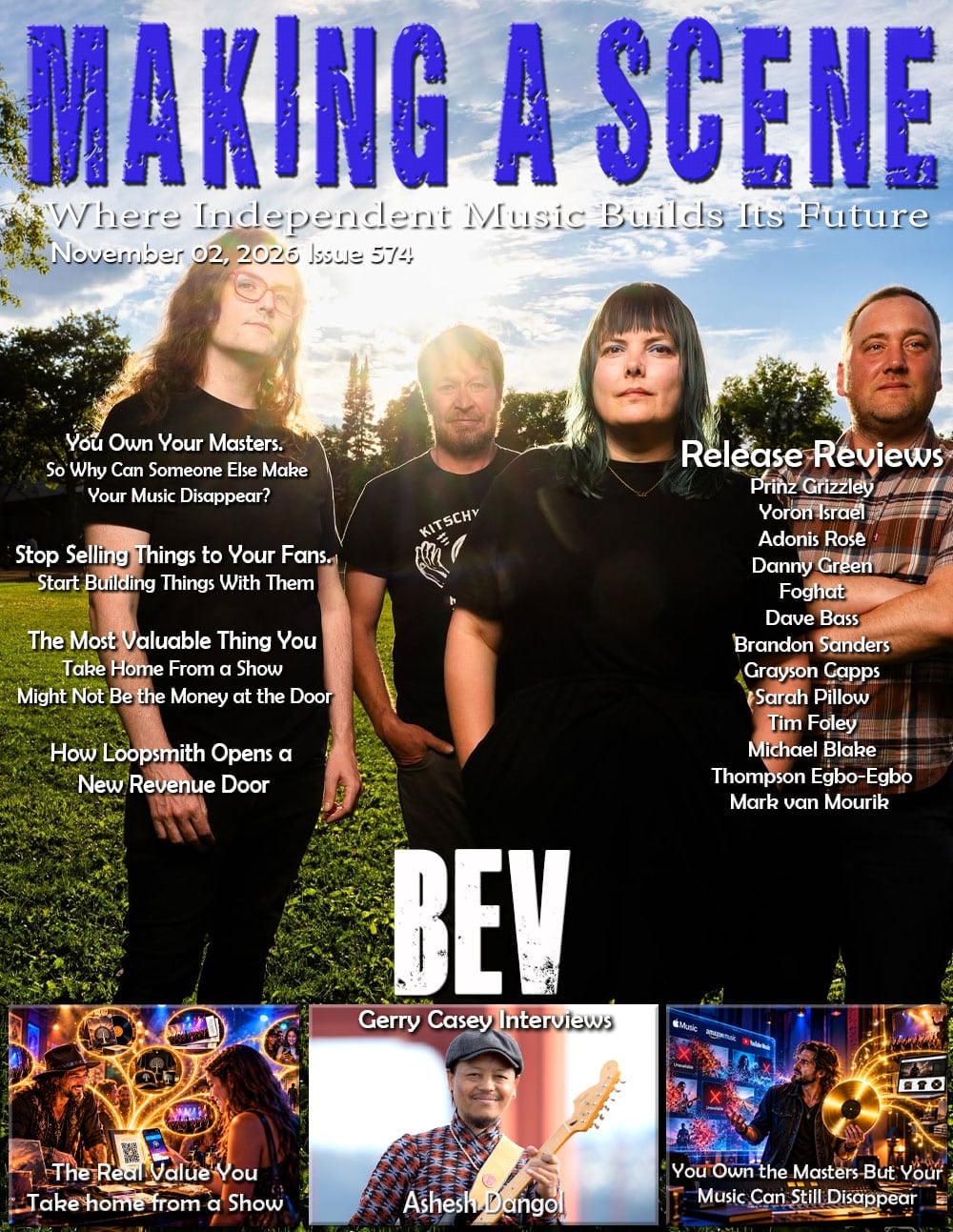

The Music Industry Is Making Billions. Independent Musicians Are Still Fighting for Their Share.





Making a Scene Presents – The Music Industry Is Making Billions. Independent Musicians Are Still Fighting for Their Share.
Listen to the Podcast Discussion
Making a Scene Weekly Music Business Wrap-Up
Another Week in the Music Business, and the Money Is Moving
There is something fascinating about watching the modern music industry celebrate another round of financial growth while thousands of working musicians are still trying to figure out how to make a decent living from their music. The companies that distribute recordings, manage catalogs, operate streaming platforms, and develop music technology continue to find new opportunities for revenue. Meanwhile, independent artists are juggling recording costs, touring expenses, marketing budgets, and the increasingly complicated business of getting paid for the music they create. The industry is certainly generating money, but whether enough of that money is reaching the people responsible for making the music remains a very different question.
This past week offered a revealing look at where the business is heading. Universal Music Group reported billions in quarterly revenue, Spotify’s plans for AI-powered remixes began taking shape, and the ongoing debate over artificial intelligence and copyright continued raising uncomfortable questions about who has the right to profit from creative work. At the same time, new recording technology promised to make music production more efficient, while research into royalty databases reminded us that collecting money from a recording can be considerably more complicated than simply releasing it. Each development represents another piece of an industry that is changing rapidly, often faster than independent musicians can reasonably keep up with.
For Making a Scene, these stories are important for reasons that go beyond the headlines. We are interested in how musicians can build sustainable careers without surrendering control of their recordings, publishing, business information, and relationships with fans. The traditional music business has spent decades operating around the idea that artists need large companies to reach an audience and generate revenue. Technology has weakened some of those old barriers, but it has also created new gatekeepers that can be every bit as powerful as the record companies they supposedly replaced.
The real opportunity for independent musicians is not simply to participate in the latest technology trend. It is to understand how the industry is changing and use those changes to build businesses they actually own. That means looking at everything from AI licensing to streaming economics through the same practical lens: how does this help an artist earn money, reduce expenses, reach customers, or protect something valuable? If the answer involves giving another platform complete control over the relationship between the musician and the audience, we should probably examine the fine print before celebrating.
Spotify’s AI Remix Plans Could Create a New Revenue Stream, but the Details Matter
One of the week’s most interesting developments came from Spotify, which is reportedly preparing a subscription-based artificial intelligence service that would allow listeners to create remixes and cover versions of existing recordings. According to reporting published by the Financial Times on October 30, the company is targeting the first quarter of 2027 for a possible launch and considering an additional monthly charge of approximately $4 to $5. Those details have not been finalized, and the service remains a reported plan rather than an available product. Nevertheless, the proposal offers a glimpse into how major streaming companies believe AI could become another source of consumer spending.
The concept is different from the familiar AI music generators that produce recordings from written instructions. Spotify’s proposed system would work with licensed recordings from participating artists, allowing subscribers to create alternative versions of music that already exists. A listener might transform an acoustic folk recording into a dance arrangement or experiment with a different interpretation of a familiar song. Reporting indicates that participating artists would be able to decide whether their music is included, while royalties from fan-created versions would flow back to the original artists under the proposed system.
Spotify has already developed licensing relationships that could support this approach. Agreements involving Universal Music Group, Merlin, and Believe demonstrate that the company is working with established rights holders rather than simply opening the entire recorded music catalog to unrestricted manipulation. That distinction matters because copyright law treats musical compositions and sound recordings as separate protected works, and any legitimate commercial remix system needs to account for the rights associated with both. The fact that licensing discussions are taking place is encouraging, although the economic terms available to individual independent musicians remain the more important question.
For an artist who owns their master recordings and controls the publishing rights to their songs, this kind of licensing arrangement could eventually provide an additional revenue opportunity. A musician with a catalog of original recordings might authorize selected tracks for AI-assisted remixing and receive compensation when listeners create or consume those versions. There could also be a promotional benefit if the activity introduces older recordings to new audiences. A song that has been sitting quietly in a catalog for ten years might find a second life through a creative reinterpretation, particularly if listeners can easily discover the original artist.
However, the history of digital music suggests that musicians should be cautious about assuming that a growing subscription business automatically produces meaningful artist income. Streaming platforms have become exceptionally good at converting large numbers of small consumer payments into substantial corporate revenue. The amount that eventually reaches an individual musician depends on licensing terms, ownership arrangements, distribution agreements, and the formulas used to allocate revenue. Adding another subscription fee does not necessarily change that relationship, especially if artists have limited visibility into how their recordings are being used.
The proposed AI remix system also introduces questions about creative control that go beyond money. Musicians may have legitimate reasons to restrict certain uses of their recordings, particularly when a remix changes the meaning, context, or character of the original work. An artist might welcome dance remixes of one recording while objecting to synthetic vocal transformations of another. There are also questions about whether an AI-generated version can be distributed outside the service, how attribution will appear, and what happens when a participating artist changes their mind. These are not minor details buried in a technical agreement; they determine how much control musicians retain over the commercial use of their work.
Independent artists should pay particular attention to the difference between giving permission and surrendering broad rights. A carefully limited license can create revenue while preserving ownership, whereas an overly broad agreement may authorize uses that were never part of the artist’s original intention. Musicians who distribute through third-party services should also understand whether those companies can enter AI licensing arrangements on their behalf and what approval mechanisms are available. The fact that a distributor has reached an agreement with a platform should not be mistaken for proof that every artist has knowingly accepted every possible use.
The larger significance of Spotify’s plans is that artificial intelligence is beginning to move from an experimental creative tool into the commercial licensing business. That could be good news for musicians who understand their rights and maintain accurate ownership records. It could also create another layer of complicated contracts and royalty calculations that favor companies with large legal and administrative departments. Independent artists should welcome new licensing opportunities without forgetting that the value being licensed begins with music someone actually created.
Universal Music Group’s Financial Results Reveal Where the Industry Is Heading
Universal Music Group released its third-quarter financial results on October 29, reporting revenue of approximately €3.394 billion, an increase of 12.3% over the corresponding quarter in 2025. The company also reported strong growth in subscription revenue and physical music sales, while its integration of Downtown Music Holdings contributed to the overall results. These figures provide an important reminder that recorded music remains a substantial global business, even as the ways people consume and purchase music continue to change.
The details are more interesting than the headline number. Universal reported that recorded music subscription revenue increased 19.2% in constant currency, although that figure includes the contribution from Downtown. Excluding Downtown, subscription revenue grew 9.5% in constant currency, while physical recorded music revenue increased 17.4%. Those distinctions matter because acquisitions can make a company’s overall growth look considerably stronger than the underlying performance of its existing business. Universal’s results still demonstrate meaningful demand for music, but they also show the importance of understanding where the reported growth actually comes from.
The continued strength of physical music is particularly relevant to independent musicians. For years, the industry treated CDs and vinyl as outdated products that would eventually disappear beneath the unstoppable march of streaming. Instead, physical formats have retained commercial value for audiences who want something more tangible than access to a digital file. The success of major-label physical releases does not guarantee that an independent artist will sell enough vinyl to recover manufacturing costs, but it does demonstrate that listeners remain willing to purchase music products when they believe those products offer value.
For a working musician, the economics of physical merchandise can be very different from streaming. A fan who buys a CD directly from an artist at a show creates a transaction in which the musician may retain a substantial portion of the sale after manufacturing, payment processing, and other costs. That same fan might listen to the recording hundreds of times through a streaming service without generating comparable income for the artist. The exact numbers depend on costs and royalty arrangements, but the broader distinction is clear: direct sales give musicians greater control over pricing, presentation, customer relationships, and the financial terms of the transaction.
Universal’s results also highlight the value of owning a catalog that generates revenue through multiple channels. Major music companies do not depend on one recording, one tour, or one source of income. They manage collections of assets that can earn money through streaming, physical sales, publishing, licensing, synchronization, merchandise, and other commercial activities. Independent musicians operate on a much smaller scale, but the underlying business principle is equally useful. A musician who owns a catalog of recordings and compositions has the potential to develop several income streams from the same creative work.
This is where the conversation about a music industry middle class becomes important. The goal should not be to convince every independent artist to behave like a multinational corporation. Most musicians would prefer to spend their time writing, recording, and performing rather than studying quarterly financial reports. But understanding how a catalog creates value allows artists to make better decisions about ownership, distribution, licensing, and long-term business development. A recording should be viewed as something that can continue generating opportunities after its initial release, not merely as promotional material for the next gig.
The growing importance of artist and label services also deserves attention. Universal’s expansion through Downtown reflects a broader industry interest in the infrastructure used by independent musicians and labels. Distribution, royalty administration, marketing, publishing services, and catalog management have become valuable businesses in their own right. That creates competition and potentially useful services for independent artists, but it also raises questions about how much of the supposedly independent music economy is becoming connected to the same large corporate groups that dominate the traditional industry.
Musicians do not necessarily need to avoid companies associated with major labels. A useful distribution or administration service can still provide real value regardless of who owns it. The important issue is whether the agreement allows the artist to retain ownership, access their business information, understand the fees, and leave without losing control of their catalog. The independent musician’s objective should be to purchase services when they are useful rather than surrender valuable assets simply because a company promises access to the industry.

The AI Copyright Battle Is Really About Who Controls the Value of Music
The ongoing copyright disputes involving artificial intelligence companies have become one of the most important economic issues facing musicians and songwriters. Recent litigation involving music publishers and AI developers reflects a larger disagreement about whether copyrighted creative works can be used to develop commercial generative systems without authorization. The legal arguments are complex, and the outcomes will depend on the facts of individual cases and how courts interpret existing copyright law. Nevertheless, the business implications extend far beyond the companies currently involved in litigation.
For decades, the music industry has operated around the principle that different commercial uses of music require appropriate rights and permissions. A company that wants to use a recording in an advertisement generally needs to address the rights in both the sound recording and the underlying composition. A film producer seeking a particular song faces similar licensing questions. These arrangements can be complicated, but they recognize that creative works have commercial value and that the people controlling the relevant rights have an interest in how those works are used.
Generative AI has challenged this system because developers may use enormous collections of creative material to train models capable of producing new content. The central legal debate involves whether particular uses of copyrighted works require authorization or may be permitted under doctrines such as fair use. Courts have not established one universal rule covering every AI training practice, and different cases involve different technologies, datasets, and allegations. It would be misleading to describe every instance of AI training as infringement, just as it would be misleading to assume that all copyrighted material can be used commercially without permission.
For independent musicians, the immediate concern is that their recordings, compositions, lyrics, and performances may have economic value in technology markets that did not exist when the works were created. If licensing becomes an established part of the AI development business, artists who own their rights may be able to participate in new forms of compensation. Those opportunities could involve authorized access to recordings, compositions, stems, or other protected materials, depending on the product and the legal rights involved. However, no musician should assume that a universal AI royalty system already exists or that every use of a recording will automatically produce a payment.
There is also an important distinction between the rights associated with a composition and those associated with a sound recording. An independent singer might own the master recording of a song while sharing the songwriting copyright with another writer or publisher. A producer might control a particular recording without having authority to license the underlying composition. Any AI licensing arrangement that involves both sets of rights needs to account for those differences. The convenience of new technology does not eliminate the legal relationships that already exist around the music.
Another concern involves the use of an artist’s voice or recognizable performance identity. Synthetic voice technology can create convincing imitations of human performers, raising questions about consent, publicity rights, consumer confusion, and the unauthorized commercial exploitation of an individual’s identity. The applicable protections vary by jurisdiction and circumstance, but musicians should understand that owning a recording and controlling the use of a personal vocal likeness are not necessarily the same legal issue. A licensing agreement involving one may not automatically resolve the other.
Independent musicians can respond to these developments by becoming more deliberate about documenting their rights and reviewing the agreements they sign. A useful AI licensing contract should describe the material being licensed, the permitted uses, the duration of the agreement, the compensation structure, and the ability to terminate or restrict future uses. Artists should be particularly careful about language that grants broad permission for future technologies without explaining what those technologies might do. Contracts written to cover every imaginable future use can become remarkably convenient for the company holding the license and considerably less convenient for the musician who signed it.
The emerging AI economy may eventually create legitimate opportunities for independent artists to license their work, develop new products, and reach audiences in unfamiliar ways. But that opportunity will be meaningful only if musicians have enough information and negotiating power to make informed decisions. The music business has a long history of discovering new ways to exploit catalogs while leaving artists to sort out the consequences years later. AI offers an opportunity to improve that history, although doing so will require more than another press release promising that creators are at the center of everything.
The Royalty Data Problem May Be More Expensive Than Musicians Realize
While artificial intelligence dominates the headlines, one of the most practical issues facing independent musicians remains the accuracy of the information used to identify recordings, compositions, and rights holders. Research discussed in an October 29 report involving AIMi Labs examined public information maintained by the Mechanical Licensing Collective and identified potentially confusing relationships between sound recordings and musical-work records. The findings deserve attention because royalty systems depend on reliable connections between the recording people listen to and the underlying composition that generates songwriter and publishing income.
The researchers examined 111 recordings associated with ten major albums, including well-known releases such as Thriller, Rumours, and Hotel California. All 111 recordings were registered, and the associated musical works showed average ownership-share coverage of approximately 99.3%. However, 56 recordings were linked to multiple musical-work records that warranted further examination. That represented approximately 50.5% of the sample, although the figure must be interpreted carefully because multiple records can exist for legitimate reasons and the research did not establish that half of the royalties were being distributed incorrectly.
This distinction is essential. Identifying a possible data inconsistency is not the same as proving that money has been paid to the wrong person. A recording may be associated with different musical-work records for reasons that require additional context, and determining whether a particular relationship is incorrect can involve examining registrations, publishing agreements, song versions, and other documentation. The research nevertheless illustrates how complicated royalty matching can become, even when the recordings involved are among the most commercially successful in music history.
For independent musicians, the problem is especially significant because most artists do not have dedicated royalty departments reviewing their registrations and investigating discrepancies. A songwriter may register a composition with a performing rights organization, upload the recording through a distributor, and reasonably assume that everything necessary to collect royalties has been completed. In reality, different organizations collect different categories of income, and a registration with one service does not necessarily satisfy the requirements of another.
In the United States, organizations such as ASCAP, BMI, and SESAC administer certain public performance rights for musical compositions. The Mechanical Licensing Collective administers eligible blanket-license digital mechanical royalties for musical works, while SoundExchange collects and distributes certain digital performance royalties associated with sound recordings. These organizations perform different functions, and the relationships among them can be confusing for musicians who are primarily focused on making records and playing shows.
The complexity increases when songs have multiple writers, publishers, producers, or ownership arrangements. A composition may have several contributors with different percentages of ownership. A recording may involve performers whose contractual rights differ from those of the songwriters. Metadata supplied to a distributor may not match information entered into a publishing database, particularly when artists use different professional names or when catalog information has changed over time. Even relatively ordinary mistakes can create administrative problems that take considerable effort to resolve.
This is an area where artificial intelligence could provide a particularly useful service to independent musicians. Rather than using AI exclusively to generate new creative material, developers can apply machine learning and automated comparison tools to examine catalog information, identify possible inconsistencies, and help artists determine which records deserve closer attention. A system that compares recording identifiers, composition registrations, songwriter information, and ownership percentages could reduce the amount of manual work required to maintain a catalog. It would still need reliable source data and human review before making corrections, but the potential business value is substantial.
For the independent musician, accurate catalog information is not simply an administrative convenience. It affects the ability to collect royalties, license recordings, negotiate publishing agreements, and demonstrate ownership when questions arise. As music catalogs become more valuable financial assets, the information associated with those catalogs becomes part of their commercial foundation. An artist who can quickly establish ownership and provide accurate documentation is better positioned to respond to licensing opportunities than someone whose records are scattered across old computers, emails, and distributor accounts.
The music industry has invested enormous resources in developing ways to distribute and monetize recordings. It now needs to apply comparable attention to ensuring that the information used to compensate rights holders is accurate and understandable. Independent musicians should not have to become professional database administrators to collect income from their own songs, but until the systems improve, maintaining reliable records remains one of the most important business habits an artist can develop.
AI Music Identification Is Becoming Part of the Streaming Business
The growing use of generative AI in music has created another challenge for streaming platforms: determining how to identify recordings that were created primarily through automated systems. YouTube Music began introducing AI-related labels during October, using information supplied by music partners alongside its own detection methods. The development reflects a broader industry effort to distinguish different kinds of music production and provide listeners with more information about what they are hearing.
The issue is more complicated than simply separating human music from machine music. Modern recording software already contains numerous forms of automation and artificial intelligence, including tools used for pitch correction, noise reduction, audio restoration, mastering assistance, and stem separation. A recording created by a human songwriter and performed by human musicians may involve several AI-assisted processes without being meaningfully described as an AI-generated song. At the other end of the spectrum, a recording might be produced almost entirely by a generative system with relatively little direct musical performance.
Those differences matter because copyright protection, licensing obligations, distribution policies, and audience expectations may vary depending on how a work was created. In the United States, copyright law generally requires human authorship for protectable expression, although the treatment of works involving both human and AI contributions depends on the nature of those contributions. A blanket assumption that every recording involving AI is either fully protected or entirely unprotected would oversimplify the issue.
For independent musicians, transparent identification could eventually become a commercial advantage, particularly among listeners who value the personal connection associated with human performers. Fans who attend a live show, speak with an artist at the merchandise table, or follow the development of a local band are participating in an experience that involves more than the sound of a recording. They are developing a relationship with the people responsible for the music, and that relationship can influence their willingness to purchase tickets, recordings, merchandise, and other products.
However, musicians should avoid assuming that listeners will automatically reject AI-generated music or pay more for human-created recordings. Consumer behavior will likely vary across genres, audiences, and listening situations. Some people may value the novelty and flexibility of generated content, while others may place greater importance on artistic identity, live performance, and the story behind a recording. Independent artists should pay attention to how their own audiences respond rather than building a business strategy around predictions about what every listener will eventually prefer.
The practical opportunity is to make the human relationship more visible and valuable. Behind-the-scenes recording footage, songwriter stories, live performances, interviews, and direct fan experiences can help listeners understand the people and creative decisions behind the music. These activities also create opportunities for direct engagement that streaming platforms cannot fully control. A musician who builds a recognizable identity and a genuine community may be better positioned to compete in an environment where the supply of recorded music continues expanding.
AI identification is unlikely to settle the debate over creativity or copyright. It may, however, encourage the industry to develop clearer standards for disclosure and give artists additional reasons to document their production processes. For independent musicians, the best response is to use technology responsibly while continuing to emphasize the artistic identity and audience relationships that make their work distinctive.
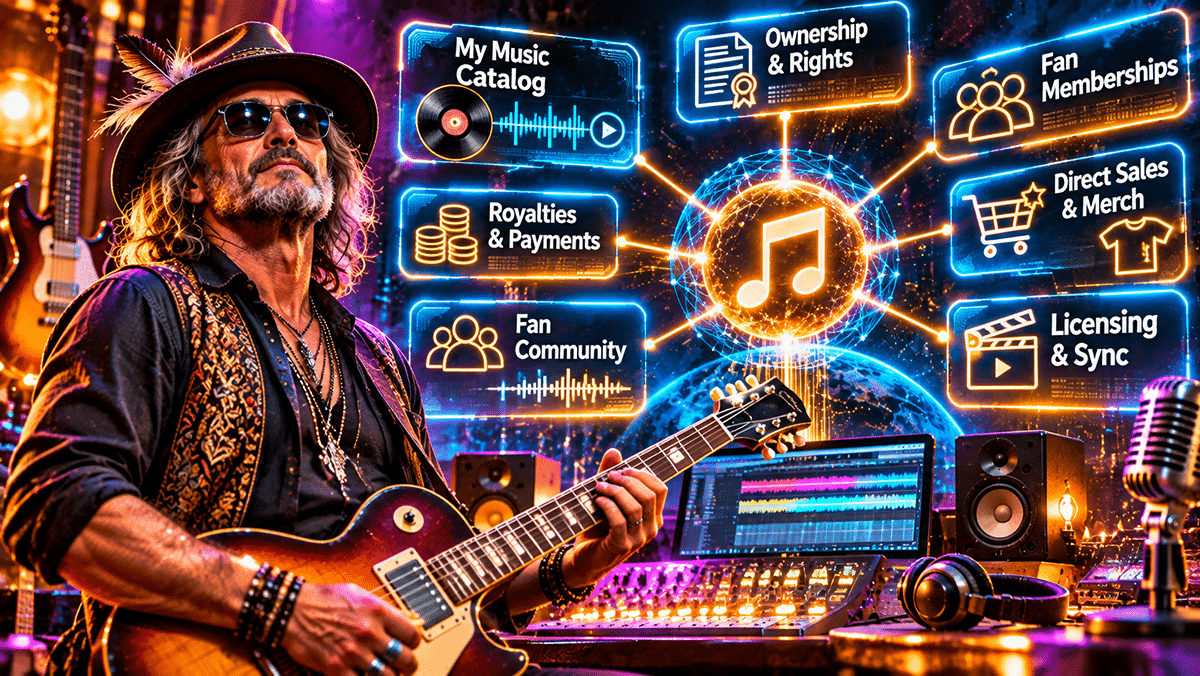
The Real Opportunity Is Not More Streams. It Is Stronger Relationships With Fans.
While much of the week’s news concerned major technology companies and music corporations, the most important long-term opportunity for independent musicians may be happening closer to home. The growing interest in direct-to-fan commerce reflects a recognition that listeners can provide far more value than a single stream or social media interaction. A fan who develops a meaningful connection with an artist may attend several shows, purchase merchandise, support a recording project, recommend the music to friends, or participate in a membership community over many years.
This is not a new discovery for working musicians. Local bands have always understood the importance of remembering familiar faces, building relationships with venues, and giving audiences reasons to return. What has changed is the availability of affordable technology that can help artists maintain those relationships beyond the performance itself. Email marketing, online stores, customer relationship management systems, digital memberships, and fan loyalty programs can now provide small music businesses with capabilities that once required much larger organizations.
The challenge is that many musicians still build their promotional strategies almost entirely around platforms they do not control. Social networks can be excellent discovery tools, and streaming services can introduce recordings to listeners around the world. But those platforms generally determine how artists reach their audiences and what information is available about individual fans. A musician might have thousands of followers without possessing a reliable way to contact those people directly when a new album is released or a tour date is announced.
The economics of that arrangement can become frustrating. An artist spends years creating content and attracting followers, only to discover that reaching those same followers may require additional advertising. The platform controls the audience data, sets the rules for visibility, and can change those rules without consulting the musician. Artists are encouraged to invest more time and money in building communities that remain largely inaccessible outside the platform’s own environment.
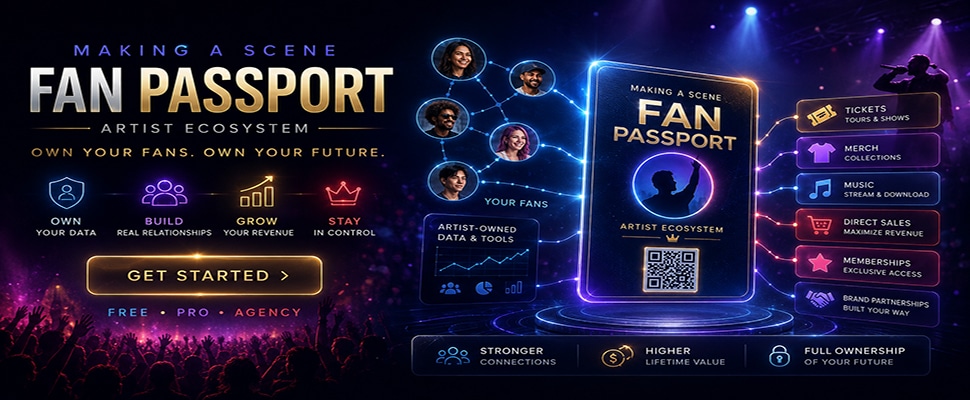
A stronger independent business model uses streaming and social media for discovery while encouraging interested listeners to develop a direct relationship with the artist. The musician’s own website can serve as the center of that relationship, supported by an email list, online store, fan program, and other tools appropriate to the audience. The purpose is not to force every casual listener into a marketing database. It is to provide people who genuinely care about the music with an easy, voluntary way to stay connected and support the artist.
Consider a regional band that performs regularly within a few hours of its home base. Instead of treating every concert as an isolated event, the band could invite interested audience members to join its mailing list, receive a free recording, or participate in a fan loyalty program. With appropriate consent, the band could maintain information about where supporters live and which shows they have attended. When another performance is booked in the same area, the musicians could contact people who have already expressed an interest in seeing them again.
That kind of relationship can improve the economics of regional touring. Rather than depending entirely on venue advertising or unpredictable social media visibility, the band develops its own audience information and can make better decisions about where to perform. Merchandise offers can be tailored to actual fan interests, and new releases can be promoted to people who have previously supported the artist. Over time, these relationships may reduce promotional waste and increase the likelihood of repeat purchases.
The key is to treat fan information as something entrusted to the artist rather than something to exploit without limits. Fans should understand what they are signing up for, receive communication that provides genuine value, and have a straightforward way to change their preferences or unsubscribe. Responsible data practices are not simply a legal obligation; they help maintain the trust that makes direct relationships commercially valuable.
For Making a Scene, this approach is central to the idea of building a sustainable music industry middle class. A musician does not need millions of anonymous listeners to develop a viable small business. A smaller community of committed supporters may provide a stronger foundation when those supporters regularly purchase tickets, merchandise, recordings, and other experiences. The exact size of that community and the income it can support will vary, but the underlying principle is that direct relationships create opportunities for repeat business that are difficult to develop through streaming alone.
Web3 May Still Have a Role, Provided Someone Remembers the Musicians
The conversation about artist ownership would be incomplete without examining Web3, although the technology has accumulated enough speculative baggage to make many working musicians understandably skeptical. Early promises about blockchain-based music businesses frequently emphasized tokens, collectibles, and dramatic predictions about the future of ownership. Some projects introduced useful ideas, while others offered complicated systems that seemed to generate more enthusiasm among investors than actual income for artists.
The underlying technology still has potential applications in music, particularly where portable digital credentials, verifiable transactions, and programmable agreements can solve genuine business problems. A fan membership might provide access to different experiences without depending entirely on one platform. Digital records might help document certain transactions or permissions, while automated payment systems could support clearly defined revenue-sharing arrangements. These possibilities deserve serious evaluation, although none should be confused with a guarantee of financial success.
There are also important limitations. Recording an ownership claim on a blockchain does not automatically establish legal copyright ownership, and an automated payment system is only as reliable as the rights information and contractual terms supplied to it. Disputes involving songwriting credits, publishing shares, and recording ownership cannot necessarily be resolved by technology alone. Musicians still need valid agreements, reliable documentation, and mechanisms for correcting mistakes.
For independent artists, the most promising Web3 applications are likely to be those that operate quietly in the background. A musician should not have to explain digital wallets, transaction fees, and blockchain architecture to every fan who wants to purchase a shirt or receive a backstage pass. If a technology makes an ordinary transaction more difficult, it needs to provide a meaningful benefit to justify that complexity. Fans are generally interested in supporting music and enjoying experiences, not completing a technical certification program before buying merchandise.
The same practical standard should apply to AI, Web3, and every other technology entering the music business. Artists should ask whether a product helps them earn more, spend less, manage rights, or build stronger relationships with supporters. They should also examine who controls the information, what happens if the service closes, and whether they can export their records and move to another provider. A system that claims to empower musicians while making their business dependent on a single company deserves careful scrutiny.
The long-term opportunity is to develop an artist-centered technology ecosystem in which independent musicians can use different services without surrendering ownership of their core assets. That could include portable catalog records, direct fan relationships, transparent licensing information, and commerce tools that allow artists to retain control over their businesses. Web3 may contribute to parts of that infrastructure, but its value will depend on solving problems musicians actually have rather than creating new ones for them to pay someone else to fix.
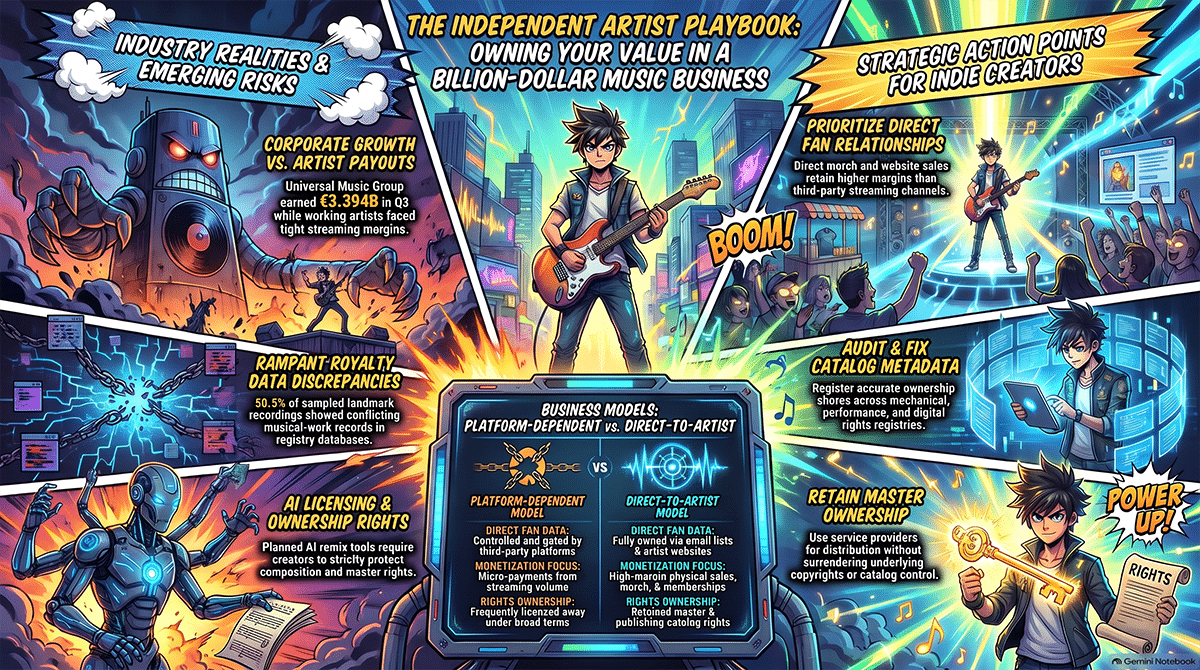
Building a Music Industry Middle Class Requires More Than Another Technology Revolution
Taken together, this week’s developments reveal an industry that is becoming more technologically sophisticated and financially ambitious. Streaming companies are exploring new subscription products, major music groups are expanding their service businesses, artificial intelligence developers are challenging established licensing practices, and recording software continues making professional production more accessible. These changes create opportunities, but they also reinforce the importance of understanding who controls the assets and relationships that generate revenue.
For independent musicians, the most valuable assets are often the ones they already possess but have not fully organized or developed. Original compositions can produce publishing income, recordings can support licensing and direct sales, and live performances can generate revenue while building lasting relationships with audiences. Accurate catalog information makes those assets easier to administer and license, while direct fan communication allows artists to promote their work without depending entirely on the changing priorities of outside platforms.
The challenge is turning those possibilities into a practical business. Musicians need affordable tools that help them manage registrations, track income, maintain fan relationships, and identify opportunities without requiring them to become full-time administrators. They also need reliable information about contracts, royalties, distribution services, and emerging technology so they can make decisions based on evidence rather than promotional promises. The music business has never suffered from a shortage of people willing to sell artists a dream, and the arrival of AI has certainly not reduced that particular industry’s enthusiasm.
A sustainable independent music career is rarely built around one spectacular breakthrough. More often, it develops through a combination of consistent creative work, sensible business decisions, repeat customers, and several connected sources of income. A musician might earn money from regional performances, merchandise, recording services, direct music sales, publishing royalties, and occasional licensing opportunities. None of those sources needs to produce enormous revenue individually for the combined business to become meaningful, although expenses and the time required to generate that income must always be considered.
Technology can make this model more efficient. AI may help artists organize their catalogs, prepare marketing material, analyze sales information, and reduce repetitive production work. Direct commerce systems can make it easier to sell products and manage customer relationships. Web3 technologies may eventually support portable membership credentials or certain forms of rights administration. The usefulness of each tool depends on whether it strengthens the artist’s business without creating unnecessary costs or surrendering control.
This is the fundamental difference between an industry built around extracting value from musicians and one designed to help musicians develop lasting businesses. In the first model, artists supply recordings, performances, and audiences while platforms compete to control distribution, information, and payments. In the second, musicians retain ownership of their creative assets and use outside services as tools that can be evaluated, replaced, or combined according to their needs. The second model does not eliminate record labels, distributors, publishers, or technology companies, but it changes the relationship between those businesses and the people whose work gives them something to sell.
The independent music community has an opportunity to build a broader professional middle class rather than accepting an economy divided between a relatively small number of major stars and a much larger population of musicians struggling to cover expenses. Achieving that goal will require better education, more transparent business practices, stronger ownership records, and technology that serves working artists instead of simply finding new ways to monetize their labor.
What This Really Tells Us About the Future of Independent Music
The most revealing part of this week’s music business news is not that Universal Music Group earned billions or that Spotify is exploring another paid feature. Those developments are important, but they are also consistent with an industry that has spent decades finding new ways to package, distribute, and monetize music. The more interesting question is whether the next generation of music technology will allow independent artists to participate more directly in the value they create.
Artificial intelligence could become a useful licensing market, a powerful production assistant, and an effective tool for identifying royalty problems. It could also concentrate more control in the hands of companies that own the platforms, manage the data, and negotiate the largest agreements. Streaming growth can expand the overall music economy, but it does not automatically provide a sustainable income for every artist contributing to that growth. Even improvements in recording technology need to be evaluated against the actual financial circumstances of musicians who have limited time and budgets.
Independent artists are not powerless in this environment, although meaningful independence requires more than uploading recordings without a record label. It involves maintaining control over masters and publishing where possible, understanding contracts, preserving accurate business information, and developing direct relationships with the people who support the music. It also means recognizing that the most valuable technology is often the technology that helps musicians manage their existing opportunities rather than constantly chasing the next new platform.
For Making a Scene, the objective remains the development of a music industry in which more artists can earn a reasonable living from their creative work. That does not require every musician to become famous or every recording to generate millions of streams. It requires practical business models that allow working artists to combine several sources of income, retain meaningful control over their assets, and develop audiences that support them over time.
The companies shaping the future of music are making decisions today that will influence how recordings are licensed, how royalties are distributed, and how audiences interact with artists for years to come. Independent musicians need to understand those decisions because they will be living with the consequences long after the announcements have disappeared from the headlines. The best response is neither blind enthusiasm for every new technology nor nostalgia for an industry that was never particularly generous to most working musicians.
The future of independent music will depend on whether artists can use the tools now becoming available to build businesses that are more resilient, transparent, and financially sustainable than the models they inherited. There is real opportunity in the changes taking place, but realizing it will require ownership, knowledge, cooperation, and a willingness to challenge business arrangements that no longer serve the people creating the music. That is the perspective Making a Scene will continue bringing to these weekly reports, because the health of the music industry should ultimately be measured not only by the revenue of its largest corporations, but also by the ability of working musicians to make a living doing what they love.
Making a Scene — Supporting the Independent Artist and Building a Music Industry Middle Class.
 |  Spotify |  Deezer |  Breaker |
 Pocket Cast |  Radio Public |  Stitcher |  TuneIn |
 IHeart Radio |  Mixcloud |  PlayerFM |  Amazon |
 Jiosaavn |  Gaana |  Vurbl |  Audius |
 Reason.Fm | |||
Find our Podcasts on these outlets
Subscribe to Our Newsletter
Discover more from Making A Scene!
Subscribe to get the latest posts sent to your email.


