

Your Music Catalog Is Becoming a Financial Asset





Making a Scene Presents – Your Music Catalog Is Becoming a Financial Asset. Here’s How to Use It Without Selling Your Masters.
Listen to the Podcast Discussion
The music business is discovering that a catalog can be more than a collection of recordings. It can become a source of funding, financial independence, and long-term opportunity. But as companies like Pipeline build a new market around music royalties, the question is whether working independent musicians will finally get access to the same financial tools available to larger music companies.
The independent music business has spent decades telling artists that their music has value, usually right before somebody else explains why they should own it. Record labels have offered recording budgets in exchange for master rights. Publishers have offered advances against songs. Investment companies have purchased catalogs from musicians who needed money today more than they needed royalty checks tomorrow. The deals have changed over the years, but the basic idea has remained stubbornly familiar. The people who control the money tend to end up controlling the music.
Now something interesting is happening. A growing part of the financial industry is beginning to recognize that music can generate income for years, sometimes decades, without the creator having to surrender ownership. Instead of treating an artist’s catalog as property that must be sold to unlock its value, some financing companies are treating future royalty income as something that can support an advance today. That might sound like a small adjustment to an old business model, but it raises a much larger possibility. Independent artists could eventually have access to growth capital without handing over the recordings that make their businesses valuable in the first place.
The arrival of Pipeline in January 2026 brought this conversation into sharper focus. The company launched with more than $200 million in capital raised and a plan to help independent music companies obtain financing based on the value of their intellectual property and royalty income. Its subsequent partnerships and acquisitions suggest that the real opportunity is not simply advancing money against songs. It is building a financial system that understands what music earns, who owns it, and how that income might develop over time.
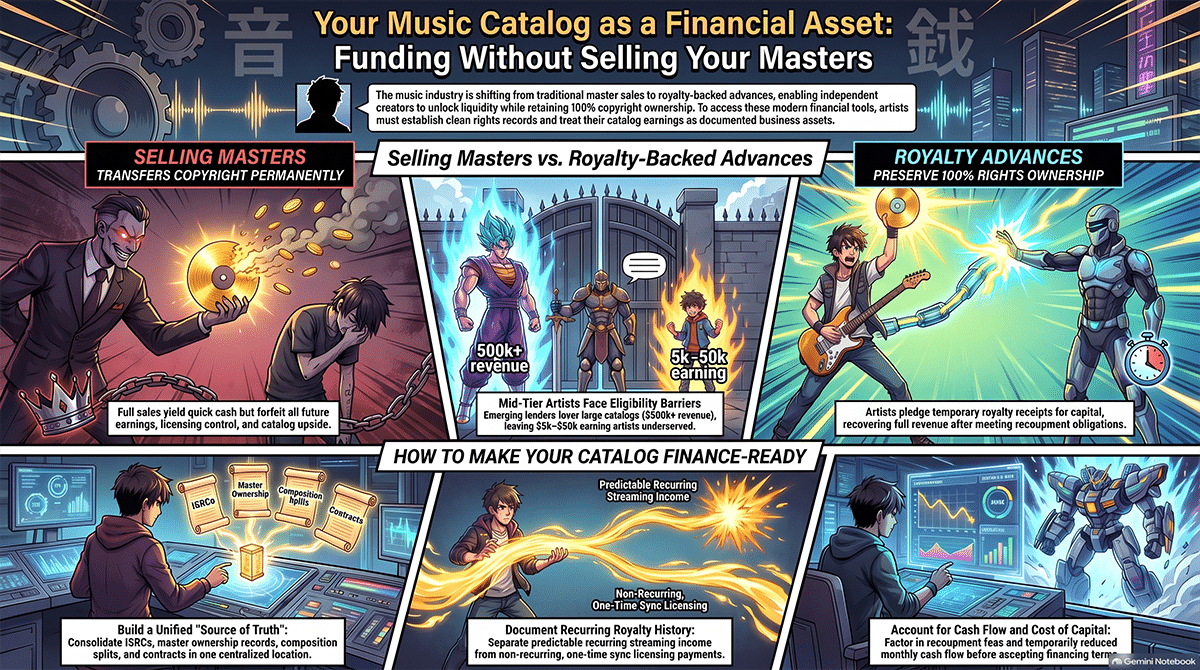
There is, however, a rather large catch. Pipeline’s currently published eligibility guidelines are aimed primarily at established music businesses, including labels with more than $500,000 in annual revenue and digital distributors with more than $1 million. That leaves an enormous number of working independent musicians standing outside the door. A songwriter earning $8,000 annually from recordings, or a touring band generating $35,000 across royalties, merchandise, live shows, and direct fan support, is operating in a very different financial world from a distributor processing millions of dollars.
That difference is exactly where the next music industry middle class could be built. The challenge is not simply convincing financiers that music has value. The major labels settled that argument a long time ago. The challenge is creating systems that recognize the value of smaller catalogs, understand the full economics of an independent artist’s career, and provide capital without allowing the financial companies to become another generation of gatekeepers.
Pipeline Is Building Something Bigger Than a Music Loan Company
To understand why Pipeline matters, it helps to look beyond the money and examine the machinery being assembled around it. A company that simply offers advances against future music royalties is not a new idea. Publishers, labels, distributors, and specialized financial businesses have been doing variations of that for years. What makes Pipeline interesting is the combination of financing, catalog valuation, royalty information, and partnerships with independent music infrastructure.
Pipeline was launched by investors associated with Jamen Capital, with Matt Spetzler serving as co-founder and executive chairman. Its January 20, 2026 announcement described a financing business intended to help independent rights holders unlock the economic value of their catalogs while continuing to own them. In practical terms, a qualifying company can receive capital based on its existing royalty income and then direct an agreed share of future royalty receipts toward recovering the advance.
Pipeline says its typical financing amounts range from approximately 20% to 100% of annual revenue, with target repayment periods generally running three to five years. Those figures are guidelines rather than guaranteed offers. A company earning $600,000 in qualifying annual royalties might be evaluated for a very different amount than another company reporting similar income from a catalog that is steadily declining. The stability of the recordings, the rights involved, the reliability of payment records, and the financing terms all matter.
What makes the arrangement especially interesting is Pipeline’s statement that its standard financing does not require the transfer of copyright ownership, liens, or control provisions. The company also offers arrangements where a qualifying business can be approved for more capital than it immediately needs and access additional funding later. That begins to resemble a working-capital facility rather than the familiar music industry situation where an artist receives a large check and discovers that nearly every future decision now requires somebody else’s permission.
The fine print still matters. Pipeline says repayment is linked to actual royalties, but its published terms also mention monthly minimums, administration charges, setup fees, and reservation fees for certain funding arrangements. That means a prospective customer needs to understand the full financial obligation, not merely the appealing promise of flexible repayment. A business whose royalties unexpectedly decline must know exactly what happens to the outstanding balance and any required minimum payments.
The company’s expansion provides clues about where the larger strategy is headed. In January, Pipeline announced a partnership with Merlin, the independent digital licensing organization, giving eligible Merlin member companies access to advances against digital royalties generated through Merlin’s licensing agreements. That relationship could reduce some of the administrative difficulty involved in verifying royalty income because the financial partner is working within an established royalty-reporting network.
In March, Pipeline acquired core assets and intellectual property from Clarty Partners, a music valuation business founded by former BMG executives. The acquisition brought specialized catalog valuation technology, royalty-data ingestion systems, and analytical infrastructure into Pipeline’s operation. Those might not be the most exciting words ever written about the music business, especially if your normal workday involves guitar amplifiers and questionable backstage coffee, but they describe something important. Pipeline was investing in the ability to understand music revenue, not merely distribute investment capital.
Curve’s new owners say the company will remain independent, with its existing leadership and client relationships intact. That distinction matters because royalty administration systems contain commercially sensitive information about artists, labels, and competing businesses. Independence cannot simply mean having a different logo on the office door. It also requires meaningful protections around confidentiality, data access, customer control, and how financial information may be used.
It would be inaccurate to describe Pipeline, Merlin, Clarty’s technology, and Curve as one fully integrated consumer financing platform. They are distinct businesses and relationships, and there is no public basis for assuming all their data systems are combined or freely shared. Nevertheless, the broader direction is clear. The businesses that can accurately understand music royalties are becoming essential parts of the financial infrastructure surrounding independent music.
For the working artist, that leads to an important realization. The next valuable company in the music industry might not be the one that discovers your next hit. It might be the one that knows, with considerable accuracy, what your last twenty songs are already earning.

Your Music Catalog Has Value Even When Nobody Is Trying to Buy It
Most independent musicians are accustomed to thinking about their catalog in creative terms. Their first album represents a particular period of their lives. Their latest single reflects their current sound. Older recordings might still bring people to shows, introduce listeners to the band, or generate small royalty payments that arrive with the exciting predictability of a restaurant server discovering another three dollars in a coat pocket.
Financial companies look at that same catalog differently. They see a collection of rights and potential revenue streams whose historical performance can sometimes help predict future income. A recording released five years ago that continues producing relatively stable royalties may be especially interesting because there is already evidence that people return to it. The business does not have to depend entirely on whether a future release becomes successful.
Consider an imaginary independent blues artist who owns the masters to six albums released over fifteen years. The artist might receive streaming income each month, occasionally license a recording for television, sell physical albums at shows, and collect digital performance royalties through SoundExchange. Perhaps the artist also owns the underlying songs and receives publishing income through other organizations.
Those recordings have value because they are connected to several distinct economic rights. The master recording is one asset, while the musical composition embodied in that recording is another. When the artist controls both, there may be additional flexibility, although ownership of one does not automatically establish ownership of the other.
The artist also owns something less obvious: a documented history of how the catalog performs. Every properly identified royalty payment adds information about the recordings’ economic behavior. Over time, that information can help show whether certain songs produce consistent income, whether listeners are discovering older material, and whether particular revenue sources are becoming more valuable.
A catalog generating $12,000 annually in reliable, properly documented royalties may be viewed differently from one earning the same amount through a single unpredictable licensing payment. Both represent real income, but a financing company trying to recover an advance over several years would usually prefer greater predictability. That does not mean the second artist has less talent or that the music is less important. It simply means a forecast based on recurring income is easier to construct than one based on deals that may never happen again.
This is where the idea of music as an asset becomes useful. An artist does not have to sell the asset merely because someone is willing to value it. A homeowner can have equity in a house without selling the house. A small business may obtain financing based on receivables without selling the company. Music royalty financing aims to create a similar set of options, although its legal structures and risks can be very different.
The objective is not to turn every songwriter into a financial speculator. Most musicians already have enough trouble deciding whether a new compressor will improve their recordings or simply make the snare drum louder. The objective is to recognize that recordings generating reliable income can sometimes support business decisions that were previously out of reach.
An artist might want to finance a new recording, expand a regional tour, manufacture vinyl before a major show, or hire a publicist for a carefully planned release. Those investments require money before they can produce returns. A properly structured advance against existing royalties could provide that money while preserving the artist’s ownership of the catalog.
But the usefulness of the arrangement depends entirely on the terms and whether the investment is likely to generate enough additional income to justify the cost.
An Advance Is Not the Same Thing as Selling Your Masters
This distinction is one of the most important financial lessons an independent musician can learn, because music industry agreements are remarkably skilled at making several very different transactions sound almost identical.
When an artist sells a master recording copyright, the buyer receives whatever ownership interest the contract transfers. A complete, permanent sale generally means the buyer becomes the owner of the transferred rights, subject to any applicable legal limitations and contractual exceptions. The artist may still receive income if the agreement provides for it, but future ownership, licensing decisions, and economic benefits can shift to the buyer.
For example, imagine an artist owns a catalog that generates $10,000 annually in master-recording royalties. A buyer offers $50,000 for permanent ownership of those masters. If the artist accepts a full sale without retaining royalty interests, the artist receives the purchase price while giving up the future income associated with the rights being transferred.
That may be a reasonable transaction under some circumstances. Artists nearing retirement, estates seeking liquidity, or businesses restructuring their assets can have legitimate reasons to sell music copyrights. Ownership is valuable, but it is not a sacred obligation requiring every creator to keep every recording forever.
The important issue is choice. Once a permanent sale is completed, the artist generally cannot assume that those rights will return after the buyer recovers the purchase price. The buyer may earn much more than expected, much less than expected, or potentially nothing. That future economic outcome ordinarily belongs to whoever owns the rights.
A royalty advance can be different. Instead of permanently transferring the master, the artist agrees that a defined portion of revenue will be directed toward the financing arrangement. Depending on the contract, this could involve a time-limited purchase of royalty income, an advance subject to recoupment, or a loan secured by royalty receivables.
Consider a hypothetical arrangement where an artist receives $15,000 today and agrees to direct 50% of qualifying master royalties toward satisfying a negotiated recoupment obligation. If the agreement requires $19,000 in total recoveries, that additional $4,000 represents part of the economic cost of obtaining the money early. The actual structure might also involve fees, a fixed term, or rules concerning what happens if the royalties underperform.
The crucial difference is that the artist might continue owning the masters throughout the arrangement. Once the contractual obligations have been satisfied and any required term has ended, the artist could regain the full benefit of the affected royalty stream, provided the agreement actually requires that result.
It is tempting to describe this as borrowing against the catalog, and that phrase may be useful conversationally, but it is not always legally accurate. Some companies specifically structure transactions as purchases of future revenue rather than loans. Others may use debt arrangements, security interests, or different financial structures depending on the borrower and jurisdiction.
The distinction affects tax treatment, creditor rights, bankruptcy exposure, repayment obligations, and the remedies available if something goes wrong. An artist should never assume that a company advertising a copyright-friendly advance is offering an ordinary unsecured loan.
Equally important, retaining ownership does not necessarily mean retaining unrestricted control over every aspect of the income. A deal might require the artist to keep recordings with an approved distributor, direct particular royalties through a specified payment system, or obtain consent before entering another agreement involving the same income stream. A term might last longer than anticipated if the advance remains unrecouped.
A musician considering an advance needs an attorney familiar with music rights and financing to explain the actual contract, while an accountant can help determine the financial and tax consequences. Paying professionals to examine the arrangement may seem expensive, but it is usually less expensive than discovering three years later that the agreement prevents a major licensing opportunity or redirects more income than the artist expected.
The key principle is to distinguish ownership of the music from temporary control over income generated by that music. Keeping the master copyright is important, but the actual financing agreement determines how much financial freedom remains.
The Real Cost of an Advance Is Bigger Than the Fee
Suppose an independent artist earns $12,000 a year from qualifying recording royalties and wants $10,000 to finance a new album campaign. The money would pay for recording costs, manufacturing, promotional materials, and a series of regional performances. Without financing, the artist expects to save for another year before launching the project.
Imagine a financing company offers $10,000 today in exchange for receiving $13,000 from future qualifying royalties. If the artist continues earning $1,000 per month and half of that income goes toward recoupment, the artist would redirect approximately $500 monthly. At that rate, satisfying the $13,000 obligation would take 26 months.
That sounds manageable until we consider the artist’s actual cash flow. During those 26 months, money that would otherwise have supported household expenses, recording costs, or touring operations is partly committed elsewhere. The advance has accelerated access to money, but it has not created free income.
If the new album campaign generates strong additional sales, more performance bookings, and new fans who continue supporting the artist, the financing might prove worthwhile. The artist could end up with a stronger catalog, a larger audience, and a sustainable increase in business revenue.
But imagine the opposite outcome. The campaign receives respectable reviews and some attention but fails to produce meaningful growth. Existing royalty income might decline while the artist still has expenses to cover. Depending on the agreement, the company may continue collecting for longer than anticipated. A payment minimum or other contractual requirement could make the situation more difficult.
That is why artists need to compare the total cost of funding with the likely business return. A recording project may be artistically essential without being financially capable of supporting an expensive advance. There is nothing wrong with making art for reasons beyond money, but financing that art creates obligations that creative enthusiasm alone cannot satisfy.
Financing also has an opportunity cost. The royalty income redirected toward recoupment cannot simultaneously fund another release, cover an emergency expense, or support the artist during a slow touring season. An advance may produce more flexibility today while reducing flexibility tomorrow.
This is particularly important for musicians whose income moves unevenly throughout the year. A blues band might earn a significant portion of its annual money during festival season and experience a much quieter winter. A songwriter might receive royalty payments months after the activity that produced them. A touring musician may have substantial gross sales but relatively little cash remaining after transportation, accommodation, musicians’ payments, and other expenses.
A responsible financing decision must account for that reality rather than treating every dollar entering the bank account as available profit.
Why the Financial Industry Suddenly Cares So Much About Your Data
The expansion of royalty-backed financing is closely connected to a much larger development in the music business. Accurate information about ownership and income is becoming a financial asset in its own right.
Historically, the music business has operated with a remarkably complicated collection of ownership records, licensing agreements, royalty reports, and payment systems. The same recording can generate income through multiple organizations, while the song underneath it may involve several writers and publishers. A recording might have one distributor in the United States, another arrangement in a foreign territory, and separate agreements governing particular licensing uses.
Even when everyone behaves responsibly, the paperwork can become complicated. When artists have changed distributors, released music under different names, collaborated without clear split agreements, or lost access to old accounts, reconstructing the full economic history of a catalog can become an expensive investigation.
A financial company cannot confidently advance money against royalty income it cannot verify. Before making an offer, it needs evidence that the applicant has the legal right to collect the income, that the payments are real, and that the revenue is reasonably likely to continue.
This is why acquisitions involving royalty accounting and catalog valuation technology deserve attention. A lender or advance provider that can process years of royalty statements, identify relationships between recordings and rights holders, and forecast possible future earnings can potentially evaluate transactions more efficiently than an organization relying entirely on manual review.
Artificial intelligence and machine learning can contribute to this process by identifying unusual revenue patterns, matching information across statements, forecasting income scenarios, and flagging inconsistencies that require further investigation. These tools can reduce some administrative costs, although the quality of their conclusions still depends on the quality of the information provided.
An algorithm does not magically repair an incorrect ownership agreement. It cannot establish that a musician owns a master merely because the song appears in a distribution dashboard. It also cannot reliably predict the next unexpected cultural moment that sends a forgotten recording into a television series or viral social media trend.
What intelligent systems can do is make large amounts of complicated information more useful. That ability becomes increasingly valuable when a business wants to finance thousands of catalogs rather than negotiate every arrangement through a traditional team of lawyers, accountants, and royalty specialists.
The problem is that data can also become another source of power concentrated away from artists. A company that controls royalty information, calculates catalog valuations, and determines financing eligibility may eventually influence what funding opportunities are available and which artists can access them.
If artists cannot inspect the information being used to evaluate their own work, challenge errors, or move their data between services, the financial system risks recreating the same dependence it claims to eliminate. The gatekeeper would no longer necessarily own the masters. It might simply own the financial dashboard that decides whether the masters are worth financing.
That would be a rather disappointing way to reinvent the music industry.

The $5,000–$50,000 Musician Is Still Being Left Behind
One of the uncomfortable realities of the new music-financing economy is that the artists most likely to benefit from relatively small amounts of capital are often the least attractive customers for the companies providing it.
Imagine a musician earning $7,500 annually from a combination of streaming royalties, digital downloads, and publishing income. Another musician receives $22,000 from recordings and songwriting while supplementing that income with live performances and teaching. A more established independent band might generate $48,000 annually from its combined music activities but reinvest a significant portion in touring and recording.
All three are operating legitimate music businesses. None necessarily has the financial profile of an artist on the verge of mainstream success, but each could use capital to make practical improvements that increase future income.
A few thousand dollars might allow the first musician to finish a recording without relying on high-interest credit cards. The second artist might use financing to produce physical merchandise and build a regional performance schedule. The band could invest in equipment, transportation, and a direct-to-fan marketing campaign that improves profitability over several years.
Yet those opportunities may be invisible to an underwriting system focused primarily on streaming royalties. A musician earning $30,000 annually from live performances, merchandise, and direct audience support might generate only $3,000 in streaming royalties. If the financier evaluates only the $3,000 stream, much of the business’s economic strength is left out of the calculation.
Other companies are already attempting to serve smaller rights holders. beatBread, for example, publicly advertises financing amounts beginning at $1,000 and extending into the millions. Its arrangements generally allow artists to retain copyright ownership while temporarily sharing specified income. The company also makes clear that eligibility depends on reliable royalty and audience data, and that not every musician will qualify.
beatBread’s published guidance describes artists with roughly 10,000 or more monthly listeners as more likely candidates, while acknowledging that its actual assessment involves many factors. That is a different entry point from Pipeline’s larger-business criteria, but it still leaves many independent artists outside the financing market. Someone with a small but intensely loyal audience can operate a successful niche music business without generating the listening volume required to interest a streaming-focused financier.
But understandable economics do not make the problem disappear.
The independent music community needs financing models built around the actual structure of smaller creative businesses. These models cannot simply take a product designed for a label earning millions and reduce the advance amount. They must account for the different ways working musicians produce revenue, the irregular timing of that revenue, and the fact that small amounts of funding can have a disproportionately large effect on a developing career.
That means the next stage of innovation must focus on reducing administrative costs without weakening consumer protections. It also means evaluating real business income instead of treating streaming activity as the only meaningful evidence of an artist’s economic value.
What Financing Designed for Working Musicians Could Look Like
Consider a hypothetical independent artist who earns $24,000 annually from music. Perhaps $6,000 comes from streaming and other recorded-music royalties, $10,000 from performances, $5,000 from merchandise and direct sales, and $3,000 from memberships and fan support. These numbers are illustrative, not reported industry averages.
A financing company examining only digital recording royalties sees a business generating $6,000 annually. A more complete financial system sees an artist with several sources of income, established relationships with paying customers, and opportunities to increase revenue through carefully chosen investments.
Those distinctions matter because a musician whose revenue comes from diverse sources may be less dependent on the performance of any one platform. An artist whose Spotify audience declines slightly might still maintain reliable ticket sales and merchandise income. Another artist might have modest streaming numbers but an exceptionally strong local following that supports profitable performances throughout the year.
A financing system that could securely verify these different revenue streams might eventually offer funding based on more complete business performance. The underwriting would need to distinguish gross sales from money the artist actually keeps, because a $2,000 concert payment is not equivalent to $2,000 in profit when the artist has $1,500 in associated expenses.
It would also need to respect the contractual differences between revenue sources. Future performance income is not the same legal asset as an existing royalty receivable, and a platform may not allow unrestricted assignment of its payment obligations. Treating every form of income as interchangeable collateral would create problems rather than solve them.
The next important improvement would be financial transparency. Instead of receiving a mysterious offer generated by an undisclosed algorithm, artists should be able to understand which income sources were considered, what assumptions were used, and how the terms change under different revenue scenarios.
An artist might receive an offer for $4,000 tied to a defined portion of catalog royalties, alongside an explanation showing the anticipated cost, likely recoupment period, and consequences of lower-than-expected earnings. The system could also show how a smaller advance might preserve more future income or how accepting a longer arrangement changes the economics.
Technology could make those comparisons affordable to deliver. Artificial intelligence could assist with interpreting royalty statements, reconciling catalog records, forecasting revenue, and preparing understandable financial reports. But an artist should still have access to human support when an algorithm makes a mistake or a contract provision is unclear.
Another possibility is financing through a trusted intermediary that already serves independent musicians. A distributor, royalty administrator, cooperative, or artist-owned business network could potentially help verify income and connect qualifying artists with multiple independent financing providers.
The strongest version of that arrangement would preserve competition. Artists would be free to compare offers, reject them, use different service providers, and move their information without losing their financial history.
There is also an important role for community lenders, credit unions, and small-business financing organizations. Not every artist needs a specialized music royalty advance. A musician with reliable business income might qualify for conventional financing, a small-business credit product, or other funding that makes more sense than surrendering future catalog royalties.
The opportunity is to make music-specific financing one option among several, not the only door available to artists who need money.
Your Catalog Needs a Source of Truth Before It Needs a Valuation
For independent musicians, perhaps the most practical lesson from Pipeline’s expansion has nothing to do with applying for financing. It is the importance of maintaining accurate information about every recording and every associated right.
Most artists can locate the audio files for their latest album. Far fewer can immediately produce a complete, verified record showing the master owner, composition writers, publishing shares, identifiers, distribution arrangements, licensing restrictions, royalty statements, and historical earnings for every song they have released.
This information should not be scattered across old email conversations, forgotten spreadsheets, distribution accounts, and files named something memorable like FINAL_MASTER_REAL_FINAL_3.wav.
A proper source of truth connects the creative asset to its legal identity and business performance. For a recorded song, this means identifying the master recording separately from the underlying composition, documenting the relevant ownership and royalty splits, and retaining copies of the agreements establishing those rights.
It also means maintaining accurate recording identifiers such as International Standard Recording Codes, commonly called ISRCs. Each distinct sound recording should have an appropriate identifier, and the artist should maintain the associated information. Musical compositions have their own identifiers and registrations, which help royalty organizations distinguish one work from another.
The U.S. ISRC Agency explains that an ISRC identifies a recording but does not, by itself, establish copyright ownership or registration. That is an important distinction. A code helps financial and music-business systems recognize the correct recording, but the contracts and underlying rights records determine who owns it.
Registering recordings and compositions correctly can make a real financial difference. SoundExchange provides tools for artists and rights holders to search for recordings, submit information, and review payments. The MLC offers resources for matching musical works to recordings that have generated relevant digital usage. These services do not replace one another because they are associated with different rights and royalty streams.
Over time, this creates a business history that can support far more than financing. A producer evaluating a licensing opportunity can identify the appropriate rights owners. A manager can prepare a realistic campaign budget. An accountant can track income accurately. A potential collaborator can understand existing obligations before entering an agreement.
That is why the source-of-truth concept is so important. It allows an artist to work with outside companies without surrendering control of the information that defines the artist’s business.
Why AI Could Make Small Catalogs Financially Visible
One reason small independent catalogs have historically been difficult to finance is the expense of understanding them. When a business has only modest annual royalties, a lengthy manual valuation process can consume a meaningful portion of the proposed funding.
Artificial intelligence offers a potential way to reduce that cost, provided it is used carefully.
Imagine an artist who has released four albums through three different distributors over a period of ten years. Royalty reports may arrive in different formats, contain different payment categories, and describe the same recordings using slightly different naming conventions.
A properly designed AI-assisted system could help import those reports, associate transactions with the correct recordings, identify missing information, and prepare a consistent financial history. The process could flag a song title that appears under two different spellings or alert the artist when a royalty statement contains a recording not found in the master catalog.
The artist would still need to verify the information, but much of the repetitive reconciliation work could become easier. Once the data is reliable, forecasting tools could help estimate possible future royalties using historical patterns and different assumptions about audience growth or decline.
That does not mean AI can determine the true future value of a catalog with certainty. Music revenue can change suddenly because of unexpected licensing opportunities, platform policy changes, viral attention, audience behavior, or economic conditions. An artist should regard algorithmic valuations as estimates built on assumptions, not as guaranteed market prices.
But even an imperfect financial model can be useful when its limitations are clearly explained. A system that accurately organizes income and shows how different scenarios might affect cash flow could help artists make better decisions about touring, advertising, recording budgets, and release schedules.
This is also where Web3 technologies could have a practical role, although the industry should resist the temptation to attach blockchain terminology to every administrative problem and call it innovation.
A secure, verifiable record of agreements and royalty transactions could help establish provenance and preserve an audit trail. Smart contracts might eventually automate parts of authorized payment distribution when all parties agree on the relevant rights and terms. Portable digital credentials could potentially help an artist prove that particular business records have been verified without exposing every confidential detail.
However, putting a song’s information on a blockchain does not establish that the person entering it actually owns the copyright. It does not repair disputed splits, compel music services to recognize a claim, or eliminate the need for contracts and legal enforcement. A useful system must rely on credible identity verification, authorized data sources, privacy protections, and processes for correcting mistakes.
The real promise of these technologies is administrative efficiency and portability. If an artist can maintain a trusted history of ownership and earnings that travels between services, changing distributors or financial partners becomes less disruptive.
That gives the artist something the old music industry has rarely been eager to provide: the ability to leave a business relationship without leaving the business itself behind.
The Missing Financial Asset Is the Fan Relationship
One of the biggest weaknesses in traditional music catalog valuation is that it tends to emphasize the income generated by recordings while paying less attention to the business relationships those recordings create.
A catalog is often valued using its historical earnings, future royalty expectations, and applicable market conditions. Those measurements are important, but they do not necessarily capture the complete economic reality of a working independent musician.
Imagine two artists with similar annual streaming royalties. One has most of their listeners concentrated on playlists controlled by outside platforms. The other has an established email list, a community of recurring ticket buyers, a direct merchandise business, and fans who purchase new recordings whenever they are released.
The streaming income might look similar, but these businesses do not have identical financial strengths. The second artist has a more direct way to reach paying customers, test new offers, and develop income without depending entirely on a streaming platform’s recommendations.
A financial company that considers only royalty statements might miss that distinction. It could underestimate the stability of the artist with an engaged direct audience while overestimating the security of another artist whose listening activity depends heavily on a temporary algorithmic advantage.
This is where an artist-controlled fan relationship system becomes an important part of the business. When musicians maintain permission-based records of attendance, purchases, memberships, direct support, and other interactions, they gain a clearer understanding of how their audience contributes to long-term revenue.
An artist who knows that a group of fans consistently attends regional shows can plan future performances more intelligently. An artist who knows which recordings lead to merchandise purchases can design better product offers. A musician who recognizes recurring supporters can develop memberships and special experiences that reward loyalty rather than constantly chasing strangers through social media advertising.
These records also help distinguish attention from economic activity. A hundred thousand passive video views may be useful for discovery, but they do not automatically mean the artist has a sustainable business. A smaller group of people who regularly purchase music, attend shows, and support future releases may be more valuable over time.
The goal should not be to turn every fan into another line on a financial spreadsheet. Musicians build careers through human relationships, and excessive tracking can quickly damage trust. Data collection needs to be transparent, permission-based, secure, and limited to legitimate business purposes.
It is also essential to separate useful internal business information from data that a financing company is legally and ethically permitted to use. An artist should not casually hand over personally identifiable fan records to obtain a loan or advance. Aggregate revenue and retention information may be sufficient for many forms of analysis, while detailed fan identities should remain protected.
Still, the larger principle is powerful. An artist who owns the music and maintains direct relationships with the people who support it has more ways to generate future revenue than an artist who controls neither.
That can strengthen the business even before any lender recognizes the value.
What This Means for the Making a Scene Artist Ecosystem
The developments surrounding Pipeline point toward an important opportunity for the Making a Scene Artist Ecosystem, particularly its Artist Source of Truth and Fan Passport systems.
The Artist Ecosystem is intended to help independent musicians operate their careers as businesses while maintaining control of the underlying information, rights, and customer relationships. That is directly relevant to a financial market increasingly built around verifiable ownership records and royalty histories.
The immediate opportunity is not to turn the Artist Ecosystem into a lender. Running a financial institution would introduce regulatory responsibilities, capital requirements, and risks far removed from the system’s primary mission. Instead, the Artist Ecosystem could help musicians become financially organized enough to evaluate financing offers when appropriate opportunities emerge.
A properly maintained Artist Source of Truth can connect recordings with their master ownership records, songwriting shares, publishing information, identifiers, distribution arrangements, and contractual restrictions. Over time, imported royalty statements could be reconciled against those records to give artists a more reliable view of their recorded-music income.
The system could then help artists prepare a financial profile containing the information a legitimate financing provider might request. Rather than uploading an unorganized collection of statements and contracts, the artist could generate a structured report showing verified income histories, associated rights, and outstanding obligations.
Such a report would not constitute a professional catalog appraisal or guarantee funding approval. It could, however, reduce the preparation burden that prevents smaller artists from approaching financial providers in the first place.
The Fan Passport system adds another dimension by helping artists document permission-based relationships with their audiences. Live show attendance, merchandise purchases, memberships, direct support, and other transactions can reveal patterns that traditional royalty statements overlook.
The information should remain under the artist’s control, with clearly defined permissions governing any external sharing. A future financing workflow might use aggregated business metrics to support an application without exposing individual fans’ personal information.
AI could also help artists evaluate the potential consequences of financing. Imagine a musician preparing to release a new album and considering a $6,000 advance. The system could compare anticipated royalty diversions with the artist’s existing operating expenses, projected recording costs, and realistic release revenue scenarios.
It could also help the musician understand the difference between funding a project through an advance, direct fan preorders, a membership campaign, or accumulated business savings.
This is particularly important because outside funding is not always the best answer. An artist with a loyal fan community may be able to finance a recording through preorders without sacrificing future royalty income. Another might discover that a smaller recording budget would produce nearly the same business results while preserving more financial flexibility.
In the longer term, the Artist Ecosystem could support a permission-based marketplace where appropriately licensed financing providers present comparable offers to eligible musicians. Any such feature would require careful attention to financial regulations, disclosures, data privacy, and conflicts of interest. It should not suggest that all financing products are comparable or that an attractive projected return makes borrowing safe.
The strongest business model would allow artists to bring their own verified data, compare independent options, and take that data with them if they leave the platform.
That would align financial technology with the mission of building a sustainable music industry middle class. Rather than collecting ownership rights from musicians, the system would help musicians understand and protect the value they already possess.
The Artist’s Practical Roadmap: Make Your Catalog Finance-Ready Before You Need Money
For artists who want to prepare for this changing financial environment, the best place to begin is not with a financing application. It is with a serious examination of what they own, what they earn, and what obligations are already attached to their work.
Start with the recordings themselves. Every released track should be associated with an accurate master ownership record, its ISRC, its release information, and any agreements that affect how it can be distributed or licensed. If another musician, producer, label, or investor has an ownership interest, that arrangement should be documented rather than left to somebody’s memory of a conversation after a recording session.
The same care should be applied to the compositions. Writers’ shares and publishing relationships need to be clear, particularly when several people contributed to a song. Registration information should be reviewed for accuracy, and conflicting claims should be resolved before they interfere with royalty collection or future licensing.
Once the rights information is organized, collect the financial history. Distribution statements, publishing reports, SoundExchange records, licensing payments, and other relevant income documents can help establish what the catalog has earned over time. Ideally, the artist should retain the underlying statements rather than relying entirely on summary numbers shown in a distributor’s dashboard.
A useful financial history distinguishes recurring royalties from unusual payments. If a song earned $5,000 because it appeared in a television production, that money belongs in the records, but it should not automatically be treated as $5,000 in annual income that will recur indefinitely.
The artist should also examine existing contractual obligations. A recording may already be subject to an advance, revenue-sharing agreement, distribution commitment, or another arrangement limiting how future royalties can be assigned. Those obligations need to be understood before approaching a new funding provider.
With that information assembled, the next stage is deciding what financing would actually accomplish. A musician who wants $8,000 to produce merchandise for a profitable tour has a different financial problem from an artist who needs $8,000 to cover personal living expenses during a slow period.
Both needs are real, but the repayment strategy may be very different. Financing a business activity with a reasonable expectation of producing additional revenue can sometimes be justified. Financing recurring losses without a credible plan to improve cash flow can create a cycle where tomorrow’s royalties are repeatedly spent to cover yesterday’s expenses.
Before accepting an offer, the artist should ask what money will be available after the financing company’s share has been deducted. If the remaining royalties are insufficient to support ongoing business obligations, the advance may weaken the operation even when it provides temporary relief.
The agreement should also be reviewed for any requirements involving copyright ownership, distributor relationships, additional financing, licensing rights, personal guarantees, minimum payments, buyout provisions, and what happens when the expected repayment period ends. The artist should understand whether unrecouped amounts remain collectible, whether the company can extend its revenue participation, and whether any obligations survive termination.
Finally, the artist should compare the financing proposal with alternatives. Direct fan sales, crowdfunding, merchandise preorders, business savings, traditional small-business financing, and negotiated distribution advances can all be appropriate under different circumstances.
The musician who enters this process with clean rights records, reliable income statements, and a clear business plan has a stronger basis for evaluating any offer. Even if no financing arrangement makes sense today, the work of organizing the catalog can improve royalty collection, licensing readiness, and future business decisions.
The Next Music Industry Middle Class Needs Financial Freedom, Not Another Owner
The expansion of Pipeline and other music-financing businesses reflects a meaningful change in how the industry views independent catalogs. Music is increasingly being treated as an economic asset capable of supporting capital investment without necessarily requiring a permanent transfer of copyright ownership.
That development deserves attention because independent musicians have historically faced a difficult choice when they needed money. They could try to finance their work from current income, accept unfavorable borrowing costs, or enter agreements that limited their control over future recordings and royalties.
Royalty-backed financing introduces another possibility, but it does not eliminate the need for caution. An advance can be useful, expensive, restrictive, or all three at the same time. The fact that an agreement preserves master ownership does not automatically make it artist-friendly.
The biggest unresolved question is whether these financial products can become genuinely accessible to musicians earning $5,000 to $50,000 annually without imposing costs that make small transactions impractical.
For that to happen, the industry will need better data portability, more affordable royalty verification, transparent underwriting, and financial products that recognize the diverse income of working artists. Technology can help reduce administrative expenses, but fair contracts, meaningful competition, and independent oversight will still be essential.
There is a broader economic opportunity here as well. Independent musicians who retain their copyrights can continue earning from recordings long after the original release campaign has ended. They can license those recordings, create new products, develop relationships with fans, and use reliable earnings histories to make better business decisions.
As their catalogs grow, the artist’s financial options may grow with them. A song recorded ten years earlier might help fund a new project. A well-maintained royalty history might support a financing application. A loyal fan community might make outside financing unnecessary by providing enough direct revenue to fund the next release.
These possibilities become much more valuable when the artist controls the underlying rights and information. Without that control, every new business opportunity risks becoming another negotiation over access to assets that the musician created in the first place.
The music industry has spent generations building financial value around artists’ creativity, often while keeping the artists themselves at a distance from the systems that manage it. Now that royalty information, rights management, and financial technology are becoming more closely connected, independent musicians have an opportunity to participate on different terms.
There is no guarantee the emerging financial industry will deliver those terms voluntarily. Investors will continue pursuing returns, financing providers will protect their own interests, and large rights holders will maintain advantages that smaller musicians cannot easily match. Building a genuine music industry middle class will require technology, education, cooperative infrastructure, and financial products designed around the economic realities of independent careers.
But the foundation is becoming clearer. A musician’s catalog is not merely yesterday’s recordings. It is a collection of rights, an income-producing business asset, and a history of creative work that may continue generating value for many years. Accurate ownership records, dependable royalty information, and direct fan relationships make that asset easier to manage and potentially more useful in future financial decisions.
The next generation of independent musicians should not have to choose between getting the money they need and keeping the music they created. If the financial industry can learn to recognize the value of smaller catalogs without demanding permanent ownership, it could help build a healthier and more independent music economy.
And if the industry cannot figure that out, perhaps the musicians who already understand the importance of owning their rights, their data, and their relationships will have to build the missing financial infrastructure themselves. Considering how much of the modern independent music business already exists because artists got tired of waiting for permission, that would hardly be a surprising development.
 |  Spotify |  Deezer |  Breaker |
 Pocket Cast |  Radio Public |  Stitcher |  TuneIn |
 IHeart Radio |  Mixcloud |  PlayerFM |  Amazon |
 Jiosaavn |  Gaana |  Vurbl |  Audius |
 Reason.Fm | |||
Find our Podcasts on these outlets

Subscribe to Our Newsletter
Discover more from Making A Scene!
Subscribe to get the latest posts sent to your email.


