
The Music Industry Has Discovered Another Gold Mine. Somebody Should Tell the Musicians.





Making a Scene Presents – The Music Industry Has Discovered Another Gold Mine. Somebody Should Tell the Musicians.
Listen to the Podcast Discussion
Making a Scene Music Business Weekly Wrapup
There is something almost comforting about the music industry’s ability to announce a revolution every few weeks. Somewhere in a corporate boardroom, executives are celebrating another record-breaking quarter, technology companies are explaining how artificial intelligence will change music forever, and streaming services are working on exciting new ways to charge people for listening to songs. Meanwhile, an independent musician is loading a guitar amplifier into a twelve-year-old van, wondering whether the promoter remembered to include parking in the contract. The technology changes, the business models evolve, and the press releases become increasingly enthusiastic, but the economic realities facing working musicians remain stubbornly familiar.
The week ending November 8, 2026, provided another fascinating look at an industry that is becoming wealthier, more technologically sophisticated, and considerably more complicated. A new international royalty report revealed billions of dollars flowing through the global creative economy, although the headline numbers came with an accounting adjustment that deserves closer examination. Splice introduced an AI-powered recording environment designed to help musicians create music with less technical frustration, while developments in live entertainment demonstrated that creative partnerships and community venues still matter in an increasingly digital world. Behind those stories, the growing business of AI music licensing continued raising questions about copyright, compensation, and who gets to control the recordings and compositions that make these new technologies possible.
For independent musicians, the challenge is separating genuine opportunities from the industry’s seemingly endless supply of shiny objects. A new recording tool might reduce production expenses, while a licensing agreement could create additional income from an existing catalog. Better royalty information might reveal money that has been overlooked, and a stronger relationship with fans could help sell more tickets without paying a social media platform to reach the same people repeatedly. The trick is understanding which developments actually improve the artist’s business and which ones simply introduce another monthly subscription that promises to change everything except the musician’s bank balance.
At Making a Scene, we believe the future of independent music depends on building a sustainable music industry middle class. That means helping working musicians develop businesses around assets they own, including their master recordings, compositions, professional skills, and relationships with audiences. It also means questioning an industry that has spent decades treating artists as suppliers of content while everyone else develops increasingly sophisticated ways to monetize it. The following stories offer a useful look at where that business is heading and what independent musicians can do to make sure they are more than passengers on the next technological roller coaster.
Global Music Royalties Hit Record Levels, but There’s an Accounting Trick Behind the Headline
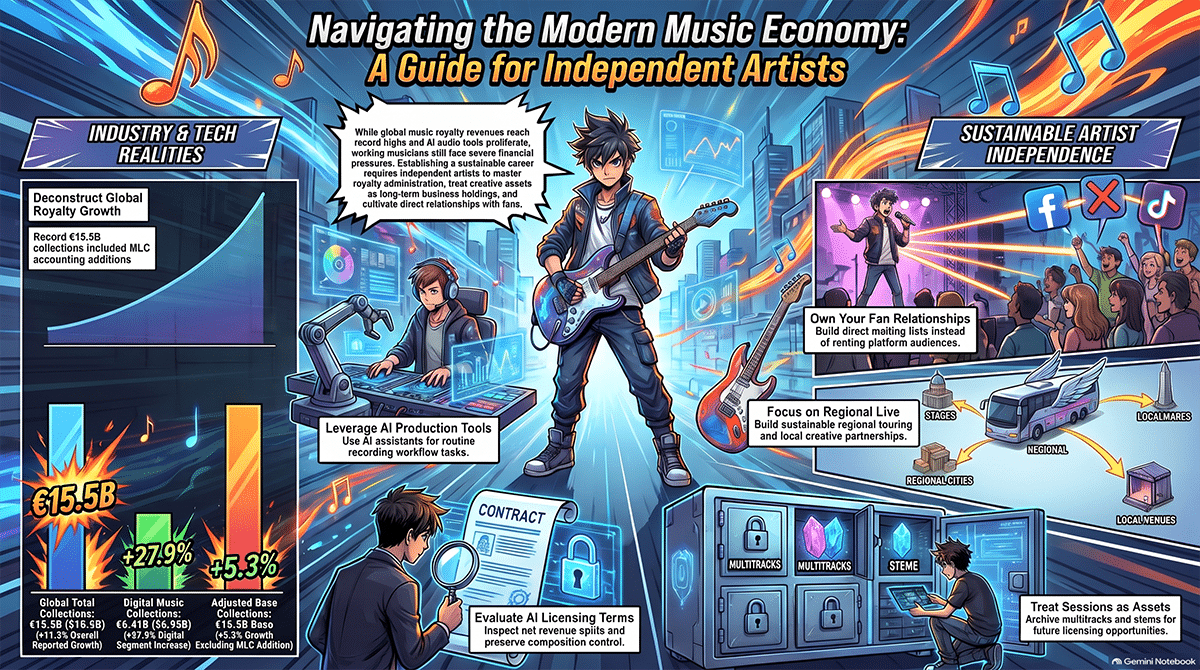
One of the most important music business stories of the week arrived on November 4, when the International Confederation of Societies of Authors and Composers, better known as CISAC, released its 2026 Global Collections Report. The organization represents a worldwide network of collective management societies responsible for collecting and distributing royalties to creators. Its latest report covers 228 societies operating across 111 countries and territories, representing more than five million creators working in music, film, television, visual arts, literature, and other creative fields. The numbers were impressive enough to make a corporate accountant reach for the good champagne, with total collections reaching €15.5 billion during 2025.
Using an illustrative exchange rate of $1.09 per euro, that represents approximately $16.9 billion in global collections, an increase of 11.3% over the previous year. Music accounted for approximately €14.06 billion, or $15.33 billion, with reported growth of 11.9%. Digital music collections climbed 27.9% to €6.41 billion, approximately $6.99 billion, while income from live performances and background music increased 7.3% to €3.62 billion, approximately $3.95 billion. Those are substantial figures, particularly for an industry that spent much of the early internet era predicting that digital technology would destroy the economic value of recorded music.
Before anyone starts calculating how much of that money should be arriving in their next royalty statement, however, there is an important detail buried beneath the celebratory headlines. CISAC included information from the United States Mechanical Licensing Collective in its reporting for the first time, and that addition accounted for approximately 52% of the reported increase in total collections. When the effect of the newly included information is excluded, underlying growth was approximately 5.3%. That is still a respectable increase, but it tells a different story from the suggestion that the global royalty business suddenly expanded by more than eleven percent through ordinary market growth.
This is the sort of accounting distinction that rarely makes it into the enthusiastic social media posts celebrating the health of the music industry. The money reported through the MLC did not suddenly materialize because songwriters became dramatically more popular during 2025. Much of the apparent increase resulted from bringing another major source of royalty information into the reporting system. There is nothing inherently deceptive about that when the methodology is properly explained, but the difference matters when musicians are trying to understand whether industry growth is translating into better financial opportunities.
For independent artists, the report offers two important lessons. The first is that music rights continue to generate enormous economic value across the world, particularly as digital consumption expands. The second is that collecting that money requires a complicated network of registrations, ownership records, licensing agreements, and administrative organizations. The musician who writes a song, records it, and uploads it to a distributor may have created several distinct opportunities for royalty income, but those opportunities do not necessarily arrive through the same payment system.
Consider an independent blues artist who writes an original song, records it in a home studio, and distributes it through a digital music service. The artist may own the sound recording, commonly called the master, while also controlling the copyright in the underlying composition. Those are separate assets, even when the same person owns both. Revenue associated with the recording may be administered through a distributor, while the composition can generate publishing income through different licensing and collection systems. The artist might receive one payment from the distributor while other royalties are collected through organizations responsible for public performances or digital mechanical rights.
The Mechanical Licensing Collective administers eligible digital mechanical royalties for musical compositions under the United States blanket licensing system. Performing rights organizations such as ASCAP, BMI, and SESAC handle certain public performance rights, while SoundExchange collects and distributes specific digital performance royalties associated with sound recordings. Each organization performs a different function, and registration with one does not automatically mean that every other category of royalty has been covered. Unfortunately, the music business has never been particularly enthusiastic about making these distinctions easy to understand, perhaps because confusion has become one of its most durable traditions.
The growth in live performance and background music collections is particularly interesting for working musicians. Artists generally think about concert revenue in terms of guarantees, ticket sales, tips, and merchandise, but the public performance of compositions can also generate publishing income under applicable licensing arrangements. A songwriter performing original material at a licensed venue may be able to report those performances through their performing rights organization, depending on the organization’s rules and reporting systems. The money will not necessarily be enormous, and not every performance qualifies for a payment, but it represents another reason for artists to understand the rights attached to their songs.
This is also where better technology could make a meaningful difference. Artificial intelligence and automated data analysis may help musicians compare registrations, identify missing information, and locate possible inconsistencies between recording and publishing records. Such systems cannot determine legal ownership simply by making an educated guess, and suspicious records still require human review. Nevertheless, software that reduces the administrative burden of maintaining a catalog could help independent musicians collect income more effectively without spending their evenings studying spreadsheets instead of writing songs.
The CISAC report demonstrates that the global market for creative rights remains financially important, but it does not prove that every songwriter is earning more money. A musician’s income depends on the use of their work, the rights they control, the accuracy of their registrations, and the agreements governing collection and distribution. The practical response is to treat royalty administration as part of running a music business rather than assuming that uploading a recording automatically takes care of everything. The industry may be collecting billions, but the artist still needs to make sure the paperwork knows where to send the check.
Splice Brings AI Into the Recording Studio, and This Time It Might Actually Be Useful
The recording technology business delivered one of the week’s more interesting developments on November 5, when Splice introduced Create, a new digital audio workstation that combines conventional recording and production tools with an integrated artificial intelligence assistant. The application entered public beta for Mac users and brings together Splice’s established sample library, virtual instruments, editing capabilities, and a system called Rheo that can help musicians perform production tasks through written or spoken instructions. The announcement represents another step toward recording software that attempts to understand what musicians want to accomplish instead of requiring them to memorize every menu, shortcut, and technical procedure.
Anyone who has spent time teaching a beginner to use a digital audio workstation understands why this idea has appeal. Modern recording software is extraordinarily powerful, but that power often comes wrapped in interfaces that seem designed by engineers who assume everyone enjoys reading technical manuals. A songwriter may have a perfectly good melody, a strong arrangement, and a reasonable idea of how the recording should sound, yet still spend an entire afternoon trying to figure out why the microphone signal is not reaching the correct track. By the time the problem is solved, the original creative inspiration may have wandered off to find a less complicated hobby.
Splice is attempting to reduce that frustration by allowing users to communicate with the software in more natural language. Rheo can help organize sessions, locate samples, insert effects, and carry out certain production operations without requiring the musician to navigate every control manually. The system also offers an educational approach that guides users through the necessary steps rather than simply completing the work for them. That distinction is important because there is a difference between software that helps someone learn a skill and software that performs the skill while the user watches.
For independent musicians operating home studios, the potential benefit is straightforward. Every hour spent wrestling with technical problems is an hour that cannot be spent recording, rehearsing, writing, or developing the business. If an AI assistant can explain how to route a microphone, organize a drum session, or prepare a basic mix, it may reduce the time required to complete a project. The value is particularly meaningful for artists who cannot afford to hire a professional engineer every time they want to record a demo or experiment with an arrangement.
Experienced recording engineers may find different uses for the same technology. A producer working with a complicated session might benefit from automated track organization, routine editing assistance, or faster access to familiar production functions. These tasks can consume considerable time without necessarily contributing to the creative quality of the recording. If software can handle repetitive operations reliably, the engineer may have more time to focus on performances, arrangements, tone, and the countless judgment calls that separate a professional recording from a collection of technically correct audio files.
Create also integrates Splice’s extensive library of licensed samples, allowing musicians to search for sounds and incorporate them into arrangements without constantly moving between applications. That convenience could be useful for producers working on demos, commercial music, or projects requiring rapid experimentation. The company says its AI features work with licensed content and that sample creators are compensated through its licensing arrangements, an important claim in a market where the sources of AI training material have become the subject of major copyright disputes. Musicians should still review the licensing terms attached to any material they use, especially when preparing recordings for commercial clients or specialized licensing opportunities.
There is, naturally, a subscription component, because apparently no technology company can introduce a useful product without eventually discovering the recurring revenue model. The Create beta can be downloaded without an upfront charge, but exporting completed productions requires an eligible paid subscription. Reporting on the launch identified an introductory Create Pro price of $9.99 per month, while certain Rheo functions may involve additional metered charges. These costs may be reasonable for musicians who use the software regularly, but they should be evaluated against the actual work being performed and the tools already available.
The ability to export and preserve finished recordings is especially important. A musician does not merely need software that makes an arrangement sound impressive inside a particular application. They need to deliver finished audio, prepare masters for distribution, send files to collaborators, and revisit projects when licensing opportunities arise years later. Any recording environment that places essential functions behind an ongoing payment requirement deserves careful consideration, particularly when artists are already managing subscriptions for distribution, websites, marketing, cloud storage, and other services.
There is also a larger question about what AI assistance means for the recording profession. Some technology companies seem convinced that the ultimate goal is to remove every human decision from the creative process, as though the greatest obstacle to making music has always been the unfortunate presence of musicians. That approach may appeal to businesses interested in producing enormous quantities of inexpensive content, but it overlooks the importance of experience, taste, and creative judgment. An engineer does not become valuable simply by knowing which button to press; the real skill involves understanding why a particular decision improves the music.
The more interesting opportunity is using AI to eliminate routine work while preserving the human decisions that give recordings their character. A producer who can prepare a session faster may have more time to work with the singer on a difficult performance. A songwriter who learns recording fundamentals through an AI assistant may become more confident about developing arrangements. A studio that reduces editing time may be able to serve additional clients or offer more specialized services without sacrificing quality.
For independent recording studios, these developments also suggest that the business of making records is becoming broader than the traditional session model. Artists increasingly need alternate mixes, instrumental versions, stems, backing tracks, and other audio assets for licensing, live performance, and digital experiences. AI-assisted tools can help prepare some of those materials, although professional quality control remains essential. A studio that understands how to organize and deliver these assets may find additional revenue opportunities even as basic recording technology becomes more accessible.
Splice Create is not proof that AI has solved every recording problem, and musicians should approach the beta with realistic expectations about reliability, compatibility, and long-term costs. Nevertheless, the announcement is significant because it places AI assistance inside an established production environment rather than treating it as a separate novelty. For working artists, the most valuable technology will be the technology that helps them create better recordings, finish projects efficiently, and retain control of the music they produce.

The Live Music Business Remembers That Actual Human Beings Still Matter
While the technology industry continues developing increasingly sophisticated ways to generate and manipulate music, the live entertainment business offered a welcome reminder that audiences still enjoy watching real people do interesting things together. On November 5, Axios reported on a collaboration involving Cincinnati Ballet, the band Over the Rhine, and musicians from the Cincinnati Symphony Orchestra. The production, presented November 6 and 7 at Cincinnati’s Music Hall, combined the band’s original music with orchestral arrangements and choreography, creating an event that crossed the usual boundaries between popular music and traditional performing arts organizations.
The significance of this collaboration goes beyond the artistic novelty of combining a band with ballet and an orchestra. It demonstrates how original music can become the foundation for experiences that attract audiences from different cultural communities. A listener who regularly attends ballet performances may discover a band they would never encounter through a streaming recommendation, while longtime fans of the band may experience its music in a completely different setting. Both organizations gain access to audiences that might otherwise remain outside their normal promotional reach.
For independent musicians, this is an important business lesson because the traditional concert format is not the only way to earn income from original music. A catalog can support theatrical productions, dance performances, educational programs, film presentations, historical events, and other collaborations that introduce songs to new audiences. These opportunities may involve performance fees, composition licensing, ticket revenue, or some combination of arrangements, depending on the project. They also require careful planning because the rights associated with compositions, recordings, and future uses should be addressed before the production takes place.
Most independent bands are unlikely to find themselves collaborating with a major ballet company next month, although anyone who has tried organizing a rehearsal with five musicians may appreciate the logistical challenge of adding an orchestra. The same principle can work on a smaller scale, however, through partnerships with community theaters, regional museums, dance schools, local filmmakers, and arts organizations. A blues artist might develop a performance exploring the musical history of a region, while a folk songwriter could collaborate with a historical society on a program combining music and storytelling. These projects may reach audiences that ordinary club performances struggle to attract.
The business arrangements are just as important as the creative concept. Musicians should understand whether they are being hired for a performance, licensing compositions, authorizing the use of recordings, or participating in ticket revenue. Agreements should address rehearsal requirements, promotional responsibilities, merchandise opportunities, and the possibility of recording or distributing the performance later. A successful collaboration can generate income and new fans, but unclear expectations can turn an exciting artistic project into an expensive exercise in discovering how many people have different interpretations of the same conversation.
Another live music story from the week involved plans to reopen the former Black Cat Licorice Theater in San Jose as an all-ages performance venue and creative incubator. According to reporting from the San Francisco Chronicle, local concert organizer Heavy Lemon is working with nonprofit Crossthread to revive the space, with an anticipated reopening in February 2027. The project includes plans for concerts, workshops, and community activities, along with fundraising efforts to prepare the building for public use.
This kind of development deserves attention because independent venues are essential parts of the music economy that rarely receive the same attention as major concert tours. Small performance spaces provide places where musicians develop their craft, experiment with new material, meet collaborators, and build audiences. They also create opportunities for promoters, sound engineers, lighting technicians, photographers, and other professionals whose livelihoods depend on a healthy local music scene. When these venues disappear, the consequences extend well beyond the loss of one room with a stage.
The economics of independent venues have become increasingly difficult as operating expenses rise and competition for entertainment spending grows. Rent, insurance, staffing, equipment maintenance, and promotion all contribute to the cost of keeping a room open. Musicians face many of the same pressures, particularly when transportation, personnel, and production expenses consume a large portion of performance income. A sustainable local music community requires business arrangements that recognize the financial realities of both venues and performers rather than expecting one side to absorb every expense.
For independent musicians, supporting local venues can also be a practical business strategy. Artists who develop relationships with reliable promoters and performance spaces may gain opportunities for recurring shows, collaborative events, and audience development. A band that consistently attracts an audience and helps promote its performances becomes a more valuable partner to a venue. Likewise, a venue that treats musicians fairly and invests in building a community can become an important part of an artist’s long-term career.
This is where the idea of regional touring deserves another look. Many musicians assume that career growth requires traveling farther, playing more cities, and spending increasingly large amounts of money on transportation and lodging. In reality, a band that develops a strong following within a manageable driving distance may have a more sustainable business than one traveling hundreds of miles to play unfamiliar rooms with little promotional support. Regional growth can allow artists to build repeat audiences while keeping expenses under better control.
Technology can support that approach when musicians use it to maintain relationships with the people attending their shows. A band that collects permission-based email contacts, records where fans live, and communicates about future performances can make more informed booking decisions. Instead of relying entirely on a promoter’s estimate of local demand, the artist can examine where interested supporters are located and whether previous performances generated repeat business. The information will not eliminate the uncertainty of live music, but it can help reduce some of the guesswork that makes touring expensive.
The Cincinnati collaboration and San Jose venue project demonstrate that the future of live music will not be determined entirely by the largest ticketing companies or the most expensive concert productions. Community partnerships, regional audiences, and independent performance spaces remain important sources of opportunity for working musicians. The artists who understand how to combine creative collaboration with sound business practices may discover that building a career closer to home is more financially rewarding than constantly chasing the next distant booking.
AI Music Licensing Is Becoming a Real Business, but the Contracts Still Deserve a Magnifying Glass
Artificial intelligence has spent the past several years creating an uncomfortable situation for the music industry. Technology companies have developed systems capable of generating music, manipulating recordings, and imitating aspects of human performance, while copyright owners have questioned whether their work was used without permission. Lawsuits, licensing negotiations, and competing interpretations of copyright law have followed, creating an environment in which the technology is advancing faster than the legal and commercial rules governing it.
Although the most significant licensing agreements were not all announced during the past seven days, their continuing influence provides important context for this week’s developments. Major music companies, publishers, distributors, and AI developers have been negotiating arrangements intended to establish authorized uses of copyrighted music and compensation for rights holders. These agreements suggest that the industry is moving toward commercial licensing models for at least some AI applications, although the legal disputes surrounding unauthorized training and other uses remain unresolved.
For independent musicians, the emerging licensing market could eventually create opportunities to earn income from recordings and compositions that already exist. An artist who owns a catalog may be able to authorize certain uses of that material in exchange for compensation, provided the agreements are appropriate and the relevant rights are controlled. Such opportunities might involve licensed access to recordings, compositions, stems, or other protected material. The value will depend on the terms, the commercial demand, and the specific technology involved, so musicians should be skeptical of anyone promising that every old recording is about to become a valuable AI asset.
The most important issue is understanding exactly what permission is being granted. A musician who owns a master recording may have authority to license that recording, but the underlying composition can involve separate songwriters and publishers. A recording agreement may also contain provisions affecting future uses, while session performers may have contractual rights that need to be considered. The fact that a technology company wants access to a recording does not mean every relevant permission can be obtained from the person who happens to possess the audio file.
Some independent distribution and music technology companies have introduced programs intended to provide creators with access to AI licensing opportunities. LANDR’s Fair Trade AI initiative, for example, announced a revenue-sharing model involving participating artists, including a reported allocation of 25% of net licensing revenue under revised terms. That percentage requires careful interpretation because net licensing revenue is not the same thing as the total revenue generated by an AI company. The definition of expenses, deductions, and the revenue pool determines what the artist’s actual share may represent.
Symphonic Distribution also announced a partnership with Sureel AI intended to help participating rights holders license material for authorized AI uses. The companies described systems for managing permissions and restrictions, reflecting the growing interest in creating licensing arrangements that can account for creator choices. These developments are encouraging because they suggest that independent artists may have options beyond agreements negotiated exclusively by major rights holders. However, the existence of a licensing program does not establish that participating musicians are receiving meaningful income, and artists should evaluate actual payment terms and reporting practices before making decisions.
There are also important questions about how these agreements affect musicians who contributed to recordings without owning the masters. The American Federation of Musicians filed litigation earlier in 2026 concerning the licensing of recordings involving its members to AI companies, arguing that certain arrangements triggered compensation obligations under existing labor agreements. Those allegations remain subject to legal proceedings and should not be treated as established violations. Nevertheless, the dispute highlights the complicated relationships among recording owners, performers, and other contributors when new commercial uses emerge.
For independent recording studios, this developing market provides another reason to improve the documentation associated with recording sessions. Producers and engineers should understand who owns the masters, who contributed to the compositions, and what agreements govern the use of recorded performances. Artists should preserve original session files, maintain accurate credits, and keep copies of contracts that establish ownership and licensing authority. These records may become particularly valuable when a commercial opportunity appears and the potential licensee needs reliable information quickly.
The industry has a long history of introducing new technologies before musicians fully understand their economic consequences. Streaming made music widely accessible but also created a system in which many artists struggle to generate meaningful income from enormous numbers of plays. AI licensing could develop differently if artists retain control over participation and receive transparent compensation. That outcome is possible, but it will require careful agreements and a willingness to question business models that promise opportunity while keeping the important financial details hidden.
Independent musicians should not reject AI licensing simply because the technology is unfamiliar, nor should they accept every offer because someone describes it as the future. The sensible approach is to understand the rights involved, evaluate the financial terms, and determine whether participation supports the artist’s long-term interests. A properly structured license can be another useful layer of income, while an overly broad agreement may create restrictions that become difficult to undo.

Your Recording Studio May Be Sitting on a Business Opportunity Nobody Has Properly Packaged
The growth of AI-assisted production tools also points toward an opportunity for independent recording engineers that has received less attention than the latest software announcements. As music becomes increasingly connected to film, games, interactive experiences, and digital commerce, clients often need more than a finished stereo recording. They may require instrumental mixes, alternate versions, stems, backing tracks, clean edits, or audio prepared for specific technical environments. Those requirements create opportunities for studios that can deliver reliable, professionally organized assets.
Traditionally, a recording studio’s business model has revolved around the time required to record, edit, mix, and master music. Those services remain valuable, but modern clients may need additional work after the original recording is finished. A film producer might request an instrumental version so dialogue can remain audible, while a game developer may need separate musical sections that can be combined interactively. An artist preparing a live performance may want backing tracks that omit certain instruments, and a music supervisor may request stems to accommodate changes during post-production.
These services can become additional sources of income for recording studios, particularly when engineers preserve the original multitrack sessions and maintain organized archives. A studio that can quickly locate a recording and prepare an authorized alternate mix provides a useful service to an artist or licensing client. When the original sessions are unavailable, AI-assisted separation may offer an alternative, although the quality of the results can vary considerably. Engineers still need to evaluate artifacts, phase problems, unwanted sounds, and other technical limitations before delivering material for professional use.
The economic opportunity is not simply charging clients for pushing a button. It involves providing expertise, quality control, and reliable delivery in situations where the client needs a specific result. A professionally prepared instrumental mix may require careful decisions about effects, automation, and elements that were originally designed to support a vocal performance. A set of stems intended for licensing may need to meet technical specifications that differ from ordinary mixing deliverables. The engineer’s knowledge remains valuable because software can assist with processing without necessarily understanding the commercial requirements of the project.
For independent artists, the same principle suggests that original recording sessions should be treated as long-term business assets. Musicians who preserve their multitrack recordings, session notes, and ownership information retain more flexibility when future opportunities arise. A song recorded several years ago may become useful for a licensing project, a live performance, or an interactive release, but preparing those versions becomes more difficult when the source files have disappeared. Maintaining organized archives is not particularly exciting, although neither is discovering that the only surviving copy of a valuable recording lives on a hard drive that stopped working during the previous administration.
Studios can also offer catalog preparation services that help musicians organize recordings for potential licensing opportunities. That might involve identifying missing files, creating properly labeled alternate versions, preserving technical information, and documenting the relationship between a master recording and its underlying composition. The work can be performed using existing production tools, with AI assistance applied where it provides reliable results. It may not produce the same emotional satisfaction as recording a great performance, but it can generate revenue while helping artists protect and develop their catalogs.
The broader lesson is that recording engineers should think beyond selling studio time. Their expertise can support a range of services connected to music assets, including restoration, editing, alternate-version preparation, technical delivery, and catalog organization. As basic recording technology becomes more affordable, studios that provide specialized knowledge and dependable results may have a stronger position than those competing solely on equipment or hourly rates.
Fan Commerce Is Where Independent Musicians Can Finally Stop Renting Their Own Audience
One of the most frustrating developments in the modern music business is the way artists have been encouraged to build enormous audiences on platforms they do not control. Social media companies promise access to millions of potential listeners, and streaming services provide convenient ways for people to discover recordings. These platforms can be useful, but they generally control the information and communication systems that connect artists with audiences. A musician may spend years attracting followers only to discover that reaching those same people requires purchasing advertising from the company that benefited from the original audience-building effort.
The problem becomes especially obvious when an artist announces a concert. A band might have several thousand followers in a particular region, yet only a small percentage of those people may see the announcement. The platform determines which posts appear, how frequently they are shown, and whether the artist should pay for additional visibility. The musician has invested time and creative energy in building the audience, but the platform controls much of the relationship. It is a remarkable business arrangement in which artists do the work of attracting customers and then rent access to those customers from someone else.
Direct-to-fan commerce offers a different approach by encouraging interested listeners to develop relationships that the artist can maintain independently. An artist-owned website, permission-based mailing list, online store, and fan membership program can provide ways to communicate with supporters without relying entirely on social media algorithms. Streaming and social platforms can still serve as valuable discovery channels, but the musician’s own business becomes the destination for people who want a deeper connection.
For working musicians, the financial opportunity extends beyond selling recordings directly. A fan who attends a show may purchase merchandise, join a mailing list, support a crowdfunding campaign, or return for future performances. Those activities can generate repeat business over time, particularly when the artist offers meaningful experiences rather than treating every interaction as another sales pitch. The objective is to develop relationships with people who genuinely value the music, not to turn every casual listener into an unwilling participant in a marketing campaign.
Consider a regional band that performs twenty shows during a year, attracting an average of one hundred audience members at each performance. That represents approximately 2,000 audience visits, although some individuals may attend multiple shows. If the band consistently invites interested listeners to join its mailing list, it may gradually develop a useful collection of direct contacts. The actual number of subscribers will depend on the quality of the offer, audience response, and proper consent, but even a modest list can help promote future performances and merchandise without purchasing access to the same audience repeatedly.
The value becomes greater when the artist understands where supporters live and which activities interest them. A band planning a regional tour might use its own fan information to identify towns where people have expressed interest in attending a show. An artist releasing a new recording could contact previous merchandise customers who have agreed to receive updates. A membership program might offer early ticket access, exclusive performances, or other benefits that encourage supporters to maintain an ongoing relationship.
This approach requires responsible handling of personal information. Fans should understand what they are signing up for, receive communication that provides genuine value, and have an easy way to change their preferences or unsubscribe. Artists should also protect the information they collect and avoid assuming that a customer’s purchase automatically grants permission for unlimited promotional contact. Trust is part of the economic value of a direct relationship, and musicians who abuse it may discover that fans are considerably better at finding the unsubscribe button than the industry is at finding missing royalties.
Artificial intelligence can help manage some of these activities by organizing information, preparing communications, and identifying patterns in sales or attendance records. The technology should assist the artist rather than replace the personal connection that makes the relationship valuable. A fan who supports a local musician is often responding to the music, the performance, and the identity of the person creating it. Automated marketing can make communication more efficient, but it cannot manufacture the genuine relationship that develops when an artist consistently delivers something worthwhile.
The long-term opportunity is to build a music business in which each activity supports the others. Live shows introduce people to the music, direct communication helps bring them back, merchandise provides additional income, and new recordings give supporters another reason to remain involved. Instead of treating streaming, touring, and commerce as separate activities, musicians can develop a connected business around their own audience. That is a much stronger foundation for independence than hoping the next algorithm change will suddenly make everything better.
Web3 Still Has Something to Offer, Provided We Can Get Past the Digital Magic Beans
There was no comparably significant, independently verified Web3 music launch in the November 2–8 reporting reviewed for this edition, and that is worth acknowledging. The music technology business has enough genuine developments to examine without inventing a blockchain revolution every Sunday. Nevertheless, the underlying questions associated with Web3 remain relevant because they involve ownership, portability, digital identity, and the ability to conduct transactions without placing every relationship under the control of a single platform.
Web3 attracted enormous attention during the early years of blockchain enthusiasm, when almost every business problem was supposedly waiting to be solved by a token. Musicians were encouraged to sell digital collectibles, launch communities around cryptocurrency, and participate in projects promising to transform the economics of creative work. Some ideas had practical potential, while others seemed designed primarily to convince artists that the future of music required purchasing something they did not fully understand. The industry has since become more cautious, which may be a healthy development for anyone who prefers business models involving actual customers and recognizable revenue.
The most useful applications of Web3 are likely to be those that solve ordinary problems without forcing musicians or fans to become experts in blockchain technology. A portable digital membership could allow a supporter to maintain access to benefits across different services. Verifiable transaction records might help document certain commercial activities, while programmable agreements could support clearly defined payment arrangements. These possibilities deserve examination, but they do not automatically require speculative cryptocurrencies, and placing an ownership claim on a blockchain does not establish legal copyright ownership.
For independent musicians, the standard should be practical value. If a technology makes it easier to sell tickets, manage memberships, document transactions, or preserve access to fan relationships, it may be useful. If it requires supporters to navigate complicated wallets, unfamiliar fees, and technical procedures before buying a shirt, the artist should probably ask whether an ordinary online store would accomplish the same thing with less frustration. Most fans want to support music and enjoy experiences, not complete an introductory course in decentralized finance before purchasing merchandise.
The broader promise of Web3 is the possibility of reducing dependence on centralized platforms, but that promise depends on how systems are actually designed. A product can use blockchain technology while still requiring artists to depend on a single company for access, administration, or essential information. Conversely, a conventional database system can provide meaningful portability when it allows users to export their records and move between providers. The important issue is not the fashionable label attached to the technology, but whether the artist retains practical control.
For the independent music industry, the most promising future may involve combining useful elements of AI, portable digital records, and direct commerce without requiring musicians to surrender ownership of their businesses. Artists should be able to maintain accurate catalog information, manage fan relationships, and use different services according to their needs. Technology companies that provide genuine value can earn revenue by serving those artists, but the relationship should resemble a business purchasing useful services rather than a musician becoming permanently dependent on someone else’s infrastructure.
Building a Music Industry Middle Class Requires More Than Another App
The developments examined this week reveal an industry that continues generating substantial revenue while becoming increasingly dependent on technology and information. Global royalty collections are growing, recording software is becoming more capable, and new licensing markets are emerging around artificial intelligence. Live music remains an important source of income and community development, while direct fan relationships offer musicians opportunities to build businesses that are less dependent on the priorities of outside platforms.
For independent artists, the challenge is turning those developments into practical improvements in their financial lives. A musician who owns a catalog but does not understand publishing administration may be overlooking income. A band with a strong live following but no reliable way to contact supporters may struggle to sell tickets when social media visibility changes. A recording engineer who invests heavily in equipment without developing profitable services may discover that a beautiful studio does not automatically produce a healthy business.
These problems do not have simple solutions, but they share a common theme involving control over assets and information. Musicians benefit when they understand what they own, maintain accurate records, and develop direct relationships with the people who support their work. They also benefit from evaluating technology according to its actual financial value rather than assuming that every new feature represents an essential investment. A tool that saves time, reduces expenses, or creates revenue may be worthwhile, while a tool that duplicates existing capabilities may simply add another recurring charge.
Artificial intelligence can help independent musicians manage some of the administrative work associated with running a business. It can assist with organizing catalog information, preparing marketing drafts, analyzing expenses, and identifying possible registration problems. These applications are useful when they reduce repetitive work and provide information that supports better decisions. They become less useful when artists accept automated conclusions without checking the underlying facts or allow technology to make important creative and financial decisions without adequate oversight.
The same approach applies to distribution, licensing, and fan commerce. Musicians should understand what a service costs, which rights it requires, how revenue is calculated, and whether essential business information can be exported. A company that provides useful services deserves to be paid, but artists should avoid arrangements that surrender valuable rights or make their businesses unnecessarily difficult to move. Independence does not require rejecting every outside company; it requires maintaining enough control to choose which companies provide value and replace them when better options become available.
A sustainable music career is rarely built around one spectacular breakthrough. More often, it develops through a combination of consistent creative work, careful financial decisions, and several connected sources of income. A regional performer might earn money from concerts, merchandise, teaching, direct music sales, and publishing royalties, while a recording engineer may combine studio services with production, editing, and specialized audio preparation. None of those activities guarantees profitability, but a business with several carefully managed income sources may be better positioned to withstand changes in the market.
The idea of a music industry middle class recognizes that not every musician needs to become internationally famous to build a worthwhile career. There should be room for professional artists who serve regional audiences, produce recordings, write songs, collaborate with other creators, and earn reasonable incomes from their work. Technology can help make that possible by reducing production costs, improving administration, and creating new ways to reach supporters. The economic benefit, however, depends on whether artists retain enough ownership and negotiating power to participate meaningfully in the value they create.
What Independent Musicians Should Be Watching in the Months Ahead
The next several months will provide important evidence about whether AI music licensing can become a meaningful source of income for independent rights holders. Agreements involving major companies and technology developers have demonstrated that authorized uses of music can be negotiated, but the terms available to smaller artists remain uneven and sometimes difficult to evaluate. Musicians should pay attention to actual payment reports, participation requirements, and the treatment of both recording and publishing rights rather than assuming that every new agreement represents an opportunity available to everyone.
Recording technology will also continue changing as AI assistants become more deeply integrated into professional software. Splice Create represents one approach, combining production functions with assistance that can either perform tasks or guide users through them. Other developers may pursue different combinations of automation, education, and creative control. Independent musicians should compare these products according to reliability, compatibility, total cost, and the ability to preserve and export their work. The most impressive demonstration is not necessarily the best choice for someone who needs to finish an album on a limited budget.
Royalty administration deserves continued attention because the CISAC report demonstrates the enormous scale of the money flowing through international collection systems. Accurate ownership information and reliable matching remain essential to getting that money to the appropriate rights holders. Better software may help identify inconsistencies and reduce administrative delays, but musicians will still need to understand the rights attached to their work and maintain accurate registrations. The industry has spent decades developing increasingly sophisticated ways to distribute music, and it would be encouraging to see comparable enthusiasm devoted to making sure the people who created it are paid correctly.
Live music remains another area where independent artists can exercise meaningful control over their businesses. Community venues, regional festivals, performing arts collaborations, and local promoters provide opportunities to develop audiences without relying entirely on national touring infrastructure. Musicians who build strong regional relationships and maintain direct communication with supporters may be better positioned to generate repeat business while controlling expenses. The most valuable touring strategy is not necessarily the one involving the greatest number of miles, particularly when the cost of traveling consumes most of the money earned.
Fan commerce and portable business information will become increasingly important as artists search for ways to reduce dependence on social media platforms. A musician who maintains a permission-based mailing list, organized customer records, and an independent website has more flexibility when outside services change their policies. These assets require responsible management, but they provide a foundation for direct ticket sales, merchandise, memberships, and other activities that support a sustainable career.
The Future of Music Should Include the People Making It
The music industry has never suffered from a shortage of ambitious predictions. Every new technology arrives with promises of greater access, lower costs, and unprecedented opportunities for creators. Some of those promises eventually become reality, while others turn into expensive lessons about contracts, ownership, and the remarkable ability of large companies to discover new revenue streams before musicians have finished reading the terms of service.
The developments of November 2 through November 8 demonstrate both the opportunities and the complications. Global royalty collections are reaching record levels, although the headline figures require careful interpretation. AI-assisted recording software is becoming more accessible, but its economic value depends on how musicians use it and what they pay. Live music organizations are developing creative partnerships and rebuilding community spaces, while the emerging AI licensing market continues raising questions about compensation and creative control. These developments are important, but none provides a universal solution to the financial challenges facing working artists.
The opportunity for independent musicians lies in understanding how these changes can support businesses built around assets they own. A master recording can generate income through distribution, direct sales, and authorized licensing. A composition can produce publishing revenue when its rights are properly administered. A live performance can create ticket and merchandise income while strengthening relationships with fans. Professional recording skills can support services that extend beyond the original recording session, and technology can help connect those activities without requiring artists to surrender control over their work.
The industry’s largest companies will continue finding ways to monetize music, and there is nothing inherently wrong with businesses earning money by providing useful services. The problem arises when the people creating the music lack the information, negotiating power, or ownership needed to participate fairly in the value they generate. Independent musicians can improve their position by treating their recordings, compositions, professional skills, and fan relationships as assets worth protecting and developing.
For Making a Scene, the goal remains the development of a broader music industry middle class in which more working musicians can earn sustainable incomes from the work they create. That vision does not depend on every artist becoming famous or every recording reaching millions of listeners. It depends on practical business knowledge, affordable technology, fair agreements, and direct relationships with audiences willing to support the music.
The technology will continue changing, the financial reports will keep arriving, and the industry will undoubtedly discover several more revolutions before the end of the year. Some will create genuine opportunities, while others will turn out to be familiar business models dressed in fashionable AI clothing. Independent musicians do not need to reject innovation, but they do need to approach it with enough knowledge and independence to decide which opportunities are worth pursuing.
A healthier music industry would be measured not only by the billions collected by corporations and rights organizations, but also by the ability of working musicians to pay their bills, compensate their collaborators, invest in new recordings, and continue creating music without surrendering everything they build. That kind of industry will require better technology, more transparent business practices, and musicians who understand that ownership is not merely a legal concept but an essential part of earning a living.
There is plenty of money moving through the modern music economy, and the opportunities for independent artists are expanding in ways that would have been difficult to imagine twenty years ago. The challenge is making sure those opportunities produce more than impressive corporate announcements and another collection of monthly fees. With better information, stronger ownership, and direct relationships with supporters, independent musicians have a genuine chance to build businesses that serve their creative ambitions and financial needs.
And perhaps, somewhere along the way, we can finally develop a music industry in which a musician doesn’t have to choose between paying for a new recording and replacing the tires on the van that gets the band to the next show. That would be a technological revolution worth celebrating, even if nobody gets to attach the words artificial intelligence or blockchain to the press release.
Making a Scene — Supporting the Independent Artist and Building a Music Industry Middle Class.
 |  Spotify |  Deezer |  Breaker |
 Pocket Cast |  Radio Public |  Stitcher |  TuneIn |
 IHeart Radio |  Mixcloud |  PlayerFM |  Amazon |
 Jiosaavn |  Gaana |  Vurbl |  Audius |
 Reason.Fm | |||
Find our Podcasts on these outlets