
DistroKid and Kobalt Want to Collect Your Publishing Royalties





Making a Scene Presents – DistroKid and Kobalt Want to Collect Your Publishing Royalties. But Who Should Control Your Music Business?
Listen to the Podcast Discussion
DistroKid’s new publishing partnership promises independent songwriters a better way to collect money they may be missing. The deal sounds simple: keep 80% of the royalties, pay a $75 setup fee, and let the professionals handle the paperwork. But beneath that offer is a much bigger question about music ownership, royalty collection, and whether independent artists should build their financial futures around another company’s platform.
The Music Industry Has Found Another Way to Help Musicians Get Paid. Naturally, There Is a Commission.
There is something almost charming about the music industry’s ability to make a simple business transaction feel like a trip through the federal tax code. You write a song, record it, release it, and people listen to it. Somewhere along the way, money is generated. You would think that the person who created the song would have a reasonably clear understanding of where that money goes and how to collect it. Unfortunately, music publishing has spent decades proving that common sense and the music business are not always on speaking terms.
For independent musicians, this confusion has real financial consequences. An artist can spend thousands of dollars recording an album, pay a digital distributor to deliver it to streaming services, promote the release, and eventually begin receiving streaming royalties. Everything looks like it is working. The distributor sends reports, money appears in the artist’s account, and the musician reasonably assumes that the music business is finally doing what it is supposed to do. What many artists do not understand is that the money arriving from their distributor may represent only one part of what their music has earned.
That is the problem DistroKid and Kobalt are attempting to address with the November 11, 2026, launch of DistroKid Publishing, a new publishing administration service designed for independent songwriters. The companies are offering eligible DistroKid users an opportunity to collect composition royalties through an arrangement powered by Kobalt’s international publishing administration infrastructure. The service is intended to make the complicated business of registering songs, tracking their use, and collecting royalties more accessible to musicians who have never worked with a traditional music publisher.
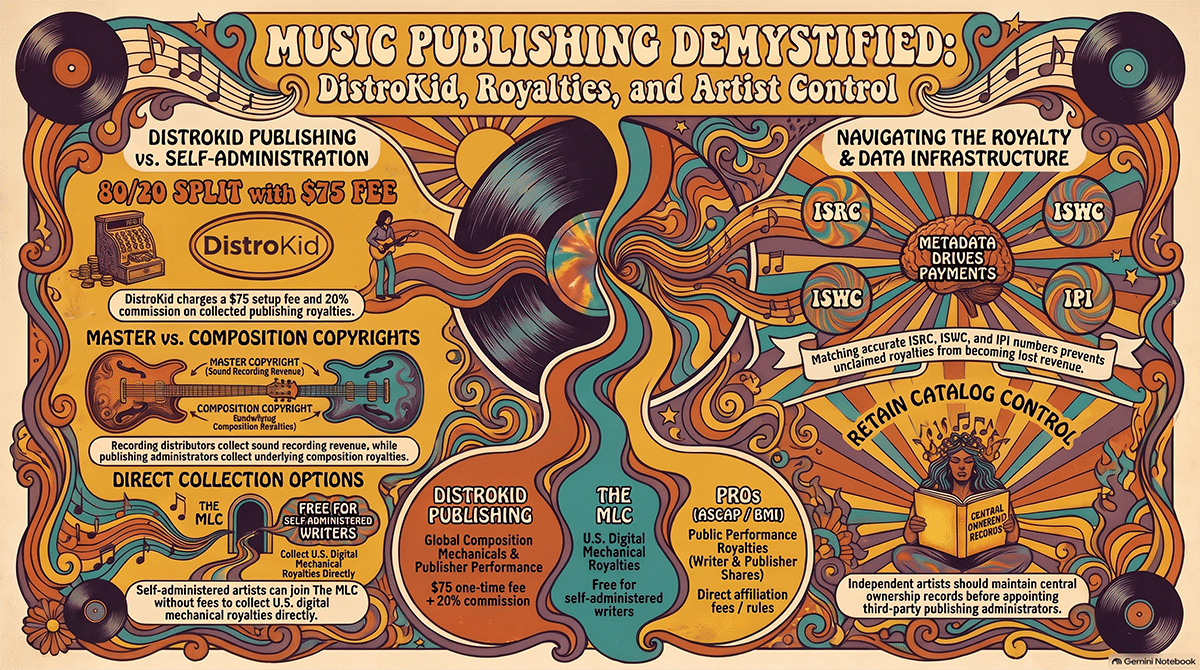
According to the official DistroKid Publishing website and reporting from Music Business Worldwide, the announced U.S. price is a one-time $75 setup fee per songwriter, followed by a 20% administration commission on the publishing royalties the service collects. The songwriter receives the remaining 80%. Eligible musicians must have at least one release distributed through DistroKid and have earned more than $50 in streaming revenue during the previous 12 months. Original songs and co-written compositions qualify, while covers, remixes, mashups, and fully AI-generated tracks are excluded.
The offer is not unreasonable on its face. International music publishing administration involves complicated databases, multiple collection societies, different territorial rules, and a remarkable amount of paperwork. A company that can successfully locate and collect royalties an artist would otherwise miss is providing a valuable service. If that service collects $1,000 in eligible publishing income, the basic 80/20 arrangement leaves the songwriter with $800 before any other applicable deductions. The important question is whether that additional $800 represents money the artist could not reasonably have collected another way, or money that could have been collected directly without paying a continuing commission.
This is where independent musicians need to start thinking like business owners rather than simply customers of music technology companies. DistroKid Publishing may be an excellent option for certain songwriters, especially those who lack the time, knowledge, or international infrastructure to manage their own publishing collections. However, signing up for any administration service without understanding what it collects, what it costs, and what rights the songwriter authorizes it to manage is not much of a business strategy. It is closer to handing someone the keys to your financial filing cabinet because they promised to organize the paperwork.
At Making a Scene, we believe independent artists should be building a sustainable music industry middle class, where musicians can earn a living by controlling the music they create, the information connected to that music, and the relationships they develop with their fans. The DistroKid and Kobalt announcement deserves attention because it addresses a legitimate problem. It also creates an opportunity to examine whether publishing administration should remain another service that artists must purchase from an outside company, or whether modern technology can help artists understand and control much more of the process themselves.
The Two Copyrights That Have Been Confusing Musicians for Generations
To understand why this new service matters, we need to clear up one of the biggest misunderstandings in the music business. When a musician releases a recording of an original song, there are generally two separate copyrights involved. One covers the actual sound recording, commonly called the master. The other covers the underlying musical composition, which includes the original music and lyrics. These copyrights may belong to the same person, but the law and the music industry treat them as separate intellectual property.
Imagine an independent blues guitarist who writes a song called “Last Train to Memphis.” She creates the melody, writes the lyrics, books a recording studio, hires a drummer and bass player, and records the song. Assuming she has retained the relevant ownership rights and properly handled any agreements with the musicians involved, she may own both the composition and the finished master recording. She is wearing two business hats, even though she probably thinks of herself as someone who just recorded a pretty good blues tune.
When the recording streams on Spotify or Apple Music, the use can generate revenue associated with the sound recording and revenue associated with the composition. The recording revenue generally travels through the distributor or record label responsible for delivering and monetizing the master. The composition revenue follows different licensing and collection arrangements involving publishers, publishing administrators, performance rights organizations, mechanical royalty organizations, and other rights holders.
The important distinction is that the money from the master and the money from the composition do not necessarily arrive together. They may be reported by different organizations, calculated under different rules, and paid at different times. An independent musician who distributes a recording through DistroKid may receive the recording revenue handled by that distribution agreement without automatically receiving every publishing royalty generated by the underlying song.
The confusion becomes even more interesting when the person performing the song is not the person who wrote it. A singer recording somebody else’s composition may own or control the master recording while having no ownership interest in the underlying song. Conversely, a songwriter whose composition becomes successful through another artist’s recording may collect publishing royalties without owning that particular recording. Once a song crosses international borders, appears in different recordings, or becomes part of a film, television program, advertisement, or other commercial use, the number of rights and payment relationships can expand considerably.
This is why a publishing administrator can be valuable. The administrator is not necessarily buying the songwriter’s copyright. Instead, the songwriter authorizes the company to perform certain administrative duties, such as registering compositions, maintaining ownership information, claiming royalties, and collecting eligible income. The administrator receives compensation for performing those services, usually through fees, commissions, or some combination of the two.
DistroKid states that artists using its new publishing service retain ownership of their music. That is an important distinction between an administration arrangement and a traditional publishing agreement in which some ownership or control rights might be transferred. However, retaining copyright ownership does not mean every contractual detail is irrelevant. The scope of administration, territories covered, payment deductions, termination procedures, and treatment of royalties earned before or after an agreement are still important matters for any songwriter to understand.
Independent musicians have spent too many years confusing the ability to upload music with the ability to operate a music business. Digital distribution solved an enormous problem by making worldwide releases accessible to artists without record label contracts. It did not automatically solve publishing administration, copyright ownership disputes, inaccurate metadata, or the complicated process of collecting every available royalty. These are different problems, and they require different solutions.
What DistroKid and Kobalt Are Actually Offering
The significance of the partnership is not simply that DistroKid has added another item to its menu. The more interesting development is that Kobalt’s publishing administration capabilities are being made available through a distributor already serving a large independent music audience. DistroKid has built its business around helping musicians deliver recordings to streaming platforms. Kobalt has built an international business around music publishing, royalty administration, and the financial systems required to manage compositions across different markets.
By connecting the two businesses, DistroKid can offer songwriters a more convenient way to address the publishing side of their catalogs. Instead of requiring a musician to find a separate publishing administrator and establish an entirely new working relationship, the service allows eligible artists to enroll through their existing DistroKid accounts. For artists who already use the distributor, that convenience has genuine value, particularly when the alternative is continuing to ignore their publishing income.
Kobalt’s international infrastructure matters because publishing administration becomes increasingly complicated when music is used outside the United States. Different countries have different collection societies, licensing systems, reporting practices, and payment schedules. Even when a songwriter has properly registered a composition domestically, that does not guarantee every applicable international royalty will automatically appear in the artist’s bank account. A qualified global administrator can help establish the registrations and collection relationships necessary to pursue that revenue.
The service collects eligible mechanical royalties and public-performance royalties. Mechanical royalties are associated with uses that reproduce or deliver a musical composition, including qualifying streams, downloads, and physical copies. Public-performance royalties arise from qualifying public uses of the composition, including radio broadcasts, live performances, and other licensed performances. The precise payment rules depend on the type of use, the country, and the organizations involved.
According to DistroKid’s published terms, songwriters do not have to surrender ownership of their compositions, and the company says there is no long-term commitment. The service also states that artists may opt out. Those provisions make the arrangement more approachable than many musicians might expect from a publishing contract, although artists should still examine the full agreement to understand how termination works and what happens to registrations and royalties after departure.
There is one additional detail worth understanding before anybody begins planning a vacation on future royalty income. DistroKid says initial payments generally take six to nine months after the applicable publishing earnings threshold is reached, with payments arriving quarterly thereafter. The company explains that international society registrations require processing time. This is an ordinary reality of publishing administration rather than necessarily a problem with the new service, but it is a reminder that publishing collections should not be confused with immediate sales revenue.
For a working musician, six to nine months can represent a substantial part of a touring or recording cycle. The artist may need to pay for rehearsal space, musicians, equipment, transportation, and promotion long before the first publishing statement arrives. That makes publishing royalties an important part of the business, but not a substitute for developing more immediate sources of income such as live performances, merchandise, direct music sales, session work, or other services.
The opportunity is to incorporate publishing royalties into a larger business strategy rather than expecting them to rescue an artist’s finances by themselves. A songwriter who earns $500 in additional publishing income has created value, even if it arrives months later. A musician who combines that income with live shows, direct-to-fan sales, licensing opportunities, and repeat customer relationships is building something much more durable.
The Hidden Problem: A Song Can Earn Money Even When Nobody Knows Who to Pay
One of the least understood problems in modern music publishing is that a composition can be generating legitimate revenue while the organizations responsible for paying that revenue have incomplete information about who owns it. Music streaming services know which recordings their customers are playing, but paying the correct songwriter requires more information than the title appearing on a streaming screen. Somebody must connect the recording to the underlying composition, identify the writers and publishers, determine their ownership shares, and establish which organizations are authorized to collect the money.
This is where music metadata becomes more than an administrative nuisance. Every commercially released recording should have an International Standard Recording Code, commonly called an ISRC, which identifies that specific recording. A composition may also have an International Standard Musical Work Code, or ISWC, which identifies the underlying musical work. Songwriters and publishers also have identification numbers that help collecting organizations distinguish one creator or business from another. These identifiers perform different jobs, but accurate relationships between them help royalty systems understand what was used and who should receive payment.
Consider a song written by two musicians who agree to divide ownership equally. The song is recorded by their band and uploaded to a digital distributor. The distributor has the recording title, the performing artist, the audio file, and the information needed to deliver the release. Unfortunately, the songwriting information may be incomplete or inconsistent with records held by a performing rights organization or a mechanical royalty database. One writer might use a stage name on the release and a legal name at the collection society. The other songwriter might have registered the composition under a slightly different title. Neither problem changes who wrote the song, but both can make the accounting more difficult.
The Mechanical Licensing Collective, usually called The MLC, provides a useful example of why matching information matters. The organization collects and distributes certain U.S. digital audio mechanical royalties under the federal blanket licensing system. When a streaming service reports a recording, The MLC attempts to match that recording to the correct musical composition. If it cannot establish the relationship, or if ownership information is incomplete, royalties may remain unmatched or unclaimed while the organization works to resolve the information.
The songwriter’s challenge is that the problem may be invisible from inside an ordinary distribution account. The master recording can be available everywhere, the streaming statistics can look perfectly normal, and the distributor can be paying recording royalties correctly. Meanwhile, publishing information associated with that same song may require attention in an entirely different system.
That gap is one of the strongest arguments for publishing administration services. A properly managed catalog needs more than distribution. It needs accurate ownership records, consistent writer identities, registered compositions, and reliable connections between the recordings and the works they represent. An administrator with international relationships may be able to locate and resolve issues that an individual songwriter would struggle to identify.
However, artists should also recognize the larger lesson. Before deciding who should collect royalties, the songwriter needs to understand and control the information that establishes ownership of those royalties. An independent musician who cannot produce an accurate catalog of compositions, writers, ownership percentages, recording identifiers, and existing administration agreements is entering a financial relationship without a complete inventory of the assets being managed.
If an artist owned a small rental property business, nobody would recommend turning the properties over to a management company without knowing the addresses, ownership documents, rental agreements, and income history. Yet musicians routinely entrust valuable intellectual property to multiple platforms while keeping their most important business information scattered across old emails, spreadsheets, handwritten notes, and the occasional document buried on a computer from three laptops ago.
The good news is that solving this problem no longer requires every musician to become a music publishing attorney. Modern databases, automated verification tools, and carefully designed AI assistants can help artists organize and monitor the information required to operate their own catalogs. These tools cannot replace the legal rights or collection relationships necessary to receive royalties, but they can make artists much better informed participants in the process.
Before Paying a 20% Commission, Meet the Organizations That Already Collect Your Money
The most important part of the DistroKid announcement may be what it encourages independent musicians to investigate before signing up. Many songwriters are unaware that they can collect certain royalties directly through organizations that already exist for that purpose. Depending on where an artist lives, which rights they control, and whether they have signed an administration agreement, some of these arrangements may be available without paying a commercial publishing administrator a percentage of the royalties collected.
In the United States, one of the first organizations an independent songwriter should understand is The MLC, available at themlc.com. Created under the Music Modernization Act, The MLC administers a blanket mechanical licensing system for eligible digital music services. Its job includes collecting certain mechanical royalties generated by interactive streaming and eligible digital downloads in the United States and distributing those royalties to the appropriate rights holders.
The important detail for independent songwriters is that The MLC allows self-administered rights holders to become members without a membership fee. A songwriter who owns or controls the publishing administration rights to original compositions can potentially register those works, examine the associated information, and collect eligible U.S. digital mechanical royalties directly. The organization also provides tools for reviewing matches between recordings and compositions and identifying potential problems in catalog information.
That does not mean every songwriter should immediately open a separate MLC collecting account. If a musician has already appointed a publisher or publishing administrator to collect those royalties, that organization may be responsible for registering and claiming the works. Attempting to register the same ownership shares independently without understanding the existing agreement can create conflicting claims and additional administrative work. The MLC specifically advises songwriters using administration services to confirm which party is responsible for their registrations and collections.
The distinction matters because the real choice is not simply whether to use DistroKid Publishing or join The MLC. It is whether the songwriter wants to personally administer the applicable rights or authorize another organization to do that work. A self-administered songwriter may save commission expenses on qualifying direct collections but accept responsibility for maintaining accurate registrations, resolving issues, and managing the remaining publishing income that The MLC does not collect.
Public-performance royalties introduce another set of organizations. In the United States, songwriters commonly affiliate with performing rights organizations such as ASCAP or BMI. Other U.S. organizations include SESAC and Global Music Rights, which operate under different affiliation arrangements. These organizations license qualifying public uses of compositions and distribute royalties under their respective rules.
For many performance royalty arrangements, there is a distinction between the writer’s share and the publisher’s share. A songwriter can receive writer royalties through a performance rights organization while publishing income associated with the same composition may be payable to a publishing entity or administrator. DistroKid explains that its new service can collect the publisher’s share of applicable performance royalties, while a songwriter generally needs a PRO affiliation to collect the writer’s share. This is an important reason not to assume that enrolling in a publishing service automatically replaces every other registration needed to collect songwriting income.
Another organization worth understanding is SoundExchange, available at soundexchange.com. SoundExchange collects and distributes certain digital public-performance royalties associated with sound recordings, including qualifying noninteractive digital audio services. Those payments involve recording rights and performers rather than the underlying composition royalties collected through music publishing administration. An independent artist who owns a recording and is also a featured performer may have different royalty interests with SoundExchange, just as the same person may have separate songwriter and publishing interests with other organizations.
This is where musicians sometimes discover that having one account with one music company does not mean the entire royalty system has been handled. The distributor may be paying the master recording revenue, the PRO may be paying performance royalties, The MLC may be handling U.S. digital mechanical royalties, and SoundExchange may be administering eligible sound recording performance income. International publishing collections and other licensing arrangements can introduce additional organizations.
A properly organized music business understands which revenue each organization collects, which rights are being administered, and whether any money remains outside the existing collection network. That knowledge is valuable whether the artist chooses to perform the work personally or pay a professional administrator.
Is Paying 20% a Good Deal? That Depends on What the Artist Actually Receives.
There is a temptation to judge publishing administration services entirely by their commission percentages. From a marketing perspective, the comparison seems easy. One service charges 15%, another charges 20%, and somebody else might advertise a different combination of setup fees and royalty deductions. The problem is that commission rates alone do not establish whether one service is a better financial decision than another.
Consider an independent songwriter who has $1,000 in eligible publishing royalties that would otherwise remain uncollected. If DistroKid Publishing successfully collects all of that money and retains a 20% commission, the songwriter receives $800 before any other applicable deductions. If the $75 setup fee is also considered, the songwriter’s net benefit from that initial $1,000 collection would be $725. That is a meaningful amount of money, particularly for a musician who did not previously know the income existed.
Now consider a different songwriter who already understands publishing administration and has properly registered the same compositions with the appropriate U.S. organizations. If that songwriter could collect the entire $1,000 directly without a commercial administration commission, paying 20% for the same collection would reduce income rather than increase it. However, that comparison assumes the songwriter can actually handle the required registrations and collections, including any applicable international income. The fee may still be worthwhile if it saves substantial work or reaches money the artist cannot collect efficiently alone.
For a practical example, imagine that a songwriter generates $2,000 in annual publishing royalties within the scope of an administration agreement. At a 20% commission, the administrator retains $400 and the songwriter receives $1,600 before other deductions. Over five years, assuming the same annual revenue and commission arrangement, the total administration commission would reach $2,000. For a songwriter earning much larger amounts, the financial significance increases accordingly.
Those figures are illustrations rather than predictions of what an individual artist will earn. Music publishing royalties depend on actual music usage, applicable royalty rates, territories, ownership shares, licensing arrangements, and other factors. An artist with modest streaming activity may collect relatively little publishing income, while a songwriter whose compositions receive substantial radio play, international usage, or successful commercial licensing may earn considerably more.
There is another detail that deserves attention. DistroKid’s announced 20% administration commission is not necessarily the only economic factor affecting the final amount an artist receives. Depending on the royalty source, contractual arrangements, and distribution process, other deductions or fees may affect payments. Songwriters should review the agreement and the accounting information supplied by the service rather than assuming every dollar identified as a gross royalty will move through the system without any other adjustments.
The real economic question is how much additional money the administrator can successfully collect after accounting for fees, delays, administrative responsibilities, and the artist’s own ability to perform the work. A service that charges 20% but finds significant international royalties the songwriter would otherwise never receive might create more value than an inexpensive alternative that leaves those royalties untouched.
Independent artists should also consider the value of their own time. A working musician who spends two weeks attempting to understand international collection society procedures may discover that the effort costs more in lost performances, studio sessions, or other income than the commission would have cost. On the other hand, a songwriter with a small catalog and straightforward U.S. royalty activity may find that maintaining direct registrations is manageable.
There is no universal answer, which is precisely why artists need access to their own information before deciding. A musician should be able to examine where royalty income originates, compare collection methods, understand which organizations receive commissions, and make an informed decision based on actual business circumstances.

The Competition Is Already Here, and Artists Should Compare More Than the Advertising
DistroKid Publishing enters a market that already includes other publishing administration services. Independent musicians can investigate alternatives such as Songtrust, TuneCore, and companies offering more specialized administration services. Each has its own eligibility requirements, collection coverage, contractual arrangements, payment practices, and pricing.
For example, TuneCore’s published publishing administration information describes a $75 per-writer setup fee and a 20% commission on applicable royalties collected through its service. It also identifies a different commission structure for synchronization-related earnings. That provides a useful reminder that two services advertising similar basic administration percentages may have different rules for particular revenue streams.
Songwriters evaluating any service should investigate which royalties are included in the administration agreement, whether the company handles international mechanical collections, how performance royalty income is administered, and whether synchronization licensing is part of the arrangement. They should also determine whether the agreement covers an entire catalog or allows specific compositions to be excluded, what happens when a song has multiple owners, and whether the administrator permits individual titles to be withdrawn.
The termination provisions deserve particular attention. An agreement that allows an artist to leave sounds attractive, but the practical meaning depends on the contract. Songwriters should understand notice requirements, registration transfers, collection of royalties earned during the agreement, and any continuing administrative obligations. The ability to stop using a service is important, but the ability to move a catalog cleanly to another administrator may be even more valuable.
Another concern is the possibility of overlapping administration claims. A songwriter who has already appointed one company to collect publishing royalties cannot safely assume that appointing a second company for the same compositions, rights, and territories will make the money arrive twice as quickly. It may instead create conflicts between collection societies, delays in royalty accounting, and disputes over which company has authority to receive the income.
This is particularly important for musicians who have used several distribution companies over the years. An artist might have released an early album through one service, signed up for a publishing administration option during a later release, and then moved newer recordings to DistroKid. Without an accurate record of existing agreements, that musician could accidentally create conflicting instructions concerning the same compositions.
The best way to avoid that problem is to maintain a complete record of who administers each composition, which territories are included, when the agreements began, and how they can be terminated. That record should belong to the artist, not exist exclusively inside a service provider’s account.
The more organized the catalog becomes, the easier it is for the artist to compare options without jeopardizing existing collections. Musicians should be able to change distributors, publishing administrators, promotional platforms, or other service providers when better alternatives become available. Their intellectual property should not become an administrative hostage simply because they want to move their business elsewhere.
The Bigger Opportunity: Artists Need Their Own Music Business Infrastructure
This brings us to the larger issue that inspired the development of the MAS Artist Ecosystem. For decades, independent musicians have been encouraged to solve business problems by opening accounts with additional platforms. Need streaming distribution? Open an account. Need publishing administration? Open another account. Need an email newsletter, online merchandise store, fan membership program, ticketing system, or concert calendar? There are services for all of them, each with its own dashboard, database, payment policies, and contractual terms.
Individually, many of these services are useful. Together, they can create a fragmented business where the artist’s most valuable information is scattered among companies that do not necessarily communicate with one another. The musician may own the songs and recordings legally, but the practical management of the business depends on several different accounts. Changing one service may require rebuilding information that should already belong to the artist.
The MAS Artist Ecosystem approaches the problem from a different direction. Rather than attempting to become another company that owns the artist’s relationship with listeners, the ecosystem is designed to give independent musicians a central place to organize their music business, preserve ownership information, maintain fan relationships, and connect different revenue opportunities.
The distinction is important because the ecosystem is not intended to replace every organization involved in distributing music or collecting royalties. An artist may still use DistroKid, another distributor, a publishing administrator, a performing rights organization, or The MLC. The purpose is to keep the artist’s business information under the artist’s control, so choosing or changing one of those services does not mean surrendering the underlying catalog records and customer relationships.
Consider the basic information required to manage an independent release. The artist needs the correct song title, songwriting credits, ownership percentages, publisher information, master ownership, recording identifiers, release dates, and applicable rights agreements. That information is useful for music distribution, publishing administration, royalty verification, synchronization licensing, and future catalog transfers. It should not be recreated from scratch every time the musician considers working with a different company.
Within the MAS Artist Ecosystem, the Source of Truth and related catalog and rights-management workflows are intended to address this problem by organizing essential information about musical assets. The larger architecture includes ownership records, songwriter and publishing details, release information, identifiers, rights documentation, and portable data. These functions provide the foundation for evaluating royalty collection opportunities without requiring the artist to surrender control of the information itself.
That distinction must be understood clearly. Maintaining accurate rights information is not the same as operating a licensed worldwide publishing administration service. The MAS Artist Ecosystem should not be represented as automatically collecting royalties from Kobalt’s international network, replacing The MLC, or performing collection functions that require separate agreements and integrations. Its present role is more appropriately understood as artist-controlled business infrastructure, with opportunities to expand into more sophisticated royalty analysis, administration preparation, and provider connections.
This creates a practical alternative to the idea that every songwriter must immediately choose a single company to manage everything. An artist could organize the catalog within the ecosystem, identify which income streams are already being collected, compare the costs of other services, and then select the appropriate collection arrangements. For one songwriter, the answer might be direct MLC administration combined with PRO membership. For another, it might be DistroKid Publishing or an alternative international administrator. Both artists would benefit from maintaining a reliable independent record of their catalog and administration decisions.
That is a more sustainable definition of independence than simply refusing to work with established music companies. Independent artists do not need to build their own global royalty collection societies. They need enough information, leverage, and control to use outside services on terms that make financial sense.

Turning the MAS Artist Ecosystem Into a Publishing Intelligence Center
The launch of DistroKid Publishing also suggests an important direction for future development of the MAS Artist Ecosystem. Instead of attempting to compete directly with established publishing administrators, the ecosystem could help artists determine what information those administrators need, which collection services make financial sense, and whether the money they receive appears consistent with their registered rights.
Imagine an independent songwriter who uploads a newly completed album into an artist-controlled catalog. Before the release is distributed, the system examines the ownership and registration information and identifies missing details. Perhaps two songs lack completed songwriting splits, a co-writer has not supplied an IPI number, or a recording does not have a documented connection to the correct composition. The system could flag those issues before they interfere with royalty administration.
The ecosystem’s existing Source of Truth concept provides a foundation for this kind of workflow. A stronger publishing intelligence layer could build on that foundation by comparing catalog information against records obtained from authorized external sources, reviewing downloaded royalty statements, and identifying possible inconsistencies. Those capabilities would require additional development, appropriate data access, and reliable verification procedures, but they represent a logical extension of an artist-owned catalog system.
Artificial intelligence could make that process considerably more accessible. An AI assistant could help a songwriter understand unfamiliar terms on a royalty statement, compare the same composition across several reports, identify apparent differences in ownership information, or explain why an ISRC and an ISWC serve different purposes. Instead of requiring the musician to become a specialist in music publishing terminology, the assistant could translate complicated administrative information into ordinary language.
The technology could also help artists prepare questions for their administrators. If one royalty statement shows income associated with a particular composition while another report uses a slightly different title, an AI system could identify the discrepancy and help the artist determine whether further investigation is warranted. It should not automatically conclude that money has been stolen or that a collection society has made an error. Royalty reporting is complicated, and seemingly inconsistent information sometimes has a legitimate explanation.
This is where the distinction between automated analysis and verified collection becomes essential. An AI system can compare documents, search appropriately accessible information, organize records, and help identify potential problems. It cannot establish copyright ownership simply by examining an audio file, and it should not submit financial claims without verifying the underlying rights. Accurate information, human review, and appropriate authorization must remain part of the process.
The ecosystem could eventually provide an administration comparison feature that allows musicians to examine different collection arrangements using the revenue information they actually possess. An artist might enter a known publishing royalty amount and compare the impact of several administrative commission rates. The software could also distinguish between U.S. mechanical royalties that may be collected directly and international royalties for which a professional administrator could provide additional value.
For artists managing larger catalogs, an enhanced system could maintain records of publishing administrators, covered territories, agreement dates, termination requirements, and administrative expenses. A songwriter preparing to move from one provider to another would then have a much clearer picture of what needed to be transferred and which rights were already being handled.
That kind of functionality would give independent musicians something far more useful than another colorful earnings dashboard. It would give them a way to understand the financial consequences of their decisions before making them. The goal would not be to promise that every missing royalty can be found with a few clicks. It would be to reduce avoidable mistakes, improve recordkeeping, and make independent artists more capable of managing the intellectual property they own.
The Fan Passport Connection: Publishing Royalties Are Only Part of an Artist’s Income
There is another reason the MAS Artist Ecosystem matters to this discussion, and it has very little to do with the mechanics of publishing administration. Even if an independent songwriter successfully collects every royalty generated by a recording, the artist is still operating a business in which much of the revenue depends on how often other people choose to use that music.
Streaming royalties are valuable, but the artist generally does not control how a streaming platform calculates payments, which recordings its recommendation systems promote, or how easily listeners can be converted into paying customers. Publishing administration can improve collection of existing composition income, but it does not automatically create a sustainable relationship between the songwriter and the people who enjoy the music.
This is why the MAS Fan Passport concept is an important companion to rights management. The Fan Passport and related artist ecosystem tools are designed to help musicians develop direct relationships with fans through permission-based contact information, engagement history, rewards, and other artist-controlled interactions.
Imagine that our independent blues guitarist releases “Last Train to Memphis” and begins building an audience through live shows, online performances, and streaming services. DistroKid or another distributor can deliver the recording, while an appropriate publishing administration arrangement can help collect eligible composition royalties. Those services address revenue generated through music use, but they do not necessarily tell the artist which listeners are most interested in attending a concert, purchasing merchandise, or supporting the next album.
A direct fan relationship creates a different economic opportunity. If the musician can invite interested listeners to join an artist-controlled fan community, she may be able to communicate with those people when announcing a hometown performance, releasing a limited edition recording, or offering merchandise. With appropriate consent, she can maintain that connection without relying entirely on a social media algorithm to decide whether her announcement is shown.
The Fan Passport model is designed to help make those relationships more valuable over time. Fans can be recognized for meaningful engagement, while the artist can develop a better understanding of how people move from discovering the music to supporting the business. A musician who knows which fans attended a previous show may be better positioned to promote a return engagement than an artist who has nothing more than a streaming total.
That does not mean an artist should collect unlimited personal information or turn every fan interaction into a marketing experiment. People should understand what information they are sharing and how it will be used. An artist-controlled relationship must also respect the fan’s privacy, consent, and ability to leave. The purpose is to build trust and repeat support rather than reproduce the worst habits of large advertising platforms on a smaller scale.
Consider the difference between two ways of earning $100. One artist receives that money through royalties accumulated across streaming and publishing systems. Another sells five $20 albums directly to fans, before production, payment processing, and other expenses. Both transactions can contribute to the artist’s income, but the second may also create an opportunity for future interaction with customers who have voluntarily established a relationship with the musician.
The lesson is not that direct sales are always more profitable or that publishing royalties are somehow less important. A musician needs to consider the costs and benefits of each revenue stream. The advantage of combining direct commerce with publishing, distribution, and licensing is that no single company or payment system becomes responsible for the artist’s entire financial future.
The MAS Artist Ecosystem is built around that broader opportunity. Ownership information helps musicians manage what they have created. Fan relationships help them develop ongoing support for what they create next. Touring, merchandise, licensing, memberships, and direct communication connect those two parts of the business.
DistroKid Publishing may help a songwriter collect income that existing music use has already generated. A well-managed artist ecosystem can also help the songwriter create new opportunities to earn money directly. Both matter, but they solve different problems.
AI-Generated Music Adds Another Complication to Publishing Ownership
One of the more revealing details in the DistroKid Publishing announcement is the exclusion of fully AI-generated music from the service. Original human-written compositions and qualifying co-written songs are eligible, but DistroKid’s published policy excludes tracks described as fully AI-generated. This reflects an increasingly important distinction between using artificial intelligence as a creative tool and claiming copyright ownership in material produced without sufficient human authorship.
The United States Copyright Office addressed this issue in its January 2025 report on artificial intelligence and copyrightability. The agency explained that AI assistance does not automatically prevent a work from receiving copyright protection. However, copyright protection requires sufficient human authorship, and merely entering prompts into a system does not necessarily establish the creative authorship required for protection. Whether a particular work qualifies depends on the nature of the human contribution.
U.S. Copyright Office+1
That distinction matters because publishing royalties are connected to rights in musical compositions. If an artist cannot establish the human authorship and ownership necessary for copyright protection, claiming publishing royalties can become legally complicated. The issue is not whether a piece of AI-generated music sounds good or attracts listeners. The issue is whether the person making the royalty claim actually controls a legally protectable composition.
Independent musicians should also recognize that a service provider’s eligibility policy is not necessarily identical to the complete legal test for copyright protection. DistroKid may decide which categories of works it is willing to administer, while the Copyright Office and courts apply copyright law to particular facts. A musician using AI for audio cleanup, arrangement suggestions, production assistance, or other technical tasks should not automatically assume that the entire composition is ineligible for copyright protection.
The more important question is what the human artist actually created. A songwriter who writes original lyrics and a melody, then uses AI-powered tools to assist with recording or production, is in a different position from someone who enters a short prompt and asks a system to generate an entire composition. The legal analysis depends on the identifiable human-authored elements and the particular circumstances, not simply whether an AI tool appeared somewhere in the production process.
This creates another practical reason for musicians to maintain detailed records. As AI becomes more deeply integrated into recording studios and songwriting workflows, artists may need to document the human creative contributions that establish their rights. Draft lyrics, songwriting notes, original recordings, session files, dated revisions, collaborator agreements, and production documentation can all help preserve an understandable history of a work’s creation.
The MAS Artist Ecosystem’s Source of Truth framework can support this approach by giving musicians a structured place to document ownership and creative contributions. Its planned rights and AI-declaration workflows are particularly relevant because future publishing administration and licensing services may request more information about how a composition was created.
A useful AI declaration should explain which technologies were used and how they contributed to the finished recording or composition. It should not make legal conclusions that the available evidence cannot support. An artist who uses AI-assisted mastering should not be treated the same as someone attempting to claim authorship over a completely machine-generated composition, and the documentation should make that difference understandable.
There is also a future revenue consideration. As authorized AI licensing markets develop, independent musicians may encounter opportunities to license certain recordings, compositions, stems, performances, or other protected materials for approved technology uses. Those arrangements should be based on clear permissions, identifiable rights, appropriate compensation, and contracts that define how the material may be used.
The same ownership information needed for ordinary publishing administration may become important when evaluating these new opportunities. Artists who maintain accurate catalogs will be better prepared to determine what they can legally license and which collaborators must approve a transaction. Artificial intelligence may create new business possibilities, but it will not eliminate the need to know who owns the music.
What Independent Musicians Should Do Before Signing Up
The most useful response to the DistroKid and Kobalt announcement is not to sign up immediately or reject the service because it charges a commission. Independent musicians should begin by examining what they already own, how those assets are registered, and which organizations are currently responsible for collecting the money generated by their music.
For an artist with a relatively small catalog, that process may begin with gathering release information, recording identifiers, songwriting credits, and existing royalty statements. The musician should establish which songs are original compositions, whether any were written with collaborators, and whether the ownership percentages have been documented and agreed upon. If two songwriters each own half of a composition, the royalty registration should accurately reflect that agreement rather than relying on an informal understanding that might be forgotten several years later.
The next consideration is the songwriter’s relationship with existing collection organizations. An artist affiliated with ASCAP, BMI, or another PRO should check that the appropriate compositions have been registered and that the songwriter’s identifying information is accurate. If the musician is self-administering publishing rights, The MLC may provide a direct collection route for eligible U.S. digital mechanical royalties. If the artist already uses a publishing administrator, the administrator should be able to explain what it collects and which rights remain outside the agreement.
It is also worth checking whether the songwriter has music that receives meaningful international use. An artist with listeners concentrated in the United States may have different administration needs from a songwriter whose catalog generates substantial activity in Europe, Asia, and South America. A professional international administrator may create significant value when the artist cannot efficiently access applicable foreign collections independently.
At that point, the financial comparison becomes more meaningful. The musician can consider the $75 setup fee and 20% commission associated with DistroKid Publishing, review competing administration services, and evaluate the additional income each arrangement might recover. For artists who already have direct registrations, the question should be whether a new administrator will expand collection or simply introduce a commission on income that is already being collected.
The artist should also understand the consequences of changing providers. Any existing publishing administration agreement needs to be reviewed before granting another company authority over the same works and territories. A songwriter who plans to move a catalog should preserve records of the previous arrangement, payment history, and termination terms. Catalog portability is much easier when the underlying information has been maintained independently.
Finally, musicians should recognize that publishing registration is not a one-time event that permanently solves every royalty problem. New recordings, alternate versions, co-writing arrangements, international releases, licensing agreements, and ownership changes can require continuing attention. Maintaining accurate records is part of operating a serious music business, much like maintaining financial statements or keeping track of equipment expenses.
The goal is not to transform musicians into full-time accountants. It is to make certain that the business created by their music does not operate entirely beyond their understanding.
Why This Partnership Matters Beyond DistroKid
The DistroKid and Kobalt partnership represents another stage in the continuing transformation of the independent music business. Digital distributors began by making it easier for musicians to release recordings without traditional record labels. Over time, distributors expanded into marketing, analytics, video distribution, direct commerce, and other services. Publishing administration is a natural addition because it addresses another financial need faced by many of the same customers.
From the industry’s perspective, the arrangement makes considerable sense. DistroKid already has relationships with independent artists who distribute substantial amounts of new music. Kobalt has established publishing administration systems and international collection experience. Combining distribution relationships with publishing administration creates an opportunity to serve musicians who may never have considered paying for a separate publishing service.
For songwriters, the expansion creates both opportunity and responsibility. Easier access to professional administration can help artists collect royalties that would otherwise be overlooked. At the same time, the growing concentration of services inside individual platforms raises questions about competition, transparency, portability, and long-term independence.
An artist who uses one company for distribution, publishing administration, promotional services, and direct commerce may appreciate having fewer accounts to manage. However, convenience becomes less attractive if changing providers later requires rebuilding the catalog, untangling multiple agreements, or losing access to important business information. Independent musicians should welcome useful services without allowing convenience to become dependence.
The history of the music business provides plenty of reasons to take that concern seriously. Record labels once controlled access to recording studios, manufacturing, radio promotion, and retail distribution. Digital technology weakened many of those barriers, allowing artists to reach listeners directly. Yet new layers of dependency emerged as streaming services, distributors, social networks, and technology platforms became central to how music reaches audiences.
There is nothing inherently wrong with paying another company to perform a necessary business service. Musicians hire booking agents, publicists, accountants, attorneys, engineers, and managers because specialized knowledge can create value. The important distinction is whether the professional relationship helps the artist build a more sustainable business or simply makes the musician more dependent on an organization whose priorities may eventually change.
The strongest independent music businesses will probably use a combination of direct ownership and carefully selected outside services. They will control their recordings and compositions when possible, maintain accurate information about their rights, evaluate collection arrangements based on real costs, and preserve direct relationships with their audiences.

Building a Music Industry Middle Class Means Owning the Business, Not Just Making the Music
The arrival of DistroKid Publishing is good news in one important respect: it brings greater attention to publishing royalties that many independent songwriters do not fully understand. If the partnership helps musicians identify and collect legitimate income that would otherwise remain unpaid, it can become a useful addition to the independent artist’s business toolkit.
However, the announcement also exposes a problem that goes beyond any individual company. Musicians are still being asked to navigate a complicated collection system that can make understanding their own income unnecessarily difficult. The solution cannot simply be an endless parade of new platforms promising to simplify one part of the business while introducing another account, another agreement, and another commission.
The MAS Artist Ecosystem represents an opportunity to approach the problem from the artist’s side of the transaction. By giving musicians tools to maintain ownership information, organize rights documentation, preserve portable catalog records, and develop direct relationships with fans, the ecosystem can help artists become more informed and financially independent. Future publishing intelligence and royalty analysis features could extend that value by helping musicians understand what they are collecting, what they may be missing, and whether outside administration services are worth their cost.
This does not eliminate the need for experienced administrators or the collection organizations that operate throughout the music industry. It creates a healthier relationship between the artist and those services. Instead of depending on a company to tell the musician what the catalog is worth, the artist can maintain the information necessary to evaluate the company’s performance.
The larger economic opportunity is to combine properly collected royalties with revenue that musicians can develop more directly. Live performances, merchandise, fan memberships, music sales, production services, licensing, educational programs, and other activities can all contribute to a sustainable career. Publishing income belongs in that mix, but it should not be treated as the only measure of financial success.
An independent songwriter who earns publishing royalties from a recording, licenses an instrumental version for a documentary, sells merchandise at a concert, and develops a loyal audience through an artist-controlled fan community is building several connected sources of income. Each revenue stream supports the others, and the musician is less vulnerable when a platform changes its policies or a particular market slows down.
That is what building a music industry middle class should mean. Musicians do not all need platinum records, enormous streaming numbers, or major-label contracts to operate successful creative businesses. They need reliable ways to earn money from the intellectual property they own, the services they provide, and the audiences they develop.
DistroKid and Kobalt are offering to help songwriters collect publishing royalties in exchange for an administration commission. For some musicians, that may be a smart business decision. Others may find that direct collection arrangements or different administrators better suit their circumstances. The important thing is that artists understand the options and retain the ability to choose.
After all, if a musician can spend years learning an instrument, write an entire catalog of original songs, master complex recording technology, and somehow fit a drum kit into a vehicle that was clearly not designed for one, that musician is perfectly capable of learning enough about publishing to make informed business decisions.
The music industry needs to stop treating artist independence as merely the freedom to upload another song. Meaningful independence means owning the music, controlling the information, understanding the money, and maintaining the freedom to choose who gets paid to help manage it. That is how independent musicians can move from being customers of the music industry to becoming owners of sustainable music businesses.
And perhaps, after all these years, that is how songwriters finally get to spend a little more time making music and a little less time wondering where the money went.
 |  Spotify |  Deezer |  Breaker |
 Pocket Cast |  Radio Public |  Stitcher |  TuneIn |
 IHeart Radio |  Mixcloud |  PlayerFM |  Amazon |
 Jiosaavn |  Gaana |  Vurbl |  Audius |
 Reason.Fm | |||
Find our Podcasts on these outlets