

25 Smart Media Products You Can Actually Build for Your Merch Table




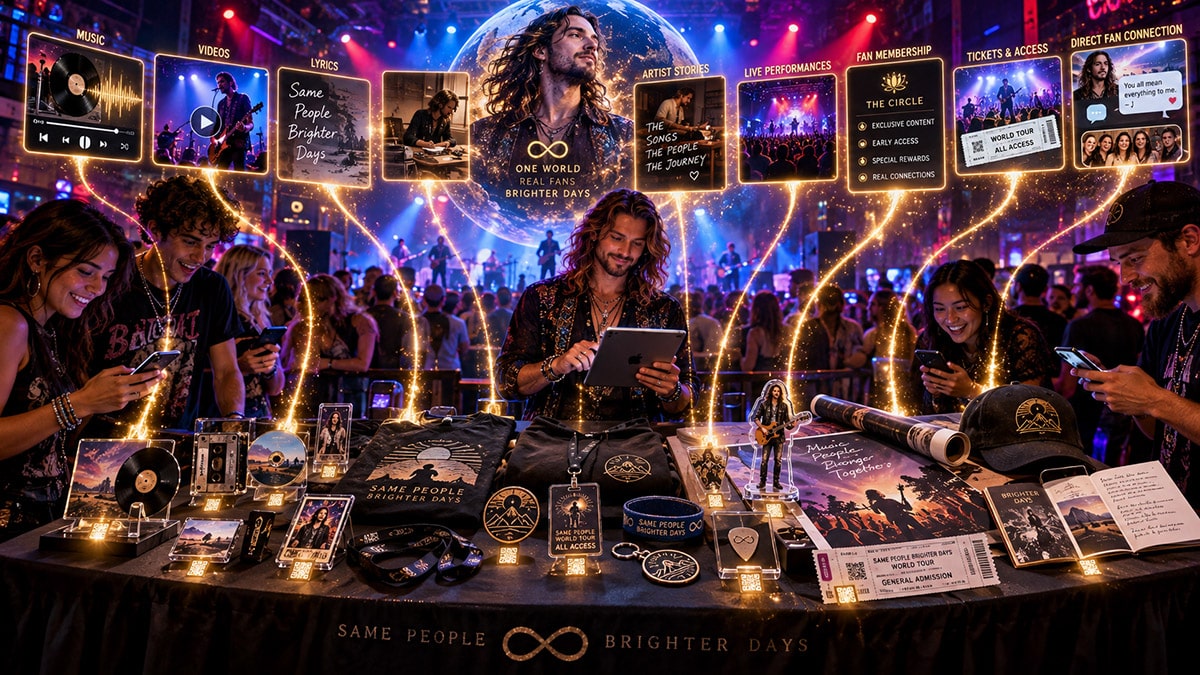
Making a Scene Presents – 25 Smart Media Products You Can Actually Build for Your Merch Table
Listen to the Podcast Discussion
How to Turn Ordinary Merch Into Physical-Digital Collectibles Without Setting Fire to the Tour Budget
The first generation of Smart Media Albums has arrived, and now comes the much more interesting question: what can an independent artist actually make with this stuff?
That question matters because nobody needs another technology looking for an excuse to exist. The music business has already provided artists with enough revolutionary tools that somehow require a monthly subscription, three passwords, a tutorial video and the patience of a Buddhist monk before anybody earns twelve dollars. Smart Media becomes interesting when we stop treating NFC as the product and start treating it as the invisible doorway inside a physical object a fan genuinely wants to own.
That changes the conversation completely. A record can become a portal into the making of the record. A guitar pick can unlock the performance where it was used. A tour laminate can become a permanent digital souvenir of the night. A shirt can stop being a piece of cotton with your logo across the chest and become a key that opens private music, backstage footage, future discounts, fan rewards and whatever else you decide to add later. The technology disappears, while the collectible becomes more valuable.
This is also where independent artists have an advantage over large corporations. You know the people standing at your merch table. You know which stories they ask about, which songs they scream during the encore and which ridiculous inside jokes have somehow become part of your little musical universe. Smart Media lets you turn those relationships into products that feel personal without having to manufacture 10,000 units in a warehouse located somewhere you cannot point to on a map.
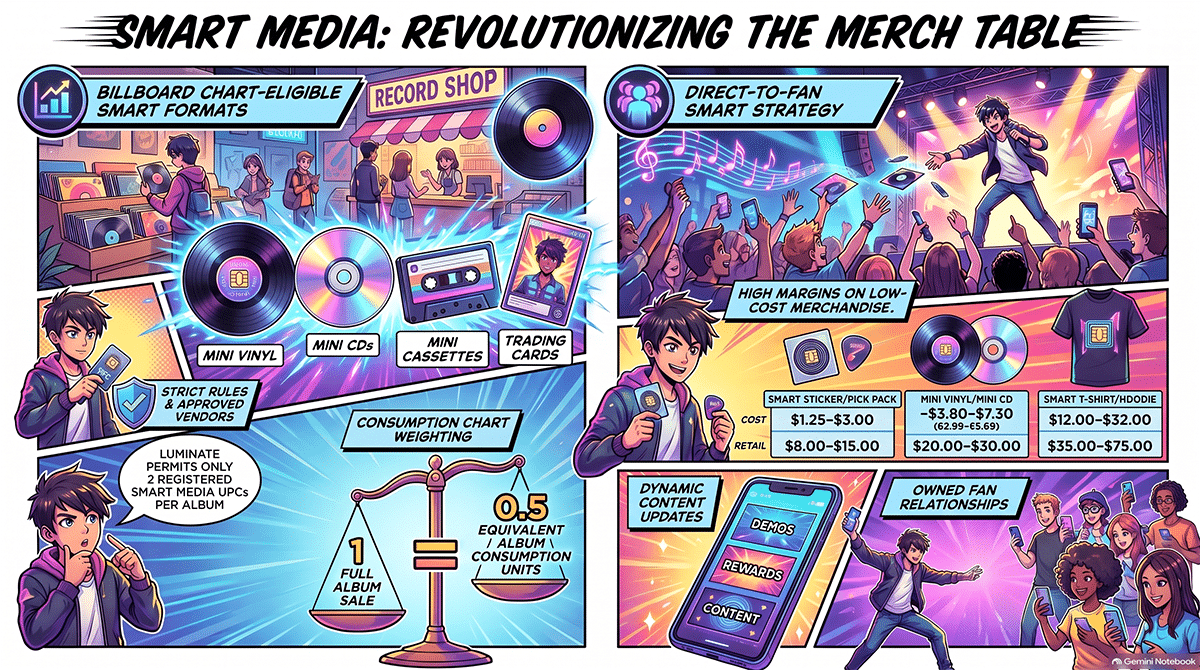
There is, however, one important distinction we need to make before anybody begins gluing NFC chips onto everything that survives long enough to sit still. Luminate began tracking Smart Media Albums in the United States and Canada on October 2, 2026, and qualifying products can now contribute to Billboard chart calculations. Luminate describes Smart Media as a physical product activated through technology such as NFC, QR codes or similar mechanisms that leads to a dedicated digital album experience rather than simply opening Spotify or another outside streaming service. Chart eligibility is limited to products handled through approved Smart Media vendors, and Luminate currently identifies KiTbetter, Serenade, Totem, IYK, WeVerse, Yoto and ZATAP among those providers.
There are more guardrails than the headline suggests. Luminate permits a maximum of two chart-designated Smart Media UPCs for one album project, and once those two are registered they cannot simply be swapped for different products later. Luminate also warns that promotional tactics or products not covered by its eligibility rules should be treated as ineligible rather than creatively interpreted by somebody who has just discovered a hot-glue gun. Billboard ultimately makes the chart determination.
Serenade makes the distinction especially easy to see. Its current U.S. Smart Formats page specifically identifies Mini Vinyl, Mini CDs, Mini Cassettes and Trading Cards as U.S. Billboard-chart-eligible formats, while it also sells or develops stickers, clothing tags, lanyards, wristbands, badges, patches and keychains as Smart Media products. That does not mean another approved provider can never make some of those other objects eligible, but it does mean an artist should never advertise a random NFC shirt, patch or keychain as a Billboard unit unless the approved provider has confirmed the exact product and reporting path.
For the products in this guide, I am therefore going to be deliberately conservative. Where a currently documented path toward U.S. Billboard eligibility exists, I will say so. Where it does not, we will treat the item as a direct-to-fan Smart Media product, which is hardly a consolation prize. A product that costs three dollars to manufacture, sells for fifteen and turns an anonymous concert buyer into a permission-based fan relationship can be considerably more useful to an independent artist than an eligible chart unit that exists mainly so everyone can spend Thursday refreshing a website.
The manufacturing figures also need to be read like a businessperson rather than an optimist in a merch booth. They are working estimates based on public supplier pricing available in early October 2026, generally before shipping, taxes and special setup charges. GoToTags, for example, currently lists custom printed NTAG213 NFC stickers at about $0.73 each at 500 units and printed on-metal tags around $1.00 at 500 units, which gives us a useful baseline for turning otherwise ordinary merchandise into connected products.
The retail prices I suggest are equally practical rather than sacred. An impulse product belongs roughly in the $8 to $15 neighborhood, a substantial collectible may live comfortably around $15 to $30, and premium pieces can move well above that when the physical object and digital experience actually justify the price. Your audience, genre, show size, manufacturing quantity and ability to tell a good story will decide the final number. Fans do not purchase spreadsheets. They purchase meaning.
With that settled, we can finally raid the merch table.
The Mini Vinyl That Is Not Pretending to Be Vinyl
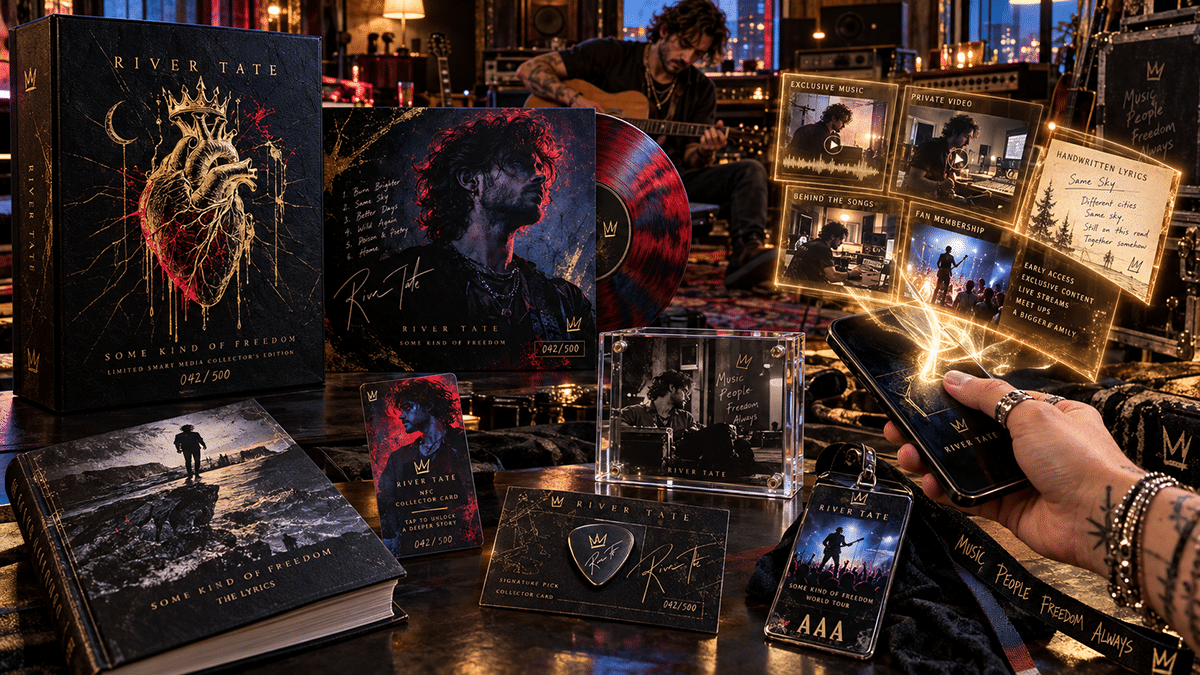
Few objects explain Smart Media more quickly than a miniature record. The fan sees something that clearly belongs to the language of music collecting, but there is no requirement to own a turntable, clean a stylus or argue online about whether 180-gram vinyl sounds more emotionally honest. Serenade currently manufactures NFC-enabled Mini Vinyl with a custom jacket and embedded chip, and its public international pricing runs from £4.49 per unit at 500 units down to £2.99 at 10,000. More importantly for an American artist, Serenade currently identifies Mini Vinyl as one of its U.S. Billboard-chart-eligible Smart Media formats, subject to release approval and current rules.
Packaging should lean hard into the illusion of a tiny record release. Give it a real cover, tiny back cover, catalog number and perhaps a miniature insert rather than tossing it into a bag like a promotional bottle opener from an insurance convention. The digital experience can open with the album, followed by lyrics, track commentary, studio photographs, alternate artwork and a short video introduction from the artist. This feels like a $20 to $30 merch-table product when the presentation is strong, and a signed or individually numbered edition could climb higher. For an artist who wants one of the two precious chart-designated Smart Media UPCs to also look like something fans actually want to collect, this is one of the clearest starting points.
The Mini CD for the Generation That May Not Own a CD Player
There is something wonderfully backward about manufacturing something that looks like a CD for people who increasingly do not own CD players, except the data says that is not nearly as absurd as it sounds. Luminate reported that CD purchases increased during the first half of 2026 and noted that many younger buyers were collecting physical music even without the hardware traditionally required to play it. That tells us the object itself has become part of fandom, which is precisely where Smart Media lives.
Serenade’s Mini CD contains an NFC-enabled miniature disc, collectible case and related packaging. Its international public pricing starts around £5.69 each at 500 units and falls with volume, while the company’s U.S. site currently identifies Mini CDs as Billboard-chart-eligible Smart Media when the release qualifies. A good experience would recreate everything we lost when album packaging shrank from LP jackets to tiny streaming thumbnails: full credits, lyrics, artwork, recording photographs, producer notes and perhaps track-by-track audio commentary. At the merch table I would think in the $20 to $30 range, with a signed deluxe version around $35 if the package includes a special card or numbered insert. The irony is beautiful: we finally made the CD useful again by making it unnecessary to put the actual music on the CD.
The Mini Cassette That Resurrects the Walkman Without Requiring Batteries
The miniature cassette is a natural Smart Media object because cassettes already carry the visual language of mixtapes, bootlegs and underground culture. Serenade’s version uses an NFC chip inside a miniature cassette presentation with custom sleeve artwork and display packaging. Current public international pricing is about £4.99 at 500 units, dropping toward £3.99 at much higher volume, and the U.S. Smart Formats page currently identifies Mini Cassettes as eligible to pursue Billboard chart treatment when the release is approved.
The digital experience almost writes itself. Instead of merely duplicating the released album, build the equivalent of an old homemade tape: album tracks, a hidden demo, spoken introductions, rehearsal-room recordings, handwritten lyric scans and perhaps an evolving “Side B” that changes months after purchase. Package it inside a tiny cassette case with the same obsessive attention an indie label might once have given a limited run of hand-dubbed tapes. Around $20 to $30 makes sense for a polished edition, while a signed or numbered version could reasonably move toward $35. If nostalgia is part of your artist identity, this one already speaks the language before the fan even taps it.
The Trading Card That Can Become a Whole Collectible Universe
Trading cards may be the most dangerous Smart Media product in this entire article because they invite musicians to rediscover the same behavior that once caused children to trade baseball cards and grown adults to spend alarming sums of money on small rectangles containing fictional monsters. That is exactly why they work. A single card can represent an album, song, tour date, band member, era, costume, guitar, venue or moment in the artist’s history, which means the physical format naturally encourages collecting without needing twelve almost-identical vinyl colors to accomplish it.
Serenade currently prices embedded-NFC trading cards at £2.49 each for 500 units, with lower prices at larger volumes, and specifically identifies Trading Cards among the four formats currently eligible for Billboard treatment in the United States when its release requirements are met. The card should come in a protective sleeve or small collector envelope rather than loose beside the tip jar. A $12 to $20 retail tier is reasonable for a standard edition, while signed, foil, serial-numbered or show-specific variants can move higher. The experience might open the album plus a unique piece of content connected to the image on that card, which creates a reason to collect different designs rather than merely accumulating duplicate gateways to the same page.
The KiTalbum Jewel Box for the Artist Who Wants the System Already Built
Not every artist wants to design the hardware, source an NFC tag, create packaging, build the digital environment and then spend Thursday night discovering why somebody’s Android phone will not read the thing. KiTbetter offers a more integrated route. Its current independent-artist program allows self-releasing musicians to order as few as 30 units, with the Standard Jewel Box configuration publicly priced at about $9.80 per unit at lower quantities and falling toward $8 at higher production levels. KiTbetter also offers on-demand manufacturing through its store with no upfront inventory requirement.
This is one of the more obvious chart-oriented products because KiTbetter is already among Luminate’s approved Smart Media providers and publicly announced Billboard eligibility for qualifying KiTalbums. Because the manufacturing cost is higher than a simple card, I would treat this as roughly a $25 to $35 retail product and push a deluxe signed edition higher. The physical package can include artwork and collectible material, while the digital side can provide music, video, lyrics, credits and additional album content through KiTplayer. The tradeoff is that you are using somebody else’s defined ecosystem instead of constructing every piece yourself, but sometimes control means knowing which problems are worth solving yourself and which problems deserve to be handed to somebody who already owns the screwdriver.
The Smart Sticker That Costs Almost Nothing but Should Never Feel Cheap
The humble sticker may be the lowest-risk entry into Smart Media. GoToTags currently lists custom printed NTAG213 NFC stickers at about $0.73 each at 500 units, while Serenade’s own connected stickers demonstrate that the basic idea can operate as a managed Smart Media product as well. Add a printed backing card, simple protective sleeve and a little assembly, and a small artist can realistically think in the neighborhood of $1.25 to $2 per finished direct-to-fan unit.
The trick is not selling a sticker for fifteen dollars while expecting the words “it has a chip” to magically settle the matter. Make it a numbered album seal, tour emblem or limited artwork edition, then let it unlock a meaningful experience such as a secret EP, monthly demo drop, members-only video diary or a fan reward path that grows over time. Packaged properly, $8 to $12 is realistic, especially if the sticker has holographic, die-cut or numbered treatment. Under current public U.S. guidance I would treat the DIY sticker as direct-to-fan rather than Billboard eligible; if an approved provider offers a qualifying sticker release in the future, confirm that before assigning one of your two Smart Media UPCs.
The Smart Keychain That Lives With the Fan Instead of in a Drawer
A keychain has an important advantage over most merch: people actually carry it around. Sticker Mule currently lists small custom acrylic keychains at roughly $1.27 each at 100 units, and an NFC element can be incorporated either through a specialized embedded manufacturer or, more simply, through an NFC-enabled backing component or smart token added during assembly. GoToTags’ custom NFC elements generally add less than a couple of dollars per unit at modest bulk quantities, making a realistic small-run target around $2.50 to $4 before premium packaging.
A simple jewelry card and small clear or kraft sleeve are enough for packaging, although a tiny rigid box makes a signed edition feel significantly more expensive than it actually was. The experience should reward repeated tapping because the object is always with the buyer: updated tour dates, presale access, loyalty points, secret songs and a “what’s new” screen work better here than a static album page. I would test a $12 to $18 retail range, perhaps $20 for numbered editions. Serenade and ZATAP both demonstrate connected keychain concepts, but unless the provider confirms the exact SKU for U.S. reporting, treat the merch-table version as direct-to-fan rather than a chart unit.
The Smart Patch That Turns a Jacket Into a Membership Card
Patches already carry social meaning. They tell the world what bands, scenes and ideas somebody identifies with, which means adding a digital layer feels far more natural than attaching technology to some random household object because the internet told us everything needs to be smart now. Serenade currently produces woven NFC patches with international pricing around £3.99 each at 500 units, including the embedded chip and instruction card.
For a DIY direct-to-fan approach, budget around $4 to $6 once the patch, NFC layer, backing card and packaging are assembled. The experience could unlock an album plus membership-style benefits, fan-club content, local show check-ins or evolving rewards whenever the fan taps the patch. Put it on a substantial backing card that explains the artwork and the unlock instead of dropping the patch into a sandwich bag from the grocery store five minutes before doors. A $15 to $22 retail range feels reasonable for a strong design. Serenade’s current U.S. page does not list patches among its four explicitly Billboard-eligible American formats, so I would currently sell this as a direct-to-fan collectible unless an approved provider confirms otherwise.
The Smart Button That Makes the Cheapest Merch on the Table Interesting Again
Buttons are beautifully democratic merchandise because they cost almost nothing and have been part of music culture since bands discovered that fans apparently enjoy putting tiny advertisements through their jackets. Sticker Mule currently prices 1.5-inch buttons at $49 for 100, or about forty-nine cents apiece. Add an NFC-equipped backing card rather than trying to cram electronics into the button itself, and the finished product can land around $1.50 to $2.50 depending on the packaging and NFC component.
That backing card is the important part because it turns a cheap button into a mini collector object. Number the edition, print a lyric on the reverse and let the NFC unlock the song represented by the button, the story behind it and a piece of bonus material. A $7 to $10 impulse price is easy to understand, while a set of three or four song buttons could move into the $20 range. Serenade also manufactures connected pin badges, but its current U.S. guidance does not list them among the four formats specifically approved for Billboard counting, so this should presently be treated as an artist-owned direct-to-fan product rather than chart inventory.
The Smart Wristband That Remembers the Show
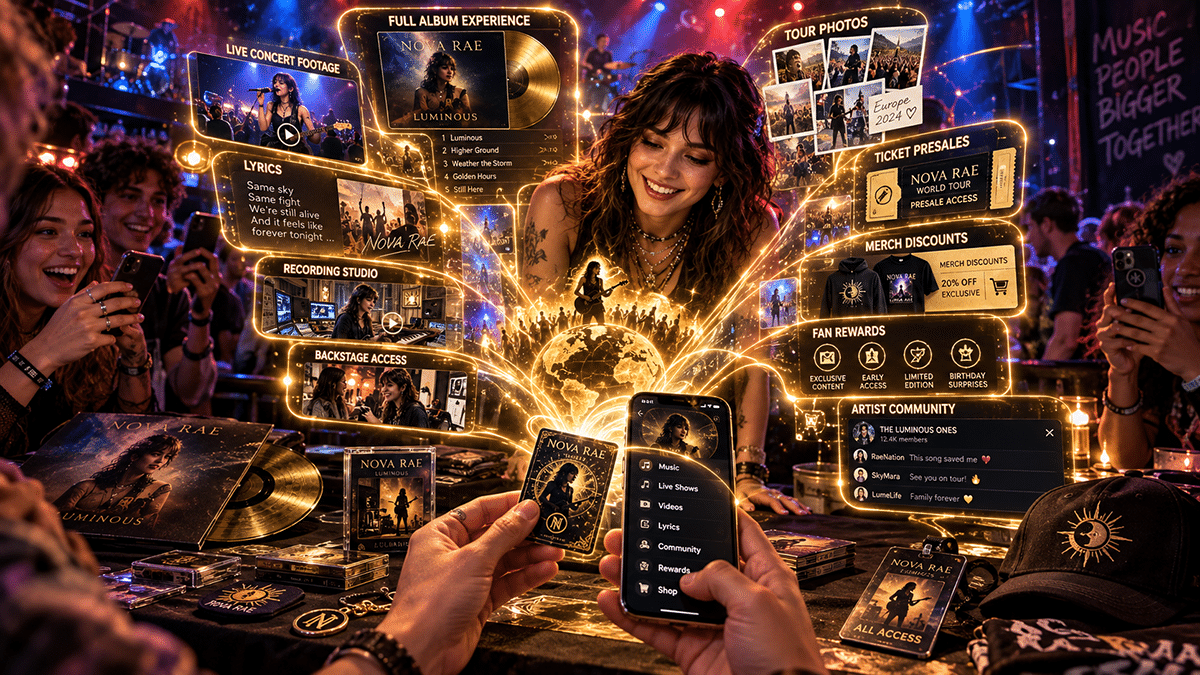
A wristband already feels like evidence that something happened. Festivals figured this out years ago when people began wearing the things long after there was any hygienic argument for doing so. Connected wristbands take that instinct and give the souvenir a second life. Serenade currently manufactures embedded-NFC silicone, elastic and festival-style wristbands, with its international 500-unit pricing ranging around £3.69 to £4.39 depending on style.
This product is strongest when connected to a specific performance. The tap could open photographs from that night’s show, the set list, a professionally mixed live track, an after-show message, future ticket presale access and a stamp inside the fan’s long-term concert history. Package it on a small event card carrying the venue and date, because context turns a strip of fabric into memorabilia. Around $15 to $20 is a believable retail tier when the digital material is good, and VIP versions can go higher. Under Serenade’s current public U.S. guidance, wristbands are not among the four explicitly Billboard-eligible formats, so their strongest role right now is fan memory, loyalty and direct revenue.
The Smart Tour Laminate That Gives Everyone Backstage Access Without Actually Letting Them Backstage
Tour laminates have magical powers. Put one around somebody’s neck and they immediately feel eleven percent more important, even if it only gives them permission to walk back to the parking lot. That makes the format wonderful merch. Serenade’s connected lanyards combine a custom PVC card, strap and embedded NFC chip; its public international pricing is around £4.29 per unit at 300 and falls with scale.
Design the card like a real crew or VIP credential, give the tour its own artwork and place the NFC experience behind the laminate rather than printing a giant QR code across the front like a restaurant menu. When tapped, it can open a tour diary, backstage mini-documentary, live recordings, road photographs, production notes and future tour announcements. A $20 to $30 retail tier feels natural because fans already understand the visual value of a laminate, and signed versions can command more. The current Serenade U.S. page does not place lanyards among the explicitly chart-eligible formats, so this is best treated as premium direct-to-fan merch whose real business value comes from repeated interaction and permission-based fan capture.
The Smart Clothing Tag That Makes Existing Merch Smarter
One of the cheapest ways to enter Smart Media may be to stop inventing entirely new products and upgrade the merchandise you already manufacture. An NFC hangtag can be attached to a shirt, jacket, tote or hat without changing the garment itself. Serenade currently lists connected clothing tags among its Smart Formats, with international starting prices around £1.79 per unit.
The package is already the garment, so the NFC tag should look more like a premium brand label than an electronics accessory. Print the release artwork on one side, explain the tap on the other, and use the experience to unlock bonus music, care instructions, authentication, rewards and future product offers. As an add-on, the smart layer may cost only a couple of dollars while giving you a legitimate reason to price a limited shirt five or ten dollars above the ordinary version. This is especially attractive to artists who already carry apparel inventory and do not want a second warehouse of experimental products. For Billboard purposes, however, treat a normal shirt with a smart tag as direct-to-fan unless an approved provider explicitly confirms the complete product as an eligible Smart Media Album.
The Smart T-Shirt That Becomes a Permanent Door Into the Artist’s World
A T-shirt remains the reliable old workhorse of the merch table, and Smart Media can make it considerably more valuable without requiring artists to reinvent apparel. Printful currently lists the Bella + Canvas 3001 with one print around $11.92 as a base price and roughly $10.37 each in an illustrative 25-unit bulk calculation. Add a dedicated NFC clothing tag or discreet smart patch and the practical production budget lands around $12 to $15 before shipping and elaborate packaging.
I would place the tag at the hem or sleeve rather than creating a mystery bump against somebody’s neck. A belly band around the folded shirt can explain that the garment unlocks a private digital experience, and the tap itself can reveal the album, a live session, garment-specific artwork, tour discounts and loyalty rewards. A $35 to $45 retail range is completely believable for a good artist shirt even before the digital layer, which means the Smart Media upgrade can increase perceived value without forcing the price into luxury-fashion territory. Unless manufactured and reported through an approved Smart Media pathway specifically confirmed for the SKU, this remains a direct-to-fan product, and that is perfectly fine.
The Smart Hoodie for the Fan Who Has Crossed Into Serious Supporter Territory
Hoodies occupy a different economic universe from stickers and picks because nobody accidentally buys a seventy-dollar sweatshirt while looking for somewhere to put loose change. That makes them excellent premium Smart Media products. Printful currently lists several custom hoodies in roughly the $22 to $32 manufacturing range before shipping and additional print locations, including its Gildan Heavy Blend Hoodie around $22.63 and Tultex Classic Hoodie around $26.50.
Add an NFC label, premium fold, branded tissue and perhaps a numbered certificate and you are realistically budgeting around $25 to $32 for a well-presented unit. I would sell it in the $55 to $75 neighborhood depending on garment quality and audience. Because this buyer has already made a meaningful commitment, the experience should feel closer to membership than downloadable liner notes: early ticket access, quarterly exclusive tracks, private livestreams, discounts and accumulating fan status make sense. This is currently a direct-to-fan play unless an approved provider specifically structures the hoodie as an eligible Smart Media Album, and artists should not assume ordinary apparel bundling rules have suddenly vanished because an NFC chip was sewn into the hem.
The Smart Hat That Quietly Carries the Fan Relationship Everywhere
A good hat is another piece of merch fans may wear for years. Printful currently says standard custom embroidered hats often cost roughly $15 to $25 each depending on style and quantity, with example pricing around $17 per unit at 100 hats. Add a smart woven label, small NFC patch or interior hangtag and a reasonable working production estimate lands around $18 to $22.
The best experience would not scream “album download.” A hat is an identity object, so let it unlock the fan’s ongoing place inside the artist community. Give owners special ticket presales, birthday drops, secret store items, show check-ins and perhaps a different collectible badge inside their digital profile each time they attend another concert. Package the hat in a branded paper wrap rather than a bulky box unless it is a genuinely premium edition. A $35 to $45 selling price is realistic, and limited embroidery or signed inserts can move it higher. For the moment, this is direct-to-fan territory unless an approved provider confirms an eligible U.S. music SKU.
The Smart Tote Bag That Becomes a Mobile Merch Table for the Fan
Totes are strangely effective artist merchandise because fans pay you for the privilege of walking through town displaying your artwork while carrying groceries. Capitalism occasionally produces poetry. Printful currently places its custom tote products roughly between $14.95 and $25.75 depending on style and printing method, so a practical Smart Media edition with an added NFC tag could begin around $16 to $20 in modest runs.
The NFC point can sit inside an exterior label or custom hangtag, while a simple branded belly band gives the product enough packaging to explain the tap. At $30 to $40 retail, the bag needs to look like real design rather than an object that escaped from the conference-swag closet. The experience might unlock the album, music videos, behind-the-scenes production material and a rotating “what’s in the bag” section offering merch discounts or surprise monthly drops. This should presently be treated as direct-to-fan Smart Media unless an approved vendor explicitly confirms chart eligibility for the exact configuration.
The Smart Poster That Keeps Changing After You Hang It on the Wall
Posters are nearly perfect for Smart Media because the physical object can remain visually timeless while everything behind it changes. Current U.S. printing prices make the basic object remarkably inexpensive. America’s Printer, for example, currently quotes 100 11-by-17 posters around $63.50, or roughly sixty-four cents each, while other short-run suppliers show comparable volume economics. Add a custom NFC sticker at roughly seventy-three cents in a 500-unit run, a protective sleeve and perhaps a backing board, and $2 to $3 is a reasonable practical manufacturing target for a nicely finished edition.
Do not put the chip in the middle of the artwork with a giant TAP PHONE HERE bullseye. Hide it elegantly behind a printed symbol or place it on the reverse and explain the interaction on a removable instruction strip. The digital experience can keep the poster alive with updated videos, alternate artwork, tour photography and future songs from the same era. A standard signed Smart Poster could sell around $15 to $25, while limited numbered prints on better stock can go much higher. Under current rules I would classify the DIY version as direct-to-fan, even though approved providers may eventually create eligible poster-based Smart Media products.
The Smart Lyric Zine That Gives Streaming-Era Music Its Liner Notes Back
One of the quiet casualties of streaming was not the plastic disc. It was the booklet. We lost lyrics, production credits, weird thank-you notes, photographs, stories and the pleasure of reading who played tambourine on track seven while listening to the record. A Smart Media lyric zine can bring that entire behavior back while letting the physical piece remain small and affordable.
Current 2026 printing guides place a 24-page saddle-stitched booklet around $1.75 to $2.75 each at 100 copies depending on paper and production choices, while Printivity offers short-run custom booklet manufacturing with a broad range of formats. Add an NFC label inside the back cover, a belly band and a protective sleeve and the realistic manufacturing target becomes roughly $3 to $5. Sell it for $15 to $25 depending on the design and whether it is signed. The experience should continue the editorial idea with audio commentary, songwriting demos, annotated lyrics and video stories about the songs. Unless an approved provider structures it as a qualifying Smart Media Album, treat this as direct-to-fan, where it can still earn considerably more money than liner notes ever did.
The Smart Photo Book That Turns an Album Era Into Something Worth Keeping
When the photographs are good enough, an album deserves more than a six-image Instagram carousel that disappears beneath somebody else’s lunch three hours later. A short-run photo book can turn a release cycle into a permanent artifact. Current promotional printing data shows 24-page full-color booklets can be produced around the mid-single-digit range at runs near 100, with one current supplier listing a 24-page full-color 8.5-by-11 booklet around $6.13 each at 100 units. Adding the NFC element, packaging and a modest finish puts a sensible target around $7 to $10 for a straightforward edition, while heavier covers and premium stock can easily push higher.
This belongs in the $25 to $40 retail tier, especially when signed. The NFC experience can expand the book into moving media by attaching audio commentary to particular images, studio video to recording-session pages and complete songs to the photographs associated with them. Suddenly the fan is not simply buying photographs; they are buying the archive of an era. Because the book is not one of the currently documented U.S. Smart Media chart formats, keep it firmly in the direct-to-fan category unless an approved vendor confirms otherwise.
The Acrylic Standee That Turns Album Art Into a Tiny Sculpture
Acrylic collectibles have become common in gaming and pop-culture fandom because they create a three-dimensional object without requiring anyone to manufacture an actual statue of the drummer. That makes them a terrific album-art product. Vograce currently lists some custom acrylic standees around $1.40 each at 100 pieces depending on size and configuration, while Sticker Mule’s smaller acrylic charms land close to a dollar each around similar quantities. Add the NFC element to the base or backing card and a small box, and a practical finished cost around $3 to $5 is entirely believable.
The artwork might reproduce the album cover, artist silhouette, mascot, guitar or stage set. The tap can trigger a dramatic full-screen splash animation before entering the album, which instantly makes the little object feel much more expensive than its bill of materials. At $15 to $25 retail, this can be an unusually profitable collectible if the art is strong. I would currently classify a DIY version as direct-to-fan, although the broader Smart Media market is clearly moving toward increasingly creative physical shapes.
The Smart Magnet That Makes the Refrigerator Part of Your Marketing Department
Magnets are not glamorous, which is exactly why they are useful. They stay visible for years in kitchens, rehearsal rooms, office filing cabinets and tour vans beside photographs, takeout menus and reminders that somebody should probably buy milk. Sticker Mule currently quotes 100 custom magnets around $81, or about eighty-one cents each.
Because ordinary NFC antennas can behave badly when placed directly against metal, this is one place where you should use an on-metal NFC tag with a ferrite layer rather than assuming every chip works everywhere. GoToTags currently prices printed on-metal NTAG213 stickers around $1 each at 500 units. Add a backing card and sleeve and you are still only around $2.50 to $3.50 for a finished unit, leaving room for a $10 to $15 retail price. The experience could become a constantly refreshed artist home screen with new songs, ticket links and monthly fan drops. This is direct-to-fan under current public guidance, but it may be one of the best long-life advertising objects in the entire pile.
The Smart Coaster That Sneaks Your Music Into Somebody’s House
The coaster may sound like the moment Smart Media finally wandered out of the music business and into a pub, but it makes surprising sense for blues, rock, country, Americana, jam bands and any artist whose natural habitat includes a bar. Sticker Mule currently prices 100 full-color custom coasters around $88, or eighty-eight cents each. Add an NFC element and simple sleeve and the total can remain around $2 to $3 per finished unit.
The fun begins with the experience. A brewery collaboration could unlock a live set from the venue, a drinking song, cocktail recipe, tour documentary or location-based reward when the fan taps the coaster at home months later. Sell one premium coaster for $8 to $12 or build a four-design set around songs, band members or album artwork for roughly $20 to $30. This is clearly direct-to-fan unless an approved provider eventually establishes an eligible product path, but a Smart Media product does not become less valuable because Billboard has never considered the chart implications of placing your record beneath somebody’s bourbon.
The Smart Guitar Pick Pack That Makes the Cheapest Piece of the Show Collectible
Guitar picks already have collector value because fans associate them with performance. Clayton Custom currently offers many custom printed pick options around forty to seventy-five cents each at 100 pieces depending on material and printing, with some basic white pick configurations starting around $39.99 per hundred. The NFC chip should not go inside the pick because that defeats the entire point of having something thin enough to play guitar with. Put the pick inside a collector card instead, embed the NFC in the card and package the whole thing like a tiny museum artifact.
A finished piece can easily stay below $2 to $3 in modest volume. At $10 to $15 retail, the fan can receive a real playable pick plus an experience containing the song performed with that guitar, a rig rundown, a lesson, isolated guitar stem or live footage. A premium variant containing a pick actually used at a specific show could go dramatically higher because provenance changes the economics. The ordinary version remains direct-to-fan, but that does not stop it from being one of the most authentically musical objects in the entire guide.
The Smart Commemorative Ticket for the Concert Ticket That No Longer Exists
Digital ticketing solved many practical problems while quietly murdering one of the cheapest pieces of music memorabilia ever invented. Fans used to keep ticket stubs in scrapbooks, wallets, guitar cases and bedroom mirrors. Now we have a line in an app reminding us that three years ago we entered Section 204 through Gate C.
Bring the physical ticket back, but do not pretend it needs to get anybody through the door. Print a beautiful commemorative ticket or show card on heavy stock, embed an NFC sticker inside a folded sleeve and number the edition to the night’s attendance. Depending on print quantity and finish, a realistic direct-to-fan production target is around $1.50 to $3, much of which is the NFC component itself. GoToTags’ current printed NFC pricing makes that economics entirely practical. Sell it for $10 to $15 by itself or include it in a higher-value show package. The tap can open the set list, photographs, live tracks, backstage recap and eventually the fan’s complete history of shows attended. This is not currently a documented Billboard product, and frankly it has a much more interesting job.
The Premium Acrylic Album Shrine for the Fan Who Wants the Ridiculous Version
Every merch table needs one product that makes somebody ask, “What the hell is that?” before they ask what it costs. A premium acrylic display can provide that moment without requiring Fabergé to reopen the workshop. Vograce currently offers more elaborate custom acrylic carousel standees with examples around $7.47 per unit at 100 pieces for one configuration, with smaller runs naturally costing more. Add a hidden NFC tag, printed certificate, serial number and rigid presentation box and a realistic production budget might land around $10 to $15 depending on how elaborate you become.
This is where the digital presentation should earn its keep. The fan taps the display and gets a full-screen animated opening, the complete album, immersive artwork, studio documentary, high-resolution downloads, alternate mixes and future updates reserved for owners of that specific edition. A $40 to $60 retail price is plausible if the object genuinely looks premium, with signed or extremely limited versions moving beyond that. Unless an approved provider designs and confirms a qualifying configuration, consider this a direct-to-fan collector piece. Nobody needs Billboard’s permission to make forty dollars instead of four.
What These Products Are Really Selling
After looking at twenty-five physical formats, it would be very easy to conclude that Smart Media is a manufacturing story. It is not. The manufacturing is actually the easy part.
An NTAG213 chip is inexpensive. Printing is inexpensive. Acrylic, cardboard, polyester, cotton and little miniature plastic records are not where the economic magic lives. The value comes from connecting the object to an experience that makes the fan feel as though they own a doorway into something other people cannot simply Google.
That experience also should not behave like a dead download page. A good Smart Media product can change after the sale. The owner can return next month and discover another demo, a new video, a presale invitation, a loyalty reward or photographs from the latest tour. The physical object stays the same while its usefulness grows, which is something conventional merchandise has never been particularly good at doing.
This is where independent artists need to resist one of the music industry’s oldest bad habits: handing the relationship away after finally earning it. When a fan activates a direct-to-fan Smart Media product, the artist should have a clear, permission-based path for that fan to join the artist’s own community, email list, rewards program or Fan Passport-style relationship system. The objective is not to collect personal information because technology makes it possible. The objective is to give the fan a reason to voluntarily stay connected because the relationship has continuing value.
The first tap might unlock the album. The second might reveal a live recording. The third could acknowledge that the fan attended another show. A purchase later in the year might unlock a new level of membership. The same person who once existed in your business as “somebody bought a shirt in Cleveland” can become a known supporter whose relationship with the artist develops over years, with consent and without requiring a social-media platform to graciously permit you to communicate with them.
That is where the Smart Media concept fits naturally with the larger Making a Scene philosophy. Spotify, Apple Music, YouTube, TikTok and whatever app arrives next Tuesday can still perform their extremely useful job of helping people discover artists. The artist’s own ecosystem should perform the much more important job of turning discovery into a durable relationship.
The Billboard Question Needs to Stay in Its Proper Place
There is real value in the arrival of Smart Media inside Luminate and Billboard’s measurement system. During the introductory phase, Billboard’s published framework says an eligible Smart Media transaction counts as one full album sale on album-sales charts while contributing 0.5 equivalent album unit toward album-consumption chart calculations. Approved vendors and the two-Smart-Media-UPC restriction remain important safeguards around that process.
For an artist mounting a serious release campaign, one of those eligible products may be worth the additional structure and provider cost. A chart appearance can produce press, credibility and a story that helps the campaign travel farther. There is nothing wrong with using the chart system strategically when the economics make sense.
The mistake would be assuming every Smart Media product therefore needs to chart. Your $12 connected guitar pick does not become a failure because Luminate has no category for it. Your $20 show laminate does not become pretend merchandise because Billboard cannot measure the relationship it created. If a $3 manufacturing cost becomes a $15 sale and that purchase also gives the fan a reason to join your owned audience, return to your next concert, buy another product and support the next release, the business already worked.
In fact, separating the two purposes may be the smartest approach. An artist could create one carefully planned chart-eligible Mini Vinyl, Mini CD, Mini Cassette, Trading Card or other provider-confirmed edition for the formal album campaign, then surround that release with direct-to-fan Smart Media merchandise whose only job is to create profit, collectibility and a stronger fan relationship.
That is a much healthier strategy than trying to bend every shirt, patch, coaster and guitar pick into a Billboard rulebook that was never designed to determine whether your refrigerator magnet is culturally important.
Start Small Enough to Learn Something
The best first Smart Media project for most independent artists is probably not a thousand-unit order. There is enormous value in learning how fans react before committing the grocery money to a revolutionary new merchandising theory.
Start with a product your audience already understands. A card, pick pack, sticker, poster or keychain can be manufactured cheaply enough that failure will be educational rather than financially character-building. Build fifty or a hundred. Put one demonstration unit on the merch table and let people tap it before they buy.
Watch what happens next.
Do fans understand the concept without explanation? Do they care about the physical object? Do they spend time inside the digital experience? Do they return after the first tap? Does the product produce email signups, repeat purchases, show attendance or membership conversions? Those questions matter far more than whether everybody told you the NFC chip was cool.
Once you see what your audience values, the next product can become more ambitious. The smart card can become a lanyard. The lanyard can become a premium photo book. The photo book can become a numbered acrylic display. The buyer who started with a twelve-dollar collectible can eventually become the person buying a sixty-dollar anniversary edition because each step made the relationship more valuable rather than simply asking for more money.
A Smart Product Should Know Why It Exists
The easiest way to ruin Smart Media is to treat the tap as a gimmick. If a fan taps your expensive collectible and lands on the same Linktree they could have reached from your Instagram bio, you have successfully manufactured disappointment with wireless technology.
The digital side should justify the physical side. If the product is a show laminate, the experience should remember the show. If it is a lyric book, the experience should deepen the songs. If it is a guitar pick, it should connect to the instrument and performance. If it is a premium collector object, opening it should feel like entering a private edition of the album rather than being sent to a webpage designed during lunch.
That also means artists should think about Smart Media before the album campaign is over, not six months later while trying to figure out what to do with leftover photographs and stems. Save studio footage. Photograph the recording process. Keep demos. Record commentary. Preserve alternate artwork. Document tour rehearsals. Treat those materials as inventory because one day they may be.
This is another quiet change Smart Media can bring to independent music. The album does not have to stop generating value after release week. Its sessions, photographs, stories, alternate versions and live history can keep creating products and experiences for years.
The Merch Table Becomes the Beginning Instead of the End
Traditional merchandise is usually a completed transaction. A fan gives you twenty-five dollars. You give the fan a shirt. Everybody smiles, and unless the person joins your mailing list for some unrelated reason, the relationship may disappear the moment they walk out of the club.
Smart Media gives that transaction a second chapter.
The physical object becomes proof of the relationship, while the digital experience provides a reason for it to continue. The artist can deliver more value. The fan can return. The product can recognize future activity. New offers can appear without printing a new object. Over time the little thing that once sat beside the shirts and vinyl can become part of the infrastructure through which the artist actually knows and serves the people supporting the music.
That is why the most important number in this guide is not the NFC chip price, the manufacturing cost or even the retail price. It is the lifetime value of the relationship that begins when somebody cares enough about your music to take a piece of it home.
For decades, the traditional music business trained artists to think about fans as numbers somebody else controlled: radio listeners, SoundScan units, followers, monthly listeners, video views and streams. Smart Media gives independent artists an opportunity to reverse that relationship by taking a physical product fans already understand and turning it into a doorway the artist controls.
Some of those products may count toward Billboard.
Some may never appear in a Luminate database.
Both can still build the music industry middle class we have been talking about all along, because the real revolution is not putting a computer chip inside the merchandise. It is finally making sure the road out of the merch table leads back to the artist.
 |  Spotify |  Deezer |  Breaker |
 Pocket Cast |  Radio Public |  Stitcher |  TuneIn |
 IHeart Radio |  Mixcloud |  PlayerFM |  Amazon |
 Jiosaavn |  Gaana |  Vurbl |  Audius |
 Reason.Fm | |||
Find our Podcasts on these outlets
Subscribe to Our Newsletter
Discover more from Making A Scene!
Subscribe to get the latest posts sent to your email.


