
You Own the Music. But Who Owns the Pipes?





Making a Scene Presents – You Own the Music. But Who Owns the Pipes?
Listen to the Podcast Discussion
For most of the modern independent music movement, we have spent a lot of time telling artists to own their masters, control their publishing, keep their copyrights, and avoid signing contracts that turn a lifetime of creative work into somebody else’s asset. That advice still matters because ownership is the foundation of almost every serious attempt to build long-term income from music. The problem is that the music business has changed enough that owning the song is no longer the entire independence question. An artist can own every note they recorded and still depend on a long chain of companies to distribute it, collect money from it, communicate with fans, license it, store it, sell tickets around it, process payments, and make it visible to the outside world.
That creates a much bigger question than the one we have been asking for the last twenty years. It is not just who owns the music anymore, but who owns the infrastructure the music has to travel through before it can become an actual business. You can own the house, but if somebody else owns the only road leading to it, another company controls the gate, another company holds the list of everyone who has ever visited, and one more company owns the cash register in the kitchen, your independence may be technically real while your ability to operate is still tied to everybody around you. That is not necessarily a conspiracy. It is just what happens when convenience slowly turns into dependency.
A new report from STVDIO, available at https://stvdio.io/, puts this question directly in front of the independent music community. Released on September 1, 2026, with support from Secretly Distribution at https://secretlydistribution.com/, the report is titled Independent Music 2026: The Fight for Music’s Infrastructure. Its central argument is that independent music has become an enormous economic force while much of the infrastructure underneath that music is consolidating into fewer corporate hands. That infrastructure includes distribution, royalty accounting, publishing administration, licensing systems, and other services that determine whether music actually reaches a marketplace and whether money finds its way back to the people who created it.
That is almost a perfect Making a Scene story because it forces us to update what we mean when we use the word independent. Independence used to mean that you did not have a major-label contract. Then it grew to mean that you controlled your masters, publishing, brand, and business decisions. Now we have reached another stage where an artist can remain legally independent while depending almost completely on systems owned by larger companies, investment firms, technology providers, or corporations connected to the same traditional industry the artist supposedly left behind. The artist may still own the music, but the road from creation to revenue increasingly runs across somebody else’s property.
Independent Music Is Bigger Than the Old Industry Story Suggests
The STVDIO report uses some large numbers to show just how important independent music has become. It points to estimates suggesting that independent music represents 46.7 percent of global recorded music ownership, around 35 percent of music consumption, and roughly 40 percent of album sales. Those figures make the independent sector look less like the scrappy little alternative to the real music business and more like a large part of the real music business itself, which is probably overdue considering how many artists have spent decades being told that independence was something you did while waiting for a proper company to discover you.
There is an important wrinkle in those numbers, however, and it deserves to be explained instead of buried beneath an exciting headline. The 46.7 percent figure comes from research by MIDiA Research at https://www.midiaresearch.com/, based on 2023 financial data. MIDiA estimated that non-major labels and artist-direct businesses represented 46.7 percent of global recorded music revenue when measured on an ownership basis. The 35 percent consumption figure and the 40 percent album sales figure come from Luminate at https://luminatedata.com/ and describe U.S. market activity rather than one single global 2026 measurement. STVDIO brings those numbers together to demonstrate the size of the sector, but they are not three parts of one identical dataset, and pretending otherwise would make the numbers sound cleaner than they really are.
The more revealing number may actually be another one buried underneath that headline. MIDiA estimated that non-major companies represented only 34.2 percent of the global recorded music market when measured on a distribution basis, even though they represented 46.7 percent when ownership was the measure. In the same research, MIDiA estimated that billions of dollars in music owned by non-major companies was nevertheless being distributed through major-label systems. That gap between who owns the music and who controls the pathway through which the music reaches the marketplace may tell us more about the future of independence than any market-share victory lap ever could.
That does not mean an artist loses ownership simply because another company distributes the recording. Distribution is a service, and using a service is not the same thing as surrendering a copyright. The more interesting issue is what happens when independent music becomes so dependent on a small number of large service providers that changing providers becomes difficult, expensive, confusing, or operationally dangerous. At that point, the artist may still own the asset while somebody else begins to control the practical conditions under which that asset earns money.
The Road Under Independent Music Is Consolidating
The consolidation beneath independent music is not theoretical. Over the last several years, several major pieces of the independent distribution and services business have changed ownership or moved closer to large corporate structures. Universal Music Group, at https://www.universalmusic.com/, announced in December 2024 that Virgin Music Group, at https://www.virginmusic.com/, would acquire Downtown Music for $775 million. That transaction was completed in February 2026 after regulatory review, bringing a large collection of businesses serving independent artists and labels into the orbit of the world’s largest major music company.
Downtown Music, at https://downtownmusic.com/, is not one simple distribution company. Its network has included businesses such as CD Baby at https://cdbaby.com/, FUGA at https://fuga.com/, Songtrust at https://www.songtrust.com/, Downtown Music Publishing, and other services that touch distribution, publishing administration, royalty accounting, licensing, marketing, and music technology. Artists and labels using those services may remain completely independent owners of their music, but the infrastructure they rely on now sits inside a much larger corporate structure than it did before the acquisition.
Sony Music Entertainment, at https://www.sonymusic.com/, has also owned significant pieces of independent music infrastructure for years. The Orchard, at https://www.theorchard.com/, became fully owned by Sony in 2015, and Sony acquired AWAL, at https://www.awal.com/, from Kobalt in 2021. Both companies work with artists and labels that may remain legally and creatively independent, which shows how complicated the word independence has become. The artist can be independent, the label can be independent, and the infrastructure carrying the product into the marketplace can still belong to a major music corporation.
Warner Music Group, at https://www.wmg.com/, moved deeper into infrastructure in 2026 when it agreed to acquire Revelator, at https://revelator.com/. Revelator provides technology for distribution, royalty accounting, rights management, analytics, and other business functions that support labels and music companies. Warner later discussed integrating that technology into its independent distribution and label-services operations. Again, this does not magically convert every customer using the platform into a Warner artist, but it does illustrate the direction of travel: the tools independent companies use are increasingly valuable enough for the majors to want ownership of the tools themselves.
Private equity is part of the story as well. In July 2026, CVC Capital Partners, at https://www.cvc.com/, announced an agreement to make a majority investment in DistroKid, at https://distrokid.com/. DistroKid has become one of the most familiar distribution services for independent musicians, particularly artists who want a relatively simple way to deliver recordings to digital platforms. The investment does not automatically mean that DistroKid becomes hostile to artists or that anything terrible happens to its customers. Private capital can help a company expand, improve technology, enter new markets, or develop services it could not afford to build alone. What it does mean is that another important piece of independent music infrastructure is tied to financial owners whose business goals may not always be identical to the goals of an individual musician trying to build a thirty-year career.
None of this requires us to turn major labels or investment firms into cartoon villains twirling mustaches beside a royalty statement. Large companies can provide stability, global reach, technology, fraud prevention, accounting, licensing relationships, and investment that smaller companies may struggle to provide. The real question is not whether big companies should exist. The question is whether independent artists are building businesses that remain functional when the big company changes the terms, sells the service, raises the price, changes priorities, retires a feature, or simply decides that the market is heading somewhere else.
Independence Does Not Mean Building Everything Yourself
Whenever a discussion about corporate consolidation gets rolling, somebody eventually suggests that artists should simply stop using these companies and build everything themselves. That sounds wonderfully independent right up until you imagine a working guitarist trying to create a global streaming delivery network between soundcheck and a 9:30 club set. Independence is not supposed to mean that you become your own bank, cloud provider, payment processor, ticketing company, distributor, telecommunications network, and international publishing administrator before breakfast.
Outside platforms are useful precisely because they solve difficult problems. A distributor can deliver music to hundreds of services. A payment processor can handle transactions without the artist becoming an expert in banking security. A ticketing company can process thousands of admissions in a way that would be absurd for a local band to recreate. An email provider can manage large mailing lists while dealing with technical delivery requirements most musicians do not want to spend their afternoon learning. A cloud platform can safely store enormous files, and an AI service may help an artist organize, analyze, market, or eventually license creative assets in ways that would be impossible to build alone.
The Making a Scene philosophy should never become a purity test where using a large platform somehow makes an artist less independent. That would turn a practical business philosophy into a religion, and the music industry already has enough people asking artists to believe things without checking the accounting. The smarter goal is to use outside platforms aggressively when they create value while making sure that no single platform becomes the only place where the artist’s business exists.
That distinction leads to what may be one of the most useful ideas for the next stage of independent music: portable independence. An artist does not need to own the distributor, ticketing company, cloud provider, AI model, or payment processor. The artist needs to be able to change those companies without destroying years of work in the process. That means the most important parts of the business have to remain accessible, organized, understandable, and portable even when a vendor changes.
Portable Independence Is Really Business Continuity
The easiest way to understand portable independence is to imagine that one of the companies you rely on disappears tomorrow. This is not because we should expect a major platform to spontaneously evaporate overnight, although the technology business has provided enough surprises that putting absolute faith in any corporation seems like an ambitious hobby. The point of the exercise is to discover which parts of your career are actually under your control and which parts exist only because another company’s dashboard happens to be working today.
Take distribution as an example. If your distributor disappeared, would you still have the approved master recording, the instrumental, the artwork, the songwriter information, the performer credits, the ISRC, the UPC, the release dates, the contracts, and the exact metadata connected to the release? Would you know which master corresponds to which identifier and which version was delivered to streaming services? If the answer is yes, changing distributors would be irritating but survivable. If the answer is no, you may discover that the most complete record of your own catalog belonged to a company you were merely paying to move files.
The same thinking applies to nearly every part of the business. If an email provider disappeared, could you legally and practically restore your permission-based mailing list somewhere else? If a ticketing platform shut down, would you retain the show records and customer information you were entitled to keep? If a sync service closed, would you still have your licensing history, rights documentation, stems, alternate mixes, and contacts? If your cloud provider locked the account, would another copy of the masters exist somewhere you control? These are not paranoid questions. They are the music-business version of keeping a spare key instead of assuming the locksmith will live forever.
Portable independence is really a business continuity plan for musicians, even if most artists would rather discuss almost anything else. The phrase “business continuity” sounds like something invented by people who enjoy beige conference rooms, but the idea is simple: your career should be able to continue when one tool fails. Independent musicians are already operating small companies whether they call them companies or not. They have intellectual property, customers, contracts, payments, digital files, marketing systems, collaborators, suppliers, and revenue sources. Once that is true, continuity stops being corporate jargon and becomes basic survival.
Your Distributor Should Not Be the Only Person Who Remembers Your Catalog
Artists have spent years learning that owning the master matters, but many still treat the distributor’s backend as the permanent memory of the release. That works right up until it does not. A distributor should distribute music, report revenue, deliver updates, and provide whatever other services are included in the agreement. What it should not become is the only surviving source of truth about the recording.
The artist should maintain an independent record of the information that gives the recording business value. That includes ownership, songwriting information, identifiers, performer information, release history, artwork, approved audio files, licensing status, agreements, and whatever other information is required to prove what the work is and what can legally be done with it. The details sound boring because they are boring, but boring information has an interesting habit of becoming incredibly exciting the moment somebody owes you money.
This is where many independent artists accidentally recreate the same weakness they thought they escaped by leaving the old label system. In the old business, a label might own the recording and control the paperwork. In the new business, an artist may own the recording but let a series of technology companies become the only places where the paperwork exists. The copyright situation is better, but the operational dependency can still become dangerous if the artist cannot reconstruct the business without logging into somebody else’s account.
Owning the Master Is Only the Beginning
The master recording is one layer of a much larger commercial system. A song may also involve publishing rights, performer agreements, producer participation, licensing permissions, alternate mixes, stems, clean versions, instrumental versions, artwork, metadata, and contracts describing how different contributors get paid. An artist can technically own the master while being unable to answer basic questions about what can be licensed, who needs to approve a use, or whether a particular collaborator ever signed the agreement everybody assumed existed.
Those missing details become expensive when a real opportunity arrives. A music supervisor may love a track for a television show but need an instrumental, proof of ownership, and fast confirmation that both the master and composition can be cleared. The artist who can answer those questions immediately has a commercial advantage over the artist who spends two days searching old email threads while trying to remember whether the bass player’s cousin co-wrote the bridge. The music itself may be equally good, but the organized artist has built infrastructure around the asset.
That is why ownership without operational control is incomplete independence. A master can generate streaming revenue, direct sales, licensing income, and other opportunities, but only if the business surrounding it is organized well enough to make those opportunities possible. The artist who owns the recording but cannot reliably locate the instrumental, rights information, or contributor permissions has an asset that is technically valuable but harder to monetize than it should be.
Publishing Has Its Own Plumbing
The publishing side of music makes the infrastructure problem even more obvious because the system is complicated enough to frighten otherwise confident adults. A song may involve performing rights, mechanical royalties, international collection societies, publishing administrators, licensing organizations, and multiple databases trying to describe who owns what. Artists often use outside companies because collecting publishing income across different territories would otherwise become a second career.
There is nothing wrong with that arrangement when the service is useful and the contract makes sense. The problem appears when the songwriter has no independent record showing who wrote the song, what each person owns, who administers the shares, which identifiers belong to the composition, and what registrations have been completed. At that point, the administrator is no longer simply helping manage the publishing. The administrator may have become the songwriter’s only functioning memory of the publishing business.
A portable system changes that relationship. The artist or songwriter keeps a reliable source of truth and allows the administrator to do the specialized work it was hired to do. If the relationship ends, another administrator can step in without forcing everybody to reconstruct the catalog from ancient emails, vague memories, and an alarming spreadsheet somebody named “splits_FINAL_reallyfinal.xlsx.”
That kind of organization is not glamorous, but it directly affects income. Publishing royalties are difficult enough to collect when the data is correct. When the data is incomplete or inconsistent, money can become unmatched, delayed, disputed, or simply too difficult to trace. Portable independence means the artist keeps enough information under their own control that a change in service provider does not create a hole in the chain of ownership.
Sync Licensing Shows How Quickly Organization Becomes Money
Sync licensing may be one of the clearest examples of why infrastructure matters because the buyer is often operating under a deadline. Film, television, advertising, gaming, and other visual-media projects may need music quickly, and the people making those decisions generally do not want a scavenger hunt. They need to know who controls the master, who controls the composition, whether the song is clearable, and whether the required versions can be delivered.
An artist who keeps an instrumental, stems, alternate mixes, licensing metadata, ownership information, and contributor agreements together can respond much faster than an artist whose sync preparation begins after the opportunity appears. That difference is not merely administrative. It can determine whether the artist receives a licensing fee, publishing income, exposure, and future opportunities or whether the buyer simply moves to another song that is easier to clear.
This is where the Making a Scene idea of building the revenue package alongside the creative product becomes so important. The finished master should not be treated as the end of the process. It should be the center of a larger set of commercial assets that allow the song to move into different markets. When those assets remain under the artist’s control and can be moved between licensing services, agencies, or marketplaces, the artist becomes less dependent on any one gatekeeper.
Your Fanbase May Be More Rented Than Owned
The infrastructure problem becomes even more personal when we move from songs to fans. Artists routinely talk about having thousands of followers, and those followers are absolutely valuable because discovery is the beginning of nearly every music relationship. Streaming services and social platforms can expose an independent artist to listeners who never would have found the music through traditional media. That reach is one of the greatest advantages musicians have gained from the digital era.
The trouble begins when artists confuse access to an audience with ownership of a relationship. A follower on a social platform belongs to the platform’s network. The artist can communicate with that person only within the rules, algorithms, and features the company chooses to provide. If the platform reduces organic reach, changes its recommendation system, loses popularity, suspends an account, or decides that artists now need to pay for something that used to be free, the artist does not get to load the entire audience into the van and drive somewhere else.
A direct relationship is different because it is based on permission and continuity. A fan who joins an artist’s mailing list, buys merchandise directly, becomes a member, purchases a ticket through a system that gives the artist lawful access to the customer relationship, or registers through an artist-controlled system has created a connection that may survive a change in platforms. That does not mean the artist owns the person or every piece of data attached to them, because privacy law and consent still matter. It means the relationship is less dependent on one company deciding whether the artist is allowed to communicate with the fan tomorrow.
This distinction is one of the central ideas behind the Making a Scene philosophy. Platforms should be discovery doors, not the final destination. An artist should use Spotify at https://www.spotify.com/, social media, playlists, video platforms, podcasts, press, radio, and every other useful discovery tool available. The mistake is allowing all of those roads to end inside someone else’s property instead of leading back toward a destination the artist controls.
The Artist-Owned Destination Still Matters
The humble artist website may be one of the least fashionable and most strategically important pieces of this entire system. It does not have to replace social media or streaming, and it certainly does not need to become a digital fortress where fans are forced to register before hearing a thirty-second clip. Its value comes from being a stable place where all the different pathways into the artist’s world can eventually connect.
A fan may discover the artist through a streaming recommendation, a concert, a friend, an interview, a social post, a sync placement, or an AI recommendation system. That first contact can happen almost anywhere because modern discovery is wonderfully messy. The website becomes valuable when it gives the artist a place to continue the relationship without depending entirely on the platform that created the introduction.
That destination can connect fans to shows, merchandise, direct music sales, memberships, licensing information, email communication, and other parts of the artist’s business. The point is not that every fan must leave Spotify or Instagram immediately. The point is that the artist gradually creates a second layer of connection that can survive when the discovery platform changes.
This is the difference between building a fanbase and simply accumulating account statistics. Followers, views, likes, and streams matter because they can signal interest, but the real business begins when some of that interest turns into a durable relationship. An artist who has no way to reconnect with fans outside the platform where they were first discovered remains dependent on the platform’s continued cooperation.

Ticketing, Merchandise, and Payments Are Part of the Same Infrastructure
Once money enters the relationship, the infrastructure becomes even more important. Ticketing companies, merchandise platforms, payment processors, membership systems, and online stores all create valuable transaction data. That data can help an artist understand where fans live, what they buy, which shows perform well, and which parts of the business generate actual revenue rather than applause from an algorithm.
Artists need to be careful here because customer information is not simply another asset they can move around however they please. Privacy laws, consent requirements, payment-security rules, and platform agreements determine what information can be collected, retained, exported, and reused. Portable independence does not mean ignoring those rules. It means choosing systems that allow the artist to keep whatever business records and customer permissions they are legally entitled to maintain.
That consideration should become part of how artists evaluate a platform. A ticketing service that helps sell out the show but gives the artist no meaningful relationship with the audience may be less valuable in the long run than a system that allows lawful communication after the concert. A merchandise platform with beautiful storefront tools may create hidden dependency if the artist cannot export customer history or transaction records. The cheapest service can become expensive when leaving it requires rebuilding years of business knowledge.
This is why the exit door should be treated as a feature. Artists spend enormous amounts of time comparing what a service does after they sign up, yet almost nobody reads the part explaining what happens when they leave. A platform that makes it easy to export important data, preserve records, retrieve files, and move elsewhere is demonstrating confidence in its value. A platform that makes departure difficult may be telling you something equally important.
Cloud Storage Is Convenient Until It Becomes Your Only Copy
The modern artist also creates a staggering amount of digital material. Recording sessions, masters, stems, alternate mixes, contracts, artwork, photographs, videos, royalty statements, invoices, licensing records, tax documents, and show information often live across multiple cloud services. Cloud storage is one of the greatest conveniences of the digital era because it lets a small music business keep enormous amounts of information accessible without maintaining racks of servers in the rehearsal room.
The danger comes when artists confuse cloud storage with a complete backup strategy. Cloud storage is still another company’s infrastructure, and access depends on an account, subscription, password, and service remaining available. Accounts can be compromised, files can be accidentally deleted, subscriptions can lapse, and companies can change products. The sensible response is not to drag every hard drive into a bunker and swear off the internet. It is to maintain independent copies of critical assets and know how the business can be restored if one service becomes unavailable.
This is especially important because a music career can last much longer than the technology companies serving it. An artist may need session files or licensing records twenty years after a song is released. There is no guarantee that the platform hosting those files today will exist in the same form twenty years from now. Portable independence means the archive belongs to the artist in practice, not merely in theory.
Every Artist Needs a Source of Truth
Once you follow all of these roads, they lead toward one central idea: the artist needs an authoritative source of truth for the business. That source does not have to be technologically impressive. A carefully organized spreadsheet and file system can be better than an expensive platform filled with incomplete information. What matters is that there is one trusted place where the artist can determine what is true about the catalog, rights, relationships, and revenue.
For a song, that means being able to identify the approved master, the composition, the writers, the ownership shares, the performers, the producer, the release information, the ISRC, the publishing information, the available alternate versions, the agreements, and any licensing restrictions or permissions that matter. As AI licensing grows, the record may also need to document permissions surrounding voice, likeness, training, derivatives, and other uses that did not exist when many older contracts were written.
The reason to centralize this information is not simply organizational neatness. Accurate data allows the artist to move between services without rebuilding the business every time. The artist can send the same authoritative information to distributors, licensing partners, publishing administrators, AI services, and other platforms instead of maintaining separate versions of the truth in every dashboard.
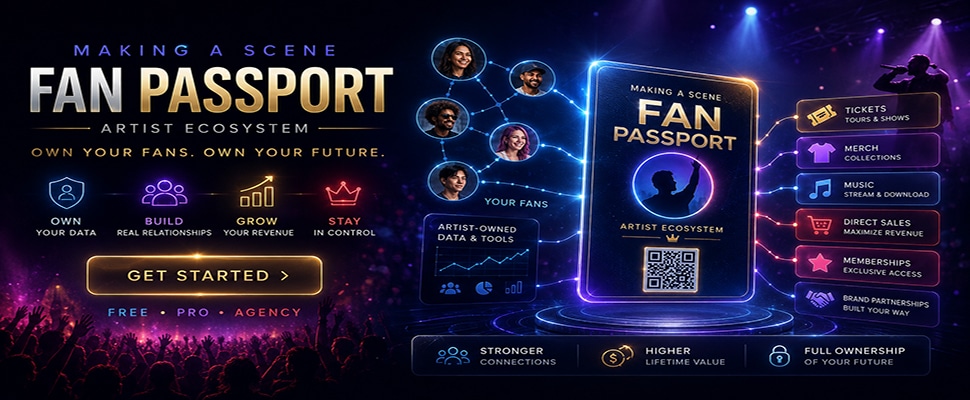
This principle is part of what we are building around the Making a Scene Artist Ecosystem and Fan Passport at https://www.masfanpassport.com/. The important idea is not that artists need another closed platform. The goal is the opposite: create an artist-controlled system that connects catalog identity, rights information, fan relationships, business history, and revenue pathways while allowing outside services to remain replaceable. Whether an artist uses that system, another platform, or a very disciplined spreadsheet matters less than adopting the underlying philosophy.
Music Already Has Standards We Can Build On
The music industry does not need to invent every piece of this future from scratch. DDEX, at https://ddex.net/, has spent years building standards that help different parts of the music business exchange information about recordings, compositions, performers, rights, sales, and royalties. Those standards exist because the industry already knows that data becomes much more valuable when different systems can understand the same information.
Interoperability may not be the sort of word that gets a crowd cheering during the encore, but it matters enormously to artists who want their business to remain portable. When every service uses completely different internal structures, the artist ends up entering the same information repeatedly. Every duplicate entry creates another opportunity for spelling errors, missing credits, incorrect ownership percentages, and mismatched identifiers.
A better independent infrastructure would allow the artist’s authoritative record to feed multiple systems. The distributor would receive what it needs for distribution, the publisher would receive publishing information, the licensing service would receive rights information, and the artist would remain the owner of the underlying source. Instead of every company becoming another isolated silo, the services could become connected tools around an artist-controlled core.
That may sound more like database architecture than rock and roll, but getting paid correctly has always involved an uncomfortable amount of paperwork. The difference now is that we have the technology to make much of that paperwork move automatically, provided the artist starts with accurate information.
AI Is About to Build Another Layer of Infrastructure
Artificial intelligence makes the infrastructure question more urgent because AI is rapidly becoming another system through which creative work may be discovered, analyzed, licensed, generated, and monetized. Artists already use AI for research, organization, marketing, production assistance, audio analysis, and administrative work. The larger opportunity may emerge when AI systems begin participating directly in music licensing, voice licensing, recommendation, catalog search, and other commercial uses.
That future will depend heavily on rights information. An AI company seeking legitimate music for training, generation, recommendation, or licensed derivatives will need to know who owns the material and what permissions are available. Artists who have organized their catalog, contributor agreements, voice permissions, publishing information, stems, and provenance will be in a much stronger position to participate in those markets than artists whose rights information exists only as assumptions.
This is where independent music should be careful not to repeat the same mistake it made with earlier digital platforms. The sector does not need to choose between rejecting AI entirely and handing over every creative asset without understanding the agreement. A middle path exists where artists use AI as a tool and participate in licensed AI markets while maintaining control over what is being licensed, for what purpose, under what terms, and for what compensation.
The infrastructure underneath that market will matter as much as the technology itself. If artists upload masters, stems, voices, or other valuable material to an AI service, they need to understand what rights the service receives, whether material can be used for training, whether data can be deleted, what commercial rights attach to generated output, and whether contributor permissions cover the intended use. Those are contract questions, but they are also infrastructure questions because they determine how easily the artist can move between services without losing control of the underlying assets.
Organizations such as Merlin at https://merlinnetwork.org/ already demonstrate how independent companies can negotiate collectively with technology platforms. New AI companies such as ElevenLabs at https://elevenlabs.io/ are also building music-generation and licensing systems that make these questions increasingly practical rather than theoretical. As AI becomes part of the commercial music economy, the artists who maintain organized rights and permissions will be better positioned to negotiate rather than simply accept whatever terms appear beside the upload button.
Web3 Becomes More Interesting When We Stop Treating It Like a Casino
This infrastructure conversation is also where some of the ideas behind Web3 begin to make more practical sense. The first wave of Web3 music enthusiasm became tangled up with cryptocurrency speculation, NFTs, collectible artwork, and the suggestion that every artist was one token launch away from financial freedom. Some useful ideas were buried underneath that noise, but they were difficult to hear while everybody was trying to explain why a JPEG of a cartoon animal represented the future of cultural ownership.
The more interesting Web3 ideas involve identity, provenance, permissions, and portability. The World Wide Web Consortium at https://www.w3.org/ has developed standards around decentralized identifiers and verifiable credentials that can allow identities and claims to be verified without depending entirely on one centralized platform. Those concepts could eventually allow artists to carry trusted identity, ownership, permissions, and provenance information between services instead of creating a new isolated identity every time they open an account.
That does not mean every music problem needs a blockchain. Conventional databases, APIs, digital signatures, export tools, and open standards can solve many of these problems perfectly well. The useful idea is not that decentralization is automatically better. The useful idea is that important information should not disappear simply because the company currently storing it disappears.
This may be the version of Web3 that independent artists actually need. Decentralization becomes valuable when it allows the artist’s business identity, rights history, permissions, and creative provenance to survive outside the lifespan of any one company. That is far more useful than attaching a token to an album and hoping the speculative market develops an appreciation for your bridge section.
Private Equity Is Not the Enemy, Dependency Is
Private equity and institutional investment deserve the same practical treatment. Investment firms are not automatically hostile to artists, and many companies need outside capital to expand, improve technology, enter new markets, or buy competitors. A financially strong owner can make a service better, more reliable, and more globally useful.
The concern is not that investors want a return. Of course they want a return. The concern is what happens when the artist’s entire business becomes dependent on a company whose priorities may eventually change because new owners, new growth targets, or new financial pressures arrive. Prices may rise, product lines may change, support may shrink, integrations may disappear, and services may be sold again.
Portable independence removes the need to predict whether any particular acquisition will be good or bad. If the new owner improves the service, the artist can stay and benefit. If the service becomes less useful, the artist can move. That ability to leave without rebuilding the career from scratch is the leverage that makes outside infrastructure safe to use.
The Next Independent Revolution May Look Boring
The first waves of independent music were highly visible. Artists pressed their own records, formed labels, booked tours, created scenes, and built alternatives to traditional gatekeepers. Digital technology pushed that movement even further by making professional recording affordable, opening global distribution, and giving musicians direct access to listeners.
The next stage may look much less dramatic because it will involve metadata, identifiers, permissions, exports, APIs, provenance, and backup systems. None of those things will look particularly exciting on a festival poster, but they may determine whether the independent sector actually keeps the economic power it has built.
Independent artists have already proven they can create the music. They have proven they can attract audiences without relying exclusively on traditional gatekeepers, and they have proven that independent ownership can represent an enormous share of the recorded music economy. The next challenge is making sure that the systems connecting those artists to the marketplace do not become so concentrated that independence exists only at the copyright level while everything surrounding the copyright remains controlled elsewhere.
This is where portable independence stops being a technology idea and becomes a strategy for building a music industry middle class. A durable middle class requires more than ownership. It requires enough control over the business that an artist can generate revenue repeatedly, survive changes in platforms, maintain relationships with fans, and preserve the information necessary to keep earning from creative work over time.
The Goal Is Not to Own Every Pipe
Independent musicians do not need to recreate Spotify, build their own international banking network, launch a distribution company, operate a cloud-computing center, and develop an AI model in the spare bedroom. That would not be independence so much as a spectacular new form of exhaustion.
The goal is to own the parts of the business that cannot easily be rebuilt while renting the infrastructure that can be replaced. The master should remain with the artist when the distributor changes. The rights information should remain available when the publishing administrator changes. The customer relationships the artist is legally entitled to maintain should survive a switch in email or commerce platforms. The creative archive should survive a change in cloud providers, and the business history should remain understandable even when the software that generated it is no longer being used.
When artists structure the business that way, platforms return to their proper role. They become tools that solve problems rather than containers inside which the artist’s entire career is trapped. A distributor can distribute, a ticketing company can sell tickets, a streaming platform can create discovery, an AI company can provide technology, and a payment processor can move money without any one of them becoming the permanent owner of the artist’s operational memory.
That may be the most useful new definition of independence available to us. An independent artist is not somebody who refuses to work with large companies. An independent artist is somebody who can change the companies they work with without destroying the business they spent years building.
The STVDIO report matters because the independent sector has become valuable enough that ownership of the surrounding infrastructure has become a serious business opportunity. If independent music were still a tiny niche, major corporations and investment firms would not be spending hundreds of millions of dollars acquiring the companies that serve it. The consolidation underneath the market is, in its own strange way, proof that independent music has succeeded.
Now independent artists have to make sure that success does not quietly rebuild the same dependency they spent decades escaping. Owning the master remains essential, but the next generation of independence will depend on something larger. Artists need to know where their catalog information lives, how their fan relationships can survive changing platforms, how their rights can move through new licensing systems, how their data can remain portable, and how their businesses can continue when one service is replaced by another.
That is what portable independence really means. It is not a rejection of platforms, labels, technology, investors, AI, or the modern music business. It is a recognition that outside infrastructure works best when the artist remains strong enough to walk away from it.
If we are serious about creating a real music industry middle class, that may be the most important shift of all. Independent artists already know how to own the music. The next challenge is making sure they do not accidentally give away control of every road the music has to travel before it reaches the people willing to pay for it.
 |  Spotify |  Deezer |  Breaker |
 Pocket Cast |  Radio Public |  Stitcher |  TuneIn |
 IHeart Radio |  Mixcloud |  PlayerFM |  Amazon |
 Jiosaavn |  Gaana |  Vurbl |  Audius |
 Reason.Fm | |||
Find our Podcasts on these outlets
Subscribe to Our Newsletter
Discover more from Making A Scene!
Subscribe to get the latest posts sent to your email.


