

Washington Just Changed the AI Music Fight




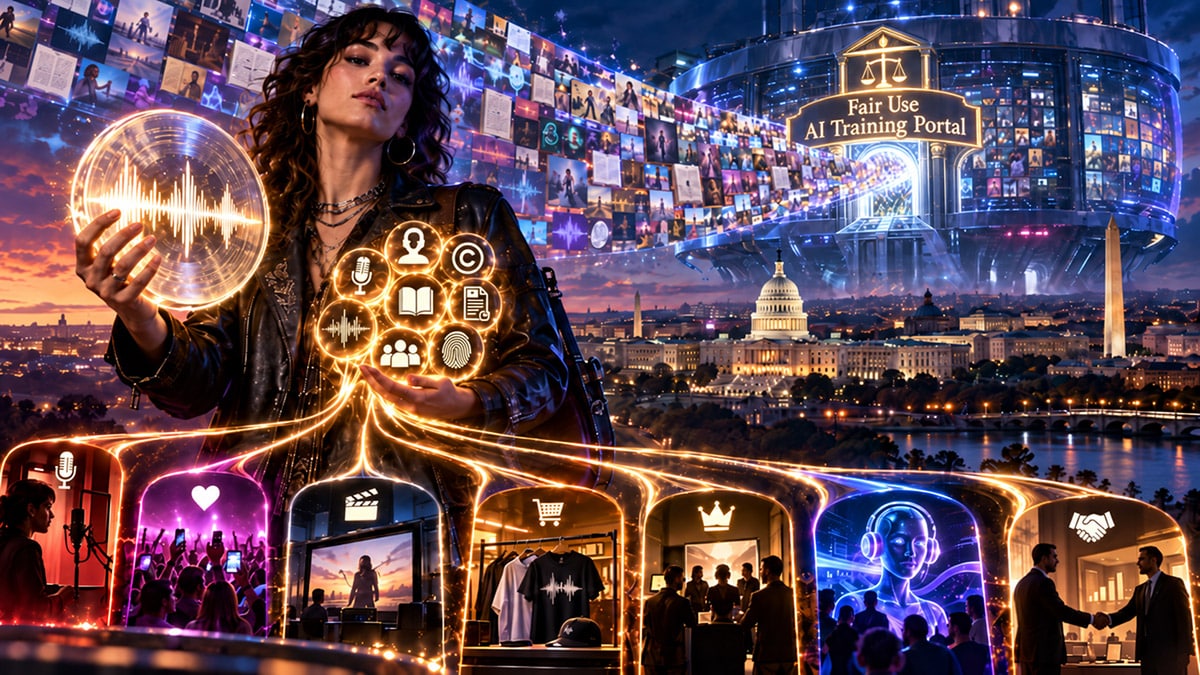
Making a Scene Presents – Washington Just Changed the AI Music Fight
Listen to the Podcast Discussion
If AI Training Becomes Fair Use, Independent Artists Need a Bigger Rights Strategy
For the last several years, the music business has been circling one giant question about artificial intelligence: whether AI companies should have to pay for the copyrighted music they use to train their models. That debate has attracted artists, record labels, publishers, technology companies, lawyers, lobbyists and enough venture capital to make almost any musician suspicious. The basic argument has always sounded simple. Creators say their work has value and should not be fed into commercial systems without permission or compensation, while AI companies argue that models learn from existing material in ways that can qualify as fair use. What changed this week is that the U.S. government stepped much more clearly into that argument, and Washington is leaning toward giving AI developers considerable freedom to train on copyrighted material.
At a G20 technology meeting in Chapel Hill, North Carolina, on September 2, U.S. Commerce Secretary Howard Lutnick urged countries to develop policies that allow AI companies to train on copyrighted creative material under fair-use principles while still protecting creators. Around the same time, the U.S. Justice Department filed a brief supporting OpenAI’s fair-use position in its copyright litigation with The New York Times and other publishers. The administration’s economic argument is straightforward: if American AI companies are forced to negotiate licenses for every piece of text, music, imagery and other material they use in model development, those costs and delays could weaken American AI development while competitors in other countries move faster.
None of that settles copyright law, because the Commerce Department does not get to decide what fair use means simply by declaring a policy preference. Judges still interpret the Copyright Act, courts still weigh the facts of individual cases, and fair use remains one of the messier areas of American copyright law. The government’s position still matters, however, because it shows where federal policy is heading, and that direction could reshape the way artists think about AI licensing. Independent musicians who have been assuming that AI training will eventually become another automatic royalty stream need to start considering a much less comfortable possibility: the law may not force every AI company to pay every copyright owner simply because a recording or song helped teach a model how music works.
That possibility does not make copyright unimportant. It does, however, expose a weakness in the way much of the music industry has framed this fight. Too many conversations have treated AI training royalties as though they are destined to become another version of performance income, where usage gets counted, money gets collected and somebody eventually sends the creator a statement that requires three cups of coffee and a degree in forensic accounting to understand. The problem is that nobody has guaranteed that system will exist, and the courts may never create it in the form many creators expect.
For independent musicians, the smarter approach is to stop building an AI strategy around a single future payment that may or may not appear. If training itself becomes broadly protected by fair use, the valuable rights may shift toward other parts of the artist’s creative identity. Voice, likeness, contractual permissions, commercial derivatives, stems, lyrics, recognizable performances, direct licensing and documented provenance may become more important because they involve specific uses that can remain commercially valuable even when general training is allowed. In other words, artists may have to think beyond owning the song and start thinking about owning the entire package of rights and permissions surrounding the song.
Copyright Is Still the Foundation, but It May Not Be the Whole House
Fair use is often discussed online as though it works like a cheat code that makes copyright disappear, but the actual legal doctrine is much more complicated. Courts look at why a work was used, the nature of the original work, how much was taken and whether the new use harms the market for the original. Those factors are weighed together, and courts can reach different conclusions depending on the facts in front of them. That is why two AI cases involving similar technology can produce very different legal reasoning, and it is why anyone claiming that the entire question has already been settled is probably selling something.
The U.S. Copyright Office made that uncertainty clear in its 2025 report on generative AI training. The Office acknowledged that some training uses may be transformative, but it stopped well short of saying that every AI training process automatically qualifies as fair use. It also warned that commercial use of enormous collections of copyrighted material can raise serious problems when the resulting system competes with the market for those works, particularly when the material was obtained from unauthorized sources. At the same time, the Copyright Office recognized that voluntary licensing markets were beginning to develop and argued that those markets should be allowed to grow rather than being crushed by an overly simple government solution.
That difference between the Copyright Office’s caution and the administration’s more aggressive policy position matters. The Copyright Office treated the issue as legally complicated and market dependent, while the administration is talking much more openly about giving AI developers room to train because it sees artificial intelligence as a strategic American industry. Creators, publishers and rights holders are understandably nervous about that direction because the practical effect could be to allow companies worth billions of dollars to build commercial products using creative material without paying every person whose work contributed to the system.
Independent artists should not react by throwing copyright out the window. Copyright still protects compositions and recordings, still supports publishing and licensing, still matters in synchronization and still gives artists important leverage when specific protected expression is copied. The more useful conclusion is that copyright may not protect every stage of the AI process in the same way. Training, acquisition, output, imitation, voice replication, commercial derivatives and identity may ultimately be treated as separate legal questions, and artists who understand that distinction will be better positioned than those waiting for one giant ruling to solve everything.
The future of AI music rights is likely to be less like a single gate and more like a collection of doors. Some of those doors may be open to AI companies under fair use, while others may still require permission, payment or contractual agreement. For independent musicians, the business opportunity lies in knowing which doors they control and making sure they do not casually hand over the keys.
The Music Business May Be Moving From Songs Toward Identity
The lawsuit involving Jason Isbell, David Lowery, Guy Forsyth and Eduardo Calle against Suno is especially important because it moves the AI argument beyond the copyright status of specific recordings. The artists are challenging what they describe as the unauthorized exploitation of their identities and recognizable artistic characteristics, which introduces a different kind of legal and economic issue. Instead of relying only on the question of whether Suno copied particular recordings during training, the case focuses attention on whether an AI company can commercially benefit from the identity of a musician without permission.
That distinction matters because a recording and the human being who made it are not the same asset. Masters can be sold, publishing can change hands, catalogs can be transferred and rights can end up inside investment funds that have never set foot in a recording studio. The person still has a name, a voice, an image, a reputation and a relationship with an audience. Those elements of identity can have commercial value even when the underlying copyright is owned by somebody else.
State publicity-rights laws already protect some aspects of identity, and those laws are becoming increasingly important as digital-replica technology improves. Tennessee’s ELVIS Act, for example, expanded protections around voice and likeness in response to AI-related concerns, while the U.S. Copyright Office has recommended stronger federal protection against unauthorized digital replicas. The details vary by jurisdiction, but the direction is clear enough for artists to pay attention. The law is beginning to recognize that reproducing a person’s voice or likeness through AI can create a different kind of harm from simply copying a copyrighted recording.
For independent musicians, that creates a business lesson that goes beyond the courtroom. If a general AI company can legally learn from a recording, that does not necessarily mean it can commercially market a product around the recognizable identity of the artist. A company that wants an authorized voice model, a branded interactive experience or a commercial derivative associated with a known performer may still need permissions that are separate from the right to train.
Those permissions can become products in their own right. An artist may decide that a voice model can be used for one tightly controlled project but not for general consumer generation. Another artist may refuse voice cloning completely while allowing instrumental stems to be used for an adaptive soundtrack. A songwriter might permit a lyric-based research project while rejecting commercial synthetic songs built from those lyrics. The important idea is not that artists should accept every new AI offer. The important idea is that each permission can be negotiated independently, and that gives the artist more control than a single blanket yes or no.
The music business spent decades teaching artists to worry about who owns the master, usually after somebody else already owned it. AI is adding a new layer to that lesson because ownership now includes the right to control how a person’s creative identity is used. The valuable asset may not always be the recording itself. In some transactions, the most valuable asset could be permission to sound like the artist, look like the artist, market something as connected to the artist or create new work that carries the artist’s recognizable identity.
Udio Is Making the Fair-Use Argument as Clearly as Possible
While the Suno litigation pushes toward identity rights, Udio is arguing directly that AI training on copyrighted recordings should be protected by fair use. In its continuing litigation with Sony Music, Udio has described its training process as “quintessential fair use,” arguing that copyrighted recordings are used internally as part of a technological learning process rather than redistributed to listeners as substitutes for the originals. Sony has alleged that Udio copied 30,117 recordings from its catalog, while Udio denies liability and argues that its training process is legally transformative.
No court has accepted Udio’s substantive position in that case, which is important because filings from lawyers are arguments, not final law. Sony is presenting a very different view and contends that the use of its recordings was unauthorized and commercially harmful. The legal fight will likely turn on complicated questions about transformation, market substitution, source material and the nature of the outputs produced by the model.
Udio’s position nevertheless reveals where the AI industry wants the law to go. AI developers are asking courts to separate internal machine learning from public distribution, arguing that a model studying recordings is not equivalent to a company selling copies of those recordings. Rights holders are pushing back by arguing that the models themselves are commercial products and that their ability to generate competing music can harm existing licensing markets.
The situation becomes even more complicated when the method used to obtain the training material enters the picture. Udio has acknowledged obtaining some material from YouTube and using tools to download audio, which creates a different set of legal questions involving access and technological protections. Even if a court ultimately decides that some training use qualifies as fair use, the way files were acquired may still matter. That distinction is a reminder that AI litigation is likely to split into many smaller legal questions rather than produce one grand ruling that neatly settles everything.
Musicians should actually find that familiar. The music business has spent generations separating a single piece of music into composition rights, master rights, mechanical rights, performance rights, sync rights and several other categories that make normal people’s eyes glaze over. AI appears to be adding training rights, output rights, digital-replica rights, data provenance and model permissions to the same family. Nobody can accuse the music business of letting a simple system survive when a complicated one can be invented instead.
The Training Royalty May Be Only One Part of the AI Market
The danger in focusing only on training royalties is that artists may overlook the much broader commercial market developing around AI. A company may want to train on a finished recording, but another company may want high-quality stems that were never publicly released. A game developer may want a version of a song that changes dynamically depending on what happens inside a game. A film producer may want alternate performances or adaptive edits. A brand may want an artist-approved synthetic voice for a campaign. These uses involve different assets, different levels of access and different commercial value.
Scarcity matters in all of those transactions. A released stereo master is widely available on streaming services and video platforms, but isolated vocals, multitracks, alternate mixes and clean stems are usually controlled by the artist or producer. Those materials are more valuable precisely because they are not sitting everywhere on the public internet. An artist who owns and organizes those assets can decide when they become available and under what terms.
This is where AI starts to look less like one mysterious royalty and more like an extension of the licensing business. A commercial buyer does not simply want “music.” The buyer wants specific rights that match a specific use. A supervisor may want the master and composition cleared for television. A game company may need interactive rights and stems. An AI developer may want permission to create a particular derivative product while also needing assurance that every performer involved has been properly cleared.
Independent artists who understand those distinctions can package their work intelligently. They can keep instrumental masters, stems, alternate endings and clean versions ready. They can document the people who contributed to the recording and the agreements that govern those contributions. They can decide which types of generative uses they are willing to authorize and which uses are off limits.
That approach is already familiar to anyone who has worked in sync licensing. Supervisors prefer material that can be cleared quickly because deadlines are short and legal uncertainty is expensive. The same logic will likely apply to AI. Artists who can prove ownership and permissions will be easier to work with than artists whose rights information lives in six inboxes, three laptops and a former drummer’s memory.
Licensed AI Can Still Exist Even If the Law Does Not Require Every License
One of the biggest mistakes artists could make is assuming that broad fair-use rulings would destroy the market for licensed AI. Companies buy licenses for reasons that go beyond legal necessity. They buy certainty, access, quality, exclusivity and lower risk. Those incentives remain powerful even if courts eventually give AI developers broad freedom to use publicly available material for training.
Stability AI provides a useful example because its Stable Audio platform has emphasized licensed training data as part of its market position. The company has treated provenance and licensing as benefits for commercial users rather than as burdens to be avoided. Major music companies have also become financially involved with Stability AI, which suggests that parts of the traditional industry believe licensed AI can become a viable business even while other companies continue fighting for broader fair-use protection.
That may lead to two AI economies operating at the same time. Some systems may rely heavily on fair use and train on whatever material the law allows them to access. Other systems may deliberately build licensed catalogs because enterprise customers, advertisers, studios, distributors and investors want cleaner rights and more predictable legal exposure.
The second market could become extremely important to independent musicians because businesses often value certainty more than theoretical legal freedom. A company spending millions of dollars on an advertising campaign does not want to discover later that the generated soundtrack created an identity-rights problem or closely reproduced protected material. A film studio may prefer a system with documented provenance because its legal department wants to know where the music came from. A game developer may choose licensed artist stems because they offer better quality and clearer commercial rights than material scraped from the public internet.
That creates a real opportunity for independent artists who prepare their catalogs properly. The advantage does not come from waiting for Congress or a federal judge to force companies to pay. It comes from making the artist’s material easier, safer and more valuable to license than anonymous alternatives. Clean rights can become a competitive advantage even when the law does not make licensing mandatory.
Provenance Is Becoming Part of the Product
The word provenance sounds like something that belongs in a museum catalog, but the idea is simple for working musicians. Provenance is the ability to show where a recording came from, who participated, who owns it and what permissions exist around its use. In an AI economy, that information may become almost as important as the audio file itself.
Consider two equally strong songs. One comes with accurate songwriter splits, publishing information, performer agreements, producer terms, master ownership, stems, instrumentals, recording dates and clear permissions surrounding AI-related uses. The other exists as a WAV file named MASTER_FINAL_REALFINAL_2.wav with no reliable paperwork and a vague belief that someone named Chris played percussion. Both recordings may sound great, but only one is ready for a complicated licensing transaction.
That difference has direct financial consequences. A company considering an AI-related use may need to know whether vocals can be manipulated, whether performers consented to derivatives, whether the composition can be changed and whether the artist has authority to approve the transaction. If those answers are documented, the deal can move quickly. If nobody knows the answers, the company may move on to another piece of music that does not require an archaeological expedition.
This is why Making a Scene has been arguing that independent artists need a source of truth for their music. Ownership, contributors, rights, metadata, alternate versions, stems and permissions should remain connected to the recording rather than scattered across devices and email threads. The same preparation that makes a song sync-ready can make it more valuable in future AI markets.
As synthetic content becomes easier to create, the ability to prove where something came from will become more valuable. A verified human recording with known contributors and clear rights may carry a different commercial status from anonymous content generated with uncertain inputs. Provenance is not glamorous, but neither are publishing statements, and musicians have learned that the least glamorous parts of the business often determine whether money actually arrives.
The Output May Matter More Than the Training Input
The industry’s fixation on training has also distracted attention from what happens after a model has been trained. Commercial outputs are where many of the most important licensing opportunities and legal disputes may appear. A model can learn from millions of works, but the economic question becomes much more specific when somebody tries to sell, distribute or market the result.
If generated music reproduces protected lyrics, melodies or other recognizable expression, traditional copyright questions can return immediately. If the output closely imitates a particular singer, publicity rights and digital-replica laws may become relevant. If somebody uploads protected stems and uses them to create a commercial derivative recording, the rights surrounding the master and composition may also come into play.
These situations show why the word AI cannot be treated as one giant legal category. Training, generation, imitation and commercial exploitation are different activities, and they may require different rights. An artist can potentially permit one use while refusing another, which gives creators much more flexibility than the simple choice between embracing AI and rejecting it.
For independent artists, this creates opportunities to build specific licenses around specific products. A brand might want permission to generate ten alternate versions of a song for different regions. A video game company might want interactive stems that change during gameplay. A fan platform might want an artist-approved experience built from a limited set of authorized recordings. These are transactions with identifiable commercial value, and they can be negotiated like any other license.
The important shift is that artists should start thinking like licensors rather than waiting to become beneficiaries of a future royalty system. A licensing mindset asks what the buyer wants, what rights are necessary, what risks are involved and what those permissions are worth. That approach puts the artist in a stronger position because it treats AI as another market to manage rather than a giant mystery controlled by technology companies.
Blanket AI Contracts Are Becoming More Dangerous
The possibility that training could receive broad fair-use protection makes contractual discipline even more important. Artists are already encountering agreements with sweeping language covering machine learning, synthetic media, derivative works, voice, likeness and sublicensing. Those clauses can be buried inside ordinary distribution, platform or service agreements where musicians may not expect to find them.
The danger is that companies may ask for far more permission than they actually need. A service that wants to analyze a recording may also seek rights to create derivatives, use an artist’s voice or sublicense material to third parties. Those additional permissions can be commercially valuable even if basic training eventually becomes legally protected without a license.
Artists need to separate those rights rather than treating AI permission as one giant checkbox. Training access, voice replication, commercial derivatives, fan-facing generation and sublicensing should not automatically travel together. Each activity can involve a different risk and a different value.
That distinction matters because a company may use the fair-use debate to make broad contract language seem harmless. If artists assume that AI rights no longer matter because training may be fair use, they could sign away the very rights that remain most valuable. The law may allow a company to study a recording, but that does not automatically give the company permission to become the artist, market the artist or commercially exploit the artist’s identity.
The independent artist’s best protection is a clear understanding of what is being granted and why. Technology does not make contracts less important. It makes vague contracts more dangerous.
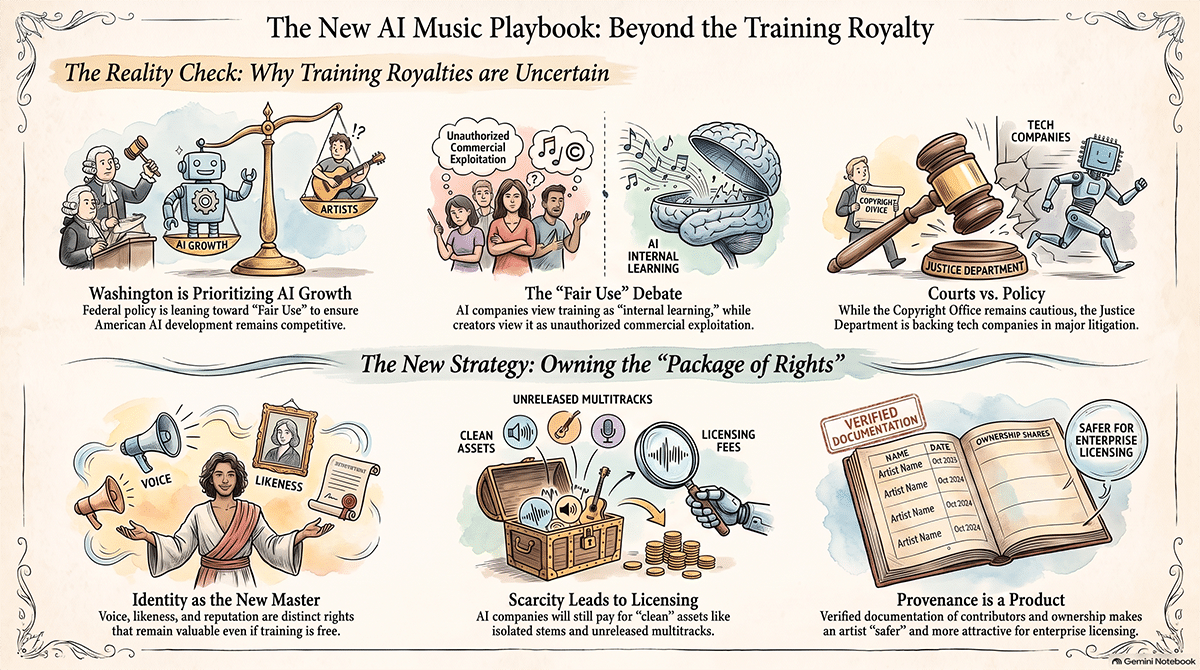
The Artist’s AI Strategy Should Become a Portfolio of Rights
The healthiest way to approach AI is to stop treating it as one single thing. Music contains compositions, recordings, lyrics, voices, performances, images, names, likenesses, stems, metadata and fan relationships. Each of those assets can have different commercial value, and different companies may want access for entirely different purposes.
Artists should decide how those assets can be used before an offer arrives. One artist may allow finished recordings to be used in a licensed research model while refusing access to isolated vocals. Another may permit instrumental transformations for gaming but prohibit voice cloning. A songwriter may allow educational analysis of lyrics while rejecting consumer-facing synthetic songs.
There is no reason every artist needs the same policy because ownership is supposed to mean the ability to make those choices individually. The music business has spent too much time framing technology as a loyalty test where musicians are expected to be either enthusiastic futurists or frightened traditionalists. That framing is useless to anyone trying to build an actual career.
An artist can use AI tools aggressively for production, marketing, administration and discovery while still refusing to surrender valuable rights. Technology can make the business more efficient without turning the artist into free raw material. The balance comes from knowing what the artist owns and deciding which parts of that ownership are available for licensing.
Human-Created Music May Become Premium Inventory
As generated music becomes cheaper and more abundant, documented human creation may become more valuable in certain parts of the market. That value will not necessarily come from some cultural revolt against AI. People have shown a remarkable willingness to accept almost any technology if it saves them enough time, and expecting society to suddenly become purist about digital tools is probably not a reliable business strategy.
The more practical advantage comes from commercial certainty and human connection. A brand may want a real artist who can appear in a campaign, perform the song live and talk about the story behind it. A film company may prefer music with a clear chain of ownership and documented contributors. A supervisor may value a catalog that includes clean stems, alternate versions and accurate metadata.
Fans may also begin to care more about the story behind music as synthetic content becomes common. Knowing who played on a recording, where it was made, what inspired it and how the artist created it can become part of the value. The human story creates context that anonymous generated material cannot easily reproduce.
For independent artists, that makes provenance part of the creative product rather than just paperwork. The recording session, contributors, songwriting process and ownership history can travel with the music into licensing systems and fan communities. That information helps commercial buyers evaluate the work and helps listeners understand who they are supporting.
The more abundant music becomes, the more valuable origin and identity can become. Independent artists should own both.
Direct Fan Relationships Become Even More Important
All of this reinforces the Making a Scene philosophy that platforms should be treated as doors rather than homes. AI companies, streaming services and social platforms can all be useful tools for discovery, but the artist needs to own the relationship that comes after discovery. That means building an audience that can be reached directly rather than depending entirely on somebody else’s algorithm.
A direct fan can buy tickets, music, merchandise and memberships. That fan can support a crowdfunding campaign, attend a livestream, join a private community and bring other people into the artist’s world. Those relationships remain valuable regardless of how a court interprets fair use.
AI can strengthen that business rather than threaten it. Artists can use AI to organize fan data, personalize communication, improve marketing, analyze catalogs and create new interactive experiences. The important distinction is that those tools should serve the artist’s ecosystem instead of replacing it.
A musician who owns the email list, customer relationship and fan community has something an AI company cannot simply scrape from a public recording. That relationship is based on trust, history and identity, and it becomes more valuable as synthetic content grows.
The lesson is the same one independent artists have been learning from streaming and social media for years. Discovery is useful, but ownership of the audience is where long-term business begins.
The Music Industry Middle Class Will Not Be Built on One Magical Royalty
The music business has a long history of waiting for one new technology to save everybody. Streaming was supposed to fix distribution. Social media was supposed to eliminate gatekeepers. NFTs were supposed to rebuild artist economics almost overnight. AI licensing is now beginning to attract the same kind of expectations.
Independent artists should resist that temptation because sustainable careers rarely come from one revenue source. A healthier music business is built from several streams that reinforce each other. Live performance supports merchandise, merchandise strengthens fan identity, direct sales create stronger margins, publishing and sync produce long-term income, and memberships can turn casual listeners into dependable supporters.
AI fits into that ecosystem rather than replacing it. An authorized voice project can become one revenue stream, a derivative license another and access to stems another. Those sources can exist beside live shows, publishing, direct sales and fan support without carrying the entire financial burden of the artist’s career.
That diversification is what creates resilience. If one court ruling changes the economics of AI training, the artist still has other revenue. If a platform changes its rules, the direct fan relationship remains. If one licensing market slows down, another can continue.
A music industry middle class will not be built from one giant check arriving from a technology company. It will be built from many smaller pieces of income that artists control and connect.
Organization Is Becoming Part of the Creative Business
The practical consequence of all this is that artists need to become more organized about what happens when a recording is created. Ownership should be documented while memories are fresh. Songwriter splits should be settled before relationships become complicated. Instrumental versions and stems should be exported while the recording session still works.
Performer information should also be accurate, and producer agreements should be clear about participation and future uses. Any permissions involving AI, digital replicas or commercial derivatives should be written rather than remembered differently by everyone involved several years later.
That preparation is useful even if the artist never signs an AI license. It improves sync readiness, catalog management, publishing administration and collaboration. AI simply gives artists another reason to adopt business practices that should have been standard all along.
This is one reason the Artist Ecosystem has focused on the concept of a Song Source of Truth. The goal is to keep ownership, contributors, rights, versions, stems, metadata and permissions connected to the song instead of scattering them across devices, inboxes and cloud accounts.
The future licensing market may increasingly expect music to arrive with documentation, not just audio. Artists who prepare that information now will be in a stronger position when new opportunities appear.
Licensed AI Can Still Become a Major Artist Market
Washington’s fair-use position does not mean licensed AI is dead. Companies may still pay for material that offers quality, exclusivity, clean rights or access to assets that are not publicly available. They may want pristine stems, isolated vocals, complete catalogs or direct participation from artists.
Enterprise customers may also prefer licensed systems because they want lower legal risk and clearer commercial rights. Investors may favor companies with cleaner provenance. Distributors and advertisers may impose their own requirements even when the law does not.
That creates room for a licensed AI market based on commercial value rather than legal compulsion. A company does not have to be forced by a court to pay for something that makes its product better or safer.
Independent artists should prepare for that market by making their catalogs easy to license while keeping control of valuable assets. The goal is not to hide music from technology. The goal is to make legitimate access more useful than unauthorized access.
That distinction matters because artists often have more leverage when they own something specific and scarce. A public recording can be heard anywhere, but clean stems, verified provenance, explicit permissions and direct artist participation cannot be duplicated as easily.
Independent Artists Need to Own More Than the Song
The AI debate is becoming less about whether copyright can stop technology and more about how many different rights surround a creative work. A song connects to a recording, the recording connects to performers, the performers have identities, the session creates stems and alternates, and the artist builds a relationship with fans. Each part of that chain can carry value.
The old music industry taught artists to think about ownership only after something went wrong. Bad deals, lost masters, confusing publishing agreements and missing paperwork became lessons learned through pain. The AI era gives independent musicians a chance to approach ownership more deliberately.
Artists can design permissions before opportunities appear. They can decide which AI uses are acceptable, document those decisions, organize the catalog and build direct relationships with fans. That creates leverage because the artist enters the market knowing what is available and what is not.
The goal is not to resist every new technology. The goal is to avoid becoming free raw material for somebody else’s business while retaining the ability to participate in new markets on fair terms.
Washington May Be Changing the Rules, but Artists Can Still Change Their Position
The most important lesson from Washington’s new position is not that copyright has failed. Copyright remains one of the strongest legal and economic tools artists have, and independent musicians should continue protecting masters, publishing and creative ownership whenever possible.
The lesson is that copyright alone may not carry the entire AI economy. If courts eventually allow broad categories of training under fair use, artists who built their strategy around a universal training royalty may find that the market develops differently.
The artists in the strongest position will be the ones who own and understand the rights surrounding their work. They will know who controls the master and publishing, have stems and alternate versions ready, understand voice and likeness permissions and keep accurate provenance records. They will also have direct fan relationships that allow them to generate revenue without waiting for a technology company, platform or court to decide what their work is worth.
That is the real opportunity hiding inside this legal fight. AI may not create one new royalty that magically fixes the economics of independent music. It may create a much wider marketplace involving licensing, identity, derivatives, fan experiences, commercial outputs and documented human creation.
For independent artists, that future requires more responsibility because there will be more pieces to manage. It also creates more possibilities because the artist can control more than one asset and participate in more than one market.
The old industry trained musicians to deliver the song and let somebody else build the business around it. The independent music economy needs the opposite approach. Artists should build the business around the song themselves, controlling the rights, the data, the licensing assets, the provenance and the fan relationships that give the music long-term value.
Washington may decide that AI companies can learn from some copyrighted music without paying for every training input. That does not automatically give those companies control over the artist’s voice, identity, stems, commercial derivatives, reputation or audience. Those remain distinct assets with their own economic value.
The future may therefore be less about protecting one right and more about understanding the entire ecosystem of rights surrounding the artist. For independent musicians willing to organize those assets and negotiate them deliberately, the AI era could become more complicated than anyone hoped, but it could also become much more useful.
That is a trade the music business should finally learn how to make.
 |  Spotify |  Deezer |  Breaker |
 Pocket Cast |  Radio Public |  Stitcher |  TuneIn |
 IHeart Radio |  Mixcloud |  PlayerFM |  Amazon |
 Jiosaavn |  Gaana |  Vurbl |  Audius |
 Reason.Fm | |||
Find our Podcasts on these outlets
Subscribe to Our Newsletter
Discover more from Making A Scene!
Subscribe to get the latest posts sent to your email.


