
When AI Becomes the Music Fan’s Personal Shopper




Making a Scene Presents – When AI Becomes the Music Fan’s Personal Shopper
Listen to the Podcast Discussion
Spotify, Meta Muse, and Why AI Agent Optimization May Become the Next Battleground for Independent Artists
For most of the internet era, musicians have been told that success begins with getting somebody to click something. First we worried about getting people to find an artist website through Google. Then musicians were told they needed Facebook pages, followed by Instagram, YouTube, TikTok, Spotify playlists, pre-save campaigns, smart links, link-in-bio pages, and whatever new platform arrived while everybody was still figuring out the previous one. Somewhere along the way, being a musician started to require the promotional instincts of a carnival barker and the technical patience of somebody assembling IKEA furniture without the little hex wrench.
Through all of those changes, however, one basic assumption remained remarkably stable. A human being was doing the navigating. The fan searched for an artist, clicked a result, opened Spotify, browsed a playlist, visited a ticket page, checked a concert date, looked at merchandise, and decided what to do next. The platforms changed, but the person remained behind the wheel.
Spotify’s September 23, 2026 integration with Meta’s new Muse personal AI agent gives us a glimpse of what happens when that assumption begins to disappear. After a listener authorizes Spotify, Muse can search Spotify, play music, save material to the listener’s library, discover podcasts and audiobooks, resume listening, create and name playlists, and schedule playback around the user’s routine. Spotify gives the example of Muse building music for a road trip and arranging for it to start when the trip begins. Spotify also notes that its service already operates across more than 2,000 device types, including cars, televisions, speakers and AI environments such as ChatGPT and Claude.
On its own, that sounds like another useful AI convenience. Put it beside what Meta says Muse itself is designed to do, however, and the implications become much larger. Meta describes Muse as a personal agent capable of using connected services, operating through a browser, completing forms and performing certain actions on a person’s behalf. For sensitive actions such as purchases, Meta says the system asks for approval before proceeding. That does not mean Muse can currently roam around the music business buying concert tickets and backstage passes through Spotify, and it would be inaccurate to claim that it can. What it does mean is that the technological pieces needed for a much more agent-driven consumer experience are beginning to appear in public products rather than research demonstrations.
For independent musicians, that deserves considerably more attention than another story about an AI making playlists. The real change is that software is beginning to move between the listener and the interfaces musicians have spent twenty years learning how to navigate. If that continues, artists will not merely be competing for the attention of people browsing screens. Increasingly, they will need to be understandable to the software acting on behalf of those people.
What Happens When the Fan Stops Browsing?
Imagine a music fan getting ready for the weekend. Today that person might open Google, search for concerts nearby, check Bandsintown, visit Spotify to hear several artists, open a venue website to see ticket prices, text a spouse about Saturday night, return to the ticket site and finally buy two seats. It is not particularly difficult, but it involves several searches, multiple websites and enough browser tabs to make a laptop fan sound like it is preparing for takeoff.
An AI agent can potentially compress much of that process into a conversation. The fan could eventually ask for three independent blues-rock artists playing within 40 miles next Saturday, specify that the tickets should cost less than $50, ask the agent to favor smaller venues, listen to samples from the artists it finds and then decide which show sounds interesting. Nothing in Spotify’s September announcement says Muse currently completes that entire chain, so we should not confuse the direction of the technology with the capabilities available today. What Spotify and Meta have demonstrated, though, is enough to make the direction difficult to ignore: conversational intent can trigger searches and actions across connected digital services.
Take that idea another step and the implications for music commerce become fascinating. A future request might be, “Find an independent Americana artist my wife would like, see whether they’re playing nearby next month, and show me any shows where two tickets cost less than $80.” Another request could add parking, accessibility requirements, seating preferences or a VIP experience. Eventually, once ticketing and commerce services expose the necessary permissions and interfaces, the fan might authorize the agent to finish the transaction rather than manually following a trail of links.
The important part for musicians is not whether that exact scenario arrives next year or five years from now. The important part is that the traditional website journey is no longer guaranteed to be the journey. The agent can do some of the searching, comparing and filtering before the fan ever sees an artist page. That means the artist has to be discoverable before there is a human visitor to impress.
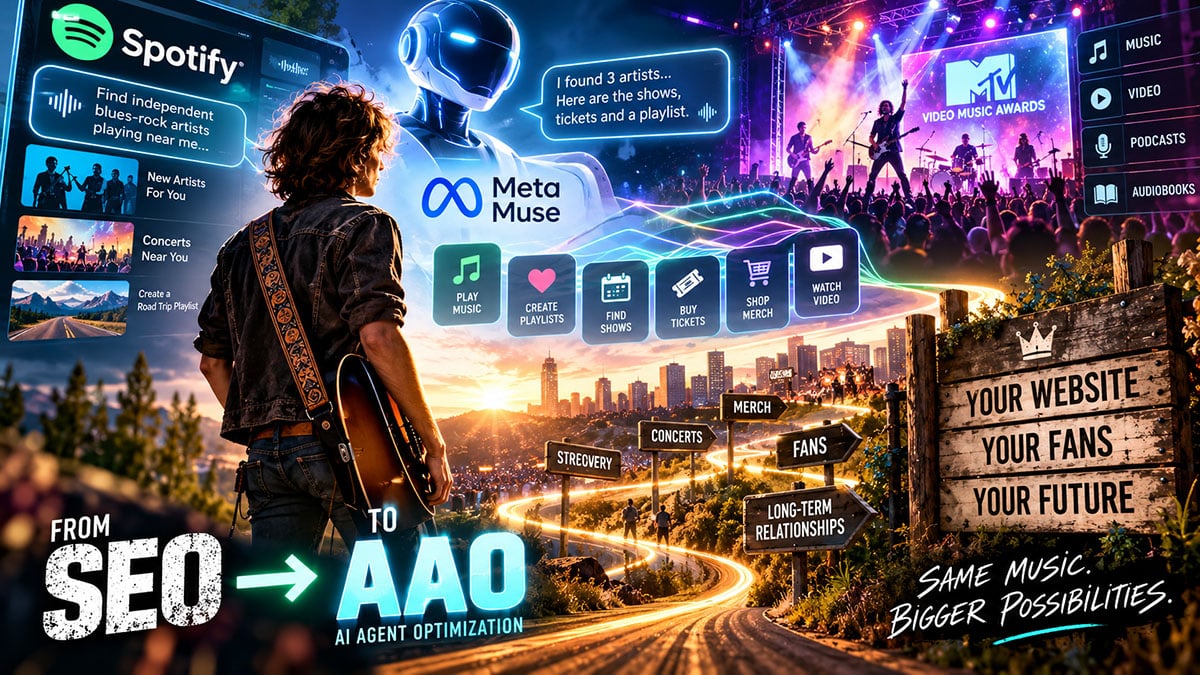
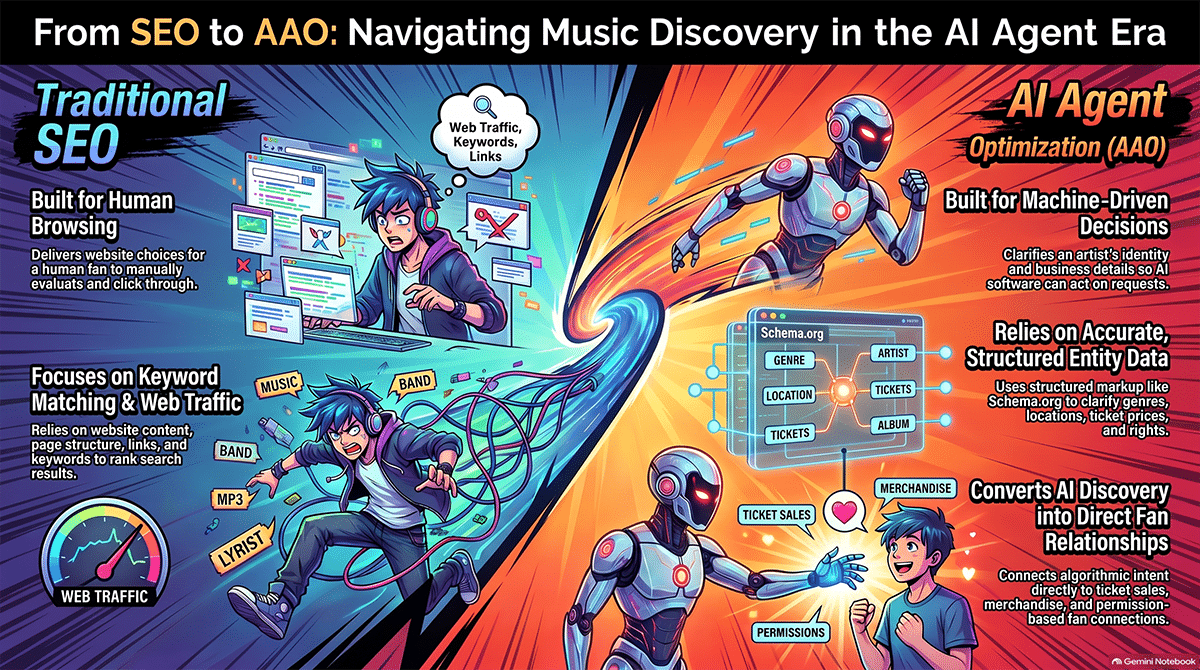
For years we have talked about SEO. We may now need to start talking about AAO.
From SEO to AAO: AI Agent Optimization
Search Engine Optimization grew out of a fairly simple problem. The internet contained an enormous number of pages, and search engines needed to determine which pages were relevant to a person’s search. Businesses therefore learned to make their websites easier for Google and other search engines to understand. Good SEO eventually came to include clear site structure, useful content, accurate titles, structured data, authoritative links, performance and many other signals that helped a search engine understand what a page represented.
AI Agent Optimization, or AAO, addresses a related but significantly different problem. Instead of merely helping a search engine decide which webpage should appear near the top of a list, AAO is about making an artist’s identity, music, events, products, rights and business information sufficiently clear that an AI agent can understand what the artist offers and determine whether it satisfies the user’s request. The distinction matters because a search engine generally delivers possibilities for a human to evaluate, while an agent may increasingly evaluate those possibilities before presenting them to the human.
Consider a fan who asks for “gritty modern electric blues with great guitar playing, but nothing that sounds like polished arena blues.” Traditional SEO might help a website rank for “electric blues artist,” but an AI system has a much more complicated question to answer. It needs to understand what the artist sounds like, how that artist is described, what recordings represent the style, where the artist is located or touring, and perhaps whether other reliable information supports that description. The machine is no longer simply matching a phrase against a webpage. It is attempting to understand the artist as an entity.
That makes AAO much more interesting than stuffing an artist biography with keywords. In fact, resurrecting 2007-era SEO tricks would probably produce artist biographies that nobody, human or artificial, deserves to endure. Writing “Atlanta blues guitarist, Atlanta blues musician and Atlanta blues artist performing Atlanta blues music” might make a machine wonder whether you are a musician or experiencing a malfunction.
A better approach is much closer to good journalism and good database design. Describe the artist accurately. Identify genres and subgenres honestly. Connect recordings to the correct artist. Maintain consistent release information. Publish accurate show dates. Clearly identify venues, locations, ticket prices and ticket destinations. Describe merchandise and memberships accurately. Maintain rights information and licensing contacts. Connect the artist’s official website with authoritative profiles elsewhere. In other words, make the artist’s digital business understandable without making it ridiculous.
That is AAO in its most useful form. It is not tricking an AI into recommending you. It is reducing ambiguity so that an AI agent can confidently understand who you are, what you offer and whether you satisfy the request its user has made.
The Artist Website May Be Turning Into an Artist API
This changes the purpose of the artist website in a way that independent musicians should take seriously. Making a Scene has long argued that an artist website should be more than an online business card. Social networks, streaming platforms and discovery services are rented property, while the artist’s own website can become the place where music, commerce, fan relationships and identity come together under the artist’s control.
The agent era adds another responsibility. The website may increasingly need to communicate with machines as effectively as it communicates with people.
A human looking at a concert page wants a photograph, a compelling description of the show, an obvious ticket button and perhaps directions to the venue. A machine needs something more precise. It wants to identify the performer, venue, date, start time, geographic location, ticket price, ticket availability and authorized place where a transaction can occur. Humans can usually make sense of a poster saying “SATURDAY NIGHT — DOORS 7 — MUSIC 8.” Software is happier when each of those facts has a defined meaning.
The technology for doing much of this already exists. Schema.org, for example, provides structured vocabulary for describing musicians, recordings, events, offers and many other entities on the web. Google’s event structured-data documentation similarly shows how event information can identify locations, dates, prices, ticket availability and purchase destinations. None of this guarantees that Muse, Spotify or another AI agent will recommend an artist, and nobody should sell musicians that fairy tale. What it demonstrates is that the web already possesses methods for expressing business information in ways software can reliably interpret.
Seen from that perspective, the artist website begins to resemble something much more important than a collection of pages. It can become the public-facing portion of an authoritative artist information system. Humans see photographs, stories, music and personality, while machines can see structured facts beneath the presentation. The same artist-owned source can serve both audiences without turning the website into a spreadsheet wearing a leather jacket.
Spotify Is Teaching Recommendation Systems to Listen to Words
Another Spotify announcement from September 23 makes AAO even more interesting. Spotify has begun rolling out Taste Profile in beta to Premium listeners age 18 and older in the United States following earlier testing in New Zealand. The feature gives listeners a simplified view of how Spotify understands their interests across music, podcasts and audiobooks, but the important development is that listeners can use natural language to change that understanding. Spotify says those instructions can begin affecting recommendations on the Home feed within hours.
Recommendation systems have historically relied heavily on observed behavior. A person listened to Artist A, so the system noticed that other people who listened to Artist A also listened to Artist B. The listener repeatedly skipped Artist C, so perhaps Artist C should appear less often. Add enough behavior across hundreds of millions of users and an extraordinarily powerful recommendation system emerges.
Natural-language preference changes add something different: declared intent. Instead of forcing the recommendation engine to infer everything from behavior, the listener can explain what they want.
That could have surprisingly important consequences for independent artists because language requires description. If somebody asks for raw Delta-inspired electric blues rather than polished contemporary blues-rock, some combination of systems must determine what those words mean and which artists fit the request. Listening patterns and audio characteristics can contribute to the answer, but descriptive information can contribute as well. Genre, subgenre, instrumentation, geography, influences, lyrical themes, performance style and cultural context all help establish what kind of artist a machine is dealing with.
Suddenly the artist biography has another potential reader. It still needs to engage journalists, fans, talent buyers and music supervisors, but accurate descriptive language may also help machines understand the artist’s identity. The same is true of song descriptions, album information and other metadata. That does not mean artists should write for robots at the expense of people. It means they should stop treating accurate information as boring administrative housekeeping and begin recognizing it as part of discoverability.
Identity Becomes an Economic Asset
This becomes especially important because musicians have one enormous problem that software engineers rarely appreciate until they encounter the music business: names are messy.
There can be multiple artists using similar names. Band lineups change. Catalogs move between distributors. Recordings appear on incorrect profiles. Collaborations create additional relationships. Remasters and reissues multiply releases. Songwriters, performers and producers may have different rights connected to the same recording. A human fan who encounters a slightly confused artist profile may recognize the mistake. An autonomous system making decisions from structured information needs considerably greater certainty.
Spotify itself relies on unique identifiers for artists and releases rather than simply assuming that a name identifies a person. Other music services similarly depend on identifiers and structured relationships because names alone are unreliable.
For an independent artist, authoritative identity therefore becomes part of AAO. The artist’s official website should clearly represent the same artist found on Spotify, Bandsintown and other important services. Releases should connect to the correct artist identity. Concerts should identify the correct performer. Merchandise should belong to the correct business. Licensing information should point toward the correct rights holder or representative.
That may sound like clerical work until an AI agent is deciding which artist satisfies a commercial request. At that point, clean identity data is not paperwork. It is part of the sales infrastructure.
Spotify Is Also Becoming a Video Destination
Two days after announcing the Muse integration and Taste Profile beta, Spotify revealed another development that makes the larger strategy easier to see. On September 25, Spotify and Paramount announced a partnership that brings archival MTV Video Music Awards material directly into Spotify, along with content surrounding the 2026 VMAs. Spotify’s announcement makes the company’s thinking fairly clear: people increasingly come to the service not only to listen to artists but to watch them.
That development fits Spotify’s larger investment in video. Earlier in September, the company announced another expansion of the Spotify Partner Program, which offers eligible creators monetization tied to Premium video engagement and advertising. Spotify said the program would expand to more than 35 additional markets during the fall.
It would be premature to describe Spotify as a replacement for YouTube, Netflix or every other entertainment service, but the direction is difficult to miss. Spotify increasingly wants to host more of the entertainment experience surrounding the audio. Music can lead into video, video can lead into podcasts, podcasts can lead into deeper engagement, and AI can help listeners move among those experiences without requiring the same amount of manual navigation.
For artists, that is both useful and dangerous in the wonderfully contradictory way most platform innovations tend to be. Spotify can become better at introducing fans to artists and better at keeping those fans inside Spotify at exactly the same time.
A Better Platform Can Become a Better Walled Garden
There is nothing mysterious about Spotify wanting listeners to remain inside Spotify. That is what successful platforms do. The longer people remain engaged, the more valuable the platform becomes to users, advertisers, creators and investors. If listeners can hear music, watch video, listen to podcasts and audiobooks, discover artists and eventually ask an AI assistant to arrange those experiences for them, Spotify becomes more useful.
Independent artists should take advantage of that usefulness rather than pretending streaming platforms can simply be ignored. A Spotify recommendation can introduce somebody to an artist who otherwise would never have encountered them. Conversational discovery could eventually make that process even more precise because a listener can explain what they are looking for rather than waiting for an algorithm to infer it.
The danger appears when discovery is mistaken for ownership. If the fan listens on Spotify, watches the video on Spotify, follows recommendations inside Spotify and allows an outside AI agent to manage the interaction with Spotify, the artist may receive meaningful exposure and some revenue without ever establishing a direct relationship with the listener.
That is why the rise of AI agents actually strengthens the argument for artist-owned destinations. It does not weaken it.
The platform can introduce the fan. The artist still needs somewhere for that relationship to grow.
Discovery Is Only the Beginning of the Fan Journey
Imagine that an AI agent eventually recommends an independent artist because the artist perfectly matches a listener’s request. The listener hears the music, likes it and attends a show. That discovery has genuine value even if the artist knew nothing about how it happened.
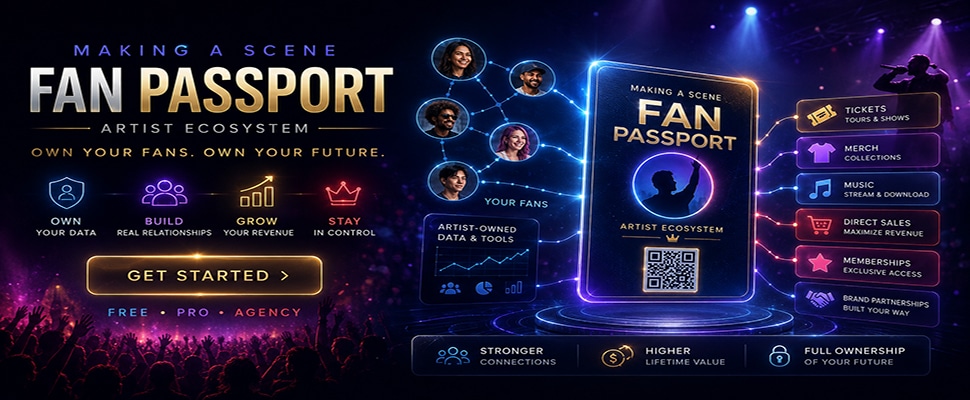
Now imagine that the fan arrives at the show, voluntarily connects through the artist’s Fan Passport, receives a show stamp, joins the artist’s permission-based fan community and buys a record at the merch table. The anonymous discovery has become an identifiable relationship with the fan’s consent.
When that person returns six months later, the artist does not have to start over. The fan can receive information about another nearby show, a new release or a limited physical product because the relationship belongs to the artist rather than disappearing into the analytics dashboard of whichever platform originally made the introduction.
That is where AI discovery can connect to an actual independent music economy. The purpose is not simply to accumulate more algorithmic attention. The purpose is to turn appropriate discovery into ticket sales, merchandise, direct music purchases, memberships, licensing opportunities and long-term fan support.
For an independent musician trying to build a sustainable career, the difference between an anonymous listener and a permission-based fan can be enormous. One produces a moment of consumption. The other can become part of a relationship that lasts for years.
The Artist Source of Truth Was Built for This Moment
This is where the Making a Scene Artist Ecosystem becomes particularly relevant to what Spotify and Meta are building. The Artist Source of Truth was conceived as a way to stop important artist information from being scattered across unrelated systems. In an AAO world, that same architecture can become the foundation for machine discoverability.
The Source of Truth can establish the artist’s authoritative identity and connect that identity to music, shows, rights, merchandise, memberships, touring information and other parts of the business. Instead of forcing every system to maintain a slightly different version of reality, the artist maintains an authoritative record that other authorized functions can use.
The Artist Ecosystem can then translate those facts into different experiences depending on who—or what—is requesting them. A fan visiting the website sees a beautiful show page. The artist sees the show workflow, advancement information, ticket performance and fan activity. A future authorized AI agent could receive the public facts necessary to determine that the show exists, where it takes place, what it costs and where legitimate tickets can be purchased.
The same architecture can eventually apply to commerce. An artist might have a limited vinyl pressing, a T-shirt available in several sizes, a membership tier, a Smart Media product or a VIP experience. Humans should see those products in an attractive store. Machines need accurate product identities, descriptions, prices, inventory status, geographic restrictions and authorized transaction routes.
That is not a separate AI business. It is the existing artist business becoming understandable to AI.
AAO Should Become Part of the Artist Ecosystem
This suggests a practical future direction for the Making a Scene Artist Ecosystem. AAO should not become another dashboard requiring artists to learn another collection of acronyms. If we build this correctly, the artist should barely have to think about it.
When an artist enters a show once, the system should be capable of producing the structured information needed by the website and other authorized services. When the artist enters merchandise, the system should create appropriate machine-readable product information. When a release is entered into the Source of Truth, the ecosystem should connect the recording, artist identity, credits, rights information, descriptive metadata and official destinations.
The Artist Academy can explain why those things matter, but the software should do as much of the technical work as possible. An artist should not have to become an expert in JSON-LD, APIs, knowledge graphs or semantic markup just to make Saturday’s gig understandable to an AI assistant. We are trying to create a music industry middle class, not retrain guitar players as database administrators.
Ask MAS could eventually play an important role here as well. Instead of merely answering questions, it could identify gaps in the artist’s machine-readable business information. If a show has no ticket price, the system can ask for it. If an artist description is too vague to establish useful genre information, AI can help improve it without turning the biography into keyword garbage. If a product has no shipping information or a release is missing important identifiers, the ecosystem can point out the problem before an outside agent encounters it.
That would turn AAO from another marketing chore into something much more useful: continuous maintenance of the artist’s digital business identity.
The Real Opportunity Is Agent-to-Artist Commerce
The most interesting future is not one in which Muse makes better playlists. It is one in which AI agents become another legitimate route into independent artist commerce.
A fan agent could discover a concert. A booking agent could search for appropriate performers. A music supervisor’s agent could look for recordings matching specific musical and rights requirements. A fan looking for a birthday present could find an artist’s official signed vinyl rather than a reseller’s listing. A venue could identify touring artists passing through a particular market with an open date.
For any of those scenarios to work well, however, the artist’s information has to be trustworthy. A music supervisor does not merely need to know that a song sounds appropriate. The supervisor needs to know whether the master can be licensed, whether the composition can be cleared, who controls the relevant rights and whether instrumental or alternate versions exist. A booking system needs reliable dates and professional contact information. A commerce agent needs actual inventory and prices.
This is where AAO becomes much more than a replacement acronym for SEO. SEO was largely about being found. AAO can eventually become about being understood well enough for software to help complete business.
For independent musicians, that is a much more valuable objective.
The Artist Should Own the Rules
There is another side to agent optimization that deserves just as much attention as discoverability. Making information machine-readable does not mean making everything public.
An artist should control which information is available to anyone, which information is available only to authorized partners and which information remains private. Fan data is an obvious example. A public AI agent may need to know that the artist has a show in Atlanta next month, but it has absolutely no legitimate reason to receive the artist’s fan database.
The same principle applies to business information. Public ticket prices can be openly discoverable while private settlement information remains protected. Public licensing contacts can be available while contracts remain private. Merchandise inventory might be available through an authorized commerce interface without exposing the artist’s complete financial records.
This separation between public discoverability and private ownership should be built into the architecture from the beginning. Otherwise, musicians risk repeating the mistake of the social-media era, where convenience gradually became dependency and dependency quietly became surrendering enormous amounts of valuable data. AI agents can work for artists without artists handing them everything. That is an important difference.
Spotify May Be Showing Us What Comes After the Click
The September announcements from Spotify are fascinating because they seem unrelated at first. Muse lets an AI agent interact with Spotify. Taste Profile lets listeners explain their preferences using natural language. Spotify’s VMA partnership expands professionally produced music video inside the service. The Partner Program expands the economic infrastructure surrounding video creators.
Viewed together, however, these developments suggest that Spotify is preparing for an entertainment environment in which people increasingly express what they want and software helps assemble the experience.
That does not eliminate playlists, artist pages, apps or websites. People will continue browsing because browsing itself can be enjoyable. Record stores survived recommendation algorithms because sometimes people enjoy wandering around looking for something they did not know they wanted.
What changes is that browsing is no longer the only route to discovery.
When the listener has a specific goal, the agent can increasingly do some of the work.
For musicians, that creates a new participant in the audience journey. There is the artist, the fan and now potentially an intelligent intermediary acting for the fan.
That intermediary needs to understand the artist before it can introduce the artist.
From Search Engine Optimization to AI Agent Optimization
SEO will not suddenly disappear. Search engines remain enormously important, and many AI systems themselves depend upon web search, structured information and authoritative sources. The better way to understand AAO is as an expansion of the work artists should already be doing.
SEO asks whether a search engine can find the artist’s information and decide that it is relevant.
AAO asks whether an intelligent agent can understand that information well enough to use it when fulfilling a person’s request.
That difference changes what good optimization looks like. The artist does not merely need a page saying there is a concert. The agent benefits from knowing where the concert is, when it starts, what it costs, whether tickets remain, who is performing and where an authorized transaction occurs. It does not merely need an artist biography. It benefits from understanding genre, instrumentation, geography, recordings and relationships between the artist’s official identities.
For independent musicians, this may actually be good news. The agent era could reward something the current social-media economy frequently ignores: accurate information.
You do not necessarily need to post seven videos before breakfast to tell an AI agent that you are a blues-rock guitarist playing in Nashville Saturday night. You need reliable information demonstrating that you are a blues-rock guitarist and that you really are playing in Nashville Saturday night.
There is something almost refreshing about that.
Build the Artist Business So Humans and Machines Can Find It
The lesson from Spotify’s latest moves is not that every independent musician needs to rush out and “optimize for Muse.” Muse will change. Spotify will change. Other agents will arrive. Some will become important and others will end up in the same digital attic where we keep Clubhouse invitations and QR-code restaurant menus nobody could read in direct sunlight.
The durable strategy is to build an artist business whose information is accurate, structured, authoritative and owned by the artist.
That means the website remains important, but its job expands. It remains a destination where fans can experience the artist’s world, while underneath that human experience sits an increasingly structured representation of the artist’s business. The Source of Truth supplies authoritative information. Fan Passport provides a permission-based bridge between discovery and long-term relationships. Fan Journey helps the artist understand how those relationships develop. Smart Media connects physical products to controlled digital experiences. Rights and recording information can make music easier to evaluate for legitimate licensing opportunities.
In that environment, Spotify can do what Spotify does extremely well. It can introduce people to music. Meta Muse and other AI agents can help people find experiences matching what they actually want. Search engines can continue directing people toward useful information. Social networks can create attention. None of those systems has to be treated as an enemy because none of them has to become the foundation of the artist’s business.
The foundation remains with the artist.
The interesting part of this new agent era is that artist ownership and machine discoverability do not have to compete with each other. Properly designed, they reinforce each other. The artist maintains one authoritative business identity and allows approved pieces of that identity to travel wherever discovery happens. Fans can find the artist through Spotify, an AI agent, Google, social media, a concert recommendation or something that does not exist yet, while the artist retains an independent destination capable of turning that discovery into a relationship.
For twenty years, the music business taught independent artists to chase people around the internet. The emerging agent economy suggests that the smarter strategy may be to build a business that machines can reliably bring people to. SEO helped search engines understand pages. AAO can help AI agents understand artists, their music and the legitimate ways fans can support them. The technology may be new, but the business principle underneath it is wonderfully old-fashioned: make it easy for customers to find you, make it easy for them to understand what you offer, and whenever possible, build a relationship that does not disappear the moment somebody closes an app.
That is a much more useful future for AI in music than simply teaching a robot to make another playlist.
 |  Spotify |  Deezer |  Breaker |
 Pocket Cast |  Radio Public |  Stitcher |  TuneIn |
 IHeart Radio |  Mixcloud |  PlayerFM |  Amazon |
 Jiosaavn |  Gaana |  Vurbl |  Audius |
 Reason.Fm | |||
Find our Podcasts on these outlets
Subscribe to Our Newsletter
Discover more from Making A Scene!
Subscribe to get the latest posts sent to your email.


