
What Independent Musicians Can Learn from Netflix, Disney, and the Streaming Wars




Making a Scene Presents – What Independent Musicians Can Learn from Netflix, Disney, and the Streaming Wars
Listen to the Podcast DiscussionThe movie and television business has figured out how to turn entertainment into an ongoing relationship with an audience. It is time independent musicians stopped thinking like content suppliers and started thinking like entertainment companies.
There is something wonderfully strange happening in the entertainment business. Netflix spends billions of dollars creating and acquiring entertainment, Disney builds entire business empires around stories and characters, and television companies are constantly searching for new ways to keep audiences coming back. Meanwhile, independent musicians are being told that the secret to success is uploading another song, making fifteen short videos about it, and hoping an algorithm decides they deserve to eat this month. Somewhere along the way, the music business managed to convince artists that being available everywhere was practically the same thing as building a successful career.
The movie and television industries have a somewhat different understanding of how entertainment makes money. They recognize that a film, television series, character, or story can become a commercial asset that continues producing income long after its original release. They understand that people will pay for access, convenience, exclusivity, experiences, and the opportunity to become more deeply connected with something they love. Perhaps most importantly, they understand that the relationship with the audience can be worth considerably more than any single piece of entertainment.
None of this means that Netflix, Disney, or the other entertainment giants have discovered some magical formula that independent musicians should blindly follow. These companies have their own problems, including enormous production costs, complicated licensing arrangements, subscription fatigue, and an apparently endless ability to make customers search through six different services to find a movie they watched last Christmas. Their business models also depend on scale that an independent musician will never need and probably wouldn’t want.
But beneath all that corporate machinery are some remarkably useful ideas that working musicians can apply without hiring a vice president of audience engagement or purchasing a small country.
The opportunity is to stop thinking of music as something that must constantly be uploaded to someone else’s platform and start thinking about the larger entertainment business that can be built around the music itself. An artist’s recordings, performances, stories, photographs, videos, knowledge, community, and creative identity can all contribute to a business that earns money through multiple connected activities. Music streaming remains part of that business, but it no longer gets to decide what the entire business is worth.
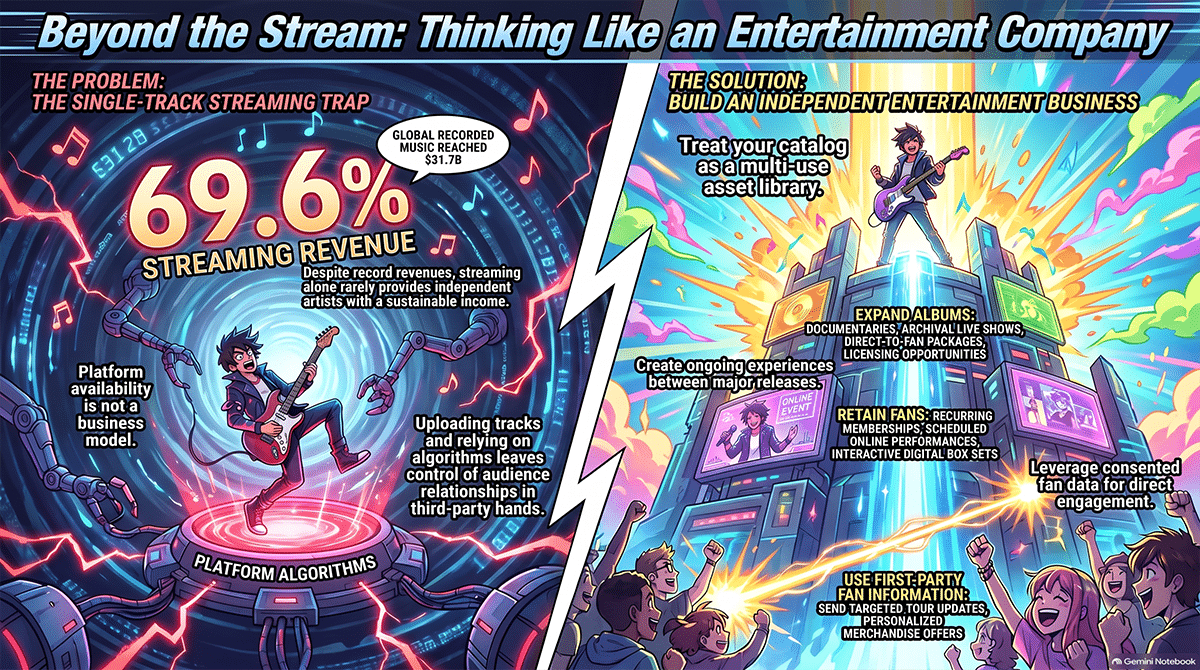
That distinction matters more than ever. According to the International Federation of the Phonographic Industry’s March 2026 Global Music Report, worldwide recorded music revenue reached $31.7 billion in 2025, with streaming accounting for 69.6% of the total. Paid subscription streaming represented 52.4% of global recorded music revenue. These figures demonstrate that streaming is enormously important to the recorded music economy, but they do not tell us how much of that money reaches an individual independent musician after contractual arrangements, distribution fees, and other expenses are considered.
The question for an independent artist is not whether streaming should exist. That ship sailed, picked up a few hundred million passengers, and is currently selling advertising on the lifeboats. The more useful question is what the musician can learn from the companies that distribute visual entertainment about creating a business that lasts beyond the next release.
Your Music Catalog Is More Than a Collection of Old Albums
Imagine walking into a movie studio and asking what the company plans to do with a film it released five years ago. The executives would probably look at you as though you had asked whether they planned to throw away the building when the electricity bill arrived. A completed movie can continue to earn money through licensing, streaming, rentals, purchases, and other commercial arrangements, depending on who controls the rights and how the film is distributed.
Disney provides a particularly revealing example. Its fiscal 2025 annual report describes a business that earns revenue through theatrical distribution, television and video-on-demand licensing, streaming subscriptions, advertising, home entertainment, merchandise, and licensing of its intellectual property. The company also makes money from entertainment-related experiences that extend far beyond watching the original film or television program.
A working musician should find that approach interesting because most artists already have collections of entertainment assets that are not being used to their full potential. They simply don’t think of those assets as a library with multiple commercial possibilities. They think of them as old albums, recordings that didn’t make the cut, photographs from a tour, video footage sitting on a hard drive, and a mountain of material that somebody should really organize one of these days.
Consider an independent blues musician who has spent twenty years playing clubs and festivals. Over that time, the artist has recorded six albums, captured dozens of live performances, participated in interviews, accumulated photographs, and written songs that document an entire musical journey. Perhaps there are rehearsal recordings, alternate versions, abandoned arrangements, and studio sessions that never made it beyond the control room.
The conventional music business approach is to concentrate promotional energy on the newest release while everything else quietly becomes part of the artist’s history. A movie studio would recognize that the history itself might have commercial value, provided the company had the rights, quality material, and an audience interested in experiencing it.
A musician could organize those recordings and visual materials into a collection that offers much more than the albums already available on streaming services. A fan might purchase a restored concert recording, a documentary about the making of an album, or a digital collection that combines music, photographs, interviews, and stories. Another fan might join a membership that provides access to selected archival material. A filmmaker might discover a recording that is appropriate for licensing, while a music historian might be interested in an interview about a particular regional scene.
This doesn’t mean every soundcheck deserves a deluxe collector’s edition. Some performances should remain safely buried, especially the ones where the drummer counted off a song in the wrong time signature and everybody pretended it was experimental jazz. But the artist should at least know what material exists and whether it could support a legitimate product.
Artificial intelligence can help with the less glamorous work of building that library. Speech-to-text tools can help create transcripts of interviews, audio analysis can assist with identifying and organizing recordings, and AI-assisted search can make an extensive archive easier to explore. The artist still needs to review the results, establish ownership, secure necessary permissions, and decide what deserves publication. AI can help organize the closet, but it shouldn’t be allowed to sell everything inside it without asking whose clothes they are.
The financial opportunity comes from treating the catalog as a continuing collection of assets rather than a series of expired promotional campaigns. New music can bring attention to older material, and older material can create additional value around a new release. A fan who discovers the artist today may be willing to purchase something recorded ten years ago, especially when the artist presents it as a meaningful experience rather than a forgotten file.
Netflix Understands Something Musicians Keep Forgetting: Give People a Reason to Return
Netflix doesn’t operate as though its business ends when somebody finishes watching a movie. Its success depends on attracting subscribers and continuing to offer enough value that those subscribers remain interested in the service.
In its January 20, 2026 shareholder letter, Netflix reported that it had crossed 325 million paid memberships during the final quarter of 2025 and generated $45.2 billion in revenue for the year. The company also described continued investment in films, television series, live programming, games, advertising, and improvements to the viewing experience.
The lesson for independent musicians has nothing to do with attempting to reproduce Netflix’s financial performance. It has everything to do with understanding that a continuing relationship can create commercial opportunities that a single purchase or streaming session cannot.
Most musicians know how the traditional release cycle works. An album comes out, the artist promotes it through every available channel, the touring schedule hopefully supports the release, and eventually the attention moves elsewhere. The musician then begins preparing another album, partly because the business has taught them that new material is the primary reason anyone should pay attention.
But what happens between albums?
What happens when somebody discovers the music six months after the release campaign has ended? What does the artist offer a fan who has already purchased the album and attended three concerts? What happens when a listener wants to know more about the person who created the music but finds little beyond a biography that hasn’t been updated since the previous presidential administration?
Television provides an answer through programming. A network doesn’t expect one successful episode to sustain an audience indefinitely. It develops a continuing relationship by giving viewers something they want to experience next.
A musician can accomplish something similar without recording a new album every month. The material surrounding a recording project can support ongoing entertainment through studio performances, discussions about songwriting, demonstrations of instruments, interviews with collaborators, live recordings, and stories about the experiences that inspired the songs.
An independent Americana artist might release a short documentary about recording an album, followed by an acoustic performance of one of its songs. A week later, the artist could share an interview with a musician who participated in the sessions. Another installment might explore the historical story behind a particular lyric, while a later performance introduces material being prepared for the next project.
Some of this entertainment can remain freely available because its purpose is to help people discover the artist and develop a connection. Other material can become part of a paid membership or a product that offers additional value to dedicated supporters.
The business opportunity becomes easier to understand when we look at a simple example. Suppose an artist develops a membership with 100 participating fans who each pay $5 per month. That would produce $500 in gross monthly revenue, or $6,000 annually, before payment processing, platform fees, production costs, taxes, and other expenses. Those are illustrative figures rather than a prediction of what any particular artist will earn, but they demonstrate why ongoing audience relationships deserve attention.
The musician doesn’t have to produce six thousand dollars of new recordings to generate six thousand dollars of membership revenue. The artist has to provide an experience that those fans consider worth supporting, while managing the cost of delivering it. That experience may combine new material, archival entertainment, early access, interaction, and a stronger connection to the artist’s work.
The crucial difference is that the fan isn’t simply purchasing another file. They are participating in an ongoing creative relationship, and the artist has a business that continues operating between major releases.
The Movie Business Knows How to Sell the Same Entertainment Without Selling the Same Experience
For decades, film distributors have used different release windows to reach audiences through separate commercial channels. A movie might appear in theaters, become available for home rental or purchase, enter a subscription streaming catalog, and later be licensed through additional distribution arrangements. The exact sequence varies considerably, but the underlying business principle is that different audiences value different forms of access.
Disney’s 2025 financial filings document its theatrical, television, video-on-demand, streaming, and home entertainment activities. The company also explains that theatrical marketing can help generate interest in later distribution markets, even though the costs associated with promoting a film can create financial pressure during the original release period.
The music business once understood this idea quite well. There were singles, albums, special editions, collector’s packages, physical formats, fan-club releases, and live recordings. Those products didn’t always contain completely different music. They offered different combinations of access, presentation, convenience, and additional material.
Streaming changed the expectations surrounding recorded music. Today, many artists make their entire album available through major platforms at the same time, then attempt to persuade fans to purchase a physical copy of music they can already hear through a subscription. That approach can still work, particularly when the physical edition offers emotional or collectible value, but it leaves other possibilities unexplored.
Imagine an independent artist preparing a new album. Before its general streaming release, the musician could offer a special direct-to-fan edition that includes the finished recording, an extended digital booklet, documentary footage, and admission to an online listening event. Fans who want the additional experience can purchase it directly, while listeners who simply want to hear the music can still discover it when the album becomes available through their preferred streaming service.
Later, the artist might release a live interpretation of the album, followed by a separate collection of alternate performances and songwriting demonstrations. Each product has its own reason to exist, and each gives the artist another opportunity to earn income from the original creative project.
There is an important distinction between creating valuable editions and artificially withholding music in an attempt to force purchases. An emerging artist may need the widest possible exposure, and an exclusive release that reaches almost nobody isn’t much of a business strategy. Distribution agreements may also restrict what can be released, when it can be released, and through which channels. Artists should examine those terms before developing their release plans.
The better lesson is that musicians can create different experiences around the same body of work instead of expecting a single streaming release to carry every financial expectation attached to the project.
Disney Doesn’t Just Build Characters. It Builds Reasons for People to Care About Them.
One of the most interesting parts of Disney’s business is what happens after the original story becomes successful. Characters and fictional worlds can be developed through additional films, television productions, merchandise, publishing, games, attractions, and licensing agreements.
Disney’s fiscal 2025 annual report identifies merchandise licensing across categories that include toys, apparel, games, home products, accessories, and other consumer goods. The report also explains that the company earns royalties from licensing intellectual property to outside businesses.
Independent musicians don’t need to manufacture their own theme parks, although I would absolutely visit a blues-themed attraction where the roller coaster breaks down and the operator tells everybody it has the same timing as the drummer. The useful idea is that a successful creative property can support a range of connected products and experiences.
For a musician, that property may be an album, a distinctive artistic identity, a collection of songs, or a body of work connected to a particular musical tradition.
Imagine an independent artist recording an album inspired by the musical history of Detroit. The original release contains the songs, but the creative project could extend into interviews with musicians, documentary footage of historical locations, photographs, performances, and conversations about the city’s musical culture.
That material could support an expanded album edition, a documentary, special live performances, educational presentations, and products that appeal to people interested in the history behind the music. Where the artist controls the relevant rights, selected recordings or audiovisual material might also be licensed for use in other productions.
The artist hasn’t changed musical direction to chase a different market. They have found additional ways to communicate the value already present in their work.
This is especially important for independent musicians whose identities are connected to recognizable communities and traditions. Blues, jazz, Americana, folk, roots music, and regional music scenes are filled with stories that extend beyond individual songs. Those stories have cultural value, and some can also support sustainable business opportunities when developed with care and respect for the people involved.
The challenge is to make the experience more valuable without turning every emotional moment into a sales campaign. Fans can usually tell when an artist is sharing a meaningful story and when somebody has decided that Grandma’s funeral should become an exclusive premium-content opportunity.
The goal is to build a deeper creative world around the music, not transform every personal experience into inventory.
Tubi Has a Lesson for Musicians Who Believe Everything Must Be Behind a Paywall
The expansion of free, advertising-supported video streaming offers another useful lesson. Audiences do not all want to pay for entertainment in the same way, and there can be substantial value in serving people who prefer free access.
On August 6, 2026, Tubi announced that it had reached 110 million monthly active users, representing 14% year-over-year growth. The Fox-owned streaming company also reported that engagement had increased 17% and quarterly revenue had risen 35% compared with the previous year. Tubi attributed part of its growth to entertainment collections organized around dedicated audience interests and emphasized that the overwhelming majority of its viewing is on demand. These are company-reported figures, available in Tubi’s official announcement. TubiTV Corporate
The important lesson for musicians isn’t that they should attempt to create an advertising-supported television service. Most independent artists don’t have audiences large enough to support that kind of operation economically, and developing the infrastructure would probably cost more than the resulting advertising revenue.
The more interesting principle is that free entertainment can create opportunities for the business surrounding it.
A musician might place a complete concert performance on their website, make selected recording sessions available through YouTube, or create a video collection that introduces visitors to the artist’s musical history. Those experiences can help someone become interested in the artist without requiring an immediate purchase.
The next step is where the business begins to develop. A person who enjoys a concert film might want to know about upcoming shows. Someone watching a studio documentary may be interested in a deluxe recording. A viewer fascinated by the artist’s guitar sound might enjoy a paid workshop or an extended performance demonstrating the recording process.
The artist can provide those opportunities through clear invitations rather than treating every visitor like a wallet that has wandered into the building.
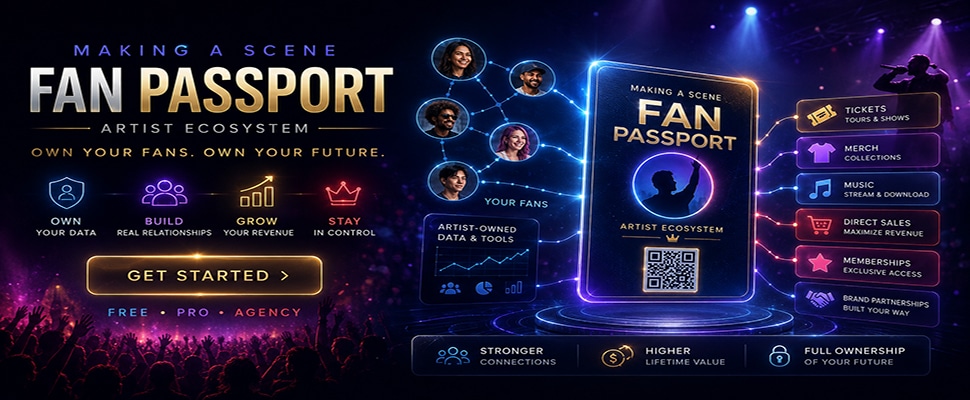
This is also where direct fan relationships become important. An artist-owned destination can invite interested visitors to subscribe to a newsletter or create a Fan Passport relationship with clear information about how their data will be used. The musician can then communicate directly with people who want that relationship, rather than relying exclusively on a third-party platform to decide whether the next message deserves to be seen.
Free entertainment becomes commercially useful when it helps people discover a deeper connection with the artist. The immediate objective may be discovery rather than a transaction, but the resulting relationship can support future ticket sales, merchandise purchases, direct music sales, and other revenue opportunities.
A Small, Dedicated Audience Can Be More Useful Than a Huge Audience That Doesn’t Care
Streaming video has made niche entertainment commercially visible in ways that traditional mass-market broadcasting could not always accommodate. A service with an extensive catalog can provide entertainment for people with specialized interests without requiring every program to appeal to the same broad audience.
Tubi’s 2026 announcements describe entertainment collections built around interests such as horror, romance, and adult animation, while Netflix’s own explanation of its recommendation technology describes how it connects viewers with content based partly on their interests and viewing behavior. The broader lesson is that audiences aren’t one giant collection of interchangeable consumers. They are people looking for entertainment that means something to them.
Independent musicians should find this encouraging because they have often been told that success requires becoming as broadly popular as possible.
An independent blues musician may have an audience that includes guitar enthusiasts, collectors, music historians, festival attendees, and listeners who simply love the emotional experience of the music. Those people share an interest in the artist, but they may connect with different parts of the artist’s work.
A guitar enthusiast might appreciate a detailed video about the instruments and amplifiers used on an album. A collector may be more interested in a limited physical release. A music historian might enjoy an interview with a veteran musician, while a festival attendee may be primarily interested in upcoming live performances.
The artist doesn’t need to become a different person for each audience. They need to understand which parts of their existing creative work are valuable to different people.
This is where a small music business can become surprisingly sophisticated. A direct-to-fan system can help the artist learn what fans voluntarily share about their interests and which products or experiences they engage with. That understanding can lead to better communication and more relevant offers without requiring the artist to purchase expensive advertising campaigns aimed at millions of people who have never heard of them.
The goal isn’t to make every fan buy everything. It is to make it easier for people to find the parts of the artist’s world that they genuinely care about.
Netflix Uses Data to Help People Find Entertainment. Musicians Could Use It to Build Better Relationships.
Netflix’s recommendation system provides one of the clearest examples of how entertainment companies use audience information to improve the experience. According to its official explanation, Netflix considers viewing history, ratings, information about titles, and other signals when suggesting what a subscriber might enjoy. The company uses that information to organize the experience around individual interests rather than presenting exactly the same catalog arrangement to everyone.
Most independent musicians operate with substantially less information about their audiences. They may know how many followers they have on social media, how many monthly listeners appear on a streaming dashboard, and how many people bought tickets to the last show. But those numbers are often disconnected from one another.
The musician may not know that the person who purchased a vinyl album last month is the same person who attended three concerts and signed up for the newsletter. They may not know that someone who follows every studio-related post has never purchased a recording but would happily attend an online workshop.
That disconnected information represents an enormous missed opportunity because it prevents the artist from understanding the relationship that already exists.
A properly designed artist business system could connect permitted fan interactions into a more complete picture. When someone voluntarily joins a fan community, attends a show, purchases merchandise, or accesses a digital product, those interactions can help the artist understand what the person enjoys and how they participate.
The Making a Scene Artist Ecosystem and Fan Passport project is being developed around this idea through Fan Memory and Fan Journey. The concept is to connect consented fan interactions into an understandable relationship instead of forcing the musician to interpret a dozen disconnected analytics reports.
Imagine an artist preparing for a show in Atlanta. Their business system identifies people who have voluntarily shared an Atlanta-area location and previously expressed interest in attending performances. The artist can communicate the upcoming show to those fans rather than sending every person in the database an increasingly desperate message about how tickets are still available.
A fan who regularly purchases physical recordings might receive information about a new vinyl edition, while someone who enjoys studio content might discover an upcoming recording workshop. Both people are fans of the same artist, but their interests make different kinds of communication useful.
AI can help interpret those relationships and suggest appropriate actions, but it should not become an excuse for collecting information that people never agreed to share. The artist’s ownership and control of fan relationships must be balanced with the fan’s right to understand and control how their information is used.
The Federal Trade Commission’s guidance on the CAN-SPAM Act explains the requirements governing commercial email in the United States, including truthful messaging and functioning opt-out mechanisms. That law does not impose a universal advance opt-in requirement for all commercial email, but affirmative permission remains a sound foundation for the kind of trusted artist-fan relationship we want to build. Other privacy and messaging requirements may also apply depending on the activity and jurisdiction.
A fan should feel that the artist understands what they enjoy, not that somebody has installed surveillance equipment in the merchandise booth.
Television’s Oldest Trick Might Be One of Music’s Most Valuable Opportunities
Long before streaming services allowed people to watch practically anything whenever they wanted, television built much of its business around scheduled programming. Audiences knew when their favorite shows would appear, and broadcasters developed viewing habits around those appointments.
Streaming changed how people consume television, but scheduled entertainment never lost all of its value. Netflix has expanded into live programming, and its own investor materials explain that live events can create audience conversation, attract subscribers, and add value to the viewing experience.
Musicians have an advantage here because they already understand live entertainment. They know that something changes when people share a performance at the same time. A concert creates an experience that cannot be completely reproduced by listening to a recording afterward, even when the recording sounds wonderful and the drummer finally gets the count-in right.
An independent musician could build a modest programming schedule around that principle. Imagine a monthly online performance that combines live music, conversation, and a look inside the artist’s creative process. Fans could attend through a membership or purchase access to individual events.
The musician might perform a few songs, explain how a recording was created, answer questions, and introduce material being developed for an upcoming release. The event provides something meaningful for fans while allowing the artist to create a performance recording that may support future products, subject to the necessary rights and permissions.
That final point is important because live entertainment can create multiple commercial opportunities from the same activity. A ticketed online performance produces event revenue, the resulting recording may become a purchasable concert film, and selected excerpts can introduce the artist to new listeners. Fans who attended can receive appropriate follow-up communication about upcoming shows or related releases.
The same approach can support touring. An artist preparing to visit several cities could host an online performance focused on fans in those regions, introduce the upcoming dates, and give interested viewers a direct way to purchase tickets.
Instead of treating an online event as a substitute for live performance, the artist can use it to develop relationships that support future concerts.
There is also an opportunity for regional music communities. A group of independent artists could produce a regular online program that introduces audiences to local talent, highlights upcoming performances, and connects fans with venues. Such a program could eventually support sponsorships or shared promotional arrangements, provided the participants agree on rights, responsibilities, and how revenue will be distributed.
The underlying concept is familiar to anyone who remembers appointment television. Give people something they enjoy, make it easy to participate, and create a reason to return.
The Music Business Needs to Learn About Licensing Without Learning to Give Everything Away
Movie studios have developed extensive licensing businesses because they recognize that controlling valuable entertainment rights creates options. They can allow another business to distribute or use content under agreed terms while retaining whatever ownership and rights the contract preserves.
Independent musicians need to approach their creative work with similar care.
The United States Copyright Office explains that a musical composition and a sound recording are separate copyright-protected works that can be owned and licensed independently. The composition covers the underlying music and lyrics, while the sound recording protects a particular recorded performance. That distinction matters whenever somebody wants to use a recording in a film, television program, advertisement, or other audiovisual production.
An independent artist who controls both the composition and the sound recording may be able to offer a simpler licensing process than a recording that requires approvals from several unrelated rights holders. But the artist must actually control those rights, and agreements with co-writers, publishers, producers, labels, performers, and distributors can affect what can be licensed.
This is why an organized music catalog needs more than album titles and cover artwork.
Imagine a filmmaker looking for a blues instrumental to accompany a documentary. The musician has the perfect recording, but nobody can locate an instrumental master, the songwriter information is incomplete, and the artist isn’t entirely sure whether a previous agreement allows the recording to be licensed for audiovisual use.
The opportunity may disappear before anybody even discusses a fee.
A better-prepared musician could maintain accurate information about each composition and recording, along with appropriate audio versions and documentation of the rights available for licensing. The artist could then respond to legitimate opportunities with confidence and speed.
AI can assist with organizing that information and preparing materials, but it cannot independently establish rights that the artist does not possess. A convincing-looking database entry is not a substitute for a valid agreement, and a beautifully generated licensing document does not resolve an ownership dispute.
The commercial lesson is that the artist’s recordings should be managed as valuable intellectual property rather than files that happen to exist on a hard drive. That approach can support licensing revenue while also improving direct sales, archival releases, and the development of new entertainment products.
Smart Media Could Give Musicians Their Own Version of the Deluxe Movie Box Set
Remember when movie collectors purchased elaborate physical editions that included commentary tracks, documentaries, interviews, and other material surrounding the main feature? Those products offered a different experience from simply watching the movie.
Music has a natural opportunity to develop something similar through connected physical and digital products.
Imagine an independent artist releasing an album as a physical collectible that includes an NFC tag. When a fan taps the product with a compatible smartphone, the tag opens an artist-branded digital experience containing the album, studio footage, song stories, photographs, and other material associated with the release.
The fan is purchasing something more substantial than a link to music that already exists on a streaming service. The physical object becomes a gateway to a collection of entertainment, and the artist can establish clear terms governing what the purchaser receives and how long access continues.
This concept connects directly with the Smart Media Experience work being developed as part of the Making a Scene Artist Ecosystem. The larger opportunity is to help musicians create and administer distinct products that connect physical ownership with digital experiences, fan relationships, and additional commercial opportunities.
A live album could have its own experience containing concert footage and backstage interviews. A studio album might include songwriting demonstrations and production material, while a collector’s edition could provide access to archival performances or other exclusive content.
The technology needs to make those experiences easy for the musician to create and the fan to enjoy. An artist shouldn’t have to become a software engineer to sell a digital box set, and a fan shouldn’t need a technical support department to listen to an album they already purchased.
The system should also avoid confusing access control with absolute protection against copying. NFC tags, private links, and authenticated experiences can help manage legitimate access, but no ordinary digital delivery method can guarantee that a determined person will never capture or redistribute content.
The business opportunity comes from creating a valuable product and an ongoing relationship, not promising impossible technological protection.
AI Could Become the Independent Artist’s Programming Department
Once a musician begins thinking about their business as a collection of connected entertainment assets, another possibility emerges. Artificial intelligence can help identify how those assets might work together to create new opportunities.
Imagine an artist preparing for a Saturday performance. The conventional approach might involve posting a few promotional messages, reminding fans about ticket availability, and making sure the merchandise is packed.
A more developed business approach could connect that show with the artist’s content library, direct sales, fan relationships, and upcoming releases.
An AI-assisted business system might identify that the artist has not released a live recording in several months and suggest capturing selected performances. It could help prepare a simple plan for recording the show, remind the artist to confirm necessary permissions, and identify existing songs that could support a post-show product.
After the performance, the system could help organize the resulting recordings and connect appropriate material with the artist’s existing catalog. It might suggest creating a short concert film, preparing a live EP, or developing an experience for fans who attended.
Fan information collected with appropriate permission could help the artist understand which people attended, whether the event introduced new fans, and which follow-up opportunities might be relevant.
None of this requires AI to make creative decisions for the musician. It requires AI to help connect the business activities that artists currently manage through scattered applications, notebooks, spreadsheets, and whatever piece of paper the bass player insists was left in the van.
This is where the Making a Scene Artist Ecosystem could apply the lessons of the visual entertainment business in a particularly practical way. The system’s Artist Source of Truth, Song Source of Truth, Fan Passport, Fan Memory, Fan Journey, commerce, touring, CRM, newsletter, and Smart Media concepts are intended to provide the information and workflows needed to connect different parts of an artist’s business.
The important architectural principle is that these capabilities should work together rather than becoming another collection of disconnected modules that musicians must learn individually.
An artist should be able to ask what they want to accomplish, provide the necessary information, and receive a useful result. The technology can handle the business complexity while the musician remains responsible for the creative direction and important commercial decisions.
Instead of requiring the artist to understand every step involved in turning a concert recording into a product, Ask MAS could eventually guide the musician through the process using the capabilities already available within the ecosystem.
That would represent a meaningful change in the relationship between technology and independent musicians. Rather than giving artists another complicated tool and wishing them luck, the system could help them operate the business they are already trying to build.
Don’t Copy the Streaming Industry’s Worst Habits
There is an important warning hidden inside all these opportunities. The video streaming business has become increasingly fragmented, and that fragmentation can make entertainment less convenient for the audience.
A movie that was available through one service may become exclusive to another. Subscription prices change, advertising becomes part of previously simpler experiences, and viewers discover that keeping track of entertainment subscriptions now requires the organizational skills of a small accounting firm.
Netflix itself describes a business that offers different pricing plans, including an advertising-supported option, while continuing to invest in entertainment and the experience of using its service. Its 2025 annual filing provides a useful picture of how a major streaming company balances content, pricing, and customer retention.
Independent musicians should learn from that complexity without reproducing it.
A fan who follows twenty artists probably doesn’t want twenty different subscriptions, twenty separate accounts, and twenty passwords that all require a capital letter, a number, and the name of their first childhood pet.
Some fans will gladly pay for ongoing access to an artist’s work. Others prefer purchasing a recording when something interests them, buying merchandise at shows, or contributing to a special project. Still others may primarily support the artist by attending performances and introducing friends to the music.
A well-designed artist business should accommodate those different relationships instead of assuming that every fan must become a monthly subscriber.
The same principle applies to technology. Artists should be able to use existing websites, authorized hosting services, commerce providers, and other business tools without being forced into a single company-controlled environment. A platform can provide useful services while allowing the musician to maintain appropriate control over their music, customer relationships, and business information.
That independence matters because the entire point is to reduce the artist’s dependence on gatekeepers, not create a shiny new gatekeeper with better fonts.
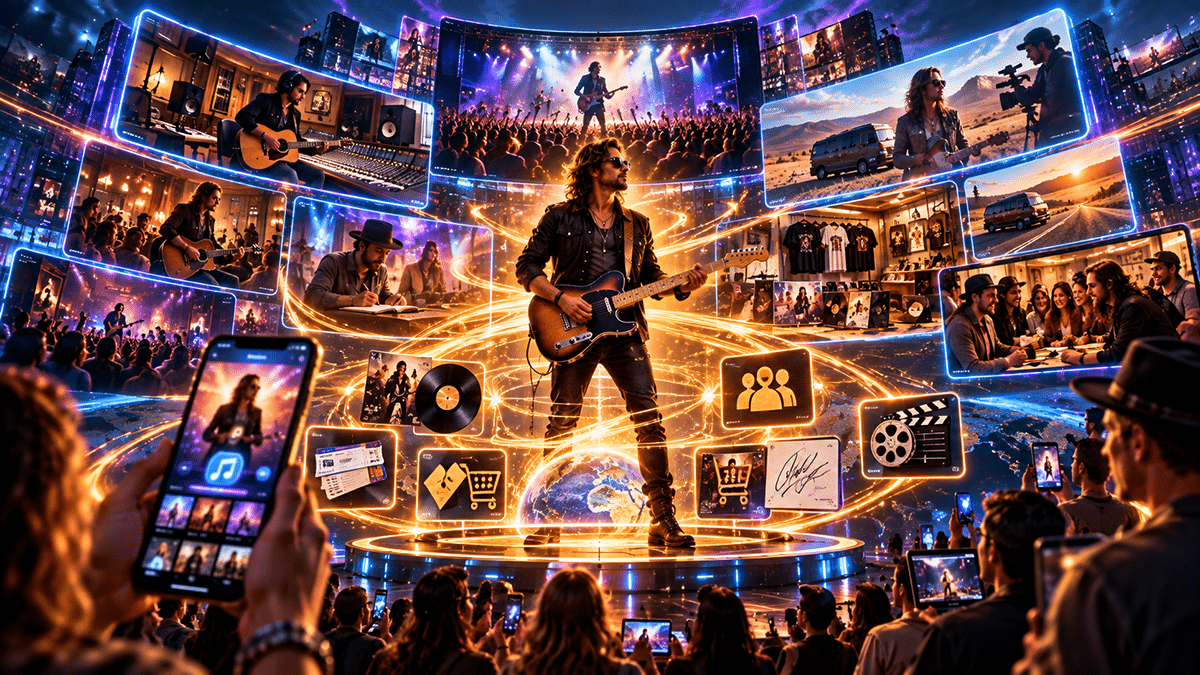
The Real Opportunity Is to Build an Entertainment Business Around the Artist
When we combine these ideas, a different picture of the independent music business begins to emerge.
The artist’s catalog becomes a permanent collection of commercial and creative assets. New releases introduce audiences to that collection, while archival material gives existing fans additional ways to participate. Live performances generate immediate income and can create recordings or visual material that support future products.
Direct fan relationships help musicians understand which experiences interest their audience, while AI can assist with organizing information and identifying useful business opportunities. Licensing creates another potential revenue stream from properly documented intellectual property, and memberships can support artists who develop continuing entertainment that fans value.
These activities don’t need to operate independently. They can reinforce one another.
Consider an independent musician who records an album, documents the studio sessions, and offers a special edition directly to fans. The album eventually becomes available through streaming services, introducing the music to new listeners. Some of those listeners discover the artist’s website, explore the recording sessions, and sign up to hear about upcoming performances.
The artist then tours in support of the album, selling tickets and merchandise while creating new fan relationships through the live experience. Selected performances are recorded and later developed into another product. Existing fans are invited to participate in a special online performance, and the recording becomes part of the artist’s growing entertainment library.
The artist’s catalog now contains more than the original album. It includes material that can support direct sales, memberships, future promotions, and potentially licensing opportunities.
This is how the entertainment business begins to produce value across multiple activities instead of depending entirely on the financial performance of a single release.
The artist doesn’t need millions of fans for the model to make sense. They need a business that recognizes the different ways their audience participates and offers enough value to support the work required to maintain it.
There will still be difficult decisions about production costs, pricing, time, and which opportunities deserve attention. Not every artist wants to make documentaries or maintain a membership. Some musicians would rather spend every available moment performing, while others enjoy teaching, writing, interviewing, or producing visual entertainment.
That’s why the business model should adapt to the musician rather than turning every musician into an exhausted full-time content creator who occasionally remembers they own a guitar.
The point is to expand the artist’s choices.
Building a Music Industry Middle Class Means Thinking Beyond the Song
For years, independent musicians have been encouraged to compete inside systems that were not designed primarily to give them control over their own businesses. They compete for playlist placements, social media attention, streaming recommendations, and whatever new promotional trend is currently being presented as the missing ingredient in artistic success.
Those activities can help people discover music, but discovery is only the beginning of a sustainable business.
The movie and television industries offer a useful reminder that entertainment can create value through a much larger collection of commercial relationships. A film can support additional releases, licensing arrangements, merchandise, and experiences because the business recognizes the value of the underlying creative property and the audience’s relationship with it.
Independent musicians possess creative properties of their own. They have songs, recordings, performances, artistic identities, stories, and communities. What many lack is a practical business structure that allows those assets to work together.
That is the opportunity behind the Making a Scene philosophy of building a music industry middle class.
We aren’t suggesting that every musician should become a miniature Disney corporation or spend their mornings studying Netflix’s shareholder reports while the drummer loads the van. We’re suggesting that independent artists deserve access to the business thinking and technology that larger entertainment companies use to develop value from creative work.
An artist should be able to release music through streaming services without surrendering the entire fan relationship to those services. They should be able to sell music directly, build a catalog of entertainment, understand their audience through properly obtained information, and develop additional products without needing a business degree or a dedicated software development team.
They should be able to use AI to reduce repetitive work and discover opportunities while retaining control over important creative and business decisions. They should be able to license their intellectual property without automatically selling away ownership, and they should be able to develop meaningful fan relationships that continue long after the newest album disappears from the promotional calendar.
Most importantly, musicians should be able to build a business that reflects the value of their entire creative career rather than measuring success through whatever a streaming dashboard happens to display this afternoon.
Netflix doesn’t survive by expecting every subscriber to watch the same movie forever. Disney doesn’t treat a successful story as something that loses all commercial value when the credits roll. The visual entertainment business understands that creative work can become the foundation of an ongoing relationship with an audience, and that relationship can support many different forms of entertainment and income.
Independent musicians have been creating those kinds of relationships for generations. They built them in clubs, at festivals, around record-store counters, through fan clubs, and in the conversations that happen after a great performance. The technology has changed, but the fundamental relationship between an artist and someone who loves their music hasn’t suddenly become obsolete.
What needs to change is the business structure surrounding that relationship.
The next evolution of the independent music industry doesn’t have to be another streaming platform promising artists exposure in exchange for surrendering control. It can be an environment in which musicians use the platforms for discovery while building their own connected businesses around music, entertainment, rights, fan relationships, and direct revenue.
That is how an artist begins to move from being a supplier of content to someone else’s entertainment empire toward becoming the owner of an independent entertainment business.
And unlike the streaming giants, the independent musician doesn’t need a hundred million subscribers, a corporate headquarters, or an army of executives to make the idea worthwhile. They need creative work that matters to an audience, practical tools that help turn that connection into sustainable income, and enough control over their business to keep building something that belongs to them.
The music industry has spent a long time teaching musicians how to become more valuable to platforms. Perhaps it’s time we started teaching them how to make their platforms, catalogs, and technology more valuable to the musicians who create the music in the first place.
That’s the kind of entertainment business worth building.
 |  Spotify |  Deezer |  Breaker |
 Pocket Cast |  Radio Public |  Stitcher |  TuneIn |
 IHeart Radio |  Mixcloud |  PlayerFM |  Amazon |
 Jiosaavn |  Gaana |  Vurbl |  Audius |
 Reason.Fm | |||
Find our Podcasts on these outlets
Subscribe to Our Newsletter
Discover more from Making A Scene!
Subscribe to get the latest posts sent to your email.


