

Your Song May Already Have Made Money You Never Collected





Making a Scene Presents – Your Song May Already Have Made Money You Never Collected
Listen to the Podcast Discussion
Somewhere Out There, Your Music May Be Making Money Without You
Imagine spending months writing a song, recording it, paying musicians, mixing it, mastering it, and finally releasing it into the world. You upload the finished master to your distributor, announce the release on social media, send an email to your fans, and watch the streaming numbers slowly climb. Eventually, the distributor starts sending payments, and you celebrate the fact that your music is finally earning something.
You might even be doing pretty well. Your song gets picked up by an internet radio station, earns a few thousand additional streams overseas, finds its way into a television program, and becomes a regular part of your live show. You keep checking your distributor’s dashboard, watching the numbers, and wondering whether this music business might actually work out.
Five years later, somebody tells you there may be money you never collected.
Not money you could have earned if you had promoted the song better. Not money from imaginary streams or some questionable online service promising to make you rich while you sleep. Actual royalties generated by legitimate uses of your music that never reached your bank account.
The unsettling part is that the money may have been there all along. You simply didn’t know which organization was supposed to pay you, how to register with it, or what information it needed to connect those earnings to your music.
Welcome to one of the least understood problems in the independent music business. Making money from music and successfully collecting that money are two different jobs, and nobody automatically does both of them simply because you released a record.
Preventing Royalty Loss Could Be the Most Important Music Business Skill You Learn
Somebody Just Raised $5 Million to Find That Missing Money
On September 17, 2026, music royalty technology company Notes.fm announced that it had raised $5 million in financing from a group of artists, music managers, executives, and music companies. Its backers include Benny Blanco, Zach Bryan, Tainy, Blake Slatkin, and other established figures in the music business.
The company was co-founded by Tim Luckow, who previously helped establish music distribution and services company Stem. Notes is building technology around a problem that has frustrated musicians for years: music earnings are scattered across different organizations, and an artist can receive payments from one part of the industry while remaining completely disconnected from another.
According to the company’s September announcement, Notes has identified more than $10 million in previously unclaimed royalties across catalogs it has examined, including music associated with James Blake, Zach Bryan, Mt. Joy, and girl in red. The company had already announced that finding when it publicly launched in October 2025, so it should not be mistaken for another $10 million newly discovered in September 2026. It is also important to distinguish royalties identified from royalties successfully recovered and paid to artists. Those are not necessarily the same amount. (Music Business Worldwide)
The company’s approach is interesting because it combines royalty discovery with distribution, publishing administration, and financial management. Instead of treating royalty recovery as an occasional cleanup project, Notes is attempting to make it part of the normal process of releasing and managing music.
Its published musician pricing includes a free level covering a limited catalog and one royalty review, with a subscription plan advertised at $5 per month. Notes says it does not take a percentage of musicians’ distribution and publishing royalties through its advertised musician offering. Artists should still review the current terms and confirm which services, rights, and territories are included before assigning collection responsibilities to any company. (Notes.fm)
There is a much bigger lesson here than whether an individual musician should use Notes. Investors are putting serious money into technology designed to locate earnings that the music industry’s existing systems have failed to deliver efficiently.
That tells us something about the business of music. The recording industry has spent decades developing new ways to distribute and monetize recordings, but the systems connecting those recordings to the people entitled to collect the money remain complicated enough to support an entirely separate royalty-recovery business.
For independent artists, understanding why that happens may be worth considerably more than finding another playlist that promises exposure.
The First Problem: One Song Is Actually Two Different Copyrights
Before following the missing money, we need to clear up one of the biggest misunderstandings in the music business. When you write and record an original song, you generally create two separate copyrighted works. The first is the musical composition, which includes the underlying music and lyrics. The second is the sound recording, which is the particular recorded performance of that composition. The U.S. Copyright Office explains this distinction in its educational materials for musicians because it is fundamental to understanding how music earns money.
Consider a songwriter who writes a blues song called “Long Road Home” and records it with a band. The melody and lyrics are the composition, while the finished recording is the master. If somebody else records that same song, the new recording is a different master, but both versions are based on the same underlying composition.
Each copyright can generate income through different licensing arrangements. Depending on the use, a songwriter may earn composition royalties even when someone else’s recording is played. A master owner may earn recording income even though they did not write the song.
For an independent artist who writes the music, performs it, and finances the recording, this can be a tremendous advantage. That artist may control both the composition and the master, meaning several revenue pathways can lead back to the same person. Unfortunately, owning both copyrights does not automatically connect every royalty system to that person.
Your distributor might know that you own the master. A performing rights organization might know that you wrote the composition. A mechanical royalty organization might have the song’s title but not know which recording contains it. Another organization might recognize you as the featured performer but have no record of your company as the master owner. You can own everything and still be missing payments because ownership information has not reached the right places.
That is the first concept every independent artist needs to understand: legal ownership creates the right to be paid, but accurate registration and collection arrangements help turn that right into money.
Your Distributor Is Not Necessarily Collecting Everything You Earn
Many musicians believe that once they upload a song through a digital distributor, the money will simply follow.
It is an understandable assumption. The distributor asks for the song title, artist name, songwriter information, release date, audio files, artwork, and other information. After you finish entering what seems like enough information to apply for a mortgage, the music appears on streaming platforms around the world. Surely somebody has connected everything. Not necessarily.
A distributor normally handles delivery of your recordings to digital music services and collection of the recording revenue covered by its distribution agreements. Depending on the company and your service plan, it may offer additional publishing administration, neighboring rights, video monetization, or other royalty collection services. Those additional services should never be assumed. They need to be confirmed.
Imagine that “Long Road Home” earns money from an on-demand stream on Spotify. The recording side of that transaction may produce revenue that flows through your distributor to the master owner. The underlying composition can also generate mechanical royalties and public performance royalties that travel through different arrangements. Your distributor reporting the recording revenue does not prove that the composition income has been collected. This is how a musician can look at a perfectly legitimate royalty statement and still be receiving only part of the money connected to the song.
The important question is not simply whether your distributor pays you. It is which rights the distributor administers, which royalties it collects, and which responsibilities remain yours.

Mechanical Royalties: The Money Many Songwriters Never Realize They Need to Collect
One of the most useful places for an independent songwriter to investigate is The Mechanical Licensing Collective, commonly called The MLC.
The MLC was established under the Music Modernization Act and began administering the United States blanket mechanical license on January 1, 2021. It collects and distributes mechanical royalties generated by covered digital audio streaming and downloading services.
Mechanical royalties are connected to the reproduction and distribution of the musical composition. In the United States, the MLC’s particular job concerns eligible digital uses covered by the statutory blanket license. It does not collect every mechanical royalty generated worldwide or replace all other music licensing and collection arrangements. (U.S. Copyright Office)
Let’s return to our songwriter.
“Long Road Home” gets released through a distributor, and the master begins generating income from streaming. Meanwhile, eligible uses of the underlying composition generate U.S. digital mechanical royalties that the MLC is responsible for administering. If the songwriter is self-administered, they need to establish the appropriate MLC membership and register their works. If they have authorized a publisher or publishing administrator to handle those royalties, that company normally takes responsibility for the relevant registration and collection work.
The complication appears when nobody has properly claimed the song, an ownership share is missing, or reported recordings cannot be connected to the correct composition.
The MLC receives usage information and royalties from participating digital services and attempts to match the reported recordings to musical works and the people entitled to payment. When it cannot make the necessary connection, the money associated with an unmatched work or share may remain unresolved while further matching and claiming efforts take place.
The MLC’s collection and payment system is not a permanent savings account where money necessarily waits forever for its owner. U.S. law establishes procedures under which certain accrued unclaimed royalties can eventually be distributed according to market-share rules. That creates a practical reason to address old registrations and missing claims promptly rather than assuming there will always be unlimited time to recover every dollar. (U.S. Copyright Office)
The good news is that registration with the MLC is free. Its Getting Started page explains how independent songwriters and publishing administrators can establish accounts, and its public search and matching tools provide ways to investigate missing song information. You do not need to hire a royalty recovery company before checking whether your own catalog has a problem.
The Most Expensive Relationship in Music May Be the One Between Your ISRC and Your Song
Every independent artist eventually encounters the alphabet soup of music identifiers. ISRC, ISWC, IPI, UPC, and several other combinations can make the administrative side of music feel like somebody lost a Scrabble game inside an accounting department. But two of those identifiers explain a major part of the missing royalty problem.
The International Standard Recording Code, or ISRC, identifies a specific sound recording. It helps distinguish your studio master from another artist’s recording of the same song or a separately identifiable live version. The International Standard Musical Work Code, or ISWC, identifies the underlying musical composition. These identifiers serve different purposes because the recording and composition are different assets.
Imagine that you record “Long Road Home” in the studio and assign it an ISRC. Two years later, you release a live version with a different ISRC. Another singer records a cover, creating yet another recording with its own ISRC. All three recordings may be connected to the same underlying composition. If a royalty organization receives information about the live recording but cannot establish its connection to the composition, the songwriting income associated with that recording may not reach the appropriate owner without additional matching work.
The MLC maintains a Matching Tool that allows eligible users to examine unmatched recording information and propose connections between recordings and the compositions they contain. That is not some theoretical future technology. It is an existing tool designed to help correct an actual cause of unpaid mechanical royalties.
A useful artist-controlled catalog should therefore do more than store an ISRC in a spreadsheet. It should preserve the relationship between every recording and the composition it contains. That relationship should remain intact when the artist changes distributors, releases new versions, licenses a recording, or discovers an old master that was never properly registered.
Performance Royalties: The Songwriter’s Other Important Paycheck
Mechanical royalties are only part of the composition side of the business. Songs also generate public performance royalties when they are performed or communicated publicly under applicable licenses. Depending on the use, these royalties can arise from radio, television, streaming, live concerts, and other public performances.
In the United States, performing rights organizations such as ASCAP, BMI, and SESAC license covered public performances and distribute royalties to represented songwriters and publishers. A self-administered songwriter should understand both the writer and publisher sides of performance income. The exact way royalties are divided and administered depends on the organization and applicable agreements, so artists should verify how their own publishing interests are registered and paid. This becomes particularly important when a songwriter establishes a publishing company or hires a publishing administrator.
Registering the song as a writer does not mean every possible publishing administration responsibility has automatically been completed. Similarly, signing with an administrator does not eliminate the need to understand which royalties the administrator collects and which payments still come directly to the songwriter. The practical question is whether the artist’s share is properly represented, the song is registered, the publisher information is correct, and the appropriate organization has the information needed to pay.
If a song has two writers, the agreed composition ownership percentages should be documented before release. A songwriting split sheet, which records each writer’s share and the agreement among collaborators, becomes an important financial document rather than a formality to complete when everybody finally remembers. The last thing an artist needs is a successful song whose income becomes trapped in an ownership dispute because the band never decided who wrote what.
SoundExchange: Another Royalty Check That May Not Come Through Your Distributor
Now let’s follow the master recording into a different part of the industry.
Suppose “Long Road Home” starts receiving airplay on a noninteractive digital radio service. In the United States, certain digital performances of sound recordings generate statutory royalties collected and distributed by SoundExchange. SoundExchange administers the U.S. statutory license for covered noninteractive digital performances of sound recordings. This includes eligible performances on services such as satellite radio and internet radio.
The distinction between interactive and noninteractive streaming matters. An on-demand Spotify stream does not simply generate another SoundExchange payment for that same stream. SoundExchange’s domestic statutory collection role concerns the covered digital performance uses, not every recording streamed on the internet. Under the statutory distribution structure, 50% of these royalties goes to the sound recording copyright owner, 45% goes directly to featured performers, and 5% is allocated for non-featured performers through the designated fund.
If our independent songwriter also owns the master and is the featured performer, that musician may be entitled to payments in two separate capacities. Other musicians who performed on the recording may also have interests in the applicable non-featured performer fund. (SoundExchange)
That creates a fascinating situation.
An independent artist could be receiving the master-owner portion while failing to collect the featured-performer portion because the appropriate performer information was never completed. Alternatively, the artist might have registered as a performer but failed to establish or claim the correct sound recording ownership information. SoundExchange registration is free, and its registration and account tools allow creators and rights owners to search for and claim recordings, maintain their catalogs, and review royalty payments.
For session musicians and backing vocalists, the AFM & SAG-AFTRA Intellectual Property Rights Distribution Fund is another important resource. Its eligible U.S. distributions do not require union membership, although requirements for certain foreign royalties can differ. This is another reason musicians should document recording credits accurately. Your drummer’s name might not appear on the front of the album cover, but a correct credit could still matter financially years later.
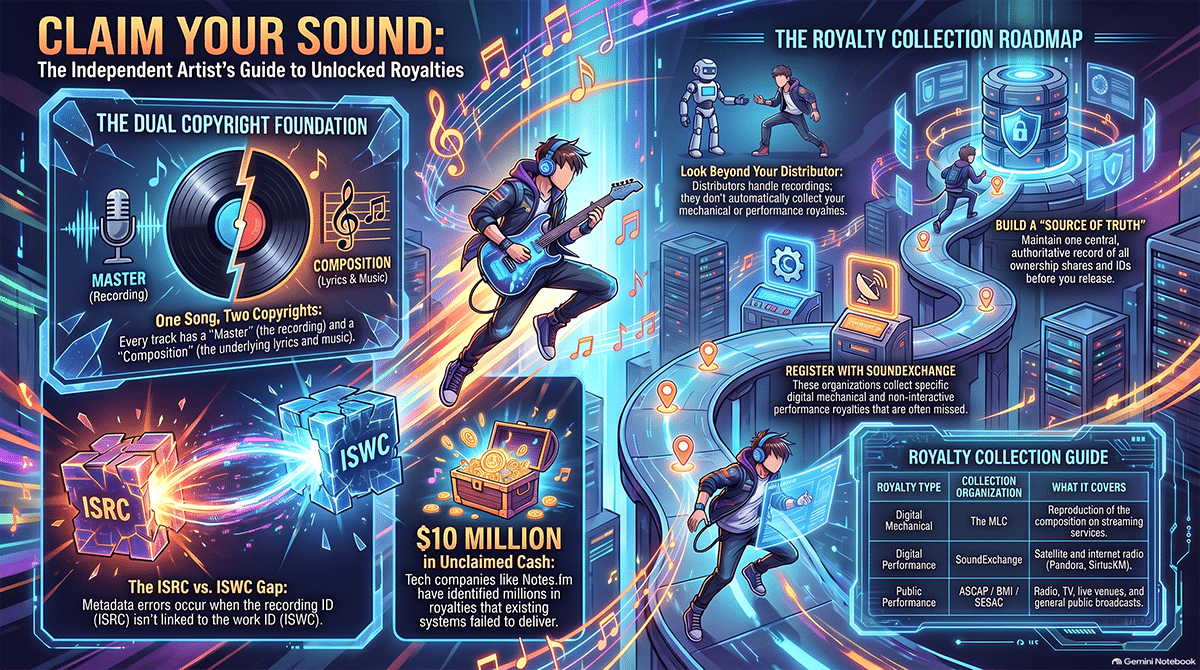
Your Music Crossed the Border. Did Your Royalties?
The internet has made it possible for an independent artist recording in a spare bedroom in Georgia to develop listeners in Germany, Japan, Australia, or South Africa. That global opportunity is wonderful, but it creates another layer of administration. Publishing and neighboring rights are collected under different laws, licensing systems, and society arrangements across territories. A collection arrangement covering the United States should not automatically be assumed to cover every type of music use in every country.
Neighboring rights generally concern certain uses of sound recordings and the related rights of performers and recording owners. Their availability and payment rules vary by territory, which makes them different from the U.S. mechanical royalties administered by the MLC. SoundExchange offers international collection services through agreements with foreign collective management organizations. According to its current information, artists and rights owners must authorize the international collection service through an appropriate international mandate to use that collection pathway. (SoundExchange)
International rights also create opportunities for accidental double administration. An artist might authorize one company to collect worldwide neighboring rights and later sign a separate agreement with another company covering some of the same territories and rights. When overlapping claims appear, resolving the resulting conflict may delay payments rather than increase them.
The goal is not to register with every royalty company that sends you an advertisement. It is to understand who is authorized to collect each type of income, where that authorization applies, and what happens when the agreement ends. For a working independent musician, keeping accurate records of those relationships is just as important as keeping track of the masters themselves.
That Show You Played Last Saturday Might Have Generated More Than Ticket Money
We tend to think of live performance income as whatever happens at the box office and merchandise table. You negotiate a guarantee, sell some shirts, hopefully move a few records, and go home with whatever remains after paying the band, buying gas, and making the traditional late-night pilgrimage to a restaurant that should probably have been closed an hour ago.
But if you perform your original compositions at eligible licensed venues, the performances may also generate songwriting royalties. BMI operates BMI Live, a program through which eligible performing songwriters submit live performance information, including dates, venues, and setlists, for consideration in royalty distributions. Other performing rights organizations have their own applicable live-performance reporting arrangements.
The details matter. Not every performance qualifies under every program, deadlines apply, and royalty amounts vary according to the organization’s distribution rules. A private house concert, a festival appearance, and a licensed club performance should not be assumed to receive identical treatment.
Nevertheless, imagine an independent artist who plays 80 shows a year and never reports eligible performances of their original songs. The artist may be overlooking an income opportunity simply because nobody connected the touring calendar to the publishing business. This is where music business administration starts becoming interesting. The same show information that helps an artist plan a tour can also support royalty reporting, accounting, fan engagement, and future booking negotiations. An organized independent music business should not treat those activities as unrelated jobs.
Television, Film, and Advertising Can Create More Than One Payment
Another place where artists need to pay attention is synchronization licensing.
Suppose a television producer contacts our songwriter about using “Long Road Home” in a scene. The artist owns both the composition and the master, negotiates permission for both, and receives an agreed licensing fee. Wonderful. That is income generated directly from an asset the musician controls.
Depending on the project, territory, use, and applicable performance licensing arrangements, the song may also generate subsequent performance royalties when the program is broadcast or otherwise exhibited. Those royalties should not be confused with the original synchronization fee. Accurate music identification and cue sheets can matter here. A cue sheet documents music used in an audiovisual production and helps the relevant parties identify compositions, writers, publishers, and uses for royalty administration.
BMI’s published royalty policies, for example, identify cue sheets as one of the sources used in registering and administering certain music used in film and television. (Broadcast Music, Inc.) An artist who accepts a sync deal and files the contract away without documenting the use, rights granted, ownership information, and expected payment routes may make future reconciliation much harder.
The same principle applies when a music library, publisher, licensing representative, or administrator handles a placement. Artists should know which rights were licensed, who collects the initial fee, who administers any subsequent royalties, and how the artist will receive statements. A $2,000 sync fee is a wonderful thing. Discovering later that the paperwork prevented you from tracking additional income is considerably less wonderful.
How Royalties Become Lost Without Anybody Actually Stealing Them
The word “lost” creates an impression that money has disappeared because somebody deliberately took it. Sometimes royalty disputes do involve misconduct or wrongful accounting. However, many collection problems begin with much less dramatic events.
A songwriter enters a legal name in one registration and a stage name in another. A collaborator changes publishers without updating an existing song record. A distributor delivers a recording with an incomplete songwriter credit. An artist changes companies and creates a new ISRC for the same recording when the existing identifier should have been retained.
None of these situations requires an elaborate criminal conspiracy. A small administrative mistake can create a chain of incorrect or conflicting information. Consider the artist who originally releases a recording through one distributor and later moves the catalog to another.
The original recording should generally retain its existing ISRC when transferred. The international ISRC agency specifically advises that the identifier remain with the same recording across different formats, services, and licensing arrangements. Assigning an unnecessary new identifier can create confusion when someone tries to reconcile historical usage and royalty statements. (ifpi-isrc) Now imagine doing that across 50 recordings.
The artist may have perfectly good audio files, beautiful artwork, and a loyal audience, but the administrative history of the catalog becomes a confusing collection of inconsistent records. This is why metadata, the information describing the music and its ownership, deserves more respect than it usually receives. A master recording without reliable ownership and identification information is like owning a rental property while losing the deed, the lease, the tenant’s name, and the address where the rent is supposed to be delivered.
You may still own the building, but collecting the income has become unnecessarily difficult.
Finding the Money: Start With the Catalog You Already Have
If this article has you wondering whether your music has missing royalties, the place to begin is not another subscription. Start with the recordings you already own and the agreements you already signed. Take a song that has been available for several years and reconstruct its business history. Find the original master, its ISRC, release date, distribution records, songwriting credits, publishing information, and any contracts assigning collection responsibilities.
Next, compare those records with the organizations that should know about the song. The MLC’s Public Work Search and member tools are a logical starting point for U.S. digital mechanical royalties. Its tools include ways to investigate missing ownership shares, identify unmatched recordings, and correct or register song information.
If you are self-administered and entitled to collect these royalties, verify that your membership and payment information are complete. If an administrator represents you, confirm that it has correctly registered your works and that your agreement covers the relevant rights and periods. Then investigate the recording side through SoundExchange. Verify your featured-performer identity, sound recording ownership claims, recordings, payment details, and any international collection authorization that may be appropriate.
Review your performing rights organization account as well. A song appearing in your distributor’s dashboard is not proof that the corresponding composition appears correctly in your performing rights organization’s catalog. The goal is to identify actual gaps, not blindly create new registrations every time something looks unfamiliar. Duplicate or conflicting claims can turn a simple correction into a much bigger problem.
If you identify a discrepancy, save the supporting documentation and contact the responsible organization or authorized administrator. A properly documented claim is more useful than a vague message explaining that somebody owes you money because your cousin heard your song on the radio.
A Royalty Audit Should Also Tell You When There Is No Missing Money
One of the dangers of the royalty recovery business is the temptation to assume that every music catalog contains a secret fortune. It doesn’t.
A musician might have every appropriate registration completed and still receive modest royalties because the recordings simply haven’t generated much eligible revenue. Some uses do not produce the royalty type an artist expects, and certain payments may be delayed by reporting cycles or minimum payment thresholds rather than missing.
A royalty audit should distinguish actual unpaid earnings from potential earnings, incomplete records, accounting questions, and money that has already been paid through another administrator. It should also establish whether a payment is legally recoverable and whether the amount justifies the cost of pursuing it. A service that identifies a possible $50 royalty problem is not necessarily providing $50 in additional profit if resolving it requires $200 in professional fees. Similarly, an estimate of royalties associated with historical music usage is not proof that the artist is entitled to recover that entire estimate.
The value of a serious royalty audit is that it replaces guesswork with evidence. It should give the musician a clearer understanding of what the catalog owns, what has been registered, what has already been collected, and which questions still need answers. That is valuable even when the final result is confirmation that the existing collection system is working properly.
The Bigger Opportunity Is Preventing Royalty Loss Before It Happens
Royalty recovery solves a problem after the damage has occurred. What happens if we design the music business to detect those problems before release? This is where the concept of an artist-controlled Source of Truth becomes particularly important.
A Source of Truth is a central record containing the authoritative information about an artist’s music, rights, recordings, collaborators, and business relationships. Instead of maintaining conflicting information in several spreadsheets, email conversations, distributor dashboards, and contracts, the artist maintains a reliable record from which different business activities can draw. For independent musicians, the most important part is that this information remains under their control.
A distributor can maintain its own records. A publisher can maintain its own records. Royalty societies can maintain theirs. But the artist should not have to rely on any one of those businesses to provide the only complete account of what the artist owns. This philosophy is central to the Making a Scene Artist Ecosystem, where the Source of Truth is intended to connect music assets, ownership information, rights administration, releases, and other business workflows within an artist-controlled environment.
The proposed Source of Truth Health Center adds an inspection layer to that foundation. Its purpose is to examine records for missing or conflicting information and help the artist address those problems before they become collection failures. The distinction is important. A central database does not magically collect royalties, establish legal ownership, or replace registration with the appropriate organizations. Its value comes from making accurate information easier to maintain, inspect, export, and reconcile.
The Health Center’s broader external-verification and royalty-prevention capabilities should be understood as a development direction, not a claim that every collection organization is already connected through a fully automated live integration. But the economic case for building those capabilities is remarkably clear.

What a Royalty Prevention System Would Actually Look Like
Imagine our songwriter has just completed “Long Road Home” and is preparing the release. The master has been approved, the artwork is finished, the distributor is ready, and the artist is eager to tell the world about the new recording. Before release, the artist opens the song’s Source of Truth record and reviews its collection readiness.
The system examines the information already associated with the composition. It recognizes the two writers and checks whether their agreed composition ownership shares total 100%. If the shares are incomplete or contradictory, the system identifies the problem and asks for clarification.
The recording record identifies the master owner and the featured performers. The ISRC is associated with the correct audio master, and the composition is explicitly linked to that recording.
The artist’s publishing administration details show who is responsible for U.S. mechanical royalties, performance income, and any other delegated collection rights. The system can recognize whether the artist is self-administered or has an existing administration agreement.
The goal is not to make the musician memorize every licensing system in the world. It is to make sure the artist has answered the important business questions before releasing the work.
A Health Center might tell the artist that the recording is ready for distribution but that the relevant SoundExchange registration still needs confirmation. It might notice that the songwriter’s publishing administration contract covers U.S. mechanical royalties but does not establish an international collection arrangement.
It might discover that the master owner’s name differs from the name recorded in the original recording agreement. These are not problems that should necessarily prevent every release. They are business risks that should be visible, understandable, and connected to practical corrective actions.
Think of it as the music business equivalent of checking whether your car has oil before driving across the country. Nobody expects the dashboard to become an automotive engineer, but it should tell you when something important requires attention.
The Artist Ecosystem Should Connect Royalty Prevention to the Actual Work of Making Music
The most useful part of an integrated Source of Truth is that it can collect information while the artist is already doing the work. When a musician creates a song record, the songwriter information can become part of its permanent history. When a producer delivers the final master, the approved audio file and its identification information can be connected to that same song.
When the recording is prepared for distribution, the release information can be generated from the authoritative records rather than reentered from memory. That matters because repetitive data entry creates opportunities for mistakes. If an artist enters the songwriter’s name one way in the recording project, another way at the distributor, and a third way with the publishing administrator, the artist has created three opportunities for those records to disagree.
The Source of Truth is designed to reduce that confusion by preserving the relationships between the song, recording, people, ownership, and business agreements. It should also preserve the history of those relationships.
Suppose a songwriter originally self-administered a composition but later hired a publishing administrator. The underlying song has not become a different composition. The artist’s collection arrangement has changed, and the system should record when that change became effective and which rights and territories it covers.
This becomes particularly important when an artist leaves a distributor or publisher. Historical royalty statements may refer to the previous company, while current income flows through a different arrangement. A complete record allows the artist to understand both without confusing them. For Making a Scene, the larger objective is not to build yet another collection company that requires musicians to hand over control of their catalogs.
It is to give musicians a reliable foundation for working with whichever distributors, royalty organizations, licensing services, and administrators make sense for their individual businesses.
A Source of Truth Health Center Could Eventually Compare Your Records With the Outside World
Internal checks are valuable, but they cannot answer every question. A songwriter can enter accurate information into a Source of Truth while an outside registry still contains the wrong ownership details. That creates a second stage of royalty prevention. Where authorized access and data availability permit, a more advanced Health Center could compare an artist’s authoritative information with outside registries and collection records.
Imagine that the artist’s Source of Truth identifies a composition as belonging equally to two songwriters, but an external registry shows a conflicting ownership claim. The system should not simply overwrite either record or declare that the artist’s information is legally correct. It should identify the discrepancy, preserve the evidence, and direct the artist toward the appropriate correction or dispute process.
Another useful check would compare the known recording identifiers with the recordings connected to a composition in the MLC database. If an artist’s live recording appears in reported usage but has not been matched to the song, that is actionable information. The artist could use the relevant MLC process to investigate and propose the correct relationship.
A similar approach could help artists verify SoundExchange recording claims, monitor administration status, and reconcile available royalty statements with expected collection routes. These functions would depend on the actual capabilities of each external organization, the permissions granted by the artist, and the agreements governing data access. They should never be presented as universal automatic recovery tools.
Still, the concept is powerful because it changes what a music catalog can do. Instead of simply documenting the assets an artist owns, the catalog begins helping the artist identify when outside records disagree with those assets. That is where ownership information becomes an active business resource rather than another digital filing cabinet.
Artificial Intelligence Could Make Royalty Prevention Far More Practical
There is an obvious role for AI in this process, and it has very little to do with generating another song. AI is particularly useful when large volumes of information need to be compared, organized, and examined for patterns. An artist may have decades of recordings, multiple distributors, several publishing agreements, old royalty statements, and collaborators whose names appear differently across releases.
A carefully designed AI-assisted system could help identify possible inconsistencies, missing relationships, incomplete registrations, and unusual changes in payment patterns. It might notice that a composition has several known recordings but that only one appears in a particular matching report. It could recognize that an artist’s royalty statement shows payments through one quarter but that no newer statement has been imported.
It could also help translate complicated administrative language into understandable instructions for a musician who would rather be writing another song than learning how collection societies operate. However, AI should assist the artist rather than invent ownership conclusions.
A language model cannot establish that someone owns a song simply because their name appears on a recording credit. It cannot determine a legally binding songwriting split from an interview, or prove that unpaid royalties exist by comparing approximate streaming numbers with an average payout figure. Ownership requires appropriate evidence, and collection questions require reliable transaction and registration information.
A properly designed AI-assisted Health Center should therefore explain why it flagged an issue, identify the supporting records, acknowledge missing information, and allow the artist to approve corrections. It should also protect private contracts, financial information, and unreleased recordings rather than uploading sensitive material indiscriminately to outside AI services.
For independent artists, the purpose of AI is to reduce administrative work and improve the chances of collecting legitimate income, not introduce a new system that confidently makes financial mistakes at machine speed.
Royalty Prevention Does Not Stop on Release Day
One of the biggest misconceptions in music administration is that registration is something you complete once and never revisit. Music catalogs change. A song may be recorded by another artist, included on a compilation, licensed for television, released as a live recording, or transferred to a new distributor. A songwriter may change publishers. A band may dissolve, a master may be sold, or a recording may find an unexpected audience in another country.
Each event can create a reason to review existing information. This suggests that royalty prevention should be an ongoing activity rather than a final checkbox in the release process. A Source of Truth Health Center could conduct periodic inspections of an artist’s catalog and identify changes that require attention.
For example, a new recording version might need to be associated with an existing composition. A publishing agreement approaching its expiration date might require the artist to review future collection responsibilities. A missing royalty statement could trigger an inquiry without automatically assuming that money has been stolen.
An artist who maintains this information throughout a career is in a much stronger position than somebody who waits until retirement to discover that an old album is still earning money through a company whose login credentials disappeared ten years ago. And it makes catalog migration much easier.
When an artist changes distributors, the Source of Truth can preserve the existing recording identifiers, ownership history, contracts, assets, and related release information. The new distributor becomes another business partner rather than the organization that determines whether the artist can reconstruct their own catalog. That is a major part of building an independent music business that can survive changes in technology and corporate ownership.
Don’t Confuse Royalty Collection With Your Entire Music Business
There is another important lesson hiding inside this conversation. Even perfect royalty collection does not guarantee a sustainable music career. An artist can recover every legitimate streaming and performance royalty and still struggle financially if the underlying music does not generate enough income.
That is why Making a Scene continues to advocate for a broader artist-owned business. Royalty collection should exist alongside live performance, merchandise, direct music sales, memberships, fan support, licensing, publishing, production services, and other legitimate sources of revenue. The important connection is that the artist owns the assets and relationships supporting those activities.
An accurate Source of Truth can help establish what the artist is entitled to collect from licensed uses of music. An artist-owned fan relationship creates opportunities for income that does not depend entirely on streaming platforms or royalty collection systems. Imagine that “Long Road Home” becomes a fan favorite at live shows.
The artist might receive streaming royalties, sell a special physical edition directly to fans, license the master for a documentary, and offer an exclusive acoustic performance through a fan membership. Those activities have different economics, but they all depend on the same underlying musical assets and the artist’s ability to control them.
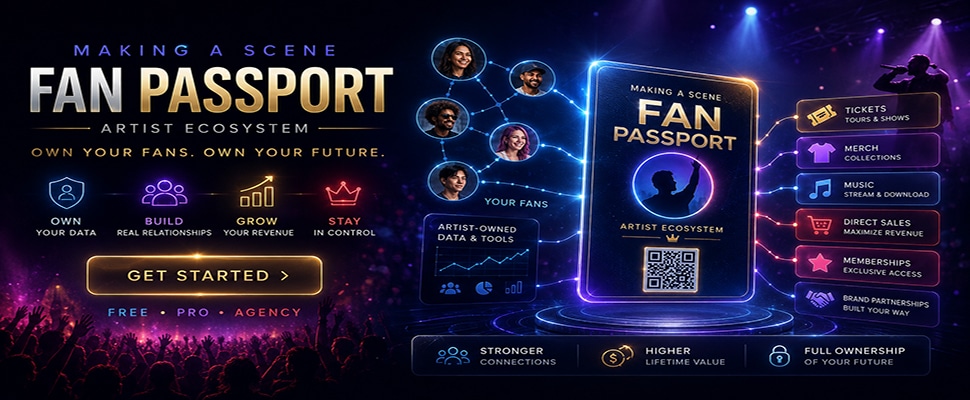
A fan relationship also provides valuable business information. The musician can learn which songs people care about, where supporters are located, which merchandise sells, and whether there is demand for another show. That is why the Artist Ecosystem’s Source of Truth and Fan Passport belong to the same larger business philosophy, even though they serve different purposes.
One helps the artist maintain reliable information about the music and business assets. The other is designed to help build consent-based relationships with the people who support the artist. Together, those foundations can support a career built around multiple sources of revenue rather than dependence on one company’s payment dashboard.
What Happens When Music Becomes a Long-Term Asset?
Independent artists are often encouraged to think about the next release, the next tour, and the next promotional campaign. Those things matter, but music can continue earning long after the original promotional campaign has ended. A song recorded twenty years ago can be discovered by a new audience, licensed for a film, covered by another musician, or used in a future media format.
The artist who maintains accurate ownership and administrative records is better prepared to benefit from those opportunities. The importance of this becomes even clearer as music technology evolves. AI licensing, new forms of digital collectibles, immersive media, and future distribution systems may create additional opportunities to license music and related assets.
However, an artist cannot negotiate effectively over rights that are poorly documented or whose ownership remains disputed. Before an artist can make an informed decision about licensing a master, composition, voice, or other protected asset, they need to understand what they control and what permissions may already have been granted.
This is where royalty prevention becomes something bigger than accounting. Maintaining an accurate catalog protects the artist’s ability to participate in future business opportunities. The Source of Truth should therefore preserve not just royalty information but the contracts, permissions, ownership changes, and provenance records that explain how the artist came to control each asset.
That information can become valuable when negotiating a licensing opportunity, examining an acquisition offer, resolving a dispute, or passing a music catalog to the next generation.
The Music Industry Needs to Stop Making Artists Discover Their Own Money
The recent Notes financing is interesting because it highlights an uncomfortable reality about the modern music business. We have developed remarkably efficient systems for putting recordings in front of listeners, measuring consumption, delivering advertising, and processing payments.
Yet musicians can still find themselves searching several databases to determine whether the money generated by those recordings has reached the people who created and own them. The problem is not entirely technological. Music ownership can be complicated, laws differ between countries, contracts change, and different rights require different collection arrangements.
There will never be one universal registration that solves every possible royalty problem. But that does not mean independent artists should accept unnecessary confusion as a permanent feature of the business. A musician should be able to maintain accurate information about a song and reuse that information across appropriate systems without starting from scratch every time.
They should be able to identify which company collects each royalty, what that company is authorized to administer, and whether an important registration remains incomplete. They should also be able to move their music between service providers without losing the history and identifiers needed to collect income generated by earlier releases.
Royalty recovery companies may provide useful services, particularly for artists with large or complicated catalogs. But their existence also demonstrates why musicians need better education and stronger systems for protecting their income in the first place. The real opportunity is not simply creating more businesses that search for lost royalties. It is creating a music industry where fewer legitimate royalties become lost.
Your Next Recording Deserves More Than a Release Date
Let’s return one final time to our imaginary songwriter and “Long Road Home.” The artist has written the song, completed the recording, established the ownership information, documented the collaborators, assigned the appropriate recording identifier, and connected the master to the composition.
The distribution arrangement is clear, publishing administration responsibilities are documented, and the artist knows which organizations are expected to collect the relevant royalties. A system supporting that process will not guarantee commercial success. It cannot promise that the song will receive radio play, land a television placement, or earn enough streaming income to pay the rent. What it can do is help ensure that success does not create a new administrative mystery.
If the song earns $50, the artist should have the information necessary to understand where the money came from and whether additional collection routes apply. If it earns $5,000, the artist should not need to hire a detective to reconstruct the recording’s ownership history. And if the recording unexpectedly becomes successful ten years from now, the artist should still be able to identify the master, the composition, the rightful owners, the applicable agreements, and the organizations responsible for payment. That is the practical meaning of treating music as a long-term business asset.
The $5 million invested in Notes shows that there is commercial interest in helping artists find revenue that existing systems have failed to deliver. The company’s reported discovery of more than $10 million in unclaimed royalties illustrates the kinds of problems a recovery service can identify, although it does not establish how much money any particular independent artist might recover. For Making a Scene, the larger opportunity is to apply the same lesson before the money goes missing.
An artist-controlled Source of Truth, supported by a Health Center that identifies incomplete records and helps verify external registrations, could make royalty prevention a normal part of creating, releasing, and managing music. That approach won’t eliminate every collection dispute or accounting error. But it can reduce unnecessary risks and give independent artists a much clearer understanding of the business they own. And that brings us back to the mission of building a music industry middle class.
Independent musicians do not need to become multinational record labels to build financially sustainable careers. They need to own valuable assets, understand their rights, maintain relationships with their fans, develop several sources of revenue, and have the tools to manage those activities without surrendering control.
Finding money that was missed years ago can be a welcome surprise. Building a music business where legitimate income has a clear path back to its owner is a much stronger foundation for the future. After all, you already did the hard work of making the music. You shouldn’t have to spend the rest of your career trying to prove that the money belongs to you.
 |  Spotify |  Deezer |  Breaker |
 Pocket Cast |  Radio Public |  Stitcher |  TuneIn |
 IHeart Radio |  Mixcloud |  PlayerFM |  Amazon |
 Jiosaavn |  Gaana |  Vurbl |  Audius |
 Reason.Fm | |||
Find our Podcasts on these outlets
Subscribe to Our Newsletter
Discover more from Making A Scene!
Subscribe to get the latest posts sent to your email.


