
The Great Engagement Lie




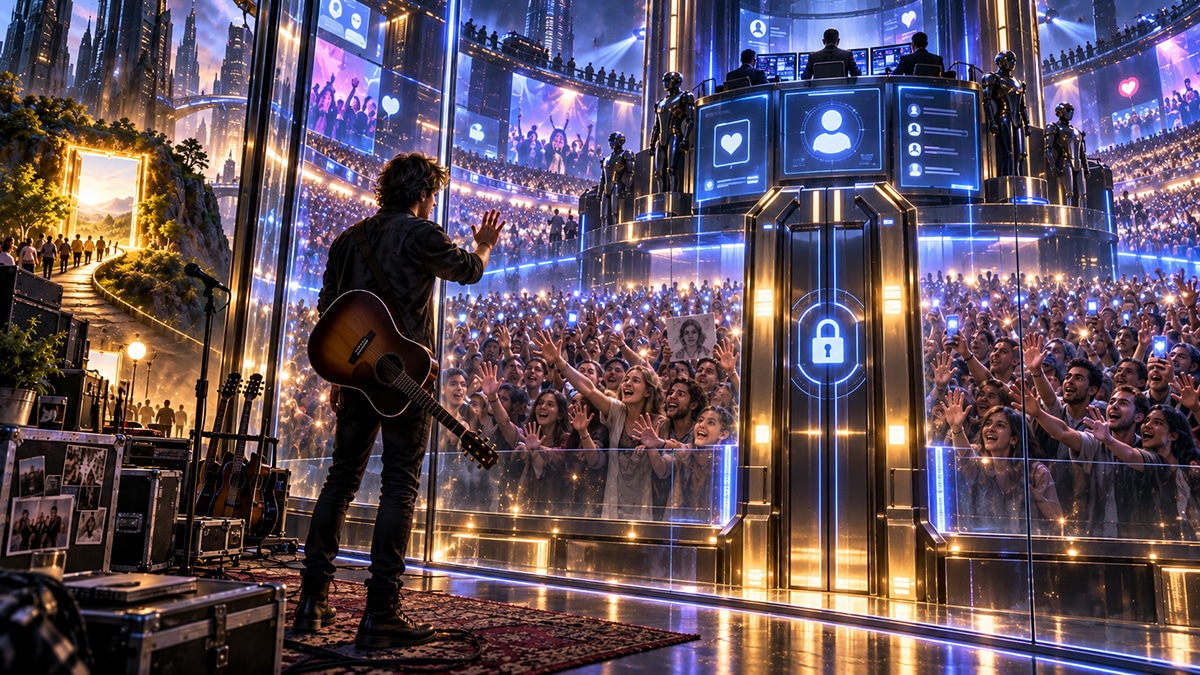
Making a Scene Presents – The Great Engagement Lie
Listen the Podcast Discussion
How Indie Musicians Became Free Labor for the Platforms That Charge Them to Reach Their Own Fans
We Were Told to Chase Likes, Followers, Hearts, and Streams. Nobody Explained Who Was Actually Making the Money.
There is a strange ritual taking place in the independent music business. Every morning, thousands of musicians wake up, reach for their phones, and check their numbers. How many people watched yesterday’s video? Did that new song get added to any playlists? How many hearts did the Instagram post receive? Did the Facebook page gain another twenty followers? Somewhere in the middle of all that excitement, a musician is sitting at the kitchen table wondering how to pay for the van repair before Saturday’s gig.
We have spent nearly two decades teaching independent musicians that success in the modern music business is measured by engagement. We have told them to post more content, make better videos, share their personal lives, chase playlists, feed the algorithm, and build enormous social media followings. We have convinced artists that if they collect enough likes, hearts, streams, and followers, a sustainable music career will somehow appear at the end of the rainbow. There is just one problem with this beautiful digital fairy tale. The rainbow appears to end at somebody else’s bank account.
A thousand likes will not pay the electric bill. Ten thousand followers will not automatically put gas in the touring van. A hundred thousand video views might make a musician feel wonderful, but unless those views generate actual income, they are not going to cover the mortgage. Streaming can produce royalties, sometimes substantial ones, but the number displayed on an artist’s profile is not the same thing as money available to spend.
The uncomfortable truth is that independent musicians have been encouraged to build businesses around numbers that primarily measure how valuable their content is to somebody else’s platform. In the process, artists have helped create one of the most profitable advertising and data businesses in human history while struggling to earn enough money to continue making the music that attracts those audiences in the first place.
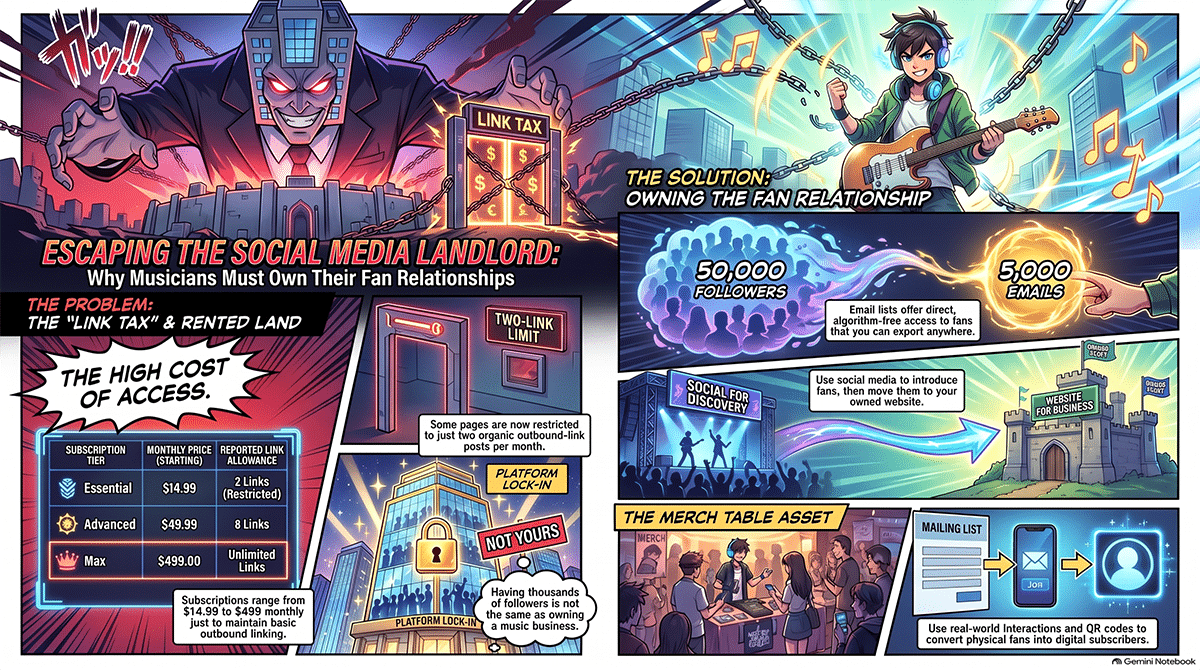
The problem is not that social media is useless. It is that musicians have mistaken the place where fans discover them for the place where their music business actually lives.
It is time to examine how that happened, who benefits from the current arrangement, and how independent artists can begin changing the relationship without abandoning the technology that helps people discover their music.
How We Became Employees of the Algorithm Without Ever Getting a Paycheck
Remember when social media was supposed to level the playing field for independent musicians? The promise sounded incredible. Artists could reach listeners around the world without radio programmers, record executives, distribution gatekeepers, or enormous marketing budgets deciding who deserved an audience.
And some of that promise was real. An independent songwriter could post a performance from a bedroom in Georgia and reach a listener in Germany. A blues guitarist could introduce a new record to someone who had never heard of the artist or the small club where they played every weekend. Musicians who might have spent their entire careers performing within fifty miles of home suddenly had access to global audiences.
But somewhere along the way, the definition of building an audience began to change. Instead of encouraging musicians to use social media to introduce themselves and establish relationships with fans, the industry began teaching them to build their entire careers inside the platforms themselves.
Musicians were instructed to create constant content. They needed short videos, behind-the-scenes footage, rehearsal clips, personal stories, announcements, livestreams, and clever little performances designed to catch someone’s attention before the next video appeared. The music became one ingredient in a much larger content machine.
Eventually, musicians began spending almost as much time trying to satisfy recommendation systems as they spent writing songs, rehearsing, recording, and performing. They were no longer simply artists using technology to promote their work. They had become unpaid content suppliers for technology companies whose business models depend on keeping people watching, scrolling, and returning.
There is nothing inherently wrong with making entertaining content. The problem begins when creating content becomes the primary objective rather than a means of developing a profitable relationship with an audience.
A musician who spends four hours editing a video that receives 5,000 views may have created something valuable for the platform. Whether that musician created something valuable for their own business depends on what happened after those views occurred.
Did anyone purchase the album? Did anyone buy tickets to the next show? Did anyone join the artist’s mailing list? Did the musician learn where those interested listeners live? Did a new fan establish a relationship that can continue beyond the lifespan of yesterday’s post? If the answer to all those questions is no, the musician may have completed another shift at the content factory without receiving a paycheck.
Follow the Money. It Usually Explains the Business.
If you want to understand what a company considers valuable, look at how it earns its money. Corporate mission statements can be wonderfully inspiring, but financial reports have a habit of explaining what is really keeping the lights on.
Consider Meta, the parent company of Facebook and Instagram. In its financial results released January 28, 2026, Meta reported approximately $201 billion in total revenue for 2025. Of that amount, approximately $196.2 billion came from advertising. That means advertising accounted for nearly 98% of the company’s reported annual revenue. The numbers come directly from Meta’s published financial results, not from an angry musician with a suspiciously low engagement rate. (Meta)
That advertising business requires attention. Advertisers pay because billions of people spend time interacting with content across Meta’s services. Musicians, comedians, writers, photographers, businesses, community organizations, and ordinary users all contribute to the enormous collection of material that makes those services attractive.
When an artist posts a wonderful performance, that performance gives someone a reason to open the app. When the artist encourages fans to follow their page, those fans become additional participants in the platform’s ecosystem. When the musician shares a link to a new video, the platform receives more opportunities to keep people engaged and show advertising.
Meta provides the software, infrastructure, recommendation systems, and advertising marketplace. The musician provides the creative work and brings people who want to experience it. Both sides receive something from the arrangement, but the economic benefits are not distributed according to how many hours the musician spent writing the song.
The artist may receive exposure, a possible sale, a future booking, or an important introduction. The platform receives activity that supports its advertising business. This distinction matters because musicians have been taught to celebrate the activity itself rather than measuring whether that activity produces a business result. A successful social media post is not necessarily a successful music business transaction. It becomes useful to the artist when it helps create something the artist can retain, sell, or develop into a continuing relationship.
The Fan You Brought to the Party Is Now Someone Else’s Customer
Imagine a band that has spent ten years building a loyal regional following. They have driven thousands of miles, played smoky bars, opened for touring acts, sold records from folding tables, and shaken hands with fans after nearly every performance. Those relationships were not created by an algorithm. They were created through music, personality, shared experiences, and years of hard work.
Now imagine that band spends the same decade encouraging every fan to follow its Facebook page. The website points people toward Facebook. The posters display Facebook links. The singer tells audiences to follow the band on Instagram. Every email signature and promotional graphic sends another person into somebody else’s digital environment.
Over time, the band accumulates 10,000 followers. The number looks impressive, and the musicians understandably feel proud of what they have accomplished. Then the band announces a new album. They publish a post about the release, but many followers never encounter it. The band can see the total number of people following the page, yet it cannot simply assume that every one of those people will receive its announcement.
Meta openly describes the role of AI-driven ranking systems in determining which content appears in people’s feeds. Following an account is one signal in that process, but it is not a guarantee that every post from that account will be delivered to every follower. (Meta Transparency) Now comes the interesting part. The musician can pay to promote the announcement.
Meta’s advertising tools even include an audience option for reaching people who like an existing Facebook page, subject to the tool’s requirements and available targeting controls. In other words, paying to reach people already connected to the artist’s page is an ordinary feature of the advertising business. (Facebook) Think about what happened here.
The musician spent years attracting fans. The musician encouraged those fans to follow a page. The platform now controls much of the process that determines whether the musician’s messages appear in those fans’ feeds. When the artist needs additional visibility, the platform offers to sell it. Nobody had to steal the fans. The artist voluntarily brought them into an environment where access is governed by another company’s rules.
The band still has the relationship in a human sense. Those people may remember the music, attend concerts, and care deeply about the artist. But the musician does not possess the independent communication channel that would allow the relationship to continue without relying on Facebook. That is the difference between having an audience and having direct access to an audience. And it is one of the most expensive misunderstandings in the independent music business.
Your Fans Are Providing Valuable Information. How Much of It Comes Back to You?
The deeper issue is not simply that platforms control visibility. It is that they also collect information about the people interacting with an artist’s music and content.
When someone watches a performance video, follows a musician, saves a song, shares a post, or interacts with an advertisement, that activity can provide useful information about the person’s interests and behavior.
Meta’s own U.S. privacy disclosures describe collecting information about people’s connections, the content they engage with, the accounts they interact with, and how they use its services. That information can help the company personalize experiences and advertising, subject to applicable privacy controls and legal requirements. (Facebook)
Here is where the relationship becomes particularly interesting for an independent musician.
Suppose 300 people in Atlanta repeatedly watch a guitarist’s videos. Many have attended live performances, some have bought albums, and others have shared the music with friends. The platform can potentially identify patterns in that behavior and use relevant information within its systems.
The guitarist may receive useful information about overall reach, engagement, and audience geography. But those statistics are not the same as having a permission-based list of people who want to hear about future shows.
The artist cannot simply download the platform’s complete collection of individual listener profiles and begin communicating with those people outside the platform. The information available to artists is limited by the service’s tools, privacy policies, and applicable laws.
That matters because the difference between knowing that 300 people in Atlanta enjoy your music and knowing which 75 people have personally requested concert announcements can determine whether your next Atlanta show succeeds. The first number describes an audience. The second represents a group of people with whom you have an actual communication relationship. Those two forms of information are not interchangeable.
Data can help a musician decide where to perform, what merchandise to produce, which songs connect with listeners, and whether a particular city deserves additional promotion. But information becomes much more useful when the musician can act on it directly, with the fan’s permission.
A dashboard showing 10,000 followers may provide a wonderful sense of accomplishment. A permission-based contact list of 500 people who regularly attend shows and purchase merchandise may provide a much stronger foundation for earning a living.
Streaming Changed the Music Business. It Did Not Turn Every Listener Into a Customer.
Streaming deserves its own place in this conversation because it differs from social media engagement in one important respect. Streaming can generate royalties for recordings and compositions. A stream is not financially identical to a Facebook like, and it would be misleading to suggest otherwise. But musicians have still been encouraged to confuse enormous streaming numbers with sustainable earnings.
According to Spotify’s royalty guide, its music royalty payments are based on streamshare rather than a universal fixed payment for every stream. Spotify pays recording and publishing rights holders, who then distribute money according to their agreements with artists, songwriters, publishers, and other participants.
The amount an individual musician ultimately receives depends on ownership, contracts, distribution arrangements, and the various royalty systems involved. There is no single Spotify payment rate that accurately describes every artist’s earnings. (Loud & Clear) There is another detail worth understanding.
Spotify’s recording royalty policy requires a track to receive at least 1,000 streams during the previous twelve months to qualify for its recorded music royalty pool. That requirement does not change how publishing royalties are calculated, but it demonstrates why the number displayed beside a recording cannot automatically be treated as a predictable paycheck. (Loud & Clear)
Streaming remains an important source of discovery and revenue. An independent musician should collect every royalty they are entitled to receive and make their music available wherever listeners want to hear it. But streaming does not automatically create a direct relationship between the artist and the individual listener.
An artist may discover through streaming analytics that a particular city is generating thousands of plays. That information could help with tour planning, but it does not necessarily provide the names and contact permissions needed to invite those listeners to a concert. The streaming service knows who its users are. The musician generally receives reporting and audience insights rather than a portable list of every listener and their contact information.
Even Spotify recognizes that listening is only one part of the music business. Its artist tools promote concerts and merchandise, including connections with ticketing partners and Shopify, because fan spending extends beyond the recording itself. (Spotify for Artists)
The important question for independent musicians is not whether they should abandon streaming. It is whether they are allowing streaming statistics to become the final destination instead of using listener interest to support a broader career. A stream can introduce someone to a song. A direct relationship can introduce that person to everything else the musician has to offer.
The Engagement Economy Is Designed to Keep You Engaged, Too
There is another aspect of this system that deserves attention. The platforms do not merely encourage fans to keep scrolling. They also encourage artists to keep producing the material that makes scrolling worthwhile.
Every artist has experienced the emotional roller coaster. A video performs beautifully, so the musician creates another. The next one receives fewer views, leading to questions about posting times, hashtags, video length, and whether the algorithm has suddenly developed a personal grudge against guitar players. Before long, a musician who intended to spend the afternoon writing a new song is researching ways to improve audience retention during the first three seconds of a video.
There is a place for that knowledge. Good marketing has always involved understanding how to attract attention and communicate effectively. The problem is that musicians have been trained to optimize their work around the platform’s measurements without asking whether those measurements correspond to meaningful progress in their own careers.
A video that receives 50,000 views may be excellent advertising for an artist. It might introduce the music to thousands of potential fans, attract a booking agent, or inspire people to purchase an album.
But if the artist has no clear way for interested viewers to continue the relationship, much of that opportunity may disappear into the endless stream of competing content. The algorithm is not responsible for building the musician’s business. It is responsible for serving the objectives of the company operating the platform. Musicians need to stop expecting somebody else’s software to care about their touring expenses.
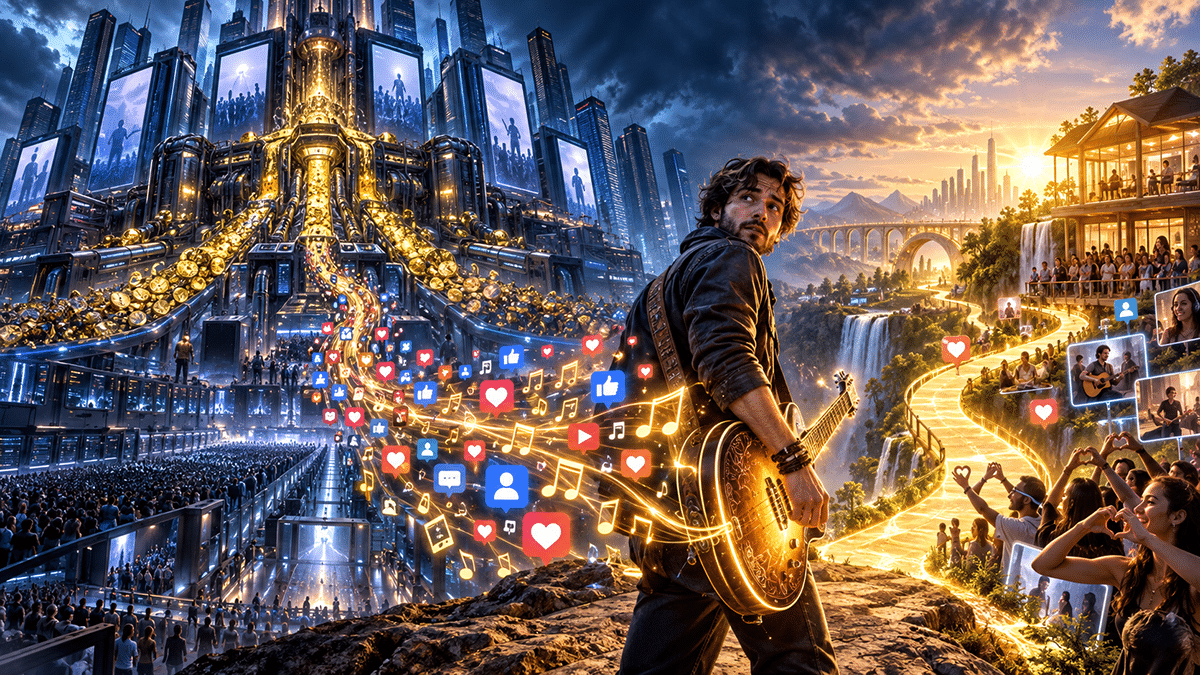
We Have Been Measuring the Wrong Kind of Success
Imagine two independent artists preparing for a weekend performance. The first musician has 25,000 Instagram followers. Their videos receive thousands of likes, and they spend considerable time studying engagement statistics. They announce the show repeatedly, hoping the posts will reach enough people to fill the room.
The second musician has 2,000 followers and a permission-based contact list of 400 fans. The musician knows that 85 of those fans live near the venue, that several attended the last performance, and that a handful regularly purchase new releases. Those numbers do not prove that the second musician will sell more tickets. There are too many other variables, including ticket price, musical appeal, geography, venue size, and the quality of the promotion.
But the second artist has something important that the first may lack. They can communicate directly with a known group of interested people, assuming the fans have agreed to receive those communications. That changes the way a musician can approach the business.
Instead of purchasing broad advertising and hoping the right people encounter it, the artist can invite fans who have already demonstrated an interest in attending local performances. Instead of offering merchandise to an anonymous audience, the musician can contact previous buyers about a new record or special edition. The goal is not to turn music into a cold mathematical exercise. It is to recognize that real relationships create business opportunities that inflated audience numbers cannot guarantee.
Consider a purely hypothetical example. A musician has 100 fans who have independently agreed to receive release announcements. Twenty of those fans decide to purchase a $25 album-and-merchandise package. That represents $500 in gross sales before production expenses, fulfillment, taxes, and payment processing.
There is no guarantee that twenty people will buy anything. The example simply demonstrates the difference between counting attention and measuring an actual transaction. If those same 100 fans had each clicked a heart on a social media post, the hearts themselves would not represent $500 in artist income. Musicians have been taught to chase the first kind of number while treating the second as something that will eventually happen if they become popular enough. Perhaps the industry should have been teaching them to build the customer relationship from the beginning.
The Music Industry Used to Understand the Value of a Mailing List
Long before musicians began counting followers, successful independent artists understood the value of knowing who came to their shows. They collected names and mailing addresses. They sent postcards announcing new releases. They maintained fan clubs, distributed newsletters, and built relationships with record stores and community radio stations.
Those systems were hardly perfect. Mailing postcards cost money, addresses became outdated, and somebody always managed to spill beer on the mailing-list clipboard. But the underlying business principle was sound. When someone supported the artist, the artist attempted to establish a way to continue the relationship.
A musician who performed in Philadelphia might collect fifty new names after a successful show. When the band returned six months later, it could contact those people rather than beginning the promotional process from nothing. That information was a business asset.
The digital revolution should have made this process dramatically easier. Email, websites, digital stores, mobile applications, and customer relationship management systems offer musicians capabilities that would have seemed impossible to independent artists thirty years ago.
Instead, many musicians moved their audience-building efforts into systems where the contact relationship remained largely under another company’s control. We exchanged mailing lists for follower counts. Then we started paying to promote announcements to the followers. Somewhere, an old-school independent record promoter is staring at that arrangement and wondering whether anybody remembers how a mailing list works.
The Missing Piece Is Not Another Social Media Platform
Whenever musicians become frustrated with an existing platform, the conversation usually turns toward finding a replacement. Perhaps another video service will offer better visibility. Maybe a new social network will treat musicians more fairly. Maybe the latest AI-powered discovery application will finally solve the problem.
Some new services undoubtedly will create valuable opportunities. Technology changes, and independent artists should remain curious about developments that can help them reach listeners. But moving the same business model into a different platform does not necessarily solve the underlying problem.
If an artist builds an enormous following somewhere else but still cannot independently communicate with interested fans, the musician has simply moved into a different rented apartment. The address changed. The landlord still controls the building. What independent musicians need is not necessarily another place to post content. They need a way to connect the places where audiences discover music with a business system that maintains direct, permission-based fan relationships.
Social media can introduce the musician. Streaming can make the music available. Video platforms can demonstrate what the artist does. Music publications, radio programs, podcasts, and interviews can help establish credibility and attract new listeners. But those activities should lead toward something the musician can continue developing independently.
That destination might begin with a website, mailing list, fan community, direct store, or membership program. The specific technology matters less than the underlying relationship. The fan should have a clear opportunity to connect directly with the artist rather than being required to maintain the relationship exclusively through a third-party feed.
Your Website Should Be More Than an Expensive Business Card
Many independent musicians already have websites. Unfortunately, those websites often function primarily as digital collections of links pointing visitors back toward other companies. A fan discovers the artist, visits the website, and immediately encounters buttons for streaming services, social media accounts, and video platforms. Those destinations may be useful, but they should not be the only meaningful actions available.
A musician’s website should also help fans support the artist, learn about upcoming performances, purchase music and merchandise, and establish a direct relationship.
Imagine someone visits a band’s website after hearing a song on the radio. Instead of simply displaying another collection of social media icons, the website invites the listener to follow the artist directly and receive updates about future performances. The fan might be offered an unreleased acoustic recording, a behind-the-scenes video, or advance notice of the next local show. The offer does not have to be expensive, complicated, or attached to a paid membership. It simply gives an interested person a reason to establish a continuing relationship. That small moment changes the purpose of the website.
The artist is no longer merely sending people onward to someone else’s platform. The website becomes part of the system through which the musician develops a fanbase that can support an actual business. The social media accounts still matter. The streaming links still matter. The videos still matter. They are now connected to something that can continue working for the artist even when individual posts stop receiving attention.
Fans Are Not Leads to Be Harvested. They Are People Who Chose to Support You.
Any discussion about fan data needs to address an important distinction. Independent musicians should have greater control over their own fan relationships, but that does not mean artists should collect every piece of information they can find about someone.
A person who listens to a song has not automatically agreed to receive marketing messages. A person who attends a concert has not necessarily agreed to join a mailing list. Following an artist on Instagram does not give that artist permission to export the person’s identity into an unrelated marketing system. The goal should be permission-based relationships. A fan should understand what they are joining, what kinds of communications they may receive, and how they can stop receiving them.
The Federal Trade Commission’s guidance on the CAN-SPAM Act explains requirements for commercial email, including accurate sender information, appropriate identification, a valid postal address, and a functioning way for recipients to opt out. Other laws, particularly those involving text messages and the handling of personal information, may create additional obligations. (Federal Trade Commission) This is not just about legal compliance. It is about respecting the people who make an independent music career possible.
Musicians who build strong relationships with fans generally do so because those fans feel connected to the music and the person creating it. Turning that relationship into an aggressive marketing campaign would defeat much of the purpose. An artist does not need to email fans every morning. They need to communicate when they have something meaningful to share. That might mean a new recording, a nearby performance, a special release, or a personal update that helps supporters feel connected to the artist’s creative journey. Good fan data allows musicians to be more relevant, not more intrusive.
Knowing that a fan lives in Chicago means the artist can avoid sending repeated concert announcements for shows in Atlanta. Knowing that someone prefers vinyl can help the musician avoid overwhelming that person with unrelated merchandise offers. The best use of fan information is to make the relationship better for both sides.
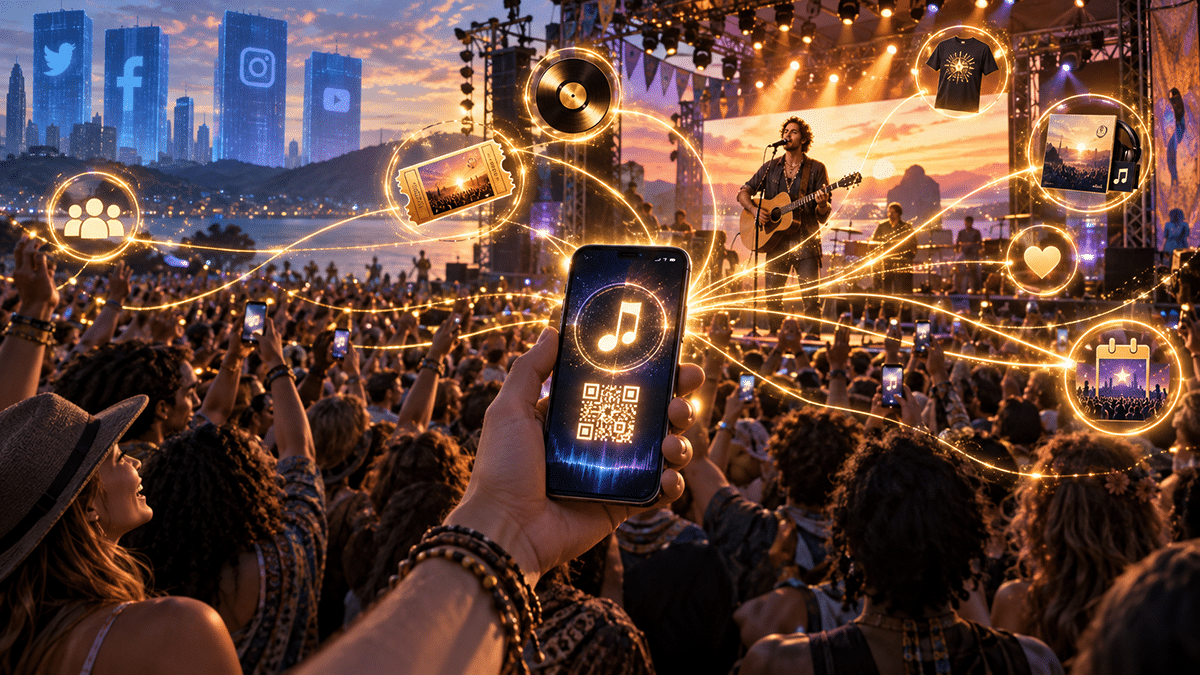
The Fan Passport Idea: What Happens When the Artist Becomes the Destination?
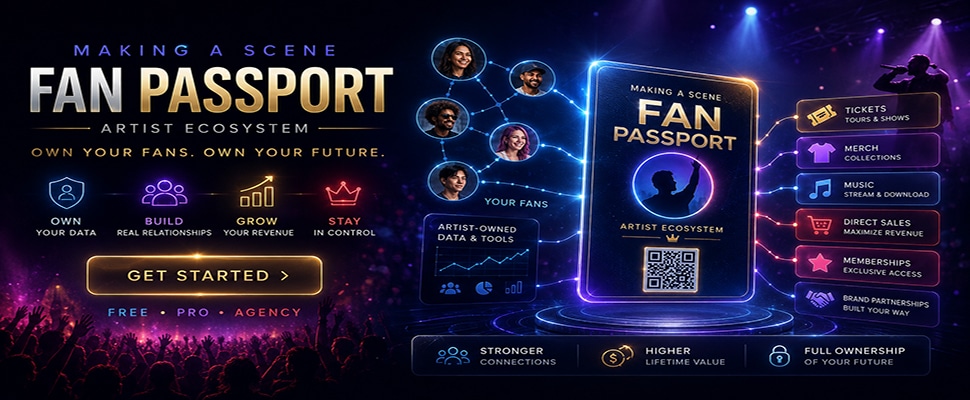
This is the problem behind the Making a Scene Artist Ecosystem and Fan Passport project. The idea did not begin with the belief that independent musicians needed another complicated subscription service or another collection of business dashboards. It began with a question that the industry should have been asking years ago.
What would happen if artists had a simple way to build and maintain their own fan relationships while continuing to use the existing platforms for discovery? Imagine an artist performing in a small music venue. Someone in the audience hears the band for the first time and decides they want to know more.
The musician could encourage that person to follow the band on Instagram, and there is nothing wrong with doing so. But the artist could also display a QR code that invites the fan to establish a direct connection through Fan Passport. The fan scans the code and chooses to follow the artist. With appropriate permission, the musician can retain the fan’s contact information and begin building a relationship that is not dependent on whether tomorrow’s social media post performs well.
The artist can potentially connect that relationship to the show where it began. Future interactions might include another performance, a music purchase, merchandise, a reward, or a special fan experience. Instead of treating these activities as isolated events scattered across unrelated services, the Artist Ecosystem is designed to connect them around the musician and the fan.
The important part is not the QR code, the mobile application, or the database. Those are tools. The important part is that the musician begins developing a relationship they can manage and continue outside the social media feed.
This is also why the system is not intended to force artists into abandoning their existing websites or preferred services. Its direction is to connect the artist’s business information, fan relationships, and revenue activities through a central cloud-based ecosystem, with website tools and other access points supporting that same underlying business. An artist should not have to create a new isolated fan database every time they decide to use another website builder or marketing tool. The relationship should remain connected to the artist.
For musicians curious about the concept, the Making a Scene Artist Ecosystem and Fan Passport currently offers a Free Core level advertised for up to 250 active fan relationships. Its published feature information includes fan capture, basic QR and smart links, consent records, fan data exports, show-related tools, and introductory direct-support workflows. More advanced business operations are associated with paid plans, and certain functions depend on connected services and configuration. (Masfan Passport)
That free starting point matters because independent musicians should not have to make another significant financial commitment before discovering whether they can successfully build direct relationships with their fans. A band does not need 25,000 people in a database on the first day. It needs to establish the process of collecting its first meaningful fan relationships and learning how to maintain them. The first fifty relationships can teach a musician more about the practical value of fan ownership than months of staring at follower counts.
The Real Value of a Fan Is What You Can Build Together
Consider how different a musician’s career might become when fan interactions begin working together rather than disappearing into separate systems. A fan attends a concert and decides to connect with the artist. Several weeks later, that person receives an announcement about a new recording. They purchase the album and return to another performance a few months later.
Over time, the musician begins to understand which supporters attend shows, which prefer recorded music, and which occasionally purchase merchandise. That knowledge creates opportunities to provide better experiences. A fan who regularly attends performances might appreciate advance notice when a new show is announced. Someone who purchases physical recordings might be interested in a limited-edition release. A supporter who lives far away might prefer livestreams, digital music, or exclusive recordings.
This is not about manipulating fans into spending more money. It is about learning how people already enjoy supporting the artist and making those opportunities easier to access. It also changes the artist’s understanding of success. Instead of celebrating a video because it received 20,000 views, the musician can begin asking whether the video introduced anyone who became part of a continuing relationship.
Instead of judging a show exclusively by the money collected at the door, the artist can consider how many new supporters discovered the music and chose to remain connected afterward. A small venue performance might produce modest immediate income but introduce the artist to twenty people who eventually purchase music, bring friends to another show, or help spread the word throughout a local community.
That does not mean every fan interaction needs a dollar value attached to it. Music is not supposed to become an accounting department with guitar solos. It means musicians should recognize that a career is built through relationships that develop over time.
Direct-to-Fan Does Not Mean Every Fan Must Buy Something Every Time
There is an unfortunate tendency in music business discussions to treat direct-to-fan relationships as if they exist solely to extract money from supporters. That is the wrong approach.
A fan might support a musician by bringing friends to a concert, sharing a song, recommending an album, or introducing the artist to someone who books performances. Another fan might buy every new release and occasionally purchase merchandise. Both relationships matter.
The advantage of direct communication is that the musician can support those relationships without constantly requiring another company to determine whether the two people are allowed to encounter each other. This makes the music business more human rather than less.
A musician can thank supporters, provide updates, invite people to special performances, and make offers that fit the relationship. Fans can decide how involved they want to become.
The Artist Ecosystem’s broader fan-memory concept grows out of this same idea. A relationship should not have to begin again every time someone buys merchandise, scans an NFC collectible, attends another show, or connects through a different channel. With the fan’s permission, those interactions can become part of a continuing record that helps the artist understand and serve supporters.
The musician no longer needs to treat every interaction as a completely new marketing opportunity. A fan can become a familiar face, even when the artist’s audience grows beyond the point where remembering every name is practical.
Stop Sending Every Fan to a Place Where You Cannot Follow Them
There is another important change musicians can make immediately, even without adopting a new software system. They can reconsider where their promotional links send people. Imagine a band announces a new album and every advertisement, video description, social post, and interview directs people exclusively to a streaming service.
The artist may generate valuable plays and royalties. But the promotional effort has also sent the entire interested audience into another company’s environment. What if the announcement instead directed fans to the musician’s own album page?
That page could allow people to hear the music through their preferred streaming service while also presenting opportunities to purchase the album directly, discover upcoming shows, buy merchandise, or join the artist’s mailing list. The fan still has the freedom to use the streaming service. The musician simply creates an additional opportunity for a direct relationship before the visitor leaves.
This is not an argument against Spotify, YouTube, or any other important discovery channel. Artists should use the services that help audiences encounter their work.
YouTube also has legitimate monetization opportunities through its Partner Program, including advertising revenue, memberships, and fan-supported features for eligible channels. The point is not that every platform interaction is financially worthless; it is that access, monetization, and audience ownership are separate questions that musicians need to understand. (Google Help)
A platform can help you earn money without becoming the sole home of your business. The objective is to use outside discovery without making the artist completely dependent on outside access.
There Are Already Signs That Another Approach Can Work
Independent musicians do not need to wait for the entire industry to adopt a new philosophy before experimenting with direct relationships. Bandcamp provides one existing example of a music platform that includes direct sales and fan communication as important parts of its service.
Artists can sell digital music and physical merchandise, set their prices within the service’s rules, and use available mailing-list tools. Bandcamp’s help center also explains how artists can export collected email addresses. Bandcamp is still a third-party platform with its own policies, fees, and technology. But its direct-sales and mailing-list functions demonstrate that online music commerce does not have to be based exclusively on accumulating streams. (Google Help) The lesson is larger than any individual company.
Musicians need services that allow audience discovery to become an ongoing business relationship. They also need to understand the costs, data-export capabilities, and limitations of those services before making them central to their careers. A service that helps artists sell recordings directly may be valuable. A mailing-list provider may be valuable. A ticketing company may be valuable.
But the strongest long-term arrangement allows the artist to maintain a usable, permission-based understanding of supporters across those activities. That information should be portable wherever contracts, permissions, and applicable laws allow. If a vendor changes its prices, discontinues a feature, or closes its doors, the musician should not have to abandon years of relationship-building. An artist can replace software.
Replacing a lost relationship with a loyal fan is a much more expensive undertaking.
AI Could Make This Better, or It Could Make the Engagement Trap Even Worse
Artificial intelligence is rapidly becoming part of the content economy, and independent musicians are being told that they need to embrace it to remain competitive. AI can help artists develop promotional materials, analyze business information, prepare marketing campaigns, organize catalogs, and understand complicated administrative tasks. Used appropriately, these tools can reduce some of the repetitive work that consumes an independent musician’s time.
But there is an important question lurking beneath all the excitement. Are we using AI to help musicians build more sustainable businesses, or are we simply using it to produce even more free content for the platforms?
An AI tool that helps an artist generate thirty social media posts per week might sound impressive. If those posts do not help the musician develop meaningful relationships or generate revenue, the technology may simply allow the artist to run faster on the same treadmill. The better opportunity is to use AI to support the musician’s own business decisions.
Imagine a system that helps an artist understand which cities have active supporters, which shows attracted new fans, which merchandise offers performed well, or which previous buyers might appreciate learning about a new physical release. AI could help the musician prepare a useful campaign based on information the artist is permitted to use, rather than guessing what anonymous people might want to see.
It could also help an independent musician identify missing business records, organize release information, prepare promotional material, or understand where a particular revenue opportunity fits into the broader career. The value comes from giving the artist greater control over decisions and reducing administrative work. Generating content faster is useful when that content serves a purpose. Generating content simply to keep feeding an algorithm is not necessarily progress.
The Music Industry Middle Class Will Not Be Built on Vanity Metrics
For years, the music business has treated artists as if they belong to one of two categories. There are the stars with enormous audiences and extraordinary financial resources, and there are everybody else. The digital revolution was supposed to make that division less important.
Independent musicians gained affordable recording technology, global distribution, direct sales, and the ability to communicate with listeners without seeking permission from traditional gatekeepers. Those developments created genuine opportunities. A musician no longer needs to become internationally famous to build a meaningful professional career. But the industry has continued to measure success using systems that reward extraordinary scale. Millions of streams. Hundreds of thousands of followers. Viral videos. Endless engagement.
That emphasis overlooks the possibility that thousands of musicians could earn sustainable incomes from smaller audiences that genuinely value their work. A regional artist might earn money from live performances, music sales, merchandise, teaching, production, session work, licensing, publishing, memberships, and direct fan support. None of those activities requires the musician to become a global celebrity. They require relationships, professional skills, useful business systems, and an understanding of where the money comes from.
An artist with a loyal audience in six cities may have a more practical touring business than someone with a much larger following scattered across the world. A songwriter with a well-organized catalog and clear ownership information may have licensing opportunities that are not reflected in social media engagement. A musician who knows which supporters purchase physical music may have a viable direct-sales business even when the streaming dashboard appears modest. This is what building a music industry middle class actually means.
It means creating conditions where working musicians can earn a living from their creative work without waiting for a record label, viral moment, or technology company to decide that they deserve access to an audience. The objective is not to make every musician rich. It is to make a professional music career economically possible for more people.
The First 250 Fans May Matter More Than the Next 25,000 Followers
The most encouraging part of this conversation is that independent musicians do not need to solve the entire problem overnight. An artist with no mailing list and a few hundred social media followers can begin building direct relationships immediately.
At the next show, the musician can invite interested audience members to stay connected. The band can offer an exclusive recording or early concert announcement in exchange for a voluntary signup. The website can provide a way for listeners to follow the artist without requiring another social media account. The artist can gradually learn what those supporters enjoy, where they live, and which kinds of communication they actually appreciate.
The Making a Scene Artist Ecosystem’s free entry level is designed around that initial stage. Its 250-fan capacity is not intended to represent the ultimate size of a successful music career. It provides a starting point for developing the habits and systems that make a direct fanbase possible.
The musician can begin learning how to turn a concert into an ongoing relationship, how to communicate with supporters, and how to connect fan activity to actual revenue. The system does not have to become the artist’s entire business on the first day. It needs to help establish a foundation that can grow.
There will still be expenses as a music business develops. Selling merchandise requires production and fulfillment. Payment services charge fees. Email and text-message delivery may involve additional providers and costs. Operating a website takes some combination of time, money, and technical support. Fan ownership is not a promise that every future business tool will be free.
It is the recognition that investing in a relationship the musician can retain may create more lasting value than continually purchasing temporary visibility. A musician who builds fifty genuine connections this month has something that can continue developing next month. A musician who receives fifty thousand anonymous impressions has an opportunity, but unless something meaningful follows, those impressions may leave very little behind.
The Algorithm Is Not Your Booking Agent, Your Manager, or Your Business Partner
We need to be careful not to turn this conversation into another oversimplified attack on technology. Facebook is not required to deliver every artist’s post to every follower. Spotify operates an enormous streaming service and distributes royalties under its published system. YouTube provides discovery and monetization opportunities that were unavailable to most independent artists in earlier generations. These companies provide services that can be genuinely useful to musicians. The mistake is expecting them to take responsibility for the artist’s entire career.
A platform’s recommendation system is not designed to determine whether a guitarist can afford health insurance. Its advertising business is not responsible for ensuring that a songwriter earns enough money to continue recording. Its audience dashboard is not a substitute for the musician’s own business records. Those responsibilities ultimately belong to the artist and the professional team supporting them. That may sound intimidating, especially to musicians who already feel overwhelmed by the business side of their careers. But there is also something liberating about it.
Once a musician understands that the purpose of social media is to introduce people to their work, the pressure to achieve enormous engagement numbers can become less important. The artist can concentrate on creating music, developing a recognizable identity, attracting interested listeners, and giving those listeners meaningful ways to remain connected. Social media becomes a tool rather than the boss. The streaming service becomes a distribution and discovery partner rather than the entire business. The website becomes a real destination rather than a directory of links. Fan relationships become a long-term asset rather than a temporary measurement of popularity. That is a very different way to approach a music career.
Maybe It Is Time to Stop Asking How Many Fans We Have
The independent music business has spent years asking musicians how many followers they have. It might be time to start asking a different set of questions.
How many people have chosen to maintain a direct relationship with your music? How many know when you are performing nearby? How many have supported your work in ways that help you continue creating it? How many can you reach without depending entirely on a social media recommendation system?
Those questions do not produce the same instant excitement as a viral video. They require more patience, more consistency, and a willingness to understand the business behind the music. But they also point toward something that musicians have been seeking for generations. Independence.
Not the romantic version of independence where an artist refuses every opportunity and attempts to survive on creative purity and discount ramen. Real independence means having enough control over your work, relationships, and income that you can make decisions based on what benefits your career.
It means being able to choose which platforms to use without becoming entirely dependent on any one of them. It means retaining the rights and information that allow your business to continue when technology changes. It means recognizing that an artist’s most important professional asset may be the relationship with the people who care enough to keep the music alive.
We were told that the future of the music business belonged to the musicians who collected the most attention. But attention is only the beginning of the relationship. The platforms have become extraordinarily successful at converting attention into revenue. Their financial results demonstrate that the business model works very well for the companies operating it.
Independent musicians deserve the opportunity to become just as intentional about converting the attention their music earns into relationships, experiences, and income that support their own careers. That does not require abandoning social media, declaring war on streaming, or asking fans to stop using the services they enjoy. It requires understanding what those services are actually providing and refusing to confuse their success with our own.
The next time a musician finishes an incredible performance and encourages the audience to follow the band, perhaps the invitation should include something more meaningful than another social media account. Invite them to become part of the artist’s world. Give them a way to stay connected. Make it easy to discover the next show, hear the next recording, and support the music in whatever way feels right to them. Then make sure the musician has the ability to continue that relationship.
Because the real value of an independent artist’s career was never the number of hearts appearing beneath a video. It was always the connection between the music and the people who cared enough to listen. The technology should help musicians protect and develop that connection, not become another gatekeeper standing between the artist and the audience.
Making a Scene believes the future of independent music belongs to artists who own their music, understand their business, maintain direct relationships with their fans, and create multiple ways to earn a living from their work. Social media and streaming can help people discover the music. The relationship that follows should help sustain the musician who created it.
 |  Spotify |  Deezer |  Breaker |
 Pocket Cast |  Radio Public |  Stitcher |  TuneIn |
 IHeart Radio |  Mixcloud |  PlayerFM |  Amazon |
 Jiosaavn |  Gaana |  Vurbl |  Audius |
 Reason.Fm | |||
Find our Podcasts on these outlets
Subscribe to Our Newsletter
Discover more from Making A Scene!
Subscribe to get the latest posts sent to your email.


