
We Solved Music Distribution. We Forgot to Solve Making a Living.




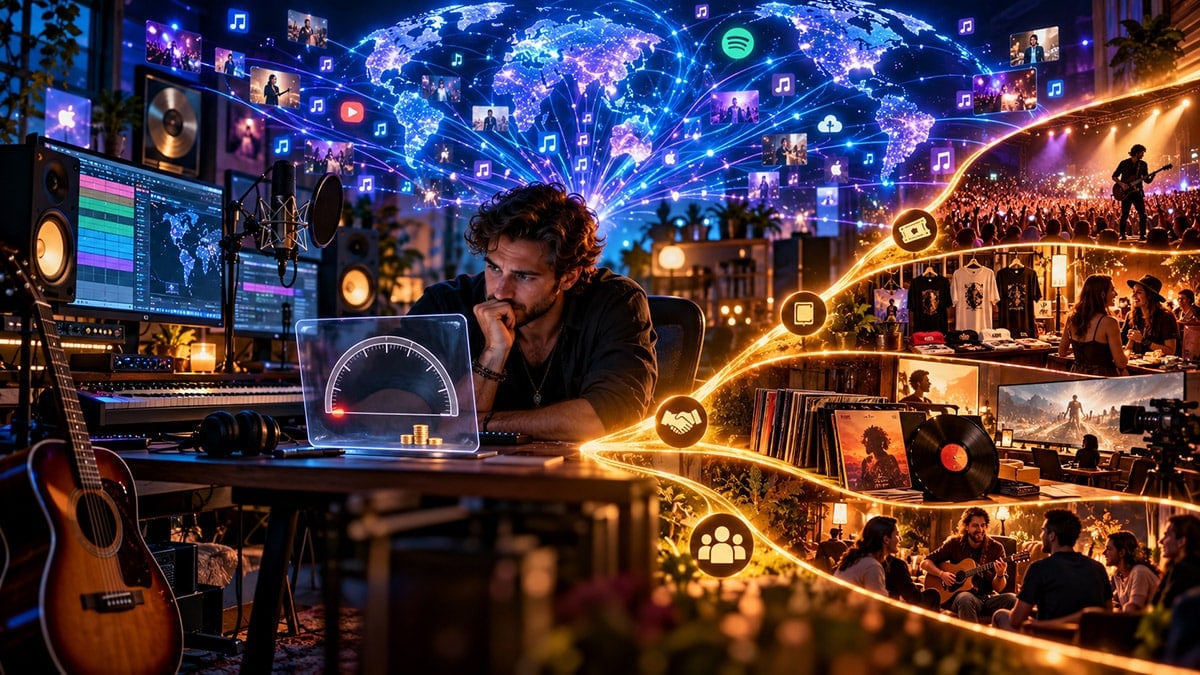
Making a Scene Presents – We Solved Music Distribution. We Forgot to Solve Making a Living.
Listen to the Podcast Discussion
There was a time when one of the biggest problems facing an independent musician was simply getting a record into the marketplace. You could make a great album, spend money you probably didn’t have recording it, press a few hundred CDs, load the boxes into your car and then discover that most of the record business had no particular interest in helping you put those CDs anywhere people might actually buy them. Distribution was a gate, and the people standing in front of that gate usually wanted to know who your label was, who your distributor was and whether somebody more important than you had already decided that you mattered. Independent musicians spent decades trying to get around that system, and eventually technology did something rather wonderful: it kicked a large hole in the wall.
Today, an artist can record a song in a bedroom, upload it through a digital distributor and make it available around the world without asking a record-company executive for permission. That change should not be minimized. It represents one of the most important transfers of power in the modern history of the music business, because access to the marketplace is no longer controlled entirely by companies with warehouses, trucks, retail relationships and large advances. The uncomfortable part is what happened next. We became so excited about democratizing distribution that we sometimes acted as though we had democratized the music business itself.
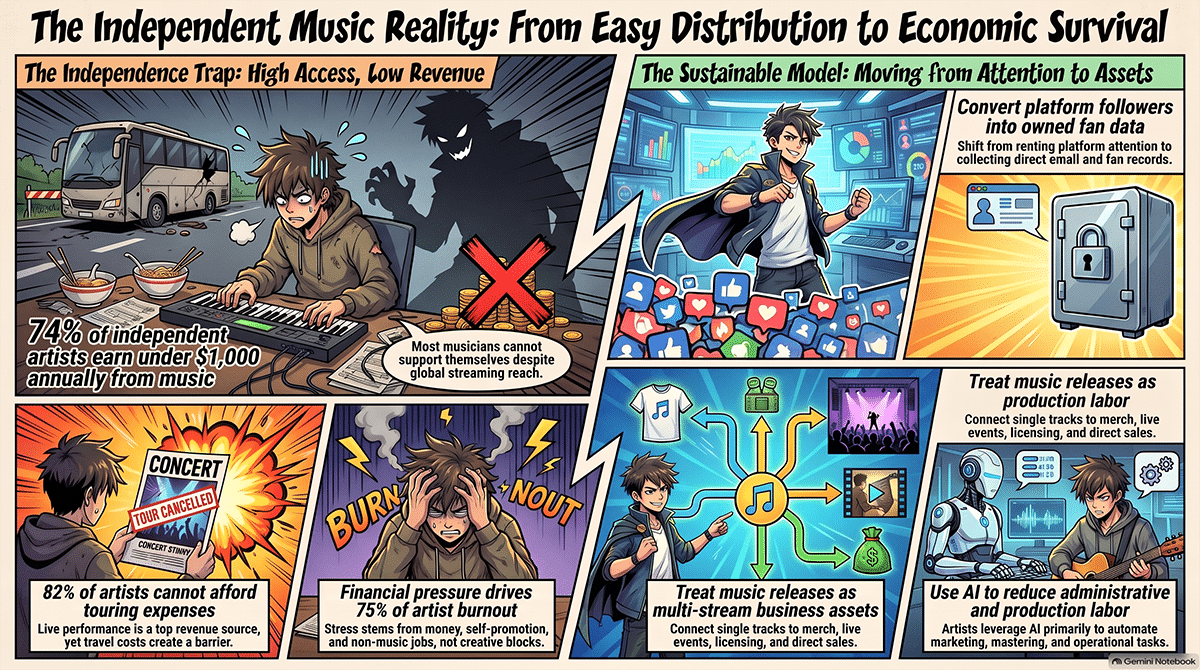
A major new study from Ditto Music suggests otherwise. Its 2026 Independent Music Report surveyed 5,039 independent artists across 112 countries, including 1,180 respondents in the United States. The report paints a picture of an independent sector with more technological power than artists could have imagined a generation ago, but with surprisingly little economic security to show for it. Seventy-four percent of respondents reported earning less than $1,000 from music during the previous year, 64 percent work a full- or part-time job outside music, and only 22 percent describe music as their full-time occupation. Perhaps most troubling, only 29 percent believe their current music income is sustainable for the next three years.
That should be the conversation.
Instead, much of the music industry’s attention keeps bouncing between the newest streaming feature, the latest social platform trick and whether somebody generated a song using artificial intelligence. Those things matter, but they can also become shiny distractions from the more basic problem sitting at the kitchen table with an unpaid credit-card bill. Independent artists gained the ability to distribute music almost everywhere. What most of them still haven’t gained is a reliable way to turn that reach into enough revenue to build a sustainable life.
A Big Survey With an Important Asterisk
Before turning Ditto’s numbers into commandments carved into the side of a Marshall stack, there is an important bit of context. The respondents were recruited through Ditto Music’s own artist community and channels, and all of them had released music through the company’s distribution service. Ditto itself says the results should therefore be understood as a survey of active, self-releasing artists using a distribution service rather than a statistically representative survey of every independent musician on the planet. That is an important limitation, particularly when comparing age groups or geographic markets, and responsible journalism shouldn’t hide it behind the amplifier.
It also doesn’t make the findings meaningless. More than five thousand working, self-releasing musicians from 112 countries represent a substantial window into the independent economy, particularly because the report asks about the parts of a music career that rarely fit into glamorous headlines. It looks at income, discovery, social media, artificial intelligence, touring, career sustainability and mental health rather than simply asking how many streams somebody got last Thursday. The picture that emerges is not one of artists who lack access to technology. It is largely a picture of artists who have plenty of tools but not enough economic leverage.
That distinction matters because our industry is still strangely obsessed with access. We celebrate the fact that almost anybody can release music, which is absolutely worth celebrating, but release is only the beginning of a business transaction. Getting a song onto a streaming service is roughly equivalent to getting a product onto a shelf containing tens of millions of other products. Congratulations, you made it into the store. The slightly inconvenient follow-up question is whether anybody knows you’re there, whether they buy anything, whether you can identify the customer afterward and whether that customer has a reason to come back.
Those questions are considerably less sexy than announcing another miracle distribution feature. They are also where the money lives.
The Independent Music Crisis Is an Income Crisis
The headline number from Ditto’s report is difficult to ignore. Seventy-four percent of the artists surveyed earned less than $1,000 from music during the previous year, while only 9 percent reported earning at least $5,000 and just 4 percent earned $15,000 or more. Meanwhile, 43 percent identified money as the single biggest barrier to growth. Taken together, those numbers describe a system in which an enormous number of people can participate in music but comparatively few can depend on that participation to support themselves.
This is where language becomes important. We often say that the independent music business has been democratized, but what has really been democratized is participation. Anybody can enter the marketplace far more easily than they could twenty years ago, and that is real progress. Yet entering a marketplace is not the same thing as building a viable company inside it. You can open a restaurant tomorrow if you have enough money and paperwork, but nobody would claim you had successfully created a restaurant business merely because the door unlocked at six o’clock.
Music somehow gets treated differently. An artist uploads a record, establishes several social accounts and creates a website, and we immediately start talking about a “career.” Then everybody acts confused when the artist discovers twelve months later that the operation produced plenty of activity but almost no profit. The musician may have thousands of followers, tens of thousands of plays and a phone full of notifications, yet the electric company continues its stubborn refusal to accept engagement metrics as legal tender.
Ditto’s findings expose the difference between visibility and sustainability. Thirty-two percent of respondents said they had considered quitting music during the previous twelve months, and the figure rose to 43 percent among respondents in the United States. Ditto also found that the largest sources of pressure were not primarily creative problems. Financial pressure, marketing and self-promotion, and balancing music with another job accounted for 75.3 percent of respondents’ largest reported sources of stress, while creative block ranked last.
In other words, musicians are not necessarily leaving because they ran out of songs. Many are getting exhausted by the job wrapped around the songs.
Distribution Became Easy. Business Did Not.
The revolution in music distribution solved a real problem, but every successful technology eventually creates the next problem. Once thousands and then millions of artists could release music easily, scarcity moved somewhere else. The scarce resource was no longer access to the store. It became attention, customer relationships, time and enough working capital to keep the operation moving.
That is why making digital distribution even easier, by itself, is unlikely to transform the financial lives of independent artists. Distribution can shorten the distance between a finished master and a streaming service, but it cannot automatically create a customer. It cannot guarantee that a listener buys a ticket, purchases a shirt, joins a membership, licenses a recording, buys a physical product or supports the next release. Those are different business processes, and they require a different generation of artist tools.
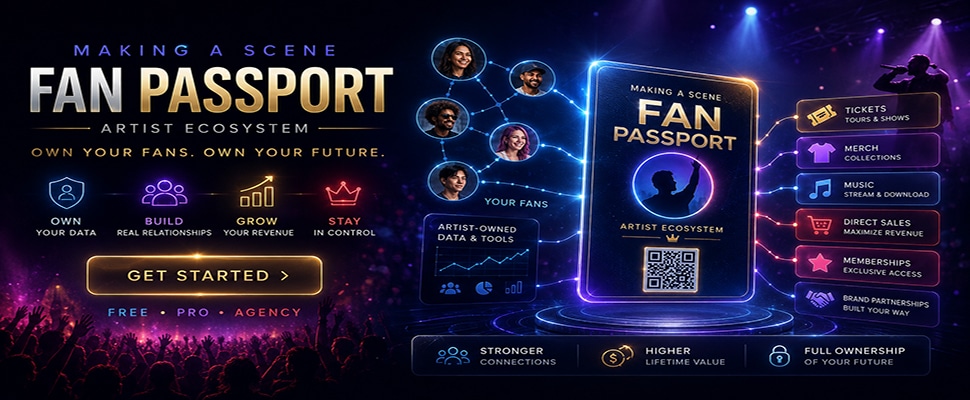
This is where the independent music industry needs to mature. For years we built software around the question, “How do I get my music out?” The next generation of software has to answer a much harder question: “How does this music create an economic relationship with somebody who cares about it?” That means connecting discovery to fan identity, fan identity to permission-based communication, communication to products and experiences, and those transactions to an ongoing relationship the artist actually controls.
The old record industry understood the basic concept of a customer even if the artist rarely got to meet that customer. Somebody bought a record. Somebody bought another record later. Somebody bought a concert ticket. The independent digital era somehow managed to create a stranger arrangement in which musicians can reach enormous audiences while frequently knowing almost nothing about the people listening to them.
That is not independence. That is renting access to somebody else’s customer database.
Attention Is Valuable, but a Fan Relationship Is an Asset
One of the most useful findings in Ditto’s report concerns discovery. Sixty-seven percent of respondents said social video platforms were their biggest source of new fans, while 86 percent said they create social content to promote their music. Three out of four believe social media success is essential to a viable music career. Those figures show how thoroughly the artist’s job has expanded from making records into feeding an endless media machine that apparently wakes every morning demanding another video before breakfast.
There is nothing inherently wrong with using those systems. Discovery platforms can be enormously valuable because they can put an artist in front of people who would never otherwise encounter the music. The mistake is confusing the discovery mechanism with the relationship itself. A follower belongs primarily to the platform’s database. The artist generally does not control whether that person sees the next post, cannot export the entire relationship and may have limited ways to communicate outside whatever rules the platform establishes next Tuesday.
An email address collected with permission is different. So is a fan account, a purchase history, a membership, a ticket record or a direct relationship created through the artist’s own website. Those connections can become part of an artist-controlled business system in which the musician understands that a particular person attended a show, bought an album, returned for another concert and might be interested in a limited release six months later. That knowledge allows the artist to serve fans better while spending less money repeatedly trying to rediscover the same people.
This is the economic difference between renting attention and owning a relationship. A social platform can introduce the artist to the fan, and that introduction can be tremendously useful. But the artist’s business should not end at the introduction. The goal should be to give that interested person a reason to cross into an environment where the relationship continues directly, voluntarily and with the artist retaining control over the data.
That is the foundation of a music industry middle class. It is not millions of anonymous streams magically creating a pension plan. It is thousands of smaller transactions and relationships accumulating around music the artist owns.
Streaming Is Revenue, but It Cannot Be the Entire Strategy
Interestingly, Ditto’s respondents identified streaming as their most common biggest source of music income, with live performance ranking second. That is worth emphasizing because it prevents this discussion from collapsing into the familiar argument that streaming is either the savior of music or a flaming dumpster pushed downhill by accountants. For many independent artists, streaming clearly produces meaningful revenue. The problem appears when streaming becomes the entire economic architecture rather than one part of it.
A stream is valuable partly because it can create money and partly because it can reveal that somebody cares about the song. The second part becomes enormously more valuable when the artist has a system for turning that interest into another interaction. A listener might eventually attend a concert, buy vinyl, purchase a Smart Media product, subscribe to exclusive content, support a crowdfunding campaign, license a track for a project or buy something from a merch table. The economics improve not because the artist found a magical replacement for streaming, but because one piece of music is now capable of participating in several forms of commerce.
This is basic business thinking, but musicians were rarely taught to think this way. The traditional industry trained artists to chase deals, radio spins, chart positions and later playlist placements because the infrastructure around monetization belonged to other companies. The independent artist now owns far more of that infrastructure potentially, but ownership comes with the annoying requirement of learning what the infrastructure is supposed to do.
A sustainable artist business therefore has to ask more from every release. A recording should certainly be distributed to places where listeners can find it, but it can also become a licensing asset, a physical product, a direct-sale item, a reason to create a live event, part of a membership and the beginning of a relationship with a fan. The same intellectual property can keep working instead of being thrown into the streaming ocean and then abandoned while everybody starts frantically promoting the next single.
The Touring Catch-22 Is Getting Ridiculous
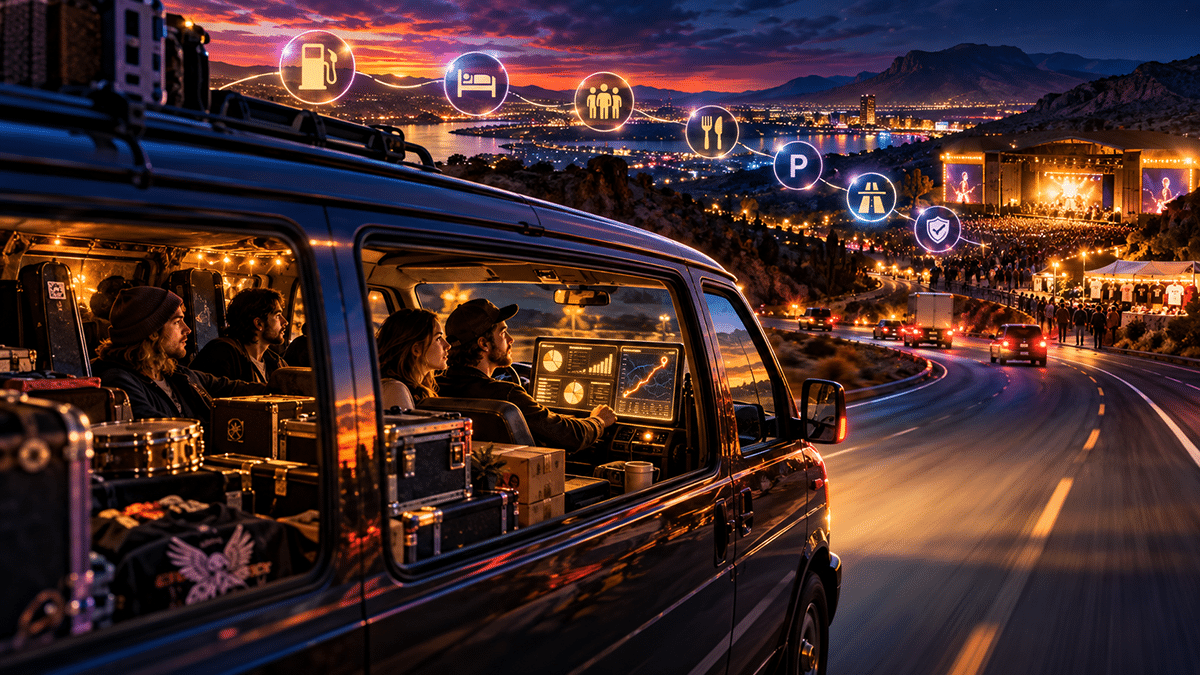
The most brutal number in the Ditto report may be the finding that 82 percent of respondents said they could not currently afford the expenses associated with touring. That would be troubling in any environment, but it becomes almost absurd when placed next to another finding in the same report: live performance is the second-largest reported source of music income behind streaming. The artist needs shows to generate money, while also needing money in order to get to the shows. Somewhere, Joseph Heller is probably wondering why he didn’t write about booking agents.
Touring has always involved risk, but the modern independent artist can face a remarkable pile of costs before playing the first note. Transportation, fuel, lodging, musicians, meals, insurance, parking, tolls, rehearsal time, production expenses and merchandise inventory all consume cash. A promoter guarantee may cover some of that, ticket revenue may cover more, and a strong merch night can turn an otherwise mediocre show into a profitable stop. Unfortunately, a disappointing Wednesday in a city six hours from home can also transform the glamorous touring life into an interstate highway connecting two overdraft fees.
Ditto reports that only 51 percent of respondents had played a live show during the previous twelve months. Among those who did perform live, 61 percent played five shows or fewer, and 66 percent of artists who perform live said touring costs had increased. Those figures suggest that the issue is not merely whether touring is technically available. For many independent musicians, the economic barrier is limiting how often they can participate at all.
This is precisely why touring software should stop behaving like a fancy calendar.
A calendar can tell the artist that the show is Friday at eight. A business system should help the artist understand whether going to the show makes financial sense before the van leaves the driveway. That requires bringing together historical ticket sales, guarantees, merchandise performance, travel expenses, lodging, musician costs, fan geography and previous results in the market. None of those factors can predict the future perfectly, but they can convert a blind gamble into an informed business decision.
Every Show Is a Small Investment
Independent artists should begin thinking about each show the same way a small business thinks about opening a temporary store in another city. Money is going out before money comes in, which means somebody should understand how much goes out, how much needs to come back and what happens when reality misses the optimistic projection everyone made while booking the date.
An artist who knows the likely travel cost, expected guarantee, ticket upside, lodging expense, musician payroll and historical merchandise average can establish a rough break-even point. If the artist also knows how many fans in the surrounding area have previously bought something, attended a concert or engaged directly, the decision becomes even more informed. Perhaps a $500 guarantee looks terrible until the artist notices that the previous visit produced $900 in merchandise. Perhaps an apparently attractive $1,200 offer becomes less exciting after two hotel rooms, a twelve-hour drive and four musicians enter the spreadsheet.
The goal is not to eliminate risk, because live music would become spectacularly boring if everything behaved like an actuarial table. Weather happens. Attendance changes. Another event appears across town. Somebody’s transmission chooses that particular weekend to develop artistic ambitions of its own. Business intelligence cannot prevent uncertainty, but it can reveal the difference between reasonable risk and financial self-harm with guitar cases.
This is one place where artificial intelligence could become genuinely useful. Instead of writing another generic social caption about how excited the band is to play Cleveland, an intelligent artist system could examine previous shows, expenses, local fan activity and sales history and tell the artist what attendance level is required to break even. It could flag a routing problem, identify markets where merchandise traditionally performs well or warn that a date makes little financial sense unless the guarantee improves.
That would be AI doing what technology has always done best: helping human beings make better decisions with information they already possess.
The Most Interesting AI Story Isn’t AI Music
Ditto’s artificial-intelligence findings may be the report’s biggest surprise. Forty-seven percent of respondents said they already use AI somewhere in their music-making process, but adoption was dramatically higher among older musicians than younger ones. Among artists over 55, 74 percent reported using AI in music-making, compared with only 24 percent of respondents aged 18 to 24. Ditto says the same overall age pattern appears among its U.S. respondents.
That turns the usual technology story upside down. We tend to imagine the twenty-year-old producer dragging the reluctant sixty-year-old musician into the future while explaining what an algorithm is. According to this sample, Grandpa may already be halfway through the manual while the kids are still arguing about authenticity.
There are many possible reasons for that gap, and the survey does not establish why it exists, so it would be foolish to invent an explanation and call it journalism. One plausible interpretation, however, is that experienced musicians may be especially interested in technology that removes repetitive labor from work they already understand. A musician who has spent thirty years editing vocals, preparing masters, writing promotional copy, organizing sessions and handling administration can immediately recognize the value of software that reduces the time required for those tasks. Younger artists entering an already digital environment may experience the technology differently.
More important is what Ditto says musicians are actually doing with AI. The report found that production assistance such as mixing, mastering and vocal tuning was comfortably the most common use among respondents who use AI in their music-making process. Almost one quarter of AI users had experimented with fully AI-generated music, which represents about 11 percent of the entire survey sample, but the dominant pattern was assistance rather than wholesale replacement of the creative process.
That is a considerably more useful conversation than pretending the only possible future contains either heroic human songwriters or robots wearing cowboy hats.
The Boring Uses of AI May Make Artists More Money
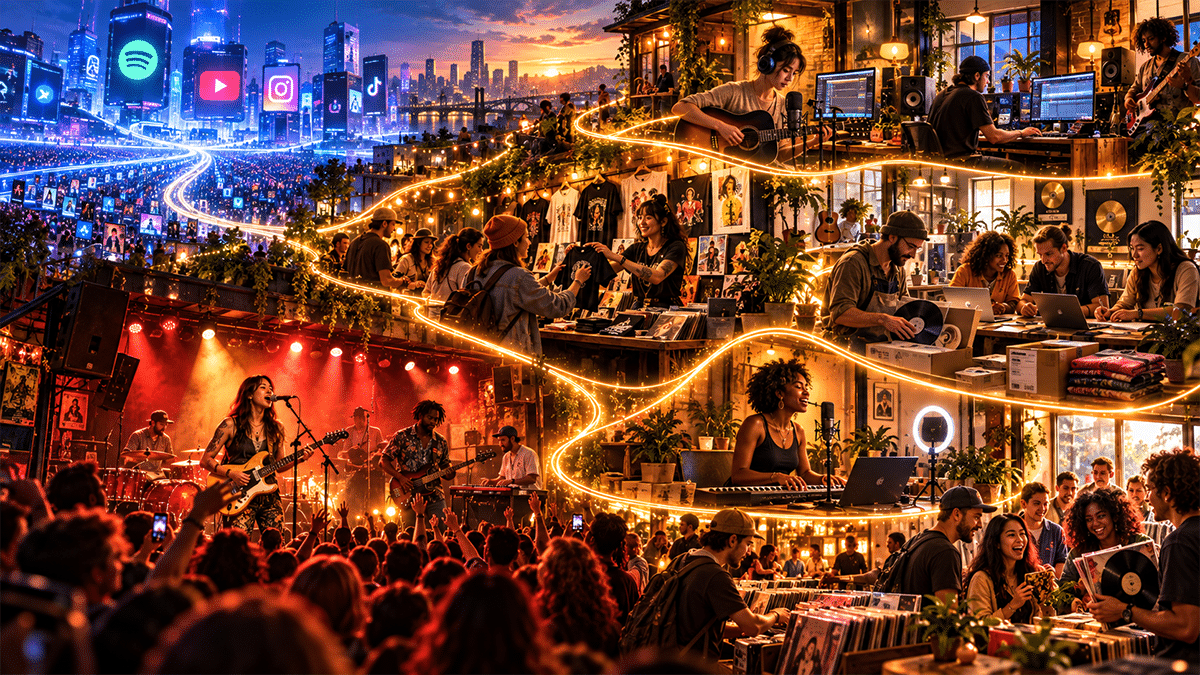
The most economically important artificial intelligence tools for independent musicians may turn out to be the least dramatic ones. If AI can help organize metadata, identify missing rights information, prepare alternate mixes, assist with mastering, draft booking correspondence, analyze tour costs, organize fan data, identify licensing opportunities or turn an artist’s own business information into useful recommendations, it can reduce the administrative burden that currently falls on people who are already trying to write, record, perform and promote music.
Ditto’s report reinforces that point outside the studio. Half of respondents who use AI reported using it regularly or occasionally in their marketing or business strategy. That suggests musicians are beginning to treat AI not merely as a creative generator but as operational technology.
For an independent artist, time is capital. An artist working forty hours a week at another job cannot manufacture another twenty hours because a social platform would like three additional videos. If intelligent software saves five hours of administrative work, those hours can move back into songwriting, rehearsal, recording, fan communication or sleep, the latter being a radical productivity technology musicians occasionally forget exists.
This is why the AI debate needs to become more sophisticated. Questions about copyright, training data, consent, digital replicas and attribution are extremely important, and artists should insist on systems that respect those rights. At the same time, rejecting every form of artificial intelligence because some generative systems raise legitimate concerns would be like rejecting electricity because somebody once got shocked by a toaster. The issue is not whether technology exists. The issue is who controls it, what it is trained to do, what rights it respects and whether the economic benefit flows toward the artist or away from them.
The best independent-artist AI should therefore behave less like a replacement musician and more like an extremely organized member of the team who never loses the settlement sheet.
Owning Rights Means Making Rights Work
There is another lesson buried inside the income problem. Independent artists frequently hear that they should own their masters and publishing, and that advice is generally sound when ownership is economically practical. Yet owning something and monetizing it are not the same activity. A musician can own one hundred percent of a master that earns twenty-seven dollars a year, which is certainly better than somebody else owning it, but perhaps not the revolutionary retirement plan promised in the brochure.
Ownership becomes powerful when the artist builds systems that allow the asset to work. A recording can generate streaming royalties, direct sales and licensing revenue. The composition beneath it can generate publishing income. Alternate versions can create additional licensing possibilities. Live performance can create ticket and merchandise revenue. Fan relationships created around the song can produce future purchases that may have little to do with the original stream.
The business opportunity is therefore not simply owning rights. It is connecting those rights to multiple markets while maintaining accurate information about what the artist owns, who shares in it and how it can legally be used. That kind of rights administration used to require teams of people, spreadsheets and enough filing cabinets to reinforce a floor. Modern software can make much of it available to independent artists if the systems are designed around the artist instead of merely around delivery to somebody else’s platform.
This is one reason Making a Scene has argued for years that the future of independent music depends on artists owning three things together: their intellectual property, their business data and their direct fan relationships. Each one strengthens the others. Rights without customers produce limited income, customers without data are difficult to reach again, and data without something valuable to sell is merely a very organized collection of email addresses.
The business appears when those pieces connect.
Discovery Should Be the Beginning of the Funnel
Ditto’s report found that 43 percent of respondents selected better playlist and discovery tools as the single change that would most improve their situation, while 41 percent chose higher streaming royalty rates. Together, those answers accounted for 84 percent of respondents.
Those concerns are understandable. More discovery can create more streams, and higher royalty rates can increase what those streams generate. Yet neither change eliminates the need for artists to build their own economic systems around that audience. Even a wonderfully generous discovery platform remains somebody else’s platform, and even improved streaming royalties are more powerful when they are one revenue stream among several.
The most useful way to think about discovery is therefore as the top of a relationship rather than the end of a campaign. Somebody encounters a song. Perhaps they listen again. Perhaps they watch something, attend a show or visit the artist’s website. If the artist creates a compelling reason for that person to join an email community, access exclusive music, claim a reward, buy a product or register for an experience, an anonymous listener can gradually become a known fan.
That transformation is where enormous value is hiding. The industry’s current infrastructure is remarkably good at counting how many people touched something. Independent-artist infrastructure has to become much better at helping artists build continuing relationships with the people who cared enough to touch it.
A million impressions sound impressive in a press release. A few thousand identifiable fans who repeatedly buy tickets, merchandise, music and experiences may create a better business.
We Need Artist Technology That Understands Economics
For most of the digital era, artist software has been built in separate boxes. One service distributes recordings, another sends email, another sells tickets, another handles merchandise, another tracks streaming statistics and another manages social posts. The musician becomes the unpaid employee responsible for moving information between all of them, usually late at night after rehearsal while wondering why becoming “empowered” feels suspiciously like taking six additional jobs.
The next generation of independent music technology needs to connect those functions around the artist’s own source of truth. A show should not merely exist as a date on a calendar; it should connect to the venue, contract, expenses, settlement, merchandise sales and fans who attended. A song should not merely exist as an audio upload; it should connect to ownership information, splits, publishing, masters, alternate versions, licensing availability and the fans responding to it. A customer should not disappear after buying a shirt; with proper consent, that transaction should become part of a continuing relationship controlled by the artist.
Once those pieces connect, technology can begin answering valuable questions instead of merely displaying dashboards. Which markets produce profitable shows? Which products sell to which fans? Which songs drive direct purchases? Which fans repeatedly attend? Which releases create licensing interest? Which promotional activities actually generate revenue instead of impressive-looking graphs?
Those are small-business questions because an independent artist is, among other things, running a small creative business. The technology should stop being embarrassed about that.
The Music Industry Middle Class Will Not Be Built on Virality
There is one more revealing result in Ditto’s report. When respondents were asked what might most accelerate their careers, only 13 percent selected a major-label deal, placing that answer last among the options presented. More chose marketing investment, viral social exposure, synchronization licensing or collaborations.
That reflects a significant change in how many artists see their careers. The old dream was simple: become good enough, get discovered and find a company willing to finance everything. The new dream is more fragmented because the business itself is more fragmented. Artists can build audiences independently, own recordings, distribute globally, license directly and operate small media companies around their music.
There is enormous freedom in that model, but there is also a trap. Replacing the fantasy of being discovered by a label with the fantasy of becoming viral does not actually change the underlying dependency. In both versions, the artist waits for an outside system to deliver enough attention to create a career.
A sustainable music middle class has to be built differently. It will come from artists who can earn moderate but meaningful revenue across several connected activities, keep reasonable ownership of the assets they create, understand their costs and communicate directly with the people who support them. Some will eventually sign label deals because those deals make strategic sense. Others will remain completely independent. The point is not ideological purity; the point is maintaining enough leverage to choose.
That is a much less glamorous story than overnight success, which is probably why nobody is making a television talent competition called “Consistently Build Customer Relationships for Seven Years.” It is also how most durable small businesses are actually created.
The Real Revolution Happens After Upload
The Ditto Independent Music Report arrives at an important moment because the music business has largely completed one technological revolution while still pretending that revolution is unfinished. Getting music into the marketplace is no longer the central barrier for most self-releasing artists. It can still be complicated, and artists absolutely need good distribution, but the larger challenge has moved downstream.
The next fight is about what happens after somebody presses play.
Can the artist identify growing interest before spending money on a tour? Can the artist convert a casual listener into a direct relationship? Can a live show generate not only tonight’s settlement but tomorrow’s customer? Can a recording become a licensing asset as well as a stream? Can merchandise become part of a continuing experience instead of a cash transaction at a folding table? Can artificial intelligence reduce administrative labor without taking ownership or creative control away from the person making the music?
Those are the questions that will define the next era of independent music.
Ditto’s survey does not prove that every independent artist is failing, nor does it suggest that independence itself is the problem. In fact, the report describes artists with more access, more technological capability and more control than previous generations could easily obtain. What it exposes is the distance between having access to the music business and having an economically sustainable place inside it.
Seventy-four percent of these surveyed artists earned less than $1,000 from music in a year. Eighty-two percent said they cannot currently afford touring expenses even though live performance ranks as their second-largest source of music income. Nearly half already use AI somewhere in music-making, while large numbers are using technology to handle production and business tasks rather than simply asking machines to make songs for them. Meanwhile, almost one third considered quitting, with the figure climbing to 43 percent among U.S. respondents. Those numbers do not describe a shortage of creativity. They describe an economic system that still has a great deal of unfinished work.
For independent artists, that unfinished work is also an opportunity. The infrastructure required to create sustainable careers no longer needs to belong entirely to labels, promoters, distributors, social networks or streaming companies. Artists can increasingly own pieces of it themselves, particularly the rights, data and fan relationships that form the foundation of a durable business.
That does not mean every musician needs to become a venture capitalist with a Telecaster. It means artists need tools simple enough to hide the complexity while still giving them the information required to make better decisions. Technology should help musicians understand whether a tour is profitable, which fans are engaged, which rights they control, which songs can generate additional income and where limited time and money should be spent.
The first digital revolution gave independent artists the ability to release music without asking permission. The next one needs to give more of those artists the ability to stay in business after they do.
That is a much harder problem than uploading a song.
It is also the problem worth solving.
 |  Spotify |  Deezer |  Breaker |
 Pocket Cast |  Radio Public |  Stitcher |  TuneIn |
 IHeart Radio |  Mixcloud |  PlayerFM |  Amazon |
 Jiosaavn |  Gaana |  Vurbl |  Audius |
 Reason.Fm | |||
Find our Podcasts on these outlets
Subscribe to Our Newsletter
Discover more from Making A Scene!
Subscribe to get the latest posts sent to your email.


