

AI Training Royalties Are Coming—But Will Indie Artists Get Paid?




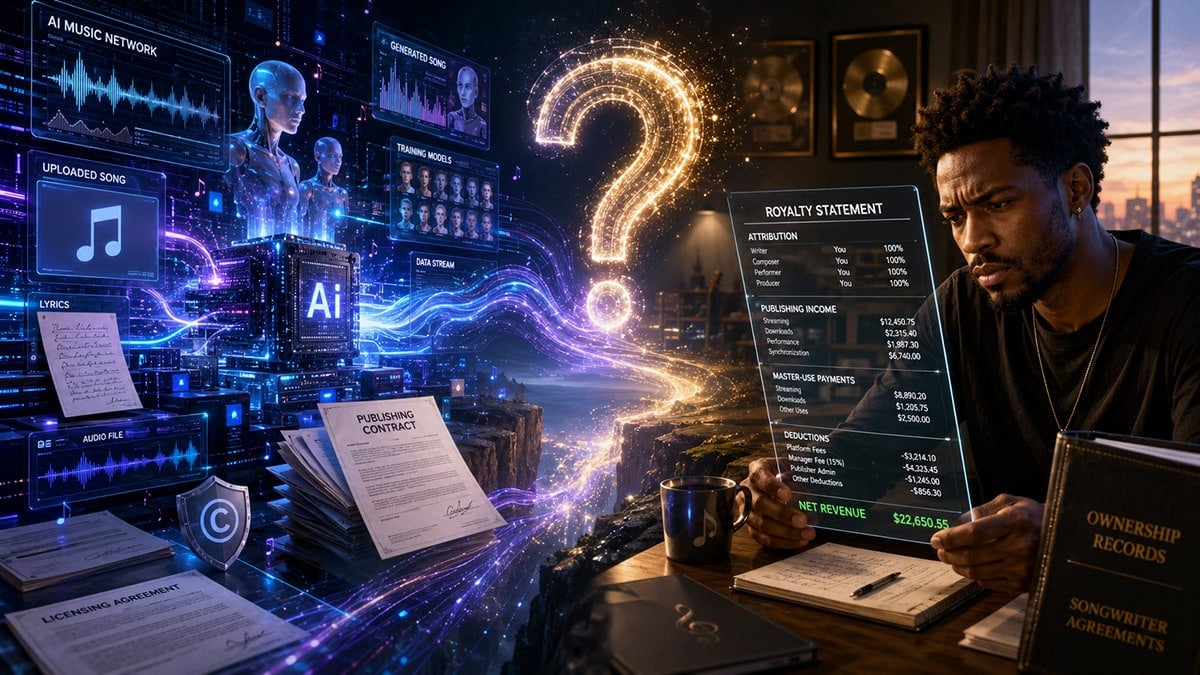
Making a Scene Presents – AI Training Royalties Are Coming—But Will Indie Artists Get Paid?
Listen to the Podcast Discussion
Artificial intelligence companies have spent the past few years treating music like an unattended buffet. Recordings, lyrics, artwork, voices, performances, and entire creative styles have been pulled into giant data collections. Artists were often left wondering whether their work had been used, who used it, what it helped create, and whether anybody planned to pay them.
Now the music business is beginning to move toward a different model. Instead of taking first and arguing about permission later, some companies are trying to build licensed AI systems in which creators can choose whether their work is included. That sounds better. It probably is better.
But “better than unpaid scraping” is a pretty low bar. A raccoon with a stolen sandwich could clear it. The real question is not whether AI licensing programs will exist. They are already beginning to appear. The real question is whether independent artists will receive fair payments, useful reports, meaningful control, and enough information to know whether the deal makes sense.
There is also another uncomfortable question. When an AI company finally comes looking for licensed music, will the artist be able to prove what they own?
A New AI Licensing Door Opens
On July 20, 2026, Symphonic Distribution announced a partnership with Sureel AI that could give participating independent artists, labels, and managers a path into licensed AI revenue.
The announcement appeared through Warner Music Group, which acquired Sureel AI in June 2026. Warner said Sureel would continue operating as a stand-alone platform serving the broader music and AI industries. The partnership announcement is available at https://www.wmg.com/news/sureel-ai-and-symphonic-distribution-unlock-fair-ai-licensing-revenue-for-symphonic-roster.
According to the announcement, Symphonic clients who choose to participate may allow certain recordings, musical compositions, and lyrics to enter licensed AI datasets. Sureel says its technology can track how those works contribute to AI models and AI-generated material. The companies say participating rights holders will be able to place permissions and restrictions on how their work may be used. They also say payments will be connected to the measurable contribution made by each work.
That is an important idea.
Instead of throwing thousands of songs into one giant digital soup pot and dividing money through a rough market-share formula, an attribution system is supposed to examine how much each work actually influenced the system or its output. Sureel describes its services at https://www.sureel.ai/. The company says rights owners can choose which material may be used, set conditions, restrict certain uses, and receive payments based on the influence their work has on AI-generated results.
Those are the company’s claims. They should be treated as claims until artists and their representatives can review the actual contracts, reports, calculations, and results. Symphonic says its AI dataset licensing opportunities are optional and require explicit consent. Its current Trust and Safety page says participation is not automatic and that content should not be used without the artist’s permission. That policy can be found at https://symphonic.com/trust-and-safety/.
The Check Is Not in the Mail Yet
The announcement sounds promising, but many of the details that would tell an artist whether the program is actually valuable have not been made public.
The public announcement does not name the AI developers that will license the material. It does not give a payment rate, revenue percentage, minimum payment, accounting schedule, contract length, reporting format, or audit procedure.
It does not tell us whether an artist might earn ten dollars, ten thousand dollars, or enough to buy half a sandwich at an airport.
It does not explain whether payments will come from an upfront dataset license, an ongoing revenue share, a per-output calculation, a subscription pool, a minimum guarantee, or some mixture of those models.
That does not mean the program is bad. It means there is not enough public information to declare it a financial victory.
The phrase “AI training royalty” is also getting tossed around as though somebody has already created a standard payment system. That has not happened.
A royalty can be created by law, by a license, or by a private contract. At this point, money connected to licensed AI training may be called a training fee, attribution payment, revenue share, usage fee, advance, data license, master-use payment, publishing payment, or something else entirely.
The label on the payment matters less than the terms behind it.
Who pays? Who receives the money first? What is deducted? What data supports the calculation? Can the artist challenge an error? Can the company change the formula? Does permission last forever? Can the artist withdraw?
Until those questions are answered, “AI royalty” is a hopeful description, not a guaranteed new column on every artist’s royalty statement.
The U.S. Copyright Office has examined possible licensing systems for generative AI training. Its report discusses voluntary and collective licensing as possible ways to manage large numbers of rights, but it does not establish a universal AI training royalty. It also warns against rushing into a compulsory system with fixed terms before the market and technology are better understood.
The Copyright Office’s AI information center is at https://www.copyright.gov/ai/. Its report on generative AI training is available at https://www.copyright.gov/ai/Copyright-and-Artificial-Intelligence-Part-3-Generative-AI-Training-Report-Pre-Publication-Version.pdf.
Will Indie Artists Be Ready?
Imagine that an AI company contacts an independent artist tomorrow.
The company wants to license twenty songs for a new music model. It wants the recordings, lyrics, instrumental versions, and perhaps separate vocal tracks.
The artist is excited. This could be a new revenue stream.
Then the questions begin.
Who owns the master recordings?
Who owns the songs?
Were the producers paid through work-for-hire agreements, or do they own part of the masters?
Did the featured vocalist sign a release?
Were any beats leased from another producer?
Were samples cleared?
Are there co-writers?
Did the band ever decide who owns what?
Does the artist control the lyrics?
Does the distribution agreement allow this new license?
Can the artist approve AI training without getting permission from somebody else?
Suddenly, the exciting new opportunity looks less like free money and more like an archaeological dig through old email accounts.
This is why catalog preparation matters.
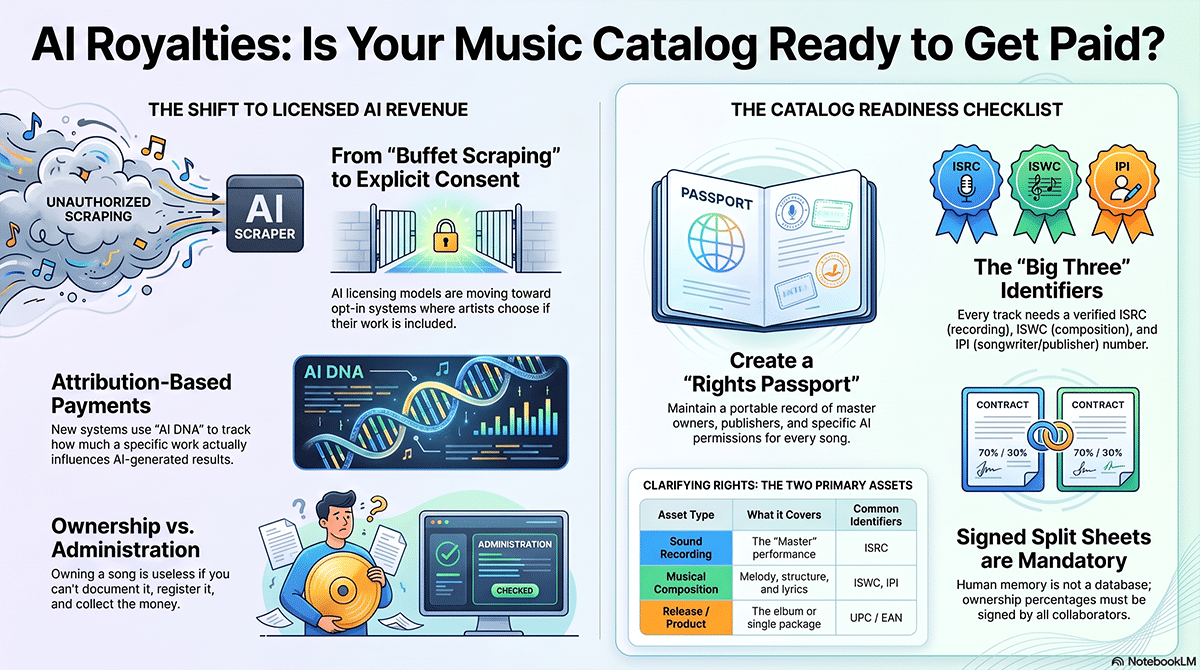
Permission does not create payment by itself. Someone must know which person or company controls each right. Ownership shares must be clear. Agreements must explain who can approve new uses. Payment information must be current. Metadata must connect the recording to the proper writers, publishers, performers, and rights holders.
AI licensing may be a new business, but the paperwork problem is ancient.
One Song Can Contain Several Rights
A finished song may sound like one creative object. Legally and financially, it is usually made of several parts.
The musical composition is the underlying song. It includes the melody, musical structure, and lyrics. The people who wrote those parts may own the composition, or they may have transferred some rights to publishers.
The sound recording is the recorded performance of that composition. It is often called the master. The master may be owned by an artist, band, record company, producer, investor, or some combination of those parties.
The U.S. Copyright Office clearly treats the musical composition and the sound recording as separate works. Registering the composition normally does not register the master, and registering the master normally does not register the composition.
The Copyright Office explains this distinction at https://www.copyright.gov/engage/musicians/. Its registration guidance for musical compositions is at https://www.copyright.gov/circs/circ50.pdf, while information about sound recordings is at https://www.copyright.gov/circs/circ56.pdf.
Consider a fictional singer named Carla.
Carla records a song called “Midnight Wi-Fi.” She wrote the melody with Devin, while Marisol wrote most of the lyrics. Carla paid a producer named Theo to record the track. A guest rapper named Lee appears in the second verse. Theo used a drum loop licensed from an online beat maker.
Carla may own the master, but that depends on her agreement with Theo and any agreement involving Lee. Carla does not automatically own the entire composition because Devin and Marisol are co-writers. The drum loop may come with restrictions. The guest rapper may have approval rights. A publisher may control part of the song.
Carla cannot safely click a button that says, “Yes, I own everything,” just because the release appears under her artist name.
The artist name on a streaming service is not a chain of title.
From Free Scraping to Licensed Use
The music business is slowly moving from a fight over unauthorized training toward systems built around permission, licensing, attribution, and payment.
The fight is not over.
Copyright owners, AI companies, lawmakers, courts, technology firms, publishers, labels, unions, and creator groups still disagree about when training requires permission and when an AI-generated result crosses the line into infringement.
Different countries are also taking different approaches.
The U.S. Copyright Office has described the issue as an intense debate. It has explained that the legal result can depend on what material was copied, how it was obtained, how the model used it, what the system produces, and whether the new use harms an existing or developing licensing market.
In other words, there is no giant legal stamp marked “ALL AI TRAINING IS FINE,” and there is no giant stamp marked “ALL AI TRAINING IS ILLEGAL.”
Each situation can involve different facts, rights, contracts, and laws.
That uncertainty is one reason private licensing programs are appearing. An AI company that receives clear permission from the proper rights holders may reduce its legal risk. A creator who grants permission may gain control, information, and revenue.
That is the theory.
The success of the theory depends on whether the system can accurately connect creative influence to the right people.
Attribution Is the Meter on the New Machine
Attribution technology attempts to answer a hard question: what protected material influenced an AI system or one of its outputs?
Traditional music identification often looks for a match between an existing recording and a piece of audio. AI attribution may need to examine something more complicated.
An AI result might not copy an entire recording. It may reflect smaller patterns connected to melody, rhythm, lyrics, arrangement, performance, vocal character, or production.
Sureel says it creates a kind of digital “AI DNA” for a work by breaking it into parts and tracking how those parts influence AI systems. Warner Music Group describes that technology in its acquisition announcement at https://www.wmg.com/news/warner-music-group-acquires-sureel-ai.
That could be useful, but no attribution system should be treated as magic.
Music contains common building blocks. Many songs use similar chord progressions, drum patterns, tempos, song forms, and phrases. A model may have learned from many works at once. A generated result may show only a small influence from one recording. Different rights owners may claim the same element.
Then there are remixes, alternate masters, live recordings, cover songs, stems, samples, interpolations, remasters, public-domain compositions, foreign-language versions, and songs written by five people who have not spoken since the van broke down outside Cleveland.
An attribution system may produce evidence. It does not automatically settle ownership.
A glowing dashboard may look impressive. It may have graphs. It may have animated lines. It may even have the mysterious purple lighting required by international technology law.
But a dashboard is not a contract.
It is not an audit right.
It is not a legal remedy.
Most importantly, it is not money in the artist’s bank account.
The Catalog Readiness Test
Before an artist considers licensed AI use, they should build a complete catalog inventory.
That inventory should include every recording the artist believes they own or control. It should cover released tracks, unreleased tracks, alternate versions, live recordings, instrumentals, radio edits, remixes, stems, demos, and music videos.
Each recording should have one clear record containing its official title, alternate title, artist name, release date, version name, recording owner, writers, publishers, ownership percentages, producer, featured performers, label, territories, samples, interpolations, and licensing restrictions.
The artist should also record where the master file is stored, who has access to it, which distributor delivered it, and whether any agreement limits future licensing.
This work is not glamorous.
No one has ever thrown a television out of a hotel window because the metadata spreadsheet was just too exciting.
Still, clean catalog information can lead to real income.
It helps with distribution, publishing, sync licensing, neighboring rights, royalty collection, samples, remixes, film, television, games, advertising, direct sales, and now possible AI licensing.
The Identifiers That Keep Music From Getting Lost
Music uses several identifiers because one code cannot describe every part of the business.
An ISRC identifies a particular sound recording or music video. It does not identify the underlying composition, and it does not identify the whole commercial release.
The International Federation of the Phonographic Industry explains ISRCs at https://isrc.ifpi.org/. It states that an ISRC gives a recording a unique and lasting identity as it travels through different services, countries, formats, and licenses.
Its official FAQ at https://isrc.ifpi.org/faqs explains that an ISRC identifies the recording, while an ISWC identifies the musical work.
An ISWC is the International Standard Musical Work Code. It identifies the composition rather than a particular recorded performance. Information about ISWCs is available through the official ISWC agency at https://www.iswc.org/home.
An IPI number identifies a songwriter, composer, publisher, or other party with an interest in a work. CISAC explains the Interested Party Information system at https://www.cisac.org/services/information-services/ipi. The older term “CAE number” is still heard in parts of the industry, although IPI is the current system commonly used in rights databases.
A UPC or EAN generally identifies a commercial product or release. It may distinguish an album, single, or package, while the ISRC identifies each individual recording inside that release. GS1 explains product identifiers and UPC barcodes at https://www.gs1us.org/upcs-barcodes-prefixes/how-to-get-a-upc-barcode.
These codes help systems find the correct material. They do not prove ownership.
An ISRC attached to a recording does not replace a producer agreement. An ISWC does not replace a split sheet. An IPI number does not prove that one writer owns more than another.
Codes identify. Contracts and copyright records explain control.
Split Sheets Before Algorithms
Every co-written song should have a signed split sheet.
A split sheet records the song title, alternate titles, writers’ legal names, professional names, contact details, performing-rights affiliations, publisher information, IPI numbers, ownership percentages, signatures, and the date of the agreement.
The Mechanical Licensing Collective provides a simple song split sheet template at https://www.themlc.com/hubfs/MLCSongSplitSheet-Toolkit.pdf. Its form includes space for writer information, PRO affiliation, publisher details, ownership percentages, signatures, and dates.
The best time to sign this document is while everyone is still in the room.
The worst time is seven years later, after the song lands in a commercial and one writer suddenly remembers contributing “most of the emotional atmosphere.”
Human memory is not a reliable rights database.
Neither is a group text from 2019.
Neither is a handshake at two in the morning after someone says, “We’ll sort it out when the song becomes a hit.”
That sentence has probably purchased more vacation homes for lawyers than for songwriters.
Split sheets are only one part of the paperwork.
Artists may also need producer agreements, beat licenses, work-for-hire agreements, featured-artist releases, session-player releases, band agreements, sample clearances, remix agreements, side-artist permissions, and written approval for borrowed lyrics or interpolated melodies.
The correct documents depend on what happened during creation and what rights each contributor kept.
An artist should not place a recording into an AI licensing program unless they have authority to license every right required by that program.
Publishing Is Where Money Goes to Hide
Independent artists often say, “I own my songs.”
That may be true. But owning a song and administering it are different jobs.
Copyright registration creates an official government record of a claim. In the United States, registrations are handled by the U.S. Copyright Office at https://www.copyright.gov/registration/.
A performing-rights organization manages certain public-performance rights for songwriters and publishers. Depending on the country and the artist’s agreements, that may include income from radio, television, venues, digital services, and other public uses.
The Mechanical Licensing Collective, found at https://www.themlc.com/, administers the blanket mechanical license for eligible interactive streams and digital downloads in the United States. It collects mechanical royalties from qualifying digital services and distributes matched money to eligible songwriters, composers, lyricists, publishers, and administrators.
The MLC is not the Copyright Office. It is not a performing-rights organization. It does not collect every kind of publishing income.
SoundExchange, at https://www.soundexchange.com/, handles a different side of the business. It collects and distributes certain digital performance royalties connected to sound recordings, including eligible uses on non-interactive services such as satellite radio and internet radio.
SoundExchange does not replace the songwriter’s performing-rights organization, and it does not register the underlying composition.
A publishing administrator may register songs, maintain ownership information, issue certain licenses, collect income, and report to the songwriter or publisher. The exact services depend on the agreement.
No single registration collects every dollar.
That is one of the music industry’s favorite practical jokes.
If an AI use involves the master recording, the master owner may need to approve it.
If the use involves the underlying melody or lyrics, the songwriters or publishers may also need to approve it.
If the use involves a performer’s voice, name, image, likeness, or digital replica, another set of rights and contracts may come into play.
An independent artist who owns both the master and the composition can have a powerful advantage. They may be able to approve a license faster and keep a larger portion of the income.
But that advantage only exists when the paperwork proves the ownership.
Lyrics Are Rights, Not Decoration
Lyrics are sometimes treated like the little words that float beneath a streaming video.
They are more important than that.
Lyrics are normally part of the musical composition. They may be written by one person, several people, a translator, an adapter, or a writer working under an agreement with a publisher.
Displaying, reproducing, adapting, translating, or incorporating lyrics may involve composition rights. The exact legal result depends on the use, the country, the agreement, and the surrounding facts.
Not every computer analysis of words automatically creates the same legal result. The law is still developing, especially when lyrics are used in training, retrieval systems, model testing, or generated outputs.
Still, an artist should not assume that owning the master gives them complete control over the lyrics.
The MLC’s official glossary defines a musical work as the musical notes, melody, and lyrics embodied in a song. It also distinguishes that work from the sound recording. The glossary can be found at https://help.themlc.com/en/support/termsanddefs.
Lyrics become even more complicated when a song has co-writers, publishers, translations, adaptations, samples, interpolations, or disputed credits.
Artists should keep the approved final lyric sheet for every song. They should record who wrote each section, who approved later changes, whether translated versions exist, and whether any outside material was included.
The lyric sheet should live with the rest of the catalog record, not inside a forgotten phone last seen near the merch table in 2022.
Before You Click the Opt-In Button
An artist considering an AI license should know exactly who will receive the music.
The contract should identify the AI company or explain how future companies may gain access. It should state whether the licensee receives full recordings, compressed files, high-resolution masters, stems, instrumentals, vocals, lyrics, metadata, artwork, or other materials.
The artist should understand whether the files may be used only for training or also for testing, retrieval, output generation, voice simulation, style replication, remix tools, stem separation, advertising, or commercial products.
The word “training” should not become a giant suitcase into which every future use can be stuffed.
The artist should also learn whether the permission is exclusive or nonexclusive. An exclusive license could prevent the artist from making a similar agreement elsewhere. A nonexclusive license may leave more freedom, but it may offer different payment terms.
The agreement should explain its length and territories. It should say whether the artist can withdraw and what withdrawal actually means.
Removing a song from a future dataset may be possible. Removing its influence from a model that has already been trained could be much harder.
That difference should not be buried on page forty-seven under a heading called “Miscellaneous Technological Continuity Events.”
The artist should find out whether the license may be transferred or sublicensed. They should know whether a new owner of the AI company can continue using the work.
Payment language deserves special attention.
How is the artist’s contribution measured? How often is the calculation performed? Does the payment come from gross revenue or money remaining after deductions? Which expenses can be charged? Does Symphonic take a commission? Does Sureel take a commission? Does the AI developer deduct costs first?
The public announcement does not answer those questions.
Artists should also ask when statements arrive, what information appears on them, and whether they can inspect the data behind the payment.
A system based on measurable contribution should allow rights holders to see something meaningful about that measurement. Otherwise, the artist may receive a mysterious number and a cheerful message saying the algorithm has spoken.
The agreement should explain how disputes are handled. It should address false matches, missing works, competing ownership claims, incorrect percentages, and unpaid balances.
Artists should also read the indemnification language. Indemnification can require one party to cover another party’s losses or legal costs.
An artist should be cautious about accepting all legal risk for a system they cannot inspect and an output process they cannot control.
Significant AI licensing agreements should be reviewed by a qualified music attorney who understands copyright, recording agreements, publishing, digital replicas, and emerging AI contracts.
This article provides educational information. It is not legal advice.
Building an AI Revenue Stack
Licensed AI use may eventually become a useful source of income for independent artists, but it should not become the latest magic bean being sold as the solution to every problem in the music business. Artists have heard plenty of grand promises before. Exposure was going to build careers, streaming was going to create fairness, and social media was going to let everyone reach their fans for free. We all know how some of that worked out.
A healthy independent music business is rarely supported by one source of income. It is built from several connected revenue streams that work together. Live shows may lead to merchandise sales. Merchandise buyers may join an email list. Email subscribers may become members, purchase new releases, support crowdfunding campaigns, or return for future shows. Additional income may come from publishing, sync licensing, direct music sales, teaching, production, session work, fan support, brand partnerships, and carefully chosen technology licenses.
AI revenue should become another layer in that stack, not the entire stack holding up the house.
An AI dataset license might pay an artist for authorized access to recordings, compositions, lyrics, stems, metadata, or other creative materials. An attribution-based payment might be connected to evidence that a song influenced a model or appeared in a generated result. Publishing income might be owed when the composition is included in a license, while a separate master-use fee could compensate the owner of the actual sound recording.
There may also be income connected to an artist’s voice, appearance, or performance identity. An artist could give written permission for a company to use a vocal likeness, digital replica, or other recognizable performance characteristics in a specific project. That permission should be narrow, clearly explained, and priced with care. Nobody wants to approve one harmless voice demo only to discover that their digital twin is now selling insurance, singing jingles, and booking casino dates without them.
Catalog administration could also become a valuable service of its own. An artist, manager, publisher, label, or rights company might earn money by organizing works, maintaining ownership records, reviewing permissions, handling licenses, tracking uses, collecting income, and paying collaborators. That work may not look exciting in an Instagram post, but neither does finding unpaid royalties because somebody misspelled the song title seven years ago.
Future AI deals could include upfront fees, recurring payments, revenue shares, minimum guarantees, blanket licenses, output-based payments, or agreements combining several of those approaches. These are possible contract structures that may appear across the developing AI licensing market. They should not be treated as confirmed terms of the Symphonic and Sureel partnership unless those companies publicly disclose them.
The larger lesson is that independent artists should not wait for one enormous check to arrive and rescue the entire career. A business that depends on one platform, one licensing deal, or one viral moment is always one policy change away from becoming a very interesting cautionary tale.
Ten modest income streams under the artist’s control may create a stronger and more dependable career than one lottery-ticket opportunity controlled by somebody else. Ticket income, merchandise, memberships, publishing, licensing, teaching, production, direct sales, fan support, and AI permissions may each contribute a manageable amount. Together, they can create something sustainable.
That is how a music industry middle class is built. It grows through ownership, administration, direct relationships, and many small business systems working together. AI may help strengthen that structure, but it should never be mistaken for the whole building.
Ownership Without Administration Is a Locked Cash Register
Owning a song is important, but ownership by itself does not guarantee that the song will earn money. The artist must also be able to document the ownership, register the work correctly, administer the rights, approve licenses, track usage, issue invoices, collect payments, divide the income, and challenge incorrect accounting when the numbers do not make sense.
Imagine owning a store filled with valuable products. None of the products have labels. The cash register is unplugged. The partners cannot agree on their percentages. The inventory list is written on a napkin, and the person with the bank password moved to another state after leaving the group under what everyone still calls “complicated circumstances.”
Technically, you still own a business.
Practically, the electric bill is beginning to look nervous.
That is what a disorganized music catalog looks like. The artist may own valuable songs and recordings, but those assets become difficult to license, sell, transfer, or collect income from when the information surrounding them is incomplete or contradictory.
Clean catalog administration turns ownership into an active business asset. A properly documented song is easier to distribute, pitch, license, audit, sell, inherit, transfer, or include in a future AI agreement. When a real opportunity arrives, the artist can respond with accurate records instead of launching an emergency search through old emails, broken hard drives, and folders named things like “NEW FINAL MASTER USE THIS ONE.”
Every artist should maintain a private catalog database under their own control. That record should preserve the business history of each song and recording, including the owners, writers, publishers, collaborators, identifiers, registrations, agreements, restrictions, contact information, and payment instructions.
A distributor may hold part of this information. A publisher may hold another part. A performing-rights organization, streaming platform, licensing service, or royalty administrator may maintain its own version. Those companies can be useful partners, but none of them should become the only keeper of the artist’s business memory.
Companies change. Platforms close. Staff members leave. Contracts expire. Businesses merge, rebrand, or replace their software. Helpful representatives move to other jobs, and passwords disappear into the same mysterious dimension that contains guitar picks, phone chargers, and matching socks.
The artist-owned record should remain.
It should be portable, secure, regularly backed up, and understandable to the artist and their authorized team. It should survive changes in distributors, publishers, managers, platforms, and technology.
Ownership creates the right to earn from a song. Administration creates the ability to collect that money. Without both, the artist may own the cash register, but it is still locked.
AI Can Help Clean the Office
AI can be genuinely useful when an artist finally decides to clean up the business side of a catalog. That cleanup may not be as exciting as recording a new song, designing merch, or walking onstage, but neither is discovering that nobody knows who owns the chorus after a licensing company offers money for it.
An AI assistant can compare spreadsheets, spot inconsistent song titles, identify empty fields, summarize royalty statements, organize agreements, create checklists, and help prepare questions for an attorney, publisher, distributor, or administrator. In other words, it can handle a fair amount of the dull office work that normally gets postponed until “next week,” a mysterious period of time that can apparently last for several years.
An artist could use an AI tool to compare a distributor export with a publishing catalog. It might notice that the same song appears under three slightly different titles. It could flag a missing writer, an incomplete IPI number, or a recording that appears to have two different release dates depending on which spreadsheet is feeling most confident that day.
AI can also help turn a long agreement into a plain-language summary. It can organize release information into a standard format, build a list of missing documents, and help an artist understand which questions still need to be answered. That alone can save hours of staring at a contract while wondering whether the phrase “in perpetuity throughout the universe” includes Mars.
There are limits, however, and they matter.
AI should not make the final legal decision about who owns a song. It should not guess ownership percentages, invent a missing signature, quietly rewrite a signed agreement, or submit a copyright registration without a human checking every detail. When information is missing, the correct response is not to let a computer fill in the blanks with its best dramatic interpretation.
AI is a useful office assistant. It is not the ghost of a music lawyer trapped inside a laptop.
Artists also need to be careful about the information they place into these systems. Contracts, unreleased masters, royalty statements, tax records, home addresses, banking information, payment details, identification documents, passwords, and private collaborator information should not be casually uploaded into a public AI service.
Before using any AI platform with sensitive business records, the artist should understand how the service stores data, how long it keeps that data, who may have access to it, and whether uploaded material may be used to train future models. Some documents may need to be redacted. Others may need to be processed through a private system that does not retain or reuse the information.
The Making a Scene approach is straightforward. Use AI to reduce boring labor, organize information, catch mistakes, and make the business easier to understand. At the same time, keep the artist in control of the records, permissions, passwords, decisions, and professional relationships.
The machine can help clean the office. It should not become the landlord.
The Artist-Owned AI Licensing Passport
Every song should have its own rights passport.
That passport would be an artist-owned business record that travels with the song throughout its working life. It would not simply say who recorded it and when it was released. It would provide the reliable business memory needed to understand what the song is, who owns it, who must approve its use, and where the money should go.
The passport would identify the master owner, songwriters, publishers, performers, producers, ownership percentages, registrations, identifiers, territories, restrictions, and contact information. It would explain who has the authority to approve a license and how collaborators are supposed to be paid.
It could also document what kinds of artificial intelligence uses are permitted. The artist might allow lyric analysis but reject voice simulation. They might approve a research model but refuse commercial advertising. They might allow instrumental stems to be used for a carefully controlled project while keeping vocals completely off limits.
The passport could include decisions about AI training, model testing, stem use, lyric analysis, synthetic voice creation, style imitation, generated commercial recordings, and other uses that are still being invented by people who apparently never sleep.
This does not need to be a public document. It should be a secure business record controlled by the artist or an authorized member of the artist’s team. The purpose is not to publish private contracts for the world to inspect. The purpose is to make sure the artist can answer important questions without digging through fifteen years of emails, three dead laptops, and a folder named “FINAL FINAL REAL FINAL.”
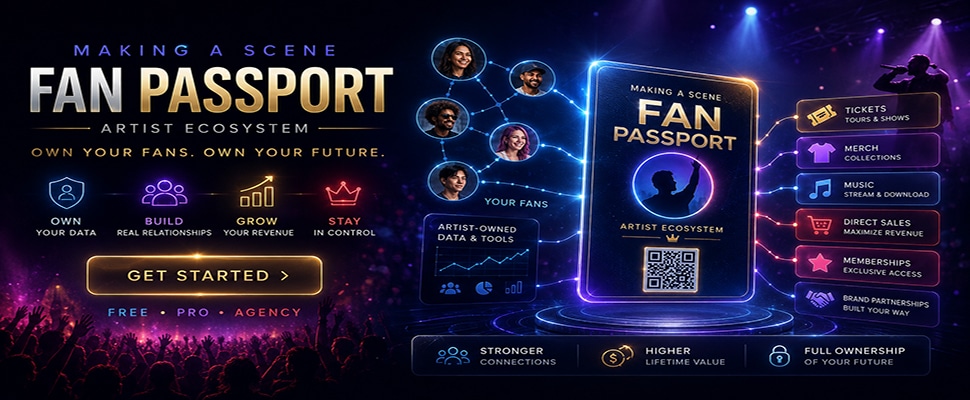
The idea fits naturally with the Making a Scene Artist Ecosystem and Fan Passport philosophy.
An artist should own the permission-based relationship with the fan. The artist should also own the reliable business memory attached to every song.
Fan data tells the artist who supports the work. Catalog data tells the artist what can be done with the work. One side protects the relationship. The other protects the asset.
Together, those records create independence.
An artist should not have to beg a social platform for permission to reach a fan. They should not have to ask a distributor to remember who owns the master. They should not have to delay a licensing request because one collaborator’s agreement disappeared when an old email account was closed.
Ownership should come with memory.
Without that memory, the artist may technically own the work but remain unable to use it quickly, license it confidently, or collect all the money it earns. That is not complete ownership. That is ownership with a very messy filing cabinet.
A Thirty-Day Catalog Cleanup
A thirty-day catalog cleanup begins with gathering everything in one place.
The artist collects distributor reports, release spreadsheets, copyright registrations, performing-rights records, MLC records, SoundExchange records, publishing information, split sheets, lyric sheets, royalty statements, producer agreements, featured-artist releases, beat licenses, sample clearances, artwork licenses, and any other document connected to a song or recording.
At this stage, nothing needs to be judged. The goal is simply to find what exists.
The artist should avoid getting distracted by every mistake discovered along the way. Otherwise, the first afternoon can disappear into an argument with a spreadsheet created in 2014 by someone who apparently considered column headings an unnecessary luxury.
Once the documents have been gathered, the artist creates one clear record for every song and every recording version. The original master, radio edit, acoustic version, instrumental, remix, live recording, clean version, and alternate mix may all need separate recording information.
The next stage is comparison.
The artist checks whether the song title appears the same way in every system. They confirm that the writers are listed correctly and that ownership percentages add up. They compare publishers, identifiers, release dates, master ownership, performer credits, producer terms, and registration records.
This is where small problems begin crawling out from behind the furniture.
One platform may list the song as “Midnight Wi-Fi.” Another may call it “Midnight Wifi.” A third may identify it as “Midnite WiFi Radio Edit,” even though it is neither a radio edit nor spelled like a responsible adult entered it.
The artist must decide which title is official. Alternate spellings and previous versions should still be recorded so future systems can connect the records. The goal is not to pretend the inconsistencies never happened. The goal is to stop them from multiplying.
The artist should also confirm that each ISRC belongs to the correct recording. An instrumental should not accidentally share the identifier assigned to the vocal master. A remix should not be treated as the original recording. A live version should not wander into the catalog wearing the studio master’s name tag.
The lyric sheet should also match the final recording. This may sound obvious, but songs change during recording. A line gets rewritten, a bridge disappears, a chorus repeats, or the singer replaces a word because the original one was impossible to sing without sounding like they had swallowed a spoon.
During the third stage, the artist begins contacting collaborators.
Missing split sheets should be completed. Producer terms should be confirmed. Featured performers should sign releases where appropriate. Beat-license restrictions should be reviewed. Sample permissions should be checked. Old handshake agreements should be turned into actual documents before everybody remembers the handshake differently.
Some collaborators may disagree about percentages, ownership, approvals, or payment terms. That disagreement is not a reason to ignore the problem. It is the reason the problem needs to be resolved before money arrives.
Money has a remarkable ability to improve people’s memory while making those memories completely incompatible.
At this point, the artist should also identify any songs that are not ready for AI licensing. A recording with a disputed split, an uncleared sample, an expired beat lease, an uncertain master owner, or missing approvals should remain outside the program until the issue is fixed.
There is no prize for licensing a song quickly if the payment is followed by three angry emails and a letter from an attorney.
During the final stage, the artist updates registrations and creates a secure master catalog record.
Clean copies of signed documents should be stored in a consistent system. Song and recording identifiers should be recorded. Contact information should be updated. Renewal dates and territorial restrictions should be noted. Backups should be created, and access should be limited to the people who actually need it.
The artist should then write a personal AI licensing policy.
This does not have to be a formal legal document. It can begin as a clear business position describing which uses the artist may consider, which uses they will reject, what information they require before granting permission, what reporting they expect, and what kind of payment would make the deal worthwhile.
One artist may allow instrumental material to be used for training while refusing all vocal cloning. Another may permit a licensed educational model but reject advertising, political content, pornography, gambling, or military use. Another artist may decide that no AI training use is acceptable under any circumstances.
All of those positions are valid.
The purpose of the cleanup is not to pressure an artist into accepting AI licensing. The purpose is to make sure they are prepared to make an informed decision when an opportunity appears.
Readiness is not the same as surrender.
Do Not Repeat the Streaming Mistake
The music industry has seen this movie before.
A new technology arrives with promises of exposure, discovery, efficiency, global reach, and a glorious digital future. The presentation is full of smiling creators, glowing charts, and words like “democratization,” which usually means nobody has yet explained how the artist gets paid.
Artists rush in before payment systems, reporting standards, and bargaining power are settled. The industry celebrates the size of the audience while quietly avoiding questions about who owns the customer relationship, who controls the data, who sets the rate, and who can change the rules later.
Years pass. The platforms become essential. The artist becomes dependent. The payment system grows so complicated that explaining it requires diagrams, accounting software, and possibly a minor in advanced mythology.
Licensed AI should not become Streaming 2: The Algorithm Strikes Back.
Artists should welcome systems that require permission. They should support technology that provides attribution, respects ownership, and creates new forms of income. There is nothing wrong with exploring a new market.
The mistake would be surrendering control simply because a company uses words such as “ethical,” “fair,” “artist-first,” or “transparent.”
Those words should not live only in a press release. They must appear in the contract, payment formula, reporting system, audit rights, approval process, withdrawal terms, and actual behavior of the companies involved.
Transparency is more than being allowed to look at a dashboard.
A dashboard can display impressive numbers while carefully avoiding the number the artist actually wants to know.
Fairness means more than receiving something instead of nothing. A tiny payment does not automatically become fair simply because it arrived with a cheerful email and a green check mark.
Control means the artist can make an informed choice, understand how the work will be used, verify the payment, enforce the agreement, and leave the program under reasonable terms.
That is the standard artists should expect before handing over the value of a catalog.
Will Indie Artists Get Paid?
Some independent artists probably will get paid through licensed AI programs.
The more difficult questions are how much they will receive, how often they will receive it, how the payment will be calculated, and whether they will be able to verify the numbers.
The Symphonic and Sureel announcement may represent an important step toward an AI licensing market in which independent artists can choose whether to participate. It may create better tracking, stronger attribution, and a new source of catalog income.
That is encouraging.
It is not yet proof that the payments will be large, transparent, predictable, or evenly distributed.
The final results will depend on the contracts, participating AI companies, attribution methods, reporting systems, administrative fees, payment formulas, opt-out rules, bargaining power, and accuracy of the artist’s ownership records.
A licensing system cannot pay the correct people when the catalog information is incomplete, contradictory, or buried in old documents. Even a company acting in good faith will struggle to divide revenue when three databases list three different ownership structures.
AI companies should not be allowed to treat the world’s music as an unattended buffet.
At the same time, independent artists should not arrive at the licensing table unable to prove what they own, who must approve the deal, or how the money should be divided.
The best time to clean up a catalog was before AI licensing became possible.
The second-best time is now.
The artist does not need to fix everything in one heroic weekend fueled by coffee and regret. They can begin with one song.
Find the master owner. Identify every writer. Confirm the publishing splits. Locate the agreements. Record the ISRC, ISWC, IPI numbers, registration information, and release details. Save the final lyrics. Document the collaborators. Write down the restrictions. Note which AI uses may be considered and which are completely off limits.
One properly documented song is the beginning of an artist-controlled catalog.
Then the artist can clean up another.
And another.
Before long, the catalog stops being a pile of recordings scattered across platforms and hard drives. It becomes an organized business asset that can be licensed, protected, tracked, inherited, sold, promoted, and used to create revenue on the artist’s terms.
An artist-controlled catalog is not only ready for AI.
It is ready to earn.
 |  Spotify |  Deezer |  Breaker |
 Pocket Cast |  Radio Public |  Stitcher |  TuneIn |
 IHeart Radio |  Mixcloud |  PlayerFM |  Amazon |
 Jiosaavn |  Gaana |  Vurbl |  Audius |
 Reason.Fm | |||
Find our Podcasts on these outlets
Subscribe to Our Newsletter
Discover more from Making A Scene!
Subscribe to get the latest posts sent to your email.


