
The Song You Already Own May Be Your Best Investment





Making a Scene Presents – The Song You Already Own May Be Your Best Investment
Listen to the Podcast Discussion
The Music Business Has Finally Discovered Something Artists Should Have Known All Along
For most of the history of the record business, artists were trained to think about music in release cycles. You wrote a song, recorded it, released it, promoted it for a few months, crossed your fingers, annoyed your friends with social media posts, and eventually moved on to the next record. The old album was pushed toward the back of the shelf while everybody chased whatever was supposed to happen next.
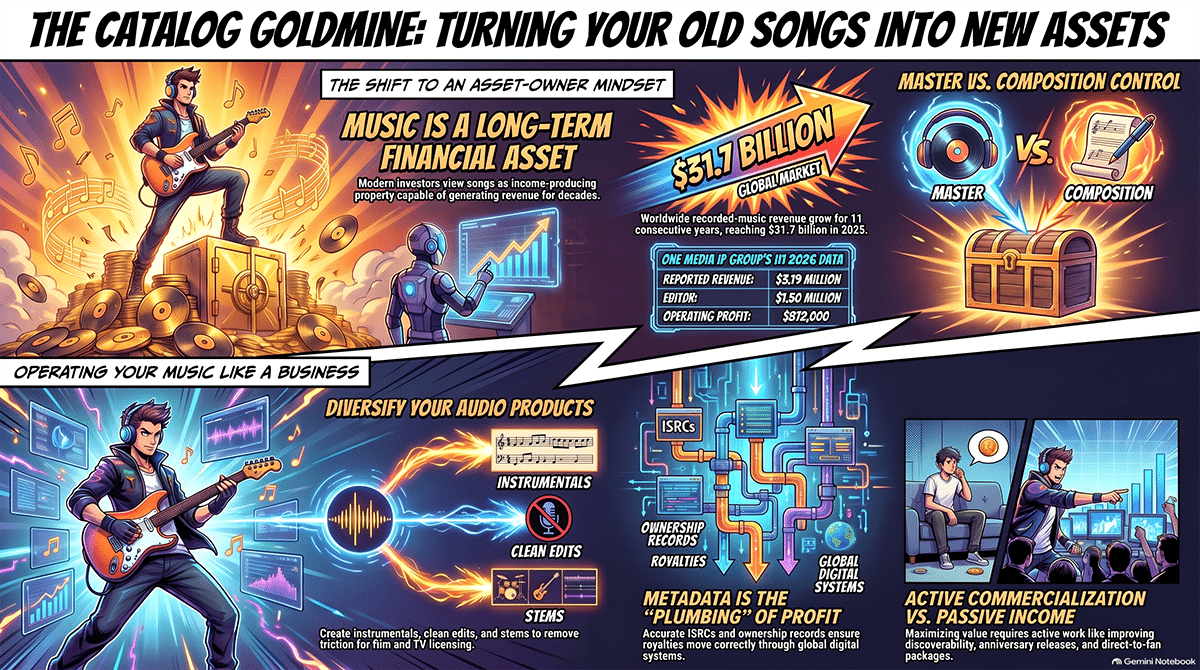
The financial world has been looking at music very differently. Investors, publishers, labels, private equity firms, royalty companies, and catalog buyers increasingly look at a song not simply as something that was released three years ago, but as an asset capable of producing income for many years into the future. That difference in thinking is enormous, because once you stop treating your catalog like yesterday’s news, you start asking very different questions about what the music you already own could be doing for you.
That idea is at the heart of an analysis published by RouteNote Radar on August 24, 2026, examining British music-rights company One Media iP Group and the economics behind its catalog of more than 400,000 tracks. The interesting part of the story isn’t really One Media itself. The interesting part is the business model staring independent artists right in the face. Read the RouteNote Radar analysis
One Media describes itself as a digital music-rights acquirer, publisher, and distributor. Instead of betting primarily on whether a brand-new artist will become the next superstar, it buys or controls rights that already have an income history and then tries to make those rights work harder. Its current business description says it monetizes music through more than 600 digital stores globally, as well as synchronization, video, publishing, and other uses. One Media iP Group
There is a wonderfully rebellious lesson hiding inside that very corporate idea. If investors think old songs can be valuable financial assets, perhaps the first person who should consider treating them that way is the artist who created them.
What One Media Is Really Selling Is Time
The latest numbers help explain why catalog ownership attracts money. One Media reported revenue of approximately $3.19 million for the six months ending April 30, 2026, with net revenue of about $2.18 million, EBITDA of approximately $1.50 million, and operating profit of about $872,000. Reported revenue was lower than the same period a year earlier, but the company said currency movements were responsible for a significant part of that change. Underneath the currency noise, it received about $1.95 million in net income during the period compared with about $1.94 million a year earlier.
That isn’t the story of a company finding one spectacular hit. It is the story of hundreds of thousands of rights quietly generating money over time. One Media’s own language is revealing because it says the business concentrates on rights with proven, repeat income streams and actively works on discoverability, accessibility, metadata, licensing, and monetization. This is not a warehouse where songs are tossed into boxes and left until somebody happens to stumble across them.
The wider recorded-music market helps explain why that model can work. According to the IFPI Global Music Report 2026, worldwide recorded-music revenue reached $31.7 billion in 2025, up 6.4 percent from the previous year and marking an eleventh consecutive year of growth. Paid subscription streaming revenue increased 8.8 percent, and IFPI counted 837 million users of paid subscription accounts around the world.
Streaming is certainly part of this story, but don’t make the mistake of thinking the lesson is simply that old songs get Spotify streams forever. The bigger lesson is that digital distribution removed many of the physical limits that once shortened the commercial life of recordings. A record store had only so much shelf space. A radio station had only so many hours in the day. A record company had a finite promotional budget and generally wanted that budget aimed at whatever it was trying to sell right now.
A digital catalog doesn’t have to disappear because a new release came along. A song can keep earning while another song is released beside it. That turns time from an enemy into something that can potentially increase the number of opportunities available to a rights owner.
A Song Is Not Just a Song Once You Own the Business Around It
Independent artists often use the word “song” to describe several different things, and that becomes dangerous when money enters the conversation. The musical composition and the sound recording are separate copyrighted works. If you wrote a song and then recorded that song, there can be a copyright in the composition and a separate copyright in the particular recording. Depending on contracts, collaborators, publishers, labels, producers, and other arrangements, the same person may or may not own both.
That distinction matters enormously when you begin treating a catalog as an asset. A filmmaker who wants to use your recording in a movie generally needs permission covering the composition and permission covering the master recording. The U.S. Copyright Office explains that the composition permission is commonly called a synchronization license, while permission for the recording is commonly called a master-use license. Unlike certain mechanical uses, there is no compulsory sync or master-use license that simply allows somebody to take your recording for a movie after paying a government-set fee.
That means control can have real economic value. If an independent artist owns the master, controls the composition, knows the songwriter splits, has the files ready, and can answer a licensing request quickly, that artist is operating a usable commercial asset. If nobody knows who owns 17 percent of the song, the instrumental mix is on a dead laptop, and the producer agreement lives somewhere in an AOL account from 2007, the song may still be creatively wonderful, but commercially it has become a scavenger hunt.
And music supervisors, advertisers, game developers, filmmakers, and other buyers generally aren’t shopping for scavenger hunts.
The U.S. Copyright Office makes another point that becomes very useful in catalog negotiations: copyright can be transferred in whole or in part, and individual exclusive rights can be owned separately. In other words, “selling your catalog” does not have to be one giant on-or-off switch unless the contract makes it one. U.S. Copyright Office copyright law and ownership resources
That should immediately change the conversation artists have when somebody shows up with a check.
The Catalog Is Not Passive Income, and That Is Good News
The phrase “passive income” has done some strange things to people’s expectations. It makes money sound as though it should float gently through the window while you drink coffee and congratulate yourself for having uploaded an album in 2018.
Catalog income can certainly continue without constantly recreating the underlying work, but maximizing a catalog is not necessarily passive. One Media’s own filings make that clear. During the first half of 2026, it reported creating new visual content around recordings, developing archive material, improving metadata and discoverability, and securing sync placements from its Point Classics catalog. It also released a previously unheard 1969 George Harrison interview that drew more than 65,000 views shortly after release.
The company specifically reported Point Classics placements in the CBS series Tracker, the feature film Only Living Pickpocket in NY, and Peacock’s The Copenhagen Test. Those placements can generate licensing revenue, but the company also pointed out that synchronization can introduce recordings to new listeners who may then go looking for the music elsewhere. One transaction can therefore have both direct and indirect economic value.
That is a useful way for an indie artist to look at an old catalog. The album does not merely contain ten old audio files. It contains ten pieces of intellectual property that may be presented, packaged, licensed, discovered, and sold in several different ways.
Maybe one track fits a film. Another could work better for a commercial. Another has a guitar break that could be sampled with permission. A fan might want a limited vinyl pressing. A content creator may want a reasonably priced license for a documentary. A longtime supporter may pay for a deluxe anniversary edition containing demos and alternate takes. A music supervisor may need an instrumental version immediately. A producer may want permission to remix something. An AI company may someday want a clearly defined authorized license for a particular use.
The recording didn’t change. The number of commercial doors around the recording did.
One Recording Can Become More Than One Product
Imagine an independent artist who released a song five years ago. The normal industry mindset says the song has already had its chance. It went through distribution, got whatever streams it got, landed on a few playlists if the algorithm gods were feeling generous, and now everybody should move on.
An asset-owner mindset asks a completely different question: what products and licenses can still be built around this recording without compromising the artist’s control?
The original master may remain the main consumer release while the instrumental version becomes useful for film and television. A clean version may open doors that the original explicit recording cannot. Carefully prepared short edits can make the song easier to consider for advertisements, trailers, social media, promos, sports, and other timed uses. Stems may become controlled assets for approved remixes or specialized licenses. A high-resolution direct download can serve fans who want something better than another rented stream.
None of those possibilities guarantees revenue. Creating a pile of files is not the same thing as having customers. But each additional professionally prepared asset removes friction from a possible sale, and that matters.
Think about a music supervisor who is considering two equally good tracks at 4:30 on a Friday afternoon. One artist has an accurate rights record, instrumental, clean master, short edit, songwriter splits, contact information, and the authority to approve the use. The other responds with, “I think my old bass player’s cousin has the instrumental somewhere.”
Musical taste may still decide the winner, but administrative chaos has an amazing ability to turn a perfectly good song into somebody else’s licensing opportunity.
One Media’s strategy is built around exactly this kind of active commercialization. Its 2025 annual report says management monitors the cost of acquisitions to seek an adequate return and measures performance partly through digital revenue, licensing deals, and sales contracts. The company isn’t merely betting that songs will magically become more valuable with age. It is operating those songs as assets.
That distinction may be the most important idea in this entire discussion.
Where the Money From a Catalog Can Actually Come From
Streaming remains one revenue stream, but it is only one part of the machinery. A self-administered songwriter in the United States may also have digital mechanical royalties connected with interactive streaming and downloads. The Mechanical Licensing Collective administers the blanket mechanical license for eligible U.S. streaming and download services and allows members to register and maintain their musical-work data. The MLC says digital services send both usage information and royalties, after which the organization matches reported uses to registered works and distributes money to the appropriate members.
On the sound-recording side, SoundExchange collects U.S. statutory digital performance royalties from qualifying non-interactive services. Under the statutory distribution described by SoundExchange, 45 percent goes directly to featured artists, 5 percent goes to a fund for nonfeatured performers, and 50 percent goes to the sound-recording rights owner. That income stream is separate from the royalties an artist may receive through a distributor for interactive on-demand streaming.
Then there is sync. There can be physical products. There can be direct digital sales. There can be licensing into games, videos, advertisements, documentaries, and other media. There can be approved sample licenses or remix permissions. There may be publishing income, performance income, neighboring-rights income in applicable territories, and new formats that do not exist yet.
This does not mean every artist gets every one of those revenue streams. Rights ownership, territory, contracts, use, registration, and eligibility all matter. It means the catalog is more like a building with several rentable rooms than a single vending machine labeled STREAMS.
The artist’s business job is figuring out which rooms actually exist, who controls the keys, and whether anybody has been forgetting to collect the rent.
Metadata Is Part of the Asset Whether Musicians Like It or Not
Musicians generally do not get into music because they have a deep emotional need to organize spreadsheets. Somewhere in America right now, a songwriter has just felt personally attacked by that sentence.
Unfortunately, information is part of the commercial value of a catalog. A buyer, licensee, publisher, distributor, collection society, or music supervisor needs to know what the work is, who owns it, who performed on it, which recording is being discussed, and who has authority to approve a use.
This is why identifiers and metadata matter. The official International ISRC Agency explains that an ISRC uniquely and permanently identifies a specific sound recording or music video. Different recordings, such as alternate mixes or edits that qualify as distinct recordings, may require distinct identifiers. Importantly, the ISRC itself does not prove current ownership; it identifies the recording so information about that recording can be connected correctly across systems.
That is an important distinction. An identifier is not a deed.
The industry’s data problem is large enough that DDEX maintains standards specifically for exchanging information about recordings, musical works, ownership claims, rights, sales, revenue reporting, contributors, and even catalog transfers. This is not glamorous stuff, but it is the plumbing through which a modern music business increasingly moves.
For an independent artist, the practical lesson is simpler than the technology. You should have one authoritative record for every song that connects the master, composition, ownership shares, writers, performers, identifiers, releases, alternate versions, contracts, permissions, registration information, licensing history, and available commercial assets.
Call it a catalog database, rights ledger, source of truth, or Fred if you really want to. The name doesn’t matter nearly as much as knowing where the truth lives.
Why Would Somebody Offer You $100,000?
Now we get to the fun part.
Suppose somebody offers an artist $100,000 for a catalog. There is a natural emotional reaction to that number because musicians are used to financial conversations containing phrases such as “exposure,” “merch split,” and “we can pay you after everybody else.” An actual six-figure check can therefore look as if a unicorn has entered the rehearsal room carrying a briefcase.
But the buyer isn’t buying the artist a lovely present.
A rational catalog buyer generally wants to acquire a stream of future economic benefits for less than it expects those benefits to be worth after accounting for time, costs, risk, financing, and uncertainty. That doesn’t mean the buyer knows with certainty that $100,000 will become $250,000. Nobody knows the future. It means the buyer has made assumptions about what those rights may produce and believes the purchase makes financial sense under those assumptions.
One Media’s disclosures are unusually helpful here because the company openly describes acquisition cost and return as key measures. It looks for repeat income, monitors acquisition costs to seek adequate returns, and tries to improve monetization after buying rights. Earlier disclosures about its Harmony iP program even discussed acquisitions in terms of multiples of existing income.
That is what the artist needs to understand before negotiating. The check on the table represents the buyer’s opinion about the value of tomorrow’s income, discounted into money today. Once you realize that, one question becomes unavoidable: what does the buyer believe it can do with my catalog that I am not doing already? That question can be worth a lot of money.
The Buyer May Actually Be Better at Operating the Catalog
There is an uncomfortable truth worth admitting because artist ownership does not require pretending artists are magically experts at everything. A professional catalog company may genuinely be able to produce more revenue from certain rights than an individual artist can.
Scale matters. One Media manages more than 400,000 tracks and distributes content to more than 600 digital stores. A company working at that size can spread technology, staff, accounting, metadata, licensing, marketing, and administration costs over a huge portfolio. It may have relationships with music supervisors, distributors, publishers, broadcasters, and technology companies that one artist simply does not have.
That can make a sale economically reasonable even when the buyer expects to earn more than the purchase price. The buyer may be purchasing both the future income and the opportunity to improve that income with capabilities the seller does not have.
The independent artist’s answer should not be to become suspicious of every buyer. It should be to find out which parts of that value creation could be reproduced without giving up everything.
Perhaps better administration would solve the problem. Perhaps the catalog needs a licensing representative rather than a new owner. Perhaps missing registrations are suppressing royalty collections. Perhaps the masters need proper metadata and searchable descriptions. Perhaps nobody has prepared instrumentals. Perhaps the artist needs a publisher administrator, sync agent, catalog manager, or direct licensing system.
If improving those things increases annual income, the value of the catalog may increase too. Suddenly the artist isn’t negotiating from, “Please tell me what my music is worth.” The conversation becomes, “Here is what this asset currently earns, here is where it is growing, here are the rights included, and here is what I am willing to sell.” Those are two very different rooms to negotiate in.
Selling a Catalog Is Not Automatically a Mistake
There is a temptation in artist-ownership conversations to turn every catalog sale into a morality play. That is not useful.
Cash today has value. An artist may need money to buy a home, pay debt, finance a tour, start another business, fund retirement, deal with family needs, invest elsewhere, reduce financial risk, or simply enjoy the money earned from decades of creative work. Those are legitimate reasons to consider converting uncertain future income into a known amount today.
The future is also uncertain. Streaming could grow, but an individual catalog could decline. A style of music can fall out of favor. Income can concentrate on a small number of works. Platforms can change policies. Distribution relationships can change. Rights can become disputed. Currency can move in uncomfortable directions, something One Media itself experienced during the first half of 2026. Even a well-managed catalog is an asset with risk, not an ATM with a copyright symbol taped to the front. A buyer is taking some of that risk when it writes the check. The problem is not selling. The problem is selling without understanding what is being sold.
You Don’t Necessarily Have to Sell the Whole Thing
One of the most useful facts in U.S. copyright law is that copyright interests can be divided. Section 201 of the Copyright Act says copyright ownership can be transferred in whole or in part, and individual exclusive rights can be separately owned. That means deal structure matters enormously.
One Media itself provides an interesting example through Harmony iP. Rather than presenting every transaction as a complete catalog buyout, Harmony describes a model in which a rights holder exchanges a portion of rights ownership for a lump sum while continuing to receive royalties on the portion retained. That does not mean its terms are right for every artist, but it demonstrates an important principle: liquidity and complete surrender of ownership do not always have to be the same transaction.
An artist considering a deal might therefore explore whether the transaction really needs to cover every right, every territory, every song, and every future use. Depending on the situation, properly drafted agreements can involve partial interests, specific rights, defined territories, particular uses, licenses, or other structures rather than a complete transfer.
That is the point where a qualified music attorney and financial or tax professional become worth considerably more than a spirited conversation in the green room. Contract language can determine who gets paid for uses that have not even been invented yet.
And that brings us to AI.
AI Just Made the Future-Rights Question Much Bigger
Five years ago, an artist reviewing a catalog deal might have concentrated mostly on streaming, publishing, sync, physical sales, and conventional digital exploitation. Those issues still matter, but artificial intelligence adds another layer because music can potentially have value not only as entertainment consumed by listeners, but also as licensed material used in technology systems.
The legal picture remains unsettled. The U.S. Copyright Office AI initiative has been studying issues involving generative AI, copyrightability, digital replicas, and training. In May 2025 it released a pre-publication version of Part 3 of its Copyright and Artificial Intelligence report dealing with generative AI training, and the Office’s website still describes the final version as forthcoming.
The report is particularly relevant to catalog owners because the Copyright Office observed that voluntary licensing arrangements for AI training have already begun to emerge. It specifically noted that licensing may be more workable in areas where valuable material can be licensed in substantial volumes, including popular music, while also making clear that the feasibility and legal analysis vary depending on the type of work and use.
That does not mean every song is about to receive an AI licensing check. It means artists should be very careful about contracts that grant broad rights covering future technologies without understanding what those words could mean.
There isn’t one magical federal copyright called “the AI right” that can simply be checked off on a spreadsheet. AI uses may touch existing copyright rights, contracts, licensing permissions, data access, derivative uses, and other areas of law depending on what is actually happening. Voice and likeness issues can raise still more questions outside ordinary copyright ownership.
So when a catalog buyer wants rights for technologies “now known or later developed,” an artist should not treat that language as decorative boilerplate wedged between the page numbers and the signature line. Future uses may become part of the economic value the buyer is trying to acquire.
That deserves a price, a limitation, or at least a serious conversation.
AI Can Also Help the Artist Operate the Catalog
The AI discussion does not have to begin and end with training licenses. One Media says it is already using AI-assisted tools for workflow efficiency, metadata enhancement, searchability, audience engagement, catalog organization, and visual content creation while keeping human judgment involved.
That points toward a much more immediate opportunity for independent artists. AI can help search large catalogs, identify missing metadata, compare royalty statements, generate descriptive tags for supervisor searches, connect alternate titles, organize lyrics, find incomplete rights records, suggest catalog groupings, and help turn years of messy information into something a human can actually work with.
The important word there is “help.”
An AI system should not invent songwriting splits because a spreadsheet has a blank cell. It should not decide who owns a copyright because two contracts seem confusing. It should not hallucinate an ISRC, sign a license, or declare that a sample has been cleared. Those are legal and business facts that require authoritative records and human decisions.
Used correctly, AI makes catalog administration cheaper and faster. That matters because the ability to manage a catalog economically is one of the advantages large rights companies have traditionally held over individual artists.
Technology can shrink that advantage.
Web3 Is More Useful as Plumbing Than as a Casino
Web3 also has a place in this story, although probably not the one that produced a thousand press releases about selling songs as tokens during the NFT gold rush.
A blockchain entry does not magically create copyright ownership. Copyright ownership comes from copyright law, authorship, valid transfers, licenses, and contracts. Putting “I own this song” into an immutable database does not make it true any more than writing “I own Graceland” on a rock makes Elvis’ estate send you the keys.
The useful part of decentralized technology is recordkeeping and provenance. An artist-owned system could keep tamper-evident records showing when a rights declaration was created, which version of a recording a license covered, what permissions were granted, when a transaction occurred, and how a particular asset relates to the artist’s authoritative rights record.
That becomes particularly powerful when the records remain portable instead of being trapped inside one platform. The goal isn’t to replace copyright law with blockchain. The goal is to make the artist’s business history harder to lose, easier to verify, and easier to move.
That fits nicely with the direction of standards work already happening in the ordinary music business. DDEX even maintains standards covering catalog transfers, recording-rights information, musical-work claims, release data, and revenue reporting. The technology underneath those records may change over time, but the problem remains the same: people need reliable information about who controls what.
For the independent artist, ownership of information may eventually matter almost as much as ownership of the audio files themselves.
Before You Sell the Catalog, Operate It
This is where the One Media story becomes useful instead of simply interesting.
Imagine an artist with three albums and 32 original songs. Streaming produces some income every year, but nothing spectacular, and a buyer eventually offers a lump sum for the catalog. The artist could look at the last three years of royalty statements, multiply a few numbers, and decide whether the offer feels large enough. Or the artist could spend several months discovering what the catalog actually is.
That might reveal songs that were never properly registered for U.S. digital mechanical royalties. The artist might discover recordings missing from a SoundExchange account, outdated publishing information, unreconciled songwriter splits, missing identifiers, old physical masters worth reissuing, fans interested in deluxe editions, compositions never pitched for sync, instrumentals that exist but were never delivered, and recordings that could support creator licenses or controlled remix opportunities.
Perhaps the artist discovers that an album everybody thought had died in 2021 still has a small but loyal group of buyers. Instead of sending those people back to another platform for another fraction-of-a-cent interaction, the artist builds a direct anniversary package containing the high-resolution album, demos, artwork, session notes, and a limited physical edition.
Maybe that generates only a few thousand dollars. That is not private-equity money, but it is new income from an asset the industry had mentally declared dead. More importantly, the artist now knows more about what the catalog can do.
Your Fan Relationship Can Increase the Value Without Being Sold With the Songs
Catalog strategy becomes even more interesting when direct fan relationships enter the picture.
A streaming platform can tell an artist that 40,000 people listened to a song, but those listeners are generally customers of the platform, not customers of the artist. The artist usually cannot export everybody’s personal information and start contacting them somewhere else, nor should they be able to without permission.
An artist-owned customer relationship is different. When a fan chooses to buy directly, join a membership, subscribe to an artist-controlled email list, purchase a ticket, order merchandise, or otherwise give appropriate permission for an ongoing relationship, the artist begins building business infrastructure around the catalog. Now an old song can be activated without waiting for a playlist editor.
An anniversary release can be offered directly to people who bought the original record. A fan who loves one song can be offered a vinyl edition. A filmmaker can find a licensing page explaining how to request permission. A songwriter can announce a new acoustic version to an audience that has already demonstrated interest. The catalog and the fan relationship begin reinforcing each other. This is the difference between owning music and actually owning a music business.
What a Buyer Knows Should Become Part of Your Negotiation
If a buyer is interested in your catalog, interest itself is information.
The buyer has probably looked at historical earnings. It may have considered trends, rights duration, repertoire quality, territories, administration, future licensing possibilities, and the cost of operating the catalog. It may believe some income is being missed. It may have access to markets you do not. It may simply have a lower cost of capital and be happy collecting predictable royalties over a very long period. None of that means the artist should refuse the deal. It means the artist should want to understand the buyer’s thesis before agreeing to the price.
Suppose the artist receives that hypothetical $100,000 offer and, after studying the catalog, concludes that existing annual income is reasonably stable but there are also several undeveloped licensing opportunities. Perhaps the artist still decides $100,000 today is worth more personally than years of uncertain income. Fine. Sell intelligently.
But perhaps the artist discovers that the catalog can be operated better, increases income over the next two years, documents that growth, cleans up the rights records, and attracts several bidders instead of one. The song didn’t suddenly become better music during those two years. The business around the song became better.
Catalog Sales Are Usually Serious Long-Term Decisions, but U.S. Law Has an Important Wrinkle
Catalog transfers can have extremely long consequences, especially when an artist grants ownership broadly and permanently. That is why the exact language matters so much.
There is, however, an important U.S. copyright wrinkle that makes it inaccurate to say every copyright transfer is necessarily irreversible forever. Under certain conditions, sections 203 and 304 of U.S. copyright law allow authors or qualifying heirs to terminate some previous copyright grants during specific statutory windows. For many post-1977 grants executed by an author, section 203 can allow termination beginning after 35 years, subject to strict timing and notice requirements. Works made for hire and certain other situations are treated differently, and derivative works introduce additional complications. U.S. Copyright Office termination information
Nobody should read that paragraph and conclude, “Great, I can sign anything and simply take it back later.” Termination rights are technical, time-sensitive, and fact-specific. They are something to discuss with a qualified copyright attorney, not a reset button to be pressed after a regrettable Tuesday.
The larger point remains intact. When an artist transfers valuable rights, that transaction may shape income and control for decades. Treat it with the same seriousness you would give the sale of any other meaningful asset. Probably more seriously than buying a new tour van, considering how tour vans usually end.
The Real Asset Is Music Plus Rights Plus Information Plus Access
The catalog itself is the foundation, but the strongest independent music business is not merely a folder full of WAV files.
The valuable system combines the recordings with the compositions, ownership records, contracts, metadata, identifiers, alternate mixes, artwork, licensing history, royalty information, transaction records, registrations, and fan relationships that make those rights commercially usable.
That is also why catalog ownership can become more valuable as technology improves. Better search can make older recordings easier to discover. Better metadata can make them easier to license. Better rights records can reduce clearance friction. AI can make administration and search more efficient. Portable databases can keep artists from rebuilding their businesses every time a technology company decides to “sunset” something everybody was using yesterday.
The asset becomes stronger when the artist can answer four simple questions without calling six people: what do I own, what can I license, where is it earning, and who wants it? Those questions sound almost embarrassingly basic. The music industry has spent decades making them surprisingly difficult.
Maybe the Best Catalog Buyer Is You
One Media iP has built an entire public company around the idea that existing music rights can generate repeat income over long periods when those rights are carefully acquired, organized, distributed, marketed, licensed, and managed. Its current portfolio contains more than 400,000 tracks, and its latest financial results still describe recurring royalty income as the foundation of the business. Independent artists do not need 400,000 tracks to learn from that model. They may need 40.
The biggest shift is psychological. Stop asking only how the new single is doing and begin asking what the entire catalog is doing. Stop measuring a five-year-old song only by last month’s stream count and begin looking at the rights, files, fans, licenses, direct products, publishing, registrations, and future uses connected to it. Then, if somebody eventually arrives wanting to buy the catalog, listen.
Maybe the offer is excellent. Maybe selling removes risk and creates freedom. Maybe a partial deal makes more sense. Maybe professional administration is all that was really needed. Maybe operating the catalog for another three years would produce more income and a higher valuation.
There is no single answer that fits every artist. There is one question every artist should be able to answer before signing anything: why does the person across the table want these rights? If the buyer believes your old songs can keep producing money for decades, the artist who created those songs deserves to understand that possibility too.
For years, the music industry taught independent artists to think of yesterday’s catalog as something that helped promote tomorrow’s release. The financial industry has quietly flipped the equation around. Tomorrow’s business opportunity may already be sitting on the hard drive. The song isn’t finished earning just because release week ended.
Sometimes the most valuable record you can make this year is the one you already made five years ago—and finally learned how to own like a business.
Discover more from Making A Scene!
Subscribe to get the latest posts sent to your email.


