
The American Music Tourism Act Is Now Law.




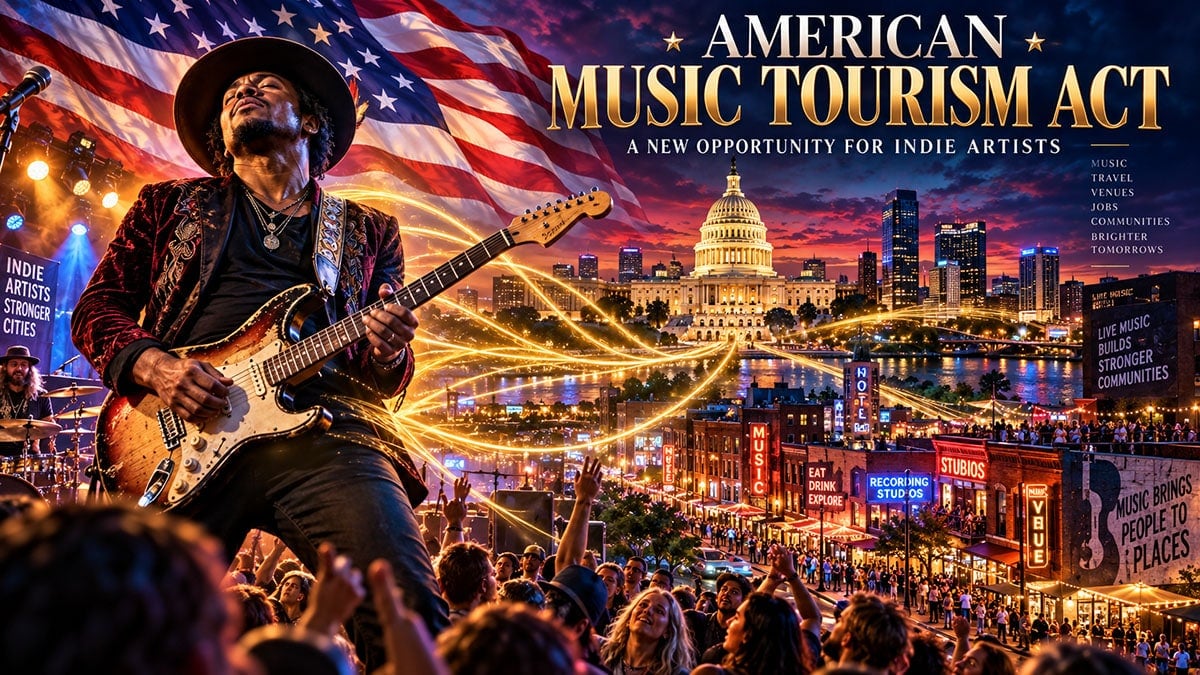
Making a Scene Presents – The American Music Tourism Act Is Now Law. Indie Artists Should Pay Attention to What Happens Next
Listen to the Podcast Discussion
Washington Has Officially Discovered That Music Makes People Travel
On October 9, 2026, President Donald Trump signed the American Music Tourism Act of 2025 into federal law. That sentence sounds like the sort of thing that normally causes musicians to politely nod, return to restringing a guitar, and assume somebody in Washington has once again created a committee to discuss creating another committee. This time, however, independent artists, venues, recording studios, festivals, local music organizations, and the communities surrounding them may want to keep reading. The law does not hand musicians checks, create an artist grant program, or magically turn the neighborhood club into a federally funded cultural palace. What it does is formally place music tourism inside the federal government’s travel and tourism strategy, and the language Congress used is broad enough to include far more than America’s famous musical landmarks. The White House confirmed that President Trump signed S. 195 into law on Friday, October 9, directing the Department of Commerce to promote domestic and international tourism to American locations and events important to music tourism. Read the White House announcement
That matters because music has always been part of the tourism business even when musicians were treated as though they were merely the entertainment hired after the important economic people finished eating dinner. A fan drives three hours to hear a band and somebody sells gasoline. Somebody rents a hotel room. Somebody serves breakfast the following morning. Somebody sells parking, drinks, coffee, barbecue, souvenirs, rideshares, museum tickets, and perhaps a suspiciously expensive bottle of water at a highway rest stop. The concert ticket may be the reason the trip happened, yet the economic value created by that performance spreads through businesses that may never pay the musicians whose work caused the visitor to arrive in the first place.
The American Music Tourism Act does not fix that imbalance by itself. No federal legislation can force a traveling fan to buy your vinyl rather than another round of nachos. What the law does is considerably more subtle: it tells the federal tourism apparatus that music-related travel should be intentionally identified, encouraged, and promoted. For independent musicians, the important question therefore is not whether Washington has suddenly become your booking agent. It has not. The real question is whether artists, venues, studios, local music organizations, and regional scenes can use this new government recognition to capture more of the economic value their music already creates.
That is where this becomes a Making a Scene story.
What the Law Actually Says
The American Music Tourism Act began as a bipartisan effort led by Republican Senator Marsha Blackburn of Tennessee and Democratic Senator John Hickenlooper of Colorado. The current S. 195 was introduced in January 2025 after an earlier version passed the Senate during the previous Congress but did not complete the legislative process. The Senate Commerce Committee advanced the new measure, the Senate passed it, the House ultimately approved the legislation in September 2026, and President Trump signed it on October 9. The politics surrounding American culture can become combustible in approximately twelve seconds, but this particular measure traveled through Congress with unusually broad bipartisan support because lawmakers in very different places understand something local business owners figured out years ago: people will travel ridiculous distances for music they love.
The operative language is remarkably straightforward. The legislation amends the Visit America Act and requires the Assistant Secretary of Commerce for Travel and Tourism to identify locations and events in the United States that are important to music tourism and to facilitate and promote domestic travel to those places. It establishes a similar responsibility for international travel. Within one year of enactment, and every two years thereafter, the Assistant Secretary must report to congressional committees on activities, findings, achievements, and vulnerabilities related to the government’s tourism goals.
More interesting for independent music is the definition Congress chose. Under the legislation, music tourism includes traveling to a state or locality to visit historic or modern music-related attractions, including museums, studios, venues of all sizes, and other music-related sites. It also covers travel to festivals, concerts, live musical performances, and music-related special events. Those words matter. Congress could have written a law centered primarily on heritage tourism and famous attractions. Instead, the statute explicitly reaches modern music activity, recording studios, contemporary events, and venues of all sizes.
“Venues of all sizes” may turn out to be four of the most important words in the entire law for working musicians.
That language means music tourism is not legally imagined only as tourists visiting the Grand Ole Opry, Graceland, the Rock & Roll Hall of Fame, or other nationally known destinations. Those attractions obviously belong in the picture, but so can the independent blues room where a great regional guitarist performs every Friday, the neighborhood jazz club that has quietly survived for forty years, the recording studio associated with a local scene, the small festival built around a particular regional tradition, and the songwriter event that persuades two hundred people to spend a weekend in a town they otherwise would not have visited.
The federal government has, in effect, acknowledged something independent music has spent decades demonstrating: cultural importance does not begin when somebody installs a velvet rope and a gift shop.
What the Law Does Not Do
Before everybody starts searching for the “Federal Government Buy Me a Tour Van” application, there is an important dose of reality.
The American Music Tourism Act does not create a new grant program for musicians. It does not establish direct payments for venues. It does not guarantee marketing dollars for regional festivals. It does not require states to hire local bands. It does not create a new federal music agency. It does not promise that the Commerce Department will advertise your Tuesday night songwriter showcase to tourists in Germany.
The Senate Commerce Committee’s own report could hardly be clearer. It states that S. 195 does not create a new program. The Congressional Budget Office estimated that implementing its requirements would cost less than $500,000 over the 2025–2030 period, with spending subject to appropriations. The same committee report said the measure would create no additional regulatory impact. In other words, this is primarily a change in federal tourism responsibilities and priorities rather than a giant new spending program.
That distinction is enormously important because music-industry press releases have a bad habit of turning government recognition into imaginary artist revenue before the ink on the legislation is dry. A law saying the government should promote music tourism is not the same thing as musicians receiving the economic benefits of music tourism. Between those two points sits a complicated collection of tourism agencies, destination marketing organizations, municipalities, chambers of commerce, festivals, venues, hotels, restaurants, ticketing systems, marketing companies, technology providers, and local political priorities.
If independent artists simply applaud the law and continue doing business exactly as they did before, the largest beneficiaries may be the same institutions that already know how to capture tourist dollars.
The artist has to become part of the business architecture.
Music Was Already Selling Hotel Rooms
The logic behind the legislation is hardly mysterious. Music gives people reasons to leave home.
According to figures cited by the Recording Academy from 2025 research by the National Independent Venue Association, independent venues and festivals support nearly one million jobs and generate approximately $10.6 billion each year in visitor spending on things such as lodging, dining, shopping, and local transportation. The Recording Academy also reported that the research attributed 9.2 percent of total U.S. travel and tourism revenue to independent venues and festivals. Those are industry research figures rather than a new economic estimate produced by the federal government, which is worth keeping clear when discussing them, but they illustrate why tourism policymakers have become interested in music as something considerably larger than the ticket business. Read the Recording Academy’s coverage
Think about what happens economically when someone travels from North Carolina to Georgia for a weekend festival. The festival may collect $75 for a ticket, but the visitor’s total trip might involve lodging, meals, parking, gasoline, merchandise, drinks, local shopping, and perhaps another attraction before heading home. If several thousand people make similar trips, the music event stops looking like a night of entertainment and starts looking like a small economic development project with amplifiers.
Independent artists are already creating part of that value. They simply have not always been organized to retain enough of it.
The touring musician sees this problem constantly. The venue has the customer’s ticket information. The ticketing company has the email address. The hotel has the guest record. The restaurant has the credit-card transaction. The social network knows what the visitor watched afterward. The streaming service knows which songs were played on the drive home. The artist who caused half of this activity may leave town with a guarantee, a few merchandise sales, and perhaps a spreadsheet containing three email addresses collected beside a tip jar.
That is not an unavoidable law of economics. It is a business design problem.
Music tourism gives artists another reason to solve it.
Stop Thinking About the Gig as a Two-Hour Product
For most independent musicians, the traditional live business begins with a date on a calendar. The artist gets booked, promotes the show, performs, gets paid, sells some merchandise, packs the van, and starts worrying about the next town. The entire commercial structure revolves around two or three hours when people are inside a particular room.
Music tourism invites a much bigger way of thinking.
Suppose a blues artist has a strong following scattered across Georgia, Tennessee, North Carolina, South Carolina, and Florida. Instead of marketing one Saturday performance as merely another show, the artist and venue could work with nearby businesses and the local tourism organization to position the weekend as a destination experience. Fans arriving Friday might be offered a studio visit, songwriter conversation, guitar workshop, historic music tour, listening event, or informal acoustic performance. Saturday could include the main concert. Sunday might feature brunch with another local artist or an intimate recording-session experience.
Suddenly the product is no longer one ticket. It is a weekend built around music.
The artist does not need to own a hotel to benefit from that model. The artist needs to understand what pieces of the experience can reasonably be owned, controlled, licensed, bundled, or used to create a continuing relationship with the visitor. Tickets can be sold directly where practical. Limited merchandise can be created specifically for the weekend. VIP experiences can generate higher-margin revenue. A live recording could become a direct-sale product. Fans can voluntarily join the artist’s email or membership community. A QR code or NFC-enabled product can connect the physical visit with exclusive digital content. A future regional event can be marketed directly to the people who already demonstrated that they are willing to travel.
That last part is where the economics get interesting.
A tourist who traveled four hundred miles to see you is not merely another social-media follower. That person has revealed something incredibly valuable: willingness to spend time and money around your music. If the only record of that relationship remains inside a ticketing platform or social network, the artist has created valuable demand while somebody else owns the customer connection.
Making a Scene has been arguing for years that discovery platforms should be doors, not destinations. Music tourism reinforces that philosophy in the physical world. A tourism campaign can introduce somebody to your town. A festival can introduce them to your music. A venue can sell the first ticket. The artist’s job is to make sure the relationship does not end when the visitor pulls onto the interstate Sunday morning.
Your Town May Be More Interesting Than You Think
There is a strange habit in the music business of assuming a scene becomes culturally important only after somebody from New York, Los Angeles, Nashville, or London writes an article explaining that it exists. History suggests otherwise. American music has repeatedly grown from local communities long before national institutions understood what was happening.
Music tourism can reward regional identity precisely because travelers are often looking for things they cannot experience everywhere else.
Detroit does not need to pretend to be Nashville. Georgia does not need to become Austin. New Orleans would be considerably less interesting if somebody decided its branding strategy should resemble Las Vegas. A regional music economy becomes attractive when there is something authentic enough that people have a reason to travel for it.
That creates an opening for independent artists because authenticity tends to live much closer to working musicians than corporate marketing departments.
A town with several blues artists, a respected recording studio, two independent venues, a record store, a regional music history, and an annual festival already contains many of the ingredients of a tourism product. Those businesses may simply have never thought of themselves as one economic ecosystem. The American Music Tourism Act gives local leaders another reason to start seeing those connections.
An artist can help create them.
Imagine several independent venues coordinating a weekend pass. A studio could offer a limited behind-the-scenes session. A music store might host an afternoon clinic. Local restaurants could offer discounts to ticket holders. A hotel could develop a weekend room package. Artists could perform at multiple locations rather than competing for the same audience on the same night. A local music organization could produce a digital guide connecting the entire experience.
None of this requires waiting for the Department of Commerce to descend from Washington carrying laminated backstage passes.
The federal law creates legitimacy around the concept. The business still has to be built locally.
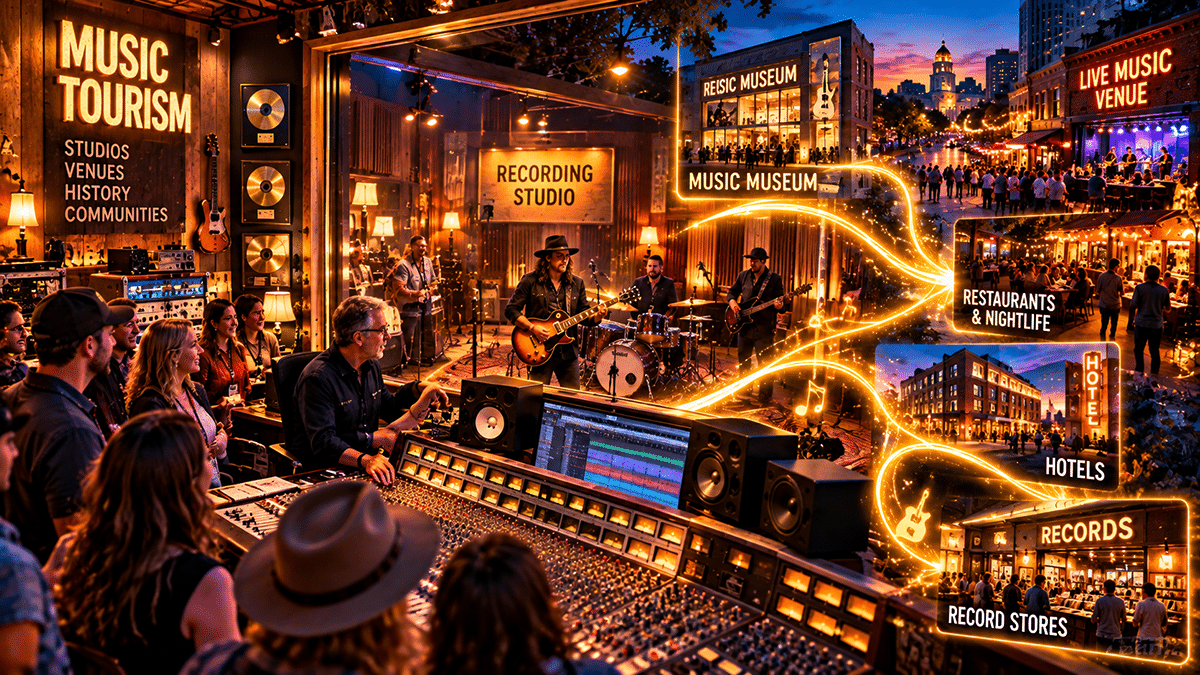
Recording Studios Just Got an Interesting Invitation
One of the quiet surprises buried in the statutory definition is the explicit inclusion of studios as music-tourism destinations.
That deserves more attention than it will probably receive.
Recording studios have traditionally earned money by selling production time, engineering, mixing, mastering, rehearsal space, or related creative services. Historic studios have long attracted visitors, but contemporary independent studios rarely think of tourism as part of their revenue model.
Perhaps they should.
A working studio connected to a recognizable regional scene could develop scheduled educational experiences that do not interfere with normal sessions. Visitors might attend a demonstration explaining how records are made, participate in a short recording workshop, hear stories about regional artists, watch a microphone or analog recording demonstration, or purchase a package allowing them to record a simple song or spoken message.
That does not mean transforming professional control rooms into musical petting zoos where tourists wander around touching the Neumann microphones. Studios remain working environments, and client privacy must be respected. The opportunity is to create controlled experiences around the studio’s knowledge, history, and craft.
For an independent studio already struggling with declining session budgets, even a modest tourism program can create additional revenue without replacing the core recording business. Better yet, those visitors may become future clients, customers for educational services, buyers of locally produced music, or supporters of the artists associated with the facility.
A recording studio is not merely a room containing expensive electronics. It is a place where culture is manufactured.
Congress just wrote “studios” into the federal definition of music tourism. Studio owners should probably take the hint.
The Political Story Is Worth Understanding
The American Music Tourism Act is also interesting because it represents something increasingly rare in American politics: cultural legislation with meaningful bipartisan roots.
Senator Blackburn, a Tennessee Republican, and Senator Hickenlooper, a Colorado Democrat, led the Senate effort. The legislation has been backed by organizations ranging from the Recording Academy and National Independent Venue Association to industry trade groups and tourism interests. During its legislative journey, supporters consistently emphasized both cultural preservation and economic development.
President Trump signing the legislation therefore represents the final step in a process that crossed party lines rather than the beginning of a single-party music initiative. That matters because independent artists should resist the temptation to interpret every useful industry policy entirely through partisan identity. Musicians can argue fiercely about politics while still recognizing when legislation creates a potentially valuable economic framework.
The healthier question is what the policy actually does.
Does it strengthen independent ownership? Does it improve access? Does it create opportunities for working artists? Does it increase competition? Does it allow local culture to generate local wealth? Does it simply funnel more business toward large corporations that already dominate music infrastructure?
Those questions are much more useful than deciding whether to cheer or boo based on which politician is holding the signing pen.
There is also a broader political lesson here. Policymakers are increasingly recognizing music as infrastructure rather than merely entertainment. A venue can anchor a neighborhood. A festival can create seasonal tourism. A recording studio can preserve regional culture. A live music scene can help attract workers, businesses, students, and visitors. Once policymakers begin seeing music through that economic lens, musicians have a stronger argument for inclusion in tourism planning, downtown development, transportation decisions, small-business policy, cultural funding, and regional branding.
The danger, of course, is that policymakers discover the economic value of music while continuing to treat musicians as interchangeable raw material.
Artists need to be in the room before that happens.
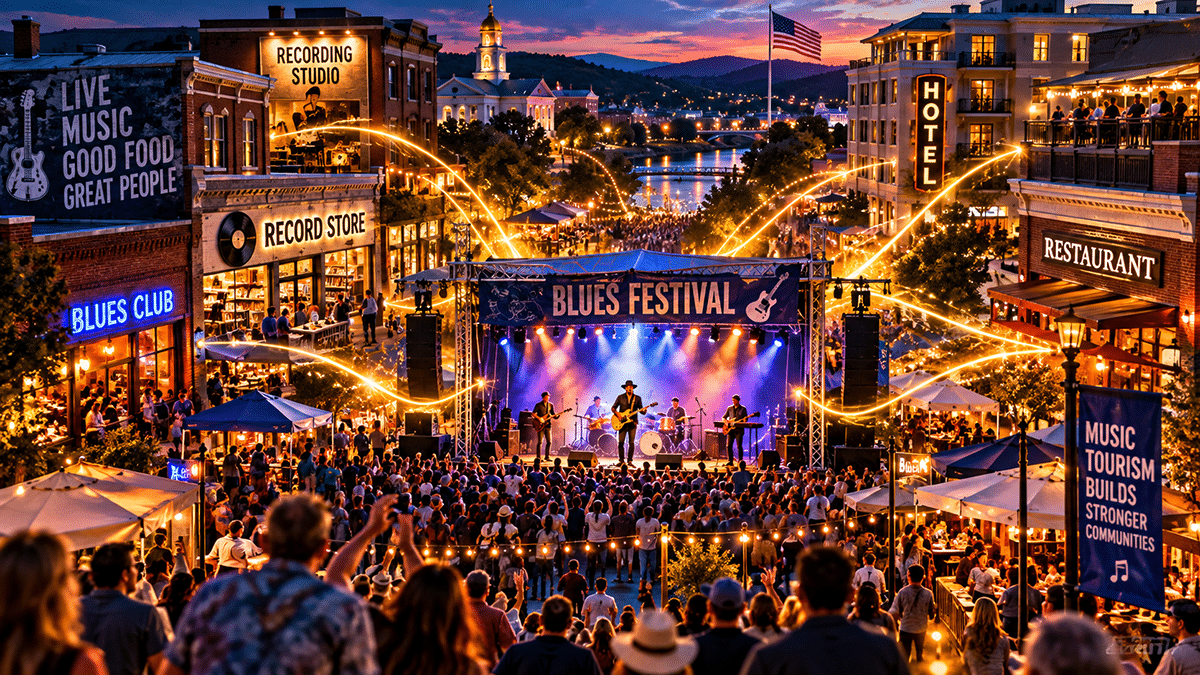
Tourism Boards Need Musicians, Whether They Know It Yet or Not
Most independent musicians have probably never scheduled a meeting with their local destination marketing organization. That may need to change.
Cities, counties, and states already spend money convincing people to visit. They produce videos, websites, calendars, advertising campaigns, travel guides, convention materials, social media, itineraries, and partnerships with hotels, restaurants, attractions, and event organizers. Music has always appeared in some of that promotion, but the new federal policy gives tourism organizations additional reason to think systematically about music-related destinations and events.
Artists should not approach these organizations asking, “Can you promote my band?”
That sounds like somebody asking for free advertising.
A much stronger conversation begins with, “We have evidence that people travel here for this music, and we would like to help build a repeatable visitor experience around it.”
Now you are talking their language.
An artist or local organization can begin documenting where ticket buyers come from, how far fans travel, which events generate overnight stays, what other businesses visitors use, and whether certain weekends consistently attract people from outside the region. None of this requires invasive surveillance. Fans can voluntarily provide ZIP codes, join an email list, answer simple surveys, or participate in membership and reward programs with clear consent.
That information becomes enormously powerful when talking to tourism officials.
Instead of claiming that your scene is important because everybody you know says so, you can show that 28 percent of attendees at a particular event came from outside the county, that a meaningful share stayed overnight, that merchandise sales rose when out-of-state attendance increased, or that a series of performances consistently draws visitors from three surrounding states.
Data changes the conversation from cultural pleading to economic partnership.
The Fan Relationship Must Belong to the Artist
This is where the Making a Scene philosophy becomes central.
Music tourism will not build an independent music middle class if artists remain anonymous suppliers inside somebody else’s customer journey.
A fan discovers an event through a tourism campaign, buys through a ticketing platform, books through a hotel website, communicates through a social network, buys food from a restaurant, streams the artist through another platform, and leaves town. If every meaningful piece of data generated by that weekend belongs to somebody except the artist, tourism may become economically larger while the musician remains exactly where the musician started.
That is unacceptable business design.
The goal should be permission-based direct relationships.
The artist does not need everybody’s private information. What the artist needs is a voluntary pathway that allows the fan to say, “Yes, I want to stay connected.”
That might happen through a QR code at the merchandise table offering a free live track. It could happen through a membership program, an NFC-enabled Smart Media product, a direct ticket purchase, a contest, a downloadable local music guide, a loyalty program, a post-show photo, or access to exclusive video from the weekend.
The gift matters less than the architecture.
The fan should clearly understand what information is being collected and why. The artist should receive consent to communicate. The information should feed an artist-controlled customer system rather than disappearing into a temporary promotional platform. The artist should then use that relationship respectfully rather than treating the email address like permission to send seventeen messages before breakfast.
This is how a weekend visitor becomes a long-term fan.
That person may buy another ticket next year. They may purchase a record. They may join a membership. They may support crowdfunding. They may buy a limited Smart Media release. They may bring friends next time. They may travel again.
Tourism brought the fan into the room.
Ownership of the relationship keeps the economic value moving after the room empties.
AI Can Help Small Scenes Compete With Big Marketing Departments
The American Music Tourism Act arrives at an interesting technological moment because independent artists now have access to marketing capabilities that once required an agency.
Artificial intelligence will not create an authentic music scene where none exists, and God help us if somebody asks a chatbot to invent “a quirky historic blues district” around three chain restaurants and a parking garage. AI is useful after the genuine cultural product already exists.
A small music organization can use AI-assisted tools to research regional visitor patterns, draft tourism itineraries, translate promotional information for international visitors, analyze ticket and fan data, create different versions of campaign copy, organize photographs, generate advertising concepts, prepare partnership proposals, and identify groups of fans most likely to travel for particular experiences.
For the individual artist, AI can help make direct fan communication practical at a scale previously difficult for a one-person operation. A musician can analyze which fans attend multiple shows, determine which geographic clusters contain enough supporters to justify a regional event, prepare personalized follow-up campaigns, organize merchandise demand, and compare the financial results of different weekend packages.
The important word remains “assist.”
The artist still needs judgment, permission, accurate information, and an actual human relationship with the audience. Feeding every scrap of fan data into whatever AI service happens to offer a free trial on Tuesday is not a data strategy. It is how musicians eventually discover that “artificial intelligence” was sometimes short for “we donated our customer list to somebody else’s business model.”
Used correctly, AI can allow a small independent operation to behave with much more sophistication while keeping strategy under artist control.
That is exactly the kind of leverage independent music needs.
Smart Media Can Connect the Tourist Experience to the Artist
Physical music products can play a particularly interesting role in tourism because travelers already like souvenirs. The independent music business has spent years treating souvenirs as simple merchandise when they can become something much more valuable.
Imagine a fan visits a regional festival and purchases a limited physical product containing an NFC chip or QR connection. Tapping it opens a digital experience containing music, live recordings, videos, photographs, local music history, future event offers, membership opportunities, and artist updates. The physical object becomes both a souvenir of the trip and an ongoing connection to the artist.
That turns a one-time tourist purchase into a relationship.
The artist could update the experience later with a new live track, announce next year’s festival, provide early ticket access, offer merchandise, or reward repeat visitors. With proper consent, the fan relationship can remain controlled by the artist rather than belonging exclusively to a social network or marketplace.
There is a larger idea hiding here. Music tourism naturally combines physical places with digital relationships. A fan visits somewhere because the location matters, but the connection does not have to end when the fan leaves.
The independent artist who understands that bridge can generate value long after checkout time.
Web3 Has a Useful Role When It Stops Trying to Be a Casino
Web3 technology may also have a practical place in music tourism, although the useful version looks considerably less like the speculative circus that once dominated crypto headlines.
Portable digital credentials could allow fans to prove that they attended certain shows, visited music destinations, purchased particular products, or earned status inside an artist community without locking every interaction into one centralized platform. A fan who attends three annual festivals might receive special access the fourth year. A supporter who visits several participating venues could unlock a regional reward. A limited physical music product could carry a verifiable digital entitlement to content or future experiences.
The point is not to force somebody’s grandmother to buy Ethereum before she can enter a blues club.
The point is portability, ownership, verification, and direct relationships.
Blockchain technology becomes useful when it disappears underneath a simple fan experience. Nobody should need to understand cryptographic keys to receive backstage video after tapping a card. The artist should not need to become a commodities trader to reward a loyal fan. If the technology makes ownership and portability easier while keeping the experience simple, it has value. If it introduces eight new passwords and a token named after a cartoon ferret, perhaps we can leave that particular revolution on the loading dock.
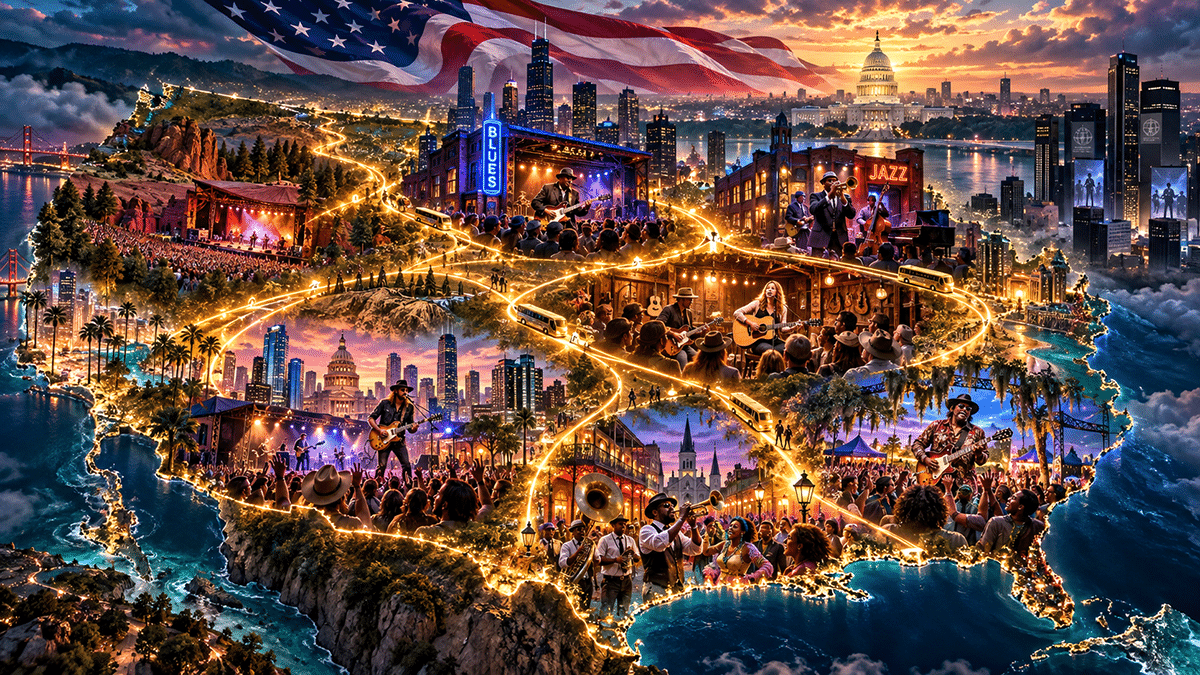
The Biggest Opportunity May Be Collaboration
Independent musicians are trained by the music business to compete for scarce attention. Tourism works better when people collaborate.
One artist rarely creates a destination by themselves. A scene can.
Imagine a regional weekend built around ten artists rather than one. Several venues coordinate programming. A studio hosts an afternoon event. A museum contributes local history. Restaurants offer packages. A hotel promotes the weekend. Artists cross-promote one another. A record store hosts signings. A local organization maintains the visitor guide. Participating musicians collect fan relationships through clear opt-in opportunities rather than relying entirely on centralized ticketing data.
Now the community has something a tourism organization can actually market.
The resulting economy can support many forms of artist revenue at once. Performance fees become only the beginning. There are merchandise sales, direct music purchases, VIP experiences, workshops, memberships, recordings, licensing opportunities, branded collaborations, sponsorships, limited physical products, and future ticket sales.
This is how the phrase “music industry middle class” moves from philosophy into economic structure.
Middle classes are rarely built around one gigantic payday. They are built around many dependable transactions flowing through businesses people actually own.
Artists Should Start Before Washington Finishes the Brochure
Nobody needs to wait for the Department of Commerce to complete its first report.
The smartest first move is to understand whether people already travel for your music. Look at ticket records you legally control. Ask audiences where they came from. Talk with venues. Pay attention to merchandise buyers from outside your region. Examine mailing-list geography. Notice whether certain performances bring people who stay overnight.
Then look outward.
Identify the tourism organization serving your city, county, or state. Understand how it currently markets local culture. Find the hotels, restaurants, museums, studios, venues, music stores, record shops, historical organizations, transportation providers, and festivals already participating in the visitor economy.
The opportunity is to build something that makes commercial sense for everybody without surrendering the artist’s relationship with the fan.
That could begin very small. One venue, one hotel, three artists, and one weekend may be enough to test the idea. Measure what happens. Learn where visitors came from. Learn what they bought. Learn what converted them into repeat customers.
Then improve it.
This is far healthier than launching a grand “Music Tourism Innovation District” with forty-seven sponsors, a ribbon-cutting ceremony, and absolutely nobody buying a ticket.
Independent music does not need more ceremonial infrastructure. It needs functioning businesses.
The Real Fight Begins After Recognition
The American Music Tourism Act deserves attention because it places something into federal policy that musicians have understood intuitively for generations: music moves people both emotionally and geographically.
President Trump signing S. 195 on October 9, 2026, does not suddenly create a golden age for independent artists. It does not solve streaming economics. It does not repair consolidation in live entertainment. It does not guarantee fair artist compensation. It does not create direct federal grants for working musicians.
What it does is give music a stronger formal position inside America’s tourism strategy.
That creates leverage.
Independent artists, venues, studios, festivals, and music communities now have stronger grounds to approach tourism officials and say that music is not a decorative extra added to a destination after somebody chooses the hotel photography. Music can be the reason the visitor comes in the first place.
The challenge is making sure artists participate in the economy they create.
If the future of music tourism becomes nothing more than giant entertainment corporations working with giant travel corporations to sell giant destination packages around giant artists, independent music will once again have supplied cultural value while somebody farther up the food chain collects the recurring revenue.
There is another possibility.
A blues community in Georgia can build a destination around its own culture. A Detroit jazz organization can connect visitors directly with working musicians. A small recording studio can turn its knowledge into an educational experience. A songwriter community can build weekends around workshops, performances, local history, and direct fan relationships. Regional festivals can collaborate rather than operate as isolated events. Artists can use QR codes, NFC products, memberships, direct sales, email, fan rewards, and carefully applied AI to turn visiting audiences into communities they can reach again.
In that version of music tourism, the artist is not merely the entertainment.
The artist is part of the destination, part of the business, and part of the economic infrastructure.
That is the opportunity hidden inside this new law. Washington has finally put music tourism on the federal map. The next job belongs to artists, venues, studios, local organizers, and independent music communities: make sure that when the tourists arrive, the money does not simply travel through the music scene.
Make some of it stay with the people who created the reason for the trip.
 |  Spotify |  Deezer |  Breaker |
 Pocket Cast |  Radio Public |  Stitcher |  TuneIn |
 IHeart Radio |  Mixcloud |  PlayerFM |  Amazon |
 Jiosaavn |  Gaana |  Vurbl |  Audius |
 Reason.Fm | |||
Find our Podcasts on these outlets