
The Music Industry Is Finally Connecting Songs to Recordings





Making a Scene Presents – The Music Industry Is Finally Connecting Songs to Recordings. Will Independent Musicians Get Their Missing Money?
Listen to the Podcast Discussion
Luminate’s new publishing intelligence connects songwriter information to recording performance, opening the door to better royalty tracking, smarter licensing, and more valuable music catalogs. But as music data becomes a business of its own, independent artists face an uncomfortable question: Who should control the information that determines how their music earns money?
The Music Industry Has a Data Problem, and Songwriters Have Been Paying for It
Imagine spending six months writing, recording, and releasing an album. You pay the musicians, book the studio, hire someone to master the recordings, and spend whatever is left promoting the release. Your distributor sends the music to streaming services, and before long, those little numbers on your artist dashboard begin moving. You might not be buying a vacation home with the proceeds, but at least people are listening, and the songs you worked so hard to create are finally reaching an audience.
Now imagine discovering that the company tracking those recordings knows exactly how many times they have been played, but the organizations responsible for collecting some of your songwriting royalties cannot reliably connect those recordings to the compositions you wrote. One database knows your recording exists, another knows who wrote the song, and somewhere between those two systems is a potentially valuable financial relationship that nobody has properly documented. If that connection is missing or incorrect in a royalty collection system, money that should be associated with the composition may be delayed, misdirected, or left waiting for someone to identify the proper rights holders.
This is one of the music industry’s most persistent administrative problems, and it has consequences far beyond the annoyance of dealing with another confusing online account. A recording and the musical composition behind it are separate copyrighted works, yet the financial systems that monitor them have often developed independently. Record companies and distributors built sophisticated systems to track recordings, while publishers, performing rights organizations, and mechanical licensing organizations maintained their own systems for identifying songs and songwriters. The information overlaps, but the connections between those systems are not always complete or consistent.
On November 18, 2026, Luminate introduced a publishing data capability within its CONNECT music analytics platform that addresses an important part of this problem. The service brings songwriter and musical work information together with recording-level streaming and sales activity, allowing professional users to examine how different recordings of the same composition perform in the marketplace. It draws on information from organizations including CISAC and The Mechanical Licensing Collective, supplemented by Luminate’s own matching technology and existing recording databases.
For music publishers, record companies, catalog investors, and licensing professionals, this represents a potentially valuable improvement in how musical assets can be researched and evaluated. For independent musicians, however, the development raises a larger question about the future of music ownership and the growing commercial value of information. If the industry is finally developing better ways to connect recordings to the compositions that make them possible, will the people who wrote those songs benefit directly, or will they find themselves paying another company to understand what is happening to their own music?
One Song, Two Copyrights, and a Remarkable Amount of Confusion
Most working musicians understand that writing a song and recording a song are different creative activities, even if they do both during the same afternoon in a home studio. Copyright law generally treats the resulting composition and sound recording as separate works, each with its own ownership, licensing arrangements, and revenue opportunities. The composition represents the underlying melody, music, and lyrics, while the sound recording represents a particular captured performance. A songwriter can create a composition that exists independently of any recording, and that same composition can eventually be performed and recorded by dozens of different artists.
This distinction is particularly important for independent musicians because an artist who writes and records original material may control two separate assets. The artist may own the copyright in the composition and also own the master recording, provided those rights have not been transferred or otherwise limited by agreements. Each asset can generate different types of income, and the business arrangements governing those payments are not necessarily connected. The recording might generate revenue through distribution and master licensing, while the composition can generate publishing income through mechanical royalties, public performances, synchronization licenses, and other eligible uses.
Consider a hypothetical blues songwriter who records an original composition called “Midnight on the Highway.” The song receives a modest release, earns some streaming income, and becomes part of the artist’s regular live show. Five years later, a country singer records a cover, and another artist eventually records an instrumental jazz interpretation. A regional blues band might also release a live performance of the song, creating yet another recording with its own sound, audience, and commercial history.
Although these recordings involve different performers and potentially different master owners, they can all be connected to the same underlying composition, assuming no changes create a separately recognized derivative work. The original songwriter may be entitled to publishing royalties arising from qualifying uses of those recordings, even though the songwriter has no ownership interest in the new masters. The master owners receive income associated with their particular recordings, while the underlying composition continues to have its own rights and commercial life. This arrangement allows a songwriter’s work to remain economically relevant long after the original recording has faded from public attention.
The difficulty comes when the systems responsible for identifying and paying the different rights holders do not recognize those relationships consistently. One service might list the original recording under the songwriter’s stage name, while another identifies the composition using a legal name or an earlier publishing affiliation. A cover recording may contain an abbreviated title, incomplete songwriter credits, or incorrect metadata supplied during distribution. None of those differences necessarily changes who legally owns the composition, but they can make the process of matching recordings to works considerably more difficult.
The music business has spent decades creating ways to identify individual recordings and compositions, yet those identification systems have not eliminated the need for accurate information and ongoing maintenance. As the number of releases and digital services has expanded, the volume of information that must be reconciled has become enormous. For independent artists who lack dedicated rights administrators, the responsibility for identifying and correcting discrepancies often falls on the same person who is writing the songs, booking the gigs, producing the recordings, and wondering why the club has not paid for last Saturday’s show.
The Two Identification Codes That Help Connect the Money
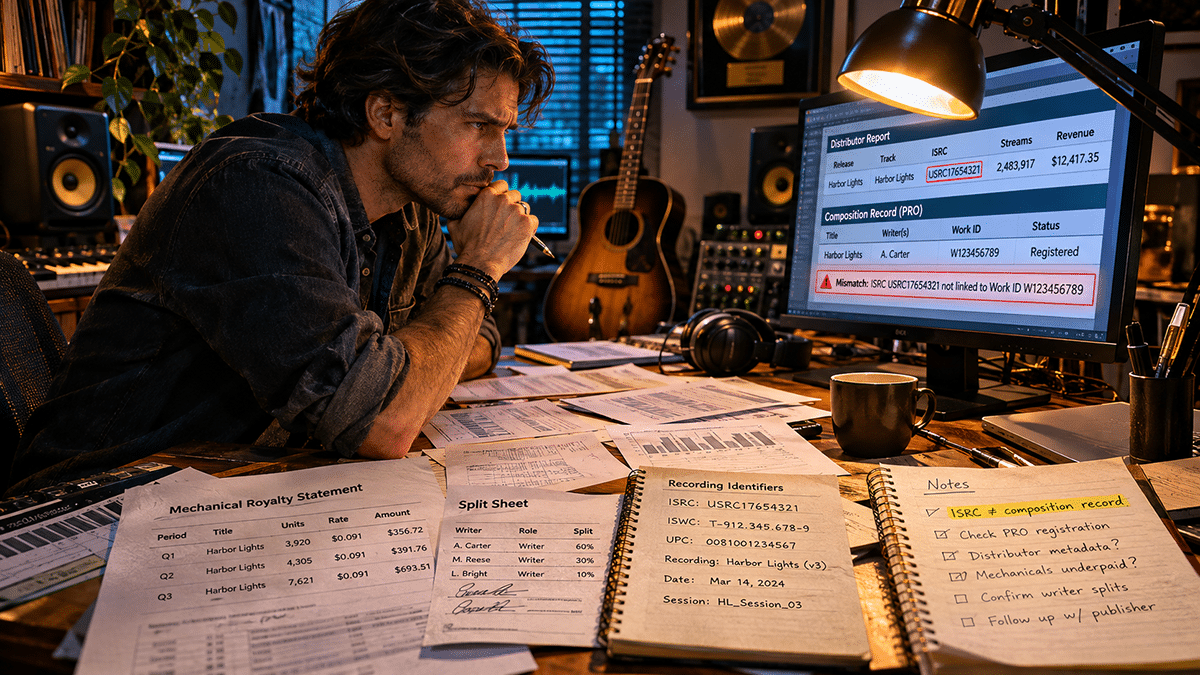
At the center of this problem are two industry identifiers that every independent songwriter should understand. The first is the International Standard Recording Code, commonly called the ISRC, which identifies a specific sound recording or music video recording. The second is the International Standard Musical Work Code, or ISWC, which identifies the underlying musical composition. These codes are designed for different purposes, but together they provide a way to associate a particular recorded performance with the composition being performed.
The International ISRC Registration Authority oversees the international recording identification system. In ordinary distribution workflows, an ISRC helps distinguish one recording from another and allows industry participants to exchange information about that recording. A new studio version, a separate live recording, or a different recorded performance may require its own identifier, even when the title and underlying composition remain the same. The identifier is not proof of copyright ownership, but it provides a standardized reference that can remain associated with the recording across distribution and reporting systems.
An ISWC performs a similar identification function for the composition rather than the recording. The international musical work identifier system is administered through CISAC, which represents authors’ societies around the world. A composition generally retains its musical work identity as it appears in different recordings, although arrangements, adaptations, and other changes may introduce additional rights and registration considerations. The relationship between an ISWC and multiple ISRCs can therefore be particularly useful when analyzing a composition that has been recorded by several different performers.
Returning to our imaginary songwriter, the original studio recording of “Midnight on the Highway” would have an ISRC associated with that particular master. The country cover, jazz recording, and live performance would ordinarily have separate recording identifiers. If all four are recordings of the same registered musical work, they can be associated with the composition’s ISWC, allowing someone researching the song to understand that these separate commercial recordings share an underlying creative work.
There is also an Interested Parties Information identifier, commonly called an IPI, that helps identify songwriters, composers, publishers, and other interested parties in rights-management systems. An artist who maintains accurate recording identifiers, composition identifiers, creator identifiers, and publishing information has a much stronger foundation for managing their catalog. These identifiers do not replace contracts or registration records, but they help different organizations identify the same people and works without depending entirely on names and titles, which can vary considerably.
Unfortunately, these identifiers do not always arrive at the same time or travel together through every system. An independent musician may receive an ISRC when preparing a recording for distribution, while the composition receives its ISWC through a separate registration process. Some organizations may recognize the songwriter’s IPI, while others display a different creator reference or use the artist’s stage name. When these details are incomplete, mismatched, or absent, the relationship between a recording and its composition can become difficult to identify even when the actual ownership is perfectly clear.
This is precisely the kind of information problem Luminate is attempting to address, and it explains why the announcement matters beyond the technical community responsible for music databases. When a composition can be reliably associated with the recordings that embody it, publishers and other rights holders gain a clearer picture of the composition’s commercial activity. That information can help them investigate possible registration gaps, understand catalog performance, evaluate licensing opportunities, and make better decisions about how musical works are administered.
What Luminate CONNECT Brings to the Table
Luminate has long been associated with music consumption measurement and the collection of industry data used for charts, analytics, and commercial research. Its CONNECT platform provides professional users with information about artists, recordings, and marketplace performance. The new publishing data capability adds musical works as another important way to organize and examine this activity, moving beyond the question of how an individual recording is performing to consider how the underlying composition is performing across different recordings.
The company’s Work Dashboards are designed to bring together composition information, songwriter credits, associated recordings, and measurable listening and sales activity. Instead of examining each recording independently, professional customers can investigate the commercial reach of a musical work through the recordings connected to it. This can be particularly useful for publishers representing compositions that have accumulated cover versions, remixes, live performances, and recordings by multiple artists over time.
Luminate’s data relationships reportedly draw on partnerships with CISAC and The Mechanical Licensing Collective, along with its own databases and matching processes. These sources provide different pieces of a complicated puzzle. CISAC’s identification infrastructure helps establish relationships involving musical works and their creators, while The MLC maintains extensive information about musical works and their relationships with recordings as part of its United States mechanical licensing responsibilities. Luminate adds recording consumption information and software designed to connect these different data elements into a commercially useful research environment.
For a publisher managing thousands of compositions, this kind of integration could eliminate considerable manual research. Rather than searching for individual recordings, checking their identifiers, and attempting to reconstruct the broader performance of a composition, the publisher can begin with the musical work and examine the recordings associated with it. The resulting information can help identify where compositions are attracting attention and whether particular recordings deserve further administrative review.
The service is also relevant to businesses that evaluate music catalogs for potential purchase or administration. A composition may have significant commercial activity spread across recordings controlled by several different companies, making its overall performance difficult to understand from a single master’s streaming history. By connecting the recordings to the underlying composition, Luminate gives professional users another way to examine how a musical work participates in the marketplace.
However, the company is not offering a universal royalty accounting system, and that distinction deserves attention. Streaming counts and sales activity do not automatically reveal the amount of publishing income owed to a particular writer. Different licensing arrangements, geographic territories, royalty categories, ownership shares, and collection systems determine how money is calculated and distributed. The new information may help identify commercial activity worth investigating, but it does not automatically establish that any particular songwriter has been underpaid or that a specific amount of money is waiting to be recovered.
There is also the matter of cost. The publishing data capability is available as an additional commercial offering rather than a universally available free service for independent creators. While organizations managing large catalogs may be able to justify paying for that intelligence, individual songwriters will need to evaluate whether the information offers sufficient practical value compared with the free and lower-cost tools already available. The development is important, but independent musicians should not confuse an impressive professional analytics product with an essential subscription that every songwriter must purchase.

Matching the Data Is Not the Same as Proving Ownership
One of the most interesting aspects of Luminate’s approach is its use of matching technology to evaluate relationships between musical works and recordings. In a perfect world, every release would arrive with complete and correct information, all songwriters would be properly identified, and every interested organization would exchange accurate updates. Unfortunately, the music industry operates in the world we have, where names are misspelled, titles are abbreviated, rights change hands, and some older recording catalogs appear to have been documented by people who considered filing cabinets an unnecessary luxury.
A matching system must therefore do more than compare two identical numbers. It may need to examine song titles, creator names, recording metadata, existing identifiers, and the reliability of information sources to determine whether a particular recording belongs to a specific musical work. This becomes increasingly complicated when multiple recordings share a common title or when compositions have been adapted, translated, or performed under alternate names.
Luminate uses confidence scoring to communicate the strength of its recording-to-composition relationships. According to the company’s published support information, its system evaluates multiple factors and applies a threshold when deciding which relationships to display. This is an important safeguard because incorrectly connecting a recording to a composition can create confusion for publishers and rights administrators, particularly when the resulting information is used to investigate income or support business decisions.
The scoring system also introduces limitations that users must understand. If a legitimate relationship does not meet the platform’s threshold, it may not appear in the results even though the recording and composition are genuinely connected. Conversely, a confident match does not automatically establish that every ownership share, publisher relationship, or licensing authority is correct. The software is evaluating evidence about a connection between works, not conducting a legal proceeding to determine who owns every relevant right.
Consider a publisher who discovers that a recording is missing from a composition dashboard. That absence might indicate incomplete registration information, but it could also reflect a title variation, missing songwriter data, or a relationship that the matching system has not yet confidently established. The missing entry creates a reason to investigate rather than proof that the recording is unlicensed or that royalties have disappeared.
The same caution applies when a match is present. A correctly identified composition can still have outdated publishing information, disputed splits, or contracts that affect the rights available for licensing. The relationship between an ISRC and an ISWC establishes something useful about the music, but it does not replace the original agreements governing the composition and recording.
This distinction matters because the music business increasingly relies on automated systems to make decisions that have financial consequences. Better software can help identify potential problems, reduce repetitive administrative work, and organize evidence, but it should not create false confidence about matters that remain uncertain. The strongest approach combines reliable identifiers, transparent evidence, human review, and access to the underlying registration and contractual records.
The Mechanical Licensing Collective Is Already Working on the Problem
Luminate’s announcement becomes more significant when considered alongside the work of The Mechanical Licensing Collective, commonly known as The MLC. Created under the United States Music Modernization Act, The MLC administers blanket mechanical licensing for eligible interactive streaming and digital download activity in the United States. Its responsibilities include receiving usage information, identifying the compositions associated with recordings, determining the appropriate rights holders, and distributing the mechanical royalties within its statutory responsibilities.
The organization operates a public musical works database and provides tools that help songwriters, publishers, and administrators identify missing information. Its official website explains the registration and matching process, while its available search and member tools allow users to examine musical work records and investigate recording relationships. These services are especially important for independent musicians because they offer a practical route to addressing certain problems without immediately purchasing a commercial intelligence subscription.
The distinction between The MLC and Luminate is important. The MLC performs a statutory licensing and royalty administration function, while Luminate provides commercial research and analytics. A songwriter whose composition is missing from a relevant MLC relationship should investigate the issue through the registration and matching processes responsible for that information. Purchasing access to a separate analytics platform does not automatically correct the underlying record or authorize a royalty payment.
The MLC also does not collect every royalty a songwriter might earn. Its United States mechanical licensing responsibilities are distinct from the public-performance royalties handled by performing rights organizations and from payments associated with master recordings. A musician who registers a composition with The MLC has not necessarily completed every registration required to collect all forms of publishing income, particularly when international uses and other licensing categories are involved.
The practical lesson is that independent artists need to understand which organizations are responsible for the different rights associated with their music. A distributor handles particular recording-related activities, a performing rights organization administers certain public-performance rights, and a mechanical licensing organization addresses a different category of composition income. Publishing administrators may provide additional services, but their responsibilities depend on the agreements involved.
Better connections between these systems could improve the ability to identify discrepancies and reduce the amount of money associated with incomplete or unmatched information. Yet the value of that improvement depends on the quality of the underlying registrations and the ability of legitimate rights holders to correct errors. For working musicians, accurate registration remains the foundation of the process, regardless of how advanced the surrounding analytics become.
Where the Money Can Actually Get Lost
The phrase missing royalties is powerful because it immediately suggests money sitting somewhere with an artist’s name attached to it. The reality is more complicated, and responsible reporting requires distinguishing genuinely unpaid royalties from ordinary differences in reporting and payment systems. When a recording is streamed, the activity may generate payments involving both the master recording and the underlying musical composition, but those payments do not necessarily follow the same route or arrive at the same time.
Master-related revenue generally flows according to arrangements between the streaming service, the recording rights holder, and any distributor or label involved. Composition-related income follows separate licensing and collection arrangements, potentially involving mechanical rights, public-performance rights, and different organizations depending on the territory and type of use. An independent musician who owns both the master and composition may ultimately benefit from several revenue streams, but those payments are calculated and administered differently.
Suppose our hypothetical blues songwriter sees strong streaming activity on a distributor statement but relatively little publishing income during the same reporting period. The difference might indicate a problem worth investigating, but it does not automatically prove that royalties have gone missing. Publishing payments can arrive on different schedules, and their amounts depend on rates, territories, licensing rules, songwriter shares, administration arrangements, and other factors that are not visible in the distributor’s master revenue report.
A more useful investigation begins by confirming that the composition is properly registered and associated with the relevant recordings in the appropriate collection systems. The songwriter can then examine available usage and royalty reports, identify any unexplained gaps, and contact the organization responsible for the information. Where a legitimate recording-to-composition relationship is missing, correcting that information may help resolve unmatched usage or improve future royalty administration.
The benefit of better composition intelligence is that it can make these investigations more focused. Instead of examining an entire catalog without knowing where the problem might be, a rights holder can identify particular recordings or compositions that deserve attention. This can save administrative time and potentially support the recovery of payments where an actual entitlement and processing problem are established.
For independent musicians, the opportunity is therefore broader than the possibility of discovering an unexpected royalty check. Better information can reduce administrative costs, support more reliable registration, and make it easier to evaluate whether a publishing administrator is providing sufficient value. It can also help musicians understand which compositions are generating meaningful commercial activity, allowing them to direct business attention toward songs that may have more potential than their original recordings suggest.
The Cover Song You Never Knew Existed
One of the most interesting possibilities created by improved composition-level intelligence is the ability to understand how a song performs through recordings made by other artists. Songwriters often think about their catalog through the recordings they personally released, particularly when they also perform and produce their own music. Yet the underlying composition can continue generating activity through covers, arrangements, and performances that have little direct connection to the original artist’s recording business.
Imagine an independent Americana songwriter who releases an album in the United States and eventually moves on to other projects. Years later, a folk group in Scandinavia records one of the songs, and a blues artist in Japan releases a separate interpretation. The original songwriter may never meet either performer or even become aware of the recordings, but the compositions remain connected to the songwriter’s publishing interests under the applicable rights arrangements.
If those recordings are properly licensed and the relevant collection systems recognize the compositions, qualifying activity may produce publishing income even without the original songwriter’s direct involvement. When relationships are missing or inaccurate, the songwriter or publisher may need to investigate whether the relevant information has been properly recorded. A system that connects commercial activity across multiple versions can make it easier to identify recordings worth examining.
The commercial opportunity extends beyond royalty collection. A composition that continues attracting new recordings may have broader appeal than its original streaming performance indicates, creating reasons to investigate licensing prospects, international publishing administration, or other uses of the work. A publisher might discover that a song has an audience in territories where the original artist never promoted it, suggesting an opportunity to improve administration or explore new partnerships.
However, the existence of a cover recording is not evidence of infringement or wrongdoing. Many cover recordings are released through lawful licensing arrangements, and the permissions required depend on the nature of the use and the territory involved. The goal of improved matching should be to understand and administer the composition accurately rather than treating every unfamiliar recording as a potential legal dispute.
For musicians who write songs that other people might perform, the larger lesson is that the original master is only one part of the composition’s commercial history. A song can have a life of its own, reaching audiences through recordings that its creator does not control. Recognizing that broader activity can help independent songwriters think more strategically about their publishing rights and the long-term value of the material they create.
Music Catalog Investors Understand Something Artists Often Overlook
The financial industry has shown growing interest in music copyrights because established catalogs can generate income from continuing commercial uses. Publishers, record companies, investment firms, and specialized buyers evaluate catalogs based on their rights, historical revenue, commercial activity, and expectations about future performance. Their interest is not simply whether a song is memorable or whether an album received good reviews, but whether the underlying assets can be identified, documented, and managed reliably.
A recording catalog and a publishing catalog can represent different financial opportunities. A company purchasing masters may examine the performance of particular recordings, their distribution arrangements, and their licensing potential. A company acquiring publishing interests must understand the compositions, songwriter ownership, existing administration agreements, and income generated by the various uses of those musical works.
When a composition has been recorded by multiple performers, examining only the original master can provide an incomplete picture of its reach. A publisher may have an interest in several commercially active recordings of the same work, even though those recordings belong to different master owners. Connecting the recording activity to the composition can help reveal patterns that would otherwise require extensive research across separate datasets.
This is one reason a service such as Luminate CONNECT can be valuable to catalog investors. Its new publishing data allows users to investigate recordings associated with particular compositions and examine the activity connected to those relationships. The resulting information may support more efficient research and better-informed questions about a catalog’s commercial performance.
Nevertheless, streaming and sales activity are not the same as verified royalty income, and analytics cannot replace due diligence. Investors still need reliable accounting statements, contracts, ownership records, information about royalty collection, and an understanding of restrictions affecting the rights being acquired. A catalog that appears commercially attractive may still contain problems involving disputed shares, incomplete registrations, or obligations that affect the income ultimately available to an owner.
For independent musicians, this should reinforce the value of maintaining professional records long before anyone expresses interest in purchasing or administering their music. An artist with documented ownership, accurate identifiers, organized registration confirmations, and reliable royalty histories is better prepared for negotiations than one whose business records are scattered among old emails and abandoned distribution accounts. Good documentation does not guarantee a higher catalog valuation, but it can reduce uncertainty and make it easier for potential partners to understand exactly what the artist controls.
The same principle applies even when selling a catalog is not part of the artist’s plans. Well-organized rights information can support licensing discussions, publishing administration decisions, financial planning, and collaboration agreements. A musician who understands the assets they own is in a stronger position to negotiate how those assets are used, regardless of whether the other party is a major publisher or a local filmmaker looking for music.
Synchronization Licensing Has Its Own Metadata Problem
The growing importance of accurate composition-to-recording information is particularly visible in synchronization licensing, where music is used in films, television programs, advertisements, games, and other visual productions. A music supervisor may discover a recording that fits a project perfectly, but identifying the recording is only the beginning of the clearance process. The production generally needs permission to use the relevant master recording and the underlying composition, with the necessary authorization depending on the rights involved and the proposed use.
This is where independent musicians can gain a practical advantage by keeping their rights information organized. An artist who owns both the master and composition, has properly documented that ownership, and can grant the necessary permissions may be able to respond efficiently to a licensing inquiry. When several writers, publishers, or master owners are involved, the clearance process becomes more complicated because the production must identify and obtain permission from the appropriate parties.
Imagine a music supervisor searching for a roots-rock song to accompany a television scene. Two recordings fit the project equally well, but one artist can immediately provide accurate writer information, master ownership documentation, and a clear licensing contact. The other recording has incomplete credits, an outdated publishing contact, and uncertainty about whether all collaborators agreed to the relevant rights. Under a tight production deadline, the difference in administrative clarity can influence which song is practical to license.
Better metadata does not automatically produce synchronization placements, but it can remove obstacles that might otherwise prevent an opportunity from moving forward. A reliable ISRC-to-ISWC relationship helps establish which composition is embodied in the recording, while accurate publishing information supports the identification of the parties who need to authorize a use. Those details become especially important when a composition has multiple versions or when a recording is controlled by a party other than the songwriter.
Independent artists can also improve their licensing readiness by maintaining high-quality production assets. Instrumental versions, clean mixes, alternate edits, and properly labeled masters can make a song more practical for certain productions. These assets should be supported by clear ownership information and an understanding of any samples, collaborations, or contractual restrictions that might affect licensing.
The connection between good metadata and income is therefore practical rather than mysterious. A music supervisor cannot license a recording simply because a database contains the correct identifiers, but accurate information can make it easier to identify the rights and move through the clearance process. In a business where opportunities can arrive unexpectedly and disappear quickly, reducing preventable administrative confusion has genuine commercial value.
Artificial Intelligence Is Making Music Metadata More Valuable
The relationship between compositions and recordings is also becoming more important as artificial intelligence changes the way large collections of music information can be examined. Music companies have long used software to compare titles, creators, identifiers, and other metadata, but increasingly sophisticated matching systems can evaluate more relationships and prioritize potential discrepancies for review. This creates opportunities to reduce the manual work involved in maintaining large catalogs, particularly when information arrives from organizations using different formats and naming conventions.
A useful AI-assisted rights system might compare an artist’s release catalog with available composition registrations and identify recordings that appear to lack corresponding work relationships. It could flag inconsistent songwriter names, missing identifiers, conflicting titles, or suspicious changes in ownership information. Rather than forcing a musician to search through several accounts and spreadsheets, the software could organize the available evidence and explain which records deserve closer examination.
The distinction between identifying a possible problem and proving a financial claim is essential. An automated system might discover that two recordings share a title and several creator names, but that information alone does not establish that they embody the same composition. Likewise, a missing relationship in a commercial database does not prove that royalties are owed or that a particular organization failed to distribute money properly.
AI can be particularly useful when it helps musicians understand complex administrative information in ordinary language. A rights management assistant could explain the difference between an ISRC and an ISWC, help an artist organize the information needed for registration, or identify which organization is responsible for a particular royalty category. These applications do not require the artist to understand database design or music industry data standards, making sophisticated rights management more accessible to people who would rather spend their time creating music.
However, these systems should preserve the evidence behind their conclusions and make uncertainty clear. The danger of a convincing AI interface is that it can turn incomplete information into an answer that sounds far more certain than the underlying records justify. When financial rights are involved, a system that confidently invents an ownership relationship can cause more trouble than one that simply admits it needs additional information.
Luminate’s matching technology illustrates both the promise and limitations of this approach. By organizing information from several sources and assigning confidence to recording relationships, the company can make complex music data more useful for professional research. The next important step for the broader industry is making similar administrative assistance affordable and accessible to independent creators without encouraging them to surrender control of their own catalogs.

The Industry Is Turning Music Information Into Another Product
Luminate’s announcement also reveals a broader commercial development that independent artists should be watching carefully. The music business has traditionally earned money through recordings, publishing, performances, licensing, and related services. Increasingly, the information generated by those activities has become a product in its own right, with companies selling analytics, catalog research, rights intelligence, and decision-making tools to professional customers.
There is nothing inherently unreasonable about charging for a service that organizes enormous amounts of information and makes it useful. Building reliable data infrastructure requires technology, staff, licensing arrangements, and ongoing maintenance. A publishing company managing thousands of compositions may be perfectly willing to pay for a service that reduces research time and helps its employees understand catalog activity more efficiently.
The uncomfortable part is the relationship between the creators who generate the underlying musical assets and the companies that turn information about those assets into valuable commercial intelligence. An independent songwriter may enter recording metadata through a distributor, register the composition with collection organizations, and provide ownership information to publishers or administrators. Other businesses may then combine portions of that information with commercial activity data and offer the resulting intelligence through paid platforms.
Professional analytics can provide genuine value beyond the information originally supplied by the artist, but the arrangement raises questions about access, control, and portability. Can the creator independently maintain accurate records of their work, or does important information become increasingly difficult to understand without purchasing additional services? Can artists export their own catalog data in useful formats, or must they remain dependent on the interface and pricing decisions of a particular provider?
These questions become more important as the music business adopts AI-powered systems capable of analyzing rights relationships on a larger scale. Companies with access to extensive datasets may develop increasingly powerful tools for identifying commercially valuable compositions, evaluating catalogs, and prioritizing licensing opportunities. Independent musicians who lack comparable information could find themselves negotiating with organizations that understand the commercial history of their own music better than they do.
The answer is not to reject commercial analytics or discourage companies from developing better technology. The more practical goal is to ensure that creators have reliable access to their own registration records, ownership information, identifiers, and business histories in formats they can maintain independently. Specialized services can add intelligence to those records without becoming the only place where the artist’s information remains useful.
The Importance of Open Standards and Portable Records
One of the strongest protections against dependence on a single company is the use of recognized music identification and data exchange standards. ISRCs, ISWCs, and creator identifiers make it possible for different organizations to refer to the same recordings, compositions, and interested parties. These identifiers are most valuable when artists preserve them in their own records and use them consistently across registration, distribution, and administrative systems.
Organizations such as DDEX have developed standards intended to improve the exchange of digital music information between industry participants. These standards provide structured methods for communicating information about releases, recordings, musical works, and rights-related activities. Although implementations vary and not every service supports every standard, the broader principle is important: music information becomes more useful when it can move between systems without losing its meaning.
For independent artists, portability should be considered a basic requirement when selecting business software. A musician should be able to maintain a usable record of compositions, recordings, identifiers, ownership information, and supporting documents without depending entirely on one provider’s private database. When moving to a different distributor or publishing administrator, the artist should retain the essential information needed to understand and manage the catalog.
This is especially important because businesses change. Distribution companies alter their pricing, platforms merge, subscription services disappear, and licensing arrangements evolve. An artist who relies exclusively on a provider’s dashboard may discover that years of useful business history are difficult to recover when the relationship ends.
Maintaining portable records does not mean every piece of information must be publicly available. Publishing contracts, financial statements, songwriter agreements, and personal information may require secure storage and controlled access. The objective is to preserve the artist’s ability to manage and share their information appropriately rather than forcing every business partner to operate inside a single proprietary platform.
A practical system should therefore separate the underlying artist-controlled records from optional services that enrich or analyze those records. An artist could use a commercial data provider to investigate catalog activity while keeping the original registrations, contracts, and ownership information in an independent source of truth. If the commercial relationship ends, the essential business records remain available and useful.
Where Web3 Can Help Without Creating Another Mess
The discussion of portable ownership information naturally raises questions about blockchain and Web3 technology. Supporters of decentralized systems have long argued that shared records and cryptographic verification could improve the management of music rights. The appeal is understandable in an industry where information must travel between many organizations and where ownership changes can create complicated administrative histories.
However, blockchain technology cannot automatically establish the legal truth of an ownership claim. If someone enters incorrect songwriting information into a decentralized registry, preserving that information permanently does not make it correct. A cryptographic record may help demonstrate when information was entered or whether a document has changed, but it cannot replace the contracts and legal evidence that determine the rights held by different parties.
More practical applications might involve preserving a verifiable history of agreements, registrations, and rights-related changes. An artist could maintain signed split agreements in secure storage and use cryptographic verification to help establish that a particular document existed in a specific form at a certain time. Authorized business partners could then examine the relevant evidence without requiring the artist to place confidential contract details on a public blockchain.
This approach could be valuable when combined with ordinary music industry identifiers and portable records. A composition could retain its ISWC, each recording could retain its ISRC, and the supporting ownership history could be maintained in a separate artist-controlled system. The technology would help preserve the integrity and history of the information rather than attempting to replace the existing legal framework.
For working musicians, the deciding factor should be whether a particular technology makes the business easier, more reliable, or less expensive to operate. A blockchain application that adds complicated wallets, transaction fees, and new administrative responsibilities without solving a real problem offers little practical benefit. A system that helps preserve trustworthy records, verify agreements, and reduce dependency on centralized services could eventually justify its place in an artist’s workflow.
The most useful direction for Web3 is therefore not to turn every song into a token simply because the technology exists. It is to develop practical ways for creators to retain control of their business records and demonstrate the history of their rights. That approach fits naturally with the growing importance of music metadata and avoids confusing technological novelty with actual economic value.
Why Independent Artists Need Their Own Source of Truth
The most important lesson from Luminate’s announcement is that independent musicians should not wait for an outside organization to assemble a complete picture of their business. Every artist who writes, records, distributes, and licenses music should maintain an organized record of the assets they create and the rights attached to them. That record should be independent of any single distributor, streaming service, publisher, or analytics company.
For each composition, the artist should document the title, writers, agreed shares, publishing relationships, relevant identifiers, and registration information. For each recording, the record should identify the master owner, ISRC, performers where relevant, release information, distributor, and underlying composition. Supporting documents such as split agreements, publishing contracts, recording agreements, and licensing permissions should be preserved in an organized and secure manner.
The relationship between compositions and recordings should be explicit rather than left for outside databases to reconstruct. If an artist releases a new recording of an existing song, the new master should be associated with the correct composition in the artist’s internal catalog. If another performer records the composition and that relationship is confirmed, the artist can preserve the information as part of the work’s broader commercial history.
A small catalog may be manageable with a carefully maintained spreadsheet and organized documents. A larger catalog involving multiple collaborators, publishers, and licensing arrangements may require specialized software, but the underlying business principle remains the same. The artist should be able to determine what they own, what they administer, where the works are registered, and which recordings are associated with each composition.
The MAS Fan Passport Artist Ecosystem is developed around this broader principle of artist-controlled business information. Its source-of-truth and data portability direction creates a natural foundation for future capabilities that could organize composition-to-recording relationships, support metadata auditing, and help independent musicians maintain reliable rights information. More advanced features such as automated ISRC-to-ISWC matching and external royalty-data reconciliation should be considered development opportunities rather than capabilities already available to artists.
The important architectural decision is that the artist’s own records remain the foundation of the system. Outside providers can contribute useful information when appropriate, but the musician should retain access to the underlying catalog, supporting evidence, and business history. This becomes especially relevant as the planned MAS Freedom desktop approach expands the emphasis on portable records, local control, and independent backup capabilities.
The goal is not to replace every publishing organization or create another closed system that musicians must depend on. It is to give independent artists a reliable business record that makes interacting with those organizations easier. Luminate’s new publishing intelligence demonstrates why better relationships between recordings and compositions are valuable, while artist-controlled systems can help ensure that creators preserve their own information regardless of which commercial services they choose to use.

What a Working Musician Can Do Right Now
Independent musicians do not need to purchase an expensive analytics subscription to begin improving the quality of their music information. A useful starting point is to choose one released composition and examine how it appears across the services responsible for distributing the recording and administering its rights. This is a manageable exercise that can reveal weaknesses in an artist’s existing workflow without turning catalog maintenance into a full-time occupation.
Begin by locating the recording’s ISRC and confirming the information associated with it through the distributor. Then examine the underlying composition registration, including the writer names, ownership shares, publisher information, and available musical work identifiers. The objective is to make sure the recording and composition are consistently identified and that the relevant rights information reflects the agreements actually governing the music.
If the composition falls within The MLC’s responsibilities, the artist can examine the available records and investigate whether the appropriate recording relationships have been established. A similar review may be useful with the artist’s performing rights organization and publishing administrator, depending on the rights and services involved. Differences between databases should be examined carefully because those systems do not necessarily collect identical information or administer the same royalty categories.
When a discrepancy appears, the artist should preserve the relevant documentation and contact the organization responsible for maintaining that information. A missing identifier, incorrect writer share, or questionable recording relationship may require different forms of correction. The important step is to investigate the underlying evidence before making a claim, particularly when other writers or rights holders could be affected.
Artists should also consider how these records are preserved for the future. Registration confirmations, split agreements, distribution records, licensing documents, and royalty statements should be stored in a secure, organized location with reliable backups. Keeping the information in a portable format reduces the risk of losing essential business history when changing distributors, administrators, or software providers.
This type of work may not create immediate new revenue, but it can prevent avoidable problems and make future opportunities easier to pursue. An artist with accurate records is better prepared to evaluate publishing statements, investigate unexpected recordings, respond to licensing inquiries, and negotiate business agreements. These advantages accumulate over time, particularly as the catalog grows and becomes more complicated.
The Commercial Value of Better Music Data Goes Beyond Royalties
The potential value of improved composition-to-recording matching extends into several areas of an independent musician’s business. More reliable rights information can help songwriters understand the commercial reach of their compositions, identify recording relationships that deserve further investigation, and make more informed decisions about publishing administration. It can also support the licensing process by making the ownership and registration history of a work easier to research.
For artists who control both their masters and compositions, good information may reduce the administrative work involved in presenting music to licensing professionals. A clearly documented catalog can help demonstrate which rights the artist controls and whether additional parties must approve a proposed use. This does not guarantee a synchronization placement, but it can make an artist easier to work with when a genuine opportunity appears.
Better catalog data can also influence how artists allocate their limited resources. If a songwriter discovers that a particular composition continues attracting activity through different recordings, the information may justify closer attention to its publishing administration or licensing prospects. If another composition has limited commercial activity, the artist may decide that additional promotion would be better directed elsewhere.
The financial benefit is not always additional revenue. Time saved on administrative research, reduced dependence on unnecessary services, and fewer preventable metadata errors can all affect the economics of a small music business. Independent musicians rarely have the resources to employ separate people for publishing administration, rights management, accounting, and licensing, so tools that reduce repetitive work can provide meaningful value.
This is where AI and open data standards could eventually produce some of their most useful benefits. An affordable artist-controlled system that identifies inconsistent information, organizes supporting records, and explains the appropriate correction process could reduce the gap between independent creators and larger organizations with professional administrative departments. The technology would not need to promise magical royalty recovery to become commercially worthwhile.
The Next Music Industry Divide May Be About Who Can Afford the Information
Luminate’s new publishing capability points toward a significant change in how music businesses evaluate creative assets. For years, the industry has invested heavily in understanding recordings, artists, albums, and consumer listening behavior. Connecting that activity to the underlying compositions gives publishers, investors, and other rights professionals another perspective on how music creates economic value.
The technology also demonstrates how information becomes more valuable when separate datasets can be connected. A recording identifier is useful by itself, and a composition identifier serves its own purpose, but the relationship between them can reveal commercial activity that neither record fully explains on its own. When those relationships are connected to reliable consumption information, the resulting intelligence can support better research, administration, and business decisions.
Large publishers and catalog owners are likely to find this information valuable because they manage enough music to justify specialized analytics investments. Independent artists may have similar questions about their own works but lack the budgets available to larger organizations. If access to integrated music intelligence remains concentrated among professional customers, the people who created the compositions could find themselves at an informational disadvantage when negotiating with companies that understand their catalogs in far greater detail.
That outcome is not inevitable, particularly as public databases, recognized identifiers, portable data standards, and affordable software continue to develop. Commercial analytics companies can provide specialized services while independent musicians maintain their own reliable catalogs and use accessible tools to investigate registration and royalty information. The important distinction is between paying for sophisticated additional intelligence and being forced to pay simply to understand the fundamental records associated with one’s own work.
Music creators should not have to choose between managing their rights accurately and retaining control of their business information. A healthy technology ecosystem would allow musicians to use several services without making any one of them indispensable. That approach would encourage competition, improve data quality, and give artists greater flexibility as their careers and business needs change.
The Real Value of a Song Is Bigger Than One Recording
For most of the recorded music industry’s history, commercial attention has centered on the recording. Record stores sold physical copies, radio programmers selected recorded performances, and digital services developed sophisticated systems for distributing and measuring individual tracks. The composition remained legally and financially important, but its commercial activity could be spread across multiple recordings and administered by organizations that did not share a complete view of the work.
Luminate’s expansion into publishing intelligence reflects a growing recognition that the composition deserves more attention as an identifiable commercial asset. By connecting musical works with the recordings that embody them, the industry can better examine the broader activity associated with songs rather than limiting analysis to individual masters. That can be useful for publishers, licensing professionals, catalog investors, and ultimately the songwriters whose creations support the entire system.
Independent musicians have a particular interest in this development because their compositions may continue generating opportunities long after the original recordings have completed their initial commercial lives. A song written for a local release might eventually be recorded by another artist, licensed for a production, or attract listeners in an unexpected territory. Those possibilities do not guarantee income, but they demonstrate why accurate rights information should be treated as part of a musician’s long-term business infrastructure.
The challenge is making sure the technology that reveals those relationships does not create another unnecessary dependency. A songwriter should be able to maintain accurate records, understand the rights associated with a composition, and investigate potential administrative problems without surrendering control of the underlying information. Commercial intelligence services can add value by organizing and analyzing data, but they should complement rather than replace the artist’s own records.
For working musicians, the most useful response is to take their metadata as seriously as their masters. Accurate identifiers, documented ownership, reliable registrations, organized contracts, and portable business records may never inspire the same excitement as a new guitar or studio compressor, but they protect the financial relationships that allow music to continue earning money over time. As AI and more advanced rights-intelligence systems develop, artists with clean, complete records will be better positioned to use those tools effectively.
Luminate has taken an important step toward connecting information that the music business has struggled to organize consistently. Whether that development ultimately benefits independent musicians will depend partly on how accessible similar tools become, how effectively rights organizations continue improving their data, and whether creators take responsibility for preserving accurate records of their own work. The industry has spent decades learning how to measure the popularity of recordings, and it now has an opportunity to improve its understanding of the compositions and creators behind them. For independent musicians building sustainable careers, that understanding is not simply another technical improvement; it is part of knowing what their work is worth, how it is being used, and how they can protect the business they are building.
 |  Spotify |  Deezer |  Breaker |
 Pocket Cast |  Radio Public |  Stitcher |  TuneIn |
 IHeart Radio |  Mixcloud |  PlayerFM |  Amazon |
 Jiosaavn |  Gaana |  Vurbl |  Audius |
 Reason.Fm | |||
Find our Podcasts on these outlets