The Indie Artist’s AI Content Calendar That Actually Leads Somewhere





Making a Scene Presents – The Indie Artist’s AI Content Calendar That Actually Leads Somewhere
Listen to the Podcast Discussion
Stop Feeding the Machine for Free
Most indie artists do not need more content.
That sounds wrong at first, because every platform tells artists the opposite. Instagram wants another reel. TikTok wants another clip. YouTube wants another short. Facebook wants another event post. Spotify wants another canvas, another artist pick, another profile update. The whole internet acts like your career will finally move if you can just post more, faster, louder, and with the right hook in the first three seconds.
But that is not a business plan. That is treadmill work.
The real problem is not that indie artists are lazy about content. Most working artists are already doing too much. They are writing songs, booking shows, loading gear, recording vocals, editing video, answering messages, chasing payments, shipping shirts, designing flyers, updating websites, pitching playlists, and trying to remember what city they are in next Friday. Then they are told they need to become full-time content creators on top of being full-time musicians.
That is how the modern artist gets tricked. The platforms turn every artist into a free media worker, and then rent the attention back to them.
So let us start with something better. The goal is not to post every day for 30 days. The goal is to build a 30-day path that moves people from rented attention into an artist-owned fan list. That list may be email. It may be SMS, if the fan clearly opts in. It may be a Fan Passport-style follow where the fan gives permission to stay connected. It may include QR scans at shows, signups at the merch table, or a simple form on the artist website. The point is the same. You are not chasing empty engagement. You are building a reachable fan base.
That is the difference between content and a content calendar that actually leads somewhere.
The Fan List Comes First
A working indie artist needs fans they can reach again.
That sounds basic, but it is the part the music business keeps trying to hide behind shiny numbers. A follower is not always a reachable fan. A stream is not always a relationship. A like is not a business asset. A comment feels good, but unless it leads to a fan taking a real step toward the artist, it can vanish in the feed by tomorrow morning.
A fan list is different. A fan list is a group of people who gave you permission to contact them. They said, in some form, “Yes, I want to hear from you.” That is powerful because it changes the relationship. You are no longer hoping an algorithm shows your post to the right people. You have a direct path back to the fan.
Email is still one of the strongest ways to do this. It may not feel as exciting as a viral video, but it is far more useful when you need to announce a show, sell a ticket, release a new song, launch a merch bundle, invite fans to a livestream, or reward the people who keep showing up. Tools like https://mailchimp.com let artists create signup forms and grow an audience through forms that can be shared, embedded on websites, or used with landing pages. Mailchimp also explains that signup forms can use single or double opt-in, depending on how the artist wants fans to confirm their subscription.
That matters because permission is the foundation. The artist should not scrape emails, steal contacts, or add people to a list because they once bought a ticket from a third-party platform unless the fan clearly agreed to receive artist updates. If you want a real fan relationship, you have to earn it honestly.
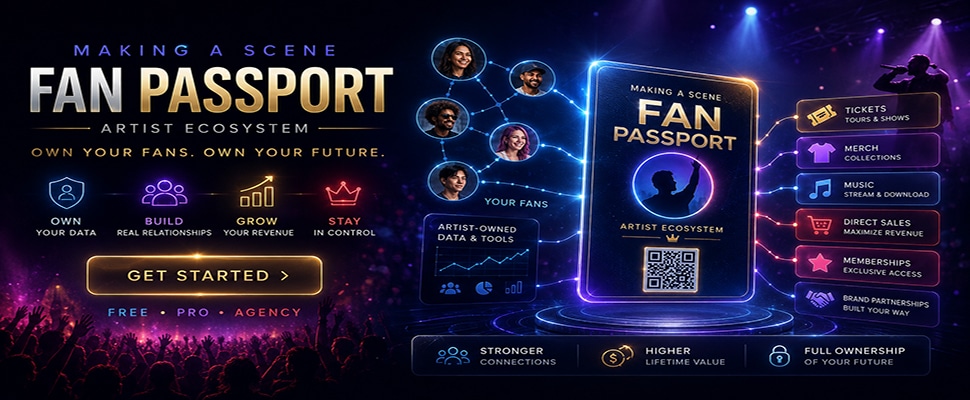
The Making a Scene Fan Passport OS fits this same idea. It treats fan capture as a permission-based relationship, not a trick. The artist can use social media, streaming, shows, QR codes, and direct offers as discovery doors, then invite the fan into the artist’s own world. Once a fan follows, scans, signs up, or claims a reward, the artist has a clearer path to build loyalty. The goal is not to trap fans. The goal is to respect them enough to give them a real reason to stay connected.
AI Is the Assistant, Not the Artist
AI can help build the calendar, but it should not become the voice of the artist.
That is the first rule.
A tool like https://chatgpt.com can help an artist turn scattered ideas into a real 30-day plan. It can help draft captions, rewrite emails, organize a release campaign, create different versions of a post for different platforms, and turn one long story into several useful pieces of content. OpenAI’s help center says ChatGPT is available at chatgpt.com, and artists can use it to start a conversation, ask for drafts, and refine ideas.
But AI does not know what it felt like when the room sang the last chorus. AI was not in the van when the tire blew out. AI did not write the bridge at 2 a.m. after the fight, the funeral, the breakup, the long drive, or the breakthrough. AI does not know why a certain lyric makes your fans cry. That part is yours.
Use AI to save time. Use AI to build structure. Use AI to get out of the blank-page panic. But do not let AI sand the human edges off your story. Fans do not want perfect brand language. They want to feel like the artist is a real person with something real to say.
A good prompt should give AI a business goal, not just a posting task. Do not ask, “Give me 30 posts for my music.” That will produce generic filler. Ask, “Build me a 30-day content calendar for a working indie artist where the main goal is growing an email list and Fan Passport-style fan list. Every post should lead toward email signup, QR scan, Fan Passport follow, ticket sales, merch, fan rewards, or direct support. The tone should be conversational, honest, and useful. Avoid empty engagement.”
That prompt gives AI a direction. More important, it tells AI what not to do. You are not looking for random questions like “What is your favorite song of mine?” unless that question leads somewhere. You are looking for posts that open a door.
Your Content Needs One Home Base
Before you build the 30-day calendar, you need one place to send fans.
This can be your website. It can be a landing page. It can be a page inside your Making a Scene Fan Passport OS setup. It can be a Bandzoogle page, a Mailchimp landing page, a Shopify page, or another page you control. The key is that it must be clear.
A fan should not tap your link and face 18 buttons, 6 outdated links, 3 streaming services, an old Christmas single, a merch page from 2021, and a contact form that looks like it was built during the dial-up era. A confused fan is a lost fan.
For this 30-day calendar, the top action should be joining the fan list. That can be phrased in a way that feels like an invitation, not a chore. “Join the list for first access.” “Get the show alerts.” “Claim your fan reward.” “Get the unreleased acoustic track.” “Get the city-by-city tour updates.” “Join the Fan Passport and collect rewards at shows.”
The offer matters. “Join my email list” is honest, but it is not always exciting. “Join the list and get the live version before I post it anywhere else” is better. “Join the list for early ticket links and merch-table rewards” is better. “Scan this QR code at the show and collect a Fan Passport stamp toward a reward” is better because it gives the fan a reason to act now.
This is where tools matter, but only when they serve the plan. https://bandzoogle.com and the soon to be released Making a Scene Artist Fan Passport OS offers musician website tools that include direct-to-fan selling for music, merch, and tickets. https://shopify.com gives artists a way to build an online store for merch and music. Spotify’s artist support documentation explains that artist teams can connect a Shopify store through Spotify for Artists to sell merch directly to fans through the artist profile. https://www.artist.bandsintown.com helps artists publish and promote tour dates. https://www.eventbrite.com can be used to create event pages and sell tickets. https://www.patreon.com can support memberships. https://www.buymeacoffee.com can help creators accept direct support.
Those are tools. The strategy is fan capture first.
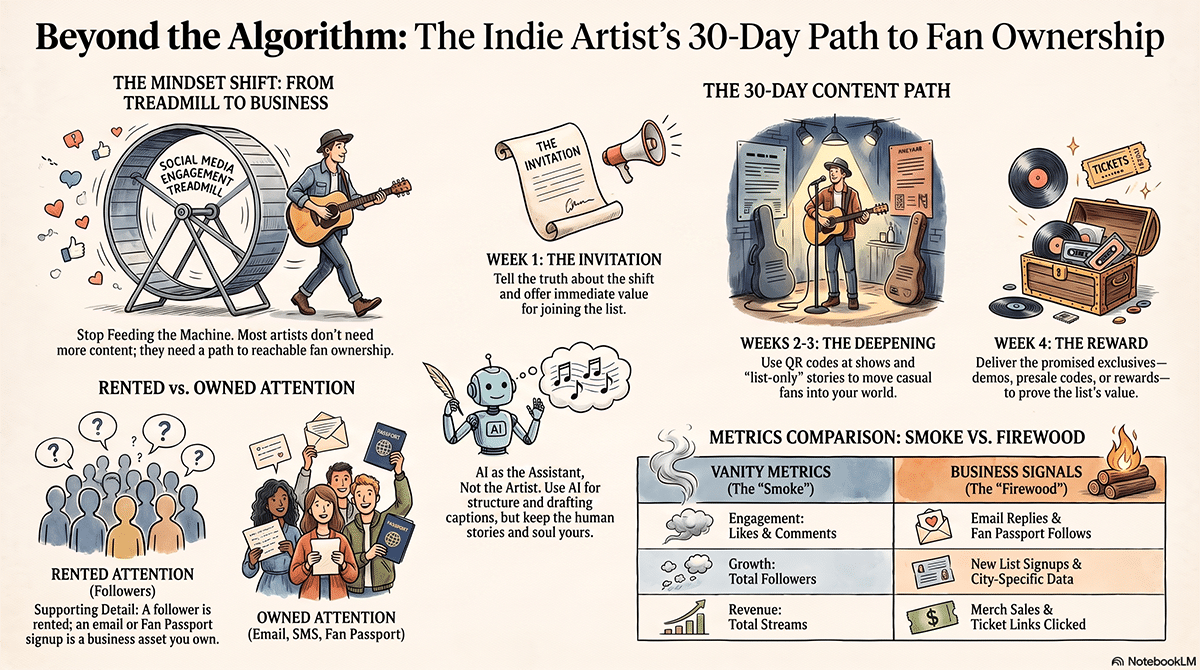
The 30-Day Path
A working indie artist does not need every tool. They need the right few tools connected to a clear workflow.
Use ChatGPT at https://chatgpt.com to draft the plan, generate caption options, rewrite posts in your own tone, create email subject lines, and repurpose one story across several platforms. Use Canva at https://www.canva.com to design clean graphics, show flyers, merch posts, story slides, and QR code graphics. Canva’s Content Planner can also plan and schedule posts as part of Canva Pro. Use Buffer at https://buffer.com if you want one social scheduling workspace across several platforms. Use Meta Business Suite if you need native scheduling for Facebook Pages and Instagram content. Meta’s own help documentation says Page posts can be scheduled through Meta Business Suite and managed in Planner.
Use Mailchimp at https://mailchimp.com or another email tool to collect fan signups with clear permission. Use WooCommerce at https://woocommerce.com if your artist website runs on WordPress and you want to sell merch, music, downloads, bundles, or fan offers from your own site. Use Shopify at https://www.shopify.com if you want a dedicated online store, and use Spotify for Artists with Shopify if that fits your merch strategy. Use Bandsintown for Artists at https://www.artist.bandsintown.com to help publish and promote tour dates. Use Eventbrite at https://www.eventbrite.com for events where it makes sense. Use Patreon at https://www.patreon.com or Buy Me a Coffee at https://www.buymeacoffee.com if direct support or memberships fit your fan base.
Artists should also watch for the soon-to-be-released Making a Scene Artist Fan Passport OS, which will include a free entry-level option, fan capture tools, Fan Passport rewards, and its own artist commerce system built around helping indie artists with a complete ecosystem that turns fan relationships into direct revenue.
But remember this. A bad strategy with good tools is still a bad strategy. The tool does not save the artist. The system does. The system is simple. Make a real offer. Send fans to a clear page. Get permission. Deliver value. Follow up. Invite the next action.
Do Not Abuse the Permission
Once a fan joins your list, treat that trust like gold.
Commercial email has rules. The FTC explains that commercial emails must avoid false or misleading header information, avoid deceptive subject lines, include a way to opt out, honor opt-out requests, and include a valid physical postal address. That is not just legal housekeeping. It is basic respect.
SMS is even more sensitive. A text message lands in a more personal place than an email. If you collect phone numbers, do it carefully. Use clear language. Make SMS optional. Do not bundle it secretly with email. Give fans a clear way to stop. Klaviyo’s SMS compliance guide explains common best practices like explicit consent, separate SMS consent, disclosure language, double opt-in, and opt-out handling. Artists should follow the rules in their country and get professional advice if they are unsure.
The Making a Scene Fan Passport OS should also be used with this same spirit. Fan data is not something to grab. It is something the fan shares. Location, email, phone, reward activity, show history, and preferences only matter if they are handled transparently. The whole point of an artist-owned ecosystem is to build a better relationship than the platforms offer. That means more trust, not more tricks.
What Success Looks Like After 30 Days
After 30 days, do not judge the campaign by likes.
Likes are useless. The better questions are more practical. How many fans joined the email list? How many followed through Fan Passport? How many scanned the QR code at shows? How many fans gave their city? How many clicked a ticket link? How many bought merch? How many replied to an email? How many claimed a reward? How many supported directly?
Those are business signals.
An artist who gains 50 real fan signups in a month has built something. An artist who gets 20 QR scans at a show has built something. An artist who learns that fans in three cities want tour alerts has built something. An artist who sells five shirts from an email has built something. An artist who gets ten replies from fans telling them which song matters has built something.
That may not look as flashy as 10,000 views. But 10,000 views that lead nowhere are smoke. A fan list is firewood.
This is how indie artists build a music industry middle class. Not by waiting for labels to save them. Not by handing every relationship to social media companies. Not by treating streaming platforms like the center of the universe. Streaming can help discovery. Social media can help reach. Video can help story. But the artist-owned fan relationship is where the business starts to belong to the artist again.
The Calendar That Leads Home
The old music business taught artists to chase permission.
The new platform business taught artists to chase attention.
The next music business has to teach artists to build ownership.
That starts with the fan list. Not because email is trendy. It is not. Not because QR codes are magic. They are not. Not because AI will do the work for you. It will not. It starts there because a reachable fan is the beginning of real independence.
A 30-day AI-assisted content calendar should not be a pile of posts. It should be a trail. Every post should help a fan understand who you are, why the music matters, where to connect, and what to do next. Some fans will join the list. Some will buy tickets. Some will grab the shirt. Some will scan at the show. Some will support the project. Some will do nothing today and come back next month.
That is fine. You are building the road.
Use AI to make the work lighter. Use your own voice to make it real. Use social media as the doorway. Use the fan list as the foundation. Use the Making a Scene Fan Passport OS or your own artist-owned system to reward real fans for real actions. Use tickets, merch, memberships, and direct support as honest offers, not desperate pitches.
The artist who understands this stops posting into the void.
They start building a world fans can actually enter.
 |  Spotify |  Deezer |  Breaker |
 Pocket Cast |  Radio Public |  Stitcher |  TuneIn |
 IHeart Radio |  Mixcloud |  PlayerFM |  Amazon |
 Jiosaavn |  Gaana |  Vurbl |  Audius |
 Reason.Fm | |||
Find our Podcasts on these outlets
Subscribe to Our Newsletter
Discover more from Making A Scene!
Subscribe to get the latest posts sent to your email.


