
The Artist Revenue Ladder: How Indie Artists Turn Free Fans Into Real Income Over Time




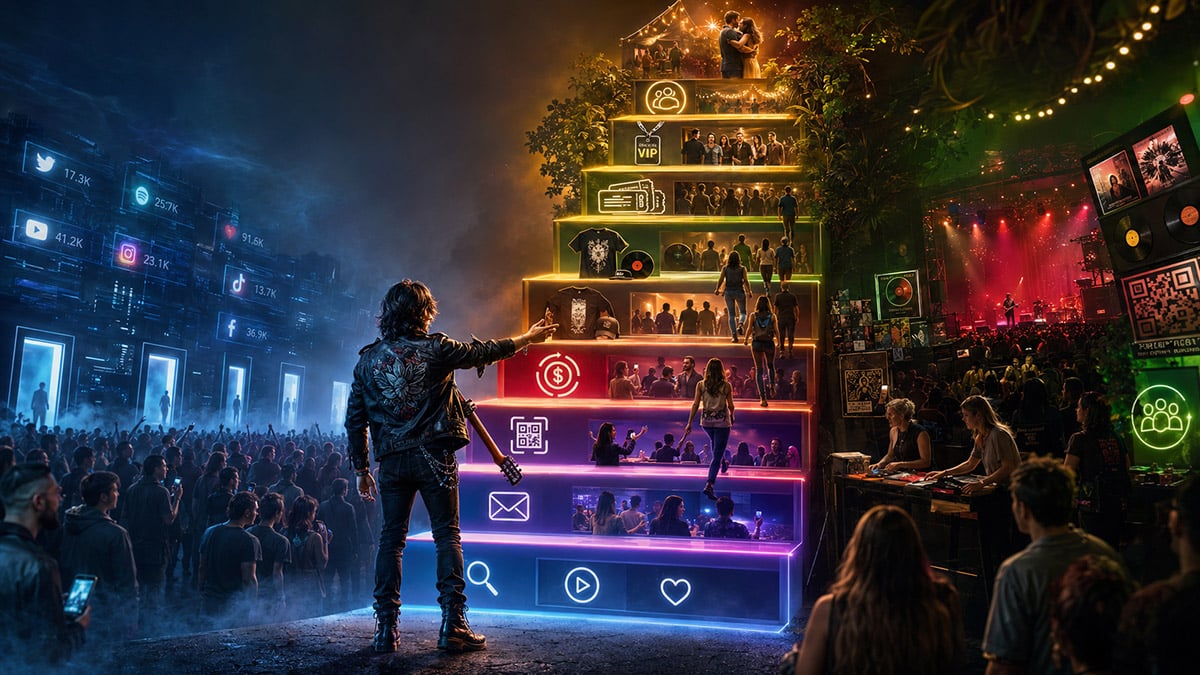
Making a Scene Presents – The Artist Revenue Ladder: How Indie Artists Turn Free Fans Into Real Income Over Time
Listen to the Podcast Discussion
There is a dangerous lie floating around the music business, and it has been sold to indie artists for years. The lie says that if enough people hear your music, the money will somehow show up later. Get more streams. Get more followers. Get more likes. Get more views. Feed the machine. Keep posting. Keep begging the algorithm to notice you. Keep hoping that one day a stranger in a boardroom or a playlist editor behind a locked digital curtain will point at your song and say, “This one.”
That is not a business plan. That is a lottery ticket with a guitar strap.
A real artist business is not built on attention alone. Attention is only the front door. The real business starts after someone discovers you. The money is not in the view. The money is not in the like. The money is not even in the stream by itself. The money is in the relationship that happens after the first spark of interest. That is where the artist revenue ladder comes in.
The artist revenue ladder is a simple idea. A fan should not be treated the same on day one as they are on day one thousand. Someone who just heard your song on TikTok, Instagram, YouTube, Spotify, or a local radio show is not ready to buy a $500 private concert package. They may not even be ready to buy a shirt. But they might be ready to scan a QR code. They might be ready to join your email list. They might be ready to save a song. They might be ready to grab a free live track, claim a Fan Passport stamp, or sign up for a small reward. That small action is where the ladder begins.
The problem with most indie music marketing is that artists try to jump from “please listen to my song” straight to “please give me money.” That usually feels awkward because the fan has not been warmed up yet. The fan has not been invited into the artist’s world. There is no journey. There is no next step. There is just noise, a link, and a prayer. The artist revenue ladder fixes that by turning random attention into a series of natural steps. Each step gives the fan more value, more connection, and more reasons to support the artist directly.
This is not about squeezing fans. Let’s get that out of the way right now. Fans are not wallets with shoes. They are people. They have rent, jobs, kids, student loans, car repairs, bad days, and favorite records that saved their lives. The goal is not to manipulate them into buying things they do not want. The goal is to build a clear path so the people who do want to support you can do it in ways that make sense for them. Some fans will only ever stream your music. That is fine. Some will buy a sticker once. That is fine too. Some will become the people who buy every record, bring friends to shows, join your membership, and book you for a private event. The ladder lets each fan climb at their own pace.
The old gatekeeper music business was built around access. Labels controlled access to studios, radio, distribution, press, retail, and tour support. The new indie music business is built around ownership. Artists need to own their music, own their data, own their fan relationships, and own the path between discovery and revenue. That is the Making a Scene philosophy in plain English. We are not waiting for the industry to save the artist. We are building the artist-owned system that makes waiting unnecessary.
Discovery Is Not The Destination
Discovery still matters. Nobody buys a ticket to a show they do not know exists. Nobody joins a membership for an artist they have never heard. Nobody buys a vinyl record from a band that has not entered their world yet. So yes, artists should use discovery platforms. Use Spotify for Artists. Use YouTube for Artists. Use TikTok for Artists. Use Instagram for Creators. Use Bandsintown and Songkick to help fans find shows. These tools can help people find you, follow you, and notice what you are doing.
But discovery platforms are not your home. They are roads. They are signs. They are billboards. They are noisy street corners. They are the doors fans walk through on the way into your world. The mistake is treating those doors like the whole house.
Spotify, TikTok, Instagram, Facebook, and YouTube can introduce people to you, but they do not give you full ownership of the relationship. A follower can vanish when reach drops. A viral video can fade by tomorrow morning. A playlist placement can disappear without explanation. A platform policy can change. A social account can get hacked. A stream can happen without you ever knowing who listened, where they are, whether they want tickets, whether they buy vinyl, or whether they would host a house concert.
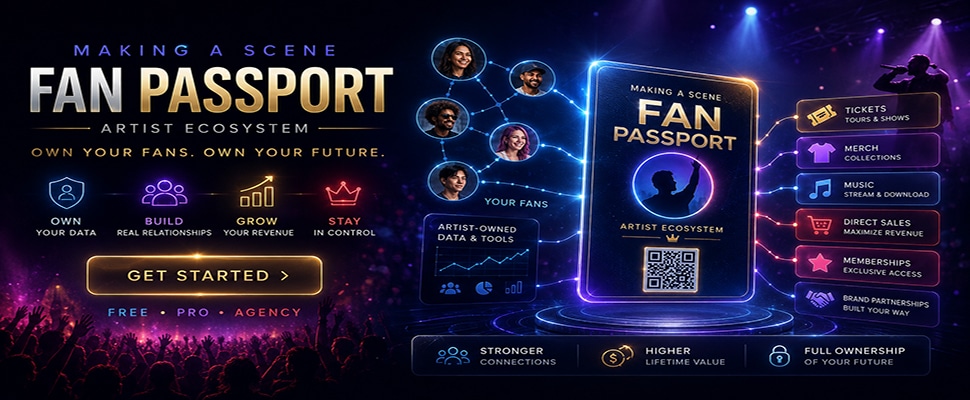
That is why the first rule of the artist revenue ladder is simple: every discovery platform should point back to an artist-owned hub. That hub can be your website, your email list, your Fan Passport, your store, your show calendar, your membership, or your direct fan community. WordPress is one way artists can build and control a website. The Making a Scene Artist Fan Passport OS, explained at https://www.makingascene.org/making-a-scene-artist-fan-passport-os-the-free-gateway-to-an-artist-owned-music-economy/, is built around this same idea: the artist needs one connected ecosystem where discovery, fan data, rewards, shows, merch, and direct support feed each other instead of getting trapped inside someone else’s platform.
This is where artists have to get a little rebellious. Do not build your whole career inside rented rooms. Use the platforms, but do not worship them. Let the algorithm introduce you. Then move the fan into a place you control.
The First Rung Is Free
The first rung of the revenue ladder is not revenue at all. That may sound strange, but it is the truth. The first rung is trust.
A brand-new fan should have an easy, free way to say, “I like this. Tell me more.” That might be an email signup. It might be a text list. It might be a Fan Passport follow. It might be a free download. It might be a QR code at the merch table that unlocks a live track, a lyric sheet, a behind-the-song video, or a discount on their first merch order.
The key is that the fan takes a small action that moves them out of the anonymous crowd and into your direct audience. That one action is more valuable than a passive like because it creates a permission-based relationship. Now you can reach that fan again without begging an algorithm for permission. You can tell them about the next show. You can invite them to a listening party. You can offer them a limited shirt. You can thank them after a gig. You can ask what city they live in. You can learn what they care about.
This is where tools like Mailchimp, Kit, and Substack at can help artists build email relationships. Mailchimp is built around email and SMS marketing. Kit, formerly ConvertKit, focuses on email marketing, automation, landing pages, forms, and creator commerce. Substack lets creators publish newsletters, podcasts, video, chat, and paid subscriptions in one place.
A free fan action should never feel like homework. Do not make someone fill out a government form just to hear a demo. Keep it simple. Scan this code. Get this track. Join the list. Claim your first stamp. Follow the artist in the Fan Passport. Get notified when we come back to town. The action should take seconds, and the reward should feel immediate.
The Fan Passport idea is powerful here because it turns the first step into something visible. A fan does not just “join a list.” They begin a journey. They collect a stamp. They enter the artist’s world. They can see that their support matters. That sounds small, but it changes the emotional math. A fan who feels seen is far more likely to come back.
Low-Cost Support Makes The First Sale Easy
Once a fan has taken a free action, the next rung is low-cost support. This is where the first money changes hands, but it should be easy, low pressure, and meaningful.
A $3 digital download can matter. A $5 tip can matter. A $7 sticker pack can matter. A $10 live EP can matter. A $12 lyric poster can matter. A $15 digital bundle with demos, photos, and notes from the artist can matter. The dollar amount is not the only point. The point is that the fan crosses the line from listener to supporter.
This first sale is a big psychological step. Once someone has supported you once, supporting you again becomes easier. They have already decided that your music is worth more than passive attention. They have already told themselves, “I want this artist to keep going.” That is a different relationship.
Bandcamp remains one of the clearest examples of a platform built around direct fan support for music and merch. Its artist page describes Bandcamp as an online record store and music community where fans discover, connect with, and directly support artists. Artists can use it to sell digital music, physical releases, and merch.
Payment links also matter at this stage. Square offers payment links, and Stripe offers payment links. These tools let artists create a checkout page or payment link that can be shared online, placed behind a QR code, or used at a merch table. Square describes payment links as clickable links or scannable codes that let a customer complete a purchase, while Stripe says its Payment Links let users create and share a payment page without needing a website or coding skills.
The artist should think of low-cost support as the handshake sale. It should not be buried. It should not be confusing. It should not require a fan to search through seven links. Put it right in front of them. “Like the song? Support the next one for five bucks.” That is clear. That is human. That is not begging. That is inviting.
Merch Turns Music Into Memory
The next rung is merch, and merch is not just stuff. Good merch is a memory the fan can wear, hold, frame, collect, or give to someone else. A shirt is not just cotton. A vinyl record is not just plastic. A signed poster is not just paper. It is proof that the fan was part of something.
This is where artists need to stop treating merch as an afterthought. Merch should not be a sad cardboard box under the table with two wrinkled shirts and a marker that barely writes. Merch is one of the most direct revenue streams an indie artist has. It also gives fans a way to identify with the artist in public. When someone wears your shirt, they become a walking recommendation. When someone spins your vinyl, they create a ritual. When someone puts your sticker on a guitar case, laptop, or car bumper, they bring you into their daily life.
A working indie artist can start small. A $5 sticker. A $10 patch. A $20 shirt. A $25 hat. A $30 signed poster. A $40 vinyl record. A $50 bundle with a shirt, CD, sticker, and download code. A $75 signed limited edition package. These numbers are examples, not commandments. The real point is to give fans a range of choices. Not everyone can afford the deluxe bundle, but many people can afford something.
Shopify can help artists build an online store for products, while Bandcamp can handle music and merch for many artist needs. Canva can help create merch graphics, social posts, flyers, posters, and QR code materials, and Canva’s QR code tool can create QR codes that send fans to a URL.
Here is the rebellious part. Merch should not only say your name in a boring font. It should carry the world of the artist. It should feel like a flag. It should say something about the fans who wear it. That might be a lyric. A symbol. A tour joke. A local scene slogan. A phrase from the chorus. A design tied to a specific show. A limited run for one city. A fan who buys merch is not just buying cloth. They are buying identity.
This is also where the Fan Passport can connect the dots. A fan who buys merch can earn a stamp. A fan who buys at three shows can unlock a reward. A fan who buys a bundle can get early access to the next release. The merch table stops being a cash box and becomes part of the artist’s living economy.
Tickets Are The Center Of The Ladder
For most working indie artists, the live show is still the beating heart of the business. Streaming can help people find you. Social media can create awareness. Email can bring fans back. Merch can lift the night. But the ticket is where the relationship becomes physical. The fan leaves the house. They bring a friend. They stand in the room. They feel the drums in their chest. They meet the artist. They remember the night.
That is why tickets are a major rung on the artist revenue ladder. The goal is not just to sell one ticket. The goal is to turn a casual listener into a repeat attendee.
A $15 local show ticket may lead to a $25 ticket next time. A $25 ticket may lead to a $50 seated listening room show. A $50 ticket may lead to a $100 VIP experience. The fan climbs because the relationship deepens. The artist earns more because the value increases.
Eventbrite is one tool artists can use to create events and sell tickets, while Bandsintown at and Songkick Tourbox can help artists manage and promote tour dates so fans know when shows are happening. Eventbrite describes itself as an event ticketing and marketing platform, Bandsintown is focused on live music discovery and concert alerts, and Songkick Tourbox is built to help manage tours and tickets in one place.
The artist-owned move is to make sure every ticket buyer has a path into the artist’s direct ecosystem. If the venue owns the ticket buyer data and the artist never sees it, the artist is doing the hard work while someone else owns the relationship. That has to change.
At every show, there should be a fan capture moment. A QR code at the door. A QR code on the merch table. A QR code on the screen before the set. A QR code on the set list. A sign that says, “Scan here for tonight’s live track.” A Fan Passport stamp for attending. A post-show thank-you email. A next-show invite. A merch offer that expires in 48 hours. This is not gimmicky. This is how a live event becomes the start of the next sale instead of the end of the night.
VIP Is Not About Ego
The next rung is VIP, and a lot of indie artists misunderstand it. VIP does not mean acting like a fake celebrity. It does not mean putting a velvet rope around yourself and pretending you are too important to talk to people. That is major-label cosplay, and it smells weird.
Real indie VIP is about giving your most committed fans a deeper experience. It can be simple. Early entry. A short acoustic song before doors. A signed poster. A photo with the band. A soundcheck hang. A small group Q&A. A handwritten lyric sheet. A reserved seat. A limited laminate. A private story about the songs. A chance to hear an unreleased track.
A $75 VIP ticket can make sense if the regular ticket is $25 and the fan gets real value. A $100 VIP bundle can make sense if it includes admission, merch, early access, and a personal experience. The important thing is honesty. Do not charge VIP prices for cheap nothing. Fans can smell lazy.
VIP also helps the artist identify serious supporters. Not every fan wants VIP, and that is fine. But the fans who do want it are telling you something. They are not just interested in the song. They want closeness. They want story. They want to feel part of the journey. These are the people who may later join a membership, buy special releases, attend a retreat, or book a private event.
The Fan Passport model fits this naturally. VIP can be unlocked by support over time, not just purchased once. A fan who attends five shows, buys merch, and shares contact permission could be offered early VIP access before the general public. That feels better than blasting the same offer to everyone. It rewards real loyalty.
Membership Turns Spikes Into Stability
Most artist income comes in spikes. A release spike. A show spike. A merch spike. A crowdfunding spike. A holiday spike. The problem is that bills do not arrive in spikes. Rent is monthly. Insurance is monthly. Software is monthly. Rehearsal space is monthly. Car payments are monthly. Groceries have the nerve to be weekly.
Membership helps smooth the chaos.
A membership can be $5 a month, $10 a month, $20 a month, or more depending on the value. It can include early demos, live recordings, behind-the-scenes videos, monthly livestreams, members-only merch, song breakdowns, studio journals, private posts, or first access to tickets. The trick is not to overpromise. A membership should be sustainable. If you promise too much, it becomes another unpaid job with a login screen.
Patreon is one well-known platform for creator memberships, and Patreon’s own materials describe it as a place to build community, share exclusive work, and turn creative passion into a lasting business. Substack at can also support paid subscriptions around newsletters, podcasts, video, live streams, and chat. Discord at and the Discord Creator Portal at can support community spaces, though an artist should be careful not to create a dead server that becomes one more thing to manage.
The smartest membership starts with the artist’s real rhythm. If you record constantly, share demos. If you tour constantly, share road stories and livestream soundchecks. If you write deeply, share lyric notes. If you teach, share lessons. If your fans love community, create member conversations. Do not copy another creator’s membership just because it looks successful. Build the membership around what you can actually deliver without burning out.
A membership is not just money. It is forecasting. If 100 fans pay $10 a month, that is $1,000 in gross monthly support before platform fees and expenses. That does not make anyone rich by itself, but it can pay for gas, rehearsal space, mixing, mastering, ads, posters, or part of a tour van repair. More important, it gives the artist a base. A floor. A little breathing room. In the indie world, breathing room is not a luxury. It is survival.
Private Events Are The Hidden High-Value Rung
Private events are one of the most overlooked rungs on the artist revenue ladder. Many artists think private events are only for wedding bands, corporate cover acts, or background music at a dinner where nobody listens. That is too narrow.
A private event can be a house concert. A backyard listening party. A birthday show. A small business customer night. A nonprofit fundraiser. A sponsor event. A VIP fan gathering. A music society concert. A private acoustic set before a festival. A special performance for a collector, patron, or local community group.
This is where the value can rise quickly. A fan who spends $25 on a ticket may later host a $500 house concert. A small business that likes the artist may sponsor a $1,000 event. A music society may book a full band show. A private fan group may split the cost of a special performance. The artist is no longer only selling a ticket. The artist is selling an experience.
Private events work best when the artist makes the offer clear. Do not hide it behind vague language. Put a page on your website that says you are available for house concerts, private listening rooms, community events, and custom performances. Explain what is included. Explain what the host needs. Explain the basic price range or starting deposit if you are comfortable doing that. Make the inquiry simple.
This is also where owned fan data becomes powerful. If your Fan Passport, email list, or CRM shows that a fan has attended several shows, bought merch, joined the membership, and lives in a strong city for you, that fan may be a great candidate for a private event offer. Not a spammy blast. A real invitation. “You have been supporting us for a while. If you ever want to host a small backyard show or listening party, here is how it works.”
That kind of message only works when there is trust. The ladder creates that trust over time.
Higher-Value Offers Are Built On Proof
At the top of the ladder are higher-value offers. These are not for every fan, and they should not be pushed on everyone. They are for the people who want a deeper relationship and have the means to support it.
A higher-value offer might be a $250 songwriting workshop. A $500 private acoustic show deposit. A $750 VIP studio visit. A $1,000 patron package tied to a new record. A $2,500 house concert weekend. A $5,000 community concert sponsorship. A custom song commission. A producer consultation. A music lesson series. A limited executive producer credit on an independent album. A sponsor package for a regional tour.
Some artists get nervous about offers like this because they think it sounds too commercial. But here is the truth: every serious artist business already has high-value activity. The only question is whether it is organized. A private event is high value. A sponsorship is high value. A licensing placement is high value. A workshop is high value. A direct patron is high value. The artist who refuses to name these things is not being pure. They are just making it harder for serious supporters to say yes.
The ethical line is value and honesty. Do not sell fake scarcity. Do not promise career access you cannot deliver. Do not make fans feel less important if they cannot afford the top rung. The fan who streams every song and brings three friends to a show still matters. The ladder is not a class system. It is a path. Different fans will stop at different places.
Higher-value offers should grow from proof. If fans already buy signed lyrics, maybe offer a custom handwritten lyric package. If fans love your house concert stories, create a house concert page. If fans ask how you record vocals, offer a home studio workshop. If fans love your live acoustic versions, sell a private acoustic livestream. The ladder should be based on real fan behavior, not fantasy.
AI Should Help The Ladder, Not Replace The Relationship
AI can help artists build and manage the revenue ladder, but only if the artist uses it as a tool, not a personality transplant. Nobody wants to join a fan community run by a robot pretending to have feelings. Fans want the artist. AI should help with the boring, repetitive, and strategic parts so the artist has more energy for music and real connection.
ChatGPT can help artists draft welcome emails, brainstorm merch bundles, write show follow-up messages, organize fan segments, create social captions, plan release calendars, and turn raw ideas into clearer offers. Canva can help create graphics, QR cards, posters, merch mockups, and visual campaigns. Email tools like Kit and Mailchimp can help automate welcome sequences and follow-up messages. Payment tools like Stripe and Square can make it easier to turn offers into simple checkout links.
The artist should use AI to ask better business questions. Which fans came to more than one show? Which city has the most email signups? Which merch item sells after acoustic shows but not full-band shows? Which fans joined the list but never bought anything? Which fans bought tickets but never joined the Fan Passport? Which fans opened the VIP email? Which fans clicked but did not buy?
Those questions matter because they turn fan activity into artist action. AI can help find patterns. The artist still makes the human decision. That is the balance.
The future is not AI replacing artists. The future is independent artists using AI to act like a smarter business without needing a major-label office full of staff. That is how we build a middle class again. Not by handing creativity to machines, but by using machines to protect the human work.
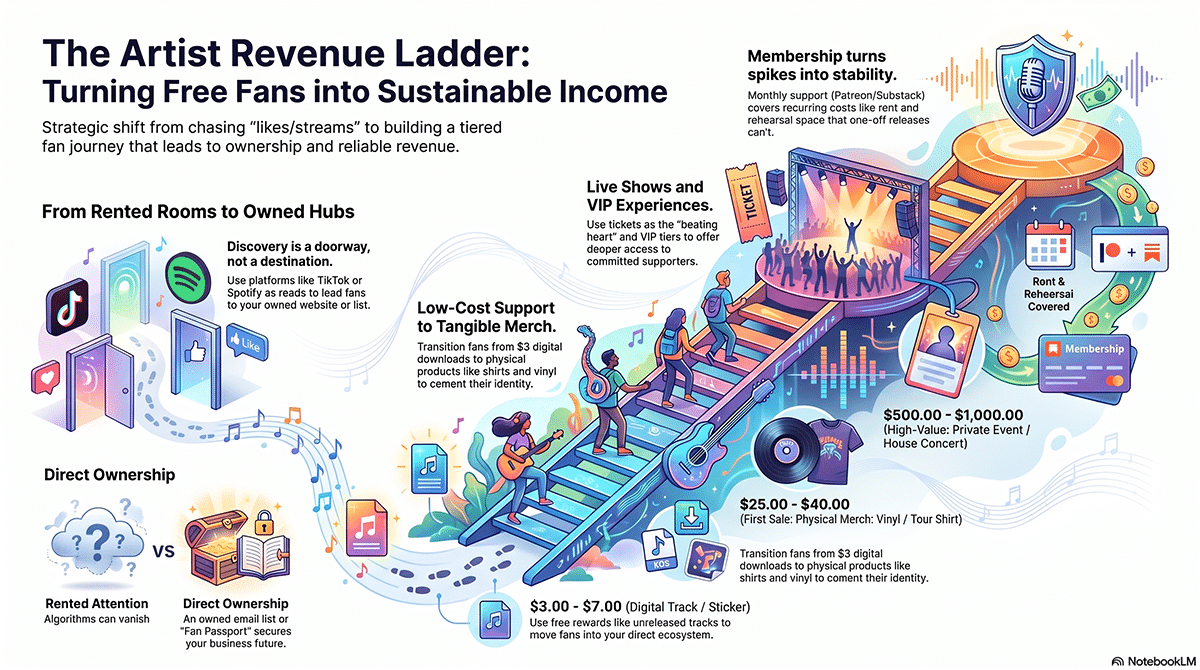
The Fictional Fan Journey: How One Listener Climbs The Ladder
Let’s make this real.
A fan named Maya hears a 30-second clip from an independent artist named River Hart on TikTok. The chorus hits her right in the ribs. She watches the video twice and follows the account. That is discovery. Nice, but fragile. If River does nothing else, Maya may forget by tomorrow.
At the end of the video, River says, “If this song found you at the right time, grab the free live version through the link in my bio.” Maya clicks. The link takes her to River’s website, not just another social platform. There is a simple form. Name, email, city. No nonsense. Maya signs up and gets the live version. She also gets her first Fan Passport stamp for joining River’s world.
A few days later, Maya gets a welcome email. It does not scream “BUY MY STUFF.” It tells the story behind the song and includes a $5 support link for fans who want to help finish the next recording. Maya sends $5 through a Stripe payment link. It is not a huge sale, but it is the first sale. She is no longer just a viewer. She is a supporter.
Two weeks later, River announces a small show in Maya’s city through Bandsintown, Instagram, and the email list. Because Maya shared her city, she gets a local show email instead of a random blast for a gig three states away. She buys a $20 ticket through Eventbrite. At the show, there is a QR code at the merch table that says, “Scan for tonight’s stamp and a secret acoustic track.” Maya scans it. Her Fan Passport shows she attended. Now River knows Maya is not only a listener. She came out.
After the show, Maya buys a $25 shirt and a $10 sticker pack. The merch purchase gives her another stamp. The next morning, she gets a thank-you email with a photo from the show and a link to pre-order a signed live EP from that night for $30. She buys it because she was there. It means something.
Three months later, River returns to the same city. Maya gets early access because she attended the last show. This time she buys a $75 VIP ticket that includes early entry, a signed poster, and a short acoustic soundcheck. She brings a friend. The friend joins the Fan Passport too. The ladder is now spreading.
A few months after that, Maya joins River’s $10 monthly membership because she wants early demos and behind-the-scenes stories. She is not doing it because an algorithm told her to. She is doing it because she has a relationship with the artist’s world. She has memories. She has stamps. She has merch. She has songs tied to real nights.
A year later, Maya hosts a backyard show for her birthday. River charges a $750 private acoustic event fee plus travel costs. Maya invites 40 friends. Ten of them join River’s list. Six buy merch. Three come to the next public show. One becomes a member.
That is the artist revenue ladder.
Notice what did not happen. River did not need one million followers to make the ladder work. River did not need a label advance. River did not need to go viral every week. River needed a clear path from discovery to ownership, from ownership to trust, and from trust to support.
That is the part too many artists are missing.
The Ladder Must Be Visible
A revenue ladder only works if fans can see the next step. Most artists have pieces of the ladder scattered all over the place. The music is on Spotify. The videos are on YouTube. The show dates are on Bandsintown. The merch is on Bandcamp. The email list is on Mailchimp. The ticket link is on Eventbrite. The membership is on Patreon. The private event info is buried in a Facebook post from eight months ago. The artist wonders why fans are confused.
Fans are not confused because they do not care. Fans are confused because the path is a junk drawer.
The artist needs one hub that makes the next step obvious. New fan? Start here. Want to support for a few dollars? Go here. Want merch? Go here. Want tickets? Go here. Want VIP? Go here. Want membership? Go here. Want to book a private event? Go here. Want to follow through the Fan Passport? Go here.
This is why the Making a Scene Artist Fan Passport OS matters as a concept. It is not just another shiny tool. The bigger idea is connection. The artist business should not be a pile of disconnected apps. It should be an ecosystem where every fan action helps the artist understand the relationship and offer the right next step.
That is how you stop leaving money on the floor. More importantly, that is how you stop leaving fans outside the door.
The Ladder Should Respect The Fan
There is a right way and a wrong way to build this. The wrong way is to blast every fan with every offer all the time. That turns the ladder into spam. Nobody wants that. The right way is to pay attention.
A brand-new fan should get a welcome. A local fan should get local show alerts. A merch buyer should get merch news. A repeat ticket buyer should get early access. A member should get deeper content. A VIP buyer should get first notice on the next VIP offer. A private event host should get a personal thank-you and a clear path to do it again.
This is where consent matters. The fan should know what they are signing up for. Email permission should be clear. SMS permission should be clear. Data sharing should be transparent. The artist does not need to spy on fans. The artist needs permission-based information that helps serve fans better.
That is a major difference between an artist-owned ecosystem and the platform economy. Platforms collect mountains of fan behavior to serve their own business. Artists need simple, useful, consent-based fan data to serve the relationship. Big difference.
A fan who trusts you will share more over time. A fan who feels tricked will leave.
Build The Ladder Before You Need It
The worst time to build your revenue ladder is the week your album comes out. That is like building the bridge after the bus is already in the river.
Artists should build the ladder before the campaign. Before the tour. Before the release. Before the festival slot. Before the big press hit. Before the song catches fire. When attention arrives, the path should already be ready.
That means your links should work. Your email welcome should exist. Your merch should be easy to buy. Your ticket page should be clear. Your Fan Passport or fan capture system should be set up. Your QR codes should be tested. Your private event page should be written. Your membership should have a simple promise. Your follow-up emails should not sound like they were written by a tired raccoon at 2 a.m.
This is where a little planning beats a lot of panic. The artist revenue ladder is not glamorous at first. It is systems work. It is link work. It is copy work. It is offer work. It is making sure fans do not fall through cracks. But that quiet work is what lets the loud moments pay off.
When a video gets attention, send people to the ladder. When a show goes well, send people to the ladder. When someone buys merch, send them to the next rung. When someone joins the membership, deepen the relationship. When someone becomes a superfan, give them real ways to support at a higher level.
That is how indie careers compound.
The New Indie Business Is A Journey, Not A Jackpot
The music business keeps trying to sell artists jackpots. Viral jackpot. Playlist jackpot. Sync jackpot. Label jackpot. Festival jackpot. Influencer jackpot. Every jackpot story makes artists feel like they are one lucky break away from safety.
But most working artists do not build lasting careers from jackpots. They build them from repeat support. One fan becomes ten. Ten become a hundred. A hundred become a room. A room becomes a route. A route becomes a regional economy. A regional economy becomes a career.
That is not as flashy as overnight fame, but it is stronger. It is also more honest.
The artist revenue ladder gives indie artists a way to stop treating fans like a mystery. It turns the question from “How do I get more attention?” into “What happens after someone pays attention?” That is the question that matters.
Free discovery is the spark. Low-cost support is the first yes. Merch is the memory. Tickets are the room. VIP is the deeper experience. Membership is the steady base. Private events are the high-value relationship. Higher-value offers are the proof that serious fans want serious ways to support the work.
The ladder does not replace great songs. Nothing replaces great songs. It does not replace a powerful live show. It does not replace craft, honesty, courage, or the weird magic that makes a stranger feel like your song was written from inside their own chest. The ladder simply protects the value of that magic after it happens.
That is the point.
Indie artists do not need another lecture about posting more content. They need a business path. They need direct relationships. They need tools that turn attention into ownership. They need systems that help fans support at the level that fits them. They need a way to build a music industry middle class one relationship at a time.
So yes, use Spotify. Use TikTok. Use Instagram. Use YouTube. Use every discovery door that makes sense. But do not leave your fans standing in the doorway. Bring them home.
Build the ladder. Start with trust. Make the next step clear. Reward the people who show up. Own the relationship. Grow the value over time.
That is how the indie artist stops waiting to be chosen.
That is how the artist chooses themselves.
 |  Spotify |  Deezer |  Breaker |
 Pocket Cast |  Radio Public |  Stitcher |  TuneIn |
 IHeart Radio |  Mixcloud |  PlayerFM |  Amazon |
 Jiosaavn |  Gaana |  Vurbl |  Audius |
 Reason.Fm | |||
Find our Podcasts on these outlets
Subscribe to Our Newsletter
Discover more from Making A Scene!
Subscribe to get the latest posts sent to your email.


