
The Album Is Not the Object Anymore




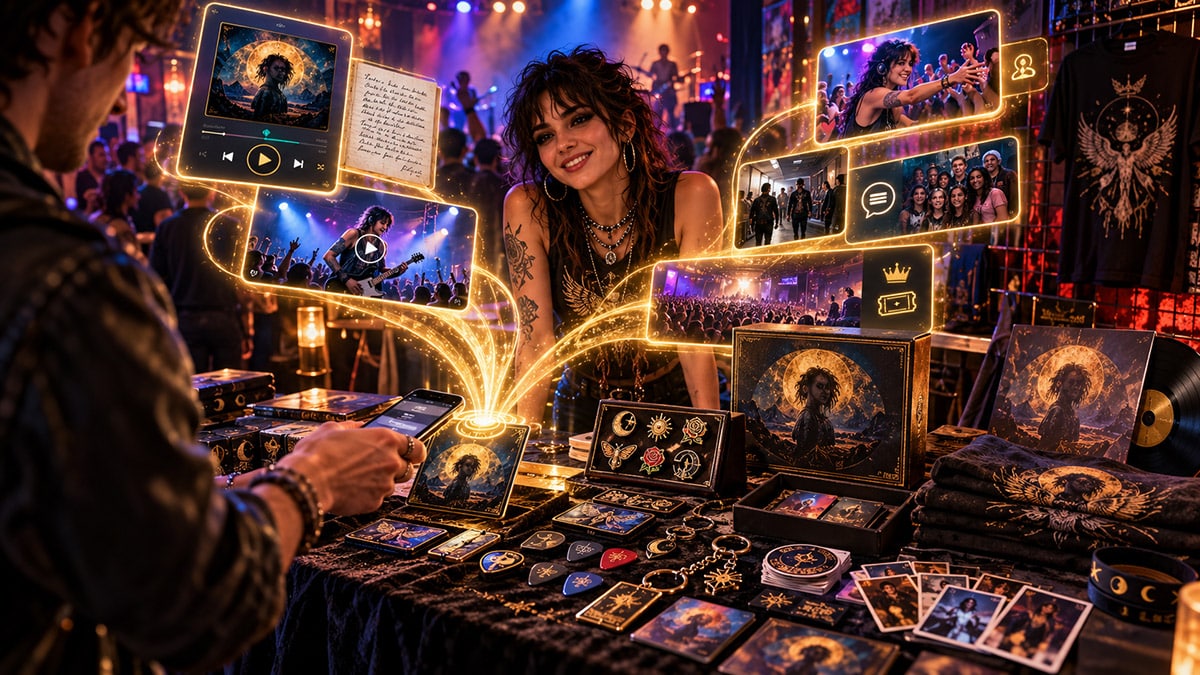
Making a Scene Presents – The Album Is Not the Object Anymore
Listen to the Podcast Discussion
How Indie Artists Can Turn Almost Anything Into a Smart Media Collectible
For most of the recorded music business, the album had a fairly simple job description. It was the thing that contained the music. You bought the vinyl record, cassette or CD because that was how you got the songs, and the artwork, photographs and liner notes came along for the ride as part of the package. Digital music separated the songs from the object, and streaming finished the job by making the physical carrier unnecessary for listening. That sounds like terrible news for merchandise until you realize that the object has now been freed from its old job and can take on a much more interesting one: instead of merely carrying the recording, it can carry the relationship between the artist and the fan.
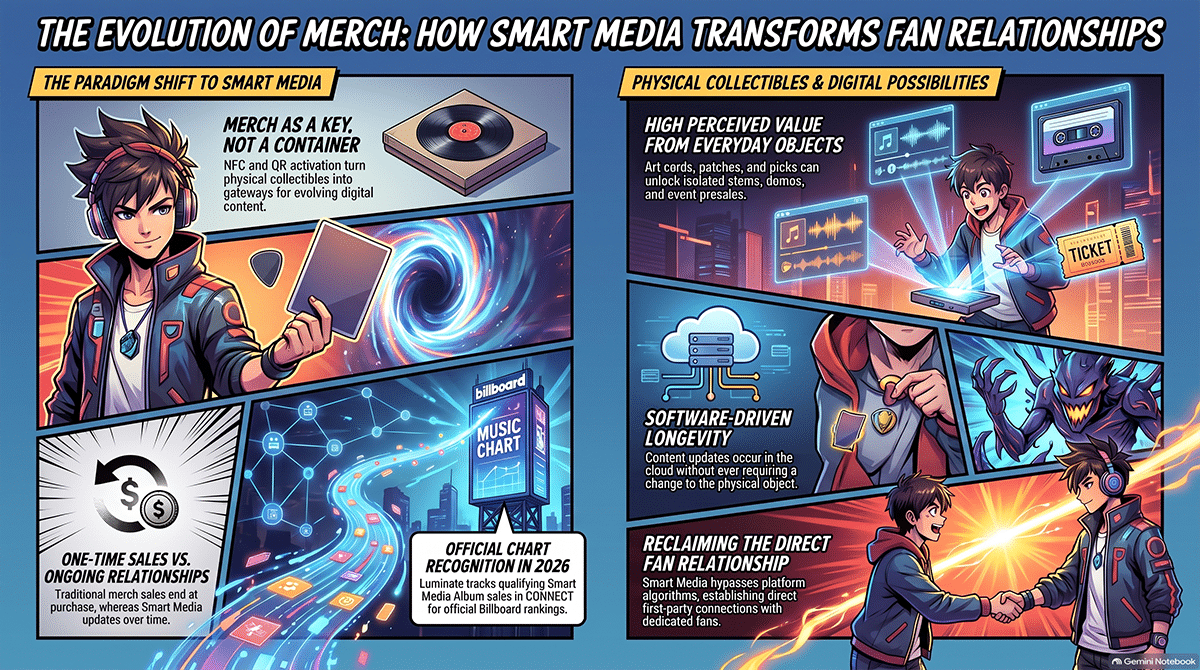
That shift is what makes Smart Media so interesting for independent musicians. The physical product can now become a key that unlocks an evolving digital experience, rather than being a container that simply holds a fixed set of songs. A Smart Media Album can use NFC, QR codes or similar activation methods to connect a physical collectible with music, video, artwork, liner notes, fan rewards and other digital experiences. Luminate formally recognized Smart Media Albums as a product format in 2026 and began making Smart Media Album sales available through CONNECT, its API and Data Share on October 2, 2026, with qualifying products also able to contribute to official Billboard chart rankings. Luminate describes Smart Media broadly enough to include objects such as keyrings, photo cards, cartridges and other collectibles that unlock digital album content, which means the industry has effectively acknowledged that the album no longer has to look like a record. The official Luminate announcement is available at https://luminatedata.com/blog/luminate-to-track-smart-media-album-sales-in-connect/.
For an indie artist, however, the bigger opportunity is not simply another line item in a chart-reporting system. The exciting part is that almost anything meaningful enough to become merchandise can potentially become the physical front end of a Smart Media experience. A guitar pick, backstage pass, enamel pin, patch, keychain, photo card, wristband, poster, necklace, art print or collector box can become the object a fan owns, while the software behind it becomes the place where the music lives and grows. That turns merchandising into something much more powerful than putting the band’s logo on another object and hoping somebody has enough room left in the junk drawer. The goal is to create something fans want to keep because the physical item carries emotional value while the digital experience keeps giving that object new meaning.
Stop Thinking About the Album as a Disc
Imagine a fan leaving your merch table with a beautifully printed hotel-style key card carrying the artwork from your new album. When they tap it against their phone, a full-screen album experience opens with the music, lyrics, recording credits, photographs, studio footage and commentary explaining how the songs were created. Six weeks later, they tap the same card and discover that you have added a live recording from the tour. Three months after that, the card unlocks an early ticket window for the next hometown show or gives the owner access to a members-only stream. Nothing about the physical object had to change, yet its usefulness and perceived value continued to grow because the software behind it remained alive.
That is a fundamentally different economic idea from selling someone a CD and hoping they remember where they put it. With conventional merchandise, the transaction often ends when the fan walks away from the table. With Smart Media, that purchase can become the beginning of an ongoing relationship, provided the experience is built around real value instead of novelty for novelty’s sake. The NFC chip or QR code is only the doorway, and the fan does not care about the name of the chip any more than a record buyer cared about the chemical composition of polyvinyl chloride. What matters is what the object represents and what happens after the fan taps it.
The technology required to create that doorway can be surprisingly inexpensive. GoToTags manufactures NFC cards, stickers, wristbands and key fobs that can be customized and connected to online experiences, and its card options include PVC, wood and metal. The company also offers services such as printing, encoding and variable data, which can matter when an artist wants each product to have its own identity instead of every card opening the same generic page. The company’s custom NFC card information is available at https://store.gototags.com/nfc-tags/nfc-cards/custom-nfc-cards/. For an artist who wants to experiment with very small runs before committing to large quantities, Tap Tag offers custom NFC cards, wristbands, stickers and keychains, including individually ordered products that can be useful for prototypes or premium limited editions. Its custom keychain information is available at https://taptag.shop/products/custom-nfc-keychain, while bulk customization is described at https://taptag.shop/pages/custom-bulk-orders.
The important lesson is that the hardware itself should almost disappear from the fan’s experience. Nobody should be buying your Smart Media Album because you successfully sourced an NTAG213 chip and would now like public recognition for your procurement skills. They should buy it because the object looks good, feels meaningful and unlocks something worth returning to. If the fan ends up thinking mostly about the NFC technology, the artist has probably spent too much time showing them the plumbing instead of designing the house.
The $5 Object That Can Feel Like a $30 Collectible
One of the easiest ways to enter Smart Media is through something as simple as a collectible art card. A beautifully printed card can carry the album cover, original artwork, a photograph, handwritten lyrics or some other visual element tied directly to the release. Add an NFC tag or QR activation method and that inexpensive piece of print becomes an entry point into a digital album experience. The physical production cost can remain relatively low while the perceived value comes from the art, the limited nature of the edition and the content the card unlocks.
MOO is particularly interesting for this approach because its Printfinity system allows multiple designs to appear within a single card order. An artist could create a set where one card features the album cover, another highlights the drummer, another contains a handwritten lyric excerpt and another uses a studio photograph, rather than printing the same design hundreds of times. Its MiniCards can include many different back designs within one pack, while its standard and square business-card formats are available on premium paper stocks and with upgraded finishes that can make the product feel much more like a collectible than office stationery. Current options can be explored at https://www.moo.com/us/business-cards/minicards and https://www.moo.com/us/business-cards.
The real creative opportunity appears when different cards do more than merely look different. A guitarist’s card could unlock isolated guitar tracks, amp photographs and notes about the recording setup, while the drummer’s card could open a rehearsal video, drum-camera footage and session notes. Another card might unlock an acoustic demo or handwritten lyric sheet, giving collectors a reason to seek multiple designs rather than treating each one as an interchangeable copy of the same product. That turns variation into part of the experience and creates a reason for fans to trade cards, compare editions and perhaps even try to complete a set.
Collecting changes the emotional math of merchandise because fans stop thinking only in terms of whether they already own the music. Nobody really needs six versions of the same album in order to hear track four, but collectors are rarely making purchasing decisions based solely on what they need. They are responding to completion, scarcity, story and identity. Smart Media allows an indie artist to use those instincts without manufacturing endless plastic trinkets, because the physical product can remain relatively simple while the digital experience gives each variation a real purpose.
The Backstage Pass That Finally Opens Something
The backstage pass is almost embarrassingly perfect for Smart Media because fans already understand what it represents. It communicates access, exclusivity and closeness to the artist before anybody explains how the product works. Musicians have been printing decorative laminate passes for years because they look cool, even though most of those fan versions do not actually open a door, unlock a room or grant access to anything meaningful. Smart Media gives us the chance to correct that small historical absurdity and create a pass that actually behaves like a pass.
A collectible album pass could begin by unlocking the record, liner notes and video content, but it could continue functioning long after release week. During the tour, the same pass might display the current show schedule, unlock venue-specific material or give its owner access to a special merch item. After several shows, it could reveal an unreleased live recording or a fan reward tied to attendance. A year later, it might unlock an anniversary stream or early access to the next release, allowing a simple piece of laminated plastic to become a permanent credential connecting the fan to that particular album era.
This is where Smart Media begins to move beyond ordinary merchandise and into Software as a Service. The artist is no longer selling a static page that will sit unchanged until somebody forgets to renew the hosting account. The software can recognize which product the fan owns, which edition it belongs to, which content should be visible and what additional experiences have been earned or released. With clear consent, the system can also give the fan a way to join the artist’s email, text or membership community, which transforms a merch-table purchase into something far more valuable than a one-time sale.
That direct relationship is crucial because streaming platforms and social networks generally know more about the artist’s audience than the artist does. They know who listened, who clicked, who followed and often who bought something through their systems, while the musician gets a graph and a reassuringly vague statistic. A Smart Media pass can help reverse that arrangement by giving fans a reason to identify themselves directly to the artist because there is something useful waiting on the other side. That is much healthier than begging an algorithm to show your next post to the people who supposedly already follow you.
The Guitar Pick Gets a Better Job
Few objects are more immediately connected to music than the guitar pick, which makes it a natural candidate for a Smart Media collectible. PickWorld manufactures custom printed guitar picks in Delaware using materials such as celluloid, Delrin and PVC, and it offers multiple shapes, colors and printing options. Custom orders generally begin around one hundred picks, although some simpler products can start lower, and the company also offers custom tins and packaging options that can turn an inexpensive pick into something that feels much more like a finished product. Its custom pick offerings can be found at https://pickworld.com/collections/custom-picks.
The smartest approach would not usually involve forcing NFC hardware directly into a conventional pick. That would create unnecessary manufacturing complexity when the pick itself can remain the collectible and the activation technology can live inside the backing card, sleeve or presentation tin. The fan still feels like they bought a special pick connected to the album, while the packaging quietly provides the digital doorway. This also gives the artist more room to print instructions, edition information, artwork and perhaps a handwritten or reproduced note about the song connected to that particular pick.
An artist could create one pick for each track or musical theme, with the digital experience behind each version offering something specifically relevant to that song. A guitar-focused card might unlock the isolated guitar performance, alternate tuning information, amplifier settings or a short lesson demonstrating how the part was played. A songwriter could include the original acoustic demo or notebook scan, while a blues artist might explain the guitar, tuning and slide used during the recording. Those details may sound hopelessly nerdy to somebody outside the audience, but dedicated fans and musicians often love exactly that kind of material because it makes them feel closer to the creation of the record.
The value comes from specificity. Generic bonus content quickly feels like marketing material, while a real piece of the creative process feels personal. That distinction is important because Smart Media should never be used as an excuse to put five ordinary videos behind a tap and announce that the future has arrived. The technology becomes worthwhile when the physical object and the digital content reinforce one another so naturally that separating them would make the whole idea feel incomplete.
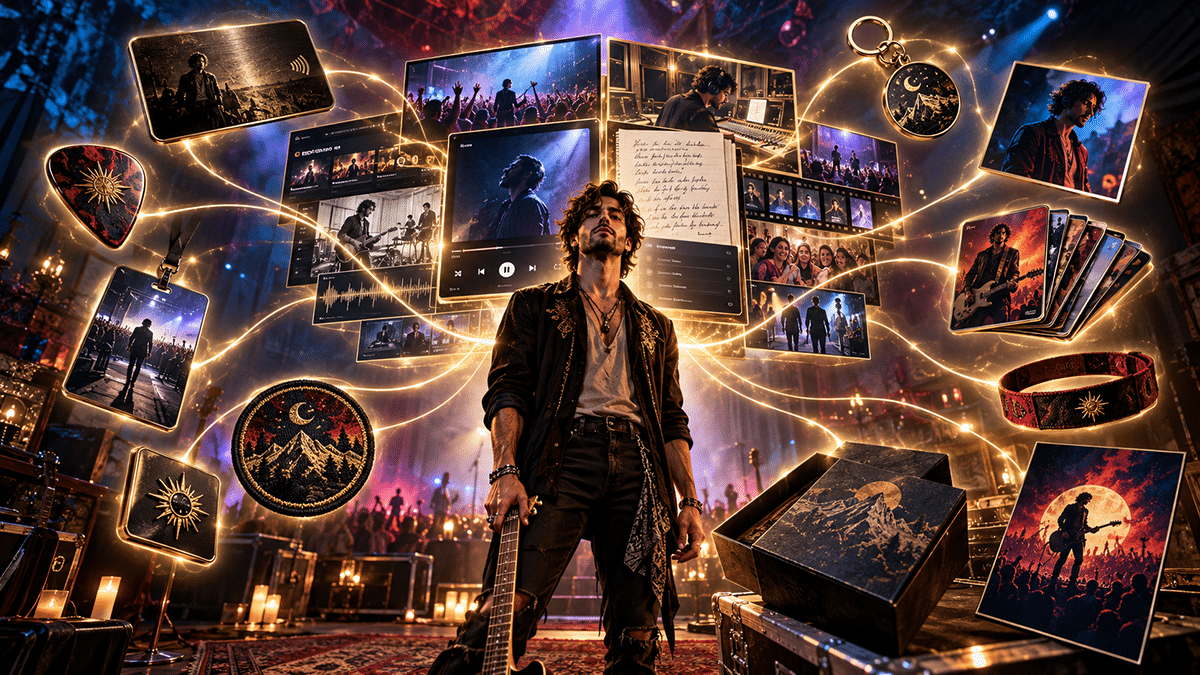
Patches That Become Membership Credentials
Custom patches are another low-cost product that can become surprisingly powerful when the digital experience is built around belonging rather than simple access. Printful offers custom embroidered patches without requiring a large minimum order, allowing an artist to test designs before committing to boxes of inventory. Bulk discounts become available at higher quantities, which gives musicians a fairly low-risk way to experiment with a design and then scale it if fans respond. Its patch options are available at https://www.printful.com/custom-patches.
The patch itself can become a symbol of membership rather than just another place to print the band’s logo. The NFC component could live inside the backing card or packaging, allowing the patch to remain comfortable and durable while the smart activation stays protected. Once activated, the product could identify the owner as part of a particular album-era fan group and unlock music, behind-the-scenes material, presale access or other benefits connected to that release.
The concept becomes even more interesting across several albums or tours. A different patch could be created for each release, and the software could recognize when the same fan has activated multiple editions. Owning three different patches might unlock a deeper archive, while owning the complete series could open an annual livestream, special merchandise or early access to limited products. Instead of every release resetting the merch relationship back to zero, each new physical object becomes another chapter in a long-term collecting system.
That is where a simple patch stops behaving like ordinary merchandise and begins acting like a credential. Fans are not paying more because polyester thread suddenly became exciting. They are paying because the object represents membership in something they care about and because the software makes that membership useful. Smart Media works best when the technology strengthens an emotional meaning that already exists rather than trying to manufacture one from nothing.
Stickers Can Be Smarter Than They Look
Smart Media does not have to begin with premium merchandise. An inexpensive product can be a tremendous entry point into an artist’s ecosystem, particularly at a merch table where not every fan has enough money left for a shirt, vinyl record and collector box after the venue has charged them fourteen dollars for a drink that tastes faintly of regret. A sticker, magnet or button can offer a low-cost way for someone to take part in the experience without requiring them to make a major purchase.
Sticker Mule sells stickers, magnets, buttons, keychains, charms, coasters, posters and other customizable products, with some items available in small trial quantities. That makes it useful for artists testing different forms before deciding which ones deserve a larger production run. Its full product range is available at https://www.stickermule.com/products. A holographic sticker or premium die-cut design can become especially effective when it carries a distinctive album symbol rather than simply repeating the artist’s name across another surface.
The digital experience behind a low-cost item does not have to reveal the entire album. It could unlock one track, a video, a lyric experience or a discount that encourages the fan to explore the rest of the artist’s store. The important thing is that the activation begins a relationship and gives the fan a reason to voluntarily return. That makes the five-dollar product more than a souvenir because it becomes a low-friction doorway into the artist’s larger direct-to-fan world.
This is a fundamentally different way of thinking about promotional merchandise. Traditionally, the artist gives away a sticker and hopes the fan places it somewhere visible enough to act as advertising. Smart Media allows that same object to advertise while also opening music, capturing voluntary fan interest and moving the person toward another purchase or experience. A tiny piece of vinyl suddenly becomes part of the artist’s customer journey, which is a much more useful job than spending two years attached to somebody’s refrigerator.
Keychains May Be the Perfect Everyday Album
Keychains are especially interesting because they solve one problem most physical music formats never could: people carry them everywhere. Vinyl records look wonderful on a shelf, but they are not particularly useful when you are standing in a parking lot and suddenly want to show somebody your favorite artist. A small Smart Media keychain can travel with the fan every day, giving the album a physical presence that is both practical and visible.
GoToTags manufactures custom NFC key fobs in materials including PVC, ABS, polycarbonate and leather, with options for printing and engraving. The company’s custom NFC key fob category can be found at https://store.gototags.com/nfc-tags/other-nfc-products/custom-nfc-key-fobs/. An artist could create a limited keychain shaped like the album logo, the band’s symbol or some object tied to the songs, allowing the collectible to feel more intentional than a generic tag with a logo slapped on it.
The digital experience could keep changing throughout the life of the product. During release week, the keychain might simply open the album, lyrics and credits. Once the tour begins, the same object could become a mobile tour companion, opening dates, venue information and special show content. After the tour, it could unlock live recordings, photo galleries and anniversary material, allowing the object to continue functioning rather than becoming obsolete when the promotional cycle ends.
That longevity is part of what makes Smart Media attractive. A traditional campaign asks the artist to repeatedly find new ways to interrupt the fan’s attention. A useful Smart Media object gives the fan a reason to come back voluntarily because the same physical key keeps opening new material. That is a much healthier relationship than spraying promotional posts into every social platform and praying the recommendation engine briefly remembers your band exists.
Wristbands Can Turn Touring Into a Story
For touring artists, NFC wristbands create another interesting opportunity because the object already belongs naturally in the live-music environment. GoToTags offers custom NFC wristbands in several formats, including silicone and fabric designs, with some customized versions requiring larger quantities that make them more suitable for established touring acts, festivals or multi-artist events than extremely small local shows. Its wristband category is available at https://store.gototags.com/nfc-tags/other-nfc-products/nfc-wristbands/.
The digital experience can turn the wristband into a tour passport rather than leaving it as something the fan removes on the drive home. A fan could purchase the wristband at the first show and use it to check in voluntarily at later performances. Each check-in might unlock a venue-specific photograph, short backstage video, live recording or digital show stamp, allowing the fan to build a personal record of the tour. Someone who attends multiple dates could eventually earn access to a special product, concert recording or members-only event.
This kind of system creates loyalty without making the fan feel as though they have enrolled in a grocery-store rewards program. The technology remains in the background while the emotional experience is about remembering where you were and what happened there. Fans often treasure wristbands, ticket stubs and backstage passes precisely because those objects are attached to memories. Smart Media simply gives the artist a way to make those memories interactive and to continue adding meaning after the event is over.
That matters because fans usually do not want to feel tracked. They want to feel remembered. If the system is transparent about consent and gives people a genuine reason to participate, a tour wristband can become a bridge between live attendance, merchandise, future ticket sales and direct fan communication. The software should support that relationship rather than turning the concert into a disguised data-extraction exercise.
Enamel Pins Can Become Achievement Badges
Enamel pins are another natural fit because people already collect, display and trade them. WizardPins manufactures custom soft and hard enamel pins with multiple plating, engraving and packaging options, and many designs can begin at relatively modest quantities. That makes pins realistic for independent artists who want something more durable and collectible than a paper card without immediately ordering thousands of pieces. Its custom enamel pin information is available at https://wizardpins.com/products/enamel-pins.
The pin itself does not necessarily need to contain the NFC hardware, which can again live in the custom backer card or packaging. That keeps production simpler while giving the artist more room to create a complete visual presentation. The backing card can carry the album artwork, edition number, activation instructions and perhaps a short explanation of what the pin represents, while the physical pin becomes the part the fan wears and displays.
An artist could create one pin representing the album, another representing the tour and another representing a specific song, venue or fan achievement. The digital experience could recognize which ones a fan owns and unlock additional content when several have been activated. This borrows some of the satisfying completion mechanics found in games without turning the music business into a slot machine. The fan gets a visible collection, while the artist gains a way to reward long-term participation.
That distinction between collecting and manipulation matters. Smart Media should not be used to trick people into repeatedly buying random objects just to chase a reward. It works best when the editions are clearly explained, the scarcity is real and the fan understands what each product offers. Collectors appreciate mystery, but they appreciate trust even more.
The Smart Media Trading Card Has Enormous Potential
Trading cards may be one of the most underused merchandising formats in independent music. They are inexpensive enough to manufacture, visually flexible, naturally collectible and already understood by fans as something that can exist in sets, rarities and editions. MakePlayingCards allows artists to create fully customized decks with different artwork on individual cards and offers many stock, finish and packaging options, including prototype quantities that can be useful before committing to a larger run. Its custom card platform is available at https://www.makeplayingcards.com/design/custom-blank-card.html.
An album could become a twelve-card set where each track receives its own artwork, lyric excerpt, credits and story. The package could contain the activation technology while the software mirrors the physical collection, giving each card a corresponding chapter inside the digital album. One card might unlock the studio demo, another a performance video and another an interview about the lyric, making the cards meaningful rather than decorative variations of the same basic object.
The collectible mechanics become much more interesting when some versions are harder to obtain. A signed card could appear in selected packages, while a concert-only card could be available exclusively at live shows. Another version might be included with online orders, giving fans different reasons to interact with the artist in different places. Completing the entire card set could unlock a hidden EP, documentary or other substantial bonus, creating an experience that rewards participation without requiring the artist to manufacture another physical format every time new content is added.
This is where physical scarcity and digital abundance can finally cooperate instead of fighting each other. The physical product gives the fan something finite to collect, trade and display, while the software gives the artist nearly unlimited room to expand what the collection means. The object stays scarce because there are only so many cards, but the experience does not have to remain frozen at the moment of purchase.
The Premium Metal Album
At the premium end of the merch table sits the product that makes somebody stop, pick it up and ask what it is. A metal NFC card can create exactly that reaction because it feels less like promotional material and more like an object intended to be kept. GoToTags offers custom metal and metal-hybrid NFC card production alongside PVC and wood formats, giving artists the ability to create something that feels substantially more luxurious than a standard plastic access card. Information about those products is available at https://store.gototags.com/nfc-tags/nfc-cards/custom-nfc-cards/.
Metal does create an important technical issue because it interferes with ordinary NFC antennas. A properly designed metal product needs construction that isolates the antenna or uses an on-metal NFC solution with an appropriate shielding layer. This is why artists should not simply buy ordinary NFC stickers and attach them to metal tins, plaques or jewelry while assuming everything will magically work because the Internet promised that NFC is easy. GoToTags explains its on-metal tag products at https://store.gototags.com/nfc-tags/nfc-stickers/on-metal-nfc-stickers/.
A premium edition could use a numbered metal card engraved with the album artwork, artist signature or edition number and packaged inside a small presentation box. Tapping it might open a deeper version of the album containing lossless audio, studio documentaries, demo recordings, handwritten lyric scans, photographs and future updates. The fan is no longer deciding whether digital music files are worth ten dollars when similar files can be streamed elsewhere. They are deciding whether a limited physical collectible combined with an evolving owner experience is worth a premium price, which is a much more useful economic question for an independent artist.
The margin opportunity comes from the fact that perceived value does not rise in a straight line with manufacturing cost. A well-designed metal object, excellent packaging and genuinely premium digital experience can feel far more valuable than the raw materials used to make them. That does not mean artists should inflate prices simply because something is shiny, but it does mean thoughtful design can create far more room between production cost and retail value than ordinary commodity merchandise allows.
The Collector Box Brings the Whole Idea Together
The most valuable Smart Media product does not necessarily have to be a single object. It can be a carefully designed collection packaged as one edition. Packlane offers custom mailer and product boxes in small production quantities, including options suitable for prototypes, along with custom sizing, printing and finishing choices. That can help independent artists create premium presentation packaging without immediately entering the slightly terrifying world of ordering ten thousand boxes from an overseas factory. The company’s packaging options can be explored at https://packlane.com/.
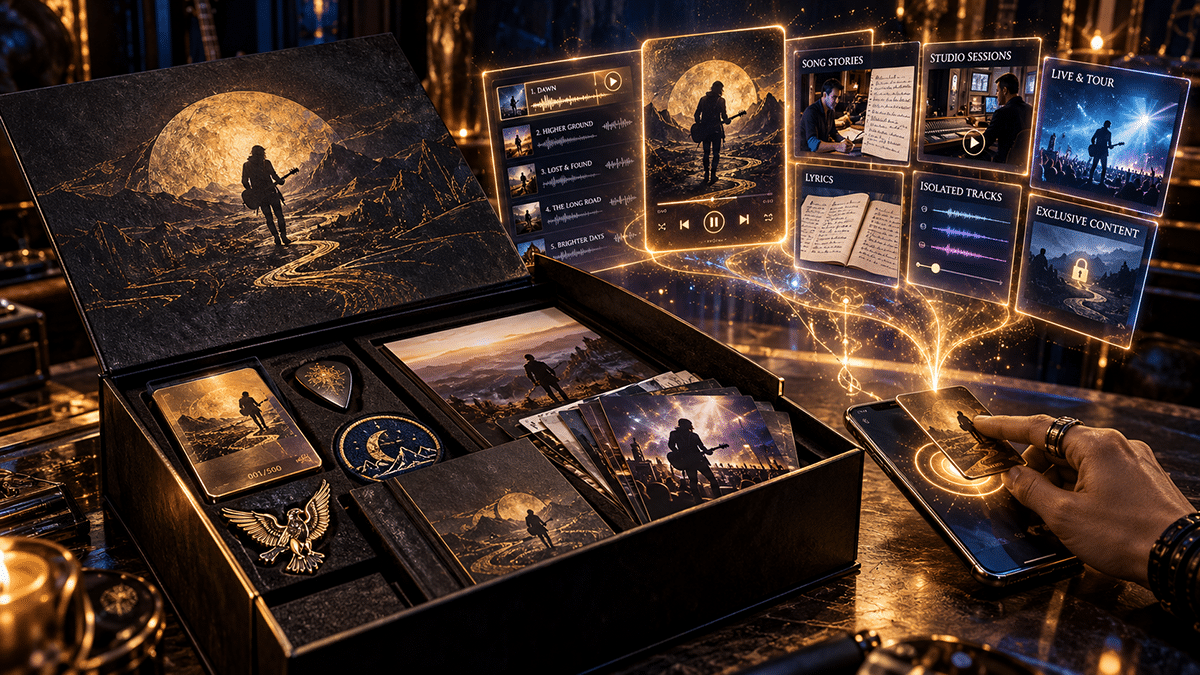
Inside the box could sit an album card, guitar pick, patch, lyric booklet, photograph, enamel pin and signed note, with only one part of the package needing to contain the activation technology. The physical contents establish the emotional and collectible value, while the digital side makes everything inside the box interactive. A fan might tap the metal album card and see a virtual representation of the complete set appear on screen, with each physical object corresponding to a different section of the digital experience.
The guitar pick might open a studio performance, while the lyric booklet launches annotated lyrics or songwriting commentary. The photograph could open a behind-the-scenes video from the day it was taken, while the pin might unlock a members-only archive or future event. The key is that the digital design reflects the physical product so the experience feels deliberately connected rather than looking like the artist assembled a beautiful box and then sent everybody to an unrelated webpage as an afterthought.
This is where packaging stops being merely protection and becomes part of the storytelling. A well-designed box can create a sense of discovery before the fan ever activates anything. Hidden messages, numbered compartments, artwork details and visual references can all carry over into the digital world, making the act of opening the product feel like the first chapter rather than the end of the purchase.
SaaS Turns the Album Into a Living Product
The software architecture behind Smart Media becomes increasingly important as the experience grows. A well-designed system should not permanently hard-code a single destination into the physical product and hope the artist never wants to change anything. The NFC tag or QR code should identify the product, edition or token, while the software behind it decides what that identity unlocks at any given moment. That distinction sounds technical, but it is what allows the physical object to remain useful for years.
If the artist adds a documentary six months after release, the card should not need to be replaced. If the video host changes, the fan should not suddenly discover that the album they purchased now leads to a dead page. If a reward becomes available after a tour, the software should simply update what the existing object opens. The physical collectible remains stable while the SaaS layer grows around it, allowing the artist to keep adding value without manufacturing a new product every time something changes.
From the artist’s perspective, the system should remain simple even if the technology underneath is sophisticated. A musician should be able to see that a particular card belongs to Album A, that a certain edition has been activated and that new content or rewards can be attached to that product. The system can handle authentication, entitlements, secure content access and analytics behind the scenes without requiring the artist to become an expert in database architecture. Very few people started a band because they felt a powerful spiritual calling toward user-permission tables.
This kind of architecture also protects the artist’s investment in the physical inventory. If the URL, hosting platform or content provider changes, the physical product should continue functioning because the identity stays the same while the destination changes behind the scenes. That is an essential principle for any Smart Media platform because a collectible should not become electronic landfill simply because a software vendor disappears.
The Living Liner Notes Experience
One of the easiest Smart Media experiences to understand is the return of the album booklet, except this time it is no longer constrained by the number of pages that fit inside a jewel case. Streaming dramatically reduced the role of credits, artwork and liner notes at exactly the moment digital technology gave artists the ability to make them richer than ever. A Smart Media Album can restore that missing context by letting fans listen to the music while exploring lyrics, photography, musician credits, recording notes and other material that deepens the experience.
Songwriters can explain where a song came from, while engineers can share photographs from the recording session or details about how particular sounds were created. Producers can talk about arrangement decisions, musicians can describe unusual instruments and visual artists can show the development of the cover design. None of this has to feel like homework if it is presented well. It becomes the digital equivalent of sitting on the floor with a record sleeve and discovering that there was more to the album than the sound coming from the speakers.
This also creates a practical benefit for the people who contributed to the recording. Modern streaming interfaces often do a poor job of presenting full credits, and important participants can become almost invisible unless a fan goes looking for them. Smart Media gives the artist enough space to properly identify songwriters, musicians, producers, engineers, photographers, designers and anyone else involved in the project. Treating those people like actual participants rather than hidden metadata fields is both respectful and useful.
The result is that the album begins feeling like a complete work again rather than a folder containing songs. That may sound almost quaint after years of playlist culture, but the physical-digital combination makes it possible to bring depth back without asking fans to abandon the convenience of their phones. Smart Media can combine the richness of older album culture with the flexibility of modern software instead of forcing artists to choose between the two.
The Producer Edition
Some artists can go much deeper by creating a premium edition specifically for musicians, producers and technically curious fans. A Producer Edition might contain the finished master alongside instrumental versions, alternate mixes, isolated stems, studio photographs and commentary from the engineer or producer. Fans could compare a rough mix with the final version, listen to isolated guitar or drum parts and hear how individual production decisions changed the song over time.
This does not mean the artist has to hand out downloadable multitrack sessions to everyone who buys a card. Protected streaming can provide deep access without giving away every production asset in its original form. An artist may decide that some material can be downloaded while other material should remain inside the experience, depending on the rights involved and how comfortable the creators are with redistribution. Smart Media gives the artist control over those decisions instead of treating every bonus file as something that must either be public or completely unavailable.
A premium physical object paired with this kind of deep educational material can create considerably more perceived value than a conventional download. The artist may already possess most of the necessary content because rough mixes, stems, photos and production notes were created during the recording process. Smart Media simply packages those existing assets into a coherent experience rather than leaving them scattered across hard drives where they will eventually be rediscovered in 2034 inside a folder called “FINAL MIX REALLY FINAL 7.”
For working musicians, this can also become a new revenue category. The same recording that generates streaming income, direct sales and licensing opportunities can now support a premium educational or collector edition without requiring the artist to record an entirely new project. That is exactly the kind of revenue stacking independent artists should be looking for because it extracts more value from creative work they already own.
The Documentary Edition
Another approach is to treat the album like a documentary rather than simply a playlist with extra buttons. Artists already generate enormous amounts of behind-the-scenes material during recording, rehearsal, songwriting and touring, but most of it is either never used or released as temporary social content that disappears under the next day’s feed. Smart Media provides a place where that material can remain connected to the album permanently.
Each song can become its own chapter containing the finished track, recording footage, photographs, lyric commentary and conversations with the people who helped create it. A fan can move through the project as a story rather than merely pressing play on twelve tracks in sequence. The physical product acts as the entrance to that documentary, which works especially well with premium photo books, collector cards and boxed editions because the physical design reinforces the feeling that the material belongs together.
This does not require cinematic production budgets. A phone recording from the studio can be valuable if it captures something genuine, while an expensive video can still be boring if it exists only because somebody decided every campaign needs “content.” The most compelling documentary material usually reveals process, personality and decisions that the fan would otherwise never see. Smart Media gives the artist a place to preserve those moments instead of feeding everything into the short-form content furnace.
The broader lesson is that fans often value context as much as polish. People who truly care about an artist want to know how the work came together, what changed during recording and which accidents became part of the final music. When the digital experience answers those questions, the physical collectible starts to feel like an artifact connected to the creation of the album rather than simply another branded product.
The Tour Edition
Touring adds another layer because Smart Media can connect the album to real-world experiences. An artist can create a tour edition that recognizes specific shows, cities or events and adds material as the tour progresses. Fans who voluntarily check in at a venue might unlock location-specific photographs, video or live audio tied to that date, turning the album into a record of where they actually experienced the music.
A fan who attends Atlanta might receive one digital stamp, while Nashville produces another and Chicago another. Over time, the Smart Media experience becomes a personal archive of that fan’s relationship with the artist rather than a generic product shared identically by everyone. This does not need to become a complicated gamification system. Even simple recognition can be powerful because music fans naturally attach songs and shows to specific memories.
The business value comes from connecting experiences that are usually separated. Concert attendance can lead to merchandise, merchandise can lead to membership, membership can lead to ticket presales and direct sales, and Smart Media can provide the connective tissue between those steps. Instead of each transaction living inside a different company’s database, the artist can begin building a voluntary first-party relationship that follows the fan across the artist’s own ecosystem.
That is a much healthier economic model than treating every album cycle as a desperate campaign to acquire strangers from scratch. A fan who bought the first album, attended three shows and activated two products should feel known when the next release arrives. Smart Media makes that kind of continuity possible if the artist builds the system around relationships rather than isolated campaigns.
The Album That Keeps Growing
Perhaps the most interesting Smart Media idea is allowing the experience to continue growing after the album goes on sale. The recording itself can be finished, mastered and complete, but the surrounding experience does not have to freeze on release day. An artist could release the album in January, add an acoustic session in March, tour footage in June, remixes in September and a one-year anniversary performance the following January.
The fan’s original physical object keeps unlocking those additions without requiring another purchase unless the artist intentionally creates a separate premium tier. That makes early ownership feel meaningful because people who supported the project at the beginning continue receiving new value as the album develops. The collector card, keychain or boxed edition begins to feel less like a static product and more like a permanent owner’s key.
This creates a very different psychology from streaming. A streaming subscription gives the fan temporary access to a massive catalog, but ownership of a Smart Media collectible can create the feeling that this particular artist has built something specifically for the people who supported the release. The value comes from continuity and identity rather than sheer quantity. Millions of available songs do not automatically feel more valuable than one album that keeps opening new rooms.
For independent artists, this can also extend the commercial life of a release. Traditional campaigns often behave as though an album becomes ancient history a few weeks after release because attention has moved on. Smart Media gives the artist legitimate reasons to return to the project throughout the year, creating new sales opportunities around additional content without pretending that the same old link has suddenly become news again.
Serial Identity Makes Collecting More Powerful
Collectibles become far more interesting when individual objects have identities of their own. A Smart Media platform can assign a unique identifier to each product rather than sending every card, wristband or keychain to the same public page. Card 0001 can therefore behave differently from Card 0327, even though both belong to the same edition.
That makes true numbered editions possible. The first ten cards might be reserved for band members, another twenty could contain signed inserts and several random editions might unlock an additional video or private stream. The fan can know exactly which object they own, and the artist can maintain a record of what that edition was designed to include. This creates real provenance rather than merely printing “limited edition” on something and hoping nobody asks how limited it actually was.
Scarcity has to remain honest if it is going to create trust. If there are 250 copies, the artist should say there are 250 and avoid quietly manufacturing another 500 identical ones after they sell out. A second run can certainly exist, but it should be visually or digitally distinguishable from the first edition. Collectors care about the story of an object, and that story becomes much more valuable when the artist treats edition information as something real rather than another marketing adjective.
The same system should avoid drifting into artificial gambling mechanics. Fans should not feel pressured to repeatedly buy random products because one invisible card supposedly contains a golden backstage lottery ticket. The goal is to create collectibility, not exploitation. Smart Media becomes far more sustainable when people understand what they are buying and still feel excited about owning it.
Smart Media Can Become a Fan Passport
The long-term potential becomes much larger when several Smart Media products work together. The album card can represent Album One, the patch can represent the tour, the keychain can represent Album Two and the concert wristband can document participation in a live event. When those products belong to the same fan, the artist begins to see a meaningful history instead of four unrelated transactions.
That history should always be voluntary and transparent. The objective is not to create a surveillance system disguised as merchandise. Fans should understand what information is being collected, why it is useful and how they can control communication preferences. If they choose to identify themselves because the experience offers real value, the artist gains something much more useful than anonymous traffic.
Streaming services know who listened, ticketing companies know who bought seats and social networks know who clicked on posts, yet the artist is often the last person permitted to understand the complete relationship. Smart Media offers a path toward changing that imbalance by giving fans reasons to create direct accounts, join communities and carry their history across multiple releases and experiences. The artist gets a relationship rather than a rented audience.
That relationship can support real revenue. Someone who owns two albums and attended three shows may be an ideal candidate for a premium collector edition, membership offer or early ticket presale. The artist does not need an intrusive advertising profile to understand that. They simply need a respectful record of interactions the fan knowingly chose to make inside the artist’s own ecosystem.
The Billboard Question Matters
Because Luminate now recognizes Smart Media, artists need to understand that creating an NFC product does not automatically make that item a Billboard-chart-eligible album. A DIY Smart Media collectible can be a great merchandise product and still have nothing to do with chart reporting. That distinction needs to remain clear because nothing destroys trust faster than indie artists being encouraged to print “Billboard eligible” on a box of NFC keychains simply because somebody discovered the phrase in a press release.
Luminate states that qualifying Smart Media albums must be hosted through a dedicated app, website or platform that the activation process opens. A product cannot simply tap the fan into Spotify or another outside streaming service and qualify on that basis. Luminate also accepts Smart Media sales reporting from approved Smart Media vendors, which means artists planning around chart eligibility need to confirm the route before manufacturing products rather than assuming that every creative implementation will count. Current eligibility information is available at https://support.luminatedata.com/portal/en/kb/articles/eligibility, while its activity-type guidance appears at https://support.luminatedata.com/portal/en/kb/articles/activity-types.
Luminate’s music-registration documentation also identifies specific Smart Media registration codes and places limits on how many Smart Media products in a release group can receive chart eligibility. That means an artist can create many creative merchandise variations while only a limited number function as chart-eligible Smart Media versions. The registration information is available at https://support.luminatedata.com/portal/en/kb/articles/music-registration.
This separation between chart strategy and revenue strategy is important. A keychain does not suddenly become a bad product because it does not contribute to Billboard. If it costs five dollars to manufacture and fans happily pay twenty-five dollars because the experience is worth it, that object is already performing a useful business function. Charts can matter, particularly when an artist has a realistic promotional strategy around them, but cash flow remains impressively capable of paying the electric bill without ever appearing in a ranking.
KiTbetter Shows What an Official Smart Media Route Can Look Like
For independent artists interested in an established Smart Media format, KiTbetter provides a practical example. The company offers self-releasing musicians its KiTalbum format, which combines a physical package with access to digital music, video, artwork and other fan content through the KiTplayer environment. Its artist program supports direct sales through KiTbetter as well as wholesale ordering for artists who want inventory for their own stores and merch tables. Current artist information is available at https://www.kitbetter.com/en/artists/landing.
KiTbetter announced in September 2026 that KiTalbums had become Billboard chart-eligible under the new Smart Media Album category. Its press information is available at https://press.kitbetter.com/. That makes KiTbetter particularly relevant for artists who want to understand what a formal Smart Media product looks like when the reporting and delivery infrastructure are already built into the service.
The lesson is not that every independent musician should immediately adopt one provider. The lesson is that Smart Media has moved beyond being an interesting merch-table experiment and is becoming a recognized commercial format with real infrastructure around it. That creates room for chart-focused products, direct-to-fan products and artist-owned SaaS experiences to coexist rather than forcing everybody into one standardized version.
For many musicians, the most sensible future model may involve an approved chart-eligible Smart Media Album as one product while a broader family of non-charting Smart Media merchandise surrounds it. The official album might be a premium collector package, while the wristband, pin, patch and keychain function as tour, membership and fan-engagement products. The artist can therefore use the recognized format where it provides value without restricting every creative merch idea to whatever the chart rules happen to allow.
What Actually Creates Perceived Value
The NFC technology itself contributes very little to perceived value, which is actually one of the best things about this business model. An NFC tag can cost very little compared with the retail value of the finished product, leaving room for the artist to spend money where fans actually notice it. Design, scarcity, packaging, personalization, storytelling and continuing access do far more to determine whether something feels collectible than the chip hidden inside it.
A numbered metal card feels different from a generic plastic access card because the material, weight and presentation communicate permanence. A guitar pick connected to the recording sessions feels different from a random promotional pick because the story gives it meaning. A twelve-card illustrated set feels different from twelve advertisements because each card contributes to a larger idea. The raw manufacturing cost may not be dramatically higher, but the perceived value can be substantially greater when the design is coherent.
Software then allows that physical value to keep growing. The object can remain exactly the same while new recordings, videos, stories and rewards appear behind it. That combination is what makes Smart Media more interesting than either digital content or physical merchandise on its own. The best products will probably be the ones where taking away either side makes the experience noticeably worse.
An artist should therefore begin with the question of what deserves to become physical. Something tied deeply to the album’s story, artwork or identity will usually have more lasting appeal than whatever promotional object happened to be cheapest that week. Once the physical idea feels worth owning, the digital experience can be designed to deepen that meaning rather than trying to rescue a weak product with technology.
Packaging Becomes Part of the Experience
Independent artists often treat packaging as the thing that keeps merchandise from being scratched during shipping, but Smart Media allows the package itself to become part of the story. A premium box can contain visual clues that appear again inside the software, while physical numbers, symbols and artwork can correspond to sections of the digital experience. The fan begins exploring before anything is tapped.
This does not require absurdly complicated design. A lyric printed inside the lid might correspond to a hidden demo, while an image on the back of a collector card could reappear as an interactive element in the digital album. A numbered compartment could open the matching digital chapter. Small connections like those make the physical and digital sides feel as though they were created together instead of stitched together after somebody remembered the word “interactive” during a marketing meeting.
Consistency matters more than technical complexity. If the physical object looks mysterious and premium but the digital destination looks like a forgotten landing page from 2007, the illusion collapses immediately. The digital interface needs the same visual language, artwork and attention to detail as the object the fan is holding. Smart Media works because the boundaries between product and experience begin to disappear.
That means artists should design the physical and digital components at the same time whenever possible. The merch manufacturer should not be the first half of the project while the web designer becomes an afterthought three days before launch. Both sides tell the same story, and the strongest experiences will feel impossible to separate.
Do Not Build an App Just Because Apps Sound Important
One of the easiest ways to make Smart Media annoying is to add unnecessary friction. If the fan taps an object and is immediately told to visit an app store, download a large application, create another password, verify an email address and approve seven categories of notifications before hearing the album, some of the magic has already leaked out. Technology should make the experience feel easier and richer, not turn a merch purchase into a software-installation project.
There are cases where a dedicated app makes sense, particularly when a provider’s platform or chart-eligible workflow is built around that architecture. KiTbetter, for example, delivers its digital experience through KiTplayer. For an artist-owned SaaS environment, however, a mobile web experience can often provide much of the same visual effect without requiring permanent installation.
The ideal interaction is simple. The fan taps the object, the artwork fills the screen and the experience opens immediately. Music, video, liner notes and fan features appear in a design that feels more like an application than a traditional website, but the person is not forced through several layers of unnecessary setup before discovering why they bought the product.
The smartest technology tends to disappear. Fans should leave talking about the music, the object and what they discovered inside it, not the impressive number of authentication steps they successfully survived. Ease of use is not boring; it is what allows the creative idea to remain the star.
The Artist Has to Own the Relationship
All of this becomes much less exciting if Smart Media simply creates a new dependency on another gatekeeper. The artist should control the music, the product identity, the fan relationship and the customer information that fans voluntarily provide whenever legally and contractually possible. The physical object should also remain useful if the original software provider disappears, changes pricing or decides it would now prefer to become an artificial-intelligence company selling enterprise solutions to dentists.
Content should remain portable, and the activation architecture should allow destinations to change without destroying the usefulness of products already sold. If a hosting provider changes, the album should still work. If video storage moves somewhere else, the fan should not notice. If the artist wants to export the consenting fan community to another system, that option should exist.
This follows the same Making a Scene principle that applies everywhere else in the modern music business. Platforms are useful as discovery and infrastructure tools, but artists should own the destination whenever they can. Smart Media becomes far less revolutionary if the result is simply replacing one rented audience with another rented audience attached to a cooler card.
The best system therefore separates the artist’s identity, product entitlements and fan relationship from any single hosting vendor. That gives independent musicians the freedom to change providers without abandoning the people who purchased their products. Physical ownership should not come with a hidden software expiration date.
The Merch Table Can Become a Record Store Again
There is something wonderfully ironic about the whole idea. Streaming supposedly made physical albums unnecessary because listeners no longer needed an object to access the music. Smart Media becomes interesting precisely because the object is no longer necessary, which means it is finally free to become desirable again.
The merch table can therefore become much more creative than the familiar row of shirts, CDs and vinyl. A casual fan might buy a five-dollar Smart Media sticker, while a guitarist chooses the pick edition. A collector might want the numbered metal card, and a dedicated supporter could purchase the complete box set. Every product can lead into the same underlying artist ecosystem while opening different levels or types of content.
That gives the artist pricing flexibility that ordinary digital music rarely provides. The musician is no longer trying to convince somebody that the same music available through a subscription service is somehow worth fifteen dollars because a different download button is involved. The fan is purchasing an object, an experience and a continuing relationship that streaming does not provide.
This does not mean abandoning vinyl, CDs or conventional merchandise. Smart Media can sit beside all of them and give artists another category rather than replacing the ones that already work. A vinyl buyer may still want vinyl because they love the format, while another fan may prefer the portability of a keychain or the collectibility of a card set. The artist benefits by having more ways to serve different kinds of fans instead of insisting everyone wants the same product.
The Real Product Is Belonging
The deeper opportunity behind Smart Media has very little to do with NFC chips. Fans do not form emotional relationships with radio-frequency identification technology. They form relationships with music, memories, artists and communities, which means the strongest Smart Media products will use the technology to reinforce those things.
A numbered edition can say that the fan supported the project early. A wristband can remind someone that they were at a particular concert. A patch can represent membership in an album-era community, while a collector card can connect the fan to the story behind a song. The evolving digital experience allows those meanings to continue after the purchase rather than ending when the card reader approves the transaction.
That sense of belonging has real economic value because committed fans behave differently from anonymous listeners. They buy tickets, purchase merchandise, support crowdfunding campaigns, join memberships, buy direct releases and tell friends about the artist. An independent musician does not necessarily need millions of strangers touching a play button if enough real people care deeply enough to participate.
Smart Media gives artists infrastructure for recognizing and serving those people. The physical collectible provides identity and emotional meaning, while the digital experience provides ongoing usefulness. When those two pieces are designed well, the product becomes far more than another thing with the band’s logo printed on it.
We Have Been Selling Souvenirs When We Could Be Selling Keys
For years, indie musicians have filled merch tables with objects that advertise the band but do very little after the fan buys them. There is nothing inherently wrong with that, and shirts, records and posters will remain important because fans genuinely enjoy them. Smart Media simply invites artists to ask a more interesting question about what else those objects could become.
A backstage pass can finally provide access. A guitar pick can open the recording session that produced the song. A keychain can become a permanent owner credential, while a patch can establish membership in a fan community. A collector card can unlock material that changes over time, and a premium metal edition can become the physical identity of an album experience that keeps growing for years.
Once you begin thinking in those terms, almost anything on the merch table can become media, provided the object deserves to exist and the software gives it a reason to remain useful. The physical product becomes the key, the digital experience becomes the world behind the door, and the artist controls the relationship between them. That combination gives independent musicians something much more valuable than another format to sell because it creates another path toward direct revenue, repeat engagement and fan relationships that belong to the artist rather than the platform.
That is the real promise of Smart Media for independent musicians. It is not about turning every object into a technological gimmick or convincing fans they need yet another proprietary music format. It is about taking the physical merchandise fans already enjoy, connecting it to meaningful digital experiences and building products whose value the artist can expand over time. Instead of asking a streaming platform what a song is worth, the artist can build an experience valuable enough that the fan makes that decision directly.
 |  Spotify |  Deezer |  Breaker |
 Pocket Cast |  Radio Public |  Stitcher |  TuneIn |
 IHeart Radio |  Mixcloud |  PlayerFM |  Amazon |
 Jiosaavn |  Gaana |  Vurbl |  Audius |
 Reason.Fm | |||
Find our Podcasts on these outlets
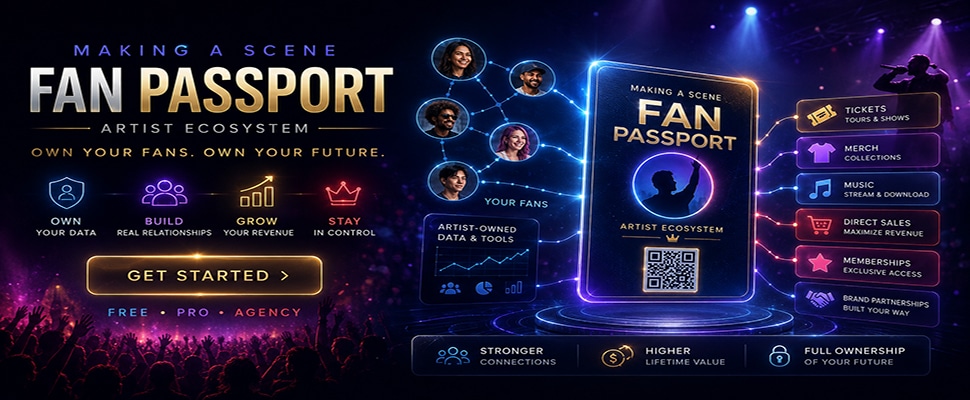
Subscribe to Our Newsletter
Discover more from Making A Scene!
Subscribe to get the latest posts sent to your email.


