

Reverb and Depth: How to Place Sounds in a 3D Space




Making a Scene Presents – Reverb and Depth: How to Place Sounds in a 3D Space
Listen to the Podcast Discussion
Flat Mixes Do Not Sound Cheap Because the Song Is Bad
A lot of indie artists think their mixes sound small because they do not have enough expensive gear, enough fancy plugins, or enough studio prestige. That is the lie the old gatekeeper system sold for years. The truth is rougher and more useful. Most flat mixes sound flat because everything is standing in the same spot. The vocal is too close. The snare is too close. The guitars are too close. The keys are too close. Nothing feels near because nothing feels far. Nothing has air around it because nothing has a believable world around it. That is where reverb stops being a decorative effect and starts becoming one of the most powerful tools in a modern mix. Mix depth is the front-to-back dimension that helps make a mix feel lifelike and three-dimensional, and it points out that this sense of dimension is one of the clearest differences between amateur and professional sounding mixes.
For indie artists, this matters way beyond engineering vanity. A flat mix does not just sound less “pro.” It also makes your record less emotionally convincing. It makes your vocal feel less intimate when it should feel intimate. It makes your chorus feel less huge when it should feel huge. It makes your catalog feel smaller when you are trying to build direct sales, licensing value, fan support, and a body of work that sounds like it belongs to a real artist with a point of view. If you want to own your music and make it carry more value without waiting for some label middleman to wave a wand over it, you need to learn how to make the speakers disappear and let the listener step into a world. Reverb is a huge part of that.
Reverb Is Really Your Brain Measuring Distance
At its core, reverb is what happens when a sound enters a space, bounces off surfaces, and reaches our ears as a dense stream of reflections after the direct sound. When a sound occurs in a space, waves reflect off surfaces and decay until the reflections die away, and that we hear those closely spaced reflections as one continuous event we call reverb. That is why reverb is not just “echo.” It is information. Your brain uses it to judge the size of the space, the hardness of the surfaces, and how far away the sound source feels.
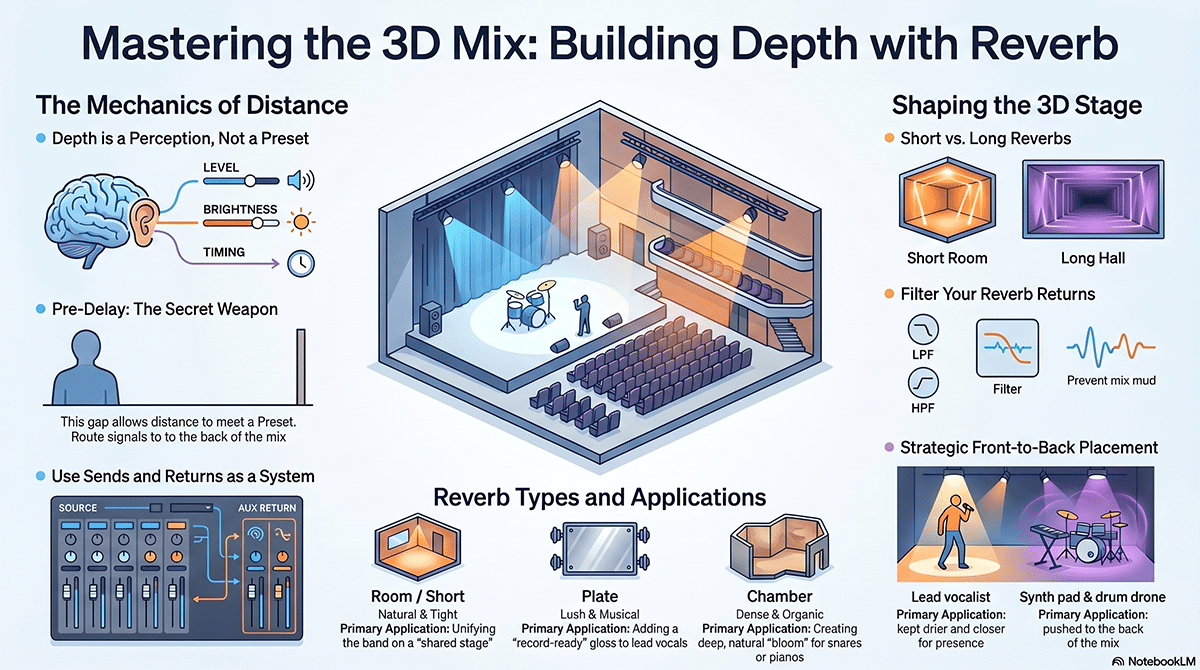
That is also why reverb creates depth. Your ears do not just hear a vocal. They hear a vocal plus a room, plus the time between the dry vocal and the room’s response, plus how bright or dark that response is, plus how long it hangs around. All of those clues help your brain decide whether the singer is right up in your face, standing a few feet back, or floating in some huge dreamlike space behind the band. Depth is a front-to-back illusion built from a mix of cues such as level, brightness, ambience, and timing, not from one magic preset.
That point is worth sitting with for a minute, because it changes how you use reverb. Reverb is not there to make a track “sound cool.” Reverb is there to tell the listener where the track lives. Once you hear it that way, you stop asking, “Which preset should I use on this vocal?” and start asking, “How close do I want this vocal to feel?” That is a much better question. It is a producer’s question, not just an effect-user’s question. And for indie artists building records at home, learning to think like that is one of the clearest ways to move from hobby mixing to making records that feel finished.
Reverb Was Not Invented as a Plugin. It Started as a Room.
In the earliest days of recording, there was no plugin, no aux send, and no “wet/dry” knob. Early recordings simply captured the natural ambience of the recording environment itself, often with a single microphone, and that this worked because the performances and recording techniques of the time were built around real acoustic spaces like halls and theaters. In other words, reverb was just the room telling the truth.
As recording changed, engineers wanted more control. They wanted to capture instruments and voices more directly, then decide later how much space to add. That led to echo chambers, which were literal rooms designed to create artificial ambience. Universal Audio’s history of EMT reverb explains that these setups used a speaker to play the dry signal into a reflective room and microphones to capture the returned ambience, which could then be blended back into the recording. That was one of the first big studio hacks in modern production. Engineers were still using a real room, but now they were using it on purpose, after the fact, as a controllable recording tool.
Then came plate reverb. EMT released the EMT 140 in 1957, widely regarded as the first plate reverb. Instead of sending sound into a special chamber, the unit sent vibration into a large suspended sheet of metal and captured the motion with pickups. The result was lush, dense, bright, and musical. Plate reverb: a large metal plate creates a spacious and distinctive sound that does not necessarily behave exactly like a real room, but became beloved because it sounded beautiful on records. That is an important little truth about reverb history. Recording people did not just want realism. They wanted useful lies. They wanted spaces that made records feel larger than life.
Spring reverb followed a similar idea but used springs instead of a plate. The spring reverb uses metal springs, an input transducer that excites them, and an output transducer that captures the resulting delays and reflections. That is why spring has that splashy, drippy, unmistakably mechanical character. It is not pretending to be a concert hall. It is a piece of machinery with attitude. Later, digital reverbs expanded the palette even more, and modern convolution reverbs went a step further by sampling real spaces and replaying them. Convolution Reverb is “acoustic photography,” because it captures the time and tonal behavior of a room or processor and reproduces it in software.
That whole history matters because it reminds indie artists of something the old studio culture often hid under mystique. Reverb has always been about shaping perspective. Whether it was a hall, a chamber, a plate, a spring, a digital algorithm, or a convolution capture, the goal was never just “more effect.” The goal was always space on demand.
Depth Is Built From More Than Wetness
This is where a lot of home mixers get into trouble. They think adding depth means adding more reverb. But depth is not just wet versus dry. It is important to point out that loudness, brightness, dryness, and timing all help create front-to-back position. Louder sounds generally feel closer while quieter sounds feel farther away. In practice, that means your brain decides distance from a whole bundle of clues.
A close sound is usually louder, more direct, more detailed, and often brighter. A farther sound is usually quieter, softer on the top end, and more blended into the environment around it. Reverb helps create that blend, but it works best when the rest of the cues support it. If you pile a huge bright hall onto a lead vocal but leave it super loud and aggressive, you may wind up with a confusing sound that feels both near and far at once. If you darken the return a little, keep the dry vocal strong, and use pre-delay so the source speaks before the room answers, the same reverb can suddenly make sense.
That is the adult version of using reverb. You are not just making things wetter. You are building perspective. That means reverb decisions should be connected to level decisions, EQ decisions, arrangement decisions, and even panning decisions. It is less glamorous than thinking one plugin will save the mix, but it is a lot more powerful. And that is the Making a Scene part of this conversation. Artist independence does not mean avoiding craft. It means owning the craft instead of renting the illusion of it.
Short Reverbs Make Things Feel Real Without Smearing the Song
Short reverbs are one of the best tools for creating depth while keeping a mix clear. Room reverbs as smaller spaces with shorter decay times and closer reflections, and modern productions often use reverb decays in the one-to-three-second range, with stronger early reflections and quicker decays helping create a stereo sense from a mono source. In plain English, shorter reverbs can give something shape and environment without washing away its punch.
That makes short rooms, ambiences, and tight chambers incredibly useful in dense indie mixes. A short room on snare can make it feel like it belongs in a real physical space instead of being a cardboard hit in the middle of nowhere. A subtle ambience on a vocal can keep it feeling expensive and alive without turning every word into a cloud. A short shared room across drums, guitars, keys, and backing vocals can make all those parts feel like they are standing on the same stage together. Shared reverb use is a way to make groups of sounds feel unified rather than disconnected.
For genre-neutral home production, short reverb is often the smartest first move because it does not announce itself as loudly as a huge hall does. It lets the mix breathe. It tells the listener, “These sounds exist in a real place,” without screaming, “Listen to my preset.” That is a big distinction. Great depth often starts subtle. It often starts with a room you do not consciously notice. You just miss it when it is gone.
Long Reverbs Are Emotional, Cinematic, and Dangerous
Long reverbs are where a lot of musicians fall in love and then ruin a mix. They are beautiful for a reason. A long hall can make a vocal feel majestic. A long plate can make a chorus open up. A giant chamber can make a snare or piano feel like it belongs in a movie. Universal Audio’s overview of reverb types notes that chamber reverb gives a natural, organic character from actual reflective spaces, plate reverb is lush and natural sounding without necessarily sounding like a room, and digital reverbs can add expansive clarity and full-on soundscape behavior that analog systems could not.
The problem is that long reverbs take up a lot of real estate. On reverb-heavy mixes it is easy to overcook a mix with reverb, especially when low frequencies pile up or high-frequency splash from consonants and percussion starts floating above the track. It is recommended that you use high-pass and low-pass filtering on the reverb signal to keep the mix from turning into mud or harsh haze. That is not a minor tweak. It is one of the core moves that separates an immersive reverb from a messy one.
So long reverbs work best when they have a clear purpose. Put them on the emotional thing. The line at the end of the chorus. The tom fill that opens the bridge. The pad that is supposed to hold up the back wall of the song. The lead phrase that needs to bloom for a second after the band drops. Long reverb is not there to sit on every track by default. It is there to create dimension and drama where the arrangement actually needs dimension and drama. When you use it that way, it can make a home-studio record feel huge. When you use it everywhere, it makes the whole song feel like it got sprayed with a garden hose.
Pre-Delay Is the Secret Weapon for Keeping Things Close and Big at the Same Time
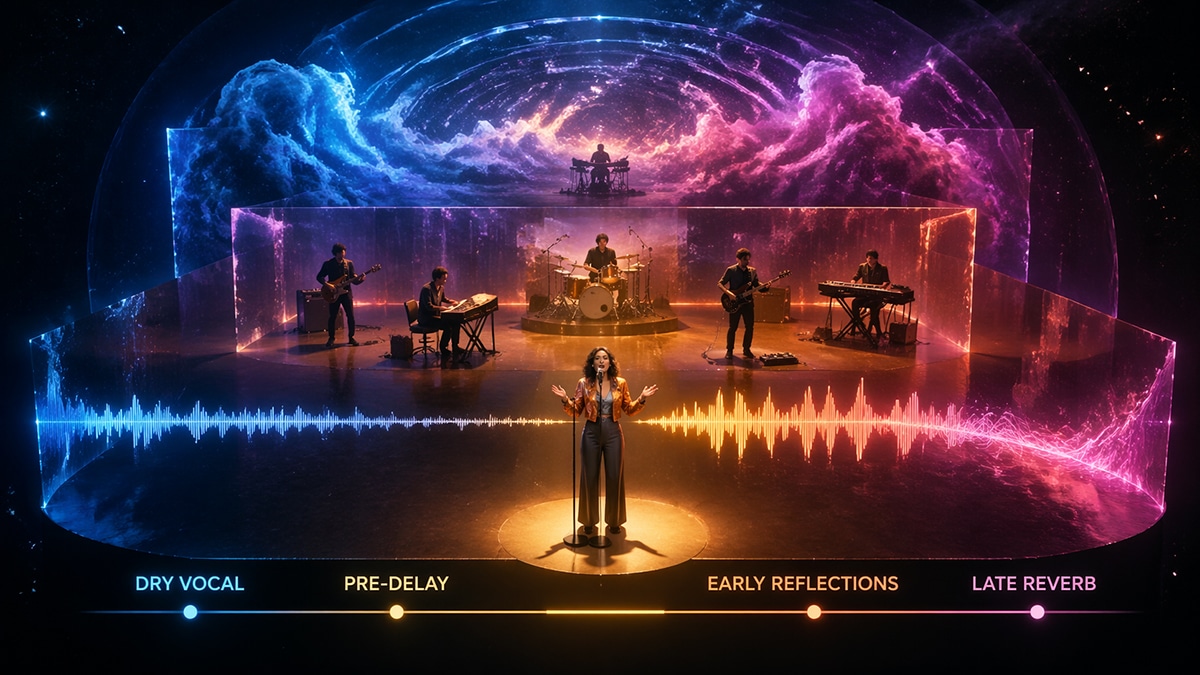
If there is one reverb control indie artists should stop ignoring, it is pre-delay. Pre-delay is the time between the original sound and the first audible reflections, and notes that adjusting it changes the apparent size of the room without necessarily changing the decay time. It also says this added gap leaves space between the original sound and its reverb, which increases transparency. That is a small technical description of a very big creative move.
Here is why it matters. Without much pre-delay, the room jumps on top of the source right away. The sound feels more embedded in the space, but it can also feel blurred or pushed back. With more pre-delay, the dry sound gets to hit the listener first and the room follows behind it a moment later. The source stays present and articulate, but the space still feels large. That is why pre-delay is so powerful on lead vocals, snares, and anything else that needs to feel close while still living in a bigger environment.
Think of it this way. Decay controls how long the room hangs around. Pre-delay controls how long the source gets to stand alone before the room answers back. That means pre-delay is a perspective tool, not just a time tool. It helps you place something at the front of the stage without forcing you to make the room tiny. Once you understand that, a lot of reverb choices get easier.
Send and Return Tracks Are Where Reverb Stops Being a Toy and Starts Becoming a System
A lot of beginner mixes get clogged because the artist keeps inserting different reverbs directly on individual tracks. One on the vocal. One on the snare. One on the guitar. One on the keys. Another on the backing vocals. Another on the lead guitar. Soon the mix is not living in one believable world. It is living in six unrelated weather systems. Using sends and returns is the difference between putting reverb directly on a track as an insert and routing signal to an auxiliary return, and using dedicated aux channels because they let you treat the reverb as a separate signal and control it more precisely.
The standard approach is to use return or auxiliary channels with the effect set to 100 percent wet. You should be thinking of reverb as another signal in the mix, almost like another instrument. The wet-only mode is what you use when the plugin sits on an aux return for channel sends. This matters because it turns reverb from a one-off effect into part of the architecture of the mix.
Once you use sends and returns, everything changes. Now one short room can serve multiple tracks. Now one longer plate can be reserved for selective emotional moments. Now you can EQ the return, compress the return, automate the return, or duck the return without touching the dry source. The send-and-return method leaves all the dry definition in the source while giving you independent control of the effect on a separate channel, and it also allows multiple channels to feed the same effect. That is how you build a consistent sense of place in a mix.
For indie artists, that also means more CPU efficiency and less chaos. But the real benefit is conceptual. You stop treating reverb like seasoning that gets sprinkled track by track. You start treating it like scenery. You decide which sounds stand in the same room and which ones deserve their own special space.
Reverb Starts Before the Plugin Ever Loads
One of the most useful mindset shifts an indie artist can make is understanding that depth starts during recording. Some depth can be captured at the source by changing mic position and taking advantage of room sound, closer microphones capture less room ambience while greater distance adds more room sound and more source-to-mic delay, which creates important auditory cues about distance. That means mic distance is not just a tone choice. It is a perspective choice.
If you want a vocal to feel intimate and close, you usually want more direct sound and less room. If you want a backing vocal to feel farther away or more blended, stepping back from the mic a little can help before the mix even begins. If you want a percussion layer to sound like it is living around the edges of the track, recording some natural room into it may save you from forcing the depth later with heavy processing. That is one reason real engineers obsess over placement. They are not just chasing fidelity. They are capturing perspective.
But there is a warning here for home studios. A bad room is not magical “natural depth.” A bad room is just a bad room. A bedroom sounds like a bedroom and a bathroom sounds like a bathroom. So yes, reverb starts before the plugin. But that does not mean every cheap room sound deserves to stay. Capture useful ambience when it helps. Control ugly reflections when they hurt. Then use artificial reverb to tell the rest of the story with intention.
How to Place Real Instruments Front to Back
When you start hearing reverb as placement, the front-to-back map of a mix becomes easier to understand. A lead vocal that should feel personal usually wants to stay fairly dry compared to the rest of the arrangement, or it may use a short ambience plus a longer reverb with enough pre-delay to keep the words clear. Using a dedicated aux channel for vocal reverb so you can shape the wet signal independently from the dry source, which is exactly what you want when the singer needs to stay in front while the space blooms around them.
Snare is often a depth anchor. A short room or plate can make it feel like it lives in an actual performance space rather than in a flat digital plane. If you want it to feel larger without pushing it backward, pre-delay helps. If you want it farther back in the stage picture, more send level and a slightly darker return can do the job. The same basic logic applies to percussion, claps, and hand-played parts. Short verbs preserve impact. Longer tails create size but need to be controlled.
Guitars and keys often live beautifully in the midground. They do not usually need to be as dry and immediate as the lead vocal, but they also do not need to drown in atmosphere unless the arrangement is built for that. A shared room, a chamber, or a filtered plate can help them feel glued into the same world as the band. On more atmospheric parts, a longer hall or adaptive space can push them farther back so they support the scene rather than compete for the center. Again, the goal is not just effect. The goal is position.
Pads, drones, swells, and cinematic layers are where you can often be bolder. These sounds can carry more of the long, dark, wide reverb because their job is often to create the back wall of the mix. They do not always need the same directness as a lyric or a snare transient. This is where a song starts feeling immersive rather than simply layered. And if the arrangement has enough dry information up front, those distant elements can make the whole record feel deeper without making it blurry.
Intelligent Reverb Tools Can Speed Up the Process Without Replacing Your Judgment
This is where the new generation of tools gets interesting. There are now reverbs that do more than imitate a room. They analyze source material, help avoid masking, and in some cases make it easier to stage depth in a way that feels perceptual instead of technical. For indie artists who are recording, producing, marketing, and often releasing music from the same desk, that kind of speed matters. Better workflow means more songs finished, more catalog built, and more revenue opportunities kept in your hands instead of delayed by endless tinkering.
iZotope Neoverb is one of the clearest examples. iZotope describes it as an intelligent reverb designed to help users find the right sound faster, and its product and tutorial pages say that its AI-powered EQ listens to the audio and helps avoid mud, artifacts, and masking. It also lets you blend multiple reverb types inside one interface, which is useful when you are trying to find a space that supports the source without spending half the session swapping plugins. For an indie artist working alone, Neoverb’s value is not that it “does the mix for you.” Its value is that it shortens the distance between the idea in your head and a reverb that actually behaves in the mix.
sonible smart:reverb 2 goes even more directly after the depth problem. sonible describes it as a content-aware reverb that understands single tracks and entire mixes, with depth staging across multiple tracks, inter-plugin communication, and intuitive controls like Distance, Size, Width, Color, and Clarity. Its manual and blog posts explain that the Distance control is meant to shape spatial impression in a perceptual way, and that inter-plugin communication helps different instances cooperate so masking is reduced and the sense of space stays cleaner across the mix. That is a serious idea. It means the tool is not only generating a tail. It is helping organize the stage.
Zynaptiq ADAPTIVERB is another fascinating tool, though it comes from a slightly different angle. Zynaptiq describes it as a reflectionless reverberation plugin that adds perceived depth and smooth tails without obscuring the source, and its product pages say it is powered by ray tracing, source separation, and advances in artificial intelligence. That makes it less of a traditional “put this in a room” reverb and more of a space-growing tool that can add body, size, and harmonic richness while preserving directness. For ambient layers, cinematic textures, synth beds, and other parts where you want a sense of depth without obvious room reflections, it can be a very creative option.
The important thing is not to fall for the hype cycle. Intelligent tools are useful when they give you speed, clarity, and a better starting point. They are not useful if they become another way to avoid learning how space actually works. The artist still has to decide what belongs up front, what belongs in the middle, and what deserves to live in the back of the room. AI can assist that judgment. It cannot replace taste.
Classic Reverbs Still Matter Because Personality Still Matters
Not every great reverb is marketed as intelligent. Some reverbs are valuable because they have a strong character and a clear musical purpose. Valhalla VintageVerb is built around classic digital-style algorithms and color modes inspired by beloved hardware from the 1970s and 1980s. Soundtoys SuperPlate focuses on five plate reverb models. Universal Audio Capitol Chambers recreates Capitol’s famous echo chambers and includes mic repositioning and signal-chain detail, while Waves Abbey Road Chambers models not only the chambers but also the delays, filters, speakers, mics, and signal path involved in the original setup.
Why does that still matter? Because depth is not always about realism. Sometimes the right choice is a plate that sounds obviously glossy and musical. Sometimes a chamber gives you density and romance that a plain room never will. Sometimes the point is not to fool the listener into believing a real room exists. The point is to make the record feel like a record. Personality matters. The trick is choosing personalities that help tell the same story instead of throwing five different histories of reverb into one song just because you can.
The Real Goal Is Not Wetness. It Is Ownership of Space.
This is the part too many indie artists skip. Reverb is not just part of mixing. It is part of artistic identity. It shapes how intimate your records feel, how cinematic they feel, how modern they feel, how raw they feel, and how believable the emotional perspective is from one line to the next. Learn to hear it as geography and suddenly your songs stop sounding like a pile of tracks and start sounding like performances happening somewhere.
That matters if you care about artist ownership. A better sense of depth does not just impress engineers. It increases the perceived value of the work you own. It helps a fan hear the difference between a sketch and a record. It helps a sync supervisor hear a finished atmosphere instead of a flat demo. It helps your catalog carry more weight when you are selling direct, pitching for placement, or building a fan-funded career one release at a time. You do not need a million-dollar room to do that. You need intention. You need a front, a back, and the discipline to stop putting every sound in the same place.
So the next time your mix feels small, do not ask only whether it needs more reverb. Ask where everything is standing. Ask who belongs close. Ask who belongs farther away. Ask what room this song deserves. Then build it. That is how reverb becomes depth. And that is how depth becomes power.

Subscribe to Our Newsletter
Discover more from Making A Scene!
Subscribe to get the latest posts sent to your email.


