

Compression in Context: Why Soloing Tracks Is Killing Your Mix





Making a Scene Presents – Compression in Context: Why Soloing Tracks Is Killing Your Mix
Listen to the Podcast Dicussion
There is a little button in every DAW that has wrecked more home studio mixes than bad microphones, cheap headphones, and internet “preset culture” combined. It is the Solo button.
That sounds dramatic, but not by much. Every indie artist knows the move. You are deep in a mix. The vocal feels uneven. The bass feels wild. The snare is jumping out in ugly ways. So you solo the track, pull up a compressor, and start shaping. Suddenly the part sounds bigger, tighter, smoother, richer, louder, more “professional.” You un-solo it, hit play on the full mix, and somehow the whole song feels smaller. The vocal no longer connects. The bass lost its groove. The drums feel choked. The track you “fixed” in solo is now fighting the record instead of serving it.
That is the trap.
Compression is one of the most powerful tools in a mix. It can make a vocal feel intimate, a bass feel steady, a kick feel controlled, a guitar feel glued in place, and a chorus feel like it finally stands up and means something. But compression is also a relationship tool. It does not just shape a sound. It changes how that sound behaves next to every other sound in the arrangement. That is why mixing in solo for too long leads to bad compression decisions. You are judging a relationship tool in isolation. That is like choosing the perfect dance partner by watching someone stand alone in a hallway.
And this matters more now than ever. The modern indie artist is not just writing songs. They are tracking vocals in a spare bedroom, producing beats in headphones, cutting guitars between day-job shifts, and trying to finish release-ready mixes without a label budget or a celebrity engineer. The home studio is not a shortcut anymore. It is the business. If you are the artist, producer, mixer, marketer, and distributor, then every mixing decision is also a business decision. A better mix means more replay value, more trust from listeners, more saves, more shares, better fan conversion, and more money from the things that actually pay independent artists: shows, merch, sync, direct sales, memberships, and fan support. The wrong compression move does not just hurt the sound. It can hurt the whole chain of value that starts when somebody hits play.
So let’s kill the old habit right now. Solo is not evil. Solo is a flashlight. It helps you find a problem. It is not where you should build the whole house.
The lie the solo button tells
The reason soloing is so seductive is simple. When you hear one track by itself, your brain stops asking, “Does this work in the song?” and starts asking, “Does this sound impressive on its own?”
That is a totally different question.
A vocal in solo might seem thin, so you compress it harder, add make-up gain, and feel proud when every word sits right in your face. Then the band comes back in and the vocal feels weirdly pinned to the speakers instead of floating inside the music. A bass might sound too dynamic by itself, so you clamp it down until every note looks neat on the meter. Then the kick disappears because the bass no longer breathes around it. Acoustic guitar in solo might feel too spiky, so you smooth every transient. Then the mix loses motion, sparkle, and rhythm. The part became more polished alone and less useful in company.
iZotope has warned against this exact mindset, noting that what matters is not what each individual track sounds like on its own, but how everything fits together in context, and that they often dissuade people from mixing in solo for long periods. Their own compression teaching materials also repeatedly move from solo examples back into the full arrangement so you can hear what the compressor is really doing when the song is playing, not when the part is isolated.
That is the whole game right there. Context is not a nice extra. Context is the job.
What a compressor is actually doing
Before we go any further, let’s strip the mystery out of compression.
A compressor reduces dynamic range. That means it turns down signals once they cross a set threshold, making the gap smaller between the louder and quieter moments. Apple’s Logic Pro guide puts it plainly: compression reduces sounds that exceed a threshold, smooths out dynamics, and can increase perceived loudness. iZotope explains it the same way, saying compression controls dynamic range by reducing the level when audio rises above a specified threshold.
That sounds technical, but the effect is emotional. Compression can make a singer sound confident. It can make a bass line feel locked in. It can make drums hit as a team. It can make a guitar stop poking holes in a vocal. It can also make a mix lifeless if you overdo it.
The main controls are not complicated once you hear them as musical choices. Threshold decides when compression begins. Ratio decides how strongly it pushes back once the signal crosses that point. Attack decides how fast the compressor grabs the sound. Release decides how quickly it lets go. Knee controls whether that grab feels abrupt or gentle. Make-up gain turns the output back up after compression pulls peaks down. Logic’s user guide lays out these exact relationships, including how slower attack can preserve transients, how release changes the feel of motion, and how make-up gain can restore lost output level.
Here is the part many beginners miss: those controls do not live in a vacuum. An attack time that feels perfect in solo can be too soft once the snare, guitars, and vocals are all fighting for the front of the mix. A release that sounds smooth alone can pump badly when the kick and bass start colliding. A vocal threshold that feels controlled in solo can erase the human rise and fall that makes the lyric believable once the rest of the track drops around it.
Compression is not just “make it even.” Compression is “decide how this part should move inside this song.”
Why soloing leads to bad compression decisions
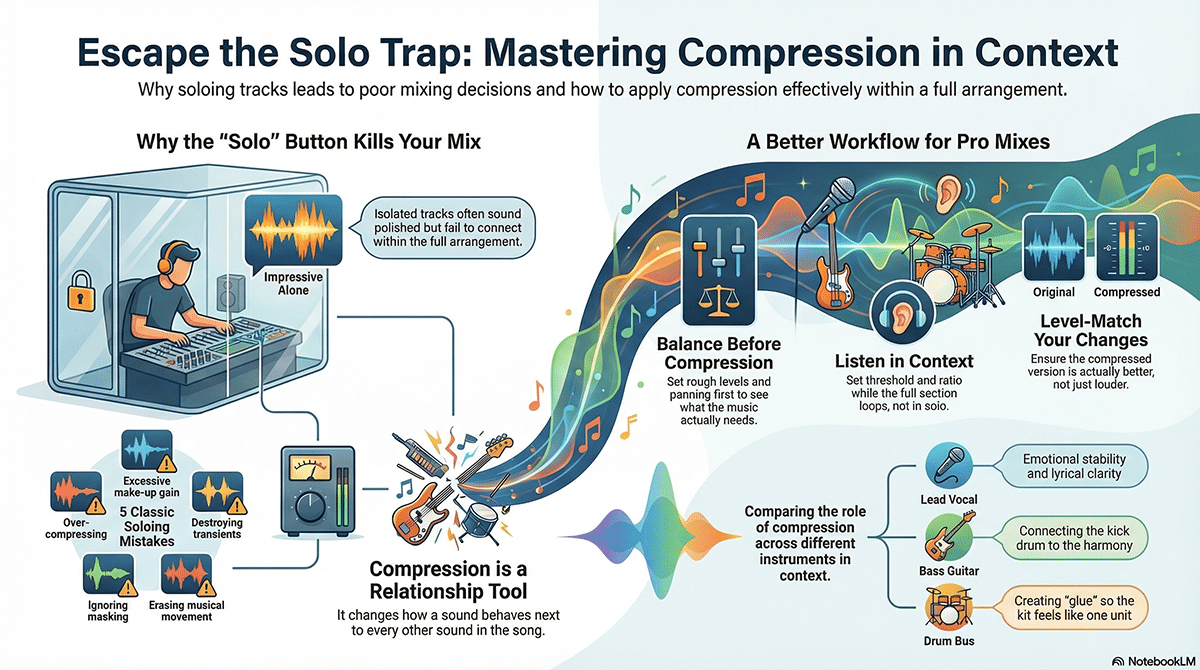
When you compress in solo, you are usually making one of five classic mistakes.
First, you over-compress because you can hear every peak. In solo, every little jump feels like a problem. In a full mix, many of those jumps are exactly what help the part cut through without needing more level. A snare crack, a bass pluck, a consonant on a vocal, the pick on an acoustic guitar, all of those can feel too sharp when isolated. In the arrangement, they are often the thing that creates definition.
Second, you add too much make-up gain because louder feels better. This is one of the oldest tricks in audio. Compress something, turn it up, and it sounds “better” even if it is actually flatter and less musical. Logic’s documentation even warns that auto gain combined with certain settings can oversaturate the signal and cause distortion.
Third, you destroy transients that the arrangement needs. Apple’s guide notes that many sounds rely on the initial attack phase to define their character, and that slower attack settings can preserve those transients. If you flatten them in solo because they feel too aggressive, you may remove the very edge that helps the part speak through the mix.
Fourth, you stop hearing masking. A compressor can make a vocal sound full in solo, but maybe the real issue was not dynamic control at all. Maybe the vocal was being masked by guitars, keys, or cymbals. Sonible’s smart:EQ 4 is built around this exact idea, offering group-based processing that can reduce masking between grouped tracks rather than forcing you to over-process one channel in isolation. Sonible literally frames smart:EQ 4 as a way to approach a project from a mix perspective instead of a one-track-at-a-time perspective.
Fifth, you forget that music is movement. A vocal should not have the same emotional density in a whisper verse and a shouted chorus. A bass should not behave the same in a sparse intro and a full hook. A compressor set in solo often chases uniformity when the song actually needs contrast.
That is why soloing can be useful for cleanup, but dangerous for judgment. Use it to hear a click, a breath, a plosive, a weird resonance, or obvious pumping. Then go right back to the mix.
The real job of compression in a mix
Once you stop treating compression like a cosmetic tool, you start to hear its real purpose.
Compression is there to help a part hold its role in the arrangement.
Sometimes that role is stability. A lead vocal needs to stay emotionally present from phrase to phrase. Sometimes that role is rhythm. A bass guitar needs to support the groove with the kick, not wobble all over the bar. Sometimes that role is glue. A drum bus needs to feel like one performance, not five separate hits from five separate planets. Sometimes that role is restraint. An acoustic guitar needs to stop stepping on the lyric. Sometimes that role is impact. A parallel drum compressor needs to bring attitude without crushing the original performance.
That is why bus compression exists in the first place. iZotope describes mix bus compression as a process that affects every element in the mix simultaneously and interdependently, which is exactly why they recommend you monitor through it while mixing instead of slapping it on at the end and undoing your balances. Sonible makes the same bigger point from another angle, noting that group compression can create cohesion and that some elements in a group may never cross the threshold on their own but still contribute to the group behavior and feel.
The keyword there is interdependently. That is the word solo mode deletes.
For the solo artist: when the song is mostly you
If you are a singer-songwriter, bedroom pop artist, rapper-producer, or solo creator building tracks around your own voice, guitar, keys, or programmed production, compression in context becomes even more important because there are fewer sounds carrying more responsibility.
Take the classic voice-and-acoustic setup. In solo, the acoustic guitar usually sounds better with a bit more body, a bit less pick, and a slightly smoother top. But if you compress it that way without the vocal playing, you often end up with a big soft blanket of guitar that covers consonants and swallows intimacy. The better move is to listen while the vocal is singing. Ask a different question. Is the guitar supporting the lyric, or competing with it? If the guitar jumps up between phrases, you may want gentle compression. If the pick attack is what gives the rhythm life, you may want slower attack so you keep the front edge. If the guitar only feels too big when the singer enters, that is not a guitar problem. That is a relationship problem.
The same goes for lead vocals. In solo, the “best” compressed vocal is often not the best vocal in the record. It might be too dense, too flat, too bright after make-up gain, too breathy because the compressor drags details forward, or too controlled to feel human. The better test is simple. Can you understand every important word without the vocal feeling stapled on top of the track? Does it stay present when the chorus opens up? Does the performance still rise when the singer leans in emotionally? iZotope’s vocal guidance makes a similar point when it says some decisions should be judged in the context of the mix, not in isolation.
If you are a solo electronic artist or beatmaker, the trap shifts a little. You may solo a synth bass, compress it until it feels huge, then wonder why the kick lost all authority. Or you may solo a pad and love the fullness, only to discover that in the mix it blocks the low end and steals motion from the drums. iZotope has written about this exact problem in other mix contexts: what sounds full in solo often clashes in the arrangement.
The lesson is the same. Do not compress a part to make it sound “finished” by itself. Compress it so it earns its place in the song.
For the Artist Mixing a Full Band
Now let’s move to a full band mix, because this is where solo mode really starts acting like a bad advisor.
In a band arrangement, compression is less about making each source perfect and more about helping the hierarchy of the song stay clear. Who is the focal point right now? Lead vocal? Snare? Main guitar riff? Hook synth? Bass pulse? The answer changes through the arrangement, and your compressors should serve that story.
Think about the drum kit. If you solo the kick, you might decide it needs heavier compression because the beater peak feels too jumpy. But in the full mix, that transient may be exactly what lets the kick survive the bass guitar, guitars, and synth low mids. If you solo the snare, you might compress until the tail blooms and the crack feels tamed. In the full mix, that same setting may push the snare backward. If you solo overheads, you might clamp down on cymbal peaks and accidentally suck the life out of the whole kit. Better to start with the drums as a system. Then decide whether the kick and snare are controlling the groove, whether cymbals are stable without choking the movement, and whether the drum bus feels like one drummer instead of a pile of close mics.
The bass is next. In solo, a compressed bass can feel glorious. Fat, even, smooth, expensive. But bass in a record does not exist to sound expensive alone. It exists to connect the kick to the harmony. If heavy compression removes the small dynamic swings that make the line dance with the drums, you did not improve the bass. You sterilized it. This is where context listening saves you. Loop the section with kick, bass, and main harmonic instruments. Then make the compression decision there.
Guitars are even trickier because compression changes not only dynamics but width, sustain, and density. In solo, sustained guitars often feel better when they are a little more controlled. In the mix, that extra sustain can sit on the vocal like wet laundry. The right amount of compression is often the amount that keeps the part stable without letting it spread into areas that belong to something more important.
Then there is bus compression. Used well, it can give the band a shared pulse. Used badly, it can erase contrast and leave you with a flat wall of “pretty good” instead of a song. iZotope’s own mix bus guidance is clear that bus compression affects the full mix simultaneously, and Sonible points out that group compression creates cohesion precisely because multiple tracks begin behaving as one unit. That means bus compression should be judged with the whole group playing, not in fragments.
What to listen for on common sources
Let’s get practical.
On vocals, listen for whether the lyric stays understandable and emotionally connected as the arrangement grows. If the compressor makes breaths, mouth noise, and room tone jump forward more than the words, back off. If the vocal sounds clean in solo but disappears when the chorus hits, do not instantly compress harder. Check masking first. Check level rides first. Check whether guitars, keys, or cymbals are living in the same space.
On bass, listen for groove before consistency. If the notes are even but the pocket feels dead, you have probably compressed for neatness instead of music. A better bass is not one that never moves. It is one that moves in the right way.
On kick, listen for whether the drum speaks through the bass and low mid clutter. Too much compression can make the kick seem thick in solo but smaller in the song. If the click disappears or the front edge gets dull, the compressor may be grabbing too fast.
On snare, listen for the balance between crack and body. A slower attack often keeps the hit alive. A faster attack can tame harshness, but it can also flatten the life out of the backbeat if you are not careful. Again, the snare’s job is not to sound beautiful alone. Its job is to hold up the groove and talk to the vocal.
On acoustic guitar, listen for movement and support. If the strums feel too static after compression, the song will lose lift. If the guitar sounds huge alone and crowded in the mix, that is your sign that the compressor is making it too dense for its role.
On the mix bus, think tiny moves. iZotope’s guidance on bus compression stresses subtlety because every setting affects the whole mix at once. If you need the mix bus compressor to do a lot, the problem is probably lower in the chain.
Where AI tools fit in now
This is where the new generation of smart tools actually helps, if you use them the right way.
Sonible’s current compressor is smart:comp 3. Sonible says it uses intelligent algorithms to translate your signal into an intuitive map of viable compression characteristics, while still giving you standard controls, style options, and spectral compression. That is important because the best AI compression tools are not there to replace your ears. They are there to get you to a musical starting point faster.
The mistake would be to insert smart:comp 3 on a vocal, run the analysis in solo, love how polished it sounds, and call it done. That is still the same old solo trap with a smarter machine. The better move is to let the plugin generate a starting point, then unsolo the track and decide whether the vocal now sits better with the drums, bass, guitars, keys, and ambience. Smart tools can shorten the distance between zero and useful. They cannot decide what the song is supposed to feel like.
The same is true with iZotope Neutron 5. iZotope describes it as a mixing suite with a faster, smarter Mix Assistant, new modules, and flexible processing modes including Mid/Side and Transient/Sustain. Their pitch is clear: the assistant creates a custom signal chain and gets you to a strong starting point fast. That is genuinely useful for indie artists working alone at 1:00 a.m. after too many ear-fatiguing decisions.
But a starting point is not a verdict. A Neutron suggestion on a bass track might technically control peaks while still leaving the bass emotionally wrong for the arrangement. The same goes for a vocal or drum bus. The real question is always, “Does this move help the song speak more clearly?”
If you want a broader sonible ecosystem around that mindset, smart:EQ 4 is worth mentioning because it explicitly works from a mix perspective, including group functions that reduce masking between grouped elements. That is not compression, but it supports the same philosophy: stop solving context problems in solo when the real issue is interaction. And if you need a sanity check at the end of the chain, true:level is built to show the relationship between loudness and dynamics, offers platform and genre references, and even lets you compare against reference tracks.
On the master side, iZotope Ozone 12 is now the current Ozone release, and iZotope describes it as an all-in-one mastering suite with a time-saving AI-powered assistant while keeping the user in control. That “you stay in control” part is the part that matters. If Ozone suggests a cleaner, louder, more controlled master, that is useful. But if the master sounds technically polished and emotionally smaller, the machine did not fail. You forgot to judge it in context.
AI is not the enemy here. Old habits are. AI can be your intern. It should not be your taste.
DAW tools that help you stay honest
You do not need expensive third-party plugins to learn this discipline. Major DAWs already give you the tools to make context-based compression decisions.
If you are in Fender Studio Pro, Fender says the software is built on the Studio One platform and includes Channel and Arrangement Overviews, along with AI-powered Audio-to-Note and other intelligent workflows. That matters because seeing more of the song and moving quickly through the arrangement makes it easier to judge what compression is doing section by section instead of getting trapped on one isolated channel.
If you use Logic Pro, Apple’s compressor guide and the parameter guide Logic explicitly gives you meter and graph views to make compression more precise, and it includes sidechain support right inside the compressor. Those are not flashy extras. They are context tools. They help you see what the compressor is doing and how one part can react to another.
If you use Cubase Pro 15, the compressor docs are at and the channel strip overview Steinberg shows the compressor living inside a broader channel strip where you can change module order by dragging. That is a huge reminder that compression is part of a chain and a context, not some magic one-button fix.
If you use FL Studio, the Fruity Limiter manual Image-Line describes it as a single-band compressor, limiter, and gate with sidechain capability. That means even in a beginner-friendly environment, you already have access to context-based moves like ducking, shaping, and dynamic control inside the actual arrangement.
The point is not that one DAW is better. The point is that the tools are already there. What most people need is not another plugin. They need a better decision-making habit.
A better workflow you can use tonight
Start with balance before compression. Get rough levels right. Pan things. Build the shape of the song. The static mix tells you what the music wants before plugins start talking over it.
Then add compression only where a role is not being fulfilled. If the vocal drifts in and out emotionally, compress it. If the bass is stepping on the groove, compress it. If the drum bus feels disconnected, compress it. If the guitar is fine, leave it alone. Compression is not a tax you pay on every channel.
When you do compress, begin in context. Let the whole section loop. Verse first. Chorus first. Bridge first. Wherever the problem shows up. Set threshold and ratio while the song is playing. Move attack and release while listening to how the part behaves against the others. Use solo only for a quick diagnostic check, then get out.
Level-match your before and after. This matters. A louder track will fool you. If the compressed version only seems better because it is louder, you do not have a better setting. You have a louder lie.
Use automation and clip gain before reaching for heavier compression. A lot of so-called compression problems are really level problems. A vocal phrase that vanishes may need one gain ride, not another 4 dB of constant gain reduction.
Check groups, not just tracks. Drums with bass. Vocal with guitars. Lead instrument with pads. Mix bus with the full chorus. Remember what Sonible and iZotope both keep circling back to in different ways: elements behave together, not separately.
And finally, take breaks. A tired ear loves over-compression because over-compression makes details jump out. The problem is that it usually kills depth, contrast, and feeling. Fresh ears are much better at hearing whether the song still breathes.
The Truth
The old gatekeeper world trained artists to believe there was some secret, elite, technical magic happening behind the curtain. There is skill, yes. There is experience, yes. But a lot of what passed for “pro mixing” was simply disciplined listening. Hearing the song as a system. Not falling in love with a soloed track. Not polishing one instrument until it sounds like a product demo while the record itself gets weaker.
That is good news for independent artists.
Because once you understand that compression is about role, motion, and context, you stop chasing the fantasy of perfect isolated sounds. You start making records that work. Records that translate. Records that feel intentional. Records that do the real job: connect with listeners strongly enough that they come see the show, buy the shirt, join the mailing list, back the membership, share the song, and stay in your world.
That is the middle-class music business in one sentence. The mix is not there to impress engineers on YouTube. The mix is there to help the song move people.
So the next time you reach for the solo button, use it like a flashlight. Find the problem. Then turn the light off and go back into the room where the song actually lives.
That room is the mix. And that is where compression tells the truth.
 |  Spotify |  Deezer |  Breaker |
 Pocket Cast |  Radio Public |  Stitcher |  TuneIn |
 IHeart Radio |  Mixcloud |  PlayerFM |  Amazon |
 Jiosaavn |  Gaana |  Vurbl |  Audius |
 Reason.Fm | |||
Find our Podcasts on these outlets

Subscribe to Our Newsletter
Discover more from Making A Scene!
Subscribe to get the latest posts sent to your email.


