
How To Use AI To Write Better Email Subject Lines For Fans




Making a Scene Presents – How To Use AI To Write Better Email Subject Lines For Fans
Listen to the Podcast Discussion
The First Line Is The Front Door
Every indie artist knows the feeling. You have a show coming up, a new single dropping, a fresh batch of shirts on the merch table, or a membership offer you finally got the nerve to launch. You write the email. You care about the email. You know the people on that list are not strangers. They are fans, friends, buyers, believers, and maybe a few people who signed up three years ago at a gig and forgot they did. Then you get to the subject line and freeze.
That tiny line suddenly feels bigger than the song.
The subject line is not the whole email, but it is the front door. If it feels fake, fans walk past it. If it feels boring, they miss something they might have cared about. If it feels like a desperate ad, they delete it. If it sounds like you, gives them a real reason to open, and respects their time, you have a much better shot.
This is where AI can help. Not because AI knows your fans better than you do. It does not. Not because AI has soul. It does not. Not because some robot is going to turn your email list into a money machine while you sit back like a cartoon villain. That is fantasy talk. AI is useful because it can give you options. It can help you get unstuck. It can show you twenty ways to say the same thing, so you can choose the one that sounds like a real human being.
Tools like ChatGPT, Claude, Google Gemini, and Perplexity can help you draft, revise, compare, and tighten subject lines. OpenAI’s own writing guide says ChatGPT is useful for drafting, rewriting, adjusting tone, and turning rough notes into clearer communication, but it also says the output should be treated as a draft you review, not a final authority. That is the whole game right there. AI is the assistant. You are the artist.
Your Voice Is The Thing Fans Signed Up For
Before we talk about prompts, testing, and subject line ideas, we need to get one thing straight. Your fans did not sign up for your email list because they wanted to hear from a marketing department. They signed up because something about your music, your show, your story, your guitar tone, your lyrics, your stage presence, or your personality made them care.
That means your real voice is not decoration. It is the product. If you are funny in real life, your subject lines can be funny. If you are direct and plainspoken, your subject lines can be direct and plainspoken. If your music is dark, poetic, loud, tender, raw, rowdy, or rootsy, your email can carry some of that flavor. The mistake is thinking AI should make you sound more “professional.” Most of the time, “professional” just means forgettable.
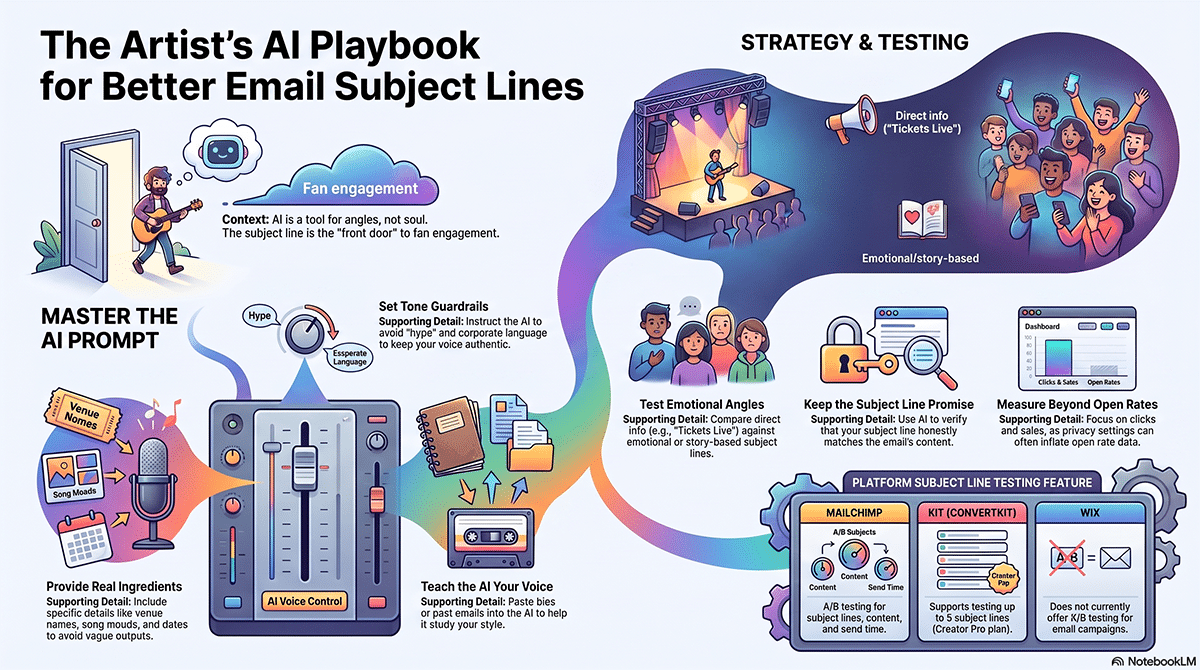
A better way to use AI is to teach it your voice before asking it to write. You can paste in a few old emails, a short bio, a social post that sounded like you, or even a rough note that says how you talk to fans. Then ask the AI to study the tone. You are not asking it to become you. You are giving it guardrails.
A good beginner prompt would sound like this: “I am an independent artist writing to fans who already know my music. My voice is warm, honest, casual, and a little funny. I do not want hype, clickbait, fake urgency, or corporate marketing language. I am announcing a show in Atlanta this Friday. Give me twenty email subject lines under 60 characters, and make them sound like they came from a real musician.”
That prompt does a few important things. It tells the AI who you are. It tells the AI who the email is for. It names the event. It gives tone rules. It says what not to do. It sets a length limit. That is much better than typing “write subject lines for my show” and hoping for magic.
The Best AI Prompt Starts With Real Details
AI gets better when you give it real ingredients. If you give it vague input, it gives you vague output. If you give it useful details, it has something to work with. For a show announcement, include the city, venue, date, who is on the bill, what makes the night special, whether tickets are limited, and what kind of fan should care. For a merch drop, include what the item is, whether it is limited, why you made it, what it costs, and whether it ties into a song, tour, or inside joke. For a release, include the song title, the mood, the story behind it, and what you want fans to do after they open the email.
The subject line is short, but the thinking behind it should not be lazy. AI can only test angles if you give it angles. A new single can be framed as a story, a feeling, a milestone, a sound, a question, or an invitation. A show can be framed as a local event, a reunion, a last chance, a night out, a tour stop, or a thank-you to the people who have kept showing up.
Try a prompt like this for a release: “I am releasing a new single called ‘Cold Porch Light.’ It is a slow, emotional song about leaving home and still missing it. My fans like honest lyrics and stripped-down recordings. Write thirty subject lines in my voice. Give me some that are emotional, some that are simple, some that are curious, and some that are direct. Avoid hype words like ‘epic,’ ‘game-changing,’ and ‘must-hear.’”
That prompt gives the AI a target. It also gives you variety. You might not use any of the thirty lines exactly as written, and that is fine. The point is to get your own brain moving. Sometimes the AI gives you a line that is almost right, and you fix one word. Sometimes it gives you ten bad lines that help you understand what you do not want. That still counts as useful.
Subject Lines Are Not Tricks, They Are Promises
A bad subject line tricks people into opening. A good subject line makes a promise the email can actually keep. That difference matters. If the subject line says, “Big news you will not believe,” and the email is just a Tuesday reminder about a gig, fans learn not to trust you. If the subject line says, “Friday night in Decatur, one more time,” and the email gives them the details for a Friday show in Decatur, trust stays intact.
This matters even more for indie artists because your email list is not a faceless crowd. These are the people most likely to buy tickets, stream the new song, share the video, grab the vinyl, order the shirt, join the membership, or send a friend to the next gig. You are not trying to beat them into opening an email. You are trying to build a relationship where opening your email feels worth it.
AI can help you check whether the subject line and the email match. After you write the email, paste both into the tool and ask, “Does this subject line honestly match the content of the email? Give me five better versions that are clear, interesting, and not clickbait.” That one prompt can save you from sounding like a discount furniture sale when you meant to sound like an artist inviting fans into something real.
Use AI To Create Different Angles, Not Just Different Words
One beginner mistake is asking AI for ten subject lines and getting ten versions of the same idea. “New song out now.” “My new song is here.” “Listen to my new song.” “New music just dropped.” That is not testing. That is rearranging furniture in the same room.
A better use of AI is to ask for different emotional angles. For a show announcement, you might test a direct subject line against a local subject line. “Tickets for Friday are live” is direct. “Athens, we are back Friday night” is local. “This Friday feels special” is emotional. “One night, two sets, no filler” is more attitude-driven. Each one reaches a fan in a slightly different way.
For a merch drop, you might compare practical language with story language. “New tour shirts are in the shop” is clear. “We made the shirt everyone kept asking about” gives the fan a little inside feeling. “The road paid for this design” creates curiosity. “Only 75 of these were printed” gives real scarcity, but only if it is true.
For a membership, you might test belonging against benefits. “Come behind the songs with me” feels personal. “Members get the demos first” is benefit-driven. “I’m opening the notebook” feels intimate. “A new way to support the music” is clear and honest. None of these is automatically better. Your fans decide by what they do.
A useful prompt would be: “Give me subject lines for this membership email in five angles: belonging, early access, direct support, behind-the-scenes, and simple announcement. Keep them under 60 characters. Make them sound human and avoid sales pressure.”
That is how you turn AI into a brainstorming partner instead of a vending machine.
The Simple Truth About Testing
Testing sounds intimidating until you realize what it means. You are just comparing one version against another to see what fans respond to. Some email platforms make this easy. Mailchimp says A/B tests compare different versions of an email or SMS to see how small changes affect results, and its email A/B testing can test subject line, From name, content, or send time. Mailchimp’s subject line testing can compare more than one version depending on the setup, and its help docs note that subject lines can be up to 150 characters, though 60 characters or less is recommended.
Kit, formerly ConvertKit, also supports subject line A/B testing for Broadcast emails. Kit’s help center says users can test up to five Broadcast subject lines, though testing more than two subject lines is limited to the Creator Pro plan. Constant Contact also offers subject line A/B testing, where you create two subject line options, send them to part of your list, and then send the winner to the rest of your audience.
Not every platform has built-in A/B testing. Wix currently says Wix Email Marketing does not offer A/B testing for campaigns. Bandzoogle has a built-in mailing list feature for musicians, with newsletters, show reminders, new music alerts, reports, and location targeting, but if your platform does not offer automatic A/B testing, you can still learn. You can manually compare different subject line styles over time. You can send one style this week and another style next week. You can track opens, clicks, replies, ticket sales, merch sales, or the number of people who actually show up.
That last part matters. A subject line is not winning because it got a pretty number in a dashboard. It is winning because it helped fans take the next step.
Open Rates Are Useful, But They Are Not The Whole Truth
For years, musicians and marketers obsessed over open rates. Open rates still give you clues, especially when you are comparing subject lines to the same kind of audience. But they are not perfect. Mailchimp explains that open tracking usually works by loading a tiny invisible image in the email, and it notes that open tracking is not 100% accurate because images may not load in some email clients. Mailchimp also warns that bot activity, including Apple’s Mail Privacy Protection, can falsely inflate open and click metrics.
Apple Mail Privacy Protection matters because it can preload tracking pixels, which may make an email look opened even when the fan did not actually open it. Mailchimp’s Apple MPP FAQ says this can result in inflated and inaccurate open rates for contacts using Apple Mail with that privacy feature enabled.
Do not let that scare you away from email. Email still matters. Just do not worship one number. If the subject line gets more opens but nobody clicks the ticket link, that subject line may have been curious but not useful. If another subject line gets fewer opens but more ticket sales, that one may have reached the right fans. If a thank-you email gets replies from real people, that matters too. Fans are not spreadsheet cells. They are humans with inboxes, jobs, kids, bills, playlists, and limited attention.
For artists, the better question is not only “Did they open?” It is “Did this email help the relationship?” Did they click? Did they reply? Did they buy? Did they save the date? Did they come to the show? Did they feel seen enough to stick around?
How To Use AI For Show Announcements
Show announcements are one of the easiest places to start because the goal is clear. You want fans in a certain area to know you are playing. You want them to buy tickets, save the date, bring a friend, or at least remember your name when they see the poster again.
The mistake many artists make is writing subject lines that are too general. “Upcoming show” is technically true, but it has no pulse. “Live this Friday” is better, but still plain. “Nashville, we’re coming back Friday” is stronger because it names the fan’s place. Local language works because shows are local decisions. A fan in Nashville does not care about every tour date. They care about the one they can attend.
Use AI to generate local, emotional, and practical versions. Try this prompt: “I am announcing a show at The Basement in Nashville on Friday, August 14. Doors are at 7. We are playing with two local bands. Tickets are $15 in advance. My voice is casual, grateful, and a little road-worn. Write twenty subject lines for fans near Nashville. Make some direct, some warm, and some funny. No fake urgency.”
The AI might give you something like “Nashville, Friday is ours,” “One more night at The Basement,” or “Your Friday plans just got louder.” You then decide what feels true. Maybe you change “louder” to “sweatier” because that sounds more like your band. Maybe you keep the simplest one because your fans respond to clarity. That is the point.
For show reminders, AI can help you avoid sounding annoying. The prompt changes slightly: “Write ten reminder subject lines for fans who already got the first show announcement. Keep them friendly and useful, not pushy. Mention that the show is tomorrow night and tickets are still available.” That gives you reminder language instead of another grand announcement.
How To Use AI For Merch Drops
Merch emails are not just about selling stuff. They are about giving fans a way to carry the music into their daily life. A shirt, vinyl record, poster, hat, lyric book, or handmade item is not just inventory. It is a little flag that says, “This music means something to me.”
Still, fans need clarity. If you have new merch, say what it is. If it is limited, say why. If it helps fund the next recording, say that honestly. Do not turn every merch drop into a fake emergency. Fans can smell that. If there are only 100 signed vinyl copies, that is real scarcity. If you can print more shirts next week, do not pretend the world ends tonight.
Use AI to test practical subject lines against story-based subject lines. A practical one might be “New shirts are up now.” A story one might be “We finally printed the desert design.” A fan-support one might be “This shirt helps fund the next record.” A collector one might be “Signed vinyl is back in the shop.”
Here is a strong AI prompt: “I am announcing a merch drop for a new black tour shirt with artwork based on our song ‘Highway Ghost.’ We printed 100 shirts for this run. The tone should be honest, a little gritty, and grateful. Give me twenty subject lines under 60 characters. Separate the ideas by feeling: direct, story-based, limited-run, and fan-support. Do not sound like a big-box store.”
That prompt gives you useful choices. It also protects your voice. You are not trying to write like an e-commerce brand selling socks. You are an artist talking to fans.
How To Use AI For New Releases
Release emails can be tricky because artists often want to say everything at once. The song took months to write. The recording session mattered. The chorus came from a hard year. The video has a story. The drummer nailed the take. The bridge almost got cut. The whole thing feels huge to you, but the subject line still needs to be simple enough for a fan to understand in one glance.
For releases, AI is useful because it can pull different doors out of the same song. One door is the title. One door is the feeling. One door is the story. One door is the sound. One door is the fan action.
A simple release subject line is “My new song is out today.” That is not bad. Clear is good. But you can test it against something with more emotional pull, like “This one hurt to write,” or “A song about leaving home,” or “The quietest song on the record is here.” The best subject line depends on the song and the fans.
Use this prompt: “I am announcing a new single called ‘Southbound Rain.’ It is a mid-tempo roots-rock song about driving away from a relationship you know you cannot fix. My fans care about lyrics. Write twenty subject lines in a human voice. Give me some that use the title, some that use the emotion, some that use curiosity, and some that are very plain. Avoid clickbait.”
Then ask the AI to critique the results: “Which five of these sound most honest for an indie artist writing to loyal fans, and why?” That second step is helpful because it slows the process down. You are not just collecting phrases. You are learning how different subject lines work.
How To Use AI For Membership Emails
Membership emails need extra care because you are asking for ongoing support. That can feel awkward. Many artists either undersell it because they are shy, or oversell it because they think they need to sound like a startup. Neither one is ideal.
The honest way to write a membership subject line is to make the invitation clear. Fans should know what they are being invited into and why it matters. Are they getting demos? Early tickets? Private livestreams? Behind-the-scenes stories? Monthly songs? Community access? A direct way to support the next record? Say it like a human.
AI can help you find language that feels generous instead of needy. Try this prompt: “I am inviting fans to join a paid membership that supports my music directly. Members get early demos, monthly behind-the-scenes notes, and first access to small house concerts. I want the subject lines to feel warm, honest, and artist-to-fan, not corporate. Write twenty options. Avoid guilt, hype, and fake exclusivity.”
The subject line might become “Come a little closer to the songs,” or “I’m starting something for the real ones,” or “A new way to support the music.” Each one says something different. The first is intimate. The second is community-driven. The third is plain. You can test these tones over time and see what your fans respond to.
How To Use AI For Thank-You Messages
Thank-you emails are underrated. Most artists send emails when they need something. Buy a ticket. Stream a song. Order the shirt. Join the list. Support the campaign. That is part of the job, but relationships cannot only be withdrawals. Sometimes you need to make a deposit.
A thank-you email after a show, release, merch sellout, livestream, or crowdfunding push can strengthen the bond with fans. The subject line should feel personal and real. “Thank you” is not weak. It is often the right line. You can also be more specific. “Last night meant a lot.” “We felt that room singing.” “You sold out the vinyl.” “That show stayed with me.”
AI can help you write thank-you subject lines that do not sound stiff. Try this prompt: “Write twenty subject lines for a thank-you email after a sold-out hometown show. My voice is humble, funny, and emotional but not cheesy. The email includes photos from the night and a short note about what the crowd meant to us. Keep the subject lines human.”
This is where your real voice matters most. If the AI gives you “An unforgettable evening of musical magic,” throw it away. If it gives you “Still thinking about last night,” that might be a keeper. Your fans do not need poetry every time. They need truth.
Keep A Swipe File Of What Works
One of the smartest things an artist can do is keep a simple subject line journal. It does not need to be fancy. Save the subject line, what the email was about, who it went to, the open rate if you trust it, the click rate, replies, sales, and any real-world result. Over time, you will start to see patterns.
Maybe your fans respond to city names. Maybe they respond to song stories. Maybe funny subject lines work for merch but not for memberships. Maybe direct subject lines sell more tickets. Maybe emotional lines get more replies. Maybe your audience hates emojis. Maybe they love one well-placed heart. You do not know until you watch.
Mailchimp offers tools like its Subject Line Helper, which gives feedback on things like word count, character count, punctuation, and emoji use. That can be useful. But even Mailchimp says A/B and multivariate tests can tell you what your specific contacts like best, while a helper tool is based on broader data. In other words, general advice is a starting point. Your fans are the real test.
AI can help you study your own history. After several campaigns, paste in your past subject lines and basic results. Then ask, “What patterns do you see? Which subject lines were clearest? Which were most emotional? Which ones sounded most like an artist talking to fans? What should I test next?” Do not paste private fan data into an AI tool unless you understand the privacy settings and have a good reason. You do not need names or email addresses for this. Subject lines and general results are enough.
Do Not Let AI Make You Sound Like Everyone Else
The danger with AI is sameness. If every artist asks the same tool for subject lines using the same lazy prompt, everyone starts sounding like the same cheerful marketing intern. “You won’t want to miss this.” “Big news inside.” “We’ve got something special for you.” “The wait is over.” These lines are not always terrible, but they are tired. They could come from a band, a dentist, a gym, or a mattress sale.
Your job is to add the fingerprints back in. Mention the song title. Mention the city. Mention the venue. Mention the weird thing fans actually say at your merch table. Mention the lyric they tattooed on their arm. Mention the van, the porch, the basement, the busted amp, the rainy festival, the hometown room, the 2 a.m. diner, the real life around the music.
AI can polish language, but you provide the lived truth. That is the difference between a subject line that sells and a subject line that connects.
The Deliverability Stuff Still Matters
A great subject line cannot help if the email never reaches the inbox. This is the boring part, but it matters. Google’s sender guidelines say all senders should use SPF or DKIM email authentication, and bulk senders need SPF, DKIM, and DMARC. Google also says authenticated messages help protect recipients from spoofing and phishing and are less likely to be rejected or marked as spam by Gmail.
You do not need to become a server engineer to send fan emails, but you should use a real email platform, send from a domain you control when possible, and follow the setup instructions your provider gives you. If you use Mailchimp, Kit, Constant Contact, Bandzoogle, Wix, Substack, or another platform, look for their domain authentication setup and do it carefully. If that sounds dull, good. Most important business chores are dull until they save you money.
Subject lines also affect trust. Avoid spammy tricks like all caps, fake replies, misleading “Re:” lines, and dishonest urgency. If the email is not really a personal reply, do not make it look like one. If the offer is not ending tonight, do not say it is. You are not just trying to get through filters. You are trying to stay welcome.
A Simple Weekly Practice
The best way to learn this is not to read about it forever. It is to practice. Before every fan email, ask AI for options. Pick three that feel closest to your voice. Rewrite them by hand. If your email platform supports A/B testing, test two. If it does not, choose one and save the others for future comparison. After the email goes out, look at opens, clicks, replies, sales, and real-world action. Then write down what happened.
Do this for show announcements. Do it for merch drops. Do it for releases. Do it for memberships. Do it for thank-you messages. Over a few months, you will get much better at knowing what your fans respond to. You will also get better at hearing your own voice.
That is the hidden benefit. AI does not just help you write subject lines faster. Used well, it helps you notice what makes your communication sound like you. You start seeing the difference between hype and invitation. You start seeing which words feel natural in your mouth and which words feel rented. You start building a language around your music that fans recognize.
The Artist Still Has The Final Say
AI can give you twenty subject lines in ten seconds. That is useful. But speed is not the same as taste. You still need taste. You still need judgment. You still need to ask, “Would I actually say this to a fan at the merch table?” If the answer is no, rewrite it.
The best subject lines are usually clear, specific, and honest. They respect the fan. They fit the email. They sound like the artist. They do not beg. They do not trick. They open a door.
For indie artists, that door matters. Email is one of the few places where you can talk to fans without waiting for an algorithm to bless you. A subject line may look small, but it is part of a bigger act of independence. You are not just posting into the void and hoping the platform shows mercy. You are reaching people who asked to hear from you.
So use the tools. Use ChatGPT to brainstorm. Use Claude to revise and compare tone. Use Gemini if you already live in Google’s world and want help drafting or refining email language. Use Perplexity when you want to research a platform feature or check a claim before you repeat it. Use Mailchimp, Kit, Constant Contact, Bandzoogle, Wix, or Substack in the way that fits your actual fan business.
Just do not hand over your voice.
The fans came for you. Let AI help you find the door handle, polish the sign, and test which wording gets more people to walk in. But when they open that email, make sure the person on the other side is still the artist they signed up to hear from.
 |  Spotify |  Deezer |  Breaker |
 Pocket Cast |  Radio Public |  Stitcher |  TuneIn |
 IHeart Radio |  Mixcloud |  PlayerFM |  Amazon |
 Jiosaavn |  Gaana |  Vurbl |  Audius |
 Reason.Fm | |||
Find our Podcasts on these outlets
Subscribe to Our Newsletter
Discover more from Making A Scene!
Subscribe to get the latest posts sent to your email.


