
The Next Music Manager May Be A Workflow Designer




Making a Scene Presents – The Next Music Manager May Be A Workflow Designer
Listen to the Podcast Discussion
The Old Music Business Loved A Gatekeeper
For a long time, the dream was simple. Find a manager who knew the right people, could get the right meetings, and maybe knew which hotel lobby to haunt during a conference. The manager was the person with access. They had the phone numbers, the relationships, the mystery spreadsheet, and the ability to say, “Let me make a call,” which always sounded like wizardry even when it meant leaving a voicemail.
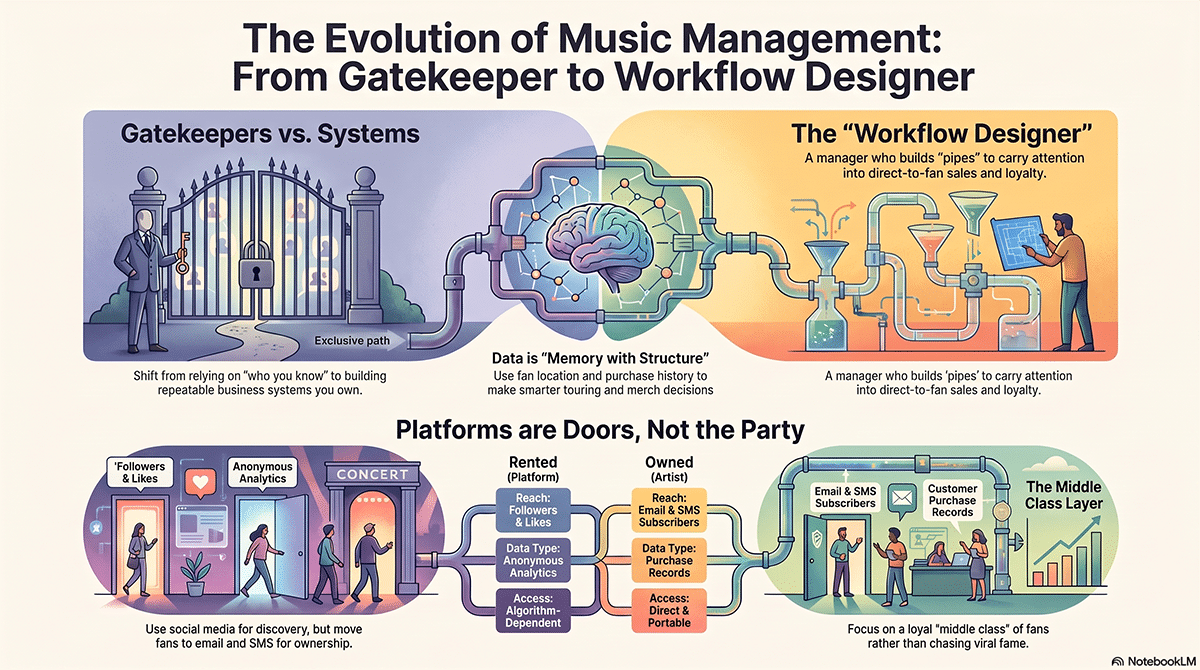
That version of management is not dead. Relationships still matter. A good manager can still open doors, negotiate deals, protect an artist from bad contracts, and keep the wheels on the van when the business starts moving faster than the band can think. But for most independent artists, the first manager they need today is not a gatekeeper. It is a system. More specifically, it is the ability to design workflows that turn attention into relationships, relationships into income, and income into a career that does not collapse every time an algorithm sneezes.
The next music manager may not be the person who promises to “take you to the next level,” which is often music business code for “I have no measurable plan, but I own a blazer.” The next music manager may be the person who understands how fan data moves, how email and SMS work together, how merch ties into shows, how content feeds releases, how direct sales create cash flow, and how every fan touchpoint should return something useful to the artist.
For independent artists, this is good news. It means you do not have to wait for permission to start managing your career like a real business. You can begin learning the management skillset yourself. You can become the workflow designer of your own music business before anyone else earns the right to sit in that chair.
Renting Attention Is Not A Business Model
Let’s say the quiet part loudly. Platforms are useful, but they are not yours. Spotify for Artists gives artists dashboards, profile tools, playlist pitching, merch and concert integrations, and performance insights. Apple Music for Artists offers analytics, milestones, promotional assets, and artist profile control. YouTube for Artists gives artists tools and education around official artist channels, analytics, videos, Shorts, and community. TikTok for Artists gives eligible artists access to music and follower insights, campaign tools, and team access.
That is all useful. Use it. Study it. Learn from it. But do not confuse access to platform analytics with ownership of the fan relationship. A stream is not a customer record. A follower is not an email subscriber. A like is not a ticket buyer. A view is not a person you can invite back next month when you play their town.
This is where the old industry thinking falls apart. Too many artists are still taught to chase public numbers because public numbers look impressive. The manager with the old playbook points at followers, monthly listeners, playlist adds, and video views as if those numbers automatically pay rent. Sometimes they help. Often they are smoke signals. Nice to look at. Hard to deposit.
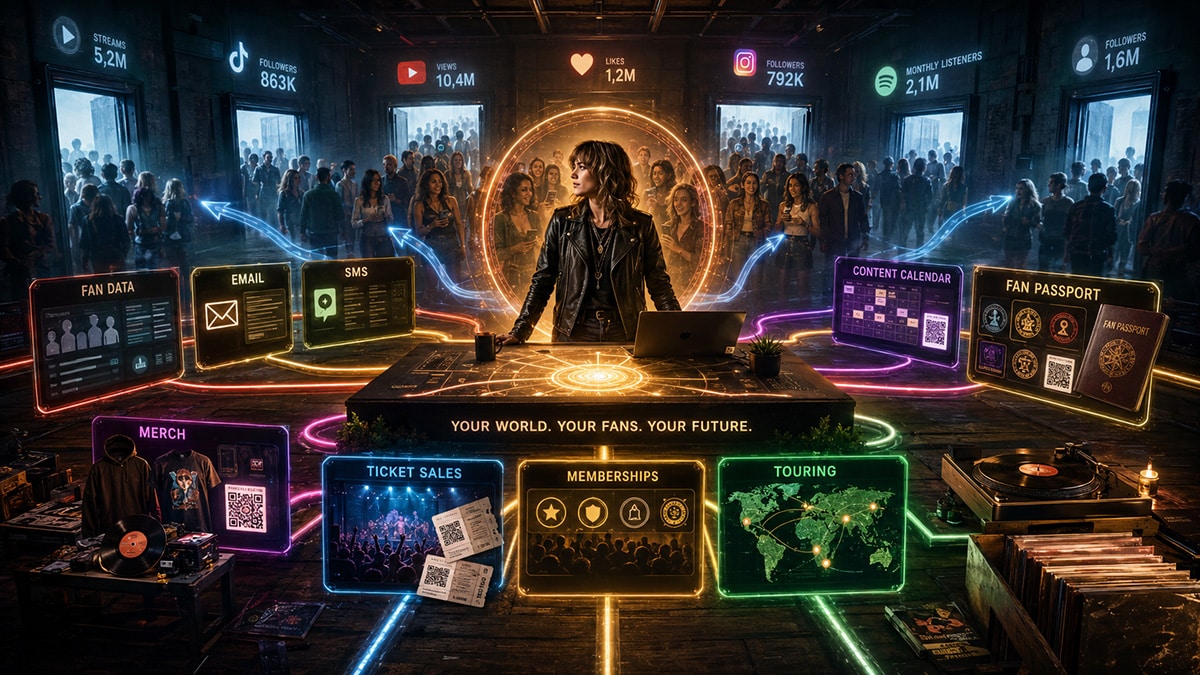
A workflow designer asks a better question. What happens after the attention? If a fan discovers you on Instagram, what path brings them into your world? If a short video pops on TikTok, how do you capture the people who care? If a Spotify listener lives near your next show, how do you make sure they know about it without begging the platform to show them your post? If someone buys a shirt at your merch table, how do you invite them into the next chapter instead of letting the relationship end with a receipt?
That is management now. Not just getting attention. Building the pipes that carry attention into something the artist owns.
The Manager As Workflow Designer
A workflow designer is not just “organized.” Organized means your files have names better than “final_final_REALfinal2.wav.” Congratulations, you are now ahead of half the planet. Workflow design goes deeper. It means creating repeatable systems for how your music business works.
When someone joins your email list, what happens next? When someone follows your Fan Passport, what information do they choose to share? When you announce a show, who gets the first message? When someone buys merch, are they tagged as a buyer? When fans attend three shows in a year, do they get rewarded? When a city keeps showing up in your data, does that change your routing? When a new release is coming, do you have a timeline for content, email, pre-save, direct sales, behind-the-scenes posts, and post-release follow-up?
This is where independent artists can win. Not because they have more money than the majors. They do not. Not because they can outspend the platforms. Please. The platforms have more money than some countries and fewer guitar cases to trip over. Indie artists win when they become more human, more direct, and more intentional.
A major label campaign often has layers of departments. An indie artist can move faster because the distance between idea, fan, and action is shorter. You can notice that fifty fans in Charlotte are opening every email, then book a house concert, small venue, or regional support slot. You can see that your vinyl buyers also buy lyric books, then create a handwritten lyric bundle. You can learn that fans who attend shows respond better to SMS than email, while online supporters like long-form updates. That is not theory. That is workflow thinking.
The manager of the future does not just say, “Post more.” The manager of the future says, “What happens when the post works?”
Fan Data Is Not Boring. Bad Data Is Boring.
Artists hear the word data and immediately imagine a sad spreadsheet wearing khakis. That is because the industry has done a terrible job explaining what fan data actually is. Fan data is not a cold corporate thing. It is simply memory with structure.
A fan’s name matters because people like being treated like people. Their city matters because touring is geography with consequences. Their email matters because you can reach them directly. Their SMS permission matters because show-day reminders can move real bodies into real rooms. Their purchase history matters because you should not sell the same shirt to someone who already bought it unless you enjoy being weird. Their favorite format matters because some fans want vinyl, some want digital, some want behind-the-scenes access, and some want to support you because your songs helped them survive a bad year.
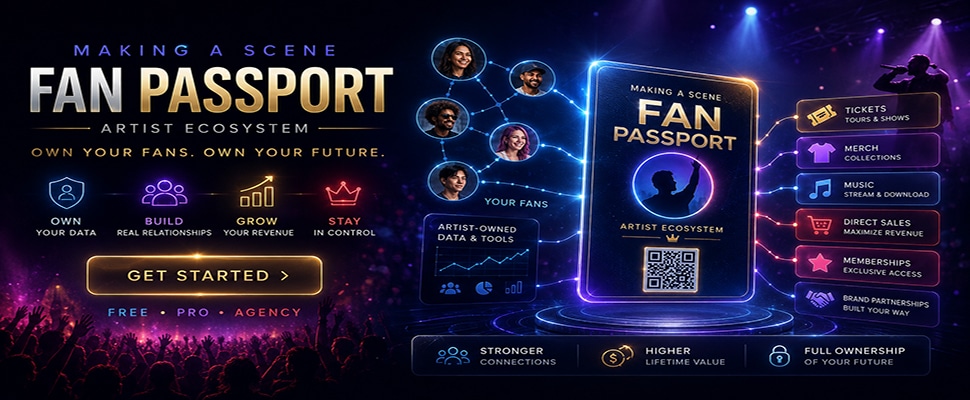
The Making a Scene Artist Fan Passport OS fits naturally into this new management model because it treats the fan relationship as the center of the business instead of a side effect of promotion. A fan follows an artist, shares the data they choose to share, collects rewards or “passport stamps,” receives direct communication, and becomes part of an artist-owned system. The artist can use that relationship for shows, merch, memberships, release campaigns, and fan support without waiting for an algorithm to decide whether the relationship is profitable enough to display.
That is the difference between a platform audience and an owned audience. A platform audience is a crowd you hope to reach. An owned audience is a community you can serve.
This does not mean you abandon platforms. That would be silly. Discovery matters. Spotify, Apple Music, YouTube, TikTok, Instagram, and Facebook are doors. But the party should not live in the doorway. At some point, you invite people inside.
Email And SMS Are Not Old. They Are Adult Supervision.
Every few years someone announces that email is dead. Email then quietly gets up, stretches, sends invoices, sells tickets, and funds another tour while the hot new platform changes its layout again.
Email is still one of the most important direct-to-fan tools because it is portable, searchable, and built for longer messages. Services like Mailchimp and Kit give creators tools for email marketing, automation, segmentation, and analytics. That means an artist can send different messages to different groups of fans instead of blasting everyone with the same “new single out now” panic flare.
SMS is more sensitive because it is more personal. A text message lands in the same place as messages from family, work, and the drummer asking if rehearsal is still “around 7-ish.” That power must be handled carefully. Tools like Twilio support business messaging, but Twilio’s own policies emphasize consent and proof of consent for messaging. This matters because text should be used for things that deserve immediacy, like show reminders, venue changes, limited VIP availability, merch pickup, or a special thank-you after a hometown sellout.
The workflow designer does not treat email and SMS as megaphones. They treat them as relationship channels. Email can carry the story. SMS can carry the timely nudge. The Fan Passport OS can make this even more practical by tying communication to real fan actions: follows, stamps, show attendance, rewards, merch purchases, membership status, and location.
That is how a small artist starts acting like a serious business without sounding like a department store coupon machine.
The Ethical Fan Data Section, Because Creepy Is Not A Strategy
Owned fan data is powerful, but it must be earned. Permission is not a technicality. It is the foundation of trust. If a fan gives you an email address for a free download, do not quietly add them to five unrelated lists, three “partner offers,” and a secret newsletter from your bass player’s candle business. That is not marketing. That is how you get unsubscribed from life.
In the United States, commercial email must follow the FTC’s CAN-SPAM guidance, including rules around truthful header information, non-deceptive subject lines, identifying commercial messages, including a valid postal address, and honoring opt-out requests. In the European Union, the European Commission’s GDPR guidance explains that consent must be freely given, specific, informed, and unambiguous, and individuals have rights over their personal data. In Canada, CASL guidance from the CRTC says commercial electronic messages generally require consent, identification information, and an unsubscribe mechanism. None of this is legal advice, and artists with serious compliance questions should talk to a qualified professional, but the practical lesson is simple enough for a merch table at midnight: ask clearly, explain honestly, store permission, and make leaving easy.
The ethical workflow is not complicated. Tell fans what they are signing up for. Let them choose email, SMS, or both. Do not buy lists. Do not scrape addresses. Do not treat a ticket buyer as if they automatically consented to every future promotion forever. Keep records of consent. Respect unsubscribes. Send useful things. Do not be a data vampire in a leather jacket.
This is another reason the Fan Passport model matters. If the artist-fan relationship is transparent from the beginning, the data becomes part of the value exchange. The fan follows the artist and understands what they are sharing. The artist uses that information to give better experiences, better rewards, better local show alerts, better merch offers, and better communication. Everybody knows what is happening. Nobody needs a shower afterward.
AI Is The Assistant, Not The Artist
AI belongs in this conversation because workflow design is where AI becomes truly useful for indie artists. Not as a fake singer. Not as a shortcut around taste. Not as a plastic replacement for the thing fans actually love. AI is useful when it helps artists understand patterns, plan campaigns, draft communication, and reduce the brain-melting admin work that keeps musicians from making music.
An artist can use AI to analyze fan data and ask better questions. Which cities are showing the strongest email engagement? Which fans have attended multiple shows? Which merch items sell best after acoustic sets versus full-band shows? Which subject lines worked for previous show announcements? Which fans joined through TikTok but later bought direct? Which content led to email signups instead of just applause from strangers?
Tools like Airtable and Notion can help artists organize projects, content calendars, fan segments, release plans, and internal notes. Zapier can connect apps and automate routine steps across thousands of integrations. These tools are not magic. They are plumbing. But good plumbing is the difference between a working house and a basement full of regrets.
The Fan Passport OS can sit inside this idea as the artist’s business memory. Instead of AI guessing blindly from disconnected platform dashboards, the artist can work from owned fan information: who followed, where they are, what they opted into, what they bought, what rewards they earned, what shows they attended, and what communication they responded to. AI can then help the artist make decisions. It can suggest a segmented email campaign. It can draft three show announcement versions. It can flag that a market is warming up. It can recommend a merch bundle for fans who have supported three times but never joined a membership.
The artist still decides. The artist keeps the voice. The artist says, “No, that subject line sounds like a robot trying to sell protein powder.” AI should help sharpen the workflow, not sand the soul off the music.
Touring Is A Workflow, Not A Wish
The old fantasy says touring works like this: get booked, get in van, become beloved, return rich. Anyone who has ever eaten gas station dinner at 1:17 a.m. knows this is adorable.
Touring is not just booking dates. It is routing, fan density, venue fit, ticket communication, local partners, merch planning, press, content, follow-up, and cash flow. A workflow designer looks at touring as a system.
If an artist has strong Fan Passport followers in Philadelphia, email subscribers in Lancaster, merch buyers in Baltimore, and Spotify listeners in Washington, D.C., that is not just data. That is a map. It suggests a regional run. It suggests where to test VIP offers. It suggests which fans should get early announcements. It suggests where to ask local supporters to bring friends. It suggests which cities may deserve a weekday acoustic show and which ones might support a full-band Saturday night.
Tools like Bandsintown for Artists can help artists publish tour dates and promote shows across connected platforms. Square can handle in-person payments and point-of-sale needs at the merch table. Shopify can support online commerce for merch and direct sales. Bandcamp remains especially important for artists because it is built around direct fan support, music, merch, and artist-controlled pricing; Bandcamp states that artist accounts are free and that it takes a revenue share on digital and merch sales while the average artist or label share is 82%.
A workflow designer connects these pieces. The show announcement goes to fans near the city first. The Fan Passport reward encourages attendance. The merch table QR code invites fans to follow the artist. The SMS reminder goes only to people who opted in. The post-show email thanks attendees and offers a live recording, limited merch, or membership invitation. The next routing decision uses the results.
That is how touring becomes less of a gamble and more of a learning system.
Merch Is Not Swag. It Is A Relationship Object.
Calling merch “swag” should be punishable by having to load the van alone. Merch is not junk with a logo. Good merch is a physical relationship between the artist and the fan. It is memory you can wear, spin, frame, stick on a laptop, or place on a shelf next to the tiny shrine of bands that made your life better.
The workflow designer does not ask, “What can we slap the logo on?” They ask, “What do our fans actually value, and how does this purchase lead to the next relationship?” A shirt buyer might want early access to a new design. A vinyl buyer might want liner notes, signed lyrics, or a listening party. A fan who buys a digital album on Bandcamp might want a behind-the-scenes email series. A person who buys at a show might want to collect a Fan Passport stamp and unlock a reward next time.
This is where direct sales become more than transactions. They become signals. If fans in one city buy more vinyl, bring more vinyl next time. If younger fans mostly buy patches and stickers, create lower-cost impulse items. If your audience buys lyric books, maybe your songwriting is part of the offer. If a fan has bought three times, do not treat them like a stranger. Thank them like a human being with excellent taste.
Merch is revenue, yes. But merch data is also management intelligence.
Content Should Feed The Business, Not Eat The Artist
Content is where many artists go to die creatively. Not literally, though after filming twelve versions of “day in the life of an indie artist,” the soul may file a complaint.
The problem is not content itself. The problem is content without workflow. Posting because “you have to post” is a treadmill. Posting because each piece has a job is a business system.
A workflow designer gives content a purpose. Some content introduces new people to the artist. Some deepens trust with current fans. Some drives email signups. Some sells tickets. Some supports a release. Some thanks the community. Some explains the story behind a song. Some points to merch, memberships, or Fan Passport rewards.
TikTok, Instagram, YouTube Shorts, Facebook, and Spotify clips can all help discovery. But the workflow question stays the same. Where does attention go next? A video about a new song should lead to the song, yes, but also to the artist’s owned world. A backstage clip before a show should lead to tickets or Fan Passport follow. A merch packing video should lead to the store. A tour diary should lead to city-specific email signups. A fan thank-you post should lead to deeper community, not just more scrolling.
The best content workflow does not make artists act like desperate influencers trapped in a ring light. It helps them turn their real work into useful communication.
Memberships And Rewards Create The Middle Class Layer
The music industry loves extremes. Either you are invisible, or you are famous. Either you are broke, or you are a brand. Either you are “emerging,” which is industry slang for “please work for exposure,” or you are suddenly important enough for people to pretend they always believed in you.
The Making a Scene philosophy lives in the space the old industry ignores: the music industry middle class. That is the artist who may never become a household name but can build a real income through shows, merch, direct sales, memberships, licensing, teaching, production, publishing, and fan support. That artist does not need every human on earth. They need enough of the right people in a system that keeps relationships alive.
Membership platforms like Patreon let creators build paid membership experiences. Bandcamp supports direct music and merch sales. Shopify can run an artist store. Email and SMS can bring fans back. The Fan Passport OS can add a loyalty layer through follows, stamps, rewards, shows, memberships, and direct communication.
This matters because fan loyalty should be recognized. A fan who comes to three shows, buys a record, brings a friend, and replies to your emails is not the same as a random passerby. They are part of the career. They should feel that. Rewards do not have to be expensive. They can be early access, a private livestream, a signed setlist, a soundcheck invite, a members-only demo, a birthday message, a merch discount, or first shot at house concert tickets.
A workflow designer builds those moments into the system. Not as gimmicks. As gratitude with structure.
A Simple Example: One Artist, One Real Workflow
Imagine an indie artist named Lena. She is not famous. She has a good regional following, a small but loyal email list, a few thousand social followers, and a new EP coming in eight weeks. In the old model, Lena might post constantly, pitch playlists, hope for press, and pray the release “does something.” This is the official business plan of many artists: vibes and anxiety.
Now let Lena think like a workflow designer.
First, she cleans up her artist profile and makes sure every platform points somewhere useful. Spotify, Apple Music, YouTube, TikTok, Instagram, Bandcamp, her website, and her Fan Passport all lead fans toward a direct relationship. She is not rude about it. She is clear. “Follow me here for show alerts, rewards, and first access.”
Then she looks at her fan data. She sees that the strongest cities are Atlanta, Athens, Charlotte, and Asheville. Her email opens are highest when she tells the story behind songs, not when she yells “OUT NOW” like a haunted billboard. Her merch buyers tend to buy physical items after live shows, while her online supporters buy digital bundles. Her Fan Passport followers respond well to rewards tied to shows.
So she builds the EP campaign around those facts. She sends a personal email announcing the project and inviting fans to follow her Fan Passport for release rewards. She posts short videos about each song, but every post has a path: listen, join, come to a show, or get the behind-the-scenes email. She uses AI to draft subject line options, summarize fan segments, and suggest a content calendar, but she rewrites everything in her own voice because she is a musician, not a chatbot with cheekbones.
She books a four-city regional run instead of chasing random dates. Fans near each city get early notice. SMS subscribers get show-day reminders. Fan Passport followers can collect a stamp at the merch table. Anyone who buys merch gets a thank-you email the next day with a live acoustic version of one EP track. Fans who collect two show stamps unlock early access to a limited shirt. Fans who attend the hometown show get invited to a small listening-room event.
After the run, Lena does not just collapse into laundry and emotional silence. She reviews the workflow. Which city sold the most tickets? Which email worked best? Which merch moved? How many Fan Passport follows came from QR codes at the table? How many first-time fans became repeat supporters? Which content brought people into owned channels instead of just getting likes?
That is management. Not glamorous, maybe. But neither is changing strings in a parking lot, and both are part of the job.
The Artist Does Not Need More Chaos
The indie artist’s problem is usually not laziness. It is fragmentation. The artist has songs in one place, fans in another place, merch somewhere else, show dates in another tool, content ideas in a notebook, email in a platform, SMS maybe nowhere, analytics scattered across dashboards, and revenue hiding in little piles like a financial scavenger hunt.
The workflow designer’s job is to reduce chaos. That does not mean using every tool on earth. In fact, please do not. The goal is not to build a NASA control room just to sell thirty tickets in Knoxville. The goal is to create a simple, repeatable path from discovery to relationship to revenue.
A beginner artist might start with a website, an email list, a direct sales page, a show calendar, a simple fan database, and a merch table QR code. A growing artist might add segmentation, SMS, memberships, automated follow-up, fan rewards, and AI-assisted analysis. A more advanced artist might connect commerce, touring, email, Fan Passport activity, and content planning into one operating system.
The important thing is that each tool must have a job. If it does not help you reach fans, understand fans, serve fans, sell something fans value, or make better decisions, it may just be another shiny object wearing productivity cologne.
Outdated Industry Thinking Deserves A Nice Funeral
The old gatekeeper model trained artists to wait. Wait for the label. Wait for the manager. Wait for the agent. Wait for the playlist. Wait for the viral moment. Wait for someone in a conference room to decide your work is worth a meeting.
No. Respectfully, no. Also disrespectfully, no.
Independent artists do not have to wait to build systems. They can start now. They can own their data now. They can communicate directly now. They can sell directly now. They can reward fans now. They can use AI now. They can organize their touring and merch workflows now. They can learn what their audience actually does instead of guessing what an algorithm might enjoy this week.
A real manager can still be valuable later. But the best manager for an independent artist will no longer be someone who keeps the artist dependent on secret knowledge. The best manager will improve the system the artist already owns. They will help build workflows, not personality cults. They will understand revenue, consent, fan communication, touring, direct sales, content, and data. They will not just chase attention. They will design what happens after attention arrives.
That is the future. The next music manager may be a workflow designer. And for the working indie artist, the first version of that manager may need to be you.
Not because you should do everything forever. You should not. Burnout is not a badge. But until you understand the system, you cannot tell whether someone else is managing your career or merely decorating the chaos.
The artist who learns workflow design is not just becoming more organized. They are becoming harder to exploit. They are becoming less dependent on rented attention. They are building a business that remembers its fans, respects their permission, rewards their loyalty, and turns music into income without begging the old gatekeepers for a golden ticket.
That is how we build a music industry middle class. Not by waiting outside the castle. By building our own damn town.
 |  Spotify |  Deezer |  Breaker |
 Pocket Cast |  Radio Public |  Stitcher |  TuneIn |
 IHeart Radio |  Mixcloud |  PlayerFM |  Amazon |
 Jiosaavn |  Gaana |  Vurbl |  Audius |
 Reason.Fm | |||
Find our Podcasts on these outlets
Subscribe to Our Newsletter
Discover more from Making A Scene!
Subscribe to get the latest posts sent to your email.


