
The Music Industry Does Not Hate AI. It Hates AI It Cannot Control.




Making a Scene Presents – The Music Industry Does Not Hate AI. It Hates AI It Cannot Control
Listen to the Podcast Discussion
Why indie artists should stop fearing the tools the major players are already using
The music industry has always been very good at one thing: warning artists about the future while quietly buying stock in it.
That is the part nobody says loud enough.
Every time a new technology shows up, the official story is usually fear. The industry tells artists that the new tool is dangerous, cheap, disrespectful, fake, or bad for music. Then, once the panic has done its job, the same industry finds a way to license it, own it, control it, monetize it, and place itself right back in the middle of the money flow.
We saw it with downloads. We saw it with streaming. We saw it with social media. We saw it with playlist culture. Now we are watching the same movie again with artificial intelligence.
The public message is simple: AI is bad for music.
The private strategy is more interesting: AI is a new revenue model, and the major players want to make sure they control the tollbooths before independent artists figure out how powerful these tools really are.
That does not mean every criticism of AI is fake. It is not. There are real problems. Unlicensed training is a problem. Voice cloning without consent is a problem. Fake artists flooding streaming platforms are a problem. AI-generated spam designed to steal royalties is a problem. Fans deserve to know whether they are hearing a real artist or a synthetic product. Artists deserve control over their voice, image, songs, recordings, and likeness.
So let’s not pretend this is simple.
But let’s also not pretend the biggest companies in music are scared of AI because they are suddenly worried about the dignity of working musicians. That would be cute. It would also require a memory wipe.
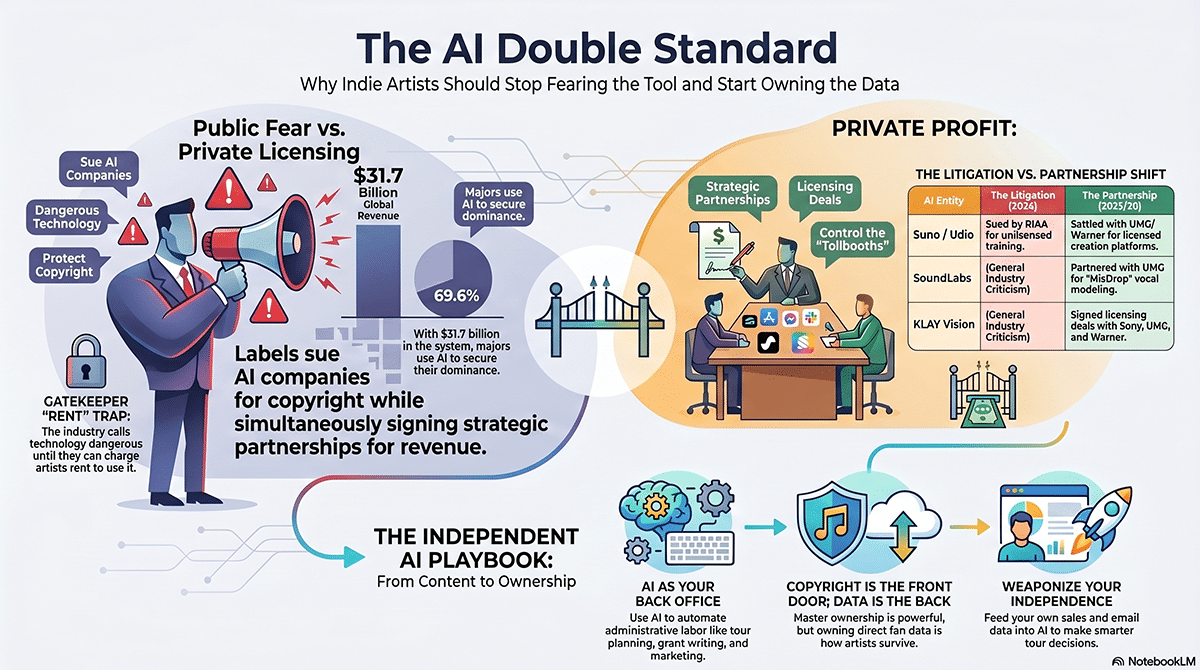
The same companies warning artists about AI are cutting AI licensing deals, building AI products, partnering with AI platforms, studying AI detection, and figuring out how to turn the next version of music consumption into another closed marketplace. In 2026, the IFPI said global recorded music revenue grew 6.4% to $31.7 billion in 2025, while also stating that AI innovation and the response to streaming fraud will shape the next era of music. The same report said record companies are “at the forefront” of AI innovation and are actively developing licensing models to create revenue opportunities around AI. That is not an anti-AI position. That is a “we want to own the business model” position.
And that is where indie artists need to wake up.
The question is not whether AI will be part of the music business. That argument is already over. The question is who gets to use it. The labels? The platforms? The distributors? The data brokers? Or the artists themselves?
The Industry’s Favorite Trick Is To Call Something Dangerous Until It Can Charge Rent On It
The major music industry is not wrong when it says AI can be abused. In June 2024, the RIAA announced lawsuits against Suno and Udio, with plaintiffs including major-label companies tied to Sony Music, Universal Music Group, and Warner Music Group. The core argument was that AI companies should get permission and compensate creators when copyrighted works are used to train commercial systems. That principle is fair. Artists should not have their work scraped, copied, cloned, and repackaged into products that compete against them without consent or payment.
The Human Artistry Campaign, backed by many major music and entertainment organizations, has also argued for respect for artists, transparency, and adherence to copyright and intellectual property law in AI development. Again, that is not a crazy position. It is the minimum floor for a sane creative economy. Artists should have rights. Songwriters should have rights. Singers should own their voices. Producers should own their masters. Performers should not wake up and find a fake version of themselves singing a song they never approved.
But here is where the story bends.
The industry does not want AI stopped. It wants AI licensed. It wants AI contained inside systems it controls. It wants AI trained on catalogs it owns or administers. It wants AI wrapped in subscriptions, permissions, walled gardens, opt-in systems, and revenue-sharing agreements. It wants to turn “AI is bad for music” into “AI is good for music once we get paid.”
That is the part indie artists need to understand.
In October 2025, Universal Music Group and Udio settled their copyright litigation and announced strategic agreements for a new licensed AI music creation platform. According to UMG’s own announcement, the new platform is planned for 2026 and will be trained on authorized and licensed music, with new revenue opportunities for UMG artists and songwriters.
The next month, Warner Music Group announced a partnership with Suno, the same general category of AI music platform the industry had been attacking in court. Warner said the deal would open new frontiers in music creation, interaction, and discovery while compensating and protecting artists, songwriters, and the wider creative community.
Also in November 2025, KLAY Vision announced separate AI licensing agreements with Universal Music Group, Universal Music Publishing Group, Sony Music Entertainment, Sony Music Publishing, Warner Music Group, and Warner Chappell Music. That is not the behavior of an industry that wants AI to disappear. That is the behavior of an industry building the next licensing layer.
Then there is Spotify. In October 2025, Spotify announced plans to work with Sony Music Group, Universal Music Group, Warner Music Group, Merlin, and Believe to develop “artist-first” AI music products. Spotify also pointed to its own AI-powered features, including AI DJ, daylist, and AI Playlist, as examples of using generative AI to connect fans and artists. Again, this is not anti-AI. This is platform-controlled AI.
So the message to artists becomes very strange.
When an indie artist uses ChatGPT to plan a release campaign, analyze fan data, write better email copy, map a tour route, build a content calendar, research licensing targets, improve metadata, or design a direct-to-fan strategy, they are told to be careful because AI is dangerous.
When the largest companies in music use AI to build new licensing products, protect catalogs, develop vocal modeling tools, create artist-partnered AI products, and open new revenue channels, that is called innovation.
Funny how that works.
The Real AI Threat Is Not The Tool. It Is The Same Old Power Structure Wearing New Clothes.
The danger is not that indie artists will use AI. The danger is that they will not.
If independent artists reject AI entirely while the major labels quietly build AI into every layer of their operations, the result will not be a more human music business. It will be a more automated version of the same old hierarchy.
The labels will have better analytics. The platforms will have better recommendation engines. The distributors will have better marketing systems. The ticketing giants will have better demand forecasting. The ad platforms will have better audience modeling. The catalog owners will have better licensing tools. The major publishers will have better sync search. The companies with the biggest datasets will train the best business machines.
And the indie artist will be told to “just make great music.”
That line has always sounded romantic. It is also how artists get robbed politely.
Making great music is the center of the whole thing. Nobody serious would argue otherwise. But in the modern music economy, great music without business infrastructure is like building a beautiful store in the middle of the desert and forgetting to build a road to it.
AI is not just about generating songs. That is the shallow conversation. The real AI revolution for indie artists is not “push a button and make fake music.” The real revolution is using AI as a business intelligence layer over the artist’s own career.
That means using AI to understand which fans are buying, which cities are responding, which merch items are profitable, which emails convert, which shows produce repeat customers, which songs are driving discovery, which audiences are worth advertising to, which sync markets fit the catalog, and which platform activity should be moved into an artist-owned relationship.
That is the part the old industry does not want to talk about.
Because when an indie artist owns the music, owns the website, owns the fan list, owns the sales data, owns the merch history, owns the ticketing relationship, owns the email relationship, and uses AI to turn all of that into decisions, the label’s old argument starts to fall apart.
For decades, the label’s pitch was access. They had the radio relationships. They had the marketing department. They had the retail pipeline. They had the tour support. They had the data. They had the money. They had the gatekeepers on speed dial.
But what happens when an artist can use Spotify for Artists, Chartmetric, Bandcamp, Bandsintown for Artists, Eventbrite, Shopify, WooCommerce, Stripe, Square, The Newsletter Plugin, SendGrid, WordPress, and ChatGPT to build a smarter version of that same machine at working-artist scale?
What happens when the artist does not need mass culture to survive?
What happens when a thousand real fans become more valuable than a million passive streams?
What happens when the fan relationship moves from platform-owned attention to artist-owned data?
That is when AI stops being a gimmick and becomes a weapon of independence.
The Majors Are Fighting AI Abuse, But They Are Also Building AI Revenue
This is where the conversation needs more honesty.
Yes, the industry has legitimate concerns about AI-generated music flooding the market. Deezer said in April 2026 that it was receiving nearly 75,000 fully AI-generated tracks every day, accounting for more than 44% of total daily delivery to the platform. Deezer also said it had detected and tagged more than 13.4 million AI tracks in 2025, and that up to 85% of streams generated by fully AI-generated tracks were fraudulent in 2025. That is a real problem. It is not paranoia. It is not old people yelling at clouds. It is an economic threat to real artists.
If streaming platforms are flooded with synthetic tracks created for fraud, the royalty pool gets polluted. If listeners cannot tell what is human and what is fake, trust gets damaged. If AI systems can clone voices, steal styles, and generate catalog knockoffs at scale, then artists lose control over their identity. Any indie artist who cares about ownership should care deeply about that.
But we have to separate two very different things.
One thing is exploitative AI. That includes unlicensed training, fake bands, synthetic spam, unauthorized voice cloning, bot streaming, deepfake performances, and corporate systems that use artist work without permission.
The other thing is artist-controlled AI. That includes fan analytics, tour planning, email segmentation, merch forecasting, ad testing, licensing research, website automation, release strategy, grant writing, royalty tracking, metadata cleanup, and direct-to-fan engagement.
Putting those two things in the same bucket is how the industry keeps artists confused.
The old gatekeepers benefit when artists think AI only means fake songs. Because if indie artists define AI only as synthetic music, they will avoid the very tools that could help them build stronger businesses.
Meanwhile, the major players are not avoiding AI at all.
UMG has already partnered with SoundLabs to offer its artists a responsibly trained AI vocal modeling plug-in called MicDrop. UMG’s announcement said the tool would let artists and producers create official high-fidelity vocal models using their own voice data while retaining ownership control and artistic approval. That is not anti-AI. That is AI with permission, ownership, and corporate access.
And that is exactly the distinction indie artists need to apply to their own careers.
Do not let someone clone your voice without consent. But do use AI to understand your fans.
Do not flood the market with fake music. But do use AI to build better campaigns around your real music.
Do not hand your catalog to a platform without clear terms. But do use AI to audit your metadata, organize your publishing information, and find missed royalty paths.
Do not confuse unethical automation with smart business operations.
The majors understand that difference. That is why they fight one version of AI while building another.
Copyright Is The Front Door. Data Is The Back Door.
Most of the public AI fight is about copyright. That makes sense because copyright is the legal foundation of the music business. Songs and recordings are assets. They have value. They should not be scraped or exploited without permission.
But the next music business will not be built only on copyright. It will be built on data.
Not creepy data. Not surveillance. Not platform manipulation. I am talking about artist-owned fan data: names, emails, locations, purchase history, show attendance, merch preferences, membership status, listening signals, direct support, and engagement patterns that fans knowingly share with the artist.
That kind of data is the new map.
A master recording tells you what you own. Fan data tells you where the money can come from next.
This is where independent artists have a chance to do something the old industry does not want them to do. They can stop treating fans like anonymous stream counts and start treating them like a living community.
A stream can tell you someone heard a song. A fan email can start a relationship. A merch sale can reveal commitment. A ticket scan can show geography. A Bandcamp purchase can show support. A fan club signup can show loyalty. A reply to an email can show emotional connection. A QR code scan at a show can turn a room full of strangers into a direct audience the artist can reach again.
Now add AI to that.
An artist can feed their owned data into AI and ask better questions. Where are my strongest cities? Which fans buy vinyl but not shirts? Which fans came to a show but have not joined the mailing list? Which email subject lines created the most sales? Which markets should I revisit? Which songs are getting attention but not converting into followers? Which fans should get a backstage offer? Which city has enough support for a house concert, listening party, or small venue show? Which merch item should I bring to the next run?
That is not science fiction. That is basic business intelligence. The only reason it sounds futuristic is because most musicians have been trained to think business data belongs to someone else.
The next model should be simple. The artist owns the music. The artist owns the fan relationship. The artist owns the data. AI helps the artist understand that data and turn it into revenue.
That revenue can be tickets, merch, vinyl, digital albums, memberships, private streams, sync placements, publishing income, direct support, VIP experiences, workshops, licensing, house concerts, livestreams, patron-style fan clubs, limited drops, and community events.
That is how a real music industry middle class gets built.
Not by waiting for a playlist editor to bless you.
Not by begging an algorithm.
Not by mistaking followers for customers.
Not by confusing exposure with income.
By building a system where attention turns into ownership, ownership turns into data, data turns into decisions, and decisions turn into direct revenue.
The Platform Model Wants You Dependent. The Artist-Owned Model Wants You Dangerous.
The platform model is easy to understand. You create content. The platform controls distribution. The platform owns the audience relationship. The platform changes the rules. The platform sells ads. The platform gathers data. The platform gives you a dashboard with just enough information to keep you hooked, but not enough to make you truly independent.
That is not a conspiracy. That is the business model.
Spotify is useful. YouTube is useful. TikTok is useful. Instagram is useful. Streaming and social platforms are powerful discovery tools. They are billboards. They are highways. They are public squares. They can help fans find you.
But they are not your home.
Your home is the place where you control the relationship. That means your website, your email list, your store, your fan club, your community, your ticketing flow, your data, your content archive, your membership system, and your direct payment pathways.
This is why the artist-owned website is not old-fashioned. It is more important than ever.
A modern artist website should not be a dusty bio page with a few links to other companies. It should be an ecosystem. It should have music, video, merch, memberships, tour dates, ticket links, email capture, SMS options, community tools, fan rewards, exclusive content, and data capture points that help the artist understand the fanbase.
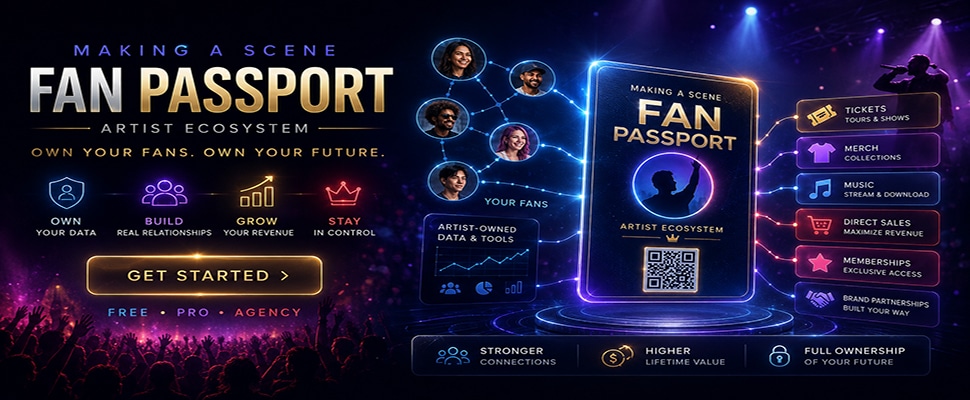
The coming Making a Scene Fan Passport system and artist website ecosystem fit directly into this future. The idea is not just to give artists another website template. The idea is to give artists a control center. A fan attends a show, scans a QR code, earns a stamp, buys merch, joins a list, unlocks content, gets a reward, and becomes part of the artist’s owned universe. That action is no longer invisible. It becomes useful information the artist can use to plan the next show, the next offer, the next email, the next release, and the next revenue move.
That is the kind of system AI makes stronger.
AI can summarize fan behavior. AI can suggest segments. AI can help create local campaigns. AI can tell an artist that fans in Pittsburgh are buying shirts but not tickets, while fans in Atlanta are opening emails but not buying vinyl, while fans in Chicago are showing enough repeat activity to justify a return show. AI can help an artist stop guessing.
This is the real threat to the old industry.
Not robot songs.
Artist intelligence.
Because once artists understand their own business, they become harder to exploit.
The Major Label Advantage Was Always Information
The record business was never just about music. It was about information.
Who knows the program director? Who knows the playlist editor? Who knows which market is reacting? Who has the marketing reports? Who has the radio data? Who has the retail data? Who knows the booking agents? Who has the promoter relationships? Who can see sales velocity? Who can track where momentum is real and where it is fake?
For decades, major labels had more information than artists. That information gap created dependency.
An artist could make brilliant music and still have no idea where their fans were, who was buying, what was working, what was not working, or how money was moving. The label held the reports. The label controlled the spend. The label managed the relationships. The label interpreted the market.
AI can help close that gap.
But only if artists own enough data to feed the machine.
That is why fan data ownership matters as much as master ownership. Owning your recordings is powerful. Owning your publishing is powerful. But if you do not own the fan relationship, you still have to rent access to your own audience.
A song can earn royalties for years. A fan relationship can create revenue for decades.
The artist who owns both is dangerous.
The artist who owns neither is content.
And content is what platforms eat.
AI Should Be The Indie Artist’s Back Office, Not Their Replacement
The best use of AI for indie artists is not replacing the artist. It is replacing the unpaid administrative labor that burns artists out.
Most independent artists are not just artists. They are booking agents, publicists, merch managers, editors, social media managers, email marketers, tour planners, web admins, customer service departments, accountants, grant writers, and data analysts. Then, after all that, they are supposed to write great songs.
That is absurd.
AI can help carry the business weight.
An artist can use ChatGPT to turn raw notes into a release plan, draft newsletter campaigns, summarize fan survey responses, create a tour outreach template, build a merch profit calculator, analyze sales exports, write better product descriptions, outline a grant application, clean up a bio, prepare interview answers, and create a weekly marketing checklist.
An artist can use Chartmetric and Spotify for Artists to spot discovery signals, then use AI to turn those signals into action. If a song starts moving in a city, the artist can build a local email segment, test a small ad, contact a venue, pitch local press, create city-specific content, or offer a limited merch bundle tied to that market.
An artist can use Bandcamp, Shopify, WooCommerce, Stripe, and Square sales data to understand what fans actually buy. Then AI can help answer the practical questions that matter: which items have the best margin, which bundles work, which cities buy physical goods, which fans support repeatedly, and which products should be offered before a tour.
An artist can use Eventbrite, Bandsintown for Artists, and venue ticket reports to understand where live demand exists. Then AI can help compare ticket sales, merch sales, email subscribers, and fan passport activity to create smarter routing.
An artist can use The Newsletter Plugin, SendGrid, Mailchimp, or ConvertKit to communicate directly with fans. Then AI can help write subject lines, segment campaigns, personalize follow-ups, identify inactive fans, and connect emails to actual revenue instead of vanity metrics.
None of this replaces musicianship.
It replaces confusion.
And confusion has always been profitable for the middlemen.
The Next Battle Is Not Human Versus AI. It Is Open Artist Systems Versus Closed Corporate Systems.
The old industry would love to frame the next fight as human artists versus AI machines. That makes for an easy headline. It also hides the real fight.
The real fight is artist-controlled AI versus corporate-controlled AI.
If AI becomes another closed system where major labels license catalogs, platforms control distribution, artists opt in under unclear terms, fans are trapped inside walled gardens, and independent artists are left with scraps, then yes, AI will become another tool of exploitation.
But if AI becomes a tool that helps artists own relationships, understand fan behavior, build direct revenue, protect rights, manage catalogs, improve marketing, and make smarter business decisions, then AI becomes one of the most important leveling tools independent musicians have ever had.
That is why the independent music community has to be careful not to let the major labels define the entire conversation.
We should support consent. We should support licensing. We should support transparency. We should support labeling. We should support protection against fake artists and unauthorized voice cloning. We should support lawsuits and laws that stop companies from stealing from creators.
But we should not support fear campaigns that convince artists to stay technologically weak while the industry becomes technologically powerful.
That is the trap.
The industry does not need indie artists to hate AI forever. It only needs them to hate it long enough to miss the window.
By the time the smoke clears, the majors will have the licensing deals, the platform integrations, the data partnerships, the AI tools, the rights frameworks, and the new monetization systems. Then they will turn around and sell access back to artists under the banner of innovation.
Same building. New paint.
The Streaming Lesson Should Still Hurt Enough To Teach Us Something
Streaming was sold as access. For fans, it worked. For labels and platforms, it worked beautifully. For many artists, it became more complicated.
The industry grew. The catalogs gained value. Subscription revenue expanded. Platforms became the center of music discovery. But the average working artist still had to fight for pennies, attention, playlist placement, and basic visibility.
In 2026, IFPI reported that global recorded music revenue reached $31.7 billion in 2025, and streaming accounted for 69.6% of global recorded music income. The money is clearly in the system. The problem is how it moves, who controls it, and how much reaches the working artist before everyone else takes a bite.
In the United States, the RIAA reported that wholesale recorded music revenue hit a record $11.5 billion in 2025, with streaming revenue at $9.5 billion and streaming representing 82% of total U.S. recorded music revenue for the fifth straight year. Again, the system is not broke in the sense that there is no money. The system is broken in the sense that too much of the money is captured before it becomes sustainable income for the independent artist.
That is why AI cannot become “streaming, part two.”
If AI licensing is built only around catalogs controlled by major labels, then independent artists will be invited into the model after the rules are already written. If AI-powered music experiences become locked inside platforms where downloads are restricted, fan data is hidden, and the artist relationship is mediated by the service, then we have learned nothing.
The Universal and Udio deal is a perfect example of the tension. AP reported that after UMG and Udio announced their settlement and new platform plans, Udio stopped allowing users to download songs they had created, which sparked backlash among paying users. The companies framed the future product as licensed and controlled, with artist permissions. That may solve one problem, but it also shows how quickly AI music can move into walled gardens where the platform decides what users can do.
Independent artists should pay attention.
Control matters.
Downloads matter.
Data matters.
Terms matter.
Ownership matters.
Permission matters.
Revenue flow matters.
The next music business will be built by the people who understand those words before signing anything.
Indie Artists Do Not Need To Beat The Majors At Their Game. They Need To Stop Playing It.
The major label game is scale. Massive catalogs. Massive data. Massive licensing deals. Massive promotional machines. Massive platform relationships.
Most indie artists will not beat that machine by trying to become a smaller version of it.
They win by playing a different game.
The indie artist’s advantage is trust. Real connection. Speed. Authenticity. Local knowledge. Direct communication. Community. Flexibility. Ownership. The ability to know the fans as people instead of demographic clusters.
AI can make that advantage stronger.
A major label may have millions of data points, but an indie artist can know that 200 fans in one city bought tickets, opened the last three emails, streamed the new single, bought shirts, and scanned a QR code at the merch table. That is actionable. That is human. That is revenue waiting to be served correctly.
A platform may know what a fan skipped. The artist can know what the fan supported.
That difference is everything.
The artist-owned model does not need every listener. It needs the right listeners. It needs people who care enough to buy, show up, share, subscribe, support, and bring friends. AI can help identify those people, organize them, communicate with them, and build offers that respect them.
This is how the “middle class” of music gets rebuilt. Not through fantasy. Not through nostalgia. Not by begging the old gatekeepers to be nicer. It gets rebuilt by stacking revenue streams around real fan relationships.
Streaming becomes discovery.
The website becomes the hub.
Email becomes the bridge.
Merch becomes proof of support.
Shows become community.
Fan passports become history.
Memberships become recurring income.
Licensing becomes leverage.
Publishing becomes long-term value.
AI becomes the operating system that helps the artist see the whole picture.
The Moral Line Is Simple: Use AI To Empower The Artist, Not Erase The Artist
There should be no confusion about the ethical line.
Do not use AI to steal someone’s voice.
Do not use AI to impersonate an artist.
Do not upload fake music to siphon royalties.
Do not train commercial tools on work you do not have rights to use.
Do not deceive fans into thinking synthetic music is human-made.
Do not hand over your catalog, voice, likeness, or data without understanding the terms.
But also do not let fear keep you from using tools that help you survive.
Use AI to build a better tour plan.
Use AI to understand fan behavior.
Use AI to turn raw data into direct offers.
Use AI to make your emails better.
Use AI to find licensing opportunities.
Use AI to clean up your metadata.
Use AI to plan content faster.
Use AI to build better websites.
Use AI to make sense of your merch margins.
Use AI to help you ask smarter questions.
Use AI to protect your time.
Use AI to build an artist-owned business.
That is not selling out. That is refusing to be left behind.
The Future Belongs To Artists Who Own The Stack
The next music industry will not be owned by the people who make the most noise about technology. It will be owned by the people who build the strongest systems around the music.
The old industry knows this. That is why it is moving fast.
The majors are not waiting for permission. The platforms are not waiting for permission. The AI companies are not waiting for permission. The catalog owners are not waiting for permission.
So why should indie artists?
The artist of the future needs more than songs on streaming platforms. They need an owned website. They need email capture. They need direct sales. They need fan segmentation. They need merch data. They need live show data. They need publishing control. They need licensing readiness. They need content libraries. They need community spaces. They need tools that help turn attention into income.
And yes, they need AI.
Not as a fake songwriter.
Not as a replacement singer.
Not as a shortcut around craft.
They need AI as a business assistant, data translator, marketing engine, planning partner, research tool, and fan relationship amplifier.
The industry would prefer artists stay scared of that version of AI. Because that version does not just make songs. It makes independent businesses stronger.
And a strong independent artist is a problem for every gatekeeper who built a career charging rent on confusion.
The Call To Action: Stop Waiting For The Gatekeepers To Explain The Future
The music industry is not going to save independent artists from AI.
It is going to monetize AI.
That does not make every AI deal evil. Some licensing models may protect artists. Some tools may create new income. Some opt-in systems may be fair. Some partnerships may be useful. But history says artists should read the fine print, own their data, protect their rights, and never assume the people building the pipeline are doing it out of pure love for music.
The future of music is not simply AI or no AI.
The future is ownership or dependency.
It is direct fan relationships or rented attention.
It is artist-owned data or platform-controlled dashboards.
It is business intelligence in the hands of the creator or in the hands of the companies negotiating above the creator’s head.
If indie artists embrace AI as a tool for ownership, they can level the playing field in ways the old industry never wanted. They can build smarter campaigns, route better tours, sell more merch, grow fan clubs, pitch sync opportunities, manage publishing, understand real demand, and create direct revenue systems that do not require permission from a label, playlist, algorithm, or platform executive.
That is the shift.
The old model said the artist needed the industry to reach the fan.
The new model says the artist needs tools, ownership, and data to serve the fan directly.
AI will not make major players irrelevant by itself. Artists will do that by using AI to build systems they own.
The major labels already understand this. That is why they are not really fighting AI. They are fighting to control it.
Independent artists should stop being scared of the tool and start being very serious about who owns the machine.
Because the next music business is being built right now.
And this time, artists should not be standing outside the room waiting to be invited in.
 |  Spotify |  Deezer |  Breaker |
 Pocket Cast |  Radio Public |  Stitcher |  TuneIn |
 IHeart Radio |  Mixcloud |  PlayerFM |  Amazon |
 Jiosaavn |  Gaana |  Vurbl |  Audius |
 Reason.Fm | |||
Find our Podcasts on these outlets
Subscribe to Our Newsletter
Discover more from Making A Scene!
Subscribe to get the latest posts sent to your email.


