
AI as a Bandmate: Where It Helps and Where It Hurts




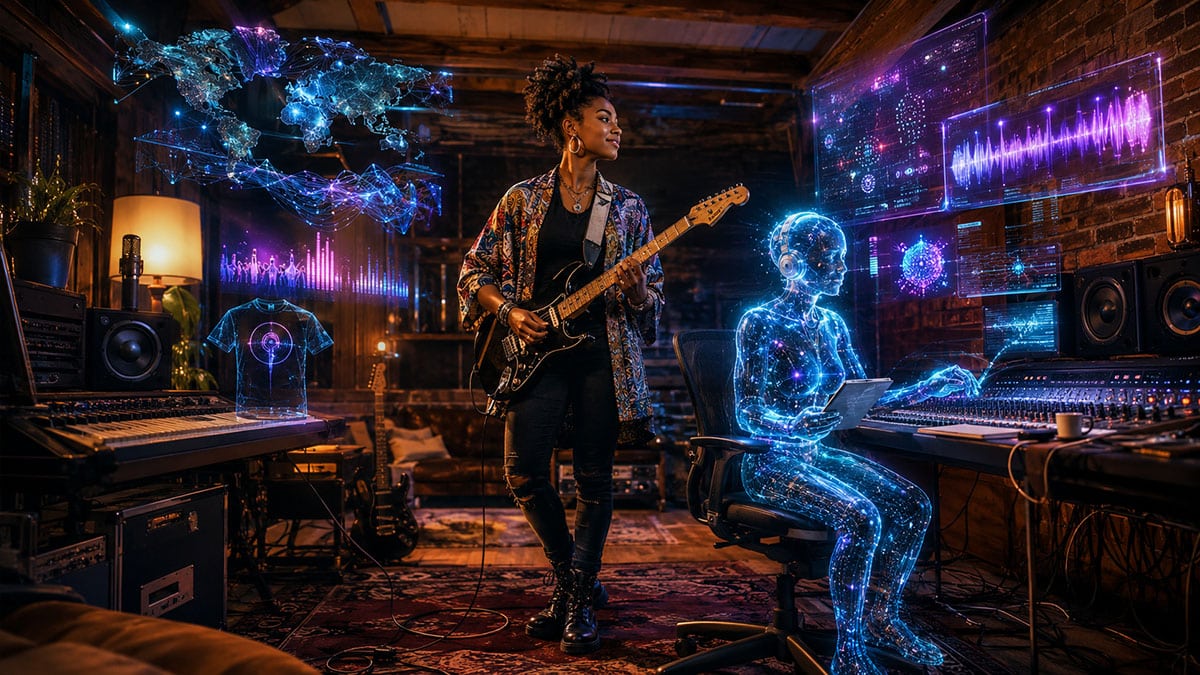
Making a Scene Presents – AI as a Bandmate: Where It Helps and Where It Hurts
Listen to the Podcast Discussion
There is a strange new player walking into the rehearsal room. It does not carry a guitar. It does not complain about the van. It does not forget the bridge, show up late, drink the last beer, or insist the snare is too loud when the snare is clearly not the problem. It sits on a laptop, in a plugin window, inside a website, behind a prompt box, or buried in the “assistant” button of a mastering tool. It is artificial intelligence, and whether artists like it or not, it is already part of the modern music business.
The real question is not whether AI belongs in music. That horse left the barn, started a playlist, wrote a press release, mastered a demo, and probably suggested five hashtags before lunch. The real question is what role AI should play. Is it a bandmate? A producer? A manager? A cheap intern? A shortcut? A threat? A tool? A thief? The honest answer is: yes, depending on who is using it and why.
At Making a Scene, the issue is not technology itself. We are not interested in the old “real musicians use tape and suffering” argument. That kind of gatekeeping usually comes from people who already had access to expensive studios, label money, radio connections, and a business structure that indie artists were never invited into. Technology has always changed music. Multitrack recording changed music. Drum machines changed music. MIDI changed music. Home studios changed music. Digital distribution changed music. The internet changed music. AI is another one of those changes, but it is moving faster, cutting deeper, and raising bigger questions about ownership, labor, data, identity, copyright, and the value of human creativity.
For the indie artist, AI can be powerful. It can help you write better emails, plan tours, clean up mixes, test arrangements, create demos, analyze fan behavior, reduce costs, and make faster business decisions. That matters because most indie artists are not sitting on a label budget. They are the songwriter, producer, booking agent, merch manager, social media department, accountant, publicist, designer, video editor, and emotional support animal all at once. Anything that removes friction can be useful.
But AI can also hurt artists. It can make lazy work easier. It can flood platforms with music nobody lived through. It can tempt artists to chase generic “content” instead of building a real voice. It can train on creative work without clear permission. It can blur the line between inspiration and imitation. It can clone voices, copy styles, create legal confusion, and hand even more power to tech companies that already know how to profit from other people’s culture.
So this is not a cheerleading article. It is not a panic article either. This is a working musician’s reality check. AI can be a hell of a bandmate. But it should never be the bandleader.
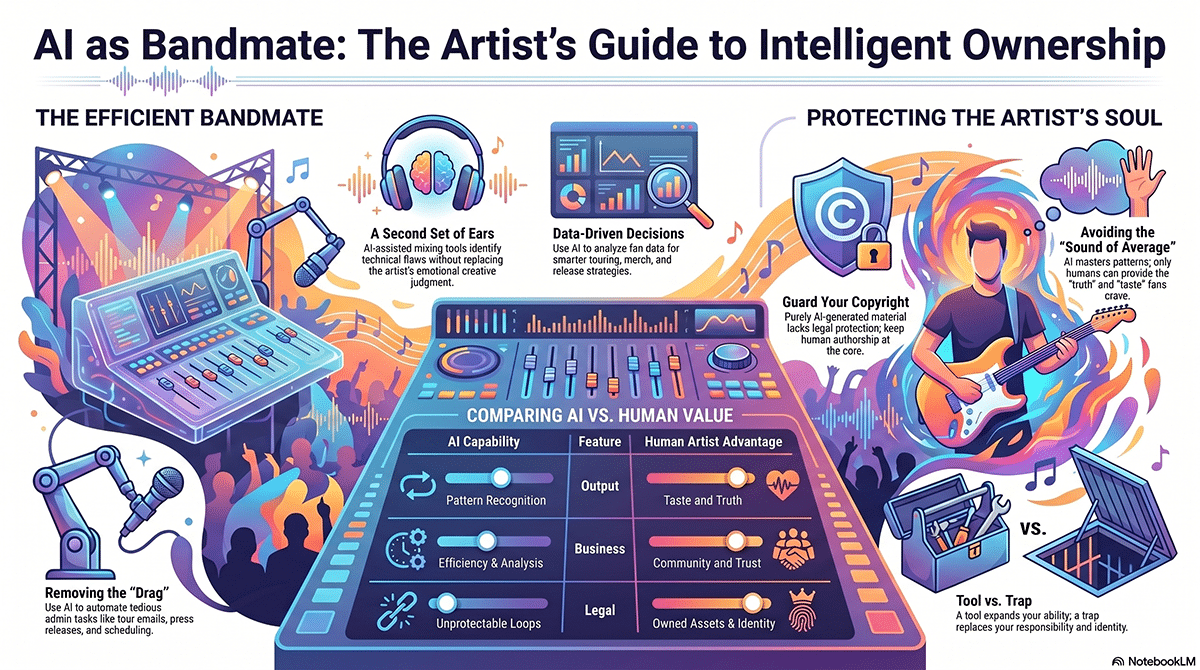
The Best Use of AI Is Not Replacing the Artist. It Is Removing the Drag.
Every indie artist knows the drag. The drag is the time between the idea and the finished thing. It is the ugly middle where great songs get buried under setup problems, bad mixes, weak marketing, missing data, poor planning, and too many jobs for one human being. AI is useful when it shortens that distance.
That does not mean AI should write your soul for you. It means AI can help clear the junk around your soul so your actual work can move. A songwriter can use ChatGPT or Claude to organize album themes, shape a press release, create a tour email, study fan comments, or build a release timeline. A producer can use AI-assisted plugins to get a starting point on a muddy vocal, harsh guitar, weak low end, or messy master. A band can use AI to compare merch sales by city, write better subject lines, map fan activity, and decide where the next run of shows should happen. These are not small things. They are the exact business tasks that used to separate artists with teams from artists working alone. OpenAI describes ChatGPT as a tool to “explore ideas, solve problems, and learn faster,” while Anthropic positions Claude as part of its broader AI assistant ecosystem; the useful point for musicians is not magic, but speed, organization, and second-opinion thinking. (ChatGPT)
This is where AI becomes practical. It is not there to make you less human. It is there to help you stop drowning in admin work. It can help a singer-songwriter draft a better booking pitch. It can help a blues artist turn show notes into a newsletter. It can help a producer explain mixing revisions to a client. It can help a band turn scattered merch receipts, email signups, and ticket sales into a clearer picture of where fans are actually showing up.
That last phrase matters: actually showing up. The future of the indie music business is not just more content. It is better fan data. Fan data is the new ecosystem for the indie artist. Not because artists should become creepy surveillance machines, but because they need to know who their real supporters are. The artist who knows which fans bought vinyl, came to the show, opened the email, scanned the QR code, joined the fan club, bought the hoodie, watched the private live stream, and shared the new single has power. The artist who only knows they got 12,000 plays from somewhere on a platform they do not control is still guessing.
AI in the Studio: The Second Set of Ears That Does Not Get Tired
One of the most useful places for AI is the studio, especially for indie artists working at home. Home recording has opened the door for thousands of artists, but it also created a new problem. Many artists can record now, but they still struggle to judge what they are hearing. Is the vocal too bright? Is the bass too loud? Is the master too smashed? Is the snare poking out or just annoying after six hours of listening? At some point, ears get tired and confidence goes out the window.
Tools like iZotope Ozone, iZotope Neutron, sonible smart:EQ 4, sonible smart:reverb 2, and the SSL autoSeries Bundle are not replacements for learning how to mix. They are learning tools if you treat them correctly. Ozone’s current mastering suite is described by iZotope as using an AI-powered assistant, Neutron 5 includes an improved AI-powered Mix Assistant, sonible’s smart:EQ 4 uses AI to correct spectral issues and help with tonal balance, and SSL’s autoSeries pairs SSL-style processing with sonible’s AI-assisted audio analysis.
The danger is thinking the assistant is always right. It is not. AI does not know what heartbreak sounds like. It does not know that the slightly nasty vocal tone is the point. It does not know that the guitar should feel like the amp is about to fall apart because that is the emotional center of the track. But AI can show you what it thinks is wrong. That is valuable. If smart:EQ pulls down a harsh frequency on a vocal, you can ask yourself why. If Ozone suggests a mastering chain, you can study the moves. If Neutron changes the balance of a mix, you can compare it to your own instinct. Used this way, AI becomes a teacher, not a dictator.
This is especially important for artists using modern DAWs like Fender Studio Pro, Logic Pro, Pro Tools, Cubase, Ableton Live, FL Studio, and BandLab. Fender’s current Studio Pro page presents it as a DAW for modern creators, and reporting around the 2026 rebrand describes Fender Studio Pro 8 as the renamed evolution of PreSonus Studio One Pro. That matters because the DAW itself is becoming less of a tape machine and more of a creative command center.
For a working indie artist, this changes the math. You can record vocals at home, use AI-assisted tools to identify rough problems, export a reference master, test it in the car, and decide whether the mix is ready for a professional mastering engineer or still needs work. That saves money. It also saves embarrassment. And when budgets are tight, saving money without lowering standards is not a luxury. It is survival.
AI as a Songwriting Tool: Useful Spark, Dangerous Crutch
Now we get to the hot stove: AI music generation. Platforms like Suno, Udio, SOUNDRAW, Boomy, AIVA, Mubert, ElevenLabs Music, and BandLab SongStarter can generate musical ideas, beats, melodies, full tracks, background music, or song sketches from prompts and settings. Suno says users can create songs from ideas in seconds. Udio describes itself as a place to create and share AI music. SOUNDRAW promotes royalty-free beats and stem downloads. AIVA calls itself an AI music generation assistant with many styles. BandLab SongStarter is presented as an AI-powered tool for generating beats and melodies to inspire new music.
These tools are not all the same, and artists should read the terms carefully before using anything commercially. Some are better for background music. Some are better for idea generation. Some create full songs with vocals. Some are built around royalty-free claims. Some are operating inside a legal battlefield that is still shifting. Any artist who uses AI-generated music without reading the license is basically driving at night with the headlights off.
That said, as learning tools, these platforms can be useful. A young songwriter can type in a mood and hear how different tempos change the emotional effect. A producer can study arrangement choices. A rapper can generate a beat idea and then rebuild it from scratch in their own DAW. A composer can use AIVA or Mubert to study structure, pacing, and mood. A band can use Suno or Udio to test lyric meter, then throw away the generated track and write the real song themselves. That is a valid use. It is not cheating to learn from a machine if the human work still comes from you.
The problem starts when the artist stops using AI as a mirror and starts using it as a mask. If the entire song is generated by a prompt, where is the artist? If the vocal is synthetic, the chord changes are synthetic, the lyrics are synthetic, and the arrangement is synthetic, what exactly is being expressed? Maybe it is a fun experiment. Maybe it is background content. Maybe it has a commercial use in certain areas. But it is not the same thing as an artist wrestling with a life, a place, a sound, a band, a story, a scene, and a reason to sing.
This is where the indie artist has to be careful. The marketplace is already full of noise. AI can add more noise at industrial speed. That does not help real artists build careers. It makes discovery harder. It makes trust more valuable. In a world where anyone can generate a passable track, the human artist with a real story, a real community, and a real live connection becomes more important, not less.
Copyright Is Not a Footnote. It Is the Floor Under the House.
The legal side of AI music is not settled, and artists should not pretend it is. In 2024, the RIAA announced lawsuits against Suno and Udio, accusing the services of mass infringement of copyrighted sound recordings. Those cases helped push the debate over training data, permission, and compensation into the center of the music business.
The U.S. Copyright Office has also made one thing very clear: human authorship still matters. In its AI copyright work, the Office says copyright can protect original expression created by a human author even if a work includes AI-generated material, but it does not extend to purely AI-generated material or material where there is not enough human control over the expressive elements. The Office has also stated that prompts alone are not enough when the human has not determined sufficient expressive elements.
That should make every indie artist sit up straight. If you are building a catalog, your catalog is an asset. It is not just “content.” It is your publishing, your master rights, your licensing future, your sync potential, your estate, your leverage, and your long-term business value. If you fill that catalog with material you may not fully control, or material that may not be fully protectable, you are building your house on wet cardboard.
This is why AI should be part of the process, not the owner of the process. Use AI to brainstorm titles. Use it to map release plans. Use it to test arrangements. Use it to clean up audio. Use it to help understand compression, EQ, or mastering. Use it to generate practice prompts. But when it comes to the core song, the voice, the lyric, the melody, the emotion, and the performance, the artist needs to remain in control.
The Human Artistry Campaign has argued that AI should support human creativity with respect for human artists, performers, and creators. That is not anti-technology. That is pro-artist. There is a huge difference. (Human Artistry Camp)
Where AI Helps the Business Side: Less Guessing, Better Decisions
The studio side gets most of the attention because it is more exciting. People love arguing about AI songs. But the business side may be where AI becomes most useful for working artists.
An indie artist does not just need a better mix. They need better decisions. Where should they tour? Which city is worth returning to? Which merch item actually sells? Which fans are casual listeners and which ones show up with money? Which email subject line gets people to open? Which post sends fans to the website? Which release campaign led to real sales instead of vanity engagement?
AI can help answer those questions if the artist has the right data. That is the key. Bad data gives bad advice. Platform-only data gives platform-shaped advice. Owned fan data gives artist-shaped advice.
Tools like Spotify for Artists, Chartmetric, Bandsintown for Artists, Eventbrite, Bandcamp, Mailchimp, WordPress, WooCommerce, Stripe, Square, Shopify, Printful, and Printify all touch pieces of the modern artist business. Spotify for Artists provides audience and playlist data. Chartmetric tracks performance across streaming, social, and traditional channels. Bandsintown for Artists focuses on concerts, fans, ticketing integrations, and live promotion. Eventbrite offers ticketing and event marketing tools. Mailchimp promotes marketing analytics, automations, and AI tools. (Spotify for Artists)
But the artist’s real power comes when these pieces feed into an owned ecosystem. That is where the Making a Scene philosophy comes in. Streaming should be discovery. Social media should be discovery. The artist website should be the home base. Email should be owned. Fan relationships should be owned. Merch sales should be measured. Ticket buyers should be remembered. Superfans should not be trapped behind a platform wall.
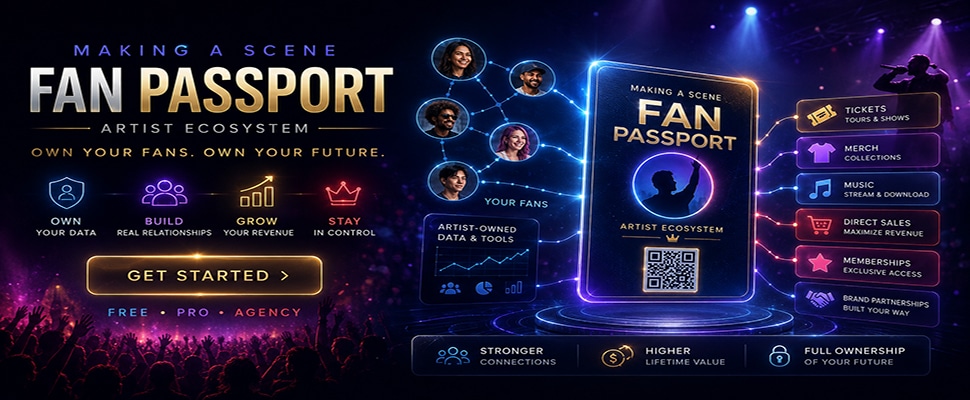
This is where a Fan Passport system becomes more than a fun loyalty idea. It becomes the data layer of an artist-owned business. Imagine a fan scans a QR code at a show. They get a show stamp. They buy a shirt. They get a merch stamp. They sign up for the email list. They unlock a private acoustic video. They come back three months later and buy a ticket in another city. That is not just “engagement.” That is a story. AI can read that story and help the artist make better choices.
An AI assistant connected to owned fan data could say, “You have 73 fans within 40 miles of Asheville who opened the last three emails, 18 who bought merch, and 12 who attended a show in the past year. That market is warm.” It could say, “Your black logo hoodie sells better in colder tour markets, but the signed vinyl moves better after full-band shows.” It could say, “Your fans in Pittsburgh buy tickets but do not buy merch, so bring lower-cost items and focus on email capture.” It could say, “Your last email got clicks from fans who have not attended a show yet. Send them a first-show discount.” That is not science fiction. That is just business intelligence finally being pointed at the indie artist instead of the platform.
The Old Industry Sold Access. The New One Should Sell Ownership.
The traditional music industry was built on access. Labels had access to studios, radio, retail, press, manufacturing, tour support, and distribution. Artists gave up ownership because they needed access. That was the bargain. Sometimes it worked. Many times it did not.
The digital era changed access but did not fully fix ownership. Artists can now distribute music, post videos, run ads, sell merch, and build websites, but many still build their careers on rented land. They rent attention from social platforms. They rent access from streaming platforms. They rent visibility from algorithms. They rent customer relationships from ticketing platforms. They rent store behavior from marketplaces. They rent audience contact from apps that can change the rules overnight.
AI can either make this better or worse. If AI is only used inside closed platforms, it may make artists more dependent. If the artist relies on a platform’s AI to decide what fans see, when fans hear the song, who gets promoted, and what content gets pushed, then AI becomes another gatekeeper in a nicer outfit.
But if artists use AI inside their own ecosystem, it becomes a lever. The artist owns the site. The artist owns the email list. The artist owns the fan history. The artist owns the store. The artist owns the ticketing path where possible. The artist owns the community. AI then becomes the assistant that reads the artist’s own business and helps improve it. That is the difference between being analyzed by platforms and using analysis for yourself.
This is why the future is not just AI. It is AI plus ownership. AI plus fan data. AI plus direct revenue. AI plus Web3-style access, proof, identity, and loyalty systems where they make sense. Not crypto hype. Not cartoon monkey nonsense. Real tools. Real fan recognition. Real direct support. Real portability. Real proof that a fan showed up, bought in, supported, and belongs to the community.
Where AI Hurts: The Sound of Average Gets Louder
AI is very good at average. That sounds harsh, but it is true. AI learns patterns. It is great at producing something that sounds like things that already exist. That can be useful when you need a starting point. It can be deadly when you need a voice.
Music does not move people because it checks the correct boxes. It moves people because something human slips through. A cracked vocal. A lyric that is too honest. A guitar tone that should not work but does. A drummer pushing the tempo because the room is on fire. A singer dragging a note because grief has weight. A bass player landing behind the beat because the song needs hips. AI can imitate the shape of these things, but it does not live them.
The danger is not that AI will make all music bad. The danger is that it will make a lot of music acceptable. Acceptable is not the goal. Acceptable is wallpaper. Acceptable is playlist filler. Acceptable is a song that does not offend anyone and does not save anyone either.
For indie artists, this is the trap. If you use AI to smooth out every weird edge, you may remove the thing that makes you worth hearing. If every press release sounds like the same “genre-defying artist blending heartfelt lyrics with infectious grooves,” nobody cares. If every mix is polished into the same streaming-safe paste, nobody remembers it. If every social caption sounds like a marketing intern trapped in a motivational poster factory, fans smell it.
The artist’s job is not to sound machine-approved. The artist’s job is to mean something.
Voice Cloning and Style Theft Are Not Innovation. They Are Extraction.
One of the ugliest sides of AI is voice cloning and style imitation. A voice is not just a sound. It is identity. It is body, memory, labor, culture, pain, breath, accent, age, phrasing, and lived experience. When AI clones a voice without consent, it is not a neat party trick. It is an attack on identity and livelihood.
This issue is bigger than celebrities. Yes, famous artists have more visible targets on their backs. But indie artists are vulnerable too. A regional singer with a devoted fanbase can be copied. A session vocalist can be cloned. A narrator, rapper, blues singer, folk artist, or gospel vocalist can have their tone scraped and reused. And once the fake is out there, the burden often falls on the human to prove what is real.
That is backwards. Consent should come first. Credit should matter. Compensation should be built in. Control should stay with the artist.
There are responsible uses of voice technology. An artist might use a licensed voice tool for backing textures. A vocalist might train a model on their own voice to create harmonies or demos. A disabled artist might use voice tools to keep creating. A producer might use vocal conversion as a temporary sketch before hiring a singer. These uses are not the same as stealing someone’s voice and selling the result as novelty content.
The rule should be simple enough to fit on a guitar case: do not use AI to do something you would be ashamed to explain to the artist being copied.
AI Can Teach, But It Can Also Make Artists Lazy
One of the best uses of AI is education. A beginner can ask what compression does. A home studio owner can ask why a vocal sounds boxy. A songwriter can ask for examples of rhyme types. A bassist can ask how walking lines work. A drummer can ask how different grooves change feel. A producer can ask for a checklist before sending a mix to mastering. Used this way, AI is like having a patient tutor who does not roll its eyes when you ask the same question five times.
This is powerful because music education has often been expensive, confusing, or hidden behind insider language. AI can explain EQ in plain English. It can help a beginner understand gain staging. It can compare microphones. It can walk an artist through release planning. It can explain publishing, PROs, SoundExchange, sync licensing, metadata, ISRC codes, split sheets, and merch margins without making the artist feel stupid.
That matters. Knowledge is power. The old industry benefited when artists did not understand the business. The new artist-owned music economy depends on artists understanding it.
But there is a flip side. AI can make artists lazy if they stop learning and just accept outputs. If you ask AI to write every email, you may never learn how to talk to your fans. If you let AI master every song without listening, you may never learn what your music should sound like. If you use AI to generate every caption, you may forget how to speak in your own voice. If you ask AI what kind of artist you should be, you are already in trouble.
The best artists will use AI to learn faster, not to avoid learning.
AI and Cost: The Democratizing Tool With a Catch
There is no denying the cost advantage. A good studio, producer, mixer, mastering engineer, designer, publicist, manager, booking agent, and marketing analyst all cost money. They should cost money because skilled people deserve to be paid. But most indie artists cannot afford all of them all the time.
AI can fill gaps. It can help a band create a rough tour budget before hiring help. It can help an artist write a first draft of a grant application. It can help a producer create alternate mix notes. It can help a singer format a one-sheet. It can help a songwriter organize sync pitches. It can help create a release calendar. It can help test ad copy. It can help translate a bio into plain language. It can help design better workflows so artists are not reinventing the wheel every week.
That is democratizing. But the catch is that AI can also devalue creative labor if people use it as an excuse to stop hiring humans altogether. A cheap AI master is not the same as a great mastering engineer. A generated logo is not the same as a designer who understands your brand. A prompt-made bio is not the same as a writer who interviews you and hears the story under the story. A data summary is not the same as a manager with taste, relationships, and judgment.
The smart indie artist will use AI where it makes sense and hire humans where humans make the work better. That is the balance. Use AI to reduce waste, not to strip the soul out of the process.
The Human Advantage: Taste, Truth, Timing, and Trust
AI can generate options. Humans decide what matters. That is the human advantage.
Taste is knowing what to keep and what to throw away. Truth is knowing when a lyric is honest or just clever. Timing is knowing when to release a song, when to hold it back, when to stay quiet, and when to shout. Trust is what fans give you after you show up enough times as yourself.
AI does not have taste. It has pattern recognition. AI does not have truth. It has probability. AI does not have timing. It has suggestions. AI does not have trust. It borrows yours.
That is why artists still matter. Not in some sentimental “humans are special” way, though they are. Artists matter because music is not just audio. It is relationship. A fan does not buy a shirt only because cotton exists. They buy it because the song meant something. They do not drive two hours to a club because the kick drum was properly sidechained. They go because the artist made them feel less alone. They do not join a fan club because the email automation was efficient. They join because they want to belong to the world the artist is building.
AI can support that world. It cannot be that world.
The Practical Rule: Keep the Artist in the Center
So how should an indie artist use AI without getting swallowed by it? The answer is to keep the artist in the center of every decision.
Use AI to brainstorm, but do not let it define your message. Use AI to analyze, but do not let it replace your judgment. Use AI to generate options, but do not let it erase your taste. Use AI to make demos, but do not confuse demos with finished identity. Use AI to clean up production, but do not polish away the danger. Use AI to read fan behavior, but do not treat fans like numbers. Use AI to save time, but spend that saved time making the work more human.
This is the difference between tool and trap. A tool expands your ability. A trap replaces your responsibility.
For the indie artist, responsibility is the whole game. Own your masters. Own your publishing. Own your website. Own your email list. Own your fan relationships. Own your merch data. Own your show history. Own your story. Own your weirdness. Own the thing that makes you impossible to prompt into existence.
The Future Belongs to Artists Who Use AI Without Becoming AI
The next few years are going to be messy. There will be lawsuits. There will be new licensing models. There will be AI music platforms that disappear, merge, settle, or change their rules. There will be streaming services flooded with synthetic tracks. There will be fake artists. There will be new tools that are genuinely helpful. There will be bad actors. There will be artists who reject all of it, artists who abuse all of it, and artists who quietly figure out how to make it work.
The winners will not be the artists who use the most AI. The winners will be the artists who use AI with the most purpose.
That means using AI to speed up the boring parts so you have more time for the meaningful parts. It means using AI to learn the business instead of staying dependent on gatekeepers. It means using AI to understand fans without surrendering those fans to platforms. It means building an artist-owned ecosystem where data becomes a compass, not a cage. It means turning fan behavior into better service, better shows, better merch, better releases, better communication, and better revenue that goes directly to the artist.
That is the Making a Scene angle. AI should not be another tool that makes corporations richer while artists get exposure crumbs. It should be part of a larger rebuild where indie artists own the relationship, own the data, and own the path from listener to supporter. Streaming can still be the billboard. Social media can still be the street corner. But the artist’s own website, email list, store, community, fan passport, and live show ecosystem should be the destination.
AI is not the revolution by itself. Ownership is the revolution. AI is just one of the tools that can help build it.
AI as a Bandmate, Not the Bandleader
A good bandmate makes the song better. A good bandmate listens. A good bandmate supports the vocal, locks with the groove, leaves space, and knows when not to play. A bad bandmate steps on everything, plays too loud, copies someone else’s licks, and thinks speed equals soul.
That is AI.
Used well, AI can be the bandmate who helps you move faster, hear problems sooner, plan smarter, spend less, learn more, and make better decisions. Used badly, it becomes the loudest person in the room, flattening your voice into the average of everything it has already consumed.
So bring AI into the room. Let it tune the workflow. Let it organize the notes. Let it suggest the route. Let it help with the rough mix. Let it draft the email. Let it study the fan data. Let it find patterns you missed. Let it be useful.
But do not hand it the microphone.
The future of music does not belong to machines pretending to be artists. It belongs to artists who use machines without surrendering their humanity. It belongs to the songwriter who still tells the truth. The producer who still trusts their ears. The singer who still means the line. The band that still knows what a room feels like when the chorus lands. The indie artist who stops begging platforms for permission and starts building a real ecosystem around real fans.
AI can help. AI can hurt. AI can speed things up. AI can make things cheaper. AI can teach. AI can confuse. AI can open doors. AI can create new traps.
But the artist still has to decide what is worth singing.
And that decision, at least for now, is still beautifully, stubbornly, dangerously human.
 |  Spotify |  Deezer |  Breaker |
 Pocket Cast |  Radio Public |  Stitcher |  TuneIn |
 IHeart Radio |  Mixcloud |  PlayerFM |  Amazon |
 Jiosaavn |  Gaana |  Vurbl |  Audius |
 Reason.Fm | |||
Find our Podcasts on these outlets
Subscribe to Our Newsletter
Discover more from Making A Scene!
Subscribe to get the latest posts sent to your email.


