
The AI Feedback Loop: Using Fan Behavior to Train Better Marketing Over Time





Making a Scene Presents – The AI Feedback Loop: Using Fan Behavior to Train Better Marketing Over Time
Listen to The Podcast Discussion
Your Marketing Should Get Smarter Every Time a Fan Clicks
For years, indie artists were told to market their music by guessing.
Guess what time to post. Guess what subject line sounds cool. Guess which city cares. Guess which merch item might sell. Guess whether fans want vinyl, shirts, livestreams, private songs, acoustic versions, behind-the-scenes videos, house concerts, VIP hangouts, or just a simple thank-you email that does not sound like it was written by a corporate intern trapped inside a coffee machine.
That old system was not really marketing. It was throwing spaghetti at the internet and calling it a strategy.
The new system is different. With AI, fan data, and an artist-owned platform, your marketing can improve itself over time. Not because the machine is magic. Not because AI knows your fans better than you do. It does not. But AI can help you study what your fans actually do. It can look at what they click, what they buy, what they ignore, where they live, what shows they attend, what emails they open, what offers they respond to, and what patterns keep showing up.
That is the AI feedback loop.
A feedback loop is simple. You try something. You measure what happened. You learn from it. Then you improve the next thing. In music marketing, that means each release, email, show, merch drop, video, ad, QR code, and fan passport stamp becomes a lesson. The next campaign gets smarter because the last campaign left clues behind.
This is where AI becomes useful for indie artists. Not as a replacement for your voice. Not as a fake songwriter. Not as a robot pretending to be your manager. AI works best as a marketing engineer. It watches the system, studies the behavior, finds the weak spots, and helps you make the next move with less guessing.
For the Making a Scene philosophy, this matters because the goal is not just more attention. The goal is ownership. The goal is building a music industry middle class where artists own their music, their fan relationships, their data, and their revenue streams. Streaming and social media can still play a role, but they should not be the final destination. They should be discovery doors that lead fans into an artist-owned ecosystem.
That ecosystem is where the feedback loop begins.
Streaming Gives You Signals, But Your Website Gives You Power
Let’s be honest about streaming. Platforms like Spotify for Artists give artists useful data. Spotify says its artist tools can help artists understand audience, playlist, and music data, and its analytics page focuses on music impact, audience insights, and fan-base development. That matters. If a song is gaining listeners in Chicago, Austin, Atlanta, London, or Nashville, you should know that. If saves are rising, if listeners are returning, or if playlist activity changes, those are signals.
But a signal is not the same as a relationship.
A stream does not automatically give you an email address. A playlist add does not automatically tell you who bought the shirt. A monthly listener number does not tell you who drove two hours to see you play. Streaming data can point toward interest, but it does not give the artist full control over the next step. That is why streaming should sit at the top of the funnel, not at the bottom.
The bottom of the funnel belongs to the artist.
Your website, email list, store, ticketing, membership system, fan passport, and community are where attention becomes revenue. That is where you can connect a fan’s behavior to a real action. Did they click the email? Did they buy the record? Did they scan the QR code at the merch table? Did they attend the show? Did they unlock a private video? Did they join the fan club? Did they buy again six months later?
That is the kind of data AI can actually use to help you build a smarter business.
Tools like Google Analytics can help website owners understand customer journeys and marketing performance, while Google Tag Manager helps manage tracking tags without constantly editing site code. Google Search Console shows how people find your site through Google Search, including queries, clicks, and performance. These are not music tools by design, but they become music business tools when your website becomes the center of your fan ecosystem.
The trick is not collecting data for the sake of collecting data. That is how you end up with dashboards that look impressive and teach you nothing. The trick is collecting the right data and asking better questions.
The Fan Passport Turns Random Fan Actions Into a Story
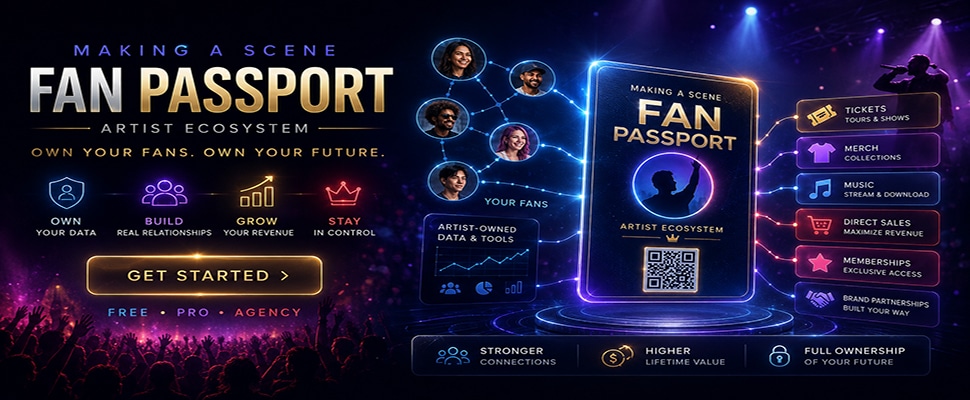
This is where the coming Making a Scene Fan Passport system becomes powerful.
A fan passport is not just a loyalty card. It is a record of relationship. It gives the artist a way to connect fan actions across the whole ecosystem. A fan might stream a song, click through to the artist’s website, sign up for the email list, scan a QR code at a show, buy a shirt, unlock a private acoustic track, attend another show in a different city, and later join a paid membership. Without a system, those actions look like scattered dust. With a fan passport, they become a map.
That map can show who your fans are becoming.
The casual listener becomes a known subscriber. The subscriber becomes a buyer. The buyer becomes a showgoer. The showgoer becomes a superfan. The superfan becomes part of the street team, the membership community, the crowdfunding base, or the local audience that makes a future tour stop possible.
Every stamp tells the artist something. A show attendance stamp tells you where the fan showed up. A merch stamp tells you what they bought. A QR scan tells you what offer attracted them. A reward redemption tells you what type of incentive worked. A city field tells you where demand is forming. A membership stamp tells you who is willing to support beyond streaming.
Now connect that to AI.
AI can help sort these patterns faster than a human staring at spreadsheets at 1:00 in the morning while eating stale venue pizza. It can identify cities where fan engagement is rising. It can compare merch buyers to email clickers. It can suggest which subject lines worked with local fans. It can summarize which offers converted casual fans into paying fans. It can help you build different messages for different fan groups without making you sound like a soulless ad agency.
That is not replacing the artist. That is giving the artist a better dashboard for survival.
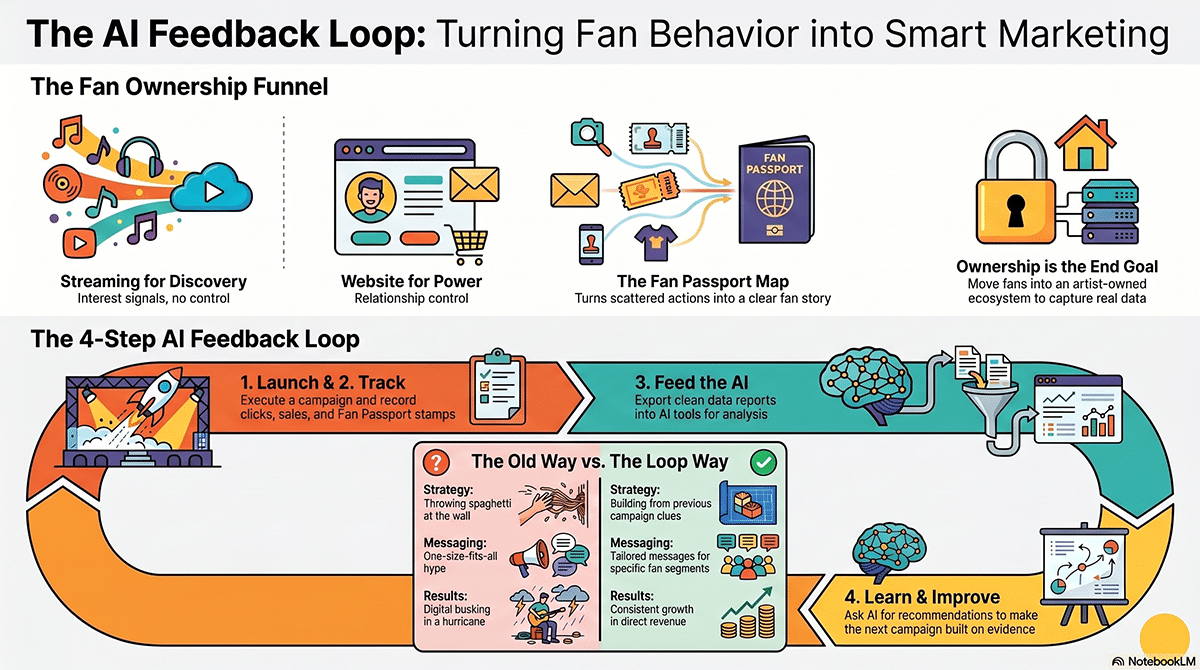
What the AI Feedback Loop Looks Like
The loop has four basic parts.
First, the artist launches a campaign. That campaign might be a new single, a video premiere, a ticket push, a merch bundle, a house concert announcement, a vinyl preorder, a fan club offer, or a private livestream.
Second, the artist tracks behavior. This includes email opens and clicks, website visits, landing page conversions, store sales, ticket purchases, QR code scans, fan passport stamps, comments, saves, follows, and direct replies.
Third, the artist gives that data to AI in a clean and responsible way. This can be done by exporting reports from systems like The Newsletter Plugin, Mailchimp, WooCommerce, Shopify, Square, Stripe, Eventbrite, or the Fan Passport dashboard. These platforms offer different types of campaign, commerce, ticketing, revenue, or sales reporting, which can become fuel for smarter artist decisions.
Fourth, the artist asks AI to explain what happened and recommend the next move. This is where tools like ChatGPT, Claude, Google Looker Studio, Zapier, and Make can become part of the working system. ChatGPT and Claude can help analyze, summarize, segment, and rewrite. Looker Studio can help visualize reports. Zapier and Make can connect tools and automate workflows across apps.
Then the next campaign is not built from scratch. It is built from evidence.
That is the loop. Launch. Track. Learn. Improve. Repeat.
A Real-World Example: The Single Release That Teaches the Next Campaign
Let’s say an indie artist releases a new single.
The old way is familiar. Post the Spotify link everywhere. Beg people to stream. Share the cover art three times. Maybe boost a post. Maybe send one email. Hope the algorithm smiles. Then complain that nobody cares. This is not a strategy. This is digital busking in a hurricane.
The feedback loop version is different.
The artist releases the single and sends fans to a landing page on their own website. That page has the song embedded, a short story about the track, a video clip, an email signup, a merch offer, and a fan passport action. Maybe fans can scan or click to collect a “first listener” stamp. Maybe that stamp unlocks a private demo, a lyric sheet, a behind-the-song video, or early access to tickets.
The artist shares clips on social media, but every post points back to the website. Streaming links still exist, but they are not the whole campaign. The artist uses streaming as discovery, then moves interested fans into the owned ecosystem.
After one week, the artist looks at the data. Spotify for Artists shows that the song is gaining saves in Atlanta and Philadelphia. Google Analytics shows that most website traffic came from Instagram Reels, but the highest-converting traffic came from the email list. The Newsletter Plugin or Mailchimp shows that the subject line with the song story got more clicks than the generic “new single out now” subject line. WooCommerce shows that the limited shirt bundle sold better than the digital download. The Fan Passport shows that fans who collected the “first listener” stamp were more likely to click the merch offer.
Now AI has something useful to work with.
The artist can paste a cleaned-up summary into ChatGPT or Claude and ask: “Analyze this campaign. Tell me which audience segments responded best, which offer created the most revenue, what message seemed strongest, and what I should change for the next two weeks.”
That one prompt can turn scattered numbers into a plan.
Maybe AI points out that fans in two cities are showing high engagement but have not been offered local shows. Maybe it notices that the personal story email outperformed the hype email. Maybe it sees that fans who watched the behind-the-song video were more likely to buy merch. Maybe it recommends a follow-up campaign aimed at fans who clicked but did not buy.
The artist still makes the final call. The artist still controls the voice. But now the artist is not guessing in the dark.
How to Instruct AI to Improve Your Marketing
AI needs direction. If you throw a messy spreadsheet into an AI tool and say, “Make this better,” you will usually get a generic answer dressed in business pajamas.
You need to tell AI what role to play, what data matters, what outcome you want, and what rules it must follow.
A strong prompt starts with context. Tell the AI who you are, what the campaign was, what you were trying to accomplish, and what data you collected. Then tell it what kind of answer you want. Do not ask for vague “insights.” Ask for decisions.
Here is a useful prompt for campaign review:
“Act as a music marketing strategist for an independent artist. I am going to give you campaign data from a new single release. The goal was to move fans from streaming and social media into my owned website, email list, fan passport, merch store, and ticket funnel. Analyze the data and tell me what worked, what failed, which fan segments showed the strongest buying intent, which cities deserve follow-up, and what three actions I should take next to increase direct revenue. Do not recommend vanity metrics unless they connect to email signups, sales, ticket demand, memberships, licensing leads, or fan passport growth.”
That prompt does something important. It tells AI not to chase empty numbers. It forces the answer back to artist income and fan ownership.
Here is a prompt for email improvement:
“Review these email campaign results. Compare subject lines, open rates, click rates, purchase rates, unsubscribe rates, and fan passport actions. Identify the tone and message that produced the strongest revenue behavior. Then rewrite the next email in the artist’s voice, keeping it personal, honest, and not salesy. The goal is to bring fans back to the artist-owned website and encourage a merch purchase, ticket purchase, or fan passport reward redemption.”
Here is a prompt for merch:
“Analyze this merch sales data by item, city, campaign source, and fan passport activity. Tell me which products are strongest, which products should be bundled, which cities are most likely to buy at shows, and what offer should be tested next. Focus on profit and fan behavior, not just gross sales.”
Here is a prompt for tour routing:
“Using this fan passport data, email location data, streaming city signals, Bandcamp sales, Eventbrite ticket sales, Square merch sales, and website traffic, identify the strongest cities for future shows. Separate cities into high-confidence markets, test markets, and weak markets. Explain why each city belongs in that category and recommend the type of venue or event offer that makes sense.”
Here is a prompt for fan segmentation:
“Create fan segments from this data. Use behavior, not ego labels. Group fans by actions such as email-only, repeat clicker, merch buyer, show attendee, repeat show attendee, high-value buyer, inactive fan, and superfan. For each segment, recommend one message, one offer, and one next action that moves the fan closer to a direct artist relationship.”
That is how you “train” AI for marketing over time. You are not necessarily training the base model itself. Most artists are not fine-tuning a private AI model from scratch. What you are doing is training your marketing system. You are giving AI better instructions, better historical data, better examples of your voice, and better definitions of success.
Over time, your prompts get sharper. Your campaign archive gets richer. Your AI assistant learns the difference between your casual listeners, your buyers, your live-show fans, and your true supporters because you keep feeding it organized campaign results.
The Data You Should Actually Track
Artists do not need to track everything. Tracking everything is how you build a digital junk drawer.
The best data connects to a decision.
For email, track opens carefully but do not worship them. Opens can be useful, but clicks and purchases matter more. A fan who clicks “buy tickets” is giving you a stronger signal than a fan whose email app may or may not have loaded a tracking pixel. Track which links get clicked, which emails cause unsubscribes, which fans return, and which messages lead to money.
For websites, track visits, sources, landing pages, button clicks, signup forms, store visits, checkout behavior, and content unlocks. Google Analytics and Tag Manager can help measure events like page views, clicks, form actions, and conversions when set up correctly.
For commerce, track what fans bought, when they bought it, where they came from, what campaign brought them in, what coupon worked, and what items sell together. WooCommerce and Shopify both provide analytics and reporting tools that can help artists understand store performance, transactions, and sales behavior.
For live shows, track ticket buyers, check-ins, merch table sales, QR scans, reward redemptions, and post-show follow-up. Eventbrite provides event analytics and exportable reports for attendees, sales, orders, and check-ins, while Square provides sales and item reporting that can help artists understand what sold at the table.
For Web3 or token-gated experiences, track access, membership status, attendance proof, and unlock behavior. POAP describes POAPs as digital mementos tied to shared memories and attendance, while Unlock Protocol focuses on smart-contract-based memberships, expirations, renewals, and subscriptions. These tools matter because they point toward portable proof of support, not just another social media like.
The Fan Passport can bring these worlds together. It can become the bridge between website behavior, email engagement, show attendance, merch purchases, rewards, memberships, and future touring decisions.
That is where the artist starts to build a real business brain.
AI Should Refine Timing, Message, and Offer
Marketing usually fails for one of three reasons. The message is wrong. The timing is wrong. The offer is wrong.
AI can help test all three.
Message is about what you say. Maybe fans respond better when you tell the story behind the song instead of shouting “out now.” Maybe they click more when you talk about the recording process. Maybe they buy more when you connect the merch to the song’s meaning. AI can compare past messages and find the language that led to action.
Timing is about when you say it. Maybe your fans click emails on Sunday evening. Maybe local ticket buyers respond best two weeks before a show, while superfans buy immediately. Maybe merch buyers need a reminder after payday. AI can help look for timing patterns, but you need to give it historical data.
Offer is about what you ask fans to do. A weak offer says, “Please support me.” A better offer says, “Get the new shirt and unlock the private acoustic version.” A stronger offer says, “Buy the show ticket now and collect a fan passport stamp that unlocks early access to the next livestream.” The best offer gives the fan a reason to act now while building a deeper relationship with the artist.
That is the key. The offer should not just extract money. It should deepen the connection.
AI can help you test a ticket offer against a merch bundle, a private video against an unreleased demo, a discount against a loyalty reward, or a one-time purchase against a membership. But AI should not be allowed to turn your fanbase into a casino. This is not about squeezing people. This is about serving fans better and building an artist business that can survive.
The Privacy Line: Do Not Be Creepy
Owned data is powerful. That means it comes with responsibility.
Fans are not data cows. They are people. They are the reason the artist has a career at all. The goal is not surveillance. The goal is service, trust, and better communication.
Artists should be clear about what they collect and why. The Federal Trade Commission says businesses should be clear about what they do with consumer data and honor the promises made in their privacy policies. The FTC also advises businesses to understand what personal information they have, how it moves through the business, and who has access to it.
Email also has rules. The FTC’s CAN-SPAM guidance covers compliance responsibilities for commercial email, including giving recipients a way to opt out. If you have fans in the European Union or other regulated areas, privacy laws such as GDPR may also matter. EU guidance says personal data collected with consent can only be processed for the purposes consent was given, and people must be able to withdraw consent.
The simple artist version is this: ask permission, explain what fans are signing up for, protect the data, do not sell it, do not upload sensitive personal information into tools casually, and let people leave when they want to leave.
Before using AI with fan data, remove anything the AI does not need. You usually do not need to paste full names, personal addresses, phone numbers, or payment details into an AI chat to get marketing insights. Use summaries, anonymized IDs, segments, cities, purchase categories, and campaign results whenever possible.
You can say, “Thirty-seven fans in Atlanta clicked the ticket link, twelve bought, six also bought merch, and four had previous fan passport stamps.” That is useful. You do not need to say, “Here are the names, emails, phone numbers, and full purchase histories of all thirty-seven people.” That is how the wheels come off the wagon.
Trust is part of the revenue stack. Lose trust, and the data becomes worthless.
Automation Makes the Loop Faster
Once the artist knows what to track, automation can make the system easier.
This is where tools like Zapier and Make become useful. They can connect one tool to another. A new WooCommerce order can add a tag to an email subscriber. A fan passport stamp can trigger a thank-you email. A ticket purchase can add someone to a city segment. A Bandcamp buyer export can be imported into the artist’s owned email system. A form submission can update a fan profile. A merch purchase can trigger a reward.
Zapier says it connects workflows across more than 9,000 apps, while Make describes itself as a visual automation platform for building and scaling AI and automated workflows across thousands of apps. For indie artists, the point is not to become a software company. The point is to stop manually moving the same fan data from one bucket to another like it is 2009 and everyone is still arguing about MySpace layouts.
Automation should support the relationship. It should not make the artist sound fake. A thank-you email can be automated and still feel human if it is written in the artist’s real voice. A fan passport reward can be automatic and still feel personal if it is tied to a real moment. A post-show message can be triggered by attendance and still feel warm if it says something honest.
The future belongs to artists who can combine soul and systems.
The Weekly AI Review
The simplest way to start is with a weekly AI review.
Every week, export or summarize the key numbers from your email platform, website analytics, store, ticketing platform, social posts, streaming dashboard, and fan passport activity. Then give the AI a clean summary.
Ask it what changed. Ask it what improved. Ask it what declined. Ask it what should be tested next. Ask it which fan segment deserves attention. Ask it what content should be created from the data. Ask it which offer is likely to create revenue without burning out the audience.
The prompt can be simple:
“Here is this week’s fan behavior summary. Compare it to last week. Identify the strongest revenue signals, the weakest parts of the funnel, the best fan segment to contact next, and one experiment to run next week. Keep the recommendations practical for an independent artist with limited time and budget.”
That weekly habit builds intelligence.
After four weeks, AI can compare a month. After three months, it can find campaign patterns. After a year, it can help identify seasonal behavior, strong cities, weak offers, best release windows, high-value fan groups, and content themes that actually move people.
This is how small artists start acting like smart businesses without becoming corporate.
The New Artist Advantage
Major labels have always had data. They had radio reports, retail reports, callout research, playlist relationships, advertising teams, and marketing departments. Indie artists were often left with vibes, gut instinct, and whatever the platform decided to show them.
AI changes that, but only if artists own the system.
If all your fan relationships live inside Spotify, Instagram, TikTok, YouTube, or Facebook, then AI can only help so much. You are still asking permission from platforms that do not exist to serve your business. They exist to serve their own.
But when your website is the hub, your email list is active, your store is connected, your shows are tracked, your fan passport records engagement, and your AI assistant reviews the behavior, something shifts.
You stop begging the algorithm.
You start building memory.
That memory is the real asset. It tells you who came back. Who bought. Who showed up. Who shared. Who ignored the last three emails. Who is waiting for a local show. Who should get a reward. Who might become a member. Who deserves a personal thank-you. Who is not ready yet.
The old music business wanted artists dependent, confused, and grateful for crumbs. The new artist-owned model says no. The artist can build the machine. The artist can own the fan relationship. The artist can use AI to make better decisions. The artist can turn behavior into strategy and strategy into revenue.
Not someday. Now.
The Bottom Line
The AI feedback loop is not about turning art into math. It is about using math to protect the art.
It helps indie artists stop wasting energy on blind marketing. It helps them see which fans are moving closer, which offers are working, which cities are warming up, which messages feel real, and which actions lead to direct income. It turns each campaign into a lesson and each lesson into a stronger next move.
The Fan Passport makes that loop even more powerful because it gives artists a way to collect fan behavior across the whole ecosystem. Not just streams. Not just likes. Real actions. Real support. Real movement from casual listener to known fan to paying supporter to community member.
That is how marketing improves itself.
The artist creates. The fans respond. The system listens. AI studies the pattern. The next message gets sharper. The next offer gets better. The next tour date gets smarter. The next release earns more because it is not starting from zero.
This is not the end of human music marketing. It is the end of dumb guessing.
And frankly, good riddance.
 |  Spotify |  Deezer |  Breaker |
 Pocket Cast |  Radio Public |  Stitcher |  TuneIn |
 IHeart Radio |  Mixcloud |  PlayerFM |  Amazon |
 Jiosaavn |  Gaana |  Vurbl |  Audius |
 Reason.Fm | |||
Find our Podcasts on these outlets
Subscribe to Our Newsletter
Discover more from Making A Scene!
Subscribe to get the latest posts sent to your email.


