
Content That Adapts: Using AI to Personalize Posts for Different Types of Fans





Making a Scene Presents – Content That Adapts: Using AI to Personalize Posts for Different Types of Fans
Listen to the Podcast Discussion!
There is a quiet little lie baked into modern music marketing, and most artists have been trained to accept it. The lie is this: one post is supposed to do everything.
It is supposed to hype the hardcore fans, introduce the new people, move tickets in one city, sell merch everywhere else, wake up dead email subscribers, impress the algorithm, and somehow still sound human. Then when it does not work, the artist gets blamed. Maybe the hook was weak. Maybe the image was wrong. Maybe the timing was bad. Maybe you just need to post more.
No. The real problem is simpler than that. You are trying to talk to different people as if they are the same person.
A superfan is not in the same emotional place as somebody who found you yesterday. A local fan who might come out on Friday night does not need the same message as a listener in another state who is more likely to buy a shirt, join your mailing list, or save the record for later. The message can stay true, but the delivery has to change.
That is where AI starts being useful in a way that actually matters to working independent artists. Not as a robot songwriter. Not as a fake personality in a leather jacket. Not as another shiny toy for tech bros who think music is a spreadsheet. AI is useful when it helps you tell the truth better, to the right people, at the right time, through channels you actually own.
And if you run that through an artist-owned site instead of renting your whole career from social platforms, it gets even better. On a self-hosted WordPress site built with the free WordPress.org software, you control the site, the content, the plugins, and the data. Add WooCommerce, and you also control the store, checkout, and customer history instead of handing that relationship to a middleman. That is not just a website choice. That is business structure.
This is the part the old gatekeepers never really wanted artists to understand. The post is not the product. The relationship is the product. The post is just one small delivery vehicle. Once you understand that, AI stops being a gimmick and starts becoming a crew member.
One Song, Three Audiences
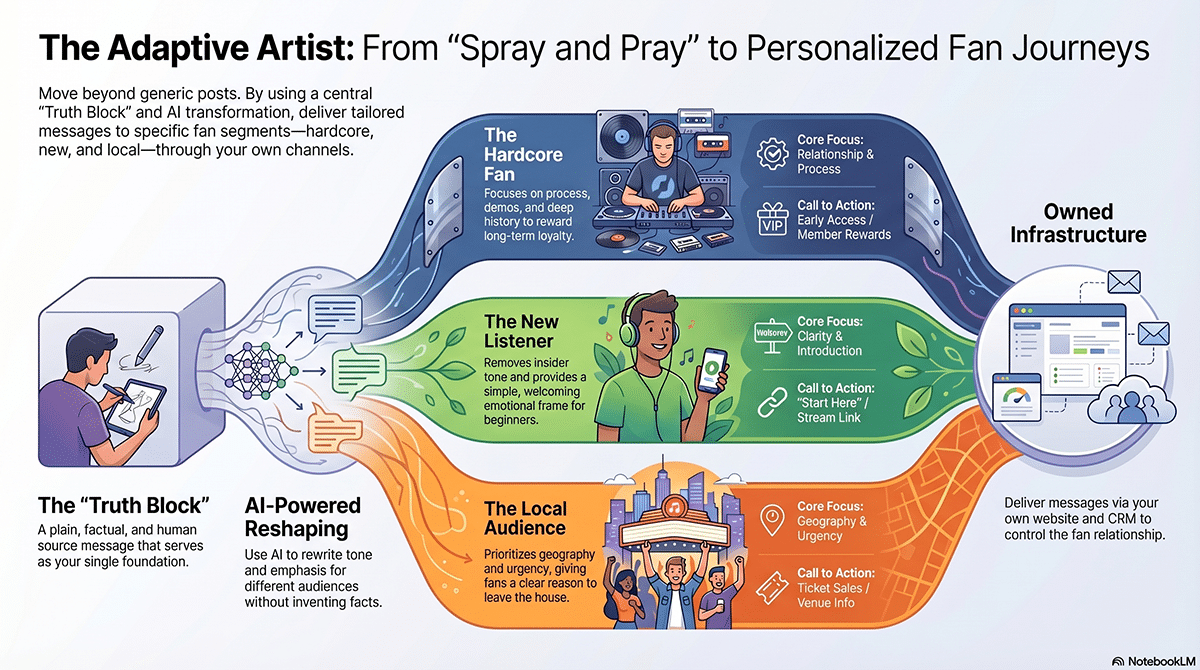
Let’s say you have a new single coming out on Friday. You are also playing a hometown show next week. Most artists will write one caption, toss it on every platform, maybe paste a version into email, and call it a day. That is the classic “spray and pray” model. It is lazy because the platforms trained us to be lazy. They want one fast piece of content they can distribute at scale because it serves their system, not your fan journey.
But in the real world, your audience is already split into groups.
One group knows your catalog, watches your studio clips, buys the vinyl, and actually cares which mic you used on the vocal. Those are your hardcore fans. Another group kind of knows your name. Maybe they streamed one song, liked one reel, or signed up for a free download on your site. Those are your casual listeners. Then there is a local audience. Some of them are fans and some of them are just nearby. They do not need your whole artistic autobiography. They need a reason to leave the house.
AI is good at taking one true source message and reshaping it for those different contexts. The important phrase there is “true source message.” You do not want AI inventing facts. You want it rewriting tone, emphasis, and framing. The event is still the event. The song is still the song. The artist is still the artist. But the angle changes. OpenAI’s platform and its API docs are built for text generation workflows like this, which is why artists and developers use language models to transform one piece of copy into many versions without rewriting everything by hand.
That means your core announcement can become three clean versions instead of one confused one. Same message. Different delivery. That is the whole game.
The Core Message Comes First
Before AI can personalize anything, you need the clean original. Think of this as your “truth block.” It should be plain, factual, and human.
Maybe it looks like this:
The new single “Midnight Radio” drops this Friday. We made this one late at night after the band got back from tour, and it ended up sounding like the part of the highway you only see at 2 a.m. We are also playing The Earl in Atlanta on May 22. We will have a limited edition poster at the show and early copies of the single on the merch table. Join the list on the site for first access.
That is the source. No fake scarcity. No algorithm begging. No “link in bio family let’s goooo.” Just the truth.
Now AI can go to work.
For the hardcore fans, the rewrite might sound like this:
You’ve been hearing us talk about “Midnight Radio” for a while, and now it finally lands Friday. This is one of those songs that changed shape on the road and got finished in the middle of the night when everybody was half fried and honest. If you’ve been with us through the demos, this one is for you. We’re bringing a limited edition poster and early copies to The Earl in Atlanta on May 22, and the mailing list gets first crack before anything goes public.
That version assumes relationship. It leans into process, memory, and loyalty. It does not waste time introducing the artist because that audience already knows who you are.
For a new listener, the AI rewrite should slow down and remove the insider tone:
We’ve got a new song called “Midnight Radio” coming out this Friday. It’s a late-night rock song with a little road-worn heart in it, and it’s one of our favorite things we’ve released in a while. If this is your first time finding us, this is a great one to start with. We’re also playing The Earl in Atlanta on May 22 if you want to hear it live.
That version lowers the barrier to entry. It does not assume history. It gives a simple emotional frame and invites the person in.
Now look at the local audience version:
Atlanta friends, we’re playing The Earl on May 22 and bringing the new single “Midnight Radio” with us before the weekend even gets started. If you’ve been meaning to catch a set, this is the night. We’ll have a limited edition poster at the merch table and early copies of the single on hand. Come be in the room for this one.
That one is about geography and urgency. It is less about the streaming release and more about the local decision. Friday night. The room. The poster. The night out.
None of those rewrites are magic. They are just smarter framing. But the difference in feel is huge. The first says, “you are already part of this.” The second says, “come meet us.” The third says, “get off the couch.”
That is what AI is actually good at for artists. It helps you stop writing in a flat voice meant for no one in particular.
Personalization Is Not About Tricks
A lot of people hear the word “personalization” and picture creepy surveillance, like some machine whispering, “We noticed you looked at a T-shirt three times at 11:42 p.m.” That is not the move. Good personalization is not manipulation. It is relevance.
The cleanest way to think about it is this: personalization means changing the emphasis based on earned context.
If someone has been on your site five times, watched a studio diary, bought a ticket once, and clicked every email about vinyl, you do not have to keep introducing yourself like you are cold-calling them. If somebody just joined your list after hearing one song, you should not hit them with the full sermon about your creative process, your fourth pressing variant, and your secret Discord room. That is not personalization. That is bad timing.
This is why artist-owned websites matter so much. When the fan relationship happens on your own site, you can see behavior with consent and use it intelligently. A WordPress-based CRM and automation tool like Groundhogg at https://www.groundhogg.io/ can track site activity, keep a contact record, tag and segment contacts, and run automations from those tags. Its activity tracking and activity timeline features are built to store things like page visits, email interactions, purchases, logins, and more inside the contact record. It also has WooCommerce integration so order events, cart activity, and store behavior can feed your segments.
That matters because now your audience stops being one giant blob called “followers.” Instead, it becomes a living map of intent.
You can start to separate the fan who reads every tour diary from the fan who only clicks local show links. You can tell the difference between somebody who buys merch and somebody who mainly opens lyric breakdowns. You can spot people who signed up and went quiet, people who come back every time you mention recording gear, and people who only wake up when there is a hometown date on the calendar.
That is where money gets clearer. Because once you know what kind of attention a person is giving you, you can offer the next logical step. Tickets. Merch. Membership. A behind-the-scenes drop. A fan passport stamp. A direct sale. A higher-value ask becomes possible only after the lower-value relationship has been earned.
Your Website Should Be Listening
This is where a lot of artists still get stuck in platform brain. They think data means followers, likes, and monthly listeners. That is rented data. It can hint at interest, but it does not belong to you in any useful way. You cannot really build a business on it because you cannot carry it with you.
Your site data is different. Your site can show you what people care about when they are on your turf.
If somebody lands on your homepage and then clicks the tour page, they are not the same as somebody who lands on your homepage and then clicks the studio journal. If somebody reads a page about your vinyl bundle, leaves, comes back two days later, and finally buys, that tells you something. If somebody claims a free live track, then visits your city-specific show page, that tells you something too.
A connector layer like WP Fusion is useful here because it syncs WordPress activity with your CRM (Customer relationship management) using tags. WP Fusion’s documentation explains that it can use tags in your CRM to control access, track user activity and engagement, and trigger automations, and that with WooCommerce it can add customers to your CRM and tag them based on products purchased. In plain English, it helps your site turn behavior into organized fan context.
That means your website is no longer just a brochure. It becomes a quiet listener.
Not in a creepy way. In a useful way.
It listens for what fans are raising their hands about.
That is a huge shift. When a fan clicks three articles about songwriting, AI should help you send more songwriting-centered messages. When a fan buys a shirt after a show, AI should help you send something closer to community and belonging. When a fan is local to your next venue, AI should stop trying to sell them on a vague brand story and just tell them where to be and why it will be worth it.
This is how content starts adapting. Not because the machine is “smart” in some mystical way. Because your infrastructure is finally paying attention.
The Basic DIY Setup
The good news is you do not need a Silicon Valley budget to do this.
A simple artist-owned setup can start with self-hosted WordPress, WooCommerce, and Groundhogg. If you want to keep newsletter creation inside WordPress, The Newsletter Plugin lets you manage newsletters from the WordPress dashboard, and it also offers an automation add-on for automatically generated newsletters. For delivery, Twilio SendGrid offers email sending through API or SMTP. On the AI side, you can use OpenAI’s platform to rewrite messages into audience-specific versions.
In normal language, here is what that setup does.
A fan joins your list on your site. Their form says they came for a free download, a live session, a show calendar, or a merch discount. That first choice already gives you your opening tag. Then the site keeps watching. Did they click the tour page? Did they buy from the store? Did they watch the studio update? Did they claim a local event invite? Those actions add more tags.
Now your AI prompt can be dead simple. You feed it the core announcement plus the segment label. Then you tell it how to rewrite.
For example, the prompt might say: “Rewrite this announcement for a hardcore fan who already knows the catalog and cares about process. Keep facts the same. Sound like a direct note from the artist. Make it warm, specific, and under 120 words.” Then you run the same source text again for “new listener” and again for “local audience.”
The artist writes once. The machine helps shape three honest versions. Your site decides who gets which one. That is not automation replacing art. That is automation protecting your time so you can keep making art.
The More Advanced Version
Once you get the basic version working, you can go further without giving up ownership.
This is where workflow tools come in. n8n is an automation platform built for workflows and AI, and it can be deployed on your infrastructure or used as a hosted service. Make is a visual automation platform with AI tools, HTTP, webhooks, and app integrations. Both are useful if you want your site, store, CRM, AI model, and Web3 layer talking to each other without you manually moving data around every day.
Now imagine a more advanced artist-owned flow.
A fan buys a ticket on your site. That order adds a “show-buyer” tag. If they are within driving distance, they also get a city tag. If they bought vinyl before, they keep that tag too. The workflow tool catches that event, passes the context to your AI prompt, and generates a follow-up email that sounds like it was meant for that exact kind of fan. Maybe it includes parking info, a note about a limited print at the table, and a reminder that passport holders get a stamp that night.
Or maybe a fan reads two blog posts about your recording process and then watches a studio video. The workflow tool sees a pattern. The next email they get is not the same show blast everyone else gets. It is a note about how the new song was built, with a soft ask to pre-order the recording or join a members-only listening room.
That is where things start feeling almost unfair in the best possible way. Not because you are tricking people. Because you are finally matching the message to the intent.
The major labels have had forms of segmentation forever. They just wrapped it in expensive teams and data silos. The indie version is now sitting in plain sight. Smaller budget. Better vibe. Less nonsense.
This Is Where the Fan Passport Gets Interesting
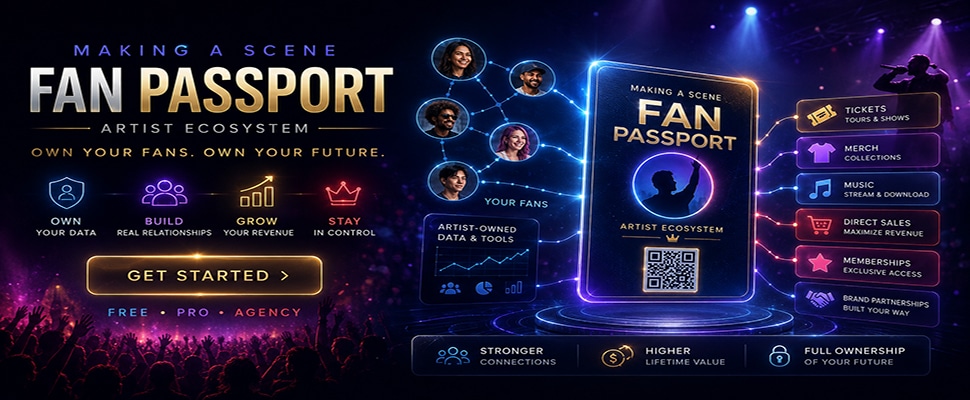
Now let’s connect this to the fan passport idea, because this is where the whole thing stops being “email marketing with extra steps” and turns into a real artist-owned ecosystem.
A fan passport is basically a record of relationship. Not just whether somebody follows you, but how they participate. Did they come to a show? Did they buy direct? Did they unlock a member page? Did they support a release early? Did they volunteer as a street team helper? Did they show up again in another city? Did they collect a live-session drop or behind-the-scenes entry token?
Once you start thinking that way, fan value stops being measured by streaming volume alone. It gets measured by contribution, presence, and momentum.
That opens the door for AI to do something much smarter than “write me a caption.” It can read the passport context and change the language of the next ask.
A first-time visitor gets welcomed. A returning fan gets recognized. A passport holder gets rewarded. A local regular gets invited deeper. Someone who has not engaged in a while gets a re-entry message that does not assume they missed nothing.
This is good business because it respects time. Fans do not all deserve the same message because they have not all had the same journey.
And this is exactly why the passport idea fits the Making a Scene philosophy so well. It values owned relationships over rented attention. It says the fan is not a metric inside somebody else’s dashboard. The fan is part of a direct economy between artist and audience.
Using Web3 Without Becoming Weird About It
Here is the part where some artists get nervous. Web3 has been sold so badly for so long that the second you say it out loud, people picture scams, ugly profile pictures, and enough jargon to kill a decent conversation.
So let’s calm that down.
For this article, Web3 is not the headline. It is the plumbing.
Unlock Protocol is built for onchain memberships and subscriptions as NFTs, and its docs describe it as a protocol for creating memberships and subscriptions that can be integrated into websites and apps. Unlock also supports token gating, metadata, and webhooks, and its main site says it is trying to make memberships easier with familiar things like email, airdrops, and Apple and Google wallets, not just hardcore crypto flows. POAP is the Proof of Attendance Protocol, built around collectible proofs of attendance that can be issued for live or virtual events.
That is all you really need to know to use them in a practical artist way.
Unlock can handle onchain memberships, recurring access, or token-gated areas of your site. POAP can act like a digital ticket stub or attendance badge for a show, release party, or special fan action. Put those together and your fan passport gets stronger. A fan is no longer just tagged in your email system. They can also carry proof of presence or membership that unlocks things later.
That matters because now personalization can cross from plain old email segmentation into a richer owned identity.
A fan who claims a show POAP might get a different follow-up than a fan who only streamed the song. A fan who holds your membership key through Unlock might get the studio breakdown, early merch access, or a private note from the road. A fan who has both could get a “core community” message that skips the basic intro and gets straight to the value.
And because Unlock supports metadata and webhooks, those membership or key events can be pushed back into your wider automation system. So the Web3 layer does not have to sit off to the side like a weird side project. It can feed your main fan relationship engine.
That is the practical version of Web3. Quiet, useful, and tied to real artist revenue.
A Full Example of the Machine Working
Let’s walk it all the way through.
A new listener hears your song because a friend shares it. They end up on your site. The homepage offers a free live version of the single if they join the list. They sign up.
Your site tags them as “new-listener.” If they click the page called “How We Made This Song,” they also get a “process-curious” tag. If they click the show page for their city, they get a local tag. If they buy the poster, the store adds a merch-buyer tag through the WooCommerce and CRM connection. If they later attend the show and claim a POAP, the fan passport now shows real-world participation too. If they buy your membership pass through Unlock, they move into a premium support tier.
Now the artist writes one core message:
We’re releasing an acoustic version next week. Passport holders get the first listen. Atlanta people, we’re doing a small room performance the night before.
The automation layer catches it. The AI creates several versions.
The new-listener version says: We made a stripped-down version of the song and it comes out next week. If you liked the original, this one gets even closer to the lyric. If you’re near Atlanta, we’re doing a small room performance the night before release.
The merch-buyer version says: You’ve been supporting the songs directly, so we wanted you to hear this first. The acoustic version drops next week, and passport holders get early access before the wide release. If you’re around Atlanta, we’re also doing a small room set the night before.
The show-attendee version says: If you were in the room with us last time, you know this song hits differently live. We’re putting out the acoustic version next week, and we’re doing one small Atlanta performance the night before. Passport holders get the first listen and another stamp when they check in.
That is what adaptive content looks like when it grows up. It is not flashy. It is just aligned.
Email, SMS, and On-Site Copy Can All Shift Too
This idea should not stop at social captions.
Your email subject line to a new listener should be cleaner than your subject line to a known fan. Your SMS to a local audience should sound like an invitation, not a generic ad. Your website pop-up should change depending on what page a fan is on. Someone reading tour dates should get a different offer than someone reading studio notes.
On the publishing side, tools like The Newsletter Plugin help you compose and manage newsletters inside WordPress, while SendGrid can handle delivery. On the automation side, Groundhogg and WP Fusion can help drive segmentation, and then your AI layer can generate the copy variant that fits the tag.
Here is how that looks in practice.
The email to a hardcore fan might carry a subject like “You should hear this one first.” The body can assume history. It can mention the demo. It can reference the last show. It can offer early access.
The email to a new listener might simply say “A new version of the song arrives next week.” The body should explain why the song matters in plain language and give one easy next step.
The SMS to a local audience should be even tighter: Atlanta — small room set Thursday night, new acoustic track first listen, want the link? That is clear. It respects the channel. It gives a reason. It does not ramble.
And on the site itself, if a passport holder logs in, the homepage hero should not waste space introducing the artist again. It should recognize the relationship and surface the next reward. Maybe a private stream. Maybe a members-only merch color. Maybe a stamp challenge. That is not just smart copy. That is respect.
The Data Must Stay Ethical
Now for the necessary gut check.
Just because you can personalize does not mean you should get weird with it.
Do not make fans feel watched. Make them feel understood.
There is a difference.
Good segmentation is built on clear consent, obvious behavior, and useful next steps. A fan knows they signed up for your list. A fan knows they bought a poster. A fan knows they attended a show and claimed a passport stamp. Those are fair signals.
Bad segmentation tries to sound like a private investigator. It overreaches. It gets too cute. It starts acting like the artist is a casino and the fan is a behavior pattern to exploit. That is platform thinking. Do not drag that poison into your own ecosystem.
The whole point of artist ownership is not to become a smaller version of a manipulative machine. The point is to build a healthier one.
If you are using privacy-friendly website analytics alongside your CRM, Plausible Analytics is one example of a lightweight analytics tool that emphasizes privacy-friendly measurement and also offers a self-hosted version. That kind of top-level analytics is useful for trend spotting, while your consent-based CRM handles the deeper relationship work.
So keep it clean. Ask only for the data you can actually use. Reward fans for sharing it. Give them value fast. Let the AI help with relevance, not manipulation.
Why This Pays Better Than Chasing Virality
Here is the economic point underneath all of this.
Adaptive content works because it pulls fans toward direct revenue instead of empty reach.
The hardcore fan is more likely to buy a membership, premium edition, ticket bundle, or limited merch drop. The casual listener is more likely to become an email subscriber or first-time buyer if the message is simple and welcoming. The local audience is more likely to turn into a ticket sale if the content speaks to place, timing, and experience. The passport holder is more likely to keep showing up if the next reward feels earned and visible.
In other words, personalization should not be about “engagement” as some abstract platform score. It should be about moving each kind of fan to the next real step in the relationship.
That is how you build a middle class in music. Not with one lucky viral spike. With many small, owned, repeatable transactions that get more efficient because your message gets smarter over time.
And this is the part I love most: the more artist-owned your system becomes, the less you need to beg the platforms for mercy.
You do not need one post to do everything when your website, your CRM, your store, your automation layer, your AI prompts, and your passport system are all doing their jobs. The platforms can still be used for discovery. Fine. Let them be the noisy street corner. But the real business happens once people step through your door.
The New Job of the Artist Post
Ten years ago, the artist post was mostly a shout into the void. Today it can be something better. It can be the opening line in a conversation that changes depending on who is listening.
That does not make your work less human. It makes it more human, because real people do not all need the same version of the same message.
The superfan wants recognition. The new listener wants clarity. The local audience wants a plan. The passport holder wants progression. The member wants access. The quiet fan who has been away for a while wants a reason to come back without being scolded for disappearing.
AI can help you write those versions faster. Your artist-owned site can help you decide who gets them. Your automation layer can help you send them at the right time. And a light Web3 layer can help your fan passport carry that relationship across shows, memberships, and direct fan experiences without turning the whole thing into a crypto circus.
That is the bigger idea here. Same message, different delivery is not a copy trick. It is a philosophy of respect.
It says your audience is not a blob. It says your fans are on journeys. It says attention should lead somewhere owned. It says the future belongs to artists who stop blasting one generic message into rented space and start building systems that recognize the difference between being discovered, being interested, being loyal, and being all in.
That future is not reserved for major labels. It is sitting right there on a self-hosted site, waiting for independent artists to act like owners.
And honestly, it is about time.
 |  Spotify |  Deezer |  Breaker |
 Pocket Cast |  Radio Public |  Stitcher |  TuneIn |
 IHeart Radio |  Mixcloud |  PlayerFM |  Amazon |
 Jiosaavn |  Gaana |  Vurbl |  Audius |
 Reason.Fm | |||
Find our Podcasts on these outlets
Subscribe to Our Newsletter
Discover more from Making A Scene!
Subscribe to get the latest posts sent to your email.


