
AI-Driven Fan Journeys: Mapping Every Step From First Listen to Lifetime Fan





Making a Scene Presents – AI-Driven Fan Journeys: Mapping Every Step From First Listen to Lifetime Fan
Listen to the Podcast Discussion
There is a quiet tragedy happening in the modern music business, and most independent artists have been taught to call it normal.
A stranger hears a song in a playlist. They like it. They tap through to a profile. Maybe they watch a clip. Maybe they save the track. Maybe they even tell a friend. Then the trail goes cold. The artist never learns who that person was, never learns what caught their ear, never learns what city they live in, never learns whether they wanted a vinyl copy, a ticket, a livestream pass, a membership, a behind-the-scenes demo, or just a reason to come back tomorrow. The fan showed up. The system shrugged. The moment passed.
That is the real leak in the independent music economy. It is not just low streaming payouts, though those are part of the problem. It is not just social media reach, though that is rented land and always has been. The bigger problem is that most artists still do not control the road between attention and income. They get discovery, but they do not own the journey. They get a listen, but they do not build a relationship. They get noise, but they do not get memory.
AI changes that if you use it the right way.
Not as a gimmick. Not as a fake robot bandmate. Not as another shiny object for people who want to sell musicians a shortcut. AI matters here because it can notice behavior, recognize patterns, and trigger the next right action fast enough that a single artist or small team can deliver the kind of timely, personal follow-up that used to require a label staff, a CRM department, a merch company, a tour marketer, and a pile of interns. Platforms like HubSpot now offer visual journey orchestration built around behavior and preferences, Klaviyo is pushing one-to-one AI personalization across channels, Shopify offers always-on automations for key customer moments, and Manychat can automate Instagram direct-message journeys for creators and brands.
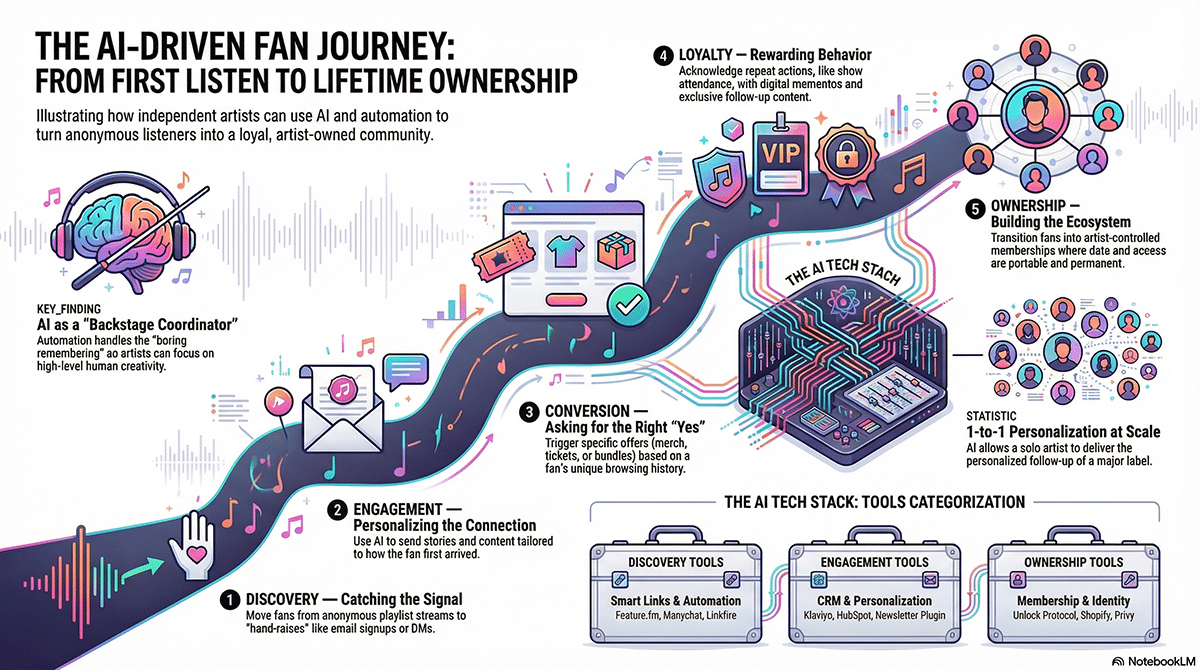
That matters because fan development is not one moment. It is a sequence. A path. A living chain of decisions, reactions, emotions, and opportunities. A real fan journey has stages. First comes discovery. Then engagement. Then conversion. Then loyalty. And if you are thinking like an owner instead of a content hamster, there is a fifth stage that matters most: ownership. Not ownership in the corporate sense. Ownership in the Making a Scene sense. The artist owns the relationship. The data. The access. The ability to speak directly to the fan without asking a platform for permission.
That is what this piece is about. Not how to “hack” fans. Not how to spam them harder. Not how to turn music into a lifeless sales funnel. This is about designing a better experience for the listener and a more durable business for the artist. It is about using AI-triggered actions and content delivery to move people from first listen to lifetime fan without losing your humanity in the process.
The Fan Journey Is Not Just a Funnel. It Is a Conversation With Memory
The old marketing model treated music fans like leads in a pipe. Push more traffic in. Hope some money falls out. That logic works great if you sell toothpaste. It works terribly if you are building a life in music.
Music is identity. Music is timing. Music is belonging. A fan does not become a fan because you hit them with seven identical ads and one discount code. A fan becomes a fan because each step deeper feels natural. The first thing they see fits the thing that pulled them in. The second thing answers the question they did not know how to ask. The third thing gives them a reason to stay. The fourth thing gives them a reason to spend. The fifth thing gives them a reason to tell somebody else.
That is why AI-driven fan journeys matter. A good system remembers what happened and changes what comes next. HubSpot’s customer journey tools are built to automate personalized paths based on behavior and preferences, Klaviyo’s AI personalization is explicitly about tailoring messages, offers, and interactions in real time, and Klaviyo flows can automate email, SMS, push, and even webhook-triggered actions that reach other tools in your stack.
In plain English, this means your system can notice that a listener found you through a stripped-down acoustic clip instead of a full-band live video. It can notice that they live near Nashville instead of Phoenix. It can notice that they clicked the merch page but did not buy. It can notice that they opened three emails about songwriting but ignored the ones about studio gear. It can notice that they came back after a show and watched your tour recap twice. Then, instead of dumping that person into the same generic blast as everybody else, your stack can send the next message that actually matches what they did.
That is not creepiness. That is hospitality with memory.
The artists who win the next decade will be the ones who build systems that remember fans better than platforms do.
Not to exploit them. To serve them. To make it easier for the right fan to get the right experience at the right time. Done right, AI becomes the backstage coordinator for your fan relationships. It watches the room, notices who walked in, remembers who bought a shirt, and quietly tells your business what should happen next.
Stage One: Discovery — Catch the Signal Before the Platform Eats It
Discovery is where most artists get distracted because it feels exciting. A playlist add. A reel that pops. A post that gets shared. A blogger mention. A burst of TikTok comments. This is the stage where vanity metrics dress up like opportunity.
But discovery is not the win. Discovery is the introduction.
If somebody hears your song on Spotify and likes it, you still do not know who they are. Spotify for Artists gives you more useful insight than it used to, including audience Segments and listener conversion metrics, and Spotify has leaned into the idea of helping artists understand “super listeners” and deeper audience behavior. That is valuable. It helps you see whether your music is being actively sought out or passively served, and that difference matters. But even with better analytics, the platform is still not your relationship. It is your first handshake.
So the goal of discovery is simple: move the fan from anonymous attention to identifiable intent.
That is where smart links and artist landing pages matter. Feature.fm’s music links product is built around bio links, pre-saves, merch, tour dates, email capture, and fan messaging. Linkfire’s smart links are designed to create a more frictionless experience across services, customize by context, and generate actionable fan insights; Linkfire also supports email sign-up on landing pages.
Here is the shift independent artists need to make. Stop treating the link in bio like a directory of places to lose people. Treat it like a checkpoint. Your discovery-stage job is not to push strangers from Instagram to Spotify to YouTube to Bandcamp and pray that karma pays rent. Your job is to create a clean next step where the fan can raise their hand.
That hand raise can be tiny. It might be an email capture on a smart link. It might be a DM keyword on Instagram. It might be a “pick your city for tour alerts” form. It might be a free download in exchange for an email address and favorite song. It might be a “want the lyrics and story behind this track?” button.
Manychat is useful here because Instagram DM automation lives where discovery already happens. The company describes its Instagram automation as a way to grow followers, attract leads, drive sales, answer questions around the clock, and automate the Instagram funnel, and it states that it is a Meta official business partner.
Now imagine the flow. Somebody comments on a live performance clip with the word “tabs.” Instead of hoping you notice it in a crowded feed, Manychat sends a polite DM: “Thanks for checking this out. Want the chord chart and the full live session?” If they tap yes, your system sends the asset and tags that person as guitar-curious, live-performance-interested, and discovered-through-Instagram. If they also enter their email, that fan is no longer anonymous. The road begins.
This is where AI starts earning its keep. You can use automation layers like Zapier or Make to move data between tools, and both companies now explicitly position themselves as AI automation or AI-agent orchestration platforms. OpenAI’s ChatGPT and the OpenAI platform can then help classify or summarize those signals so your system knows what kind of follow-up to send.
A simple discovery prompt might look like this:
The fan who came in through a songwriting clip should not get the same follow-up as the fan who came in through a tour teaser. The person who clicked from a pedalboard demo should not get the same next step as the person who came in through a breakup lyric video. AI lets you sort that at scale. Not perfectly. Not magically. But well enough that your system starts to feel like a good manager instead of a distracted vending machine.
Stage Two: Engagement — Turn Curiosity Into Connection
Once a stranger has raised a hand, most artists make one of two mistakes. They either say nothing, or they say too much too soon.
They go silent and waste the moment, or they fire off the digital version of “Hi, nice to meet you, buy my hoodie.”
Engagement is the stage where you earn the right to ask for anything later. This is where you deepen context, reveal personality, and begin teaching the fan how to belong in your world.
Klaviyo is built for this kind of behavior-based follow-up. Its official materials describe AI-powered personalization that tailors messages, offers, and interactions to individual behaviors in real time, and its flows can automate email, SMS, push notifications, and webhook actions into the rest of your stack. HubSpot’s journey tools are designed for awareness-to-advocacy mapping across multiple channels.
For an indie artist, this means engagement content can branch based on the reason the person showed up. If a listener asked for the lyrics, send a story about where the song came from and a private acoustic performance two days later. If they clicked from a city-specific post, send a “tell me your side of town” message and a tour alert opt-in. If they engaged with your studio content, send a note about the gear, the process, or the mistakes behind the recording. If they came in from a political or social issue song, send them the deeper essay, the inspiration, and the community action tied to that track.
This does not require a giant corporate stack. If you run your own site on WordPress, The Newsletter Plugin lets you create, send, and track email from inside WordPress, and its Automated add-on can send scheduled newsletters built from posts, events, products, or other content types, with targeting by lists and language. Twilio SendGrid’s email API can handle sending and delivery at scale through API or SMTP if you want more control over the delivery layer.
That is important because the owned-web approach changes the economics. Instead of paying forever to rent access to the same audience, you begin building a database you actually control. You publish a story, a demo, a show recap, a lyric breakdown, a merch drop, or a behind-the-scenes video on your site. Your automation sees which fans click what. AI scores the pattern. Then the next email, DM, or SMS references behavior instead of guessing.
A good engagement prompt can keep your voice consistent while still personalizing the message:
This is the stage where artists need to remember something brutal and liberating: fans do not owe you loyalty because they streamed you three times. They become loyal when they feel seen. Engagement is where you prove that there is a real ecosystem behind the song. A voice. A worldview. A reason to come back that has nothing to do with whether an algorithm decides you are trendy this week.
Stage Three: Conversion — Ask for the Right Yes, Not the Biggest One
Conversion has been poisoned by internet marketing nonsense for years. Too many artists hear the word and think it means “aggressively sell.” That is not the move.
Conversion means the fan crosses a line from interest to investment.
Sometimes that means a ticket. Sometimes a shirt. Sometimes a vinyl preorder. Sometimes a paid livestream. Sometimes a membership. Sometimes a direct download bundle. Sometimes a show-up-in-person moment that matters more than a sale that day. The point is not to force the biggest ask. The point is to identify the next believable ask.
Shopify’s automation tools are built around exactly this idea. Shopify says its automations can engage customers at every stage of their journey and trigger messages around critical moments, including first order and milestone behavior. Its help docs also show abandoned checkout, abandoned cart, and abandoned product-browse workflows that can be adjusted and turned on as templates.
So if you sell merch, vinyl, tickets, memberships, or bundles through Shopify, your system can stop acting like every fan is standing at the same place in line.
A fan who opened three emails about your upcoming Atlanta show, clicked the venue page twice, and saved the event date probably does not need a generic merch blast. They need a clean ticket link, a “what songs should we play?” prompt, or a city-only bundle that includes a ticket plus exclusive poster pickup. A fan who watched a studio breakdown and spent six minutes on the gear page might convert better on a paid workshop, sample pack, or behind-the-scenes production membership than on a T-shirt. A fan who clicked the lyric notebook photos and ignored the tour content might be better suited for a limited zine, annotated lyric PDF, or early access writing circle.
That is where AI-triggered segmentation becomes real money. Klaviyo’s webhooks can send real-time information to external tools, which means behavior inside your email and commerce system can trigger actions elsewhere. Linkfire smart links can give you traffic source, service click-through, and other insight that helps you understand not just whether people clicked, but how they arrived and where they wanted to go next. Spotify for Artists can help you understand whether a listener is casual, programmed, active, or moving toward deeper fandom.
Here is the practical translation. You do not want one offer. You want offer logic.
If the fan has not replied to anything yet, the next ask might be low-friction: “Pick your city for tour alerts.” If they have replied twice and watched a live clip, the next ask might be a ticket. If they bought once, the next ask might be a bundle. If they attended a show and opened the recap email, the next ask might be membership. If they keep engaging but never buy, the next ask might simply be “what pulled you in?” because the answer will teach your whole system something.
A useful conversion prompt looks like this:
And here is the part that needs to be said out loud: the best conversion is the one that moves the fan closer to your owned system. Not closer to a platform metric. Not closer to a playlist. Closer to your store, your site, your email list, your membership, your community, your direct revenue.
Stage Four: Loyalty — Reward Behavior Before It Goes Cold
This is the stage where too many artists disappear.
The fan bought the ticket. Ordered the record. Came to the show. Joined the list. Maybe even wore your shirt in public like free street team labor. And what happens next? Nothing. Silence. Another generic release post two months later. The whole relationship goes back to zero.
That is madness.
Loyalty is where a sustainable music career gets built because loyalty is where repeat behavior lives. Repeat attendance. Repeat purchases. Repeat attention. Repeat replies. Repeat advocacy. This is the stage where your system should feel less like marketing and more like good memory.
Shopify can trigger thank-you or milestone workflows after purchases. Klaviyo can run retention flows across channels. The Newsletter Plugin can automate ongoing content from your site. SendGrid can support the delivery layer if your owned stack needs more sending infrastructure.
But loyalty is bigger than email cadence. It is the shape of recognition.
If a fan came to a show in Nashville, your system should know that. If they bought a live record, your system should know that. If they always click tour stories but never studio nerd content, your system should know that too. AI is useful here not because it is dramatic, but because it helps translate behavior into relevance.
A post-show fan should not get the same follow-up as a pre-show fan. Somebody who bought a hoodie should not get the same next message as somebody who bought a handwritten lyric sheet. Somebody who attended twice in six months deserves a different path than somebody who bought once during a holiday sale and vanished.
This is also where collectible proof and memory tools can become powerful when used with taste. POAP defines itself as Proof of Attendance Protocol and allows organizers to mint digital mementos for shared memories. That makes it useful for show attendance, special events, listening parties, launch nights, or fan-club milestones.
Now imagine the loyalty path. A fan scans a code at the merch table or after the encore. They receive a POAP, not as a crypto flex, but as a timestamped badge of participation. The next morning your system sends a thank-you note, a live-photo gallery, a private link to one unreleased demo from the show city, and a question: “Should we come back?” If they attended multiple shows, the follow-up changes. If they bought merch at the same event, the follow-up changes again. AI can see the pattern and pick the branch.
A smart loyalty prompt might be:
Stage Five: Ownership — Turn Fans Into Members of an Ecosystem You Control
This is where the conversation gets more radical, and frankly, it needs to.
A loyal fan is great. A reachable fan is better. A fan whose access, history, and rewards live inside your own ecosystem is better still.
This is where Web3 becomes useful, not because artists need to cosplay as fintech startups, but because programmable access and portable identity solve real problems. Unlock Protocol is built around membership state, including expirations, renewals, pricing, durations, member lists, status indicators, and automated renewals. Guild manages access, quests, and analytics across onchain and social activity. Privy and thirdweb are both focused on reducing wallet friction by offering embedded or white-label wallet onboarding, including email, social, or other easier login methods instead of forcing every fan to arrive as a crypto native.
That changes the final stage of the fan journey because now your “loyalty program” does not have to live inside a platform that can disappear, throttle reach, or change the rules next quarter. It can live inside a membership layer that you control.
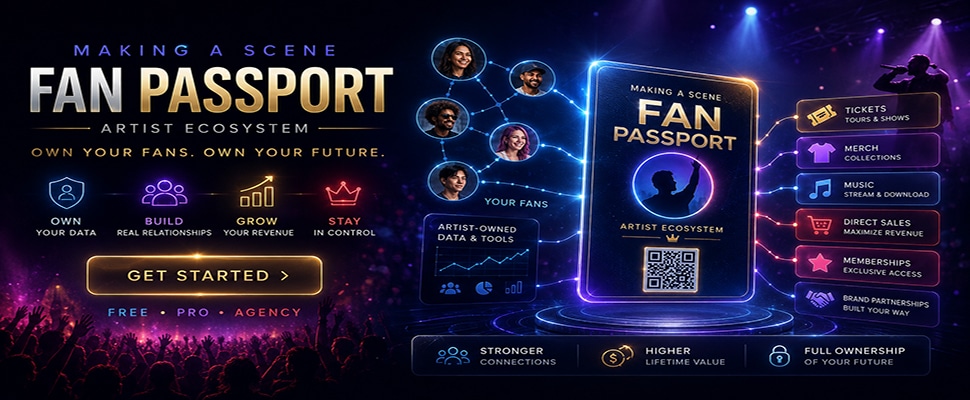
This is where the fan passport idea stops being a cool concept and becomes infrastructure. A fan who joined your email list, attended a show, bought a shirt, minted a badge, and unlocked membership access is not just a follower anymore. They have a history with you. They have a record. They have a place in the system.
And here is where AI becomes strategic instead of merely reactive.
Once you have a real fan passport layer, AI can start spotting patterns that a tired human brain misses. It can notice that fans who first entered through political songs tend to buy tickets faster than merch. It can notice that acoustic-session fans become higher-value members when offered writing-circle content before store discounts. It can notice that people who attend one show in a secondary city often convert to paid membership if they receive a city-specific follow-up within forty-eight hours. It can notice that fans holding three attendance badges are your best candidates for local ambassador programs, street teams, or early-bird touring syndicates.
Guild is designed to reward behavior across onchain and social signals. Unlock is designed to manage recurring or time-based access. Privy and thirdweb are designed to make the wallet step less painful for normal humans. POAP records meaningful moments. That means your final stage is not “customer retention.” It is artist-owned community architecture.
A useful ownership-stage prompt might look like this:
What the Stack Can Look Like in the Real World
For a solo indie artist with a small budget, the stack does not have to be fancy to be effective. You can use Spotify for Artists to understand listener segments, Feature.fm or Linkfire to build smarter links and capture intent, Manychat to automate DMs where discovery happens, WordPress plus The Newsletter Plugin to own content and list-building, Twilio SendGrid for delivery, and Zapier or Make to connect the steps. If you want to add memory and status later, bring in POAP and then layer Unlock membership when your community is ready for it.
For a bigger DIY operation with merch, touring, a store, and some help on the team, Shopify, Klaviyo, HubSpot, and a wallet layer like Privy or thirdweb can give you a more formal journey system with stronger branching, better lifecycle marketing, and a cleaner path into memberships, fan passports, and multi-step loyalty programs.
The important thing is not which logo you choose first. The important thing is that your system knows five things. Where the fan came from. What they responded to. Where they are located. What they have already done. What the most sensible next ask is.
Everything else is decoration.
A Better Story of the Fan Journey
Let’s make it real.
A listener hears your song in a playlist and taps through. Spotify tells you over time whether listeners are active, programmed, previously active, or moving toward deeper fandom, but it cannot hand you the relationship. So your profile, reels, and release posts point to a smart link with one job: route the fan cleanly and capture intent. The fan picks Spotify, then requests the lyric sheet. Your system logs the source, the city, the song, and the lyric interest.
Next, Manychat delivers a DM with the lyric sheet and an invite to hear the stripped version on your website. The fan clicks. Your site tags them as high-intent on songwriting content. AI summarizes the behavior. Two days later they receive an email, not a sales blast, but a story about how the song was written and an invitation to reply with what line hit them hardest. They reply. That reply matters more than another passive stream because now the relationship has shape.
A week later you announce a show forty minutes from their city. Your system knows they engage with acoustic versions and lyric-driven material, so the message is not “Tickets on sale now!!!” It is, “We’re bringing the quiet version of this song to Atlanta next month. Want first access before public on-sale?” They click. They buy. Shopify records the order. Klaviyo or your owned stack marks them as first-time ticket buyer.
At the venue, they scan a code and claim a POAP. The next day they get a thank-you note, a photo set, and a private rehearsal audio from that city. Two weeks later, because they now have ticket, attendance, and reply history, the system offers them a paid membership with early access to future dates, songwriter notes, and demo drops delivered through an artist-owned site and, if you want, an Unlock-based membership layer. They join. Now they are not just a fan in a dashboard. They are a member in your ecosystem.
That is the journey. Not theoretical. Not futuristic. Not something only giant acts can do. The tools are already here. The harder part is deciding to stop acting like discovery is the destination.
The Real Point
AI is not the star of this story. The fan is. The artist is. The relationship is.
AI just makes it possible for a small independent operation to behave with the memory, timing, and personalization that used to belong only to bigger companies. It helps you notice. Sort. Trigger. Respond. Learn. Improve. It helps you deliver the right thing to the right fan without losing your whole life to spreadsheets, tags, late-night copywriting, and missed opportunities.
But the attitude matters. If you use AI to crank out more junk faster, you will get junk faster. If you use it to deepen a system you do not own, you will still be feeding somebody else’s machine. If you use it to move fans from rented space to owned space, from anonymous attention to known relationship, from passive stream to direct support, then AI becomes what it should be: leverage for independence.
That is the Making a Scene version of the future.
Not “go viral.”
Not “hope the algorithm blesses you.”
Not “build your whole career inside apps you do not control.”
Build a road. Map the journey. Own the checkpoints. Remember what your fans tell you. Reward the people who show up. Let AI do the boring remembering so you can do the human part better.
The first listen is not the business. The lifetime fan is.
 |  Spotify |  Deezer |  Breaker |
 Pocket Cast |  Radio Public |  Stitcher |  TuneIn |
 IHeart Radio |  Mixcloud |  PlayerFM |  Amazon |
 Jiosaavn |  Gaana |  Vurbl |  Audius |
 Reason.Fm | |||
Find our Podcasts on these outlets
Subscribe to Our Newsletter
Discover more from Making A Scene!
Subscribe to get the latest posts sent to your email.


