
From Data to Story: Using AI to Turn Analytics Into Compelling Fan Narratives




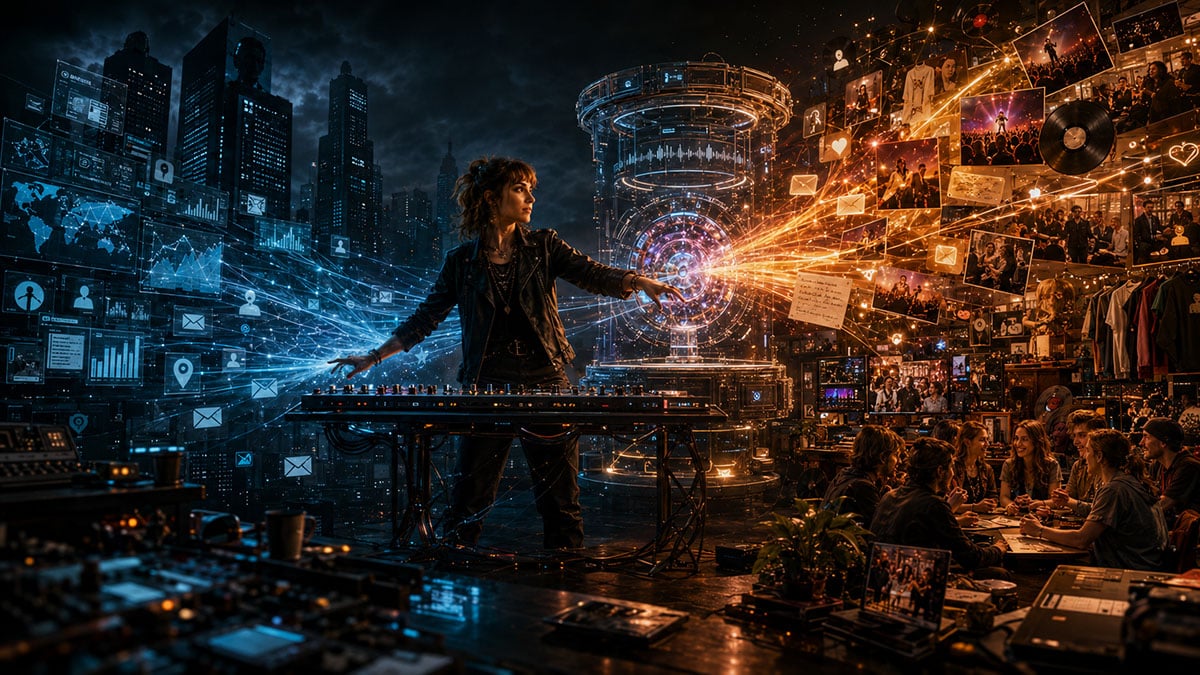
Making a Scene Presents – From Data to Story: Using AI to Turn Analytics Into Compelling Fan Narratives
Listen to the Podcast Discussion
Transform boring numbers into emotional storytelling that connects with fans
There is a funny thing about music data. It looks cold when it is sitting inside a dashboard. A city name. A stream count. A spike on a graph. A merch order. An email click. A replay on a video. None of that feels very human at first. It looks like math wearing a cheap suit. But behind every number is a person. Behind every stream is somebody who hit play while driving to work, cleaning the kitchen, walking through a breakup, closing down a bar, or trying to feel less alone at 2:00 in the morning. Behind every “top city” is a room full of potential fans. Behind every merch sale is somebody who wanted to carry a piece of the artist’s world into their own life.
That is where AI becomes useful. Not as a replacement for the artist. Not as some magic robot that “does marketing” while the artist becomes a content puppet. That is the nightmare version, and frankly, we have enough plastic nonsense floating around the internet already. The useful version of AI is much simpler and much more powerful. AI can help an artist look at boring analytics and ask, “What is the human story hiding inside this?” Then it can help turn that story into a post, an email, a video idea, a tour update, a merch campaign, a fan thank-you, or a bigger strategy that brings people closer to the artist.
For independent musicians, this matters because attention alone does not pay the rent. Streaming numbers are nice. Social likes feel good for about twelve seconds. A playlist add can help. But none of that becomes a real business unless the artist can turn attention into relationships, and relationships into revenue. That is the Making a Scene philosophy in plain English. Use the big platforms for discovery, but do not let them own the relationship. Bring fans into your own world. Own your fan data. Build your email list. Sell directly. Route tours smarter. Reward real supporters. Tell better stories. Stop begging the gatekeepers for scraps from a table the artists built in the first place.
AI can help with that. But only if the artist gives it the right job.
The Problem Is Not a Lack of Data. The Problem Is a Lack of Story
Most artists already have more data than they think. Spotify for Artists shows useful listener information, including top cities where people are streaming, which can help artists think about where demand is forming. YouTube Studio Analytics helps creators understand channel and video performance, and its Advanced Mode can show more specific reports and export data. Google Analytics can help website owners understand visitor behavior, campaign performance, and customer actions. WooCommerce Analytics and Shopify Analytics can show store activity, product performance, transactions, and sales trends.
The problem is that most of this data sits in separate rooms and refuses to talk like a normal human being. Spotify tells you one piece of the story. YouTube tells you another. Your website gives you another. Your email list gives you another. Your store gives you another. Your ticket sales give you another. Your Bandcamp sales give you another. Then the artist is expected to somehow turn all these scattered numbers into a marketing plan while also writing songs, booking shows, fixing the van, answering emails, making reels, and remembering where the drummer left the kick pedal.
No wonder most artists ignore the data.
But data is not the enemy. Bad dashboards are the enemy. Platform lock-in is the enemy. Thinking that “analytics” means staring at numbers until your soul leaves your body is the enemy. The goal is not to become a spreadsheet monk. The goal is to use data as a flashlight. It shows where fans are leaning in. Then AI helps turn that signal into language that real people can feel.
A stat might say, “Atlanta is your number three streaming city.” A story says, “Atlanta, you found this song before almost anyone else, and now we’re building the next run around you.” A stat might say, “This acoustic version has the highest completion rate on YouTube.” A story says, “Apparently the stripped-down version hit people harder than we expected, so we’re recording a full live room version for the fans who stayed to the end.” A stat might say, “Vinyl buyers also bought the tour poster.” A story says, “The fans who want the record also want the memory of the night, so we’re building a limited show bundle.”
That is the difference. Numbers report. Stories connect. AI helps translate.
Platform Data Is Useful, But Owned Fan Data Is Power
Let’s get one thing straight. Platform analytics are useful. Artists should look at Spotify, YouTube, Instagram, TikTok, Bandcamp, website traffic, email reports, and store sales. Ignoring that information is like driving a van on tour with the windshield painted black. But platform data is not the same as owned fan data.
A platform tells you what happened inside its walls. It may tell you a city, a song, a click, a play, a view, or a trend. But in most cases, it does not give the artist a full, portable, long-term relationship with the fan. The platform owns the environment. The platform controls the algorithm. The platform controls who sees what. The platform can change the rules, bury the reach, shut down a feature, or decide that your fans should see somebody else’s ad before they see your music. That is not ownership. That is renting attention in a casino with mood lighting.
Owned fan data is different. Owned fan data means the artist has direct permission-based contact with the fan. It means an email address, a city, a purchase history, show attendance, membership level, fan club activity, merch interest, street team action, or other information gathered through the artist’s own ecosystem. That can come from an artist website, a newsletter signup, a direct sale, a fan club, a QR code at the merch table, a ticket purchase, a membership, or a Fan Passport-style system that tracks real fan engagement over time.
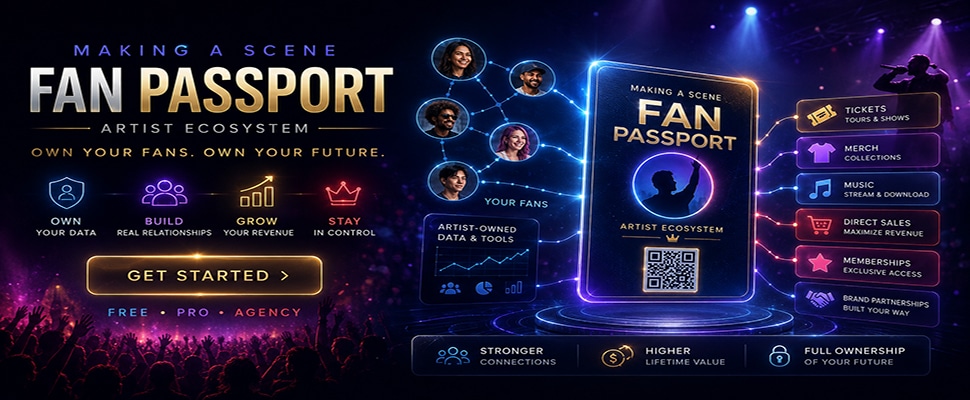
This is where the Fan Passport concept becomes so important. The idea is simple but powerful. Instead of treating fans like anonymous numbers scattered across platforms, the artist gives fans a way to carry their relationship with the artist. A fan attends a show and gets a stamp. They buy merch and get another stamp. They join the email list. They scan a QR code. They unlock a backstage video. They support a crowdfunding campaign. They bring a friend to a gig. Over time, those actions become a map of the relationship.
That map is not just data. It is memory.
And memory is what makes great fan storytelling possible.
An artist with a Fan Passport system can say, “Nashville has the most repeat show attendees,” or “Chicago fans bought more vinyl than any other city,” or “Our street team in Philadelphia moved the most tickets,” or “The fans who joined the acoustic livestream were the same fans who bought the handwritten lyric sheets.” That is not a cold metric. That is a living story. It gives the artist a way to honor fans, reward them, and make smarter business moves.
This is also where AI becomes more than a content machine. If the artist owns the data, AI can help analyze it and turn it into useful stories without handing the whole relationship back to Spotify, Meta, Google, or TikTok. AI can help write the email, shape the post, build the video script, suggest the merch bundle, plan the tour routing, or identify which fan segment deserves a special offer. But the engine is still the artist’s own data.
That is the difference between being used by the machine and using the machine.
AI Is Not the Artist. AI Is the Translator
There is a lazy way to use AI, and it usually sounds like this: “Write me a viral post about my new single.” That prompt is not evil. It is just weak. It gives the AI no truth, no fan behavior, no context, no voice, and no reason for anyone to care. The result is usually a shiny pile of marketing oatmeal. “We are so excited to announce…” Congratulations, the internet has fallen asleep.
The better way is to feed AI real signals. Tell it what fans are actually doing. Give it the top cities, most streamed songs, merch sales, email clicks, ticket scans, video retention, comments, and fan actions. Then ask it to find the story.
Tools like ChatGPT, Claude, and Perplexity can help artists summarize data, create campaign angles, draft copy, compare audience behavior, and turn messy notes into clearer content. ChatGPT is built for conversational assistance, Claude is part of Anthropic’s AI product ecosystem, and Perplexity describes itself as an AI-powered answer engine with real-time answers.
But the artist still has to lead. AI should not decide what the artist stands for. It should not fake excitement. It should not invent fan stories. It should not pretend a city is “going crazy” if the truth is that twelve people streamed the song twice because one cousin kept replaying it. AI should help reveal the emotional truth inside real behavior.
The best prompt is not “make this sound cool.” The best prompt is, “Here is what actually happened. Help me explain why it matters to the fans.”
That one shift changes everything.
Turning Top Cities Into Local Belonging
One of the easiest data points to turn into a fan story is location. Top cities are more than dots on a map. They are signs of where the music is finding a home. If an artist sees that Detroit, Asheville, Atlanta, Pittsburgh, and Austin are all showing strong streaming or email activity, that is not just an analytics note. That is the beginning of a tour story.
The old-school version says, “Our top cities are Detroit, Asheville, Atlanta, Pittsburgh, and Austin.” Fine. Accurate. Also boring enough to be used as a sleep aid.
The story version says, “We noticed something wild this month. Detroit keeps showing up for the new single. Asheville is streaming the deep cuts. Atlanta is opening every email. Pittsburgh bought the most vinyl. Austin keeps watching the live clips. So instead of guessing where to go next, we’re listening to the people who are already listening to us.”
That kind of message does a few things at once. It makes fans feel seen. It turns data into gratitude. It teases future touring. It gives local fans a reason to share. It also tells promoters and venues that there is activity in those markets. That can matter when booking shows.
This is how AI helps. The artist can copy their top city data from Spotify for Artists, email location data from Mailchimp or Kit, sales data from Shopify Analytics, and website location data from Google Analytics, then ask AI to turn it into a local fan message. Mailchimp supports segments using contact information, ecommerce data, and location, while Kit offers email marketing, newsletters, automations, forms, and creator-focused selling tools.
A strong prompt might sound like this: “Act like a music marketing strategist for an independent artist. Here are my top streaming cities, email cities, merch buyer cities, and recent show markets. Find the strongest local story and write three human-sounding post ideas that thank fans without sounding fake. Tie each post to a possible show, merch drop, or email signup.”
That prompt does not ask AI to make up hype. It asks AI to connect real signals to real action.
Turning Most Streamed Songs Into Emotional Content
Most artists look at their most streamed songs and think, “Cool, that one is doing well.” Then they move on. That is leaving money and connection on the table.
A song that keeps getting played is a clue. Why are people returning to that track? Is it the chorus? The mood? The lyric? The video? The season? Did it land in a certain city? Did it get picked up by a playlist? Did fans quote a certain line in comments? Did acoustic clips outperform full-band clips? Did a sad song quietly become the song people send to friends?
AI can help investigate the pattern. The artist can gather song-level stats from platforms, comments from social media, YouTube retention notes, and email replies. Then they can ask AI to summarize what the audience seems to be responding to. The result can become a story series.
For example, let’s say the most streamed song is not the newest single. It is an older track from two years ago. Instead of treating that like a random accident, the artist can turn it into a fan narrative. “This song found its people late.” That is a great story. It could become a post about songs having their own timeline. It could become a stripped-down performance video. It could become a limited merch design. It could become an email asking fans where they first heard the track. It could become a fan-submitted story campaign.
That is how data becomes content that actually feels human.
Here is a sample social post an artist could create from a real streaming insight:
It was not the loudest track. It was not the obvious single. But it keeps showing up in the streams, the messages, and the late-night comments. So we’re going to treat it like what it has become: a song that found its people.
We’re recording a stripped-down live version this week for everyone who carried this one further than we expected. Thank you for giving the deep cut a second life.
That is the revenue bridge. The story opens the door. The owned ecosystem gives the fan somewhere meaningful to go.
Turning Merch Data Into Culture, Not Inventory
Merch data is one of the most underrated storytelling tools an artist has. A T-shirt sale is not just a T-shirt sale. A vinyl order is not just a vinyl order. A poster bundle is not just a bundle. Merch tells you what fans want to carry, wear, collect, and remember.
Bandcamp is built around music and merch sales for artists, while ecommerce systems like WooCommerce Analytics and Shopify Analytics can help artists review product, order, customer, and sales activity.
If the black shirt sells out first, that says something. If cassette buyers also buy patches, that says something. If fans in one city buy more posters than shirts, that says something. If the signed vinyl sells slowly online but flies off the merch table after shows, that says something very important. It means the object may need the emotional charge of the live event to sell.
AI can help connect those dots.
The lazy artist view says, “We sold 47 shirts.” The smarter story says, “The road shirt became the thing fans wanted after the show.” The lazy artist view says, “Vinyl sold best in Chicago.” The smarter story says, “Chicago is becoming a collector city for us.” The lazy artist view says, “The poster bundle had a high average order value.” The smarter story says, “Fans want a memory package, not just a product.”
This matters because artists do not make real money from vague awareness. They make money when they understand what fans value enough to buy. AI can look at merch reports and help write stories around scarcity, fan identity, place, and memory.
A useful prompt might be: “Here is my merch sales data by product and city. Help me find three fan stories inside this data. Do not just tell me what sold best. Tell me what the sales might mean emotionally, and suggest one email, one social post, and one merch bundle idea that could increase direct revenue.”
That prompt moves the artist from “inventory report” to “fan culture.” That is the whole game.
Turning Email Analytics Into a Better Conversation
Email analytics can look painfully dull. Open rate. Click rate. Unsubscribes. Link clicks. Segment activity. It feels like something invented in a beige office by a person allergic to guitar amps. But email data is one of the clearest windows into fan intent because email is closer to ownership than social media.
A fan who opens your email is making a choice. A fan who clicks is leaning forward. A fan who replies is raising their hand. A fan who clicks on tour dates but not merch is telling you something. A fan who clicks on vinyl but not streaming links is telling you something else. A fan who always opens behind-the-scenes emails may want a membership or fan club. A fan who clicks on local show announcements may be ready for a ticket offer.
Tools like Mailchimp, Kit, and The Newsletter Plugin can help artists build lists, send campaigns, create automations, and track email activity. Mailchimp’s documentation says segments can be created from audience data such as ecommerce data and location; Kit describes itself as an email marketing and newsletter platform for creators; The Newsletter Plugin describes itself as a WordPress-based newsletter and email marketing system.
AI can help turn those email numbers into better conversations. Let’s say the artist sends an email about a new single and most people click the behind-the-scenes studio photo instead of the streaming link. That is not a failure. That is information. The fans may want the story behind the song more than another link to a platform. The artist can follow up with a deeper studio journal, a short video, a lyric breakdown, or a members-only demo.
Here is a sample email built from that kind of insight:
Last week we sent out the new song, and something surprised us.
A lot of you clicked the studio photo before you clicked anything else. That told us something important. You were not just curious about the track. You wanted to see where it came from.
So we put together a short behind-the-scenes note about the room, the take, the mistake we almost kept, and the reason this song ended up feeling more honest than polished.
You can read it here, and we added an early live version for the people on this list first. Thanks for listening past the surface. That means more than a stream count ever could.
Again, this is not about squeezing fans. It is about listening better.
The Fan Passport Turns Fan Behavior Into a Living Story
The Fan Passport concept may be one of the clearest ways to understand the future of artist-owned fan data. Think of it as a loyalty system, a memory system, and an analytics system rolled into one. It does not need to feel cold or corporate. It should feel like a fan’s personal history with the artist.
A fan sees the artist in Athens and gets a show stamp. They buy a vinyl copy and get a merch stamp. They join a livestream and get a digital stamp. They bring a friend and get a street team stamp. They support a crowdfunding campaign and get a founding supporter stamp. They attend three shows in one year and unlock a private acoustic performance. The fan feels recognized. The artist gets better data. Everybody wins without needing some corporate platform to stand in the middle with a clipboard and a hungry ad machine.
AI can make this system even more powerful because it can look at fan actions and help the artist tell stories that honor those actions. “Our Atlanta fans have the most repeat show stamps.” “The vinyl supporters helped fund the next video.” “The fans who came to the spring shows are getting first access to the fall tour.” “The street team in Ohio moved more tickets than our paid ads.” “The people who bought the acoustic EP are getting the first demo from the next record.”
This is the kind of storytelling that platforms cannot fake because it comes from real relationships. A stream is a signal. A Fan Passport stamp is a memory. A purchase is a commitment. A show scan is proof that the digital connection became a real-world moment.
That matters for revenue. If an artist knows which fans buy merch, which cities show up, which supporters travel, which fans engage with video, and which people respond to offers, the artist can make better decisions. They can bring the right merch to the right city. They can offer VIP bundles where demand already exists. They can create city-specific rewards. They can avoid wasting money on markets that only look good on streaming but do not convert into ticket sales. They can pitch sponsors with real community behavior instead of vanity metrics.
This is not hype. This is how a music middle class gets built. Not from one viral moment. From thousands of owned connections that compound over time.
Turning Analytics Into Video Fans Actually Watch
Video is where data-to-story can really shine. A statistic can become a visual moment. A top city map can become a tour teaser. A most-streamed lyric can become a short-form video. A merch sales spike can become a thank-you clip. A fan passport milestone can become a mini-documentary.
Tools like Canva, CapCut, and Descript can help artists turn these stories into visual content. Canva describes itself as an online design tool for social posts, presentations, posters, videos, logos, and more. CapCut offers AI-powered video editing and creative tools. Descript supports video and audio editing through text-based workflows, transcription, captions, and publishing tools.
But the same rule applies. Do not start with the tool. Start with the story.
A weak video idea says, “Here are our top five cities.” A stronger video says, “These are the cities that found us before the industry noticed.” A weak video says, “Our new song passed 10,000 streams.” A stronger video says, “This song started as a voice memo, and now thousands of you have carried it into your own lives.” A weak video says, “Buy our merch.” A stronger video says, “We made this shirt because fans kept asking for the lyric from the bridge.”
A simple video script could begin with the artist looking into the camera and saying, “We were checking the numbers this week, and normally that sounds boring. But then we saw something that felt human. Three cities keep coming back to this song. So this is a thank-you to the people in those places who found it first.” Then the video can cut to map visuals, live clips, handwritten lyrics, fan-submitted photos, or rehearsal footage. The call to action should not be “follow for more” like every other exhausted algorithm goblin. It should be specific: “Join the email list if you want first notice when we route the next shows,” or “Scan the QR code at the next show to get your Fan Passport stamp,” or “Preorder the live version direct from our site.”
That is a real funnel. Not a fake guru funnel. A human one.
AI Prompts That Help Artists Find the Story
The quality of the AI output depends on the quality of the artist’s input. If the artist gives AI vague hype, AI gives vague hype back. If the artist gives AI real data, real context, and a clear mission, it can help shape something useful.
A good prompt for city data might say: “I am an independent artist building direct fan relationships. Here are my top streaming cities, email subscriber cities, merch buyer cities, and recent show attendance numbers. Help me find the strongest three city stories. For each one, suggest a social post, an email angle, a tour routing idea, and a direct revenue opportunity. Keep the tone human, grateful, and not salesy.”
A good prompt for song data might say: “Here are my top five songs by streams, saves, video views, and email clicks. Find the emotional pattern. Which song seems to be connecting most deeply? Write a short explanation of why fans may care about it, then suggest a behind-the-scenes post, a direct-to-fan offer, and a video idea.”
A good prompt for merch data might say: “Here is my merch sales report by product, city, and order value. Tell me what fans seem to value. Do not just rank products. Help me understand what story the buying behavior tells. Suggest one limited bundle, one email campaign, and one Fan Passport reward.”
A good prompt for email data might say: “Here are my last five email campaigns, subject lines, open rates, click rates, and most-clicked links. Tell me what my fans are responding to emotionally. Suggest three future email ideas that deepen the relationship and lead toward direct sales without sounding pushy.”
A good prompt for Fan Passport data might say: “Here are recent fan actions: show stamps, merch stamps, email signups, livestream attendance, and reward redemptions. Help me identify three fan segments I should thank, reward, or invite into a deeper experience. For each segment, suggest a story, a message, and a revenue path.”
The key phrase in all of these prompts is “what story does this behavior tell?” That question keeps the artist from treating fans like data points. It asks the artist to interpret behavior with respect.
Do Not Let AI Turn You Into a Fake Version of Yourself
There is a danger here. AI can make artists sound smoother than they are. That is not always good. Sometimes the rough edge is the truth. Sometimes the slightly awkward thank-you is more believable than a polished brand statement. Sometimes fans do not want “optimized messaging.” They want the artist they believe in.
So use AI as an editor, not a mask. If the artist is funny, let the copy be funny. If the artist is quiet and poetic, let it stay that way. If the artist is blunt, do not let AI turn them into a startup founder talking about “leveraging audience touchpoints.” No fan ever got chills from the phrase “leveraging audience touchpoints.” That phrase should be taken behind the shed and retired.
The artist should always read AI-generated copy out loud. If it sounds like something they would never say, fix it. If it sounds like a press release wearing too much cologne, fix it. If it turns fans into “consumers,” fix it immediately. Fans are not consumers. They are people. They are listeners, supporters, friends of the work, and sometimes the reason the work survives.
AI can help make the message clearer. It should not sand off the fingerprints.
The Ethics Matter Because Trust Is the Real Currency
If artists are going to use fan data, they need to treat it with respect. This is not optional. Fans are giving access. They are trusting the artist with email addresses, location, purchase behavior, show attendance, and maybe membership activity. That trust has to be protected.
The Federal Trade Commission advises businesses to pay attention to how they protect personally identifying information, financial information, and other sensitive data. The FTC has also warned about dark patterns that can trick or manipulate people into giving up privacy or paying for things through deceptive design. For artists with fans in Europe, the European Commission’s data protection information explains that GDPR includes rights over personal data and rules for organizations that process it.
For indie artists, the practical rule is simple. Do not be creepy. Do not pretend you know a fan personally because they clicked a link. Do not expose private information. Do not shame people for not buying. Do not use AI to fake intimacy. Do not say “we noticed you haven’t bought a shirt yet.” That sounds less like music and more like a haunted mall kiosk.
Instead, talk to groups respectfully. Say, “A lot of you in Chicago have been listening,” not “Steve from Chicago played track three 47 times.” Say, “Vinyl supporters helped make this possible,” not “We know exactly who spent the most money.” Say, “Fans who came to the last tour get first access,” not “We tracked your movements.” Respect keeps the relationship healthy.
The goal is not surveillance. The goal is service.
The Revenue Path Has to Be Built Into the Story
A good fan story should make people feel something. But for the artist, it also needs to connect to a real business action. Otherwise, the artist is just making heartfelt content for platforms that monetize the attention better than the artist does. That is the old trap with better lighting.
Every data-to-story campaign should ask one basic question: where does this story lead?
If the story is about top cities, it can lead to an email signup for tour alerts, a local presale, a house concert request form, a venue pitch, or a city-specific Fan Passport reward. If the story is about a most-streamed song, it can lead to a direct download, acoustic version, lyric sheet, limited shirt, behind-the-song video, or members-only demo. If the story is about merch buyers, it can lead to a bundle, preorder, collector item, or reward for repeat supporters. If the story is about email engagement, it can lead to a better welcome sequence, fan club tier, livestream invitation, or direct sale. If the story is about Fan Passport activity, it can lead to loyalty rewards, VIP access, sponsor proof, tour routing, and smarter merch planning.
This is where the independent artist gets power back. The story does not end with “like and follow.” That is platform begging. The story ends with “come into our world.” Join the list. Scan the QR code. Buy direct. Unlock the live room version. Get your show stamp. Come to the next gig. Bring a friend. Join the supporter tier. Help build the next chapter.
That is how story becomes revenue without feeling gross.
A Simple Weekly Workflow for Artists
An artist does not need a giant team to do this. They need a simple rhythm. Once a week, they can check the numbers that matter. Not every number. Not vanity numbers. The useful ones.
Look at top cities. Look at top songs. Look at email clicks. Look at merch sales. Look at website pages. Look at video retention. Look at ticket sales. Look at Fan Passport actions if the artist has that system in place. Then gather the most interesting signals and ask AI to find the story.
The artist can write a weekly prompt like this: “Here are this week’s fan signals. Tell me what changed, what fans seem to care about, what story I should tell, and what action I should invite fans to take. Keep it human. Tie each idea to direct revenue or deeper fan ownership.”
Then the artist chooses one story. Not twenty. One. Maybe this week it is a city story. Next week it is a song story. The week after that it is a merch story. Then a fan thank-you. Then a behind-the-scenes email. Then a tour-routing update. Over time, this creates a marketing rhythm that feels less like screaming into the void and more like documenting a living relationship with fans.
That is sustainable. That is human. That is how independent artists can compete without pretending to be content factories.
The Future Belongs to Artists Who Can Read the Room
For too long, the music industry has treated artists like they should be grateful for any number that moves upward. More streams. More followers. More views. More playlist adds. More impressions. More noise. The problem is that more does not always mean better. A million empty views can be worth less than one hundred fans who buy tickets, bring friends, wear the shirt, join the list, and show up again.
AI can help artists see the difference.
It can help an artist understand that a smaller city with strong merch sales may be more valuable than a giant city with passive streams. It can show that a deep cut has more emotional power than the official single. It can reveal that fans want behind-the-scenes stories more than polished promo. It can help identify the supporters who are ready for a fan club, membership, livestream, vinyl preorder, or street team campaign.
But the real future is not AI by itself. The future is AI plus owned data plus artist voice plus direct fan relationships. That is the stack. That is the new engine.
The artist owns the songs. The artist owns the site. The artist owns the fan data. The artist owns the story. AI helps connect the pieces. The fans become part of the journey, not just numbers inside a corporate dashboard. The money flows closer to the artist. The decisions get smarter. The community gets stronger.
That is how you build something that lasts.
Final Thought: The Numbers Are Not the Story. The Fans Are.
Data by itself is not inspiring. Nobody ever cried because a dashboard refreshed. Nobody got a band tattoo because of a conversion rate. Nobody drove three hours to a show because a spreadsheet had nice column headers.
People care about stories. They care about belonging. They care about feeling like they were there early, that they helped something grow, that the artist noticed, that the music means something beyond the algorithm.
That is the real power of turning data into story. It reminds the artist that analytics are not just numbers. They are traces of human connection. They show where the music landed. They show who leaned in. They show where the next chapter might happen.
AI can help read those traces. It can help shape the message. It can help turn the cold dashboard into a warm invitation. But the heart of the story still belongs to the artist and the fans.
And that is exactly where it should stay.
 |  Spotify |  Deezer |  Breaker |
 Pocket Cast |  Radio Public |  Stitcher |  TuneIn |
 IHeart Radio |  Mixcloud |  PlayerFM |  Amazon |
 Jiosaavn |  Gaana |  Vurbl |  Audius |
 Reason.Fm | |||
Find our Podcasts on these outlets
Subscribe to Our Newsletter
Discover more from Making A Scene!
Subscribe to get the latest posts sent to your email.


