
SoundCloud Put the Sale Next to Discovery. That Could Change the Indie Music Business




 Making a Scene Presents – SoundCloud Put the Sale Next to Discovery. That Could Change the Indie Music Business
Listen to the Podcast Discussion
There is something almost delightfully old-fashioned about one of the more interesting music-business announcements of 2026. A fan hears a song, likes the song, decides it is worth a few dollars, gives the artist some money, and receives a copy of the music. After more than two decades of streaming pools, recommendation engines, royalty calculations, subscription tiers, content IDs, creator dashboards, discovery algorithms, and enough acronyms to make a federal agency jealous, SoundCloud has stumbled back onto a business model people understood perfectly well when record stores still had listening stations and somebody behind the counter knew which local band was worth hearing.
On August 26, SoundCloud launched a U.S. beta that allows selected artists to sell downloadable music directly from their SoundCloud profiles. The initial group includes roughly 200 U.S.-based Artist Pro creators who already have Fan Support enabled, and participating artists can choose which tracks they want to sell, set their own prices, and provide downloadable formats such as MP3 or WAV. SoundCloud says it takes no commission from the music sale itself, although payment-processing costs and applicable taxes still exist, which means the transaction is simple but not magically exempt from the laws of commerce, government, or the unfortunate fact that payment processors also enjoy eating dinner.
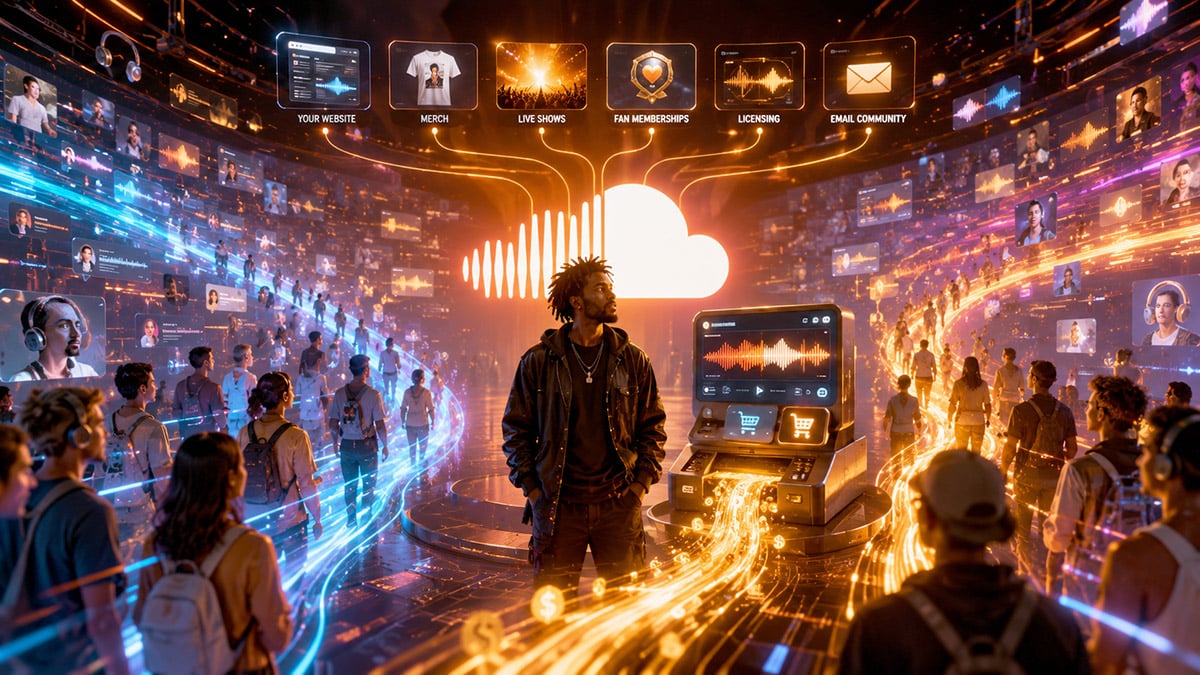
What makes this worth watching is not that SoundCloud has rediscovered the downloadable music file. Downloads never vanished completely, and independent artists have been selling digital music through Bandcamp, their own websites, and other stores for years. The interesting change is that SoundCloud is placing the opportunity to buy music directly beside the place where people already discover it, listen to it, comment on it, follow the artist, and begin forming a relationship with the music. That shortens the distance between discovering something you love and deciding that you want to support the person who created it, and for an independent artist, shortening that distance can matter a great deal.
SoundCloud Has Always Been Good at the Front Door
SoundCloud has never behaved exactly like Spotify or Apple Music, even though all three ultimately deliver recorded music to listeners. SoundCloud grew from a culture where artists could upload music directly and let the audience decide whether something was interesting before the traditional music industry got around to holding a meeting about it. Demos, remixes, DJ sets, rough mixes, underground releases, alternate versions, live recordings, strange experiments, and entire new scenes could begin moving through SoundCloud without first needing a formal distribution strategy, a label release schedule, or somebody in an office deciding that the music fit neatly enough into an existing market category.
That culture mattered because SoundCloud was never only about putting an audio file on a server. Listeners could comment directly on waveforms, repost tracks, follow artists, exchange messages, and discover music through networks of people who cared about the same strange corners of music that they did. At its best, SoundCloud felt less like walking through a giant digital supermarket and more like wandering through a rehearsal building where every studio door had been left open. Some rooms sounded incredible, some sounded unfinished, and a few probably needed an electrician, but discovery happened because people were close to the creative process rather than standing at the end of a polished corporate release pipeline.
Over time, SoundCloud has been adding tools designed to turn that discovery into a deeper relationship. Artist Pro creators can use follower-exclusive releases to make certain tracks available only to people who follow them, Fan Support gives listeners a way to contribute money directly, and the Fans and Advanced Insights tools help artists identify listeners who are engaging more deeply with their work. Those features begin moving SoundCloud away from the idea that it is simply another place where a song can generate plays and toward something closer to a community where listening can become participation.
The direct-purchase beta takes that progression another step because a person who discovers a song no longer necessarily has to leave SoundCloud to become a buyer. That sounds like a minor improvement until you think about how many steps artists routinely put between enthusiasm and a transaction. When somebody is excited about a song, that excitement has a shelf life, and every additional click gives real life another chance to interrupt the sale.
Stop Making Fans Cross the Internet to Give You Money
Independent artists have become remarkably good at creating complicated paths toward simple transactions. A listener hears a song on one platform, visits the artist profile, clicks a link page, chooses another service, searches for the release again, finds the version they want, creates another account, enters payment information, and may eventually make a purchase if nothing more interesting happens along the way. By the time that person reaches the checkout screen, their phone may have rung, the dog may have started barking, somebody may have sent them a message, and Instagram may have served up a video of a raccoon stealing a sandwich, which is admittedly difficult competition for most independent musicians.
Every extra step introduces friction, and friction matters because buying music is often an emotional decision. A fan does not usually schedule twenty minutes on Thursday afternoon to conduct a detailed cost-benefit analysis of whether a four-dollar alternate mix represents a sensible allocation of household resources. They hear something, feel something, and decide that they want it. The closer the buying opportunity sits to that emotional moment, the better the chance that the transaction actually happens.
SoundCloud’s experiment makes sense because the listener is already there when the purchase opportunity appears. The artist does not have to recreate the emotional context on another website because the song that created the interest is still playing. This is not revolutionary technology, but it is good retail, and sometimes the music business becomes so intoxicated with futuristic language that it forgets that placing the product beside the person who wants it has been a fairly effective strategy for several thousand years.
Discovery and Commerce Are Beginning to Live Together
For years, independent artists have been forced to build businesses from a collection of platforms that each handled one small piece of the job. One service streamed the music, another sold merchandise, another managed email, another handled memberships, another sold tickets, another processed payments, and another displayed analytics that told the artist almost everything about the audience except why the checking account still looked personally offended. The result was an online music business held together with browser tabs, passwords, spreadsheets, and the kind of optimism usually associated with musicians loading gear into a van that is making a new noise.
Those boundaries are now disappearing because platforms increasingly want to control more of the relationship between creators and audiences. Membership companies are building discovery systems, social platforms are adding commerce, streaming companies are creating fan tools, ticketing systems are trying to become customer databases, and commerce platforms are adding community features. The creator economy has reached the point where nearly every technology company eventually looks at its original product and decides that it should also become a record store, a fan club, a ticket office, a marketing service, and possibly your manager.
SoundCloud has clearly been moving in that direction. It already offers Fan-Powered Royalties, direct Fan Support, distribution, artist analytics, fan-identification tools, follower-exclusive content, ticketing connections, and physical-product experiments such as on-demand vinyl. The company also acquired assets connected to Nina Protocol in July 2026, bringing elements of a decentralized independent-music culture built around direct artist economics into the broader SoundCloud ecosystem. Direct music sales now add another commercial layer to a platform that is steadily becoming more interested in what happens after somebody discovers a song.
That does not mean SoundCloud has suddenly become a complete artist business operating system, and it would be premature to describe it that way. What it does mean is that the company is experimenting with connecting discovery, engagement, and commerce inside the same environment. For an independent artist, that is much more interesting than the tired argument over whether downloads are somehow coming back to replace streaming, because nobody needs downloads to replace streaming for direct sales to become useful.
Streaming and Purchasing Are Different Behaviors
Streaming remains extraordinarily valuable because it solves a problem listeners clearly wanted solved. People can access enormous catalogs immediately, discover new artists, build playlists, listen repeatedly, and carry practically the entire history of recorded music around in a pocket. Artists benefit from global reach, repeated consumption, recommendation systems, playlist exposure, and the simple fact that somebody in another country can hear a song within seconds of learning that the artist exists.
A purchase does something different because it represents an intentional financial decision about one particular artist or one particular piece of music. A stream tells the artist that somebody listened, while a purchase tells the artist that somebody cared enough to move from attention into economic support. That person is not automatically a lifelong fan, and nobody should start planning a stadium tour because somebody bought one WAV file, but the transaction reveals a level of commitment that an anonymous stream cannot.
SoundCloud already recognizes part of this difference through Fan Support, which lets listeners contribute money directly to participating artists. A supporter who sends money is clearly expressing something stronger than ordinary listening, but a music purchase adds another layer because the fan is not merely saying that they like the artist. They are saying that a specific product created enough value for them to spend money, and that information can help an artist begin understanding what their most engaged listeners actually want.
For an independent musician, that distinction is important because sustainable careers are not built from attention alone. Attention creates opportunity, but revenue begins when some portion of that audience chooses to act. The artist does not need every listener to become a buyer, but they do need to recognize the difference between somebody who passed through the music and somebody who deliberately reached for the wallet.
Zero Commission Is Useful, but the Whole Transaction Matters
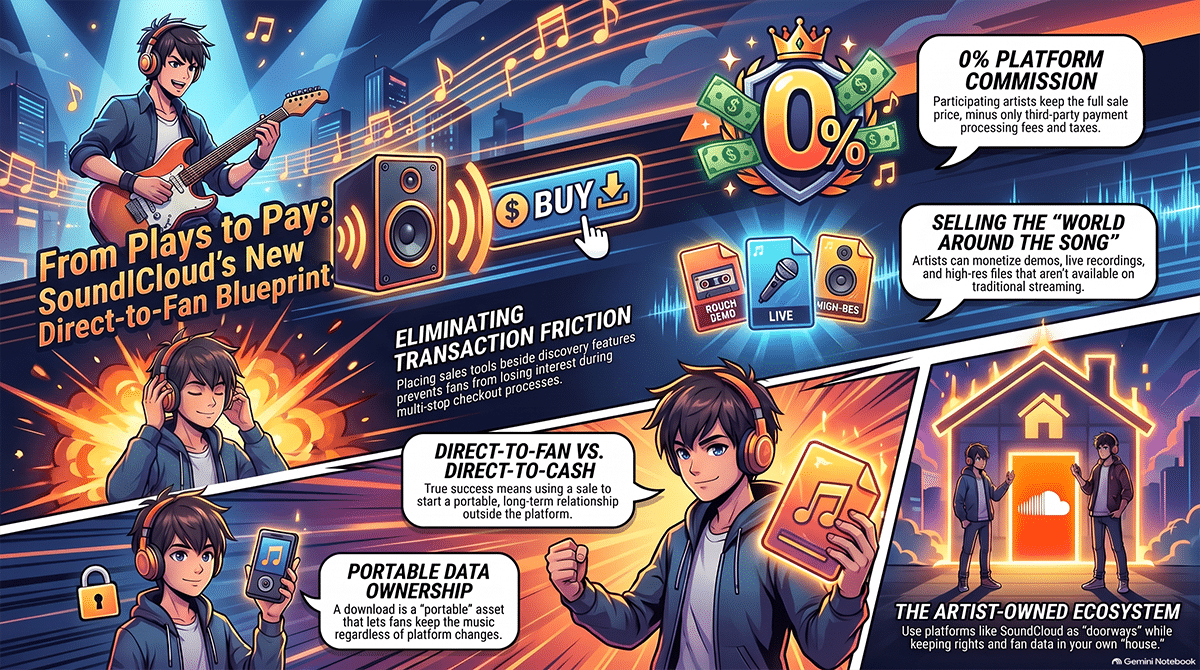
SoundCloud’s promise to take no commission from direct music purchases deserves attention because every percentage kept by the artist matters, particularly when independent musicians are working with relatively small transaction volumes. If the model remains as SoundCloud currently describes it, the artist sets the price and receives the proceeds after applicable payment-processing costs and taxes rather than surrendering an additional percentage of the sale to SoundCloud. That is an attractive structure, even though it is important to understand that zero platform commission does not mean that running the entire system costs nothing.
Artist Pro itself carries a subscription cost, payment processors still charge for moving money, and taxes remain taxes no matter how inspirational the product announcement sounds. None of that invalidates the zero-commission claim, but it does illustrate why artists need to learn to follow the money through an entire transaction instead of becoming hypnotized by whichever percentage appears in the headline. A five-dollar sale only becomes meaningful when the artist understands how much of those five dollars actually reaches them and what they had to spend to create the opportunity in the first place.
Bandcamp provides a useful contrast because it charges a platform percentage on digital sales while also attracting a community of listeners who arrive expecting to buy music. That purchasing culture has enormous value, and it demonstrates why the lowest fee does not automatically create the strongest business opportunity. A platform that charges a higher percentage but consistently produces paying customers can easily outperform one that charges nothing and produces no meaningful sales.
SoundCloud’s advantage may be that it already owns the moment when discovery happens. The question is whether that discovery culture can become a purchasing culture without losing what made SoundCloud valuable in the first place. If listeners begin seeing direct purchases as a natural part of the SoundCloud experience, zero commission becomes considerably more interesting because the artist is not merely keeping more of a sale; the platform may also be helping create the sale.
Give the Fan Something Worth Buying
The biggest mistake artists can make with direct music sales is assuming that putting a price beside the exact same master everybody already streams will automatically create demand. Some supporters will absolutely buy the standard release simply because they want to give money directly to the artist, and those people are precious. Most listeners, however, need a reason to purchase something they can already hear through a subscription they are paying for every month.
That creates an opportunity to think about the material surrounding a finished recording. A fan may be willing to buy the high-resolution WAV because they care about audio quality, while another may want the original demo because they love hearing how the song developed. A live recording from a memorable show, an acoustic version, an instrumental master, an alternate mix, or a deluxe digital package can all create value because the buyer is receiving something meaningfully different from the version available everywhere else.
This is where direct digital sales stop being a nostalgic attempt to recreate the old download store and start becoming part of a modern catalog strategy. The artist is not trying to persuade fans to pay twice for the same experience. They are creating additional experiences around the same creative work, which allows the recording to serve different levels of interest without forcing every listener into the same economic behavior.
That approach is healthier because most people will continue streaming, and there is nothing wrong with that. A smaller group may decide they want to buy, while an even smaller group may want something rare, exclusive, high quality, personal, or deeply connected to the artist’s creative process. Independent artists do not need every fan to behave identically; they need enough different ways for people to support them at the level that makes sense.
A Song Should Have More Than One Job
The traditional release cycle encourages artists to think of the finished master as the final product. The song gets recorded, mixed, mastered, distributed, promoted, and then placed into the enormous river of streaming music where the artist begins the familiar ritual of watching analytics and trying to determine whether all those numbers eventually combine into groceries. That model can make the song feel like a single-use object when, in reality, the recording can sit at the center of many different products and revenue opportunities.
The standard master can remain available everywhere for casual listeners while other versions serve people with different needs. The high-resolution file may appeal to serious listeners, the instrumental may be useful to both fans and licensing buyers, the songwriter demo may interest people who care about the creative process, and a live performance may matter because it captures a particular moment that cannot be recreated. The artist is not creating fake scarcity; they are recognizing that one creative work can have different forms of value depending on who is interested and why.
This is the beginning of catalog thinking because the artist stops seeing the song as something that was released on a particular Friday and starts seeing it as an asset that can continue producing opportunities for years. A release is an event, but a catalog is a business resource. Independent artists need both, and the difference between them often comes down to whether the artist has preserved and organized enough of the creative material to do something useful with it later.
Build the Revenue Assets While Everybody Still Remembers the Session
The smartest time to create additional versions of a song is usually when the original session is still open and functioning. The engineer remembers where everything is routed, the plugins are still installed, the automation still makes sense, and nobody has yet moved the entire project onto an external drive labeled something wonderfully informative like OLD MUSIC MAYBE KEEP. Waiting several years to recreate an instrumental or alternate version can turn what should have been a simple export into an archaeological expedition through missing plugins, broken file paths, expired subscriptions, and computer folders created by a younger version of yourself who apparently hated the future.
Creating the instrumental master while the final mix is being approved means the artist can make sure it actually sounds like a finished record rather than simply muting the lead vocal and discovering that half the arrangement was leaning on vocal effects. Useful stem groups can be exported while the mix architecture is intact, high-resolution masters can be preserved properly, and alternate mixes can be finished while everybody still remembers what the alternate mix was supposed to accomplish.
The goal is not to produce dozens of files simply because storage is cheap. Musicians already have enough folders full of FINAL, FINAL2, REALLYFINAL, and USETHISONE to keep digital archaeologists employed for generations. The purpose is to create useful commercial options while doing so is easy, because nobody knows whether the future revenue opportunity will come from the full master, the instrumental, the live version, the alternate mix, or some other asset that seemed almost unnecessary on the day it was exported.
This is how the recording session becomes part of the business-building process instead of ending the moment the streaming master is approved. The artist is preparing the song for a longer economic life rather than treating release day as the finish line.
A Download Is Useful Because It Can Leave
One of the most interesting things about a downloadable file is that it can exist independently of the platform where it was purchased. Streaming is fundamentally an access relationship because the listener reaches the music through a service, while a downloaded MP3 or WAV can live on the fan’s computer, phone, music server, backup drive, or whatever personal listening system survives the next round of technology companies deciding that ports are unfashionable.
That portability does not mean the fan acquires the copyright in the recording. Buying a copy of the music generally gives the purchaser a file for use under the terms of the sale, while ownership of the master recording, composition, publishing, synchronization rights, and other commercial permissions remains with the appropriate rights holders. The distinction matters because a digital product can be portable without becoming legally ownerless.
This creates an interesting opportunity for independent artists because different transactions can involve different rights without requiring the customer to become an entertainment lawyer. A person buying the instrumental for personal listening does not automatically gain the right to put it underneath a commercial video, while somebody purchasing stems does not automatically receive permission to release a remix. A high-resolution WAV can be a consumer product without transferring master ownership, and the artist can continue licensing that same recording to commercial buyers under entirely different agreements.
The more products an artist builds from one song, the more important it becomes to know what each product actually represents. Direct commerce works best when the customer understands what they purchased and the artist understands what they sold.
Web3 Gets More Useful When It Stops Being the Main Character
SoundCloud’s direct download experiment also provides a useful lesson for Web3 because many of the problems blockchain advocates have been trying to solve are real even when the technology has occasionally been presented with the subtlety of a marching band in a library. Direct artist payments, portable identity, digital ownership, provenance, and licenses that can travel with assets are legitimate ideas, but fans generally care about the useful result far more than the infrastructure underneath it.
A person buying a live recording usually wants the live recording. They are not secretly hoping that checkout will require a wallet, a seed phrase, a token exchange, and a detailed conversation about consensus architecture. An artist wants to make the sale, know what was sold, understand the rights attached to the transaction, and have a reasonable path toward staying connected with that customer if the customer wants to remain connected.
If decentralized technology can make the purchase record more portable, preserve provenance, carry clear license information, or help identity travel between services, that can become genuinely valuable. The important thing is that the technology should solve those problems quietly rather than demanding that the fan admire the plumbing before being allowed to drink the water.
This is where decentralized infrastructure starts becoming mature. The technology becomes more useful when the customer barely notices it because the experience simply works.
Nina Protocol Makes SoundCloud’s Direction More Interesting
SoundCloud’s July 2026 acquisition of assets connected to Nina Protocol makes the direct-sales experiment worth watching even more closely. Nina built its identity around independent music, editorial discovery, direct artist economics, and decentralized infrastructure, which naturally creates curiosity about whether any of those ideas are influencing SoundCloud’s broader strategy.
There is no good reason to claim that the new direct-purchase feature is powered by Nina’s technology unless SoundCloud actually says so. The timing is interesting, but interesting timing is not evidence, and one of the most useful habits music journalism can develop is resisting the urge to turn two nearby dots into a giant glowing arrow simply because it makes the story prettier.
What can reasonably be said is that SoundCloud has been moving toward a deeper involvement in the economic relationship between artists and fans. The Nina acquisition fits that direction, as do Fan Support, artist analytics, distribution, vinyl experiments, follower-exclusive content, and now direct downloads. Whether blockchain infrastructure eventually becomes part of that system matters less than whether the overall platform gives artists more useful ways to turn discovery into sustainable revenue.
That is the business story worth following.
The Customer Relationship May Be Worth More Than the Download
The most important question raised by SoundCloud’s new sales system may eventually have very little to do with MP3s and WAV files. Once somebody buys something, the artist needs to understand what happens to the relationship with that person. If the platform can tell the artist who purchased the music, provide legitimate ways to communicate again, and eventually allow the fan to voluntarily create a portable relationship outside SoundCloud, the transaction becomes much more powerful than a single sale.
SoundCloud already provides meaningful fan intelligence through Advanced Insights and its Fans tools, which can help artists identify listeners who are engaging deeply with the music. That gives artists more information than they receive from many traditional streaming environments, where the listener often appears primarily as a stream count, a location, or a demographic category rather than as somebody who can develop a continuing relationship with the artist.
What is not yet clearly established in the public documentation surrounding the direct-sales beta is whether participating artists receive an exportable purchaser record that could function like a traditional customer database. There is no reason to assume SoundCloud provides buyer email addresses simply because it facilitates the sale, and there is equally no reason to assume the company will never build deeper portability into the system. The feature is new, which means this is exactly the kind of question artists should be asking while the product is still developing.
If SoundCloud eventually gives artists permission-aware, exportable customer information, the feature becomes much more powerful as a true direct-to-fan system. If customer communication remains primarily inside SoundCloud, the sales opportunity can still be valuable, but the artist should recognize that part of the relationship remains dependent on the platform.
Direct-to-Fan Should Mean More Than Direct-to-Cash
The phrase “direct-to-fan” has become so widely used that it sometimes means little more than an artist being somewhere near a payment button. That is not enough. A transaction can be financially direct while the ongoing relationship remains controlled entirely by an outside platform.
SoundCloud’s model is meaningfully direct because the fan chooses the artist, the artist chooses the product and price, and SoundCloud says it takes no sales commission. Those are important improvements over a system where revenue comes from a large pooled streaming economy and the artist has very little visibility into the individual person whose listening generated the payment.
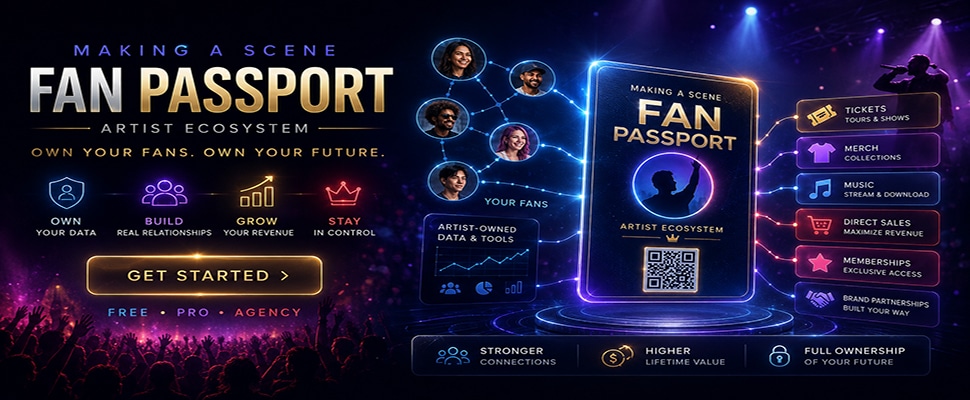
The stronger version of direct-to-fan commerce continues after the money moves. The buyer has an opportunity to remain connected through a permission-based relationship, perhaps by joining the artist’s mailing list, creating a Fan Passport, visiting the artist’s own website, joining a membership, buying a ticket, or participating in some other part of the artist’s business. The fan chooses whether that relationship continues, and the artist gains something more durable than another transaction trapped inside somebody else’s dashboard.
That is the difference between direct-to-cash and direct-to-fan. One creates revenue, while the other can begin creating a business relationship.
The Artist Website Was Never Supposed to Beat Spotify at Being Spotify
Artist websites spent years being treated like digital brochures because the real activity moved onto social platforms, streaming services, ticketing systems, and ecommerce tools. Many musicians eventually wound up with a website containing an old press photo, a few embedded videos, and a newsletter form that nobody had tested since the previous redesign, while all the meaningful customer activity happened somewhere else.
That does not mean the website became irrelevant. It means artists gave it the wrong job. The artist’s website does not need to compete with SoundCloud at discovery because SoundCloud has enormous network effects, recommendation systems, and millions of listeners, while the average artist website has a tour picture and a menu item called “News” containing one post from 2023.
The website’s job is to become home. A fan can discover the artist through SoundCloud, Spotify, YouTube, TikTok, a festival, a podcast, a blog, a sync placement, radio, or an AI recommendation system, because the artist does not need to control the first doorway. The artist does need somewhere that relationship can eventually lead, and that destination can connect music, merchandise, tickets, memberships, licensing, email, Fan Passport activity, and other parts of the business the artist controls.
SoundCloud can be an excellent doorway without needing to become the deed to the property. That distinction sits at the heart of the Making a Scene philosophy because platform use is useful while platform dependency is dangerous.
The Fan Passport Fits After the Fan Chooses to Go Deeper
The Making a Scene Artist Ecosystem and Fan Passport make sense in this model because they are not intended to replace SoundCloud. Their role is to preserve and deepen relationships that begin somewhere else, which means SoundCloud can remain excellent at discovery and commerce while the artist maintains an independent layer underneath that activity.
Imagine somebody discovers a track on SoundCloud and purchases a five-dollar high-resolution version. That person has already demonstrated more interest than a casual listener, and the artist now has an opportunity to invite them into a continuing relationship rather than treating the transaction as the end of the story. The invitation might come through the artist profile, a link included with the download, artwork containing a QR code, or another clear path leading toward the artist’s website, Fan Passport, mailing list, membership, or show community.
The important thing is that the fan chooses to continue. The artist is not secretly vacuuming customer information into a marketing database and announcing that ownership has been achieved. The artist is giving the fan a reason to remain connected somewhere that is not completely dependent on the platform where the discovery originally happened.
That arrangement lets SoundCloud do what SoundCloud does well while letting the artist maintain control of the broader business relationship. The platform becomes part of the ecosystem instead of becoming the entire ecosystem.
Owning Fan Data Should Never Mean Owning the Fan
The phrase “own your data” can become ugly very quickly if artists begin treating human beings like rows in a spreadsheet that have somehow become their property. That is not the goal. The reason fan information matters is that relationships have continuity, and a musician should not lose years of legitimate customer history simply because one social platform changes its algorithm or one commerce service decides to reinvent itself.
At the same time, fan trust has economic value because people are much more likely to remain connected with an artist who respects them. Permission matters, privacy matters, and an artist-controlled system should collect information because it serves the relationship rather than because software makes collection possible. Independent artists do not need to become miniature data-brokering companies with guitars.
The healthier model is one where the artist understands enough about supporters to serve them better while the fan understands what relationship they have agreed to. That produces a stronger business because the connection rests on trust rather than technical captivity.
A music-industry middle class will not be built by replacing giant gatekeepers with thousands of smaller gatekeepers who happen to own pedalboards. It will be built by artists creating direct relationships that people actually value.
The Better SoundCloud Gets, the More Important Portability Becomes
SoundCloud’s direct-sales beta is especially interesting because it joins a growing collection of tools the company already provides. Distribution, streaming royalties, Fan Support, fan analytics, exclusive content, ticketing connections, physical-product experiments, and direct music sales increasingly allow artists to conduct more of their business in one environment.
That convenience can be genuinely useful because independent musicians already spend too much time managing technology instead of making music or talking to fans. If SoundCloud can reduce the number of disconnected systems an artist has to maintain while improving revenue, that deserves credit.
The problem appears when convenience becomes dependency. The more of an artist’s business one platform handles, the more important it becomes to know which pieces can survive outside that platform. Masters should remain under artist control, royalty histories should be preserved, important metadata should exist independently, and customer relationships should be portable wherever fan permissions and platform terms allow.
This is not an accusation against SoundCloud. It is simply the rule artists should apply to every platform they trust with important parts of their careers. A useful service is a partner, while a service the artist cannot leave has quietly become infrastructure the artist does not control.
Put the Song at the Center and Let the Platforms Orbit Around It
The strongest independent music business does not place SoundCloud, Spotify, Bandcamp, or any other platform at the center. The creative work belongs there, surrounded by reliable business information that explains what the song is, who owns it, who wrote it, who contributed to it, what versions exist, which identifiers belong to it, and what permissions govern different commercial uses.
That is the basic idea behind the Making a Scene Artist Ecosystem’s Song Source of Truth. The artist should be the authoritative source for information about the artist’s own music, because relying on outside services to remember the business identity of the catalog creates exactly the kind of dependency that becomes painful whenever a platform changes direction.
SoundCloud can receive a copy of the master, Spotify can receive another, a fan can buy a WAV, a music supervisor can receive the instrumental, and a filmmaker can license a shorter edit. Those files can travel into very different commercial environments while the artist’s own system continues understanding that they all came from the same underlying work.
That is how the catalog remains coherent even while the music becomes more portable. The artist is not trying to lock the song inside one system; the artist is making sure the business identity survives wherever the song goes.
The File Should Carry Its Story With It
Direct downloads make provenance and identification more important because the music can now leave the closed environment where the transaction happened. Inside SoundCloud, the platform knows exactly which track is being played, but once the file lives on the fan’s computer or music server, that context no longer travels automatically.
Metadata can help preserve descriptive information about the recording, while audio fingerprinting can provide another way to identify the audio itself. Those technologies serve different purposes, and neither should be confused with copyright ownership, licensing authority, or magical enforcement. A fingerprint does not suddenly become a tiny digital police officer chasing unauthorized uses across the internet.
The Making a Scene Artist Ecosystem’s Data Encoder and fingerprint approach is intended to help maintain the relationship between distributed assets and the artist-controlled Source of Truth. The value comes from lineage because a high-resolution download, instrumental, alternate mix, sync edit, or other version can remain connected to the authoritative record that explains where it came from and what rights surround it.
That becomes increasingly useful as artists create more products from one song. A catalog can expand without becoming an incomprehensible pile of files if each asset remains connected to the information that gives it meaning.
Direct Sales and Licensing Can Grow From the Same Catalog
The same creative assets that become fan products can sometimes become licensing assets as well, which is another reason independent artists should prepare them thoughtfully. An instrumental master can be sold to fans for personal listening while also becoming useful for film, television, advertising, gaming, or other synchronization opportunities under entirely different licensing terms.
A live recording may become a direct-to-fan product while still having potential commercial licensing value, and stems might support a carefully designed fan experience while also making a recording easier for professional editors to adapt. The important thing is understanding that selling the audio file and licensing commercial rights are separate transactions.
When those distinctions are clear, one song can support several markets without creating confusion. The artist can sell something directly to a fan while preserving the right to license the same underlying recording elsewhere, because the product and the permission are understood separately.
This is how catalog thinking creates flexibility. The artist does not need to choose between fan commerce and business-to-business licensing because the same creative work can serve both when the rights and assets have been organized properly.
AI Makes Organized Rights Data More Valuable
Generative AI adds another reason to keep all of this information organized because music is increasingly moving through systems where identity, provenance, licensing permissions, and ownership matter. That does not mean every direct download needs to become an AI compliance project or that every WAV file requires a blockchain wrapper and a twelve-page manifesto.
It means the artist should know what the recording is and what uses have been authorized. If a master has been approved for particular AI applications, that information should be documented, and if the artist has prohibited those uses, that decision should also be preserved. Derived assets such as instrumentals, stems, and alternate edits should remain connected to the same authoritative song identity.
The future catalog is therefore becoming more than audio. It is audio surrounded by reliable information explaining ownership, permissions, lineage, and commercial use. That information is increasingly where flexibility lives because a buyer can move faster when the artist already knows exactly what can be licensed.
Good catalog hygiene may not sound nearly as exciting as generative AI, but it has the useful advantage of actually helping somebody get paid.
The First Five Dollars May Be the Beginning of Something Much Bigger
A direct sale should not be judged only by the amount of money generated in that moment. If a fan buys a five-dollar track and never does anything else, the artist still earned five dollars directly, and honest revenue does not need to apologize for failing to become a marketing case study.
The business becomes more interesting when that buyer remains connected. A person who purchases a track today might later buy a ticket, order vinyl, join a membership, support another release, attend another show, or introduce friends to the artist. The original transaction becomes the first visible sign of a relationship that may generate value for many years.
Business people call this customer lifetime value, which is a wonderfully expensive phrase for the simple observation that somebody who supports an artist repeatedly over ten years is worth more than somebody who listened once while cleaning the kitchen. Independent musicians do not need an MBA to understand that distinction.
This is why the customer relationship may eventually be more valuable than the download itself. The purchase creates revenue today, while the relationship can help create the career.
SoundCloud Still Has to Prove That Listeners Want to Become Buyers
The fact that SoundCloud’s experiment makes sense does not mean the experiment is guaranteed to work. The initial beta is small, and roughly 200 participating creators cannot tell us whether millions of SoundCloud listeners will eventually develop the habit of buying downloadable music there.
Artists will need to learn which products generate interest, what prices make sense, and whether SoundCloud’s listening culture can also become a purchasing culture. Some creators may discover that fans happily buy exclusive live recordings or demos while showing little interest in purchasing the same standard single they already stream. That kind of information will matter more than any launch-day press release because it will reveal whether the platform can produce meaningful commerce rather than simply provide another feature.
The broader market also suggests keeping expectations realistic because streaming dominates recorded music while downloads represent a relatively small part of current industry revenue. Independent artists, however, do not need downloads to dominate the entire market before they become useful. A niche revenue source can still be extremely valuable when it reaches the right audience with the right product.
That is one of the advantages of building an independent business. You do not need to win the global music industry; you need enough people who genuinely care about what you make.
SoundCloud May Be Perfect for the Material That Does Not Belong Everywhere
One of SoundCloud’s greatest cultural strengths has always been its comfort with music that does not fit neatly into a formal commercial release schedule. That makes direct purchasing particularly interesting because the artist does not have to treat every product like a major single destined to live forever on every DSP.
A live recording from last night may be valuable precisely because it captures a moment that will never happen again. A demo may be interesting because the fan can hear the song before the arrangement became polished, while an alternate mix can reveal an entirely different emotional character. A rehearsal recording may mean very little to the general streaming public but become deeply valuable to the small group of people who understand why that performance matters.
That kind of material fits SoundCloud’s culture naturally because the platform has always allowed music to exist somewhere between polished commercial release and creative conversation. Direct sales can give some of that material an economic life without requiring the artist to build a traditional release campaign around every recording.
SoundCloud does not need to recreate iTunes to make this work. It may be more interesting if it helps artists sell the world surrounding the official record.
Create Something Worth Buying and Give the Buyer Somewhere to Go
The practical opportunity begins with a simple question about one song the audience already cares about. Instead of asking how to make people pay for the exact same master they can already stream, the artist can ask what additional experience exists around that recording that would make a direct purchase feel worthwhile.
For one artist, that may be the high-resolution master, while another audience may care more about the live version, demo, instrumental, alternate mix, or a small deluxe collection. The answer depends on the relationship between artist and audience because value is not created by the file extension; it is created by what the product means to the person buying it.
Once the purchase happens, the artist should think about the next stage of the relationship without treating the buyer like captured data. If SoundCloud provides legitimate communication tools, use them. If the artist can invite the fan into a broader permission-based relationship through the website, Fan Passport, mailing list, shows, membership, or another owned channel, give that fan a clear reason to make the choice.
The goal is not to trap somebody after they buy a song. The goal is to make it easy for somebody who already cares to remain connected.
Use Every Doorway, but Make Sure You Own the House
SoundCloud’s direct-purchase experiment fits almost perfectly into the Making a Scene philosophy because independent artists should use every useful platform capable of creating discovery, engagement, or revenue. SoundCloud can introduce a listener, Spotify can introduce another, YouTube can show someone the video, a festival can create a fan in person, a music blog can start a conversation, and an AI recommendation system may eventually bring somebody else through an entirely different doorway.
The artist does not need to own every doorway because that would be impossible and unnecessary. The artist needs to make sure that the business waiting behind those doorways does not disappear whenever one outside platform changes direction.
That means the website, customer relationships, rights records, catalog information, fan permissions, and business memory should remain under the artist’s control as much as possible. SoundCloud can generate discovery and perhaps create the sale, but the strongest model gives the fan an opportunity to become part of something that belongs to the artist’s broader business.
That is the difference between using a platform and depending on one. Making a Scene has never been interested in telling artists to reject useful tools; the goal is to use the tools without allowing the tools to become the owner of the career.
The Best Technology Eventually Disappears Into the Experience
There is a larger lesson here for AI, Web3, and every other technology currently promising to reinvent the music business. Fans do not need to understand the infrastructure behind a useful transaction, and artists should not be forced to turn every sale into a technology seminar.
A fan should be able to hear something they love, buy it easily, receive something worthwhile, and remain connected with the artist if they choose. Behind the scenes, technology can handle payments, provenance, rights information, permissions, analytics, identity, customer relationships, and portability without forcing the listener to care about how any of it works.
This is where emerging technology becomes mature because it stops demanding attention and starts solving problems. Blockchain can be useful when it quietly preserves a license or proves provenance, while AI can be useful when it reduces administrative work or helps the artist understand the catalog. Neither technology needs to become the star of the transaction.
For years, technology companies have tried to sell musicians the plumbing. The more useful future is one where the plumbing works so well that everybody can get back to talking about the music.
SoundCloud May Have Put the Cash Register in the Right Place
SoundCloud’s direct-purchase beta may change dramatically as it expands, and it may eventually prove that listeners do not want to buy downloadable music there in meaningful numbers. That uncertainty is exactly what a beta is supposed to answer, and nobody needs to declare the beginning of a new music economy before the first few hundred artists have even finished testing the checkout button.
What makes the experiment valuable is that SoundCloud is testing the right relationship. It already has discovery, community, listeners, and a culture where artists upload material that often sits outside the formal commercial release cycle. Adding purchasing beside that environment gives the platform a chance to see whether some listeners can become buyers without being sent somewhere else first.
The smartest independent artist will not respond by declaring streaming dead, building a shrine to the MP3, and waiting for 2007 to return. They will look at the larger opportunity and ask what they own, what additional products can be created around their catalog, which fans might want those products, and how those transactions can become part of a longer relationship.
SoundCloud can create discovery, generate streams, and perhaps create direct sales, while other platforms can bring other listeners through other doorways. The artist’s job is to make sure those opportunities eventually feed a business that belongs to the artist rather than remaining isolated inside whichever platform happened to create the first interaction.
That is how discovery becomes fandom, fandom becomes commerce, and commerce begins becoming a sustainable independent music business. The technology matters because it makes that journey easier, but the real value remains the same thing it has always been: somebody cares about the music enough to support the person who made it, and the artist has built a business capable of keeping that relationship alive.
 |  Spotify |  Deezer |  Breaker |
 Pocket Cast |  Radio Public |  Stitcher |  TuneIn |
 IHeart Radio |  Mixcloud |  PlayerFM |  Amazon |
 Jiosaavn |  Gaana |  Vurbl |  Audius |
 Reason.Fm | |||
Find our Podcasts on these outlets
Subscribe to Our Newsletter
Discover more from Making A Scene!
Subscribe to get the latest posts sent to your email.


