
Build the Stack, Own the Fan: How Independent Artists Can Create a Sustainable Music Business




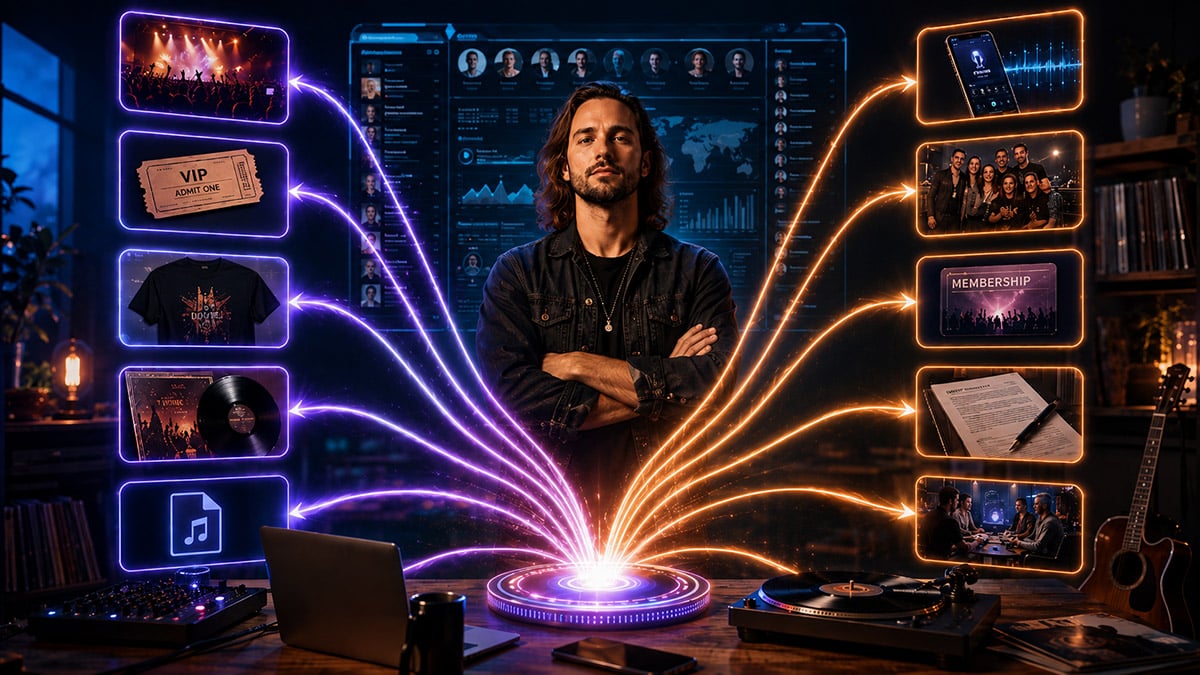
Making a Scene Presents – Build the Stack, Own the Fan: How Independent Artists Can Create a Sustainable Music Business
Listen to the Podcast Discussion
Stop Waiting for One Check to Save Your Career
Independent artists have spent decades being sold different versions of the same dream. There is always supposed to be one thing that changes everything, whether that thing is a record deal, radio airplay, a viral video, a giant playlist, a million streams, a social-media breakthrough, an NFT collection, or whatever shiny object arrives next Tuesday.
The problem is that sustainable businesses rarely depend on one source of income. A recent Warner Music Group earnings report provided a useful reminder of this because the company’s growth was spread across streaming, physical music, artist services and expanded rights, and several publishing categories rather than coming from one magical royalty stream. That does not mean an independent artist should try to become Warner Music, but it does mean there is something worth stealing from the business model.
The lesson is simple. Stop looking for one revenue stream that will support everything, and start building several connected ways for the music, the rights, the audience, the live show, and the artist’s skills to create income.
That is the revenue stack.
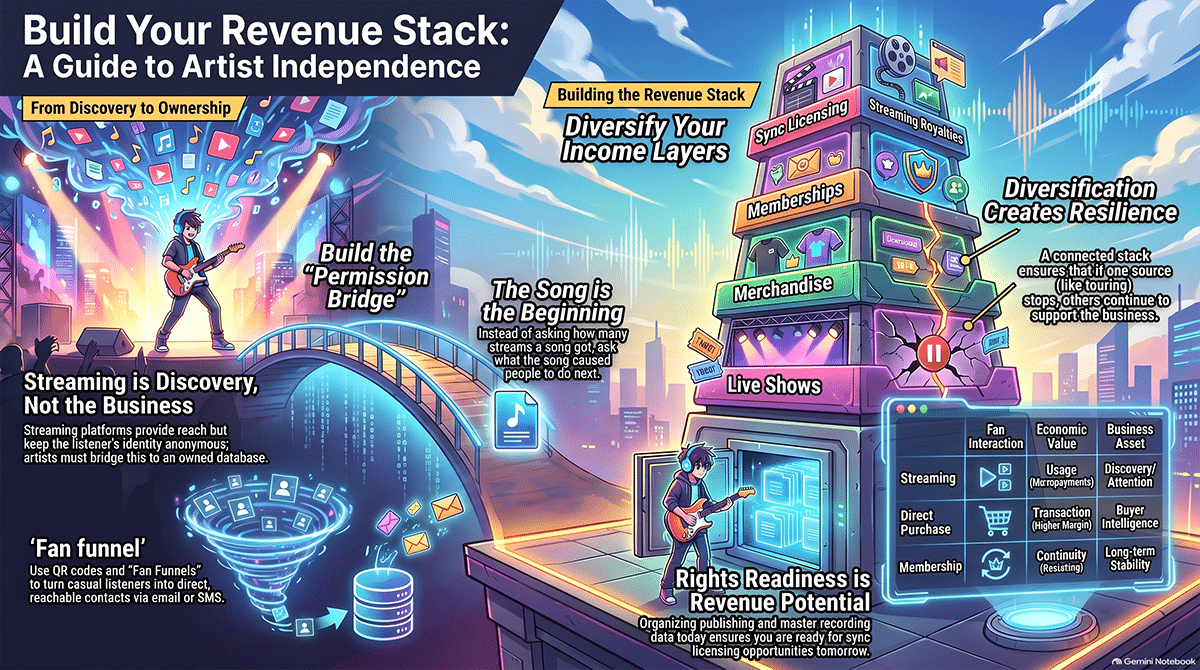
For an independent artist, the stack might include streaming royalties, direct music sales, live shows, merchandise, memberships, tips, VIP experiences, publishing income, mechanical royalties, digital performance royalties, sync licenses, production work, teaching, session work, or other services that make sense for that particular artist. The goal is not to build all of them at once, because that is less of a business plan and more of a nervous breakdown with a Shopify account.
The real goal is to connect the revenue sources that naturally fit the artist’s career. A song should be able to lead to a fan relationship, a fan relationship should be able to lead to a sale, a sale should be able to lead to another interaction, and every interaction should teach the artist something useful about the business.
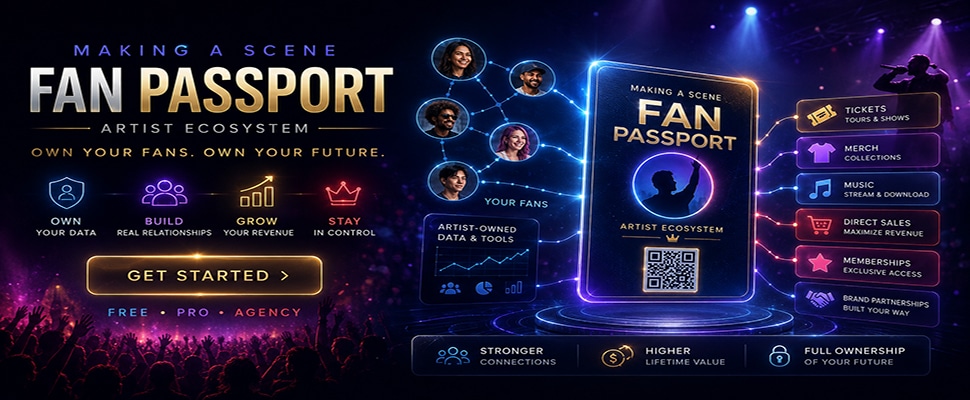
That is where the Making a Scene Fan Passport Artist Ecosystem becomes much more important than simply being another place to store fan names. The system at https://masfanpassport.com/ is designed around the idea that discovery should lead to an artist-owned, permission-based relationship that the artist can keep, measure, and use to build direct revenue. Its public feature set connects fan capture, shows, rewards, commerce, campaigns, rights, sync licensing, analytics, education, and data portability around a common artist-controlled source of truth.
That is exactly the kind of infrastructure a revenue stack needs.
The Song Should Be the Beginning, Not the End
Most independent artists naturally think of the song as the product. You write it, record it, upload it, promote it, and hopefully people listen. There is nothing wrong with that, but the economic life of the song should not necessarily end when somebody presses play. The song can be the beginning of a much larger relationship.
Someone hears the song on a streaming service and becomes curious. They find the artist’s website, scan a QR code at a show, follow through Fan Passport, join an email list, buy a ticket, order a shirt, support the artist directly, or eventually license the track for a project. Now one song is participating in several parts of the business.
The streaming royalty is still useful, but it is no longer carrying the entire economic burden of the music. The song is also functioning as marketing, fan acquisition, intellectual property, concert promotion, merchandise promotion, and potentially a licensing asset. This is one of the biggest changes an independent artist can make in the way they think about releases. Instead of asking only how many streams a song generated, ask what the song caused people to do next.
That question begins turning music promotion into business development.
Streaming Is Discovery, Not the Whole Business
Streaming belongs in the revenue stack. It gives artists access to audiences on a scale that would have been almost impossible for most independent musicians in the old physical-distribution system. The mistake is treating the streaming platform as the artist’s customer database.
A listener can hear your song repeatedly without the artist ever knowing who that person actually is. The platform may provide useful aggregated analytics, but the artist does not automatically receive a direct, permission-based relationship with every listener. That means the artist should create an intentional bridge between discovery and ownership.
The Making a Scene Fan Passport Artist Ecosystem is designed to provide that bridge. Its Free Core includes Fan Funnel capture, Fan Passport relationship records, unified fan identity and source history, basic profiles and activity timelines, permission tracking for email and SMS, and fan-data hygiene tools. It supports capture paths through websites, newsletters, QR codes, NFC, tap-to-text, and live shows when those tools are configured.
The free system currently supports up to 250 active fan relationships, which makes it possible for an artist to begin proving the model before needing a large audience or a paid business system. The Pro level expands the system to unlimited fan relationships and adds deeper segmentation, conversion monitoring, campaign workflows, automated follow-up, rewards, and reporting.
That matters because the first hundred real fans can teach an artist more about the business than ten thousand anonymous impressions. When somebody voluntarily joins your Fan Passport or gives permission to receive communication, the relationship changes. You are no longer dependent on an algorithm deciding whether that person is allowed to see your next announcement.
You have a direct connection. That connection should never be abused. The point of fan ownership is not to become a tiny surveillance company that happens to own a guitar. The point is permission.
Fan Passport records consent and contact-sharing information and tracks email and SMS permissions, while its export tools are designed around permission-safe data handling. The artist can therefore build an owned audience while still maintaining the distinction between someone who has given permission to receive communication and someone who has not. That is not simply good data management. It is the foundation of a direct-to-fan business.
Make Every Show Build the Next Show
A live show is one of the easiest places to see the revenue stack in action.
Too many artists still treat the gig as a single transaction. The band gets paid, everybody loads the gear into the van, someone discovers they left a cable onstage, and the night is officially over.
But a show can produce much more than the performance fee.
The people in that room are not theoretical followers. They actually showed up.
That makes the live show one of the best opportunities an artist has to turn attention into an owned relationship.
The Fan Passport Artist Ecosystem includes show management, venue records, Bandsintown imports where connected, show-business workflows, printable show QR fan-capture signs, Show Kit functions, Fan Passport stamps and rewards, and post-show follow-up prompts in the Free Core. Pro expands those capabilities with an advanced Show Kit, staff access for show, door, and merchandise workflows, QR and NFC fan capture tied to unified fan records, touring and live-revenue workflows, market-demand reporting, and booking-proof tools.
That changes the purpose of the QR code sitting on the merch table. It is no longer just a link. It can become the doorway into the artist’s own fan ecosystem. Someone scans because they want a reward, concert update, special offer, stamp, download, or connection with the artist. With permission, that person becomes part of a fan record the artist can continue serving after everyone goes home.
Now the show can help sell the next show.
If the artist can identify permission-based fans in a particular city, the next time a date is booked nearby the artist has an audience that can be reached directly. The artist can also start seeing which markets generate fan growth and which markets produce real purchasing activity. That is far more useful than simply looking at a map of streams and assuming everyone in the blue area is willing to buy a ticket.
The Pro system’s market-demand, fan-geography, projected-draw, and booking-proof capabilities are intended to help turn that information into something an artist can actually use in touring and venue conversations. Suddenly, fan data is not just a marketing asset. It becomes booking intelligence.
Turn the Merch Table Into a Relationship Table
Merchandise is another obvious layer of the revenue stack, but the best independent artists can think beyond the immediate sale. A shirt sale is great. A shirt sale connected to a known, permission-based supporter is better.
When commerce and fan data are connected, the artist can begin understanding what people actually buy instead of relying entirely on intuition. Musicians are very good at intuition until they order four hundred shirts because someone in rehearsal said, “Trust me, everybody wants orange.”
Fan Passport’s Free Core includes basic merchandise prompts, an Offer Catalog foundation, tips, simple support offers, buyer follow-up prompts, and a Revenue Moment Dashboard. Pro adds the full Artist Commerce OS, Merch Table Mode, physical merchandise workflows, digital music and protected-content delivery, memberships, ticketing and door-list workflows, VIP offers, buyer segmentation, post-purchase follow-up, and revenue-stack planning and reporting.
That means merchandise can become part of the artist’s broader business intelligence. If a fan buys a shirt, comes to two shows, and later joins a membership, those actions should not have to live forever as three unrelated records inside three companies.
The ecosystem’s unified fan timeline is designed to connect activity across Fan Funnel capture, Fan Passport, QR and NFC activity, email, SMS, shows, rewards, commerce, and campaigns. Now the artist can begin distinguishing between attention and support.
One person may watch videos every week. Another may buy music, attend shows, and purchase merchandise. Both are fans, but they are behaving differently. Knowing the difference allows the artist to communicate more intelligently instead of sending the same message to everyone on Earth and hoping something happens.
Direct Sales Give the Artist a Different Kind of Customer
Streaming and direct sales do not need to compete with each other. A fan can stream your album because that is convenient and still buy something directly because they want to support you. The economic relationship is different. A stream is usage. A purchase is a decision.
Someone who buys a download, physical album, ticket, membership, VIP experience, or merchandise has demonstrated a willingness to spend money on the artist. That person deserves attention. This is why direct commerce should connect back to fan data instead of existing as an isolated checkout page.
Fan Passport’s Pro commerce tools are designed to maintain offer, order, fulfillment, revenue, and buyer information while connecting the buyer relationship back into the larger artist system.
That creates possibilities far beyond the original sale. A customer who buys a vinyl record might be interested in a signed edition next time. A fan who buys tickets repeatedly might respond to an early-access offer. A supporter who tips the artist may be a strong membership candidate. None of that requires creepy tracking or secret profiling.
It requires permission-based relationship data and the artist paying attention to what customers voluntarily do. That is how small businesses have worked forever. The difference is that independent musicians finally have tools capable of connecting the information without needing a corporate IT department.
Membership Can Put a Floor Under an Unpredictable Business
Most music income arrives unevenly. Touring income rises when the artist is touring. Merchandise often rises around shows or releases. Physical products have launch cycles. Sync licensing can be wonderfully profitable when it happens and completely uninterested in your rent when it does not.
Recurring fan support can help smooth that roller coaster.
Fan Passport Pro includes membership and recurring-support workflows as well as gated or members-only content and community options. It also supports exclusive-content libraries and access rules that can be used to build an ongoing relationship around the artist rather than a single transaction.
The useful part of membership is not merely the monthly payment. It creates continuity. A member is making an ongoing decision to support the artist. That makes the relationship different from someone who bought one album four years ago. The artist can respond by creating meaningful reasons for that support to continue, whether that involves early access, private performances, demos, special releases, show discounts, exclusive content, fan conversations, or experiences appropriate to that particular audience.
The trick is sustainability. Do not promise so much exclusive content that by month three you are producing sixteen videos, two podcasts, four livestreams, a handwritten newsletter, and a cooking show while wondering why no new songs are getting written.
Membership works best when the value is real and the workload is realistic. That is what the stack is supposed to do. It supports the music instead of replacing it.
Publishing Is Another Layer Hiding Inside the Song
The revenue stack also forces artists to look at rights more seriously. A recorded song contains more than one economic asset. The sound recording and the underlying musical composition are separate copyrights, and the people or companies controlling those rights may be different.
For self-administered U.S. songwriters and other eligible musical-work rightsholders, The Mechanical Licensing Collective at https://www.themlc.com/ administers the U.S. blanket compulsory mechanical license for eligible interactive streaming and download services and distributes the royalties it collects under that system.
SoundExchange at https://www.soundexchange.com/ handles a different part of the system. It is designated in the United States to administer statutory sound-recording performance royalties associated with eligible non-interactive digital services, including services such as digital radio and webcasting.
These are different rights and different revenue flows. That distinction is exactly why artists need their rights data organized.
The Fan Passport Free Core includes basic release metadata, catalog and rights records, release-readiness checks, and handoff worksheets designed to help artists prepare information for distributors, PROs, The MLC, SoundExchange, and related registrations. It also includes the Artist Data Vault and an Output Registry for saved business information.
Pro goes considerably deeper.
The system supports detailed songwriter, composer, lyricist, publisher, administrator, master-owner, performer, producer, and engineer records, along with ownership worksheets for composition and master rights. It also tracks readiness around identifiers and registrations such as IPI or CAE numbers, ISRCs, UPCs, ISWCs, work IDs, and copyright-registration information.
This is where the phrase “source of truth” stops sounding like software jargon and starts becoming very practical. If somebody wants to license your song tomorrow, you should know who owns it. Not “I think Dave has twenty-five percent.” Not “The drummer’s girlfriend made the spreadsheet.” Not “There is an email from 2022 somewhere.” The business needs an authoritative answer.
Your Rights Catalog Should Know What You Can Actually Sell
A revenue stack only works if the artist knows what can legally and practically be monetized. That becomes especially important with sync. A great song is not automatically a licensable song.
Someone needs to know who owns the master, who owns the composition, whether co-writers must approve the use, whether samples or interpolations are involved, whether the artist has authority to approve the requested license, and whether the required audio assets actually exist.
Fan Passport Pro includes a Rights Catalog designed to act as the authoritative record of what the artist owns, controls, and can approve. It also includes rights mapping, licensing-readiness reporting, sample and interpolation tracking, approval records, licensing authority information, artist-defined pricing starting points, and granular licensing policies covering areas such as media, territory, term, exclusivity, master rights, composition rights, lyrics, stems, remixes, AI-related uses, and other permissions.
That is an important part of the revenue-stack model because artists often focus entirely on generating opportunities without asking whether the business is ready to accept them. Opportunity without preparation can disappear very quickly.
If a supervisor sends an inquiry and the artist spends the next four days figuring out who owns the publishing, there is a reasonable chance that the supervisor will have found another song before the answer arrives. Professional readiness is part of revenue generation.
Sync Turns the Catalog Into Business Inventory
Sync licensing is one of the clearest examples of how an artist can make the same music work in a completely different revenue channel.
A song released for fans can also potentially be licensed for film, television, advertising, games, online media, corporate productions, documentaries, and other visual uses, depending on the needs of the buyer and the rights available.
The Making a Scene Fan Passport Pro system includes access to the MAS Sync Marketplace, with the public supervisor search available at https://masfanpassport.app/sync. The system is designed to allow artists to publish eligible, artist-approved tracks from their Rights Catalog into the marketplace while keeping rights control with the artist.
The marketplace combines creative search information with structured rights information. AI-assisted tools can suggest genre, mood, instrumentation, lyrical themes, scene suitability, tempo, energy, and supervisor-facing descriptions, but the public system specifies that the artist must approve AI-generated metadata before those suggestions become searchable marketplace information.
That distinction matters. AI can help organize and describe the catalog. It should not become the authority on what the artist owns. The system keeps creative matching separate from hard rights and availability filters, which means a song can be creatively perfect for a scene without the software pretending that automatically makes the rights clear.
That is how AI should work inside an artist business. It assists. The artist remains in control.
Get the Audio Ready Before Somebody Asks for It
Sync readiness is not only about rights. The assets matter too.
Music supervisors and production teams may need instrumental versions, clean versions, alternate mixes, television mixes, a cappella versions, shorter edits, stems, or other production assets depending on the project.
Fan Passport’s sync system supports structured records for full masters, instrumentals, clean and explicit versions, TV mixes, a cappellas, alternate mixes, shorter edits, stems, and intentionally supplied multitracks. It also includes learning material around broadcast-ready files, naming, sample rate, bit depth, stem preparation, and the reasons supervisors may need those assets.
This is another example of building the stack before the money arrives. If the artist prepares the instrumental today, it exists when the opportunity appears six months from now. If the artist waits until somebody requests it, the opportunity immediately becomes an emergency. Nothing reveals the quality of an archive quite like receiving an email that says, “Can you send the instrumental by 2 p.m.?” Suddenly every hard drive in the house becomes a suspect.
The artist ecosystem is intended to move that preparation into the normal business workflow, so songs become organized licensing assets rather than random files scattered across laptops and cloud folders.
That makes the catalog more useful. A useful catalog has more opportunities to earn.
The Fan Data Should Connect the Revenue Streams
This is where the revenue stack becomes something much bigger than having several ways to collect money. The real power appears when the revenue streams share information.
Imagine that an artist plays a show and twenty people join the Fan Passport. Three buy shirts. Two buy a signed album. One becomes a member. Several interact with a reward campaign, and six months later some of those same people buy tickets when the artist returns to the city.
If every one of those transactions lives in a different platform, the artist sees fragments. The ticket company sees ticket sales. The merchandise company sees merchandise. The email company sees opens. The social network sees engagement. The artist sees six dashboards and develops a headache.
Fan Passport is designed around a unified fan identity so activity from multiple parts of the business can be tied back to the same fan relationship where permissions and available integrations allow it. Its public feature set describes a unified timeline spanning Fan Funnel capture, Fan Passport interactions, QR and NFC activity, SMS, email, shows, rewards, commerce, and campaigns.
Now the artist can begin asking much more valuable questions. Does a fan who attends two shows become more likely to buy merchandise? Do people who claim a reward come back to another event? Are members concentrated in certain cities? Are ticket customers becoming direct buyers? Which release brings the most people into the artist-controlled ecosystem? Those questions are where data becomes strategy. The purpose of fan data is not simply knowing more things about people.
It is knowing what parts of the artist’s business actually work.
AI Can Help the Artist Understand the Stack
The biggest music companies can hire teams to analyze marketing, touring, licensing, catalog performance, audience behavior, merchandise, and revenue. Independent artists generally have themselves. This creates a slight staffing disadvantage. AI can help narrow that gap when it is used carefully.
The Fan Passport ecosystem includes AI-assisted next-best-action recommendations, Fan Funnel diagnosis, revenue-stack recommendations, release-strategy assistance, touring and market-opportunity analysis, rights-readiness analysis, website and campaign recommendations, and saved recommendation records that can be reviewed rather than blindly accepted.
That is exactly the role AI should play. The system might recognize that a particular market is producing strong fan engagement. It might identify that an artist has listeners but weak fan capture. It might point out missing rights information before a song can become sync ready. It might recognize that an artist has merchandise activity but no structured follow-up with buyers.
Those observations can save enormous amounts of administrative time. But the source of truth should remain the verified artist data. AI should help interpret the business. It should not invent the business. If AI decides your drummer owns half the publishing because his name appeared prominently in an old press release, you do not have an exciting new metadata feature. You have a problem. The artist approves what becomes authoritative. That protects the integrity of the revenue stack.
Portability Protects What You Build
There is another side of sustainable revenue that artists do not always think about until something goes wrong.
What happens when a platform disappears?
What happens when your favorite service changes its business model, increases prices, removes a feature, gets acquired, stops serving musicians, or simply decides that your account violated a policy you did not realize existed?
If the artist’s business exists only inside that platform, the platform has become a single point of failure.
Fan Passport’s Artist Data Vault, Fan Data Export Center, permission-aware CSV exports, and Output Registry are designed to help keep important artist and fan information portable. The Pro system adds additional import and export workflows and is designed to preserve suppression, unsubscribe, bounce, complaint, STOP, and do-not-contact information as part of safe data handling.
This matters enormously to the revenue stack. The artist should be able to replace technology without replacing the business. Your master recordings should still be yours. Your rights information should still be yours. Your permission-based fan relationships should still be yours. Your customer history should remain usable and portable where legally appropriate.
Your licensing records should not vanish. Your business intelligence should not reset to zero. That is the difference between using a platform and being trapped inside one.
The Free System Can Start the Ownership Loop
An artist does not need to build every part of this system on day one.
That would defeat the purpose.
The Fan Passport Free Core is designed to let an artist start with the foundation: an Artist Profile that acts as a master source of artist information, basic website and EPK functions, smart links and QR discovery, fan capture, consent records, show tools, simple revenue workflows, basic catalog and rights information, exports, and guided education.
That is enough to begin changing the direction of the business. A listener can become an identifiable, permission-based fan. A show can produce fan relationships instead of simply applause. A basic merchandise or direct-support offer can begin producing buyer information. A release can become an organized record rather than merely an upload. The artist can start seeing the business. That first stage matters because the revenue stack does not begin with having seven revenue streams. It begins with owning the foundation underneath them.
Pro Connects the Full Business
As the artist grows, the Pro Artist Business OS expands that foundation into a much more complete operating environment. Fan growth connects to campaigns and rewards. Commerce connects merchandise, digital products, support, memberships, tickets, VIP experiences, and buyer records. Live activity connects fan geography, post-show reports, touring decisions, and booking proof.
Rights records connect to licensing readiness and the MAS Sync Marketplace. AI analysis connects the information back into decisions about what the artist should work on next. The important thing is not the number of features. The important thing is that they are designed around the same artist-owned business.
That is the difference between a tool collection and an ecosystem. Most artists already use plenty of tools. The problem is that the tools generally do not know what happened anywhere else. The newsletter does not know someone bought a ticket. The ticket company does not know someone bought a shirt. The streaming service does not know someone joined a membership. The sync platform does not know that a particular track creates unusually strong direct-fan engagement. When the artist owns the source of truth, those relationships can begin making sense.
Your Revenue Stack Should Grow From Real Fan Behavior
There is no universal revenue stack. That is worth repeating because the internet is extremely good at convincing musicians that everyone needs the same seventeen income streams by Friday. A touring artist may find that tickets, merch, VIP experiences, and direct fan capture deserve most of the attention.
A songwriter with a large catalog may find more value in publishing administration, sync preparation, and licensing. A producer may build income around music releases, mixing, production work, sample creation, and education. An artist with a small but deeply committed audience may find recurring memberships more useful than trying to reach a million casual listeners. The right answer comes from the audience.
That is why Fan Passport’s data layer matters so much to the revenue stack. The system can tell the artist what people are actually doing inside the artist’s own ecosystem. That is different from copying somebody else’s business because they made a convincing video titled “Seven Income Streams Every Musician MUST Have.” Your fans may not want seven. They may want three.
If those three work, use them.
Stop Measuring Only Popularity
The revenue-stack approach also changes how an artist measures success. Streams matter. Followers matter. Views matter. But those are measures of attention. A sustainable business also needs measures of relationship and transaction.
How many listeners become permission-based fans? How many fans become buyers? How many buyers come back? How many people attend more than one show? How many supporters join a membership? How many catalog assets are actually licensing ready? How much revenue does each part of the business produce after its costs? Those are business questions.
Fan Passport’s revenue reporting, fan timelines, conversion monitoring, buyer segmentation, show reporting, campaign analysis, and licensing analytics are designed to give artists more of that context rather than treating every number as an isolated victory.
That helps move the artist away from vanity metrics. Ten thousand people clicking something can look impressive. Fifty people buying something might be more useful. The artist needs to know the difference.
Revenue Is Not Profit
This is also where a sustainable revenue stack has to become slightly less glamorous. Revenue is not profit. A $2,000 show is not worth $2,000 if it costs $1,700 to play. A $30 shirt does not generate $30 of profit when manufacturing, payment processing, sales taxes, shipping, venue commissions, and fulfillment have eaten their share. A vinyl campaign can produce thousands of dollars in sales while also producing a beautiful collection of cardboard boxes that apparently intend to live in your house permanently.
The stack needs financial visibility. The artist should eventually know which income streams generate the healthiest margins, which create repeat customers, and which consume more time and money than they return. Fan Passport‘s commerce records, Revenue Moment Dashboard, revenue-stack reporting, show and touring reports, licensing ledger, and My Money connections are intended to make those financial relationships easier to follow inside the wider business.
That gives the artist a chance to make smarter decisions. More revenue is good. Better revenue is better.
The Stack Creates Resilience
The most important advantage of diversified artist revenue may not appear during the best year. It appears during the bad one. An artist whose entire business depends on touring can be devastated when touring stops. An artist whose entire business depends on streaming can be extremely vulnerable to changes in reach, recommendation systems, market conditions, or audience behavior.
An artist relying almost entirely on one social platform is trusting a company they do not control with a frightening amount of the career. A connected revenue stack creates more ways for the business to survive change. If touring slows, direct sales, memberships, licensing, publishing, teaching, production, or other activity may continue.
If a social network declines, permission-based fan relationships can remain. If a commerce provider becomes unsuitable, portable customer and business records make migration easier. If one revenue source weakens, the others do not automatically disappear.
That creates resilience. Resilience creates leverage. An artist who has more than one way to earn money has more freedom to reject bad opportunities. That is where business independence becomes artistic independence.
This Is How We Build a Music Industry Middle Class
The ultimate goal is not to turn every musician into a giant entertainment corporation. The goal is almost the opposite. We need more artists capable of supporting themselves without needing to become giant entertainment corporations. That is what Making a Scene means when we talk about creating a music industry middle class.
A healthy music economy should not consist only of a handful of global stars at the top and millions of musicians fighting for attention underneath them. There should be room in the middle. There should be working artists who earn sustainable income because a few hundred or a few thousand people genuinely value what they create. Those artists do not need every person on Earth to know their names.
They need enough people to buy tickets. Enough people to purchase music and merchandise. Enough people to support memberships. Enough opportunities to earn publishing and licensing income. Enough direct relationships to make the next release easier than the last. The revenue stack makes that possible because no single transaction has to do all the work.
The fan who streams today may buy a ticket next month. The person who attends that show may buy a shirt. The merchandise customer may become a member. The member may bring two friends to the next show. The same song that started the relationship may eventually earn publishing income or land a sync license. The parts reinforce one another.
Own the Music, Own the Data, Own the Relationship
The most important part of the revenue stack is not actually the number of ways an artist gets paid. It is who owns the foundation.
If the streaming company owns the listener relationship, the social network owns the followers, the ticketing company owns the customer history, the merchandise company owns the transaction information, and a licensing marketplace controls the catalog relationship, the artist may have revenue without having much independence.
The Making a Scene Fan Passport Artist Ecosystem is built around a different idea. The artist should remain the center of the business.
The Artist Profile can become the source of truth for public artist information. The Rights Catalog can become the source of truth for ownership and licensing readiness. The unified fan record can become the source of truth for permission-based fan relationships. The Data Vault and export tools help preserve portability, while commerce, shows, campaigns, rewards, memberships, and sync activity can build around those records rather than replacing them.
That is the infrastructure needed to make a revenue stack more than an interesting idea. It gives the artist somewhere to connect the pieces. A streaming listener has somewhere to go. A show attendee has a way to remain connected. A merchandise customer becomes more than an order number. A member becomes part of a measurable community. A song becomes a rights-managed business asset. A sync opportunity can connect to an organized catalog. AI can analyze verified information instead of guessing from scattered records. The artist can see the business.
The Goal Is Not More Platforms
Independent musicians do not need another lecture telling them to join sixteen more platforms. Most already have enough passwords. The goal is not to create more accounts. The goal is to create an artist-owned center capable of using outside platforms without depending completely on any one of them.
Streaming services can bring discovery. Social networks can bring attention. Ticketing systems can process sales. Commerce platforms can move products. Distributors can deliver recordings. PROs, The MLC, SoundExchange, and other rights organizations can perform their respective roles in the royalty system. The artist ecosystem should connect what matters back to the artist.
That is the difference between using the modern music industry and being used by it.
Build the Stack One Relationship at a Time
An artist does not need thousands of fans before this becomes useful. Start with one. Then another. Then another.
The first goal is to create the ownership loop. Someone discovers the music, chooses to connect directly, receives something valuable from that relationship, supports the artist in some way, and remains reachable with permission. Repeat that enough times and the business begins changing. Now releases do not begin from zero.
Tours do not begin from zero. Merchandise launches do not begin from zero. Memberships do not begin from zero. Licensing does not begin with a pile of disorganized files. The artist has infrastructure. That infrastructure compounds. The person who joined two years ago can still be part of the next release.
The customer who bought a ticket can become part of the next tour. The rights information entered today can support a licensing opportunity later. The clean metadata prepared for one purpose can make another process easier tomorrow. That is what sustainable business looks like. It is not one giant break. It is thousands of small advantages accumulating over time.
Stop Waiting to Be Chosen
The old music business trained artists to wait. Wait for the label. Wait for the manager. Wait for the booking agent. Wait for the playlist. Wait for the festival. Wait for the algorithm. Wait for somebody with a nicer office to decide you are worth investing in.
Independent artists do not have to wait for all of that anymore. They can build. They can use streaming for discovery while building direct relationships through Fan Passport. They can turn shows into fan-capture and revenue events. They can connect merchandise and direct commerce to real supporters. They can develop recurring membership income. They can organize publishing and rights data. They can prepare the catalog for sync licensing. They can use AI to understand what the business is telling them. They can keep permission-based fan information portable instead of surrendering the entire audience to somebody else’s platform. Most importantly, they can connect those pieces around one artist-owned source of truth.
That is where the Making a Scene philosophy and the revenue-stack model meet. You do not need one massive revenue source. You need enough working revenue sources, connected to enough real fans, to create a sustainable business. You do not need everybody. You need your people.
You do not need to become a major label. You need to understand something the major music companies understood long ago: no serious music business should depend on one check. The independent version can actually be better because it can remain personal. The artist can know the fans, own the relationship, control the catalog, keep the data portable, and build income around the music without surrendering the business underneath it.
That is how an artist stops simply releasing songs and starts building an asset. That is how a fanbase becomes a business. That is how revenue streams become a revenue stack. And that is how we begin building a real music industry middle class, one independent artist and one owned fan relationship at a time.
 |  Spotify |  Deezer |  Breaker |
 Pocket Cast |  Radio Public |  Stitcher |  TuneIn |
 IHeart Radio |  Mixcloud |  PlayerFM |  Amazon |
 Jiosaavn |  Gaana |  Vurbl |  Audius |
 Reason.Fm | |||
Find our Podcasts on these outlets
Subscribe to Our Newsletter
Discover more from Making A Scene!
Subscribe to get the latest posts sent to your email.


