
The AI Copyright Fight Will Be Won by Whoever Has the Best Records




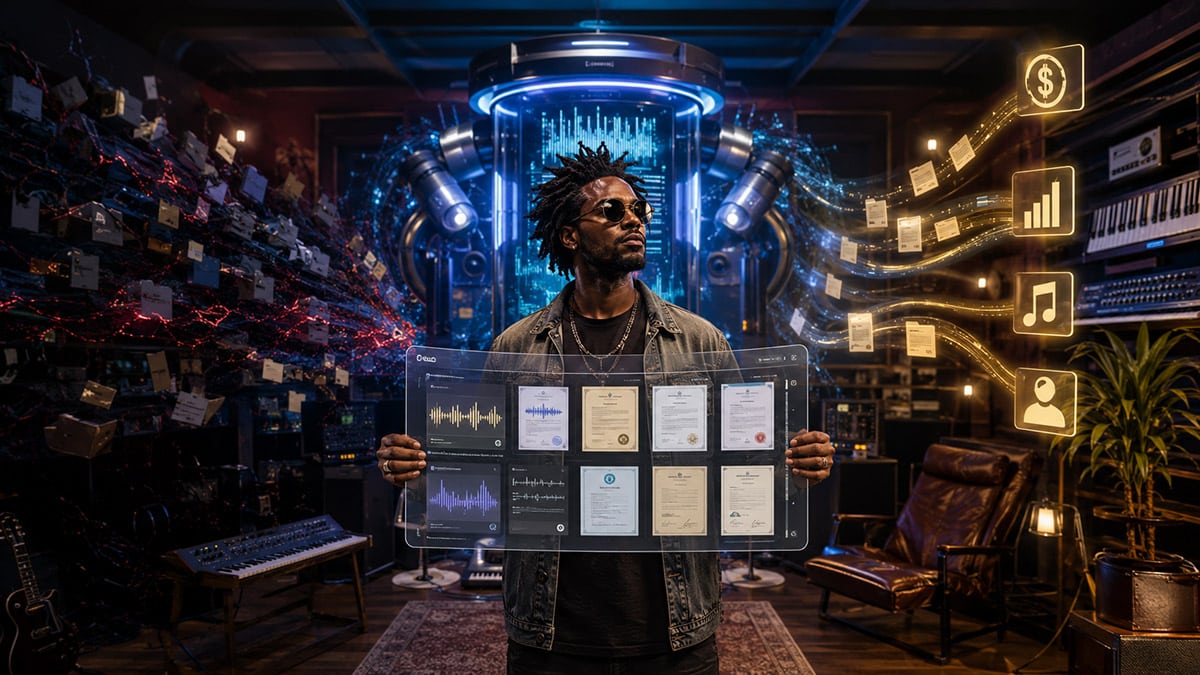
Making a Scene Presents – The AI Copyright Fight Will Be Won by Whoever Has the Best Records
Listen to the Podcast Discussion
Sony’s New Lawsuit Comes With a Very Long Song List
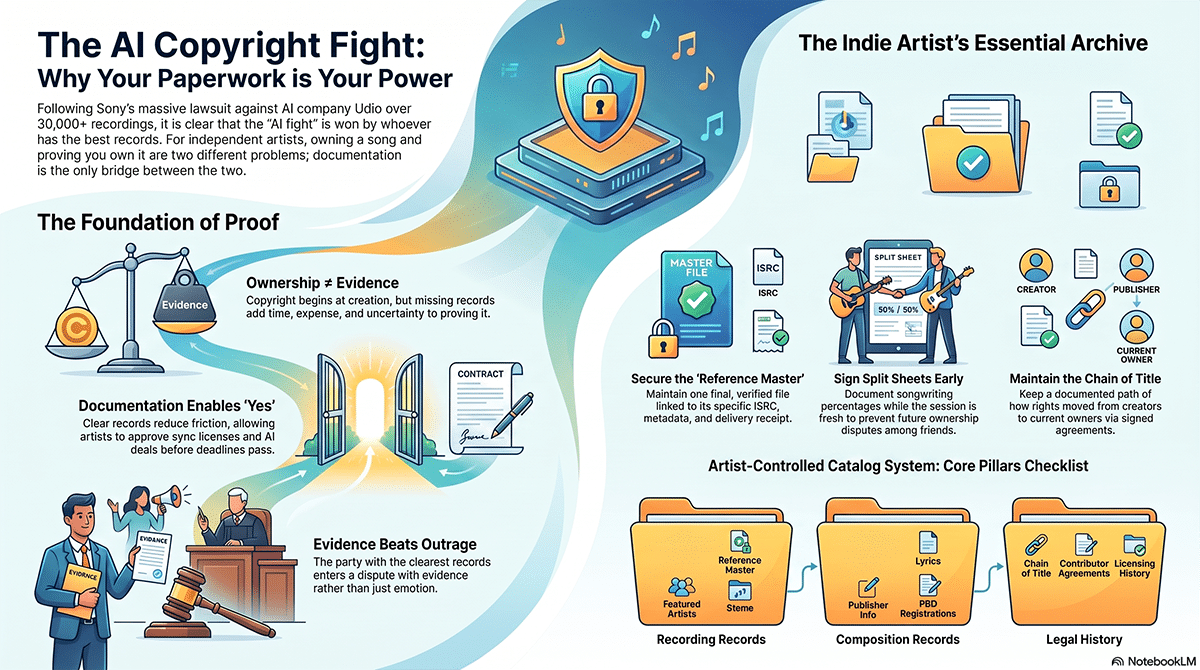
Sony Music Entertainment filed another federal lawsuit against AI music company Udio on July 20, 2026. This time, Sony’s complaint concerns more than 30,000 sound recordings that it claims were copied and used in connection with Udio’s generative AI models without permission.
That is an enormous number of recordings. It is large enough to make the average independent artist stare at their own hard drive, notice three folders named “Old Masters,” and quietly close the laptop.
Sony had previously attempted to add 30,442 recordings to the lawsuit it originally brought against Udio in 2024. On July 2, 2026, U.S. District Judge Alvin K. Hellerstein denied that request, leaving the earlier case focused on 333 works that remained in the original action. Sony responded by filing a separate lawsuit covering the additional recordings.
Sony says it found the additional works after gaining access to information about Udio’s training data during legal discovery. According to Sony’s allegations, it then used audio-fingerprinting technology to compare that information with recordings in its catalog.
Those words matter: according to Sony’s allegations.
A lawsuit is not a final judgment. A complaint explains what one side claims happened and what that side wants the court to do about it. Sony has not yet received a final ruling establishing that Udio infringed every recording named in the new complaint. Udio will have opportunities to respond, challenge the claims, raise defenses, question the evidence, and present its own legal arguments.
That distinction may feel like lawyer language, but it is important. An accusation is not the same as evidence. Evidence is not always the same as proof. And a technical match is not automatically the same as a legal finding of copyright infringement.
Still, Sony’s new case offers independent artists a lesson that reaches far beyond Udio, AI training, or the major labels.
The lesson is that the person with the clearest records enters the fight carrying something more useful than outrage.
They enter carrying evidence.
The Major Labels Are Taking Different Roads
The major record companies are no longer following one shared path in their dealings with Udio.
Universal Music Group announced on October 30, 2025, that it had settled its copyright litigation with Udio and entered strategic agreements to develop a licensed AI music creation platform. Universal described the arrangement as one designed to use authorized and licensed music while creating new commercial opportunities. Its announcement is available at https://www.universalmusic.com/universal-music-group-and-udio-announce-udios-first-strategic-agreements-for-new-licensed-ai-music-creation-platform/.
Warner Music Group announced a similar change in direction on November 19, 2025. Warner said its agreement resolved its copyright infringement litigation with Udio and established a framework for a licensed music creation service expected to launch in 2026. Warner’s announcement is available at https://www.wmg.com/news/warner-music-group-and-udio-collaborate-to-build-a-new-licensed-music-creation-service.
Sony has continued its legal action rather than announcing a comparable Udio settlement.
That does not automatically mean one company is defending artists while another is surrendering. It also does not mean a settlement is always good, a lawsuit is always bad, or every licensed AI relationship will benefit every performer, producer, or songwriter whose work may be involved.
In fact, the American Federation of Musicians filed a separate lawsuit in June 2026 against Warner and Universal. The union alleges that the labels’ AI licensing arrangements violated obligations owed to musicians whose performances appear on the recordings. Warner and Universal dispute the broader criticism of their conduct, and that case also remains an unresolved legal dispute rather than a proven conclusion.
The larger point is that different rights holders can choose different strategies. One company may litigate. Another may settle. A third may negotiate a license while keeping certain claims alive. A fourth may decide that its rights are too unclear to do any of those things confidently.
Every one of those roads begins at the same place.
The rights holder must know what it owns.
The Indie Lesson Is Hiding in the Paperwork
The Sony lawsuit will naturally produce headlines about billions of dollars, famous recordings, AI training, technology companies, and armies of attorneys billing in six-minute increments.
The indie lesson is quieter.
Sony can use catalog databases, copyright registrations, ownership records, audio-recognition systems, discovery requests, internal staff, outside experts, and experienced legal teams to investigate thousands of recordings.
Most independent artists cannot.
An indie artist probably does not have a fingerprinting laboratory down the hall from the merch closet. The tour manager is unlikely to double as a forensic data scientist. The drummer may know a surprising amount about conspiracy podcasts, but that is not quite the same thing.
Independent artists can still build the foundation required to protect their work.
That foundation is a clear record of what was created, who participated, which rights exist, who controls those rights, what was registered, what was licensed, and what permission was never granted.
The coming AI copyright fight will not be won merely by whoever feels most wronged. It will often be shaped by whoever can identify the work, connect it to the correct owner, document the history of the rights, show what was authorized, and explain what was not authorized.
Ownership without documentation can become little more than an argument waiting for a place to happen.
That place might be a courtroom. It could also be a publisher’s office, a distributor’s support desk, a film clearance department, a royalty administrator’s claim system, or an uncomfortable group text with a bass player who left the band nine years ago.
Owning Music and Proving It Are Different Problems
Copyright protection generally begins when an original work is created and fixed in a tangible form. The U.S. Copyright Office explains this basic principle at https://www.copyright.gov/what-is-copyright/.
That means a songwriter does not need to wait for a government certificate before the song can receive copyright protection. A recording can also receive protection when it is fixed in a recorded form.
But owning a right and being able to demonstrate that ownership to another person are not exactly the same problem.
An artist may honestly own the master while having no written agreement explaining how that ownership was established. A songwriter may own half of a composition while the performing-rights database shows the wrong percentage. A producer may have been promised three royalty points through a series of messages now trapped inside a broken phone.
The law may still recognize a valid ownership interest. The artist’s problem is that every missing record adds time, uncertainty, and expense to the process of proving it.
That uncertainty can cost money long before anyone considers filing a lawsuit.
A music supervisor may pass on a song because ownership cannot be cleared before the production deadline. A publisher may hold income while conflicting claims are investigated. A distributor may reject a correction because the artist cannot provide enough supporting information. A buyer may reduce the value of a catalog because several songs carry unresolved ownership questions.
The song can be wonderful and the records can still be terrible.
Sadly, the guitar solo does not repair the paperwork.
What Audio Fingerprinting Actually Does
Audio fingerprinting sounds like a machine dusting a recording for tiny digital thumbprints. That picture is not entirely accurate, although it would make a fine television show.
An audio fingerprint is a compact digital description made from characteristics found in a sound recording. It is not simply another full copy of the song. A fingerprinting system analyzes parts of the audio and produces data that can be compared with fingerprints made from other audio.
Different systems may examine different characteristics. They can look for patterns involving frequency, timing, rhythm, spectral information, or relationships between prominent sounds. The purpose is often to recognize a recording without needing to compare two files byte for byte.
This matters because the audio heard online may not be identical to the original file. It may have been compressed, shortened, shifted in pitch, changed in speed, placed under dialogue, mixed with other audio, or recorded from speakers in a room.
A good fingerprinting system may still find enough matching characteristics to flag the recording as a possible match.
The word “possible” belongs in that sentence.
Fingerprinting systems have limitations. They can produce false matches, miss altered recordings, or return uncertain results. Their performance depends on the technology, the quality of the source audio, the type of changes made to the recording, and the standards used to decide what counts as a match.
A fingerprint match can be a useful investigative lead. It does not automatically prove ownership, copying, lack of permission, or legal liability.
The system might identify the sound, but it cannot independently explain who owns the master, whether the composition was licensed, whether a distributor granted certain rights, or whether a legal defense applies.
Technology can point toward the door. Evidence and legal analysis still have to walk through it.
A Fingerprint Is Not an ISRC
An audio fingerprint is also different from an ISRC.
The International Standard Recording Code is an identifier assigned to a specific sound recording. A studio version, live version, remix, and remaster may each require separate treatment because they are distinct recordings.
An ISRC is attached to the identity and administration of a recording. A fingerprint is calculated from characteristics within the audio.
The difference is similar to the difference between a license plate and the physical details of the vehicle. The plate helps identify the registered vehicle. The physical details can help recognize the vehicle even when the plate is not visible.
Neither one tells the entire ownership story.
An ISRC does not, by itself, prove who currently owns a master. Incorrect information can be entered into a distributor’s system. Rights can also be assigned or transferred after the identifier is issued.
An audio fingerprint may recognize a recording but will not reveal every songwriter, producer agreement, publishing share, license, or ownership transfer connected to it.
Indie artists need both accurate identifiers and accurate rights records. One without the other leaves a hole in the story.
Every Release Needs a Verified Reference Master
Every commercially released recording should have one clearly identified reference master.
This is the exact final file approved for release. It should be the file delivered to the distributor, label, manufacturer, or other release partner.
That file should be connected to the official title, version name, duration, file format, sample rate, bit depth, release date, ISRC, artist name, featured performers, credits, artwork, distributor, delivery confirmation, and any other information needed to identify the release.
This sounds simple until someone opens the master folder.
Inside are files named “Song_Final.wav,” “Song_Final2.wav,” “Song_NewFinal.wav,” and “Song_REAL_FINAL_USE_THIS.wav.”
There may also be one called “Song_REAL_FINAL_USE_THIS_v3_FIXED.wav,” which is how the hard drive announces that everyone involved stopped believing in language.
The joke becomes less funny when the artist needs to prove which file was released.
Suppose an artist finds audio online that appears to contain part of their recording. The artist compares it with “Song_Final.wav,” only to discover that this file was an earlier mix with a different vocal edit. The commercially released master may be on another drive, in a producer’s archive, or inside an old distributor account.
Now the first stage of investigating the possible use becomes a scavenger hunt.
A reference master solves part of that problem. It gives the artist a known point of comparison.
It also improves licensing. When a film editor asks for the approved instrumental, the artist can provide the correct version instead of sending three files and the hopeful message, “I think it is one of these.”
The Catalog Is Usually Bigger Than the Album
A released album is rarely one neat set of finished songs.
There may be original masters, instrumentals, clean versions, radio edits, alternate mixes, acoustic versions, live recordings, remixes, remasters, television mixes, and performance tracks.
Each version can have a different business history.
A remix may involve a new producer who owns a share of that version or receives a royalty. A live recording may include venue or broadcast permissions. A remaster may be controlled under an agreement different from the original release. An instrumental may be the most useful version for sync licensing even though fans have never heard it.
These files should be clearly separated and labeled.
That does not mean preserving every temporary bounce created at 2:14 in the morning while someone debated whether the tambourine was emotionally ready.
Artists should preserve the versions that have lasting creative, legal, or commercial importance.
The approved master matters. The instrumental matters. The clean version matters when it is distributed or offered for licensing. Important alternate mixes and remixes matter. Source sessions and stems matter when they can support future work.
The goal is not to preserve clutter. It is to preserve history.
Timestamps Help Build a Timeline
Dated records can help show when a work was created, revised, delivered, registered, or released.
Useful records may include session folders, cloud revision histories, emails, studio calendars, invoices, distributor receipts, registration confirmations, publishing records, signed agreements, and dated exports.
No single timestamp should be treated as a magical ownership certificate.
File dates can change during copying, migration, restoration, or export. An email may show that a person sent a recording on a certain day, but it may not explain who wrote the song or who financed the master.
A dated invoice may show that studio work took place. It does not automatically tell the court whether the engineer owns part of the recording.
Timestamps become powerful when several independent records tell the same basic story.
A voice memo shows the early song. A calendar shows the writing session. Messages identify the co-writers. The split sheet records the agreed percentages. Studio records document the recording dates. The final master is linked to a distributor delivery receipt. Registration records confirm what was filed.
Together, those pieces form a believable timeline.
A strong rights record is rarely one perfect document. It is usually a group of consistent documents that support one another.
Session Files Preserve the Creative History
Recording sessions can document how a master was built.
A complete archive might contain original audio, vocal takes, MIDI performances, edits, production notes, track sheets, photographs, studio logs, engineer notes, and dated mix exports.
These materials can help answer useful questions. Who recorded the lead guitar? When was the vocal replaced? Which mix became the master? Did the featured artist appear on the commercially released version? Was a disputed sound already present in an early session?
Session files should remain in their original format when possible, with copies of important exported audio stored in widely supported formats.
Artists should also remember that software changes. A session created with an old DAW, plugin, or operating system may not open correctly years later. Printing important virtual instruments, preserving raw audio, saving consolidated tracks, and storing session notes can make the archive more useful.
Possessing the session does not automatically mean possessing the copyright.
An engineer may hold the files because the recording happened at their studio. A producer may have created the session while working under an agreement with the artist. A band member may have taken the project home to edit drums.
The files document creative activity. Agreements explain the rights.
You need both.
Songwriting Records Tell a Different Part of the Story
The recording is one asset. The song underneath it is another.
Songwriting records may include lyric drafts, melody demos, voice memos, chord sheets, writing notes, text conversations, split sheets, publishing registrations, performing-rights registrations, mechanical-rights records, and copyright registrations.
Each record serves a different purpose.
A lyric draft can help show how the words developed. A voice memo may capture an early melody. Writing-session notes may identify who contributed. A split sheet records the writers and their agreed ownership percentages.
A performing-rights registration helps connect a composition to the writers and publishers entitled to certain public-performance royalties. Mechanical-rights records help identify compositions when certain reproductions or digital uses generate mechanical royalties.
No single database should become the artist’s only source of truth.
Information can be entered incorrectly. Registrations can conflict. Names may appear in different forms. A writer may change publishers. An administrator may control a share for a limited period.
The artist-controlled record should explain what is correct and contain the documents needed to support it.
Split Sheets Should Arrive Before the Money
A split sheet is a written record of who wrote the song and what percentage of the composition each writer owns.
This agreement should be completed while the writing session is still fresh.
That is when everyone remembers who brought the chorus, who changed the melody, who rewrote the second verse, and whether the person making sandwiches actually contributed to the bridge.
Five years later, memory becomes a less reliable witness.
The sync offer arrives. A publisher asks for confirmation. An AI company proposes a license. Suddenly, four people remember the writing session in four creatively different ways.
This is often the point where someone says, “But we were all friends.”
Exactly.
Clear split sheets protect friendships because they prevent money from forcing friends to reconstruct old decisions under pressure.
A songwriting split sheet should not be confused with master ownership. The people who wrote the song may be different from the person or company that owns the recording.
The singer may own the master while sharing the composition with two co-writers. A label may own or control the master while the writers retain their publishing interests.
Without that distinction, an artist may accidentally offer rights they do not control.
The Song and the Recording Are Separate Assets
Imagine that a songwriter writes a song called “Long Road Home.”
The melody, lyrics, and underlying musical structure make up the composition.
The songwriter records a studio version with a full band. That particular recorded performance becomes a sound recording, often called the master.
Another artist later records a stripped-down acoustic cover. The cover is a different master, but it uses the same underlying composition.
A filmmaker who wants to use the original studio recording may need permission involving both the composition and that specific master.
A filmmaker who wants to create a new recording may still need permission involving the composition, but not the original master.
AI licensing can create similar layers.
A proposed deal might seek access to sound recordings, compositions, lyrics, stems, vocal performances, or several of those assets together.
The person signing the agreement must know which rights they control.
“I made the record” is not always a complete answer.
Chain of Title Is the Ownership Story
Chain of title sounds like something stored in a castle, possibly guarded by a minor character from a fantasy novel.
It is simply the documented path showing how rights moved from the original creator or owner to the person or company claiming control today.
The path may include band agreements, producer agreements, musician releases, featured-artist releases, label contracts, publishing agreements, copyright assignments, sample clearances, distribution agreements, business sales, or estate documents.
Suppose a band originally owned a master together. The members later assigned the master to their company. The company licensed it to a label for ten years. After the license ended, control returned to the company. The company was later dissolved, and the rights were assigned back to the members.
Every step matters.
A current owner who cannot document the earlier transfers may face trouble proving that the rights arrived legally and completely.
That is why a buyer reviews chain of title before purchasing a catalog. The buyer is not merely purchasing audio files. The buyer is purchasing whatever rights the seller can legally transfer.
Missing documents turn confidence into risk.
Risk usually turns into a lower offer.
Paying Someone Does Not Automatically Settle Everything
Artists often believe that paying a collaborator automatically gives them every right connected to the contribution.
The law is not always that simple.
“Work made for hire” has a specific meaning under U.S. copyright law. Its application can depend on the working relationship, the type of contribution, and whether the required conditions were established in a valid written agreement.
A payment receipt shows that money changed hands. It does not necessarily resolve copyright ownership, royalty participation, reuse, approval rights, or credit.
An artist should get qualified legal advice when an agreement depends on work-made-for-hire language, copyright transfers, publishing ownership, master ownership, or long-term control of creative work.
That does not mean every club recording requires a twenty-page contract delivered by horseback.
It means the important rights should be addressed clearly before everyone relies on assumptions.
Assumptions are inexpensive at the beginning and remarkably costly at the end.
Collaborators Are Not the Enemy
Former band members, producers, engineers, session players, beatmakers, photographers, featured vocalists, co-writers, managers, and designers can all become part of a documentation problem.
That does not make them villains.
Most disputes begin with different expectations rather than secret evil plans.
The artist may believe a producer received a flat fee. The producer may believe that fee was an advance against future royalties. A guitarist may believe a riff earned a songwriting share. The songwriter may view it as part of the arrangement.
A featured vocalist may believe the artist promised approval over future uses. The artist may remember agreeing only to a credit.
Written agreements make those expectations visible while people are still working together.
Clear agreements are not an insult to trust. They are a tool for preserving it.
The goal is not to turn the control room into a courtroom. It is to avoid using a courtroom years later to explain what happened in the control room.
The Band With the Mystery Hard Drive
Consider an independent band that recorded an album eight years ago.
The album was successful enough to build a loyal regional following. It still receives streams, sells a few vinyl copies, and occasionally attracts licensing interest.
The business records are another story.
The final band agreement is stored in the email account of a guitarist who left six years ago. Nobody remembers the password, including the guitarist.
The producer’s royalty was discussed through text messages. One member remembers three points. Another remembers five. The producer remembers that everyone agreed to “something fair,” which is a lovely phrase and a terrible accounting method.
Several songs have no signed split sheets. The distributor lists the singer as the sole writer of one song that was actually co-written with the bass player.
The only complete recording session is on the drummer’s old external drive. The drummer believes the drive is “probably in the garage.”
Then three things happen.
A television production wants one song for an episode airing in six weeks. An AI company approaches the band about including parts of the catalog in a licensed project. At the same time, a fan sends the band a link to generated audio that appears to contain a familiar vocal passage.
The band should be looking at three opportunities to protect or earn money.
Instead, it is looking for the drummer’s garage key.
The sync placement slows down because the supervisor cannot confirm composition ownership. The AI offer cannot be evaluated because the band cannot say whether every necessary rights holder has approved the deal.
The possible unauthorized use is difficult to investigate because nobody can immediately locate the exact master, instrumental, or session source.
None of these problems began with AI.
They began years earlier when the band treated business records as something to handle later.
Later has now arrived, and it brought a deadline.
The Organized Indie Artist Has an Advantage
Now consider an independent artist with a smaller catalog.
The artist has released two albums and several singles. Nothing has gone platinum. There is no corporate legal department, private jet, or emergency conference room filled with people saying “circle back.”
The artist does have a verified reference master for every release.
The compositions are connected to signed split sheets. Contributor agreements are stored beside the appropriate sessions. Copyright and publishing registration confirmations are saved. Release metadata, ISRCs, artwork, lyric files, stems, and distributor receipts are organized by project.
Important files exist in more than one location.
When a licensing company asks about a track, the artist can identify the master and composition owners quickly.
When a publisher notices conflicting information, the artist can provide the correct split sheet.
When an attorney investigates a suspected unauthorized use, the artist can deliver the official master, dated sessions, release history, and agreements without spending two weeks searching through old messages.
This artist does not have Sony’s resources.
The artist has something more realistic and immediately useful: readiness.
Organization does not make the music better. It makes the music easier to license, easier to administer, easier to value, and easier to pay.
That is a competitive advantage.
Copyright Ownership and Registration Are Related but Different
The U.S. Copyright Office states that copyright protection begins when an original work is fixed in a tangible form. Registration is a separate process. The Office provides registration information at https://www.copyright.gov/registration/ and general copyright education at https://www.copyright.gov/.
Registration can provide important legal benefits.
For U.S. works, registration is generally required before a copyright owner can bring an infringement action in federal court. The timing of registration may also affect whether certain remedies, including statutory damages and attorney’s fees, may be available.
Those rules contain details, exceptions, and deadlines that should not be reduced to a clever slogan. Artists should review current information from the Copyright Office and consult an experienced attorney when a dispute or major transaction is involved.
Registration does not prevent copying.
It does not place a force field around a song. It does not guarantee victory in court. It does not repair an incorrect split or prove that every contributor transferred their rights.
It creates an official record and may strengthen the owner’s legal position.
That makes it part of a larger documentation system, not a replacement for one.
Good Records Create Revenue Before They Prevent Lawsuits
Catalog records are not valuable only when something goes wrong.
They make legitimate deals easier to complete.
A music supervisor working on a television show may need a song cleared quickly. The supervisor must know who controls the master and composition.
When an artist can provide that information immediately, the song remains a practical option. When the ownership is unclear, the production may choose another song.
The second song is not always better.
It is sometimes simply easier to clear.
Publishing administration also depends on correct information. Titles, writer names, ownership percentages, identifiers, publishers, recordings, and release data help administrators match uses with the proper works.
Mechanical royalties, performance royalties, neighboring-rights income, producer royalties, master-use fees, and international collections all rely on records.
Strong records do not guarantee that every royalty will arrive correctly. The music business has spent decades proving that it can misplace money even when everyone brought a map.
Good records allow the artist to identify errors, support claims, correct registrations, and show why a payment belongs to them.
The better the records, the easier it becomes to follow the money.
Clean Catalogs Are Easier to Value and Transfer
A music catalog can become a long-term business asset.
It may earn from streaming, direct sales, publishing, sync licensing, public performance, neighboring rights, physical products, samples, remixes, and new forms of authorized technology use.
A buyer or licensing partner will want to know whether the seller controls the rights being offered.
That review may involve agreements, royalty statements, registration records, licenses, contributor obligations, active disputes, samples, and chain of title.
A catalog with unclear ownership creates uncertainty.
The buyer may reduce the offer, exclude songs, demand stronger guarantees, delay the deal, or leave.
Music can be emotionally priceless to its creator while being commercially difficult to value.
A clean catalog allows the business side of the music to be examined. The buyer can see which rights exist, how income is produced, which obligations remain, and whether the seller has authority to complete the transaction.
Documentation turns a pile of recordings into a business asset someone can understand.
AI Licensing Requires Real Permission
AI licensing adds another reason to understand the catalog.
An artist cannot grant meaningful permission without knowing what the artist controls.
A proposed agreement might cover master recordings, compositions, lyrics, voices, likenesses, stems, metadata, session files, or generated outputs.
It might permit training, fine-tuning, retrieval, voice simulation, remixing, or other defined uses.
Those terms are not interchangeable.
Giving permission to analyze a master is not automatically the same as giving permission to create a digital replica of the singer’s voice.
Licensing lyrics does not necessarily grant rights in the master. Licensing the master does not automatically resolve every songwriter’s publishing interest.
Artists should seek clear definitions of the materials and uses involved. They should understand the duration, territories, payment terms, attribution rules, sublicensing rights, retention practices, withdrawal procedures, reporting duties, and audit provisions.
Major AI agreements deserve review from an experienced music attorney.
The artist’s job is not to memorize every possible legal clause. The artist’s first job is to know which assets exist and who has authority over them.
Good records make that conversation possible.
Permission Records Matter After the Contract Is Signed
Artists also need to remember what they have already licensed.
A permission record should connect each agreement with the correct song, master, composition, lyric, stem, vocal, image, or other asset.
It should explain who received permission, what the recipient may do, how long the permission lasts, where it applies, what payment is required, and which restrictions remain.
This becomes especially important when contracts accumulate.
An artist may see a recording used in a new product and assume it was unauthorized. A search of the permission history may reveal that a distributor, label, publisher, library, or other partner has an applicable agreement.
The opposite problem can also occur. An artist may assume an older contract covers a new AI use when the language never addressed that use.
A folder full of contracts is not a complete permission system.
The artist must be able to connect each agreement with the assets it affects.
Otherwise, the artist owns a library of legal documents and no practical way to understand them.
Lyrics Need Their Own Records
Lyrics are part of the musical composition, not simply a decoration attached to the master.
They may be reproduced, displayed, licensed, processed, or analyzed separately from a commercial sound recording.
An AI system could process lyric text without using the official master. A website could display lyrics without streaming the recording. A book, film, or merchandise product might seek permission to reproduce part of a lyric.
Artists should preserve final approved lyrics, earlier drafts when important, writer information, publishing ownership, registration details, and records of authorized uses.
They should also avoid assuming that every title, short phrase, common expression, mood, or style is protected in the same way as a complete original lyric.
Copyright protects original expression, but it does not grant one artist ownership over every general idea, emotional theme, genre, or familiar phrase.
Good records help identify what was actually created.
They do not turn ordinary language into private property.
Stems Can Create Revenue and Risk
Stems are grouped elements from a recording, such as drums, guitars, keyboards, lead vocals, or background vocals.
They can be commercially valuable.
A music supervisor may need an instrumental or a mix without lead vocals. A remixer may need separate groups of instruments. A live show may use prepared playback. An immersive audio project may require access to original elements.
Licensed AI tools may also seek access to stems because separated elements can be more useful than a finished stereo master.
That usefulness creates risk.
When stems are sent without clear terms, artists may lose track of who has them and what they are allowed to do.
Each stem archive should be labeled and connected to the correct master, session, version, contributors, and permissions. The artist should preserve clean original copies and keep reasonable records of important deliveries.
Stems can open doors to new revenue.
They should not be tossed through every open window.
Backups Are Part of Rights Protection
A catalog archive that exists on one hard drive is not secure.
Hard drives fail. Laptops disappear. Cloud accounts become inaccessible. Studios flood. Buildings burn. Former band members stop returning messages.
Important files should exist in more than one location, with at least one copy separated from the primary working system.
That might include a local working drive, a separate backup drive, and secure cloud or off-site storage.
Artists should periodically test the backups.
A backup that cannot be opened is not a backup. It is an expensive decorative object.
Old sessions may depend on software, plugins, licenses, and operating systems that no longer exist. Preserving consolidated audio, exported stems, final masters, MIDI files, notes, and original session folders can improve the chance that the work remains usable.
Preserving file formats matters, but so does preserving context. Ten perfectly stored audio files named “Audio_01” through “Audio_10” may survive for decades while explaining absolutely nothing.
A Hash Can Show Whether a File Changed
A cryptographic hash is a calculated digital value produced from a file.
When the file changes, even slightly, the hash will usually change too.
This can help an artist confirm that two files are identical or that an archived master has not been altered since its hash was recorded.
Hashes can be useful in catalog management, delivery verification, and evidence preservation.
They are not ownership machines.
A matching hash does not prove who created the file, who owns the copyright, or when the file first existed. Someone can calculate a hash for a file they do not own.
A hash helps demonstrate file integrity.
It answers the question, “Is this the same file?”
It does not automatically answer, “Who owns it?”
Blockchain Records Are Evidence, Not Magic
Blockchain systems can add another layer to catalog documentation.
An artist might use a blockchain record to show that certain data was associated with a wallet or recorded at a particular time. Verifiable credentials could help connect identities, permissions, and asset information across services.
That can be useful.
It is not magic.
A blockchain cannot make incorrect information accurate. It cannot resolve a disputed songwriting split merely because one person entered a percentage first. It cannot replace a signed agreement or repair a broken chain of title.
Bad information stored permanently remains bad information. It is simply bad information wearing a futuristic hat.
The practical value of Web3 lies in portability, transparency, and verification.
Artists may benefit from identities, permissions, rights metadata, and licensing histories that can move between services instead of remaining trapped inside one company’s private database.
The source records still matter.
Technology should strengthen the artist’s evidence, not distract from its absence.
AI Can Organize Records but Should Not Invent Them
AI tools can help artists manage catalog information.
They may extract titles from file names, compare spreadsheets, identify empty fields, standardize naming patterns, summarize agreements for human review, locate likely duplicates, and flag conflicting metadata.
An AI system could notice that one spreadsheet lists a songwriter at 25 percent while another shows 50 percent.
That is useful.
The AI should not decide which number is legally correct.
It should flag the conflict and direct the artist toward the supporting agreements.
AI should not guess ownership, invent contributors, create signatures, decide whether a contract is enforceable, file unreviewed copyright claims, or treat a possible audio match as proof of infringement.
The machine can help clean the office.
It should not become the unsupervised lawyer, publisher, accountant, witness, judge, and extremely confident intern.
Human review remains essential.
What an Artist-Controlled Catalog System Should Contain
An artist-controlled catalog system should connect each sound recording with the composition underneath it.
The recording record should identify the title, version, featured artists, master owner, release date, ISRC, duration, format, distributor, reference master, alternate versions, artwork, credits, sessions, stems, fingerprints when available, file hashes, and backup locations.
The composition record should identify the title, writers, ownership percentages, publishers, administrators, performing-rights registrations, mechanical-rights information, lyric files, split sheets, copyright records, and recordings connected to the song.
The contributor record should explain who performed, produced, engineered, mixed, mastered, photographed, designed, or otherwise contributed. Relevant agreements should be connected to the correct project.
The licensing history should explain where the song or recording was used, who granted permission, what rights were included, how long the agreement lasts, and where payment should arrive.
This system does not need to begin as expensive enterprise software.
It can begin with organized folders, secure storage, consistent naming, and a carefully maintained spreadsheet.
The essential rule is that the artist controls a useful copy and can export it.
A platform should not become the only keeper of the artist’s business memory.
Catalog Ownership and Fan Ownership Belong Together
Catalog records and fan records serve different purposes, but they support the same goal.
The catalog system tells the artist what creative assets exist, who owns them, who must be paid, and what can be licensed.
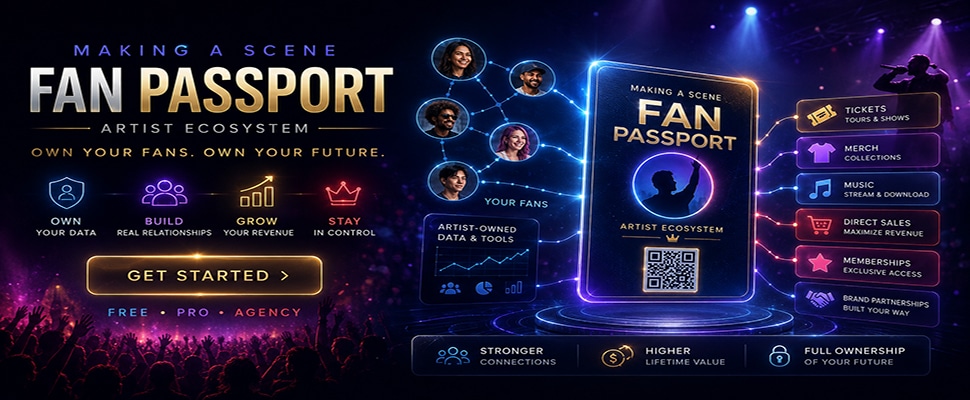
An artist-owned CRM and Fan Passport system tell the artist which fans have chosen a direct relationship, what communication permissions they granted, and how the artist can continue serving those fans outside a social or streaming platform.
One system protects the music business from ownership confusion.
The other protects the audience relationship from platform dependency.
Together, they create durable infrastructure.
A streaming service can introduce a listener. A social network can spread a video. A distributor can deliver music. An AI platform can create a new licensing opportunity.
None of those companies should become the only place where the artist’s assets, evidence, or relationships live.
Platforms change rules. Companies merge. Features disappear. Accounts get suspended. Services close.
The artist needs a business that can travel.
Good Records Help Artists Say Yes
Catalog organization is not only defensive.
It helps artists say yes.
A licensing request arrives, and the artist can respond before the deadline.
A publisher finds missing income, and the artist can provide the registrations and splits needed to support a claim.
A filmmaker wants the instrumental, and the correct file is ready.
An AI company proposes a license, and the artist can identify exactly which rights are available for negotiation.
An estate can continue collecting revenue because heirs and representatives know where the assets and agreements are stored.
A buyer can evaluate the catalog because the ownership history is understandable.
Good records reduce friction.
They let opportunity move toward payment instead of getting stuck in an email chain titled “Does Anyone Remember Who Owns This?”
The Goal Is Not to Become a Bureaucracy
Most musicians did not begin making music because they dreamed of spending Saturday night renaming folders.
Catalog management should not become a giant administrative machine that prevents the artist from creating.
The best system captures information when it is easiest to obtain.
Splits are recorded when the song is written. Contributor terms are handled before files are widely shared. Metadata is checked before delivery. The reference master is archived when approved. Registration confirmations are saved when received. Licenses are connected to the assets they cover.
Small habits prevent large repairs.
Ten minutes spent organizing the final master today may save ten days of confusion years later.
The goal is not paperwork for its own sake.
The goal is a working music business.
The Paperwork Is Part of the Music Business
Sony’s lawsuit against Udio does not mean every independent artist needs a billion-dollar legal department, a private fingerprinting system, or a team of attorneys waiting beside the rehearsal room.
The deeper lesson is that rights enforcement begins long before anyone enters a courtroom.
It begins when the song is written and the writers agree on their shares.
It continues when the session is recorded, the contributors understand their roles, the final master is approved, the metadata is checked, the agreements are signed, and the evidence is stored somewhere the artist can actually find it.
Strong records will not prevent every unauthorized use.
They will not guarantee that an artist wins a lawsuit. They will not force every platform, label, publisher, distributor, or AI company to behave fairly.
They give the artist a foundation from which to act.
An artist with clean records is better prepared to consult an attorney, question an unauthorized use, correct a royalty error, negotiate an AI license, complete a sync placement, transfer a catalog, administer publishing, protect an estate, or prove the authority to make a deal.
That is where this story connects directly to the Making a Scene philosophy.
The independent music business should not be built on artists renting temporary access to their own careers from labels, streaming services, social networks, distributors, or AI companies.
It should be built on artists controlling the assets that make a career possible.
Those assets include the masters, compositions, metadata, agreements, registrations, licensing histories, business records, and direct fan relationships.
A streaming service may create discovery. Discovery is valuable, but discovery is not ownership.
A social platform may create attention. Attention is useful, but attention is not a customer relationship.
An AI service may create a new revenue opportunity. Opportunity matters, but opportunity without clear rights can become another deal the artist is unable to complete.
An artist-owned catalog system and an artist-owned fan system form two sides of the same independent business.
One answers, “What do we own?”
The other answers, “Who has chosen to stay connected with us?”
Together, they help the artist build revenue through live shows, merchandise, direct music sales, licensing, publishing, memberships, fan support, and carefully chosen technology partnerships.
That is how we begin building a music industry middle class.
It will not be built through one viral video, one streaming playlist, one AI deal, or one lucky contract.
It will be built by artists owning the parts of their businesses that continue producing value after the attention moves somewhere else.
Catalog cleanup may look like boring office work. It is not separate from the creative life.
It is how creative labor becomes a durable, licensable, transferable, and income-producing asset.
The artist with the best records is not automatically the artist with the largest audience, the biggest budget, or the fanciest attorney.
That artist is simply better prepared.
Better prepared to protect what was created.
Better prepared to collect what is owed.
Better prepared to recognize a fair deal.
Better prepared to walk away from a bad one.
The future of music will include AI systems, new licensing models, portable identities, verifiable permissions, direct fan networks, and tools nobody has invented yet.
Artists cannot control every change.
They can control whether they know what they own.
They can control whether splits are written down.
They can control whether masters are labeled.
They can control whether metadata is accurate.
They can control whether agreements can be found.
They can control whether fan relationships are portable.
They can control whether the next opportunity produces income or another frantic search through a former band member’s abandoned email account.
The AI copyright fight may be argued in courtrooms, negotiated in corporate offices, and analyzed by powerful machines.
For an independent artist, the first victory is quieter.
It is the moment the artist can open a trusted system, locate the correct recording, identify every rights holder, produce the agreements, confirm the permissions, and confidently say:
This is what we own.
This is what you may use.
This is what it will cost.
That is not paperwork getting in the way of the music.
That is the artist taking control of the business the music created.
 |  Spotify |  Deezer |  Breaker |
 Pocket Cast |  Radio Public |  Stitcher |  TuneIn |
 IHeart Radio |  Mixcloud |  PlayerFM |  Amazon |
 Jiosaavn |  Gaana |  Vurbl |  Audius |
 Reason.Fm | |||
Find our Podcasts on these outlets
Subscribe to Our Newsletter
Discover more from Making A Scene!
Subscribe to get the latest posts sent to your email.


