
The Breakthrough Myth Has a Cash-Flow Problem




Making a Scene Presents – The Breakthrough Myth Has a Cash-Flow Problem
Listen to the Podcast Discussion
A viral moment can make an artist look successful. A durable mix of shows, merch, direct sales, publishing, licensing, fan support, and useful technology can help an artist stay successful. Week One of The Artist-Owned Middle Class replaces the lottery-ticket version of the music business with a system working artists can actually build.
The Music Business Still Sells Lottery Tickets
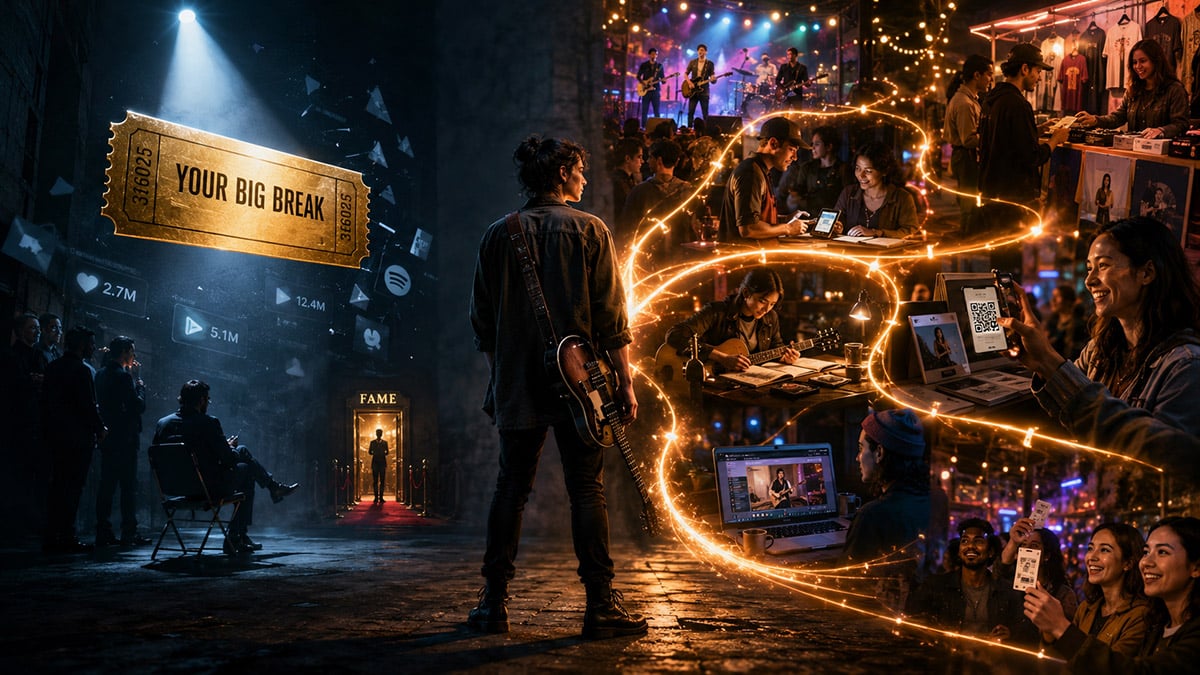
The music business loves a breakthrough story. It is simple, dramatic, and easy to sell. An unknown artist uploads a song, the right person hears it, the algorithm catches fire, the crowd arrives, and life changes before lunch. Roll the credits. Somebody call the documentary crew.
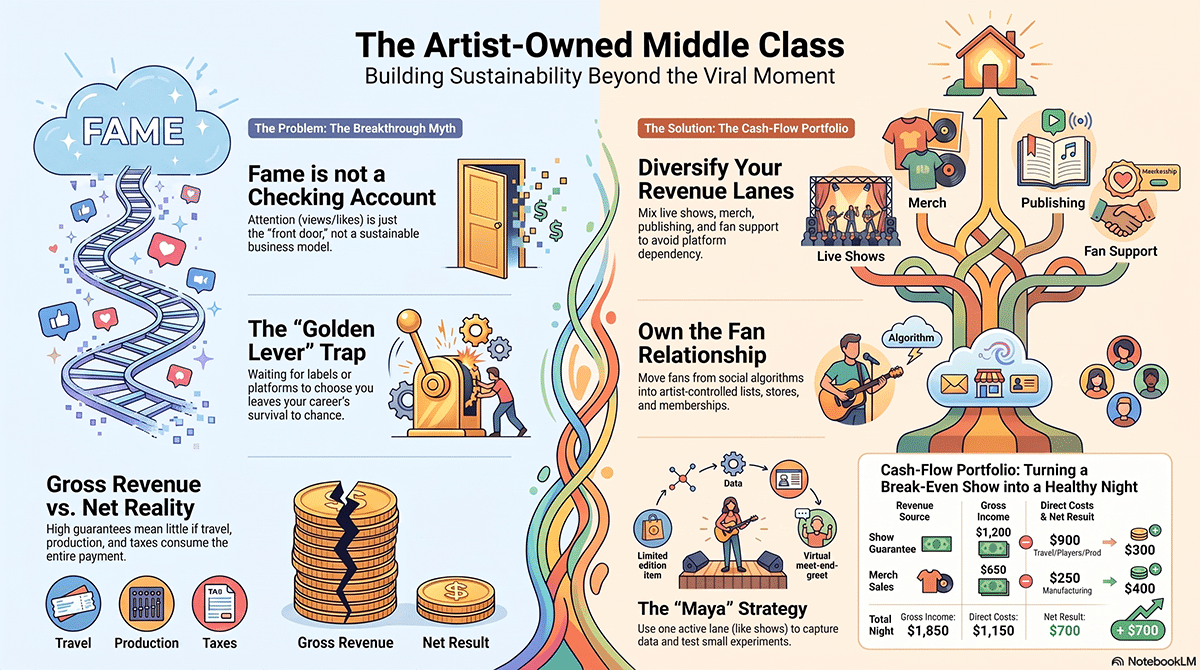
There is only one small problem with this story: it skips the part where a career has to pay its bills. Attention is not a checking account. A packed comment section cannot pay for a van repair. A playlist placement does not automatically create a merch customer. A huge view count may look wonderful in a screenshot while the artist is still moving money from a day job to cover rehearsal space.
This does not mean attention is useless. Attention is the front door. It can introduce a song, create curiosity, and give an artist a chance to start a relationship. The mistake is treating the door as the whole house. If fans enter through a social feed or streaming service and the artist has no way to bring them into an owned website, email list, direct store, show calendar, membership, or fan relationship, the crowd can disappear as quickly as it arrived.
The breakthrough myth survives because it keeps artists looking upward. The artist waits for a label, manager, promoter, playlist editor, investor, influencer, or platform to pull a golden lever. Meanwhile, the smaller levers sitting on the artist’s own desk remain untouched. Those levers may not create overnight fame, but they can create something far more useful: steady cash flow, repeat customers, useful information, and a career that does not collapse every time a platform changes its rules.
Fame and Cash Flow Are Not the Same Job
Fame answers the question, “How many people know your name?” Cash flow answers a less glamorous question: “Did enough money arrive at the right time to cover the cost of making the music business run?” The first question makes a better headline. The second one keeps the lights on.
Cash flow is the movement and timing of money coming into and going out of the business. An artist may earn a large payment and still have a cash-flow problem if most of that money was already promised to travel, musicians, production, manufacturing, advertising, taxes, or debt. Gross revenue is the total money collected. Net revenue is what remains after the direct costs are paid. Neither number tells the whole story unless the artist also knows when the money arrives and whether it can happen again.
Imagine a fictional band that receives a $1,200 show guarantee. That sounds like a strong night until $350 goes to travel, $300 goes to hired players, $150 goes to lodging, and $100 goes to small production costs. The performance leaves $300 before general business expenses and taxes. Now imagine the band also sells $650 in merch that cost $250 to make. That adds another $400 before overhead. The crowd did not get larger, but the night became much healthier because the band had more than one way to earn.
Those numbers are only an example, not an industry average. Every artist, city, genre, venue, and tour is different. The lesson is that a career cannot be understood by looking at the loudest number. A show guarantee, streaming total, crowdfunding result, or viral video may be impressive, but the working artist needs to know what remained, what was learned, who can be contacted again, and what can be repeated.
The Music Industry Middle Class Is a Condition, Not a Trophy
There is no single dollar amount that defines a music industry middle class for every artist. A solo acoustic performer has different costs from a seven-piece touring band. An artist living in a small town has a different monthly reality from an artist living in a major city. A producer who earns from sessions has a different income mix from a songwriter who earns from catalog activity.
For this series, a music industry middle class means a working condition. The artist can cover the reasonable costs of creating and presenting the work. The business produces enough margin to reinvest. Income comes from more than one source. Fan relationships can survive outside any single platform. The artist has enough control to make plans instead of living entirely from emergency to emergency.
That definition is not as flashy as “making it,” but it is more honest. Middle-class artists may still have difficult months. They may keep part-time work, teach lessons, produce other artists, or accept freelance jobs. Independence is not a costume that requires pretending everything is perfect. It is the growing ability to make choices because the business has assets, relationships, and several working revenue lanes.
The old industry often treated the middle as a waiting room. You were either an amateur waiting to be chosen or a star who had already arrived. That left little language for serious working artists who write, record, tour, teach, license, produce, sell, and build community every day. Making a Scene rejects that empty waiting room. The middle is not where a career goes to disappear. It is where a sustainable music economy can be built.
Think Like a Portfolio, Not a Jackpot
This does not mean every artist must do everything. A songwriter does not need to launch twelve merch products, start a record label, teach lessons, build a token, and open a coffee shop before breakfast. That is not a business plan. That is a nervous breakdown wearing a lanyard.
The point is to avoid depending on one fragile result. If nearly all income comes from shows, illness, travel costs, weather, or venue changes can hit hard. If nearly all income comes from one platform, a policy change can weaken the business overnight. If nearly all income comes from merch, manufacturing costs and unsold stock can lock up cash. A healthy mix gives each lane a job and keeps any single problem from becoming the whole story.
The artist’s first task is not to add endless work. It is to see the business clearly. Which lanes already produce money? Which produce attention but no relationship? Which depend on somebody else’s permission? Which could grow with the fans, songs, skills, and live moments the artist already has? That is what the Income Mix Map is designed to reveal.
Live Shows Must Build Tomorrow, Not Just Survive Tonight
But a show should not end when the last cable goes back into the case. A good night can also create merch sales, email permission, future booking proof, city-level fan knowledge, photos, video, testimonials, and a reason for the fan to return. The performance fee pays for tonight. The relationship built around the performance can help pay for the next release, the next ticket, and the next trip through town.
This is where many artists leave money and memory on the floor. They perform well, thank the crowd, sell a few shirts, and then let everyone walk away without a clear next step. A simple, permission-based path to an artist-controlled list or fan profile turns a successful show into a business asset.
The goal is not to attack the crowd with a clipboard while they are trying to enjoy the encore. The goal is to offer a fair trade. A fan might receive an unreleased recording, live download, early access, show-night reward, or useful piece of the artist’s world in exchange for permission to stay connected. The artist earns more than an email address. The artist earns the right to continue the conversation.
Merch and Direct Sales Turn Attention Into an Exchange
Merch is often treated like a logo printed on whatever object was cheapest that week. That approach can still sell a few shirts, but it misses the larger value. Good merch helps a fan carry a memory. It lets the fan say, “I was there,” “this song matters to me,” or “I belong to this little world.”
Direct digital sales give fans another choice. Some want a download they can keep. Some want a physical edition, high-quality files, liner notes, alternate mixes, stems, a live version, a songbook, or the story behind the recording. The artist-owned website can connect that offer to the music, email permission, show calendar, booking path, and follow-up. It becomes more than a digital business card. It becomes the artist’s business home.
Every direct offer should answer a simple question: why would a fan want this version, bundle, or experience? “Because the artist needs money” is honest, but it is not the whole value. The fan is not an ATM with a favorite playlist. Give the fan something meaningful, useful, collectible, personal, convenient, or memorable. Direct revenue becomes stronger when the exchange respects both sides.
Publishing and Licensing Let Songs Work in Different Rooms
A song is not only a recording placed on a listening service. It is also a composition, a set of rights, and a potential fit for many uses. Publishing income and licensing opportunities can allow the work to earn in rooms where the artist is not physically performing.
That does not mean every song will land in film, television, advertising, games, or other media. Licensing is not passive magic. Songs need accurate ownership information, clear splits, organized files, usable versions, and people who know the music exists. A great track with missing metadata and unclear ownership is not “mysterious.” It is difficult to use.
This lane begins with order. The artist should know who wrote the song, who owns the recording, what agreements exist, and where clean files, instrumentals, lyrics, and supporting information live. That work may feel less exciting than writing the next chorus, but it turns the catalog into an asset that can be searched, pitched, cleared, and paid. Old work can then help support new work instead of becoming a pile of forgotten release files.
Fan Support Should Feel Like Belonging, Not Begging
Some fans want to do more than buy one product. They want to help the artist keep creating. Direct fan support can take the form of a membership, recurring contribution, paid community, private stream, early-access club, tip, patron circle, or special event. The form matters less than the promise. What does the fan receive, how often does it arrive, and can the artist deliver it without turning every week into a content factory?
The strongest support programs are not built on guilt. They are built on closeness, access, usefulness, shared purpose, or a deeper experience of the work. A fan may value a monthly studio note more than a flood of rushed videos. A small listening session may matter more than an enormous archive nobody has time to explore. The artist should design the promise around what can be delivered consistently and honestly.
The Real Engine Is the Relationship
Revenue lanes look separate on a spreadsheet, but fans do not experience them as separate departments. The same person may hear a song, attend a show, buy a shirt, join an email list, purchase a limited recording, bring a friend, support a membership, and request a private event over several years. The relationship connects the transactions.
That is why artist-owned fan data matters. The point is not to collect everything possible about people. The point is to remember the permission a fan gave, the city they care about, the offer they chose, and the kind of communication they asked to receive. Ethical memory helps the artist send fewer, better messages. It also helps the fan avoid being treated like a stranger after every purchase.
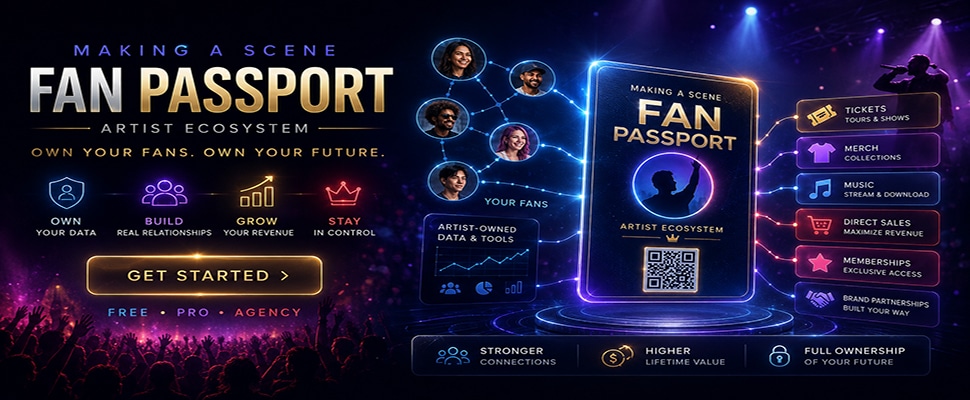
The Making a Scene Artist Fan Passport OS is designed around this idea: shows, fan permission, rewards, offers, and direct communication should strengthen an artist-owned relationship instead of scattering the story across disconnected platforms. It is not a magic replacement for good music or human care. It is a system for remembering the relationship after discovery happens.
An artist does not need a complicated database to understand the principle. Start by asking what the fan agreed to, what value was exchanged, what the artist should remember, and what invitation makes sense next. Technology should make that work easier. It should never become an excuse to spy, spam, or pretend automation is friendship.
Maya Stops Waiting for the Big Thing
Imagine a fictional artist named Maya. She writes sharp, soulful songs and performs with a small band. She has respectable listening numbers, active social pages, and a few strong videos. People tell her she is “about to break” so often that the phrase has started to sound like a threat.
Maya’s problem is not a lack of talent or attention. Her problem is that every campaign begins at zero. She announces a song, posts repeatedly, gets a rush of engagement, plays a release show, and watches the energy fade. Most listeners stay inside platforms she does not control. She cannot easily identify who attended, who purchased, who lives near the next show, or who asked to hear more.
When Maya builds her Income Mix Map, she discovers that almost all of her direct money comes from performance fees. Merch is inconsistent because she orders too much of one design and rarely records what sells. Her catalog is organized for release but not for licensing. She has email addresses, but they are spread across old forms, ticket exports, and personal contacts with unclear permission. She has no recurring fan offer.
Maya does not respond by launching six businesses at once. She chooses one weak lane connected to activity she already has: live shows. At the next three shows, she offers a show-specific live recording in exchange for clear email permission. The delivery page includes her next dates and one limited bundle connected to the recording. The follow-up asks what the fan enjoyed and offers a simple way to stay close.
The result is not instant superstardom. It is more useful. Maya leaves each room with a larger permission-based audience, better knowledge of where fans live, a direct-sale path, and an offer she can test again. Her show fee still matters, but the show is no longer a financial island. It feeds the next part of the business.
The Breakthrough Expense Trap
Attention can create costs before it creates income. A post gains momentum, so the artist rushes to buy advertising, order inventory, hire help, book travel, upgrade production, and build a campaign big enough to “take advantage of the moment.” Sometimes that investment is wise. Sometimes the artist has turned a temporary signal into a permanent bill.
The breakthrough myth makes restraint feel like failure. If the artist does not spend aggressively, somebody warns that the opportunity may disappear. That fear can lead to decisions without a clear path to recovery. How many sales are needed to cover the cost? Who can be reached directly after the campaign? Does the spending create an owned asset, or does it only rent more attention for a few days?
AI Should Be the Bookkeeper, Not the Lead Singer
Artificial intelligence can help an artist understand an income mix, but it should not invent the numbers or make the decisions. An artist can use AI to organize notes, group expenses, summarize show reports, compare offer results, prepare spreadsheet categories, or turn messy observations into questions for a monthly review. That is useful back-office leverage.
AI can also help spot patterns that a tired artist might miss. Perhaps shows in one city produce lower guarantees but higher merch sales. Perhaps a certain story in an email leads to more direct purchases. Perhaps private events earn more net income per day than a long run of low-margin dates. The tool can surface the pattern, but the artist must decide what it means.
The guardrail is simple: use real inputs, keep sensitive fan information protected, and verify every output. AI is very good at making a confident sentence. Confidence is not bookkeeping. The artist should be able to trace every financial conclusion back to a real sale, cost, agreement, or observation.
Build the Income Mix Map
The Income Mix Map turns the argument into an owned business asset. It is not a forecast designed to impress an investor. It is a plain-language picture of how money currently enters the artist business, what each lane costs, who controls the customer relationship, how repeatable the lane appears, and what experiment should happen next.
Enter gross revenue for each lane, then enter the direct costs required to create that revenue. The map calculates net revenue by subtracting direct costs from gross revenue. It also asks for the approximate hours spent. Dividing net revenue by hours does not measure artistic value, but it can reveal where time is being consumed. A low hourly result may still be worth keeping if it creates future relationships, catalog value, or creative growth. The number is a question, not a verdict.
Next, record who controls the fan or buyer relationship. “Artist” means the artist can contact the person again with clear permission. “Shared” means the artist has some access but depends on another system or partner. “Third party” means the artist may receive money or attention without a durable customer connection. This column often reveals why a busy career can still feel like it starts over every month.
Finally, score repeatability and strategic value. Repeatability asks whether the lane can reasonably happen again. Strategic value asks whether it strengthens music ownership, fan relationships, catalog value, booking power, or another part of the business. The workbook combines those answers with the lane’s current contribution and control level to suggest a priority, but the artist remains in charge.
Choose One Lane, Not Seven New Jobs
The map is complete when it helps the artist choose. A weak lane is not always the one with the least money. It may be the lane with the best connection to work already happening. Maya chose live-show fan capture because she was already performing. Another artist may choose catalog organization because a strong group of songs is sitting unused. A producer may choose direct education because the same client questions appear every week.
The best first experiment is small enough to finish, cheap enough to survive, and clear enough to measure. It should use an existing strength. It should create or improve an owned asset. It should connect to a real revenue path, even if the first result is modest.
An artist might test one merch bundle at three shows, prepare five songs for licensing pitches, invite twenty known supporters into a simple membership pilot, package a limited direct edition, or create a paid workshop from a repeated skill. Choose a review date before starting. At that review, ask what money came in, what it cost, what the artist learned, what relationship was created, and whether the experiment should stop, change, or continue.
The First Thirty Days
During the first two weeks, complete the map with the best honest records available, choose one lane, and design the smallest complete experiment. “Sell more merch” is not complete. “Test a signed lyric-card and download bundle at the next three shows, then record units, costs, questions, and email permissions” is complete. It names the offer, setting, time frame, and learning goal.
During the final two weeks, run the experiment, keep the raw facts, and decide what happens next. Continue it, change it, pause it, or remove it. At the end of thirty days, the artist may not have a dramatic success story. Good. Dramatic stories are what got us into this mess. The artist will have something better: a clearer income picture, one completed experiment, better records, and a decision based on owned information.
Stop Waiting to Be Declared Successful
The breakthrough myth asks an artist to wait for a public event that proves the career is real. The cash-flow model starts with a quieter claim: the career becomes real every time the artist builds an asset, serves a fan, keeps a promise, learns from a sale, organizes a right, improves an offer, and turns today’s work into tomorrow’s opportunity.
This is not an argument against ambition. Make the record that seems too big. Play the room that scares you. Pitch the song. Chase the collaboration. Build the strange idea. A music industry middle class should not make artists smaller. It should give them enough stability to take better creative risks without handing the entire future to one gatekeeper.
If a breakthrough arrives, enjoy it. Use it. Celebrate loudly enough to annoy the neighbors. But do not confuse the spark with the power grid. Attention becomes a career only when it connects to owned music, permission-based fan relationships, useful offers, organized rights, and several honest ways for money to reach the artist.
Week One ends with the Income Mix Map because inspiration without an asset is just another pleasant afternoon on the internet. Fill it out. Choose one lane. Run one experiment. Keep the relationship. Count what remains.
Next week, The Artist-Owned Middle Class moves from income to infrastructure with “The Minimum Viable Artist Business.” We will identify the seven assets an artist should control before spending more money to reach people. The breakthrough myth told artists to get louder. The next step is to make sure there is a business waiting when somebody finally listens.
 |  Spotify |  Deezer |  Breaker |
 Pocket Cast |  Radio Public |  Stitcher |  TuneIn |
 IHeart Radio |  Mixcloud |  PlayerFM |  Amazon |
 Jiosaavn |  Gaana |  Vurbl |  Audius |
 Reason.Fm | |||
Find our Podcasts on these outlets
Subscribe to Our Newsletter
Discover more from Making A Scene!
Subscribe to get the latest posts sent to your email.


