Why More Followers Don’t Mean More Money




Making a Scene Presents – Why More Followers Don’t Mean More Money
Listen to The Podcast Discussion
There is one of the most dangerous lies in modern music marketing, and independent artists hear it every day.
It goes like this: if you can just get more followers, everything else will take care of itself.
More followers means more opportunity. More opportunity means more growth. More growth means more money. That is the fantasy. It is sold in ads, in guru videos, in conference panels, and in endless content from people who want artists to keep feeding the machine. It sounds logical. It even looks true from the outside. A page with fifty thousand followers feels more successful than a page with five hundred. A video with a million views looks like proof that the artist has arrived. A post with thousands of likes creates the impression of momentum, demand, and cultural relevance.
But then the artist announces a show and only a few people buy tickets. They drop merch and sales barely move. They release a vinyl preorder and the same small circle of real supporters buys it while the rest of the “audience” scrolls past. They ask their followers to join a mailing list and almost nobody signs up. They try to turn attention into income and suddenly discover the ugly truth: most followers are not businesses. Most followers are just rented attention.
That is the difference between attention and monetization, and too many artists learn it after they have already spent years building on platforms that were never designed to make them financially independent.
This is the problem at the center of today’s indie music economy. Artists have more ways than ever to be seen, but far fewer ways to turn being seen into stable income. Social media has trained musicians to confuse visibility with leverage. Streaming has trained them to confuse access with ownership. The result is a generation of artists who may be discoverable everywhere but profitable nowhere.
The real question is no longer how to get attention. The real question is what you own once you get it.
The platform economy sells the dream but keeps the customer
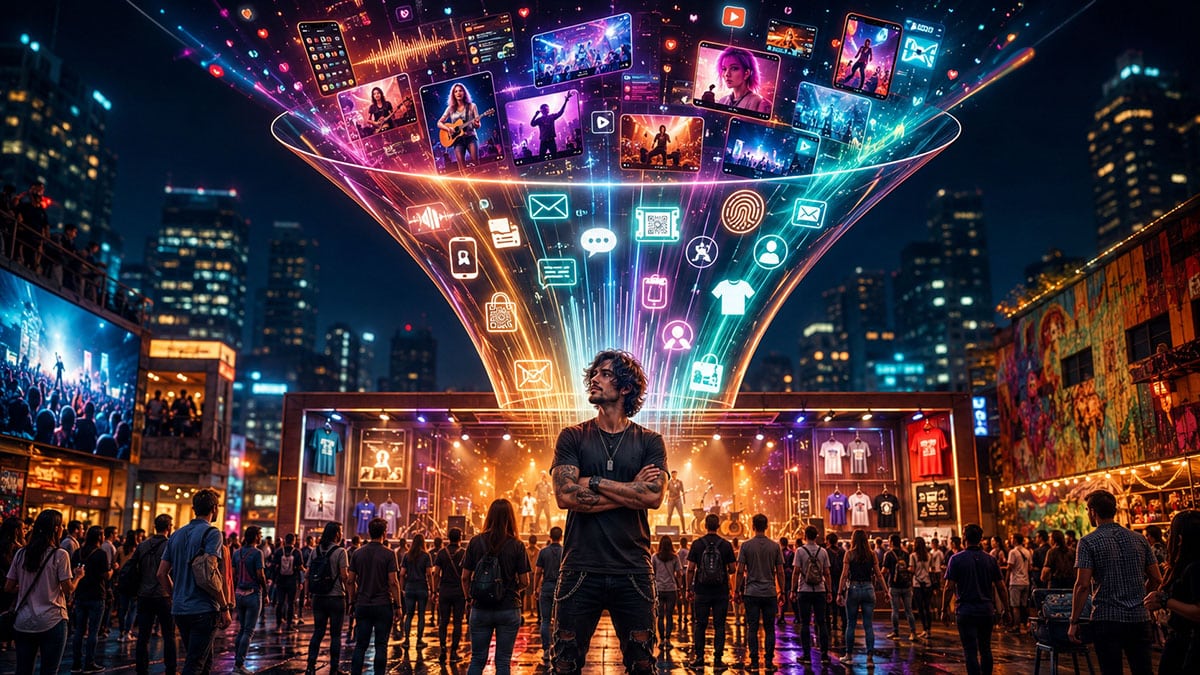
Social media platforms are brilliant at making artists feel bigger than they are. That is not an accident. The entire platform economy runs on perceived momentum. Instagram, TikTok, Facebook, YouTube, and even Spotify all reward signals that look like activity. Views, likes, shares, saves, streams, impressions, reach. These are not useless metrics, but they are incomplete metrics. They measure motion, not conversion. They measure exposure, not commitment. They measure the size of the crowd standing outside the store window, not how many people walked in and bought something.
That distinction matters because platforms are built to benefit from your attention economy, not your ownership economy. If an artist has a viral video on TikTok, TikTok wins whether the artist makes money or not. If an artist gets a bump in streams on Spotify, Spotify wins whether the artist can pay rent or not. If an artist gets huge engagement on Instagram, Meta wins whether those followers ever buy a ticket, a T-shirt, a membership, or a record.
The platform is not your business partner. The platform is your landlord. It lets you occupy digital space as long as you keep generating activity that benefits its model. The moment you stop feeding that machine, your reach drops, your posts disappear, and your “audience” becomes harder to access. You do not own the relationship. The platform does.
This is why artists can have what looks like a successful online presence and still struggle financially. Their fans may know them, but they are not connected to them in a direct, monetizable, repeatable way. They are trapped in someone else’s ecosystem, where every interaction is filtered through an algorithm whose interests do not align with the artist’s long-term survival.
In the old music industry, radio stations used to hold that kind of power. They controlled attention and framed it as promotion. Artists were told that the exposure itself was the reward, and that real money would come later through record sales and touring. Today, social media and streaming platforms play a similar role. They offer discovery and visibility, but the actual business value only appears if the artist moves that attention somewhere they control.
If that move never happens, the artist becomes popular without becoming sustainable.
Followers are not customers
A follower is not a customer. A listener is not a buyer. A viewer is not a supporter. A stream is not a relationship.
That sounds harsh, but indie artists need to hear it clearly because the market keeps blurring those lines. The number on your profile is not the same thing as the number in your customer base. A social following can be full of casual observers, people who liked one clip six months ago, inactive accounts, people outside your touring radius, and people who enjoy watching content but have no habit of spending money on music.
Plenty of artists have learned this the hard way. They announce merch to ten thousand followers and sell twelve shirts. They announce a local show to twenty thousand followers and struggle to fill a fifty-cap room. They get tens of thousands of Spotify monthly listeners and still cannot predict a meaningful number of ticket sales or direct purchases.
That is because the behavior required to follow is almost frictionless. Tap a button. Keep scrolling. No cost. No commitment. No investment. The behavior required to become a customer is different. It requires intention. It requires trust. It requires a path. It requires the fan to understand why they should go deeper, what they get in return, and where that relationship lives.
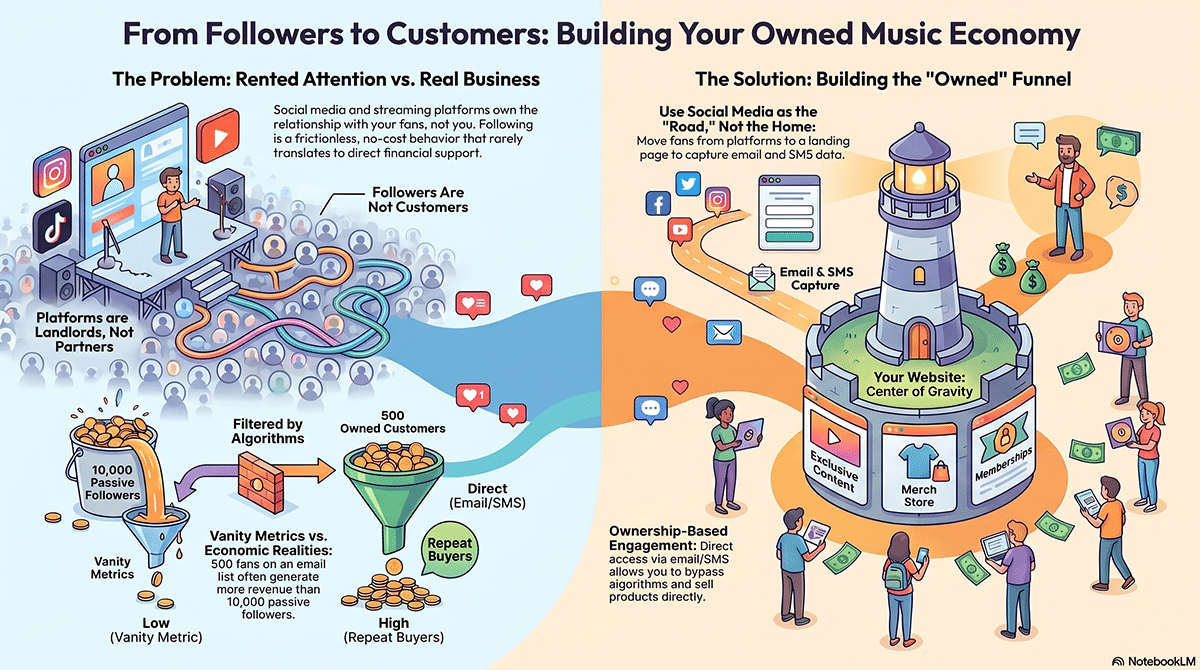
That is why an artist with five hundred real fans who are on an email list, respond to text messages, attend local shows, buy limited merchandise, collect special releases, and interact through a fan passport system can absolutely make more money than an artist with ten thousand passive followers on a platform. The first artist has a customer base. The second artist has a vanity metric.
This is not just a marketing problem. It is a structural problem. The platforms are optimized to produce spectators. Artists need systems that produce participants.
Social media inflates perceived success because it rewards performance, not depth
Modern platforms are engineered to reward the appearance of popularity. They surface what creates more engagement loops, not what creates stronger economic relationships. That means artists are pushed toward content that is fast, repeatable, emotional, and algorithm-friendly. The goal becomes staying visible, not becoming valuable. The artist ends up working as a content factory to maintain reach, often without building a meaningful customer journey behind the scenes.
This has a psychological cost as well as a financial one. Artists begin to judge their career by reactions rather than by revenue. They feel pressure to post constantly, chase trends, adapt to whatever format the algorithm likes that week, and produce endless snippets designed to hold attention for a few seconds. It becomes a treadmill. Motion without destination. Effort without ownership.
A lot of musicians are exhausted not because they are lazy or untalented, but because they are trying to build a business on top of tools that were not built for business ownership. They are trapped in attention maintenance. Even when they “win,” the payoff is often temporary. A viral moment can create a spike in followers, but if there is no funnel, no landing page, no email capture, no SMS opt-in, no direct offer, and no owned ecosystem waiting on the other side, the moment evaporates.
The problem is not that social media is evil. The problem is that social media is being used as a destination instead of what it should be: the top of the funnel.
That is the shift artists need to make. Stop treating platforms like home. Treat them like roads leading people back to a place you own.
Attention matters, but ownership is what makes it pay
Attention is not worthless. It is just incomplete. Discovery is still important. Social content still matters. Spotify, TikTok, Instagram, Facebook, and YouTube can all play a role in building awareness. But awareness is only the first step. If the entire strategy begins and ends there, the artist is building someone else’s business.
Monetization begins when attention is converted into owned contact, owned context, and owned experience.
Owned contact means the artist has a direct way to reach the fan without needing an algorithm’s permission. That is where email and SMS come in. A fan who gives you their email address is worth more than a casual social follower because you can reach that person directly. A fan who opts in for text updates can be activated around shows, merch drops, and time-sensitive offers with far more reliability than a social post buried in a feed.
Owned context means you know something about the fan that helps make the relationship more useful and relevant. Maybe you know their first name, email, city and state, whether they bought merch, whether they attended a show, or whether they engaged with a previous release. That data is not about surveillance. It is about service. It helps an indie artist stop shouting into the void and start building more intelligent, respectful, targeted communication.
Owned experience means the fan has a place to go where the artist sets the rules. That could be the artist’s website, a membership area, a private community, a direct-to-fan store, an exclusive content hub, or a fan passport dashboard that turns passive support into visible participation.
The difference between attention and monetization is not just that one leads to money. It is that one is borrowed and the other is owned.
The direct-to-fan funnel is how attention becomes income
For years, indie artists were told to focus on traffic. Get more traffic. Grow your following. Reach more people. But traffic without structure is just noise. What matters is not how many people see you. What matters is what happens next.
A healthy direct-to-fan funnel gives casual attention a clear path toward deeper participation. It begins where people already are, which usually means social media, streaming platforms, video platforms, or live shows. But instead of asking fans to stay there forever, it invites them into an owned system.
A social post should not just say, “here is my new release.” It should move people toward a splash page or landing page. That page should offer something worth claiming, such as an exclusive track, a live recording, a discount, a presale code, a behind-the-scenes video, a lyric sheet, a fan club invitation, or access to a special experience. In exchange, the artist asks for the first pieces of real relationship data: first name, email, maybe city and state, and sometimes SMS permission.
That is where the real work begins. Once the fan enters the system, the artist can deliver a welcome sequence. The first message fulfills the promised gift. The second builds the relationship. The third learns more about the fan or introduces a next step. The fourth can invite the fan into the fan passport system, a members-only area, a merch offer, or a local event opportunity.
Now the artist is no longer just posting into the public square. They are guiding the fan into a structured, owned journey.
This is where a tool like ManyChat can help for social DMs, where platforms like Mailchimp or Substack can play a role for certain creators, and where artist-owned systems like The Newsletter Plugin, WooCommerce, FluentCart, or Bandcamp can be layered into a larger stack. Patreon can work for memberships. Unlock Protocol can power token-gated access. POAP can mark attendance or participation. But none of those tools are the point by themselves. The point is the funnel.
Without a funnel, content is just content. With a funnel, content becomes conversion infrastructure.
Why email and SMS still matter more than the trend of the week
Every few years, somebody declares email dead. Meanwhile, email continues doing what algorithms often fail to do: reliably reaching people who asked to hear from you. It is not sexy, but neither is getting paid always. Sometimes boring tools are the tools that actually build careers.
Email matters because it is stable. It matters because it scales. It matters because it can be automated. It matters because you can segment your audience and speak to different kinds of fans in different ways. You can invite fans in one city to a local show. You can offer your top buyers a special merch drop. You can welcome new subscribers with a thoughtful sequence that turns strangers into supporters.
SMS matters because it is immediate. A well-timed text about a show tonight, a limited offer, or a surprise drop can outperform a social post by a mile because it lands where people actually pay attention. Used well, SMS feels personal and urgent. Used badly, it becomes spam. That is why permission and relevance matter. The artist who respects the channel wins the trust.
The biggest advantage of email and SMS is not just deliverability. It is independence. You are no longer begging an algorithm to show your message to people who already chose to hear from you. That is a major shift in power.
For indie artists, power matters. Not abstract power. Practical power. The power to launch something and know you can reach your audience. The power to sell directly. The power to test offers. The power to build recurring revenue. The power to survive without needing to go viral every month.
That is what ownership-based engagement looks like in real life.
Fan passports turn fandom into participation
This is where the fan passport becomes more than a clever idea. It becomes the bridge between attention and monetization, between audience and community, between passive consumption and active support.
Most fan relationships are invisible. A person likes a song, follows an account, maybe attends a show, maybe buys a shirt, maybe signs up for a list, and those moments often remain disconnected. The artist may never see the whole picture. The fan may never feel that their support is accumulating into anything meaningful. A fan passport changes that.
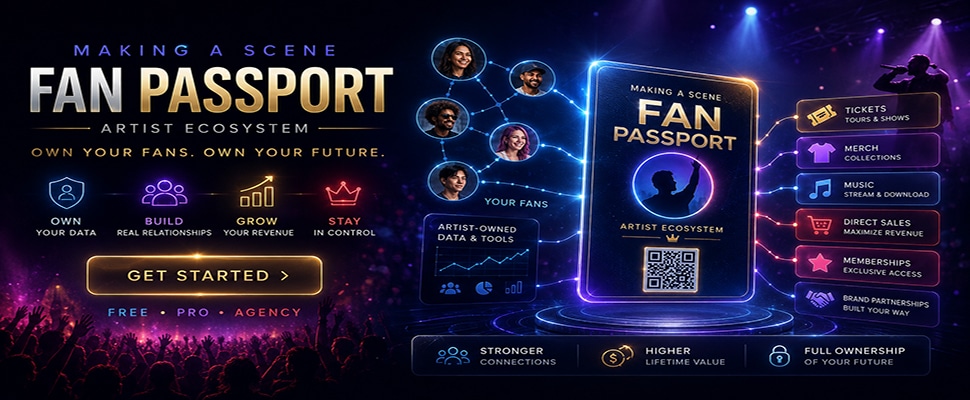
A fan passport gives the relationship a structure the fan can feel. It creates visible progress. It can reward attendance, merch purchases, livestream participation, referrals, content engagement, memberships, and local activity. It can turn a live show into a data capture opportunity. It can turn a QR code on a merch table into a fan journey. It can turn supporters into collectors, members, insiders, and repeat customers.
This matters because fans often want to support artists more deeply, but they need a clear path and a reason to do it. A passport system provides both. It says your support counts, it is remembered, and it unlocks something. Maybe that is exclusive content. Maybe it is discounts. Maybe it is early access. Maybe it is status inside a fan community. Maybe it is proof of participation through something like POAP. Maybe it is a hybrid model using Unlock Protocol for gated access. The exact implementation can vary, but the larger principle remains the same: people engage more when engagement has meaning.
For the artist, the fan passport is not just a reward system. It is a business intelligence system. It helps identify who your real supporters are, where they are located, what they respond to, and how they move through your ecosystem. That data becomes actionable. It helps with touring decisions, local promotions, merch planning, membership offers, and community building.
Most artists do not need more random followers. They need better ways to recognize, activate, and reward the people already raising their hands.
The artist website has to become the center of gravity
If the platforms are the top of the funnel, the website has to become the center of gravity.
That means the site can no longer function like a dusty digital brochure with a bio, some photos, and a few links leading fans back out to corporate platforms. The artist website has to behave more like a platform of its own. It needs to keep people there. It needs to listen, sell, reward, and invite participation.
Fans should be able to hear music on the site, not just click away to Spotify. They should be able to buy merch directly. They should be able to join a membership. They should be able to access exclusive content. They should be able to sign up for the newsletter, opt in to SMS, join the fan passport, collect rewards, and participate in the artist’s world.
That is how artists build a music industry middle class. Not by chasing infinite scale and hoping scraps fall from the platform table. By building revenue stacks. By owning masters, publishing, fan data, and customer relationships. By turning casual listeners into known fans, known fans into customers, and customers into long-term community members.
This is the future for independent artists who want stability. Not anti-platform, but post-dependency. Use social media. Use Spotify. Use YouTube. Use TikTok. But demote them. They are not the house. They are the front sidewalk.
From vanity metrics to real economics
One of the hardest truths in independent music is that the market often rewards illusion before it rewards substance. It is easy to look successful online. It is much harder to build a durable micro-economy around your art. But durable is what matters.
A fanbase makes money when it is organized. When it is reachable. When it is invited to participate. When the artist has something to sell, somewhere to sell it, and a system that makes buying feel natural. Revenue does not emerge from audience size alone. It emerges from relationship depth, offer quality, repeat engagement, and ownership of the customer journey.
That is why five hundred true fans can outperform ten thousand casual followers. Five hundred true fans might buy tickets, T-shirts, limited vinyl, subscriptions, livestream access, VIP experiences, digital exclusives, and special releases. They might travel to shows. They might respond to texts. They might join a private community. They might collect stamps through a fan passport and become part of the culture around the artist.
Ten thousand followers might do nothing except inflate the ego and the media kit.
Artists should not feel ashamed if their “big numbers” do not produce big income. They should feel informed. The system was designed to make attention look like business. It is not. Not until you build the bridge.
Stop trying to be famous everywhere and start becoming valuable somewhere
This is the hard-hitting part. Too many artists are still chasing fame-shaped goals with small-business realities. They are trying to look large instead of trying to become sustainable. They are optimizing for social proof rather than customer behavior. They are obsessed with reach while neglecting retention. They are hoping that bigger numbers will solve structural problems that only ownership can solve.
They will not.
If you do not control the relationship, you do not control the business. If you cannot reach your fans directly, you do not have a dependable audience. If your followers never enter an owned ecosystem, you do not have leverage. If your website does not convert, if your email list is weak, if your SMS channel is nonexistent, if your fan passport system is not in place, then your fanbase may be emotionally encouraging but economically fragile. That does not mean the dream is dead. It means the strategy has to grow up.
The future belongs to artists who stop confusing noise with signal. Who stop worshiping exposure for its own sake. Who stop building castles on rented land. The winners in the next phase of the indie music business will be the artists who understand funnels, who value direct relationships, who treat data as a creative asset, and who build fan experiences that reward support instead of taking it for granted. From followers to customers is not a trick. It is a philosophy shift. It is the difference between performing for the algorithm and building an actual economy around your art.
That economy can be modest at first. It can begin with one splash page, one welcome sequence, one merch offer, one local show QR code, one fan passport signup, one meaningful email list. It does not have to be massive. It has to be owned. It has to be intentional. It has to lead somewhere. The modern artist does not need millions of passive admirers. The modern artist needs a working system.
That system starts by telling the truth. Attention is not monetization. Followers are not customers. Visibility is not ownership. Social media is not your business. Streaming is not your business. Your relationship with the fan is your business. Build that, and the numbers start meaning something.
Ignore it, and you may spend years looking successful while staying broke.
That is the real op-ed lesson here. Most fanbases do not make money because they were never built to. They were built to feed platform metrics. If independent artists want a different outcome, they need a different architecture. Direct-to-fan funnels. Email. SMS. Websites that act like platforms. Fan passports. Ownership-based engagement. Revenue stacks. Repeat participation. Real relationship systems. That is how followers become customers. More importantly, that is how customers become a community that can actually sustain an artist’s life and work.
And in the end, that is the point. Not to go viral for strangers. To build something real with people who care enough to stay.
 |  Spotify |  Deezer |  Breaker |
 Pocket Cast |  Radio Public |  Stitcher |  TuneIn |
 IHeart Radio |  Mixcloud |  PlayerFM |  Amazon |
 Jiosaavn |  Gaana |  Vurbl |  Audius |
 Reason.Fm | |||
Find our Podcasts on these outlets
Subscribe to Our Newsletter
Discover more from Making A Scene!
Subscribe to get the latest posts sent to your email.


