The Live Show Is Not Just a Night Out. It Is the Front Door to Your Whole Music Business.




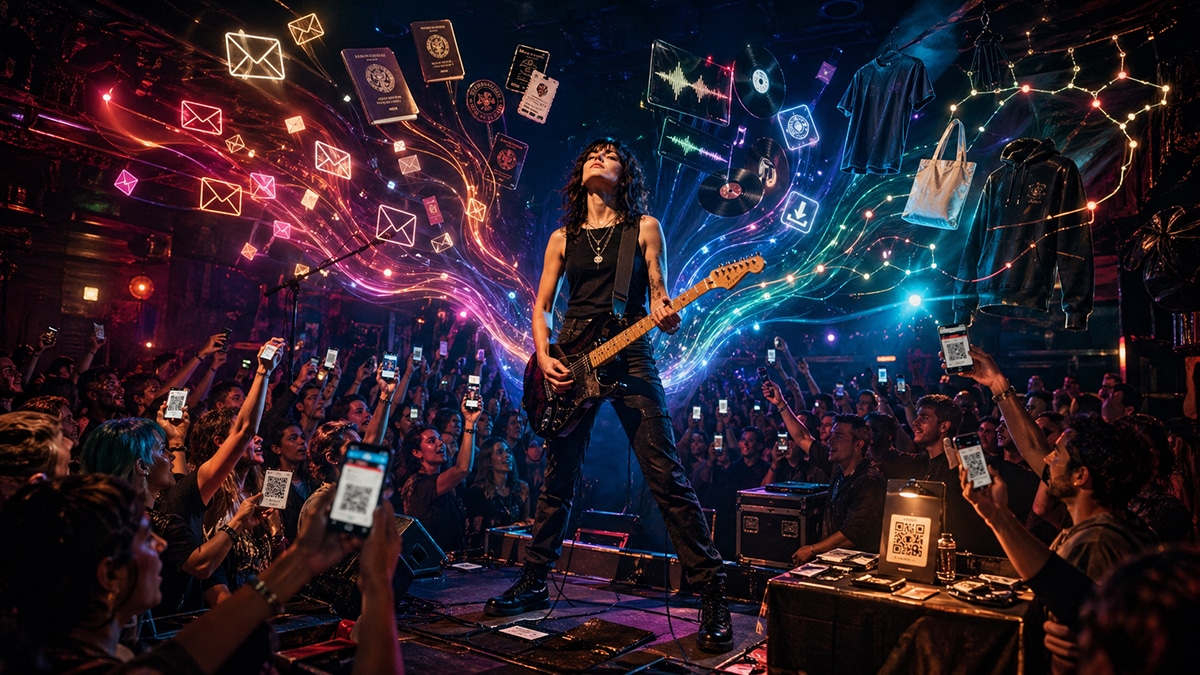
Making a Scene Presents – The Live Show Is Not Just a Night Out. It Is the Front Door to Your Whole Music Business.
Listen to the Podcast Discussion
For too long, indie artists have been taught to think of the live show as a single transaction.
A fan buys a ticket. The artist plays the set. Maybe somebody buys a shirt. Everybody goes home. The venue sweeps the floor, the bartender counts the drawer, the band loads out, and the whole night disappears into the fog of tired backs, ringing ears, and gas station coffee.
That is the old way. The new way is different.
The live show is not just a night out. It is not just a gig. It is not just a chance to play loud, sell a few shirts, and hope somebody remembers your name next week. The live show is the most powerful conversion point an independent artist has. It is the one place where attention, emotion, money, identity, and community all show up in the same room at the same time.
That is rare. That is valuable. That is not something you hand over to Spotify, Instagram, TikTok, Ticketmaster, or some rented platform that lets you borrow your own audience in exchange for feeding its machine.
A live show is where a casual listener becomes a real fan. It is where a name on a poster becomes a face, a voice, a laugh, a handshake, a story, a memory. It is where your music stops being content and becomes an experience. And if you build the right system around that experience, the show does not end when the last cymbal fades. It keeps working. It keeps earning. It keeps bringing people into your world.
That is the real game.
Not just ticket money. Not just merch money. Not just applause. The goal is to turn one night of attention into an ongoing artist-owned relationship.
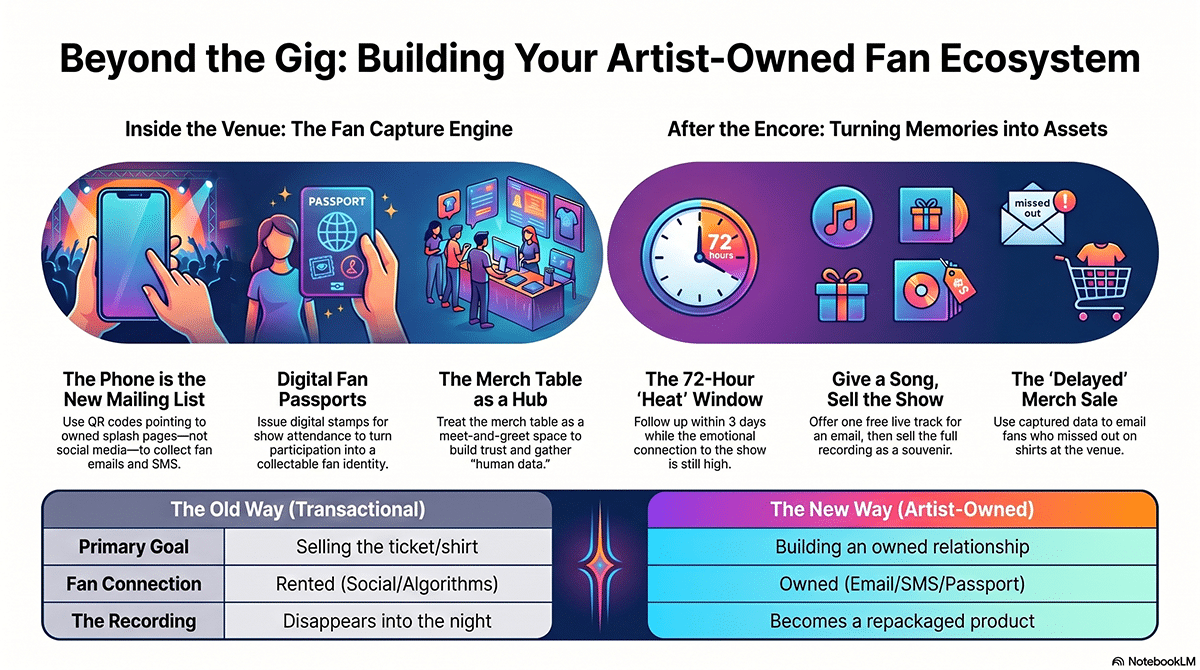
That means collecting fan data with permission. It means using QR codes, splash pages, email, SMS, fan passports, digital downloads, live recordings, merch follow-ups, and smart post-show offers. It means treating the merch table like the most important room in the building. It means building a setlist that controls emotion instead of just organizing songs by tempo and key. It means recording the show, repackaging the night, and turning one performance into a product fans can take home.
In other words, the live show is not the finish line.
It is the beginning.
The Ticket Sale Is Only the First Dollar
The old music business loved to make artists think small.
Get the gig. Sell the ticket. Play the set. Hope the venue asks you back. Maybe sell enough merch to cover gas. Maybe not. Repeat until burnout.
That model is not a career plan. It is a hamster wheel with a drink minimum.
The ticket sale matters, of course. Nobody is saying it does not. But the ticket sale is only the first dollar. It is not the whole value of the fan. If somebody paid money, left their house, drove to a venue, parked the car, stood in a room, and gave you their attention for an hour, that person is worth more than one night’s admission.
That person has already crossed the hardest bridge. They showed up.
Now your job is to make sure they do not vanish back into the algorithmic swamp after the show. Because that is what happens when you do not have a system. The fan has a great time. They follow you on Instagram. Maybe they stream you the next day. Then the platform buries your next post, Spotify recommends ten other artists, and your “fan” becomes platform inventory.
That is not fan ownership. That is fan leakage.
The better move is to treat every live show as a fan capture event. Not in a creepy way. Not in a spammy way. Not like some desperate pop-up ad wearing a leather jacket. You do it by offering something valuable in exchange for permission.
That could be a free live recording from that night. It could be a digital tour poster. It could be a fan passport stamp. It could be a backstage voice memo. It could be a discount code for the shirt they forgot to buy. It could be early access to the live album from the show. The point is simple: the fan gives you permission to contact them, and you give them something that makes the night feel even more special.
This is where the live show becomes an owned media engine.
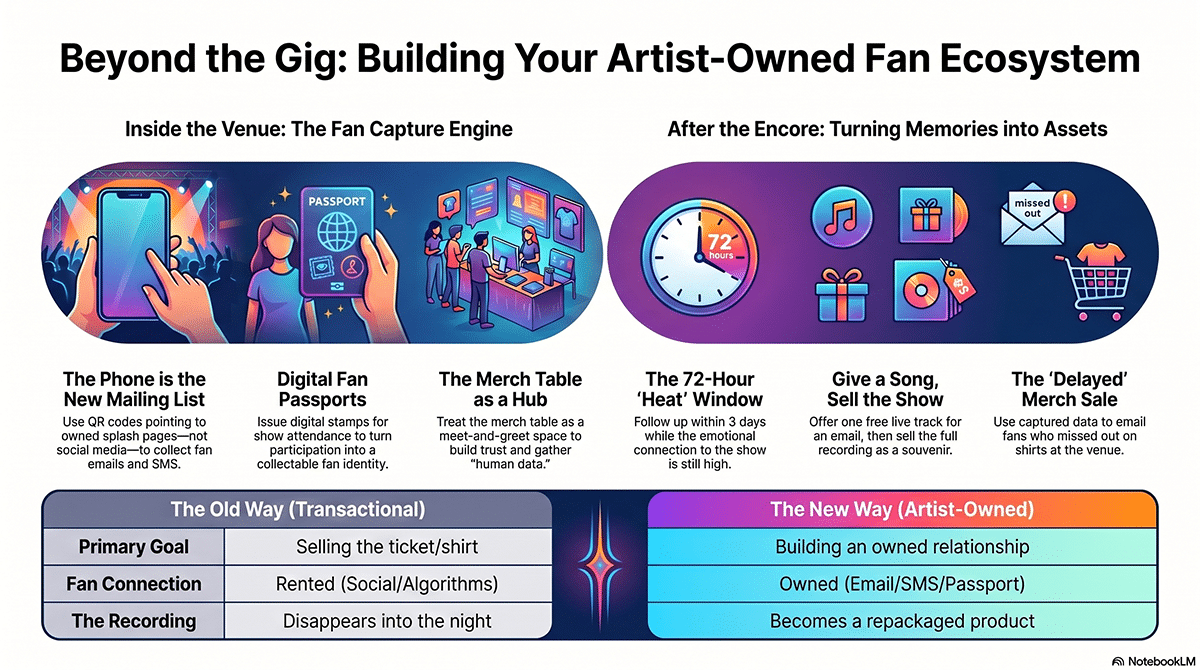
The QR Code Is the New Mailing List Clipboard
There was a time when the mailing list lived on a clipboard at the merch table. Some of us still love that clipboard. It had charm. It had coffee stains. It had names you could barely read and email addresses that looked like they were written during an earthquake.
But today, every fan already walked into the venue with the most powerful sign-up device ever built sitting in their pocket.
Their phone.
That is why the QR code should be part of your live show system. Put it on the merch table. Put it on small cards. Put it near the stage. Put it on the projected screen if the room has one. Put it on the back of the setlist. Put it near the bathroom line if the venue allows it, because let’s be honest, people standing in line will scan anything if the offer is good enough.
But do not send that QR code to a link tree full of distractions.
Send it to your own splash page.
That page should live on your artist website, not on rented social real estate. A simple WordPress page can do the job. A WordPress-based setup using The Newsletter Plugin can create subscription forms, lists, segmentation, and email tracking directly inside your own site; the WordPress plugin listing says it supports list building, sending, tracking, unlimited subscribers, forms, double opt-in, privacy checkboxes, and subscriber segmentation.
That is powerful because now the artist is not just “getting followers.” The artist is building an owned contact list. There is a huge difference.
A follower belongs to the platform first. An email subscriber belongs to your business relationship. When you send an email from your own list, you are not begging an algorithm for permission to reach someone who already asked to hear from you.
That is why your live show QR code should lead to a clear, single-purpose page. Not twelve buttons. Not every social platform. Not “listen everywhere.” The fan is already there. They already found you. Stop sending them away.
The page should say something simple: “Get a free live recording from tonight’s show.” Or “Claim your fan passport stamp.” Or “Join the after-show list and get the live EP first.” Ask for first name, email, city, and state. City and state matter because they turn your list into touring intelligence. You are not just collecting names. You are building a map.
Tools like Bitly QR Codes can create custom QR codes and track scan data, while QRCode Monkey can generate print-ready static QR codes with high-resolution formats like PNG and SVG. Bitly also states that its QR product can show scan data such as totals, location, browser, and operating system on paid plans, while QRCode Monkey notes that its static codes cannot be edited after printing.
That last part matters. If you print a static QR code that points directly to one page, you are stuck with that destination. A better move is to use a redirect link you control, either through your own website or a dynamic QR platform. That way, the same QR code can point to tonight’s free song, next month’s tour presale, or a new fan passport page without reprinting everything.
The QR code is not magic. The offer is magic.
Nobody wants to scan “Join our mailing list.” That sounds like homework. But “Get the live version of the song we just played” feels like a souvenir. “Claim your fan passport stamp from tonight’s show” feels like belonging. “Unlock the after-show download” feels like access.
Same technology. Different psychology.
The Fan Passport Turns Attendance Into Proof
A ticket proves somebody bought access to a room.
A fan passport proves they are part of the story.
That is the deeper idea. The fan passport can be simple at first. It does not need to be some overbuilt tech monster that takes six months and three exhausted developers to launch. It can start as a password-protected page, a member profile, a digital stamp system, or a private fan account inside your website.
The goal is to turn participation into memory.
When a fan attends a show, they scan a QR code and claim a stamp for that city, venue, and date. Now the show lives inside their fan identity. That stamp can unlock something small, like a free track, a thank-you video, or a merch discount. Over time, those stamps can unlock bigger things: early tickets, VIP soundcheck access, private livestreams, limited vinyl, tour posters, or fan-only live albums.
This changes the emotional structure of the live show. The fan is no longer just watching. They are collecting proof that they were there.
And for the artist, the passport turns scattered live attendance into usable business data. You can see who came to which city. You can see who attends more than once. You can see who buys merch after scanning. You can see which markets have casual listeners and which markets have loyal fans.
That is not vanity data. That is routing data. Merch data. Release data. Community data.
If an artist wants to add a Web3 layer later, tools like POAP can be used to issue proof-of-attendance-style digital collectibles, while Unlock Protocol can support token-gated memberships. But the Making a Scene rule is simple: never add tech just because it sounds futuristic. Add it only when it gives the artist more ownership, more direct revenue, or a stronger fan relationship.
A fan passport does not need to scream “crypto.” It needs to say, “You were here. You matter. Come deeper into the world.”
That is the whole point.
Permission Is Part of the Deal
Here is where indie artists need to be smart.
Collecting fan data is powerful, but it has to be done with clear permission. This is not just about being legal. It is about trust. You do not want to build your fanbase like a sketchy nightclub promoter with a stolen spreadsheet.
If fans give you their email, tell them what they are signing up for. If they are getting a free live recording and joining your newsletter, say that. If you plan to send tour alerts, merch offers, and new music announcements, say that too. Keep it simple. Keep it human. Keep it honest.
In the U.S., commercial email has to follow CAN-SPAM rules. The FTC says the CAN-SPAM Act covers commercial messages, gives recipients the right to make you stop emailing them, and requires compliance for commercial email, including messages that promote content on commercial websites.
That means your emails need honest subject lines, accurate sender information, a real unsubscribe option, and a valid physical mailing address or compliant business address. This is not glamorous, but neither is getting your email domain wrecked because you treated consent like a suggestion.
SMS is even more sensitive. The FCC says commercial texts require written consent, and CTIA messaging best practices say senders should get consent before texting consumers and provide a way to opt out.
So if you collect phone numbers at a show, do not casually dump people into a text blast. Add a clear checkbox. Say what they will receive. Keep a record of consent. Give them a simple way out.
This is not gatekeeper nonsense. This is how you protect the relationship. Because the fan is not a lead. The fan is a person.
The Merch Table Is Not a Store. It Is the Meet-and-Greet
Now let’s talk about the merch table.
For too many artists, the merch table is treated like an afterthought. A folding table. A cash box. Some shirts in sizes nobody can find. A tired friend trying to make change while the band loads gear.
That is leaving money and relationships on the floor.
The merch table is not just where you sell things. It is where the show becomes personal. It is where the fan gets to say, “That song meant something to me.” It is where a first-time listener becomes a repeat supporter. It is where somebody who was too shy to talk before the set now has a reason to walk up and start a conversation.
And yes, the artist should be there. Not hiding backstage. Not escaping to the van. Not acting like the crowd should be grateful for the privilege of buying a shirt from somebody else. Be at the table.
Shake hands. Sign records. Take photos. Ask people where they are from. Ask how they found you. Ask what song hit them hardest. Ask if they want to scan the code and get the live track from tonight. Ask if they want to claim their passport stamp.
That moment is not beneath you. That moment is the business. A fan who meets the artist is more likely to remember the night. A fan who remembers the night is more likely to open the email. A fan who opens the email is more likely to buy the live recording. A fan who buys the live recording is more likely to come back next time.
That is the chain.
The merch table should also connect the physical and digital business. If you use WooCommerce on your WordPress site, it gives you control over checkout, data, costs, payment choices, and selling online or offline, according to WooCommerce’s own platform description. If you prefer a hosted commerce system, Shopify POS says it can sync inventory, payments, and customer data between in-person and online sales, which is useful when the merch booth and online store need to talk to each other. Square POS is another practical option for taking in-person payments and managing inventory and sales reports.
The tool matters less than the workflow.
The real goal is this: the person who bought a shirt at the table should be able to get a follow-up email later that says, “Thanks for coming out last night. Here’s the live track we promised. We also put the tour shirt online in case your size sold out.”
That is not spam. That is service. And it makes money.
The Fan Who Forgot the Shirt Is Still a Customer
Every live show has the same lost revenue hiding in plain sight.
The fan who wanted a shirt but the line was too long.
The fan who only had enough cash for drinks.
The fan who forgot to stop by the merch table.
The fan whose size was sold out.
The fan who saw the hoodie after they already closed their tab.
The fan who came with friends and did not want to hold merch all night.
In the old model, that sale is gone.
In the new model, it is just delayed.
If your QR code brings fans into your email list or fan passport system, you can follow up after the show. Not with a generic “buy our stuff” blast, but with a city-specific message. “Atlanta, you were loud. The live recording is coming. We restocked the black tour shirt. Here is the link for people who missed the merch table.”
That is how you extend the value of the night.
A live show creates emotional heat. The mistake is letting that heat cool before you make the next offer. The fan is most connected to the show in the first twenty-four to seventy-two hours after it happens. That is when the thank-you email should land. That is when the live track should arrive. That is when the merch reminder should feel natural.
This is where The Newsletter Plugin with SendGrid or Twilio’s SendGrid Email API can become part of an artist-owned machine. SendGrid describes its email tools as including an Email API, SMTP service, and email campaign tools, while The Newsletter Plugin can handle WordPress-based list building and email sending/tracking.
The practical setup is not complicated.
The fan scans the QR code. They claim the free live song. They enter their email and city. They get an automated thank-you. The next email offers the full live recording. Another email offers the merch they missed. Another invites them to the fan passport. Another announces the next nearby show.
That is not a funnel in the sleazy internet-marketing sense. That is hospitality. You are saying, “You came into our house. Here is how to stay connected.”
The Setlist Is Not About Tempo. It Is About Control.
Now let’s get into the part musicians love to argue about. The setlist.
A lot of artists build a setlist like they are organizing a sock drawer. Fast song. Medium song. Slow song. New song. Old song. Song in E. Song in G. Big ending. Done.
That is not enough. Tempo matters. Key matters. Tuning changes matter. Vocal stamina matters. Flow matters. But the real purpose of a setlist is control.
Not control in an arrogant way. Not control like you are manipulating people. Control like a filmmaker controls a story. Control like a preacher controls a sermon. Control like a great DJ controls a dance floor. Control like a comedian controls tension and release.
Your setlist should take the audience somewhere.
The show should have an opening image, a first emotional hook, a rise, a breath, a deeper turn, a surprise, a communal moment, a release, and a final memory. The audience should feel like they have traveled from one emotional place to another, even if they could not explain how you did it.
That is what separates a gig from a show.
The first song is not just “something upbeat.” It is the doorway. It tells the crowd what kind of night they are entering. The second song proves you can deliver. The third song starts building trust. Somewhere in the middle, you can pull them closer. You can tell a story. You can bring the room down. You can create silence. Then you build again.
This is emotional architecture. The mistake is thinking every song has to impress. It does not. Every song has to serve the journey.
Some songs are doors. Some are windows. Some are staircases. Some are explosions. Some are quiet rooms where the audience catches its breath and realizes they care more than they expected.
When you control the setlist, you control the emotional path. When you control the emotional path, you increase the value of the night. Fans buy merch because they feel something. They scan the QR code because they want to keep the feeling. They buy the live recording because it captures the emotional trip they just took.
That is why the setlist is part of the business plan.
Not because art should be reduced to sales. That is boring. The point is the opposite. The more powerful the art experience, the more valuable the artist-owned ecosystem becomes.
A weak set with a QR code is just a weak set with office supplies. A great set with a smart system becomes a career-building engine.
Talk Less, Mean More
Stage banter is part of setlist control too.
Some artists talk too much because they are nervous. Some do not talk at all because they think mystery is a personality. Neither extreme works for every room.
The better approach is intention.
Every thing you say onstage should have a job. It should deepen the song, bring the room together, create trust, give context, build anticipation, or point fans toward the next step.
This does not mean you turn the stage into a sales seminar. Please do not do that. Nobody came to hear a ten-minute lecture about your mailing list unless your bass player is changing a string and you are trapped in conversational combat.
But you can make one or two simple calls to action feel like part of the show.
Before a song you know fans respond to, say, “We’re recording tonight, and we’re going to send one song from this show to everyone who scans the code at the merch table.” That is clean. That gives value. That does not beg.
Near the end, say, “Come say hello after the set. We’ll be at the merch table, and if you were here tonight, make sure you claim your fan passport stamp.” That gives people a reason to approach.
The artist should never sound like they are apologizing for having a business.
You are not begging. You are inviting.
There is a difference.
The Live Recording Turns One Night Into a Product
Here is where things get exciting.
The live show does not have to disappear.
Today, many artists have access to technology that would have been absurdly expensive not that long ago. A club may already be using a digital console that can output multitrack audio. Some venues can give you a stereo board feed. Some can give you direct outs. Some can give you nothing but attitude and a sticky stage. That is why you prepare your own capture system when possible.
A mixer like the Behringer XR18 is a common indie-band option because it functions as an 18-input digital mixer with an 18×18 USB audio interface for multitrack recording, meaning you can capture individual inputs into a DAW instead of relying only on a stereo board mix.
If you do not want to interfere with the house sound system, a mic splitter can help send the same stage signals to both front-of-house and your recording rig. The ART S8 is an 8-channel splitter with one direct output and one transformer-isolated output per channel, designed so signals can be sent to more than one destination.
This is where an indie artist starts thinking like an owner.
Record the show. Back it up. Label the session by date, city, and venue. Then turn that recording into value.
You can offer one live song free in exchange for email signup. You can sell the full show as an attended-only download. You can create a “Live in Nashville” or “Live at The Basement” release. You can make a limited digital EP for fan passport holders. You can bundle the recording with a shirt. You can send everyone who bought a ticket a private link and say, “You were there. Here is the night.”
That is not just content. That is memory packaged as product.
And memory sells differently than ordinary music. A fan may stream your studio single once and move on. But a live recording from the night they attended carries personal proof. They remember where they stood. They remember who they came with. They remember the song that hit them. They remember the joke before the encore. They remember the room.
You are not selling audio.
You are selling the night back to the people who lived it.
Give Away the Song. Sell the Show.
One of the smartest live-show offers is simple.
Give away one song. Sell the full show.
The free song gets the email address. The full show creates the paid product. The post-show email sequence creates the relationship.
For example, after the show, everyone who scanned the QR code gets a message: “Here is the live version of the song we promised from last night.” That email delivers value immediately. No bait-and-switch. No nonsense.
Then, a day or two later, you send another message: “We finished the rough live mix from the whole show. Everyone who attended gets first access.” Price it low enough to be an impulse buy but high enough to matter. Maybe five dollars. Maybe ten. Maybe more if it includes video, photos, a digital booklet, or a special fan passport stamp.
You can sell the full show through your own WooCommerce store as a downloadable product. WooCommerce documentation supports virtual and downloadable products, where files can be attached to a product for customer download.
You can also use Bandcamp if you want a direct-to-fan music marketplace option. Bandcamp’s artist tools include track and album codes that fans can redeem for streaming and high-quality downloads, and those codes can be sent by email or printed for shows. The bigger point is not which platform you use. The bigger point is that you stop letting the live recording sit on a hard drive until it becomes digital dust.
Every show can become an asset.
Not every show has to become a public album. Some nights will have technical problems. Some performances will be rough. Some rooms will sound like the drums were recorded inside a soup can. That is life. But even then, you may be able to pull one great song, one backstage acoustic take, one soundcheck jam, or one thank-you voice memo.
The live show gives you raw material.
Your job is to build the system that turns raw material into fan value.
Be Smart About Covers, Rights, and Permission
Now, a necessary reality check.
If your live set includes only songs you wrote and control, releasing live recordings is much easier from a rights standpoint. You still need to make sure all performers, band members, and hired musicians understand how the recording will be used and how they are paid or credited. Put that in writing. Even a simple agreement is better than “we’ll figure it out later,” which is musician language for “future argument.”
If you perform cover songs and want to distribute recordings of those covers, you need to understand mechanical licensing. Songfile from the Harry Fox Agency says it helps license cover songs for physical and digital formats such as CDs, downloads, ringtones, and streams, and its FAQ says that if you record or distribute a song you do not own or control, U.S. copyright law requires a mechanical license regardless of whether you sell the copies.
Do not skip this.
The old “it’s just a live recording” excuse is not a business plan. If you are going to sell music, treat the rights like a grown-up. That is how indie artists build power. Not by pretending rules do not exist, but by owning the paperwork better than the gatekeepers expect.
Also, make sure the venue is okay with recording. Some rooms have policies. Some contracts include recording language. Some house engineers are cool if you ask early and a nightmare if you spring it on them five minutes before doors.
Do not be that band.
Advance the recording plan before the show. Talk to the venue. Talk to the sound engineer. Label your inputs. Bring your own drive. Bring backup cables. Bring power. Bring gaff tape. Bring humility. The sound engineer can become your ally or your enemy, and only one of those gets you clean kick drum.
Mixing in the Van Is Not a Fantasy Anymore
There was a time when recording a live show meant renting a truck, hiring a mobile recording crew, and praying nobody tripped over a cable that cost more than your van.
That world still exists at the high end. But indie artists now have another option.
A powerful laptop, a compact interface or digital mixer, and a modern DAW can turn travel time into post-production time. You can record the show, save the multitracks, and start organizing the session the next day while driving to the next city. Not while you are behind the wheel, obviously. Let’s not turn the van into a crime scene. But someone in the passenger seat or back bench can clean up sessions, label tracks, color-code songs, make rough balances, and prep mixes.
A DAW like Fender Studio Pro is built as all-in-one music production software for recording, producing, mixing, mastering, and performing, and Fender says it is built on PreSonus’ Studio One platform with a modernized interface and updated workflows.
This matters because the road has dead time. Lots of it.
You wait for load-in. You wait for doors. You wait for the drummer. You wait for the promoter. You wait for food that may or may not qualify as food. You sit in the van between cities. That time can become editing time.
The workflow can be simple. After the show, copy the multitrack session to two drives. The next day, open the session. Label the tracks. Cut the dead air. Mark the best songs. Make a rough mix template with EQ, compression, reverb, delay, and master bus processing ready to go. Drop in the audience mic if you captured one. Build quick fades. Export one free track first. Then work toward the full show product.
The point is not perfection. The point is speed and consistency.
Fans do not expect a live recording from a club show to sound like a million-dollar concert film. They expect energy. They expect honesty. They expect to hear the night they attended. If you can deliver that within a few days, the emotional connection is still hot.
Wait six months and the moment is gone.
The Audience Mic Is Your Secret Weapon
A board mix alone can sound weird.
Vocals may be too loud. Guitars may be too low. Drums may be all close mics and no room. Audience reaction may be missing. The show may feel less like a concert and more like someone trapped inside the console.
That is why an audience mic or room mic matters.
Even a simple stereo recorder placed safely near the mix position can help capture applause, room tone, singalongs, laughter, and the natural glue of the space. Blend that carefully under the multitrack mix and the recording starts to feel alive.
Do not overdo it. Nobody needs seven minutes of people ordering drinks during your ballad. But a little room sound reminds the fan that this was not a sterile studio file. It was a human event.
This is another reason the live recording has value. The mistakes, the crowd, the room, the shout from the back, the singer laughing before the last chorus — that is the stuff streaming platforms cannot manufacture. That is the fingerprint of the night.
And fingerprints are worth more than generic polish.
Turn the Setlist Into a Product Map
Here is where all the pieces start connecting.
Your setlist is not just an artistic arc. It can also become a product map.
The opening song grabs attention. The second or third song becomes the free download. The emotional centerpiece becomes the fan passport unlock. The big singalong becomes the live video clip. The encore becomes the paid download teaser. The merch table offer connects to the song that got the biggest reaction.
Now the show is not random. It is designed.
This does not mean you fake the art. It means you understand how the audience experiences the night. If one song always makes people pull out their phones, that song should probably be part of your post-show content. If one lyric always gets people talking at the merch table, that line might belong on a shirt. If one deep cut gets a wild reaction in Pittsburgh but not in Atlanta, that tells you something about that market.
Your live show is research.
Not cold corporate research. Not some soul-dead spreadsheet built by people who call songs “audio assets.” This is human research. You are watching bodies move. You are hearing voices. You are seeing who comes to the table. You are learning what connects.
Then you use that knowledge to build smarter offers.
That is how indie artists win. Not by guessing. By listening.
The Merch Table Conversation Is Data Too
Data does not always look like analytics.
Sometimes data is a fan saying, “I drove two hours to be here.”
Sometimes data is someone asking, “Do you have this shirt in 2XL?”
Sometimes data is three different people asking if a song is on vinyl.
Sometimes data is a fan telling you they found you from a local college radio show, a playlist, a friend, a podcast, or a live clip.
Write that stuff down.
After the show, take five minutes and make notes. What songs got the biggest response? What merch sold first? What sizes ran out? What city did people come from? Did people scan the QR code? Did the free live track offer work? Did fans understand the fan passport idea? Did anyone ask for vinyl? Did people want posters? Did a certain lyric become the conversation starter?
That is business intelligence.
And unlike platform analytics, it belongs to you because you gathered it through direct relationship.
This is the Making a Scene philosophy in real time. Own the masters. Own the publishing. Own the fan data. Own the relationship. Use platforms for discovery, but bring the value home.
The live show is where that philosophy becomes physical.
More Ways to Add Value to the Live Show
Once the basic system is working, the live show can support several small revenue streams without turning the night into a flea market.
You can offer a “show bundle” that includes a ticket, a shirt, and the live recording. You can sell a limited poster only available to people who attended. You can create a city-specific merch design and print small runs. You can sell a VIP soundcheck hang for real fans, not fake velvet-rope nonsense. You can offer a post-show livestream replay for fans who could not attend. You can create a “tour diary” email for passport members. You can sell stems from one live song to producers and remixers if your audience fits that world. You can offer a signed setlist download or photo pack. You can make a private podcast episode from the road.
The key is not to add junk.
The key is to extend the emotional life of the show.
If it does not deepen the fan relationship, help the artist earn, or bring people into the owned ecosystem, skip it. Indie artists do not need more busywork. They need smarter work.
A good live-show ecosystem might look like this: the ticket gets the fan into the room. The QR code gets them into the database. The passport stamp gives them identity. The merch table creates relationship. The free live song creates trust. The paid live recording creates revenue. The follow-up email brings them back to the store. The city data helps route the next tour. The fan history helps identify superfans. The next show becomes easier to promote because the last show did not disappear.
That is how one night becomes infrastructure.
Stop Treating the Venue Like the Whole Business
Venues matter. Promoters matter. Local scenes matter. We need good rooms. We need good sound. We need small venues that take risks on original music. We need promoters who build culture instead of just renting stages.
But the venue should not be the only business system around your show.
If all the ticketing data stays with the ticketing company, all the bar money stays with the venue, all the discovery happens on social platforms, and all the music listening happens on streaming services, what does the artist actually own after the show?
Maybe some cash. Maybe some memories. Maybe a few blurry photos.
That is not enough.
The artist needs a system that captures value before, during, and after the performance. Not because we want to turn art into accounting. Because we want artists to survive without begging gatekeepers for scraps.
A live show should feed your whole business. It should grow your email list. It should sell merch. It should create content. It should produce live recordings. It should generate city-level fan data. It should identify superfans. It should create products. It should make the next show stronger.
This is how we build a music industry middle class.
Not by waiting for a label to rescue us. Not by praying for playlist placement. Not by feeding every fan into a platform that pays pennies and owns the relationship.
We build it by turning real-world fan energy into artist-owned assets.
A Simple Show-Night System
Picture this.
Before the show, the artist creates a splash page on their website. The page says, “Scan here to get a free live recording from tonight and claim your fan passport stamp.” The form asks for first name, email, city, and state. There is an optional SMS checkbox with clear consent language.
The QR code is printed on merch table signs, small cards, and the setlist. It points to a link the artist can change later. The merch table has a clear display: shirts, records, stickers, download cards, and a sign that says the full live show will be available to attendees first.
The band records the show through the house system if possible. If not, they use their own splitter and mixer rig. They capture multitracks and a room mic. After the set, the artist goes straight to the merch table. They talk to fans. They sign things. They ask where people are from. They remind fans to scan the code for the free live track.
That night, the files are backed up.
The next day, while traveling, someone opens the session in Fender Studio Pro, cleans up the best song, creates a rough mix, and exports it. The email goes out: “Thanks for being there. Here is your live track.”
Two days later, the full show download goes on sale through WooCommerce or Bandcamp. The email goes out only to the people from that city first. Then the fan passport gets updated. Then the merch follow-up goes out: “If you missed the table, the tour shirt is here.”
Now the artist has email subscribers, city data, merch sales, a digital product, fan passport activity, and a stronger relationship with people who actually showed up.
That is one show.
Now imagine that system across a whole tour.
That is not a gig calendar.
That is an artist-owned economy.
The Future Belongs to Artists Who Capture the Moment
The live show is one of the last places where music still feels fully human.
No skip button. No algorithmic shuffle. No passive background stream while somebody folds laundry. A show is bodies in a room. It is sweat, volume, risk, mistakes, connection, laughter, release. It is the place where an artist can still prove that music is not just content. It is culture.
But culture has to be captured, or it evaporates.
That does not mean exploit the night. It means honor it. Build a system worthy of it. Give fans a way to remember it. Give them a reason to stay connected. Give them a path from one ticket to a deeper relationship.
The live show is more than a night out.
It is a data capture point. It is a merch store. It is a recording session. It is a fan club gateway. It is a content engine. It is a relationship machine. It is a market research lab. It is a product launch. It is a community ritual. It is the one place where an indie artist can look a fan in the eye and say, without begging any platform for permission, “You are part of this now.”
That is power.
And the artists who understand that are going to stop treating shows like isolated events. They are going to treat them like the front door to an owned ecosystem.
Because the future of the independent music business will not be built by artists who simply play and leave. It will be built by artists who turn every room into a relationship, every relationship into a community, and every community into a sustainable career.
 |  Spotify |  Deezer |  Breaker |
 Pocket Cast |  Radio Public |  Stitcher |  TuneIn |
 IHeart Radio |  Mixcloud |  PlayerFM |  Amazon |
 Jiosaavn |  Gaana |  Vurbl |  Audius |
 Reason.Fm | |||
Find our Podcasts on these outlets
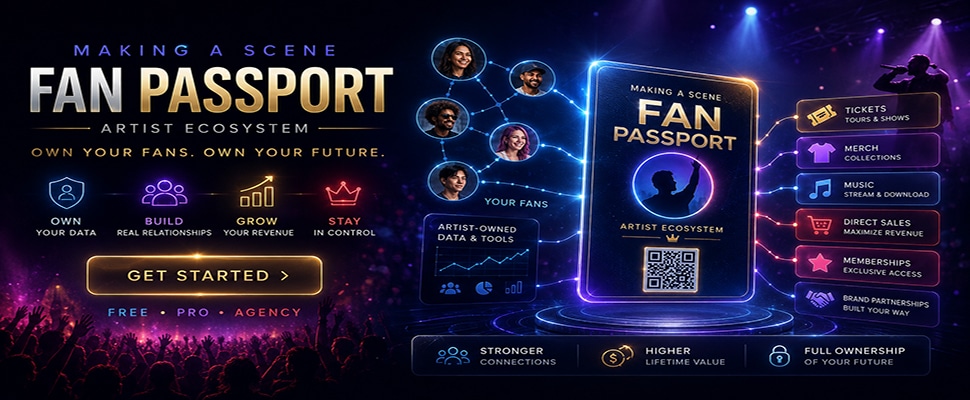
Subscribe to Our Newsletter
Discover more from Making A Scene!
Subscribe to get the latest posts sent to your email.


