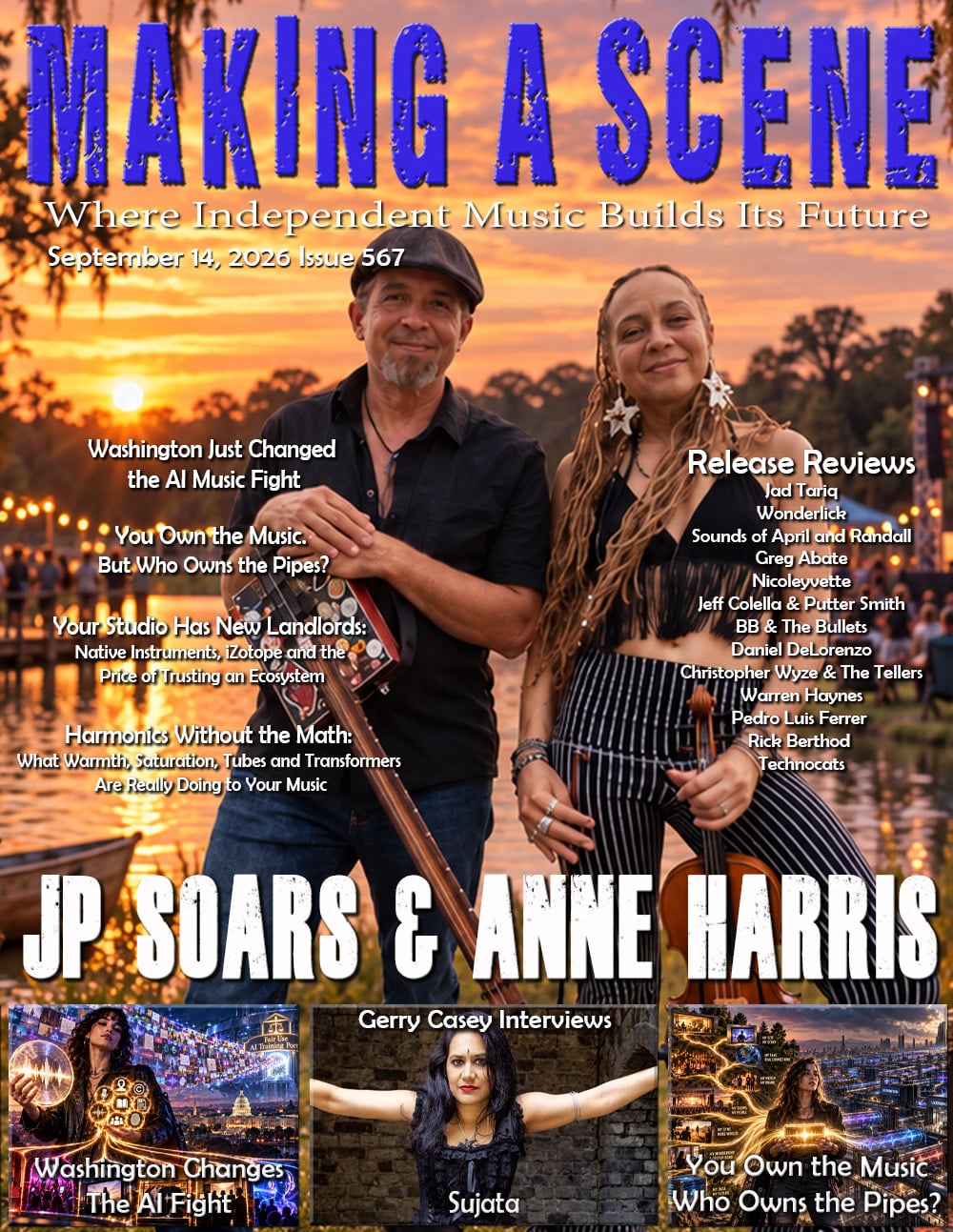

Your Distributor Is Becoming Your Storefront





Making a Scene Presents – Your Distributor Is Becoming Your Storefront: Private Equity, Consolidation, and the Fight for the Independent Artist’s Customer
Listen to the Podcast Discussion
For many independent artists, choosing a music distributor feels like choosing a mailbox.
You upload the song, type in the title, attach the artwork, enter enough names and numbers to make your eyes glaze over, and then wait for the music to appear on Spotify, Apple Music, Amazon Music, YouTube Music, TikTok, and the rest of the digital neighborhood.
The distributor delivers the package. The stores play the music. Royalties eventually trickle back. Everybody goes home.
That simple picture is becoming badly outdated.
Today’s distributors do not want to be mailboxes. They want to become operating systems for an artist’s entire business. They want to distribute the music, process the royalties, split payments among collaborators, create promotional links, sell merchandise, build websites, manage fan engagement, administer publishing, track data, and offer the artist another seventeen buttons that promise to “accelerate growth.”
Some of those tools can be genuinely helpful. A working musician does not receive a trophy for juggling twelve disconnected services and remembering twelve passwords. There is real value in making the business easier to run.
But there is also a much larger fight taking place under all those friendly dashboards.
The fight is over who controls the relationship between the artist and the fan.
That question became more important on July 6, 2026, when CVC Capital Partners announced that it had signed a definitive agreement to make a majority investment in DistroKid through CVC Capital Partners IX. Insight Partners, which had already invested in DistroKid, is expected to retain a significant minority stake. The companies said the transaction was expected to close during the third quarter of 2026, subject to customary closing conditions. Financial terms were not disclosed. As of July 30, the official announcement still described the transaction as an agreement expected to close, not as a completed acquisition.
The official announcement can be found at:
https://www.cvc.com/media/news/2026/cvc-capital-partners-to-make-majority-investment-in-distrokid/
This does not mean DistroKid suddenly became evil, changed its terms, raised its prices, or sent a private-equity associate to confiscate your snare drum.
None of those things has been announced.
It does mean that one of the largest gateways used by independent musicians is moving toward majority ownership by a major investment firm. That deserves more than a shrug, especially when distributors are expanding beyond distribution and into the areas where artists build their audiences, sell products, and collect customer information.
The real question is not whether private equity is automatically good or bad. The real question is whether independent artists are building businesses they can carry with them when the companies around them change owners, priorities, prices, or policies.
What a Majority Investment Actually Means
Private equity sounds mysterious because finance people enjoy using language that makes ordinary business activity sound like an ancient wizard ceremony.
A majority investment generally means an investor will own enough of the company to exercise substantial control over major decisions. The exact rights depend on the final ownership structure and legal agreements, which have not been made public in this case.
CVC Capital Partners is a global private-markets investment firm. According to the July 6 announcement, the investment is being made through CVC Capital Partners IX. Insight Partners will remain involved as a significant minority owner. DistroKid founder and Chief Executive Officer Philip Kaplan will continue leading the company, according to the announcement.
That last point matters. This is not an announcement that DistroKid’s founder is leaving or that the company is being folded into another distributor tomorrow morning. It is an ownership change that may provide DistroKid with more money, business connections, and resources while also bringing new expectations from investors.
Investment firms do not normally invest large amounts of money because they enjoy looking at colorful album covers. They expect the business to grow in value.
That growth can happen in healthy ways. DistroKid could improve its infrastructure, strengthen fraud detection, speed up payments, provide clearer royalty reports, expand customer support, enter more markets, improve security, and build tools that save artists time.
All of those things could help independent musicians.
A distributor handling millions of releases needs serious technology. Fraud is not a tiny side issue. Fake streams, stolen recordings, false claims, artificial activity, and manipulated accounts can damage both legitimate artists and the services paying the royalties. Better detection can protect the system.
More investment could also improve support. Anyone who has ever tried to explain a complicated release problem through a support form knows that “Please select the topic closest to your issue” is sometimes the first chapter of a very long novel.
Investment can help fix that.
It can also create pressure to produce more revenue. That might eventually mean attracting more subscribers, selling more optional services, introducing higher-priced plans, bundling features, acquiring other companies, reducing expenses, or finding new ways to earn money from transactions and customer activity.
Again, DistroKid and CVC have not announced that these changes will happen. It would be irresponsible to report possible outcomes as established plans.
It would be equally irresponsible for artists to pretend ownership changes never affect the companies they use.
The sensible response is not panic. It is preparation.
Why DistroKid Matters So Much
DistroKid is not a small side tool hiding behind the stage curtain. It is a major part of the independent music pipeline.
The company distributes music to a large range of streaming services and digital stores. Its current public material says artists can upload unlimited music under its subscription model and keep the earnings allocated to them by stores, minus applicable banking fees and taxes. DistroKid says it does not take a percentage of ordinary store and streaming income, although optional services can have separate charges or revenue shares. For example, its Social Media Pack retains 20 percent of revenue generated through that optional monetization feature.
The main site is:
Its help center is:
https://support.distrokid.com/
Artists use DistroKid for much more than uploading an audio file. The service handles release delivery, metadata submission, store selection, royalty reporting, withdrawals, collaborator payment splits, promotional landing pages, optional YouTube and social-video monetization, and other release-management tasks.
DistroKid’s HyperFollow pages can gather streaming destinations and, in some cases, invite listeners to share an email address with the artist. DistroKid also offers Spotify for Artists access, music-video tools, mastering through Mixea, publishing-related services, artwork tools, and numerous paid Album Extras. The exact availability and cost of these features varies, so artists should read the current pricing and support pages rather than assuming everything is included in the basic subscription.
That growing collection of services makes DistroKid useful. It also makes it easy for an artist to let the account become the only place where essential business records live.
Inside a distributor dashboard may be the official spelling of a release title, the version name, the release date, the artwork, the UPC, the ISRC for every track, the list of stores, the names of collaborators, the percentage assigned to each collaborator, royalty statements, payment records, tax information, and old support conversations.
That is not just dashboard clutter.
That is part of the artist’s business history.
If the only complete record of a five-year catalog lives inside one company’s system, the artist does not have an organized catalog. The artist has access to somebody else’s organized catalog database.
Those are not the same thing.
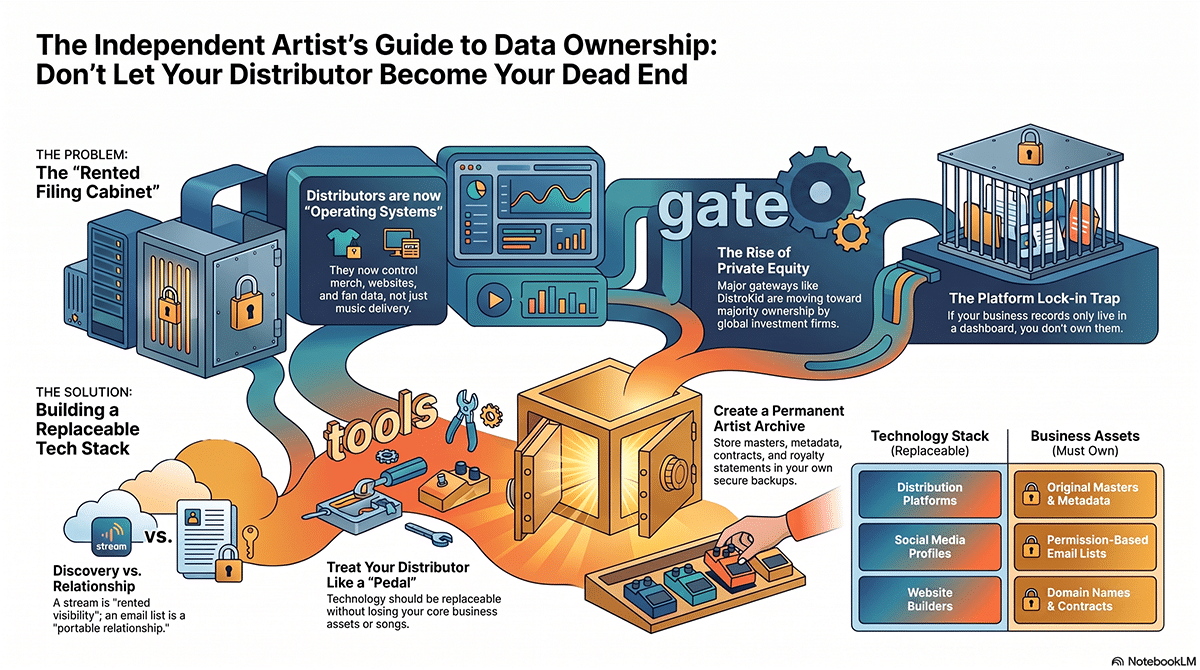
A distributor should be a replaceable service provider. It should not be the only filing cabinet containing the artist’s career.
A rented filing cabinet is perfectly useful until the rent changes, the office moves, the key stops working, or the company decides your cabinet is now available only with the Deluxe Platinum Filing Experience.
Independent Music Technology Is Consolidating
DistroKid’s ownership change is part of a wider pattern.
Music technology may look like a giant collection of independent apps, distributors, marketplaces, ticketing tools, publishing services, fan platforms, artificial-intelligence companies, and creator products. Behind those different brand names, however, ownership and investment relationships often connect them to a smaller group of major labels, media companies, technology firms, venture funds, private-equity firms, and institutional investors.
Water & Music founder Cherie Hu has tracked these connections through the organization’s “Music Tech Ownership Ouroboros.” The 2026 edition was published on March 12, 2026—not July 30—and examined the web of investments and acquisitions surrounding music technology. The analysis described growing consolidation in areas including artificial-intelligence music tools and live entertainment. It also emphasized that the map was not exhaustive and focused mainly on growth-stage investments and acquisitions involving major corporate or institutional buyers.
The article is available at:
https://newsletter.waterandmusic.com/archive/music-tech-ownership-ouroboros-2026-edition/
This does not mean every company is secretly controlled by the same three people sitting in a basement beside a glowing map and a bowl of cheese snacks.
Consolidation is usually less cinematic.
One company may own a majority stake. Another may hold a minority investment. A parent company may own several brands that continue operating separately. A distributor may depend on another company’s delivery technology. A platform may use outside providers for payments, fulfillment, hosting, advertising, analytics, rights management, or customer messaging.
The company name on the login screen may not tell the entire story.
An organization can be independently operated without being independently owned. It can be independently branded while relying on infrastructure controlled by much larger companies. It can call itself an independent platform while accepting investment from institutions that also hold positions in other parts of the music business.
None of that automatically makes a product dishonest or harmful.
It does mean the word “independent” is not a complete ownership report.
Artists should ask practical questions. Who owns the company? Who controls major decisions? What other companies share that owner? What happens to artist data? Can records be exported? Are important services supplied by another business? What rights does the platform receive under its terms?
The logo is not the business model.
Distributors Are Moving Into Direct-to-Fan Commerce
DistroKid’s move toward a broader artist-business platform began well before the CVC agreement.
In September 2023, DistroKid acquired Bandzoogle, a website-building and ecommerce service created specifically for musicians. The financial terms were not publicly disclosed. Reporting and DistroKid’s current support material describe Bandzoogle as part of DistroKid’s direct-to-fan ecosystem.
Bandzoogle’s site is:
Bandzoogle allows musicians to build websites, sell music and merchandise, create electronic press kits, collect mailing-list signups, use custom domains, sell tickets, and manage other direct-to-fan activity. Its public material promotes commission-free selling through artist websites, although artists must still consider subscription costs, payment-processing charges, fulfillment expenses, and any fees charged by connected services.
DistroKid and Bandzoogle also became more directly connected in 2026. Bandzoogle introduced a feature that lets artists import tracks from DistroKid into a Bandzoogle website. According to Bandzoogle, those imports can include FLAC audio, album artwork, UPC information, and ISRC data. That can save artists from entering the same information twice and help them sell downloads from their own website.
That is a practical example of useful integration. The artist distributes through one service and brings the release into a direct-sale website without rebuilding everything by hand.
DistroKid also operates Direct, its own print-on-demand merchandise service. DistroKid describes Direct as a platform that turns release artwork into products that can be sold without the artist holding inventory, packing boxes, or handling shipping. Artists choose products, set a profit margin, and keep the amount remaining after production, tax, and shipping costs.
The Direct service is at:
As of July 30, 2026, DistroKid’s support center lists Direct at $70 per year for each merch shop. The subscription renews automatically each year. DistroKid says fulfillment is handled through Gelato. The standard setup requires the artist to connect a PayPal account so customer money can be deposited and production costs can be withdrawn. DistroKid has also described a limited Stripe pilot as an alternative payment arrangement.
DistroKid says Direct can ship to customers in more than 200 countries and regions using a network of more than 140 print partners, with local production available in 32 countries.
That is no longer simple music delivery.
That is distribution, merchandise production, storefront operation, payments, fulfillment, promotion, and direct commerce moving into one connected ecosystem.
The distributor no longer delivers the song and quietly leaves the room.
The distributor would also like to sell the shirt, build the page, collect the payment, show the analytics, and perhaps offer the artist a few more upgrades before dessert.
SoundCloud Is Moving in the Same Direction
SoundCloud is following its own version of this strategy.
SoundCloud began as an upload, sharing, listening, and community platform. It now offers artist subscriptions, distribution, on-platform monetization, promotional tools, mastering, audience insights, YouTube Content ID, comments, direct messages, fan-powered royalties, and other creator services.
Its artist platform is:
https://artists.soundcloud.com/
On July 22, 2026, SoundCloud acquired assets connected to Nina Protocol after Nina wound down its service. Nina had announced in May that it would close its website and app by July 15 after failing to find a sustainable revenue strategy at its size. Before closing, Nina told users to withdraw earnings and export releases, purchases, and connections.
That instruction alone should be printed in large letters and taped above every artist’s computer:
Export your business before the platform disappears.
The SoundCloud agreement brought Nina’s editorial archive and genre map to SoundCloud. Nina artists were also given an optional process to transfer releases into SoundCloud’s creator ecosystem. SoundCloud’s migration page invited Nina users to transfer tracks and redeem a five-month Artist Pro trial.
The migration page is:
https://partner.soundcloud.com/nina
The transaction was sometimes described in headlines as SoundCloud “acquiring Nina Protocol,” but the details matter. Nina’s original service had already shut down. The deal involved the editorial archive, the genre map, and an optional migration path for artist catalogs. It did not simply keep the full Nina platform running exactly as it had before.
SoundCloud emphasized its tools for distribution, direct fan monetization, audience growth, fan engagement, mastering, promotion, uploads, and analytics. Reports about the acquisition also highlighted SoundCloud’s pitch that migrating artists could sell music directly to fans while retaining the sale revenue.
Artists should still read the details carefully.
“Keep 100 percent” can mean several different things depending on the service. It might refer to the amount the platform receives after payment-processing charges. It might apply only to direct sales, not streaming. It might apply to distribution royalties while stores, collection partners, tax authorities, or payment processors still make deductions.
SoundCloud’s monetization terms distinguish between on-platform monetization and off-platform distribution. Those terms state that participating music services and third-party providers may retain amounts before revenue reaches SoundCloud. The terms also describe payment schedules, a $25 payment threshold, metadata requirements, and SoundCloud’s nonexclusive rights while content participates in monetization or distribution.
This is not a criticism unique to SoundCloud. It is a reminder that a marketing headline cannot replace reading the agreement.
DistroKid and SoundCloud are different companies with different histories and products. The similarity is the direction of travel.
Platforms that once controlled one step of the music pipeline increasingly want to control several steps: upload, delivery, discovery, engagement, analytics, promotion, sales, payments, merchandise, and fan communication.
The Stream Is No Longer the Whole Prize
Why are so many music companies interested in direct-to-fan services?
Because the stream itself may not be the most valuable event.
A stream can create discovery. It can generate revenue. It can help a song travel. It can provide useful signals about what audiences enjoy.
But a stream usually does not give the artist a direct customer relationship.
The listener may love the song, save it, add it to a playlist, and play it twenty times. The platform knows who that person is. The artist usually receives an audience number, a city, an age range, or a chart.
The artist does not necessarily receive the listener’s name, email address, purchase history, communication permission, or a dependable way to reach that person outside the platform.
The artist sees the crowd through glass.
Direct-to-fan commerce changes the value of the interaction. A person who buys a ticket, shirt, vinyl record, download, membership, lesson, livestream pass, or special edition has done more than press play. That person has entered a business relationship.
Platforms understand this.
A listener may generate a fraction of a dollar through streams over time. A committed fan may buy a $25 shirt, a $20 ticket, a $30 record, and a membership. That does not mean every fan will do those things. It means the commercial relationship around the music can be worth more than the stream alone.
The company that controls that relationship gains something valuable.
It can see what fans buy. It can recommend more products. It can process future transactions. It can measure demand. It can sell additional services to artists. It can become harder to replace.
That is why the direct-to-fan layer is becoming a battleground.
“Can I Sell a Shirt?” Is the Wrong Question
A platform-hosted store may be convenient. That does not automatically make it an artist-owned customer relationship.
The wrong question is:
“Can I sell a shirt here?”
The better question is:
“When somebody buys the shirt, do I gain a customer relationship I can continue without this platform?”
That question forces the artist to look past the storefront.
Can the artist export the customer’s name and email address? Does the export include the product purchased, transaction date, location, order value, refund status, and consent record? Is the information delivered in a common format such as CSV? Can it be imported into another system? Can the artist continue communicating with the buyer if the store closes?
Does the artist even have permission to send marketing email to that buyer?
A purchase receipt is not automatically permission for endless promotion. Privacy and marketing laws vary by location, but the basic principle is simple: people should know what they are signing up for, why their information is being collected, and how to unsubscribe.
An artist should separate necessary transaction messages from marketing consent.
The receipt saying, “Your shirt has shipped,” is part of fulfilling the purchase.
The email saying, “Here are fourteen exciting reasons to attend every show for the rest of your natural life,” is marketing.
The artist needs a lawful and clearly documented reason to send it.
True control means more than being able to view a customer inside a dashboard. It means the artist has usable access to the information, valid permission to use it, records showing how that permission was obtained, and the ability to move the relationship to another system.
Analytics are not the same as data ownership.
Seeing that 482 people in Atlanta visited a page is useful. Being able to contact 120 people who knowingly joined the artist’s list is a business asset.
The first is rented visibility.
The second can become a portable relationship.
Distribution Must Be Replaceable
Artists should not necessarily leave DistroKid, SoundCloud, or any other service because of an investment or acquisition.
Moving a catalog can create its own problems. A rushed change can lead to duplicate releases, lost links, metadata mismatches, delayed delivery, split-payment confusion, and disruption across streaming services.
The goal is not constant movement.
The goal is the ability to move when necessary.
That ability begins with records.
Every artist should maintain a separate catalog archive containing the original master for every release. That archive should also include instrumentals, clean versions, alternate mixes, stems when appropriate, lyric sheets, artwork, photographs, credits, ownership documents, split sheets, licenses, producer agreements, work-for-hire agreements, mechanical information, publishing information, and registration confirmations.
The artist should preserve the exact metadata submitted with every release. That includes the artist name, release title, track title, version title, featured-artist formatting, songwriter names, producer names, contributor roles, language, explicit-content status, genre, release date, original release date, copyright notices, ISRC, UPC, and store selections.
Royalty statements should be downloaded regularly. Do not assume they will remain available forever. Save withdrawal confirmations, payment-processor records, tax forms, fee receipts, collaborator-payment records, and copies of communications involving disputed income.
Collaborator splits deserve special attention.
It is easy to remember the agreement during release week, when everybody is in the same group chat and still answering messages. Five years later, one musician has changed email addresses, another has moved, the producer is using a different business name, and somebody remembers the deal as “I’m pretty sure it was fifteen percent.”
“Pretty sure” is not an accounting system.
Save the agreed percentages, the date of the agreement, the rights involved, the names and contact information of the parties, and any later changes. Keep signed agreements somewhere outside the distributor.
Artwork should be preserved at full resolution. Do not rely on whatever compressed image can be downloaded from a streaming page. Save the original design file when possible, along with properly sized export versions.
Keep delivery and takedown records. Save the date a release was submitted, accepted, delivered, edited, rejected, or removed. Preserve support messages involving errors, artist-page conflicts, store mapping, ownership claims, or metadata corrections.
This paperwork is not the glamorous side of music. Nobody has ever held a lighter in the air while a singer downloaded a royalty statement.
It is still what allows the business to survive.
Changing Distributors Is a Metadata Problem
Artists often assume changing distributors is as simple as uploading the same audio somewhere else.
It can work smoothly, but continuity depends heavily on matching information.
When moving a release, artists generally try to preserve the same master recording, ISRC, artist name, track title, version information, artwork, and original release date. Matching metadata can help streaming services identify the recording as the same release rather than a completely new one.
It does not guarantee that every play count, playlist placement, review, social use, or platform statistic will remain connected. Streaming services control their own matching systems and policies.
That is why artists should never begin a distributor move by guessing.
The ISRC identifies a particular recording. The UPC identifies the release product. Those numbers should be copied accurately. A missing letter, different featured-artist format, changed title, alternate mix, or modified audio file can affect how a service handles the release.
The original distributor’s release record should be compared carefully with the new submission. The artist should also coordinate the timing of the new delivery and old takedown to reduce the chance of a gap.
The artist who has preserved every identifier can approach that process calmly.
The artist who has not preserved them may spend a memorable weekend searching old emails for a subject line containing the words “Your release is live.”
Build a Real Artist Archive
A useful archive does not need to look like a government records facility.
It does need to make sense six months from now.
Create one main folder for the artist business. Inside it, organize material by catalog, releases, accounting, agreements, publishing, fans, merchandise, shows, promotion, photographs, video, and website assets.
Each release should have its own clearly named folder. Use the release date and title. Inside that folder, keep the final masters, artwork, metadata sheet, credits, lyrics, identifiers, agreements, distribution records, promotional materials, and royalty information connected to that release.
Avoid filenames such as “final.wav,” “final2.wav,” “final_REAL.wav,” and “use_this_one_I_mean_it.wav.”
Include the song title, version, sample rate, bit depth, and date when useful. Clear filenames save money because they reduce mistakes when sending music to distributors, mastering engineers, licensing clients, radio stations, filmmakers, and collaborators.
Keep at least two backups in different locations. One might be an encrypted local drive. Another might be a reputable cloud-storage service. Highly important material may justify a third copy stored offline in another physical location.
Protect the accounts with unique passwords and two-factor authentication. Preserve recovery codes somewhere secure. Keep account ownership connected to an email address controlled by the artist or artist business, not an old manager, former band member, temporary assistant, or cousin who once promised to “handle the internet stuff.”
This work connects directly to revenue.
Organized records make it easier to license music, answer royalty questions, pay collaborators, register works, prepare taxes, prove ownership, move distributors, supply instrumental versions, respond to infringement, and deliver files quickly when an opportunity appears.
A music supervisor is unlikely to wait three weeks while the artist searches a broken laptop for the clean mix.
Separate the Technology From the Assets
An artist’s distributor is part of the technology stack.
So are the website builder, email provider, payment processor, ticketing company, merchandise service, customer-management system, cloud-storage provider, and social networks.
Those services can change.
The artist’s masters, songs, metadata, contracts, domain, customer records, consent history, photographs, brand assets, and direct fan relationships are business assets.
Those should survive changes in the stack.
Think of it like a touring guitar rig. Pedals can be replaced. Cables can be swapped. An amplifier can be rented. One wireless system may work better than another.
The songs, audience, identity, and reputation are the part you should not casually leave behind at the venue.
Your distributor is a pedal.
It may be an excellent pedal. It may save the whole show. It may remain on the board for twenty years.
It is still not the song.
The Artist-Owned Destination
The artist’s domain should be the center of the business.
That does not mean every fan must begin there. Fans may discover the artist through Spotify, YouTube, TikTok, Instagram, SoundCloud, radio, a playlist, a review, a live show, a friend, or a mysterious person at the end of the bar who insists the band will “change your life.”
Discovery can happen anywhere.
The destination should be controlled by the artist.
An artist-owned website should load quickly on a phone and immediately show visitors who the artist is. It should contain current music, upcoming shows, a useful biography, professional photographs, merchandise, direct purchasing opportunities, an electronic press kit, and clear contact information.
Most importantly, it should give the fan a reason to connect.
“Join my mailing list” is not always a compelling reason. The fan should understand what they will receive. That might be early access to tickets, new music, live recordings, local show alerts, special merchandise, behind-the-scenes material, fan rewards, or membership benefits.
The signup should clearly explain what information is being collected and what the fan is agreeing to receive.
That permission-based connection becomes the bridge between discovery and revenue.
A social post can lead to the site. A streaming profile can lead to the site. A merchandise package can include a QR code leading back to the site. A live-show announcement can lead to a fan-capture page. A review can introduce the artist, while the website continues the relationship.
Social media and streaming are doors.
The artist’s ecosystem is the room those doors should open into.
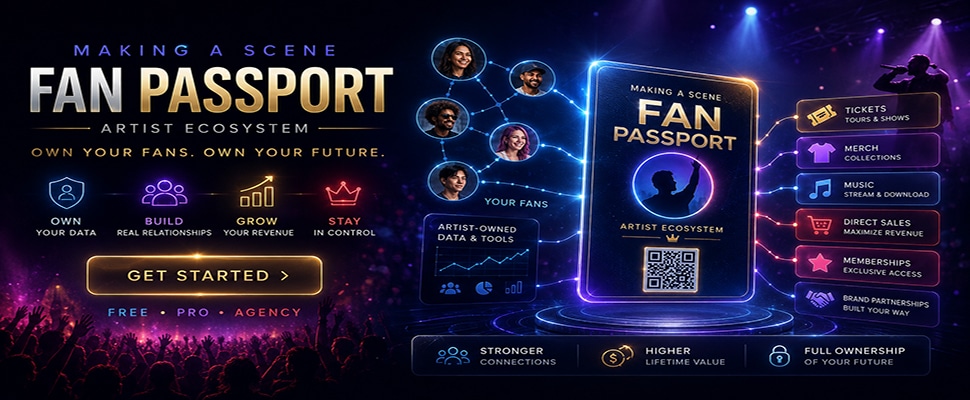
The Making a Scene Fan Passport Approach
The Making a Scene Fan Passport concept is built around this idea of permission, portability, and continuing connection.
An artist can place a QR code at a show, merchandise table, livestream, release page, website, poster, or physical product. That code leads to a focused fan-capture page.
The page should not demand a small mortgage application before allowing someone to hear the next song. It should ask only for useful information and explain the value of joining.
The fan might join to collect a show stamp, receive a reward, unlock a song, get early ticket access, enter a fan club, receive local show alerts, or support a release.
The important part is that the fan knowingly connects with the artist.
The system should record what the fan agreed to receive. The artist can then use that permission to build a respectful relationship through music, tickets, merchandise, memberships, rewards, direct sales, and special experiences.
This is not about “capturing” people like they wandered into a poorly designed wildlife trap.
It is about inviting supporters into an artist-controlled community.
The fan should be able to understand the exchange. The artist offers something useful. The fan grants permission for an ongoing connection. The artist respects that permission and does not turn one signup into a daily avalanche of desperate sales messages.
Done properly, the Fan Passport becomes portable proof of the relationship rather than another follower count trapped inside somebody else’s platform.
How AI Can Help Without Taking Over the Office
Artificial intelligence can help artists organize the administrative side of independence.
An AI tool can compare metadata sheets, identify blank fields, find spelling differences, organize filenames, summarize royalty reports, classify documents, prepare release checklists, and point out when one database lists a different songwriter name than another.
It can help an artist ask better questions about a platform’s terms. It can summarize difficult language and identify sections involving fees, termination, licenses, data use, arbitration, AI training, or account access.
The artist should still verify the answer against the original document. AI can misunderstand legal language, overlook exceptions, or confidently explain a clause that is not actually there. Confidence is not accuracy. Sometimes it is merely punctuation wearing a suit.
Artists should also be careful about what they upload.
Do not place confidential contracts, tax records, fan databases, passwords, unreleased masters, identification documents, or private customer information into a public AI service without understanding its privacy, security, and retention policies.
AI should not invent ownership information, guess royalty splits, create songwriter credits, sign agreements, or make legal decisions.
Use AI to clean the office.
Do not let it rewrite the deed to the building.
What Web3 Can Contribute
Nina Protocol’s history also shows that Web3 technology alone does not solve the business problem.
Nina used blockchain infrastructure to support direct music sales, artist ownership, custom catalog hubs, and other community functions. It still concluded that it could not find a sustainable revenue strategy at its size and shut down its original service.
That does not mean every Web3 idea failed.
It means decentralization must include a sustainable business.
Useful Web3 concepts include portable identity, verifiable permission, transparent transaction histories, digital membership, interoperable credentials, and artist-controlled access rights. Those tools can help a fan relationship move between services instead of disappearing when one platform closes.
A token alone does not create ownership. A blockchain entry does not guarantee that the artist controls the legal rights, customer records, private keys, or future communication channel.
The technology helps only when the artist controls the practical parts of the relationship.
That is the lesson artists should take from both Nina and the wider wave of consolidation.
Platforms can have good missions. Founders can sincerely care about artists. Communities can create real value. Technology can be innovative.
The business must still survive, and the artist must still keep portable records.
What Artists Should Watch After the Investment
DistroKid customers should pay attention to published changes over the months and years following the CVC investment.
Watch subscription pricing, renewal rules, optional extras, withdrawal costs, payment schedules, support access, catalog-removal procedures, royalty-report formats, collaborator requirements, merchandise fees, data exports, privacy policies, and account-termination terms.
Watch how new products are bundled. A useful tool introduced for free may later move into a higher plan. A feature sold separately may become part of a package. A legacy price may disappear. A new service may require an additional agreement.
None of those possibilities should be reported as a planned DistroKid change unless DistroKid announces it.
They are simply normal areas to monitor whenever a service becomes more central to an artist’s business.
Save dated copies of important agreements and policies when legally permitted. Keep receipts showing what you purchased. Preserve emails announcing changes. Compare actual invoices rather than relying on memory.
Terms pages can change.
It is difficult to compare the old agreement with the new one after the old agreement has climbed into the internet attic and hidden behind a box of AOL trial discs.
Documentation turns suspicion into evidence.
If a fee changes, the artist can identify it. If a policy stays the same, the artist can confirm that too. If a support answer conflicts with the written terms, the artist has something specific to question.
This is how business owners behave.
They do not need to assume every company is plotting against them.
They also do not build a career on the comforting belief that nothing will ever change.
Independence Is the Ability to Leave
An independent artist can use a distributor owned by private equity and remain independent.
An artist can use a major social platform and remain independent.
An artist can distribute through SoundCloud, build a site with Bandzoogle, sell merchandise through DistroKid Direct, process payments through PayPal, store files in the cloud, and use AI tools to organize the office.
Independence does not require refusing every outside service and mailing vinyl records from a cabin with no electricity.
Independence is measured by control.
Can the artist retrieve the catalog records?
Can the artist preserve the ISRCs and UPCs?
Can the artist prove who owns the masters and compositions?
Can the artist export royalty statements?
Can the artist move the website domain?
Can the artist take permission-based fan information to another system?
Can the artist continue communicating with supporters?
Can one service be replaced without rebuilding the entire business from nothing?
Those questions matter more than the logo on the dashboard.
A platform may call the artist independent while controlling the customer login, transaction history, communication system, analytics, and store.
A company may say the artist “owns the relationship” while providing no useful export.
Ownership is not a slogan.
It is possession, permission, documentation, portability, and the practical ability to act.
Use the Platform Without Becoming the Product
Private equity is not automatically the villain in this story.
DistroKid is not automatically the enemy.
Convenience is not automatically a trap.
A well-run distributor can save an independent artist enormous amounts of time. It can deliver music around the world, collect income, simplify royalty splits, provide useful promotion, connect releases to merchandise, and help an artist operate professionally without hiring a large team.
Artists should use those capabilities when the benefits are greater than the costs.
The danger begins when access to a platform is mistaken for ownership of a business.
A dashboard is not a backup.
A follower count is not a mailing list.
An audience graph is not a customer database.
A store page is not automatically a portable customer relationship.
A royalty balance is not a royalty archive.
The artist must remain bigger than the account.
The strongest independent musician is not the one who refuses every platform. It is the one who can use platforms aggressively without becoming trapped inside any of them.
Build a replaceable technology stack around a nonreplaceable core.
Own the masters. Preserve the compositions. Maintain accurate metadata. Organize the agreements. Control the domain. Back up the business records. Collect fan information with permission. Build a direct path from discovery to tickets, merchandise, music, memberships, licensing, publishing, and support.
Let distributors compete to provide better delivery.
Let merchandise companies compete to print better products.
Let streaming platforms compete to introduce more listeners.
Let technology companies compete to make the artist’s work easier.
But never surrender the only road connecting the artist to the fan.
Your distributor can deliver the music. Your merchandise service can print the shirt. Your streaming page can introduce the listener.
The artist must own the road that brings that fan home.
 |  Spotify |  Deezer |  Breaker |
 Pocket Cast |  Radio Public |  Stitcher |  TuneIn |
 IHeart Radio |  Mixcloud |  PlayerFM |  Amazon |
 Jiosaavn |  Gaana |  Vurbl |  Audius |
 Reason.Fm | |||
Find our Podcasts on these outlets
Subscribe to Our Newsletter
Discover more from Making A Scene!
Subscribe to get the latest posts sent to your email.


