
TREBEL Buys Sesh and the Race to Own the Superfan Layer Begins




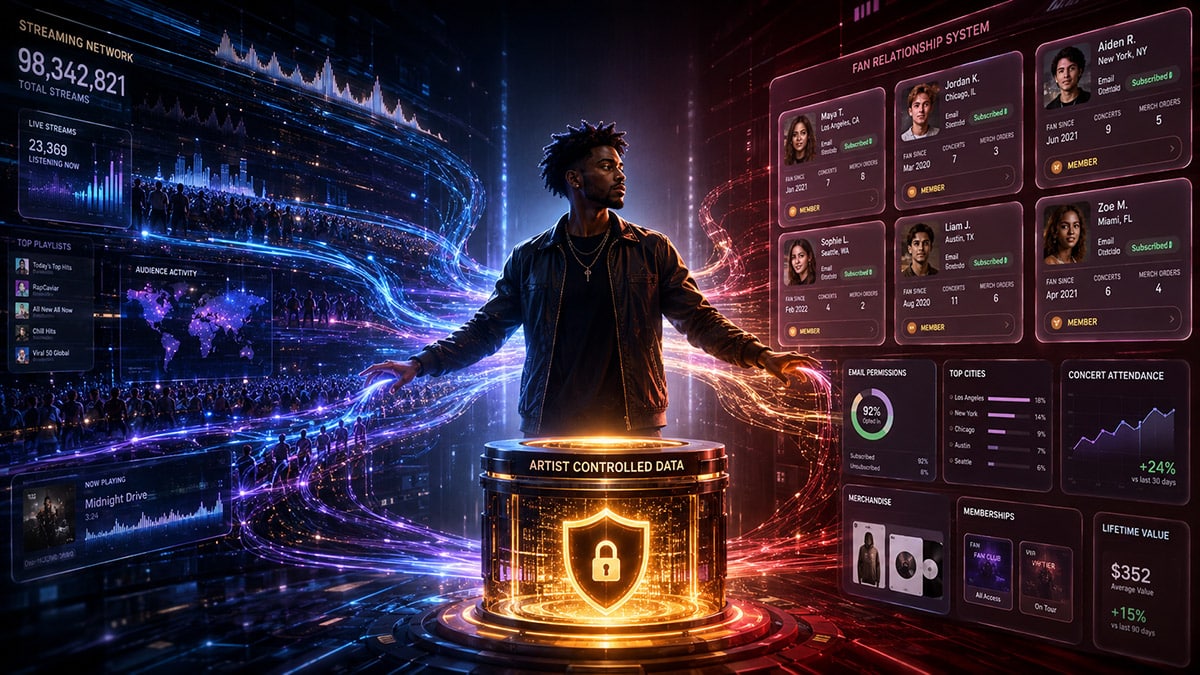
Making a Scene Presents – TREBEL Buys Sesh and the Race to Own the Superfan Layer Begins
Listen to the Podcast Discussion
For most of the streaming era, the music platform business has revolved around one basic action: getting someone to press play. The listener searches for a song, finds a playlist, follows a recommendation, or taps whatever the algorithm places in front of them. The platform tracks the activity, serves an advertisement or collects a subscription payment, and sends a small portion of the revenue through the music-rights system. The artist receives a stream count, a royalty report, and perhaps a map showing where the listening took place. Everyone calls this engagement, although the artist usually still has no idea who engaged.
That model is beginning to change. Streaming companies are discovering that the play button may be the beginning of the commercial relationship rather than the end of it. A listener who enjoys a song might also buy a concert ticket, purchase a vinyl record, join a membership, support a crowdfunding campaign, buy merchandise, attend a livestream, or pay for a premium experience. The trouble is that most streaming systems have historically kept that listener anonymous to the artist. The platform knows who the listener is, but the musician usually sees a number on a dashboard.
The acquisition of Sesh by TREBEL is important because it brings those two parts of the music business together. TREBEL has an audience of listeners, while Sesh has built technology intended to help artists identify, organize, and communicate with fans. Financial terms of the acquisition were not disclosed. The deal may prove useful for artists, but it also raises one of the most important questions in the modern music business: when a platform helps an artist build a fan relationship, does the artist actually get to take that relationship with them?
TREBEL Brings the Listeners and Sesh Brings the Relationship Tools
TREBEL, available at https://home.trebel.io/, is an advertising-supported music service operating across the United States and Latin America. It allows listeners to access music without paying the monthly subscription fee required by many other streaming services. On July 30, 2026, TREBEL announced that it had acquired Sesh, a platform focused on helping artists develop direct fan relationships. Sesh can be found at https://www.joinsesh.ai/.
The basic logic of the deal is not difficult to understand. TREBEL already has people listening to music, while Sesh has tools that are designed to turn some of those listeners into identified fans. According to public descriptions of the service, Sesh allows artists to collect information such as email addresses, locations, and dates of birth. Fans can also save an artist membership card inside a mobile wallet, giving the artist another way to stay connected outside a traditional social media feed.
Sesh also provides artist-facing customer relationship management tools, often shortened to CRM. A CRM is simply a system for organizing the people who have raised their hands and shown interest in an artist. Instead of seeing only a follower count, the musician can begin to see individual fan records, signup sources, locations, interests, purchases, memberships, or campaign activity. TREBEL says the combined operation will connect its listener base with Sesh’s artist campaign and relationship tools.
That sounds promising because artists need better ways to move people from passive listening into active support. The music business has spent years celebrating streams while avoiding the awkward question of whether streams alone can support a working musician. A stream can introduce someone to an artist, but it does not automatically sell a ticket, move a shirt, fund a recording session, or help pay for the van that has developed three warning lights since Ohio. The real business begins when the artist can invite the listener to take another voluntary step.
Streaming Is Useful, but Anonymous Listening Has Limits
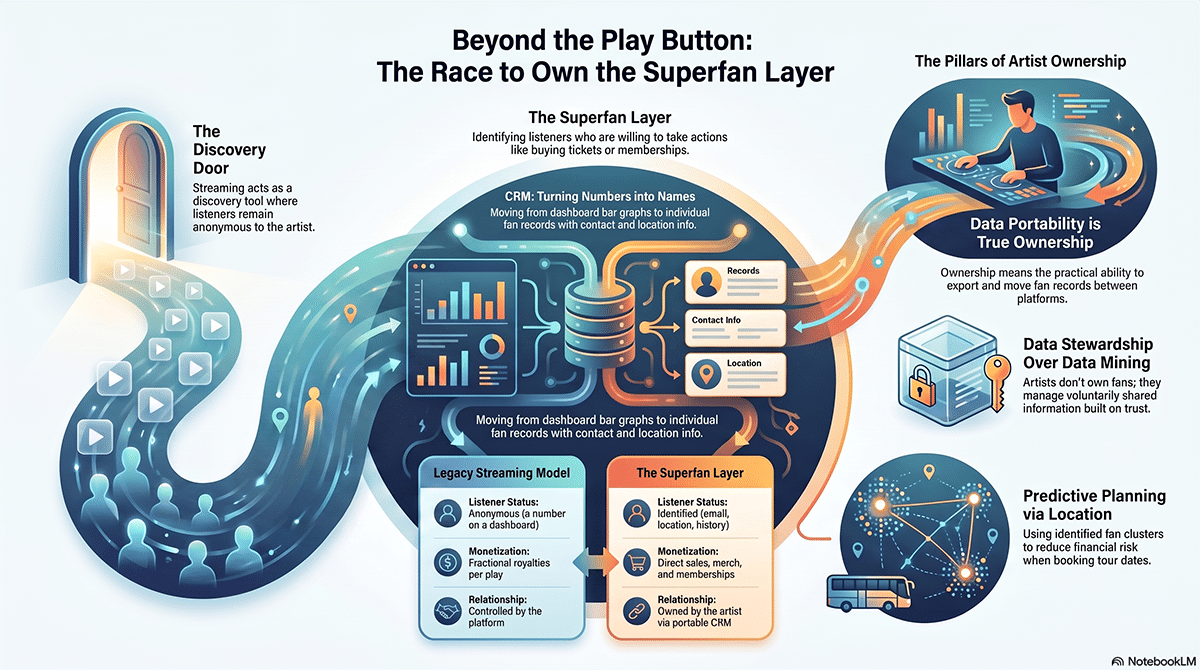
Streaming is an extremely useful discovery tool. A listener may hear an artist for the first time through a playlist, a recommendation, an advertisement, a shared link, or a search. That moment can open the door to a lasting relationship. The problem is that the artist is often standing on the other side of that door without the listener’s name, contact information, or permission to communicate.
A streaming dashboard may tell an artist that a song has listeners in Atlanta, Nashville, Chicago, or Los Angeles. It may show age ranges, playlist sources, follower growth, and total listening time. Those numbers can help an artist plan releases, advertising, and touring. They still do not provide a direct way to contact the people behind the activity.
An artist cannot send a ticket offer to a chart. A musician cannot thank a percentage for purchasing a record or invite a bar graph to join a membership. Numbers help describe an audience, but they are not a relationship. A relationship begins when a fan voluntarily identifies themselves and gives the artist permission to stay in touch.
That permission is what turns attention into a business asset. An email address, mobile-wallet membership, text permission, account profile, or direct purchase can create a connection that survives after the song stops playing. The artist can then communicate about upcoming shows, releases, merchandise, memberships, livestreams, and other offers. The fan can choose what they want to receive and how deeply they want to participate.
This does not make streaming unimportant. It simply places streaming in the correct position inside the artist’s business. Streaming should be treated as a discovery door that leads toward an artist-owned destination. Trouble begins when musicians mistake the door for the entire house.
The Superfan Layer Is the New Battleground
The music business is now racing to control what might be called the superfan layer. This is the part of the system where an anonymous listener becomes a known supporter and where that supporter begins spending money directly or indirectly around the artist. Streaming companies, labels, ticketing businesses, distributors, merchandise platforms, social networks, and direct-to-fan services all understand that this layer can be extremely valuable. Whoever controls the fan relationship can influence where the fan buys, communicates, subscribes, attends, and returns.
The word “superfan” can sound as though it refers only to someone who owns every record, travels to every concert, and can explain the artist’s 2009 lineup change in uncomfortable detail. In reality, the superfan layer includes many different levels of support. One person may join an email list, while another buys a ticket. Someone else purchases a shirt, supports a crowdfunding campaign, or joins a monthly membership.
The important change is not that every listener suddenly becomes a highly committed fan. The change is that platforms want to identify which listeners are willing to take another step. That information creates the possibility of more targeted campaigns, recurring revenue, better tour planning, and stronger merchandise sales. It also gives the platform more influence over the artist’s business.
This is why the TREBEL and Sesh deal is bigger than a simple technology acquisition. It shows that streaming services increasingly want to move beyond delivering music. They want to become the place where artists identify supporters, create campaigns, build communities, sell experiences, and manage recurring revenue. That may give musicians access to valuable tools, but it also means artists must pay close attention to who controls the underlying records.
A Platform CRM Can Be Helpful Without Being Artist-Owned
A CRM can be one of the most valuable tools in an independent artist’s business. It can help the musician keep track of names, contact information, locations, signup sources, purchases, memberships, show attendance, and communication preferences. It can also help the artist stop sending the same message to every person in every city. A fan in Boston probably does not need six reminders about a show in Phoenix unless the artist is including a plane ticket.
Sesh describes its tools as helping artists build and manage direct fan relationships. The platform includes features for collecting fan information, creating digital membership cards, organizing campaigns, and communicating with different parts of an audience. These tools could help an artist identify supporters in a particular market, invite frequent buyers to a premium offer, or communicate with members without relying completely on a social platform’s feed. That is genuine practical value.
However, there is an important difference between using a CRM and owning the relationship stored inside it. A platform may give an artist access to fan records while the account remains active. The artist may be able to send messages, create segments, and view campaign activity. None of that automatically proves that the full history can be moved elsewhere.
An artist-owned CRM should be portable. The musician should be able to export the records in a common format and move them into another system if the service changes, closes, raises prices, removes features, or is acquired. The artist should also understand exactly which fields are included in the export. A list containing only names and email addresses is useful, but it may leave behind much of the history that made the CRM valuable.
That history can include signup dates, locations, consent records, purchase activity, campaign responses, membership status, reward history, tags, and communication preferences. It may also include unsubscribe information that must be preserved so fans are not accidentally placed back onto a marketing list they already left. Portability is not simply about downloading something with “CSV” in the file name. It is about preserving the working memory of the fan relationship.
A Dashboard Is Not the Same as Ownership
Technology companies frequently describe data as being owned by the user. That language sounds reassuring, but artists should look beyond the headline. Ownership should mean more than being allowed to view information inside a branded dashboard. It should include the practical ability to download, understand, protect, and move the records.
Artists should know whether they can export fan names, email permissions, locations, signup sources, purchase history, membership details, and campaign activity. They should know whether the export can be performed at any time or only after requesting help from support. They should understand whether the records remain available if the account is downgraded, suspended, or closed. They should also know whether any important data is locked inside proprietary scores or internal platform systems.
This does not mean that Sesh or TREBEL are necessarily preventing portability. It means that artists should never assume that a marketing phrase answers every operational question. Sesh publicly presents its system as artist-focused and describes the information as artist-owned. That is a positive starting point, but every musician should still review the current terms, export features, privacy rules, and account-closing process before making any service the only home for important fan information.
The strongest platforms should welcome these questions. A service that truly supports artist independence should make it easy for musicians to leave with their lawful, permission-based records. It should not require the artist to send repeated support requests, locate a forgotten password, and perform a ceremonial dance under a full moon before receiving an incomplete spreadsheet. Portability should be a normal feature rather than an emergency escape plan.
Fan Data Must Be Collected With Permission
The phrase “own your fan data” can become dangerous when people forget that the fan is a human being rather than a row in a database. Artists do not own fans. They manage information that supporters voluntarily share for a stated purpose. That relationship should be built with clear permission, honest communication, and reasonable security.
An artist should explain why information is being collected. A fan who enters an email address for ticket updates should understand whether that also includes release announcements, merchandise offers, membership invitations, or newsletters. A person who shares a date of birth for an age-restricted event may not expect it to be used for unrelated marketing. Clear language builds trust and reduces confusion.
Artists should also avoid collecting information simply because a form allows it. Location can be extremely useful for tour promotion. A birthday may support a reward program or age verification. Purchase history can help the artist avoid sending irrelevant offers. Every additional piece of information also creates another responsibility to store and protect it properly.
Federal email rules require commercial messages to include a clear method for opting out, and those requests must be honored. Artists should preserve unsubscribe records when moving from one platform to another. A fan who left a list should not suddenly reappear because someone imported an old file without checking the consent history. Nothing destroys trust faster than an artist announcing, “You are receiving this because you asked us to stop contacting you three years ago.”
Fan ownership should therefore be understood as stewardship. The artist controls the relationship record, but the fan controls whether the relationship continues. That balance is not a burden placed on the business. It is the reason the relationship has long-term value.
The Fan Journey Begins With a Small Step
The purpose of identifying a listener is not to immediately hit that person with twelve sales offers. The first job is to give the listener a clear and useful reason to come closer. That might be early notice of a show, access to an unreleased song, a behind-the-scenes story, a digital membership card, a discount, or a private update. The offer should match the artist and the moment.
When the listener accepts, the relationship changes. The artist now knows that someone enjoyed the music enough to take another step. A welcome message can introduce the artist, explain what the fan will receive, and offer a simple path into the catalog. The artist does not need to deliver an autobiography, complete production diary, and three-hour livestream before breakfast.
Over time, the fan may move through several levels of support. They may open emails, follow show announcements, purchase a ticket, buy merchandise, join a membership, support a new recording, or attend a VIP event. Each action provides more information about what the fan values. The artist can then make better offers instead of sending the same generic message to everyone.
This process should feel natural rather than mechanical. A good fan journey resembles a growing relationship, not a vending machine that keeps requesting another dollar. The artist provides music, stories, access, community, and useful opportunities. The fan decides when and how to support the work.
Tickets Turn Fan Locations Into Tour Opportunities
Location information can have a direct effect on an artist’s income. Streaming reports may show that a city has listeners, but an identified fan list can reveal who has actually asked to receive information. Those people are more useful when planning a show because the artist has a direct way to test demand. A targeted message can help determine whether a market is ready for a ticket offer.
An artist with several hundred known supporters near a city may be able to announce a show, offer presale access, or test interest before committing to a larger room. The response may help the musician decide whether to add a second date, arrange a house concert, create a small VIP gathering, or partner with a local venue. The information does not remove the financial risk, but it makes the decision less dependent on hope.
Location-based communication can also improve the fan experience. People receive show announcements that are actually relevant to them. A supporter in Georgia does not need repeated reminders about a Tuesday-night appearance in Oregon. The artist saves money, the fan sees fewer useless messages, and the campaign becomes more effective.
The artist should still consider travel costs, venue guarantees, ticket prices, local promotion, lodging, and production expenses. A cluster of email addresses does not automatically mean the band should rent a bus and begin printing backstage passes. Fan data improves judgment, but it does not replace a budget.
Merchandise Turns Support Into Both Revenue and Identity
Merchandise is one of the clearest ways for a fan to move from listening into visible support. A shirt, poster, vinyl record, lyric book, hat, or signed item can create immediate revenue for the artist. It also gives the fan a physical connection to the music. A person wearing an artist’s shirt is publicly carrying the relationship into the world.
Purchase history can help the artist make future offers more relevant. Someone who bought a vinyl record may be interested in a signed edition, deluxe release, or anniversary pressing. A fan who purchased a shirt at a show might respond to a new design or tour bundle. The artist can also avoid repeatedly offering the same product to a person who already owns it.
This only works when merchandise information remains connected to the larger fan record. If the store knows what was purchased but the email system does not, the artist sees only part of the customer. If the ticketing service knows who attended but the CRM does not, another part of the relationship is missing. The strongest artist-owned system brings these pieces together.
That combined view can help the musician understand which products sell in different markets, which fans support multiple releases, and which offers create repeat business. The goal is not to study every supporter like a laboratory specimen. The goal is to remember what people have already done and treat them like valued members of the artist’s community.
Memberships Can Create More Predictable Income
Memberships are especially valuable because they can create recurring revenue. Ticket income arrives around performances, while merchandise income arrives when someone makes a purchase. A monthly or annual membership can help smooth out the periods between releases and tours. That stability can support recording costs, rehearsal space, travel, marketing, and other ongoing expenses.
A membership does not need to turn the artist into a full-time content machine. Fans may value early ticket access, private livestreams, unreleased recordings, studio updates, member-only merchandise, discounts, listening parties, or occasional online conversations. The best membership offers are realistic for the artist to maintain and meaningful enough for fans to remain involved.
Sesh publicly promotes membership tools and digital fan cards as part of its platform. Those features may help artists create a more organized community and offer different levels of access. The important ownership question is whether the member records can move if the artist later changes systems.
Membership data involves more than a name and email address. It may include payment status, renewal dates, membership level, promised benefits, reward history, and access rights. If that information disappears during a platform change, the artist still owes fans the experience they paid for. A portable system should preserve enough history to continue serving members without forcing everyone to begin again.
Direct Sales Make the Fan a Customer
Direct music sales create a different relationship from streaming. When a supporter buys a download, record, CD, cassette, live recording, or deluxe package, the artist receives both revenue and evidence of demand. The fan becomes a customer rather than remaining an anonymous listener. That transaction can become the beginning of future business.
Direct sales also allow artists to offer products that do not fit neatly inside a streaming service. A musician might sell a live concert recording, acoustic version, instrumental edition, remix stems, handwritten lyric sheet, signed pressing, production notes, or limited bundle. These products can serve collectors, musicians, producers, and supporters who want something deeper than ordinary access.
A well-organized CRM can help match the right offer to the right fan. Someone who repeatedly attends shows may want a live recording. A producer who joined through a studio workshop may be interested in stems or session notes. A longtime supporter may want a signed deluxe edition.
The artist should avoid turning every fan interaction into a sales message. Direct sales work best when the product has genuine value and the offer makes sense. A fan relationship can produce revenue because trust has been built, not because the artist has discovered the “send campaign” button and become emotionally attached to it.
VIP Experiences Can Create High-Value Revenue
Some supporters value access more than physical products. VIP experiences can include soundcheck visits, meet-and-greets, songwriting sessions, studio tours, private performances, listening parties, online workshops, small-group question-and-answer events, or production breakdowns. These offers can create significant direct revenue without requiring stadium-level audience numbers.
A local artist might invite a small group of supporters to a preshow gathering. A producer could offer a private mix review. A songwriter might hold a monthly writing session or lyric workshop. A touring band could combine a ticket with early entry, exclusive merchandise, and a short acoustic performance.
Fan segmentation makes these offers more practical. The artist can invite people who have already shown deeper interest rather than presenting an expensive package to every casual listener. That protects the artist from wasting promotional money and protects fans from receiving offers that do not fit their level of interest.
VIP experiences must still be delivered carefully. The artist should be clear about what is included, how long it lasts, and whether access is limited. A disappointing premium experience can damage trust faster than an ordinary merchandise problem because the fan paid for closeness, not just a product.
Crowdfunding Works Better With an Identified Community
Crowdfunding is much stronger when the artist already has a relationship with the people being asked to contribute. A campaign launched into the general internet may depend heavily on algorithms, paid advertising, and repeated social posts. An artist-controlled fan list provides a more dependable starting point. The musician can explain the project directly to people who have attended shows, purchased merchandise, joined memberships, or supported earlier releases.
A recording campaign might offer signed records, studio visits, production credits, private performances, handwritten lyrics, or early listening access. A tour campaign might include house concerts, travel diaries, limited merchandise, or local sponsor packages. These rewards can generate revenue while giving supporters a meaningful role in the project.
The artist still needs a realistic budget and delivery plan. A CRM cannot rescue a campaign that promises 900 custom paintings, 400 private concerts, and delivery by next weekend. Technology helps the artist find and communicate with supporters, but the business still requires planning.
An identified fan community also makes it easier to continue the relationship after the campaign ends. Backers can receive progress updates, delivery information, future offers, and invitations to the next project. The crowdfunding platform becomes a tool rather than the only place where the community exists.
Sponsor Offers Become Stronger With Real Audience Knowledge
Sponsors often want more information than a public follower count can provide. A brand may care about where the audience lives, how actively fans participate, what kinds of events they attend, and whether the artist can communicate directly with them. An artist-owned CRM can provide combined audience insights without exposing individual personal information.
The artist might show that a meaningful number of supporters live in a particular region, attend live events, purchase merchandise, or respond to specific campaigns. That information can make a sponsorship proposal more credible. It demonstrates that the artist has a working community rather than a collection of passive numbers.
A sponsor could support a tour, livestream series, educational program, recording project, fan reward, or community event. The artist receives revenue or resources, while the sponsor receives a connection to an engaged audience. The arrangement should also provide something useful or enjoyable to the fans.
Individual fan records should not be handed to sponsors unless the fan has clearly agreed. Audience insights can be shared in combined or anonymous form. The artist’s responsibility is to create value without turning the fan list into a rental property.
AI Can Help Artists Understand Their Own Data
As an artist’s fan records grow, the information can become difficult to understand. A musician may have thousands of contacts, multiple campaigns, merchandise records, ticket buyers, memberships, and location data. Artificial intelligence can help organize that information and identify patterns. This is one of the more practical uses of AI in an independent artist’s business.
An AI system connected to permission-based fan data could help identify cities with growing support, groups of people likely to attend a show, past customers who may want a new product, or members who have stopped engaging. It could summarize campaign results, suggest audience segments, and help the artist draft more relevant messages. Sesh has promoted AI-supported strategy tools as part of its artist platform.
AI should not be treated as an automatic decision maker. A sudden increase in listening activity from one city might reflect a real fan community, a playlist placement, a viral post, or unusual automated traffic. The software can point toward the pattern, but the artist still needs to understand the reason behind it.
The quality of the AI also depends on the quality of the data. If fan information is scattered across unrelated platforms, the system sees an incomplete picture. An artist-controlled CRM creates a cleaner foundation. AI can then help the musician understand the business without replacing human judgment or the personal nature of the fan relationship.
Web3 Matters Most When It Supports Portability
Web3 has often been sold to musicians through speculation, collectibles, and promises that sounded suspiciously like someone had discovered money growing behind the rehearsal space. The more useful Web3 idea is portability. A digital credential could allow a fan to prove membership, attendance, support, or access rights across compatible services. That could reduce the need to rebuild the same community every time an artist changes platforms.
A fan might hold a digital membership credential showing that they supported a release, attended a tour, or earned early ticket access. The credential would not need to expose private personal information publicly. It could simply confirm that the person qualifies for a benefit.
This approach could help preserve continuity when an artist moves between ticketing, membership, community, or commerce tools. The fan would not lose every reward or status marker because a company changed direction. The artist would not need to reconstruct the entire history manually.
That is the practical Web3 opportunity for independent musicians. The value is not in encouraging fans to speculate on the artist’s popularity. The value is in creating portable proof of a real relationship, purchase, membership, or reward.
Every Acquisition Should Remind Artists to Plan for Change
The TREBEL purchase of Sesh may produce better tools and greater reach. TREBEL can connect listeners with Sesh’s artist relationship technology, while Sesh may gain access to a larger audience. The combination could make it easier for artists to identify supporters and create direct revenue opportunities. There is good reason to watch the development closely.
The acquisition also demonstrates why artists need portability. Companies are purchased, merged, renamed, repositioned, and closed. Leadership changes, pricing changes, product plans change, and features sometimes disappear. Even a well-run service cannot promise that its current form will exist forever.
This does not mean artists should avoid platforms. A musician can benefit from streaming, ticketing, social media, commerce, and direct-to-fan services without surrendering control of the whole business. The artist should use each tool for what it does well.
The danger comes from allowing one outside company to become the only keeper of the fan relationship. When the company changes, the artist may be forced to rebuild the audience. A portable CRM allows the musician to change tools without abandoning the people who supported the work.
The Making a Scene Artist Ecosystem and Fan Passport
The Making a Scene Artist Ecosystem and Fan Passport are built around the idea that artists should control their own business relationships. Information about the system is available at https://masfanpassport.com/, while the hosted artist platform can be found at https://masfanpassport.app/. The goal is not to replace every streaming, ticketing, social, or commerce service. The goal is to create an artist-controlled center that connects those services.
An artist may discover fans through TREBEL, another streaming platform, social media, live shows, press coverage, or advertising. The important next step is bringing interested people into a permission-based relationship that the artist can manage. Fan Passport is designed to support that journey through artist profiles, fan connections, show activity, rewards, QR codes, and direct communication.
The system allows streaming and social platforms to remain discovery doors. The artist-owned ecosystem becomes the destination where fans can learn more, join the community, receive relevant updates, buy products, attend shows, and deepen the relationship. This structure reduces the risk of rebuilding the audience every time a platform changes.
It also connects online discovery with real-world activity. A fan can hear a song, join the artist’s system, attend a show, check in, receive a reward, buy merchandise, and continue the relationship afterward. That creates a record of support instead of leaving each interaction isolated inside a different company’s dashboard.
Build the Exit Door Before You Need It
Artists should investigate portability before becoming dependent on any fan platform. They should know what information can be exported, what format is used, how often the export can be performed, and whether the process requires support. They should also understand which records may remain trapped inside the original service.
A strong export should contain more than email addresses. It should preserve names, locations, signup sources, dates, permissions, tags, purchases, membership status, campaign history, reward activity, and unsubscribe records where those fields exist. Some internal scores, automation rules, wallet connections, or platform-specific measurements may not transfer.
Artists should download backups regularly and store them securely. Access should be limited to trusted team members. Files containing personal information should not be scattered across laptops, old email attachments, and mystery drives labeled “Band Stuff Final Final 2.”
The artist should also test the export. Opening the file and checking the fields can reveal missing information, duplicates, broken characters, or incomplete consent records. A backup that has never been examined is not a reliable business plan. It is a comforting theory.
Use the Platform, but Own the Relationship
The TREBEL and Sesh deal points toward a future in which streaming services do more than deliver music. They may help artists identify fans, create campaigns, sell experiences, manage memberships, and build recurring revenue. That can be a meaningful improvement over a system that produces only anonymous plays and royalty reports.
Artists should use useful tools wherever they find them. They should use TREBEL, Sesh, ticketing platforms, merchandise services, social networks, crowdfunding systems, and streaming companies when those services help the music reach people. Refusing every outside platform would leave most musicians performing private concerts for the family dog.
The artist should still maintain an independent foundation beneath those tools. Permission-based contact information, purchase history, memberships, fan locations, campaign activity, and communication preferences should live in a portable system the artist controls. That system becomes part of the value of the business.
The race to own the superfan layer has begun because the music industry understands that the most valuable part of streaming may happen after the stream. A listener becomes an identified fan, then a ticket buyer, merchandise customer, member, direct music buyer, crowdfunding supporter, VIP participant, or long-term patron. Each step can create revenue that reaches the artist more directly.
The companies building this layer may provide excellent services, but the artist should never confuse a convenient platform with permanent ownership. Use the dashboard, learn from the data, and build campaigns with the tools. Just make sure the fan relationship can leave when the artist does.
Independent musicians do not need to own every platform. They need to own the connection that survives after the platform changes. That connection is where trust lives, where direct revenue grows, and where a real music industry middle class can finally begin to take shape.
 |  Spotify |  Deezer |  Breaker |
 Pocket Cast |  Radio Public |  Stitcher |  TuneIn |
 IHeart Radio |  Mixcloud |  PlayerFM |  Amazon |
 Jiosaavn |  Gaana |  Vurbl |  Audius |
 Reason.Fm | |||
Find our Podcasts on these outlets
Buy Us a Cup of Coffee!
Join the movement in supporting Making a Scene, the premier independent resource for both emerging musicians and the dedicated fans who champion them.
We showcase this vibrant community that celebrates the raw talent and creative spirit driving the music industry forward. From insightful articles and in-depth interviews to exclusive content and insider tips, Making a Scene empowers artists to thrive and fans to discover their next favorite sound.
Together, let’s amplify the voices of independent musicians and forge unforgettable connections through the power of music
Make a one-time donation
Make a monthly donation
Make a yearly donation
Buy us a cup of Coffee!
Or enter a custom amount
Your contribution is appreciated.
Your contribution is appreciated.
Your contribution is appreciated.
You can donate directly through Paypal!
Subscribe to Our Newsletter
Order the New Book From Making a Scene
Breaking Chains – Navigating the Decentralized Music Industry

Breaking Chains is a groundbreaking guide for independent musicians ready to take control of their careers in the rapidly evolving world of decentralized music. From blockchain-powered royalties to NFTs, DAOs, and smart contracts, this book breaks down complex Web3 concepts into practical strategies that help artists earn more, connect directly with fans, and retain creative freedom. With real-world examples, platform recommendations, and step-by-step guidance, it empowers musicians to bypass traditional gatekeepers and build sustainable careers on their own terms.
More than just a tech manual, Breaking Chains explores the bigger picture—how decentralization can rebuild the music industry’s middle class, strengthen local economies, and transform fans into stakeholders in an artist’s journey. Whether you’re an emerging musician, a veteran indie artist, or a curious fan of the next music revolution, this book is your roadmap to the future of fair, transparent, and community-driven music.
Get your Limited Edition Signed and Numbered (Only 50 copies Available) Free Shipping Included
Discover more from Making A Scene!
Subscribe to get the latest posts sent to your email.


