
There Are Humans Inside the WAV File: What the AFM’s AI Lawsuit Is Really Teaching Independent Artists




Making a Scene Presents – There Are Humans Inside the WAV File: The AFM AI Lawsuit and the Rights Revolution Independent Artists Should Start Building Now
Listen to the Podcast Discussion
There is a wonderful moment at the end of making a record when all the complicated things that went into it suddenly appear to become simple. The drummer has gone home, the guitar amps are quiet, the background vocals have finally stopped multiplying, the producer has approved the mix, and somebody has decided that the mastering revision really is the last revision this time. Sitting on the hard drive is one beautiful WAV file, although years of recording-studio experience suggest there is at least a fighting chance it has been given a name like SONG_MASTER_FINAL_V8_REALLY_USE_THIS_ONE.wav while several neighboring files make equally persuasive claims to the throne.
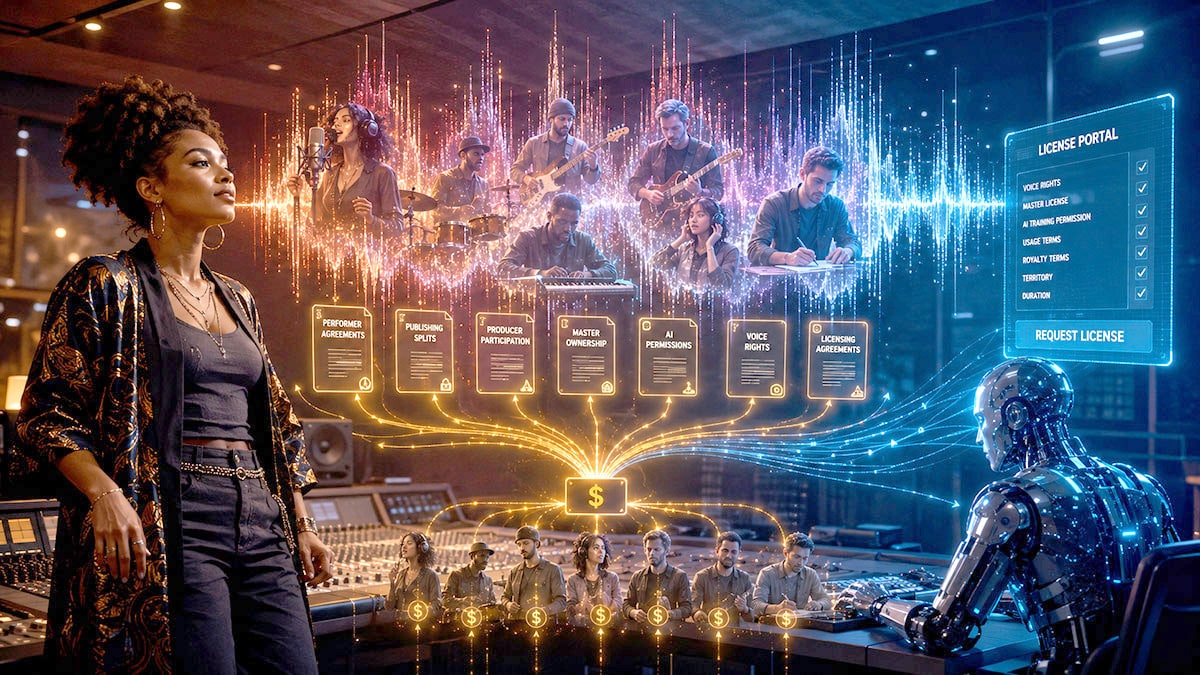
To the computer, that finished master really is one file. To the music business, however, it may contain an entire small civilization. The drummer may have been hired under one agreement, the bass player under another, the producer may have royalty points, the guitar player may also own part of the song, a guest singer may have signed a release, and several songwriters or publishers may control pieces of the composition underneath the recording. Around all those people can be union obligations, copyright interests, invoices, split sheets, approvals, old emails and the occasional handshake agreement everybody remembers with remarkable confidence until a check arrives and suddenly three people remember the conversation differently.
Generative artificial intelligence is forcing the music industry to confront that messy human reality because AI companies are not merely interested in distributing finished recordings. Some are building systems that can learn from music, analyze it, transform it, imitate aspects of it or generate something new from enormous bodies of existing material. That means the industry is suddenly asking questions about recordings that were made years before anyone thought to put words like “model training,” “fine-tuning” or “digital replica” into a session agreement. As usual, technology has raced several miles ahead while the paperwork is still looking for its car keys.
That collision is now playing out in federal court. The American Federation of Musicians of the United States and Canada, whose home is at https://www.afm.org/, filed suit on June 5, 2026, in the Southern District of New York over AI licensing arrangements involving recordings performed by AFM musicians. After an amended complaint and a corporate-name correction, the defendants include Universal Music Group, Warner Records and Atlantic Recording Corp. The union argues that AI licensing arrangements involving Suno and Udio triggered the “new use” provisions of the Sound Recording Labor Agreement and therefore created notice and compensation obligations to covered musicians. Universal, Warner Records and Atlantic dispute the AFM’s interpretation, and as of August 28, 2026, Judge Edgardo Ramos has not ruled that the labels violated the agreement. The case remains an active contract dispute, not a completed victory lap for either side.
That legal distinction matters because this article is not about declaring the labels guilty before the judge gets around to reading the briefs. The much more useful question is what the dispute exposes for independent artists. Beneath all the legal language sits a remarkably practical problem: when human beings make a recording today, what have they actually agreed can happen to their performances tomorrow?
For independent artists, that question does not have to arrive as a crisis. It can become part of how we build a cleaner, more valuable and more flexible music business from the beginning.
When an Old Recording Contract Meets a New Machine
The AFM lawsuit grew out of something that would have sounded fairly exotic only a few years ago. Major music companies that had previously accused generative-AI companies of infringing their recordings began making commercial agreements with some of those same companies. Universal Music Group announced a settlement and licensing arrangement with Udio on October 29, 2025, covering recorded music and publishing for a new licensed AI platform. Warner Music Group announced its own Udio agreement on November 19 and followed on November 25 with a Suno partnership that also settled previous litigation. Those agreements did more than end lawsuits; they began creating a commercial framework in which licensed music could become part of new AI-powered products.
Suno can be found at https://suno.com/ and Udio at https://www.udio.com/. Both companies continue to change their products and commercial relationships, which is worth remembering whenever somebody speaks about “AI music” as though it were a single machine in a basement somewhere with one permanent business model. The technology, licensing structures and products are changing quickly enough that today’s description may need another paragraph by breakfast next Thursday.
The AFM’s case is not simply a copyright lawsuit claiming the labels stole recordings. Its central argument is contractual. The union contends that the Sound Recording Labor Agreement already anticipated the larger principle that a recording made for one purpose may later become valuable for another, and that when covered recordings are put to certain new uses, obligations can follow the recording into that later market. The 2023 agreement materials specifically address “non-traditional” licensing and amend Article 21, while earlier AFM materials explain the broader idea that recordings moved into a new medium can create compensation obligations under the agreement.
The labels see the AI situation differently. Universal has argued that Article 21 does not simply manufacture a new compensation rate whenever technology invents a new commercial use, because the provision points to payment under an applicable AFM agreement for that later use. Warner has advanced a related argument that there is no existing AFM agreement establishing a rate specifically for generative-AI training, while the union argues that the provision would make little sense if it could apply only after another agreement had already anticipated the new medium. The AFM has pointed to earlier developments such as video games as evidence that new-use obligations have historically had to confront technologies that did not arrive carrying their own convenient rate sheet.
That disagreement is why there is a lawsuit instead of a payment spreadsheet. The court will have to decide what the parties’ contract means, assuming the dispute is not resolved another way first. For an independent artist, though, the lesson does not depend on predicting the judge. The more important fact is that one of the biggest arguments in modern music now turns on what people decades ago meant when they wrote down the rules governing the future use of a recording.
There is a certain music-business poetry in that. We have gigantic generative models, billions of dollars in technology investment and computers capable of producing music from text prompts, yet everyone eventually ends up hunched over a contract asking what paragraph twenty-one means.
Warner Did Not Simply Vanish From the Case
The Warner side of the lawsuit became confusing because corporate names do what corporate names do, which is make simple sentences require footnotes. The AFM originally named Warner Music Group Corp., the parent company. Warner argued that the parent was not the relevant signatory to the Sound Recording Labor Agreement, so the AFM filed an amended complaint on July 24 naming Warner Records and Atlantic Recording Corp. alongside Universal Music Group.
When the AFM later voluntarily dismissed Warner Music Group Corp. from the action, that filing could easily be read as though the Warner portion of the case had collapsed. It had not. The AFM issued a clarification on August 21 explaining that Warner Records had replaced the parent company as the relevant Warner defendant, and subsequent reporting on the dismissal confirmed that it was limited to Warner Music Group Corp. The claims involving Warner Records and Atlantic continued.
This may sound like fussy legal housekeeping, but it demonstrates why this story requires more care than a headline reading “Union Drops Warner” would provide. In active litigation, the difference between a parent corporation and the operating company alleged to have signed the contract is not decoration. Nobody has won because a company name disappeared from one line of the caption, and nobody should build an argument about AI rights on the assumption that the court has decided something it has not.
Universal filed a motion seeking dismissal of the amended complaint on August 5, and Warner Records and Atlantic later sought dismissal as well. The court previously set a briefing schedule extending into September, meaning the legal fight was still very much in motion as this article was being prepared. That is precisely why every description of the case needs to retain the words “alleges,” “argues” and “disputes,” even if those words are considerably less exciting than the ones social media usually prefers.
What makes the case valuable right now is not that it has answered the AI question. It is that it has exposed the question in public.
There Really Are Humans Inside the WAV File
Musicians naturally think of a master recording as an asset, and that is exactly what it is. When you finance the record, control the master and retain ownership, you have placed yourself in a much stronger business position than an artist who casually signs away that control and hopes somebody else eventually remembers to send statements. Master ownership gives an independent artist real leverage over licensing, catalog value, direct sales and whatever legitimate future markets develop around recorded music.
The problem comes when the wonderfully useful advice to “own your masters” gets stretched into a very different sentence: “If I own the master, I can do absolutely anything imaginable with every human contribution inside it forever.” Those two ideas are not the same, and the AI era is making the difference harder to ignore.
The U.S. Copyright Office explains the first important split very clearly. A musical composition and the sound recording embodying that composition are separate copyrighted works, commonly owned and licensed separately. The musical work is the underlying song, including the music and lyrics, while the sound recording is the fixed recording of a particular performance. The Copyright Office also recognizes performance and production authorship in sound recordings, although who ultimately owns the copyright depends on the facts, agreements and transfers involved. Its musician resources are available through https://www.copyright.gov/engage/musicians/.
Imagine a fairly ordinary independent record. The singer-songwriter may own the master because she financed the session, but perhaps the producer receives royalty points under a production agreement. The drummer may have been hired for a flat fee, while the guitar player also happens to own twenty-five percent of the song because he wrote the bridge. A guest vocalist could have a separate release, and another songwriter might have assigned administration of her share to a publisher. None of those arrangements automatically destroys the artist’s master ownership, but neither do they evaporate because somebody bounced the mix to a stereo WAV.
This distinction becomes commercially important whenever somebody wants to do something new with that recording. A conventional sync placement may require clearance of both the master and composition. A licensing arrangement may activate producer or featured-artist accounting provisions. A union-covered recording may carry obligations under a collective bargaining agreement. A proposal involving an identifiable digital replica of a singer may introduce another question that is not answered merely by producing the copyright registration for the master.
That does not mean every musician who played a tambourine on a Tuesday afternoon secretly holds veto power over your entire catalog. It means rights come from actual law and actual agreements rather than from whichever side of a negotiation shouts the word “ownership” with the most enthusiasm.
Good ownership gets stronger when you understand its boundaries. If you know exactly what you control, you can license it with confidence instead of crossing your fingers and hoping the buyer never asks the second question.
The Song Is Still Sitting Underneath the Recording
The distinction between the master and the composition deserves more than the ten seconds artists are usually given before somebody starts talking about distribution. A record may feel like one creative object because that is how we experience it, but the business sees at least two core pieces of intellectual property. One is the recorded performance you hear; the other is the song being performed.
That distinction already appears in the commercial AI market. Universal’s Udio agreement says its licenses include recorded music and publishing, and Warner’s Udio arrangement likewise spans the company’s recorded-music and music-publishing businesses. Those agreements do not prove that every imaginable form of AI training legally requires exactly the same set of licenses, because U.S. law around generative-AI training remains unsettled and private contracts can license more rights than a court might eventually decide are strictly necessary. What the agreements do show is that serious companies negotiating authorized AI products are paying attention to more than one layer of music rights.
The Copyright Office has been examining that unsettled legal terrain through its broader AI study at https://www.copyright.gov/ai/. Part 1 addressed digital replicas in 2024, Part 2 addressed copyrightability in early 2025, and the Office released a pre-publication version of Part 3 on generative-AI training in May 2025. The Office still describes the final Part 3 version as forthcoming without substantive changes expected to its analysis and conclusions, which should give everyone a little humility before announcing that every AI copyright question in America has already been settled by somebody’s favorite podcast guest.
For an independent artist, you do not have to solve the national policy argument in order to improve your own business. You do need to know who wrote the song, who controls the publishing and whether anybody else must be involved when a license reaches the composition. If you own all of it, great. If you have co-writers, that can be perfectly workable too, provided the splits and relationships are documented instead of living in a text thread everyone assumes will still be searchable ten years from now.
AI did not invent songwriter-split problems. It merely found another way to make old ones expensive.
The $250 Vocal Session That Suddenly Became a Technology Deal
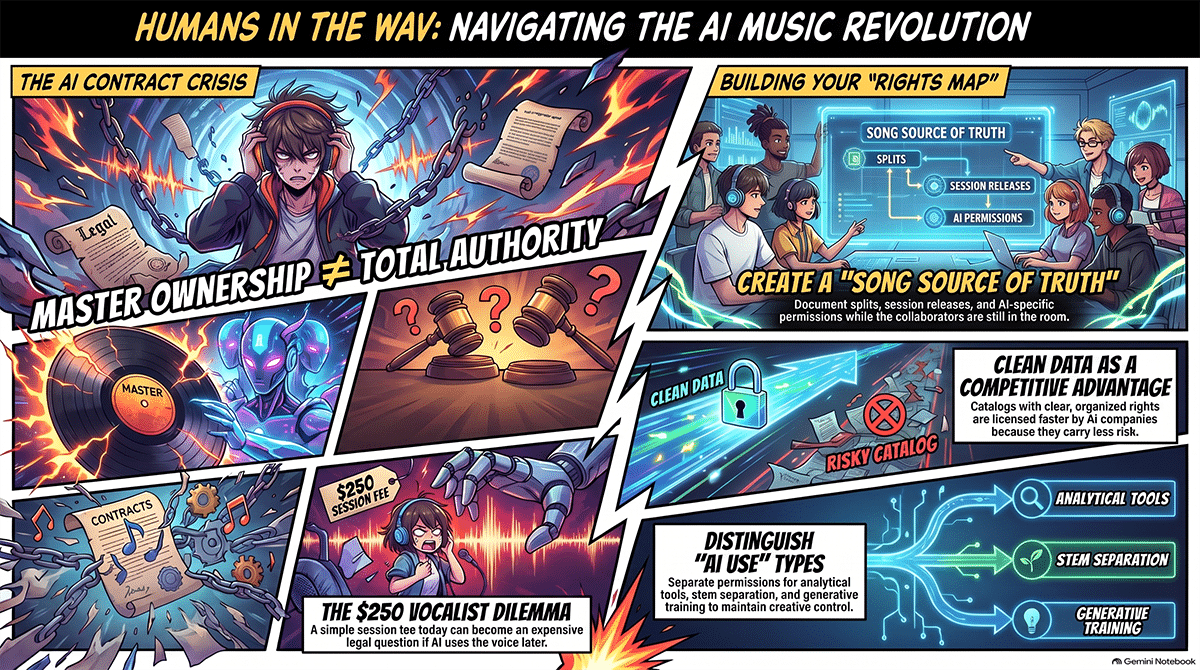
Picture a background-vocal session that could happen in almost any independent studio. You hire a singer for $250, she comes in after dinner, learns the part, stacks a few harmonies and turns an ordinary chorus into the thing everybody remembers. You pay her, she signs whatever session document you normally use, and everybody goes home happy except perhaps the engineer, who is still trying to figure out why input eleven has developed a hum that apparently respects no known law of electricity.
The song gets released and becomes part of the artist’s catalog. Nothing especially futuristic happens for several years. Then a legitimate technology company comes along and wants to license that catalog for a new product.
Now the questions begin to change. Perhaps the company wants recordings for authorized model training. Perhaps it wants to fine-tune a specialized model around a smaller body of licensed music. Perhaps it wants listeners to create authorized remixes or alternate versions. Perhaps it wants to enable generated vocals that remain recognizably connected to an identifiable singer.
At that point the most important document in the room may not be the AI company’s technical presentation. It may be that boring little session agreement from Wednesday night five years ago.
Maybe the agreement clearly grants everything needed for the proposed use. Maybe it contains broad language that counsel concludes covers the transaction. Maybe it gives the artist the necessary recording rights but says nothing useful about a recognizable digital replica. Maybe some rights were retained, or perhaps state law creates an additional issue because the proposed use reaches beyond ordinary exploitation of the recording and into the singer’s identity.
There is no universal answer because the facts and contracts matter, and this is exactly the point where artists should involve qualified counsel rather than allowing an article on the internet to cosplay as a law firm. What an independent artist can do is make future agreements much more intentional so that the next new technology does not have to be interpreted entirely through paperwork written for the last one.
The singer still comes in and sings the harmony. Nobody needs a seventeen-page philosophical debate about machine learning before she steps up to the microphone. The improvement is simply that the agreement can begin recognizing the world in which the recording may eventually live.
A Human Voice Can Raise Questions Beyond the Master
Voice is particularly important because a recognizable human identity can create legal issues beyond ownership of one sound recording. The Copyright Office’s 2024 digital-replicas report concluded that existing protections contain gaps and recommended a federal law addressing unauthorized digital replicas. That recommendation itself makes an important conceptual point: identity rights and copyright rights may overlap in a transaction without becoming the same thing.
States have already begun addressing the subject in different ways. Tennessee’s ELVIS Act added voice to the state’s protected personal rights and took effect July 1, 2024. California’s AB 2602 addresses certain personal-service agreements involving digital replicas and can make provisions unenforceable when intended uses are not described with sufficient specificity and required representation conditions are absent. These laws are different, and neither should be treated as a magical nationwide rule applying identically to every artist and every contract.
Congress is also considering federal legislation, but here again dates matter. The NO FAKES Act of 2026, S. 4591, moved through the Senate Judiciary Committee and onto the Senate legislative calendar, but as of this writing it has not become federal law. The Senate-reported proposal concerns rights in voice and visual likeness and includes provisions dealing with digital replicas, but proposed law is still proposed law no matter how confidently somebody puts the word “Act” in the title.
For the artist, this makes the business question more precise. A buyer asking to include an existing recording in a licensed training dataset is making one kind of request. A buyer asking for the ability to generate brand-new performances that listeners would identify as a particular singer may be asking for something substantially different.
A rights system that records only “AI: yes” or “AI: no” may eventually prove about as useful as an old contract that described radio, television, streaming, video games and motion pictures as “electrical stuff.”
AI Is Too Big a Word to Put in One Checkbox
The music business has developed an unfortunate habit of using “AI” as a bucket large enough to hold nearly anything involving a clever computer. That becomes a serious problem when contracts follow the same habit, because different technical activities can create very different business questions.
NIST, whose AI resources can be found through https://airc.nist.gov/, distinguishes stages such as pre-training and fine-tuning in the development of AI systems. Pre-training generally teaches a model broad patterns, while later fine-tuning can adapt that model toward more specific information or tasks. The finished system may then be used for inference or generation, which is again a different stage of the process.
That technical distinction matters because music software can use machine learning in ways that have almost nothing in common economically. A tool analyzing tempo, key, instrumentation or song structure is solving a different problem from a generative system trained to create new music. A stem-separation process is not automatically the same kind of use as feeding recordings into a large generative model. Fine-tuning around a small authorized catalog may call for different business terms from broad initial model training, while creating a new vocal performance that clearly evokes a real singer can introduce yet another set of concerns.
Independent artists do not need to become machine-learning engineers to negotiate intelligently. They do need enough vocabulary to ask what somebody actually plans to do with the music.
That is a healthy change. For years, musicians have signed technology clauses whose meaning boiled down to “anything anybody invents later,” partly because nobody wanted to hold up the session while lawyers imagined every possible future machine. Now that future machines have become actual businesses, it makes sense to give permission a little more shape.
Style, Performance and the Things the Law Does Not Magically Turn Into Property
The same discipline is useful when musicians talk about style. Everybody understands the ordinary meaning of the word. We know when a guitarist is reaching for a Hendrix vocabulary, when a drummer is living in the neighborhood of John Bonham, or when a singer is borrowing enough phrasing from another performer that everyone in the control room knows exactly whose records were studied.
That does not mean general artistic style automatically functions as a copyright category. Copyright protects particular expression and particular works; it does not simply give somebody ownership of every broad artistic characteristic associated with their career. The Copyright Office’s digital-replica work has likewise treated style carefully rather than recommending a sweeping federal property right over artistic style itself. That does not erase ethical concerns, contractual restrictions or other possible legal theories in a specific case, but it should make artists cautious about confusing “I believe this is unfair” with “I definitely own a statutory right covering it.”
This is another place where contracts can do useful work. Parties are free to negotiate restrictions and permissions that are more specific than a slogan about owning a sound. If a performer cares about certain uses, the discussion can happen while the relationship is friendly and everyone remembers what was intended rather than a decade later after somebody discovers a market none of them had imagined.
Clear agreements are admittedly less cinematic than declaring war on the robots. They become considerably more interesting when someone is ready to pay for a license.
Producers Have Been Hiding in the WAV File the Whole Time
Producers deserve particular attention because “producer” may be the most elastic job title in the recording studio after “guy who knows how the patchbay works.” One producer may be paid a flat fee and receive royalty points, while another participates in master ownership. A producer may also be a songwriter, programmer, keyboard player, engineer or featured performer, sometimes before lunch.
That variability matters whenever a new category of master income appears. Suppose an artist receives a substantial payment from an authorized technology license. Whether the producer participates may depend on how the agreement defines royalties, receipts, licensing income and the particular revenue base against which the producer’s points are calculated. There is no sensible universal answer that says every producer automatically receives money from every AI license, just as there is no sensible rule saying producers can never participate.
The contract decides a great deal of this, which means the futuristic AI deal may send everybody back to an agreement written when the album was made. Somewhere inside paragraph nine may be a definition that suddenly became much more valuable than it looked when everybody was arguing about the snare sound.
This is going to happen throughout the AI economy. Extraordinary technology will keep running headfirst into extremely ordinary business documents, because commerce eventually needs to answer questions that software demos are allowed to skip.
Follow the AI Dollar Instead of the AI Hype
It would be easy to jump from all these new agreements to a breathless prediction that AI licensing is about to shower independent artists with money. There is no reliable evidence for that claim, and musicians have already been sold enough magic beans to open a respectable agricultural operation.
What we can say is that a licensed AI market is clearly developing. Warner says its Udio arrangement creates new revenue streams for participating artists and songwriters, and its Suno partnership includes opt-in controls around the use of names, images, likenesses, voices and compositions in new AI-generated music. Universal says its Udio agreement includes recorded-music and publishing licenses that provide additional revenue opportunities. BMG joined the movement on August 12, 2026, announcing a global Suno alliance covering recorded and publishing repertoire and saying participating artists and songwriters will be compensated.
Warner has gone further in explaining how it thinks about the economics. In a shareholder letter, the company said its AI agreements use variable economics designed to grow as its partners grow, although the detailed formulas governing what ultimately reaches individual contributors are not public. That distinction matters because “there is an AI licensing deal” and “we know exactly what every musician will receive” are very different sentences.
For an independent artist, this is where the Making a Scene habit of following the money becomes useful. If an AI license produces revenue tied to the master, the next question is whether any producer, featured artist, performer or other participant shares in that income under existing agreements. If the transaction includes composition rights, songwriter and publisher interests enter the picture. If it asks for a recognizable digital replica or another separately negotiated permission, there may be economics attached to that as well.
The money may therefore be divisible before it ever becomes “artist income.” That is not a flaw in the system; it is the natural result of several people contributing different rights and services to one commercially valuable piece of music.
The time to understand those divisions is before the check lands in the account. Otherwise the world’s most advanced technology will once again be supported by one of the music industry’s most durable operating systems: six people arguing over a spreadsheet somebody named FINAL_ACCOUNTING_NEW2.xlsx.
Independent Artists May Have an Advantage Nobody Talks About
Major music companies own something independent artists can only dream of building at the same scale: huge catalogs containing decades of commercially significant recordings. Those libraries are enormously valuable, but history comes attached to them.
A large catalog may contain recordings made under agreements from the vinyl era, cassette era, compact-disc era, download era and streaming era. Rights have changed hands, companies have merged, artists have renegotiated, publishers have changed, producers retained participations, union agreements evolved, and portions of catalogs may have been sold more than once. Then generative AI arrives and somebody wants to know whether thousands or millions of recordings can be licensed into a use that did not exist when many of the musicians entered the studio.
That can become rights archaeology.
The independent artist staring at ten new songs may feel hopelessly small by comparison, but small can be an advantage when somebody needs an answer. The artist who made the record last month can still remember who played on it. The songwriter can still reach the co-writer. The producer knows what was negotiated. The guest singer has probably not changed her email address three times and moved to a cabin somewhere beyond the reach of civilization.
This is the moment to build the rights picture because the information is still alive.
Independent artists cannot out-catalog Universal Music Group or Warner Music Group. They can absolutely build new catalogs whose rights are cleaner, whose contributors are documented and whose licensing authority can be understood without dispatching an archaeological team.
That kind of readiness has value.
Build the Rights Map While Everybody Still Remembers the Session
Think about how much information is sitting in the room while a record is being made. You know who played bass because the bass player is still there explaining why the bass needs to be louder. The producer remembers which tracks she contributed to, the writers know where the chorus came from, the invoice is being generated, and the guest musician who needs to sign something is still reachable without hiring a private investigator.
It will never again be this easy to document the project.
That means the recording process can create two things at once. It creates the music assets everyone expects, including the finished master and whatever additional versions make sense for the artist’s business. At the same time, it can create a business record explaining who contributed, which rights exist, who owns or controls them, which agreements govern them and what approvals might be needed later.
This does not require musicians to turn the control room into the county clerk’s office. Nobody wants the drummer waiting to punch in a fill while the producer asks whether he has completed Section 14-B of the machine-learning permissions worksheet. The goal is to capture information naturally as it becomes known and connect it to the song before memory starts leaking out of the project.
When songwriting is finished, preserve the splits. When a producer agreement is signed, connect it to the recording. When a guest musician is hired, preserve the agreement. If a contributor has specific restrictions or approvals, record them while both sides know what those words are supposed to mean.
The creative work still leads. The paperwork simply stops pretending the creative work has no commercial future beyond next month’s release date.
“No” Can Be Extremely Valuable Information
Artist ownership does not mean creating an infrastructure designed to approve every technological use that appears. Sometimes the most valuable thing a rights record can contain is a clear refusal.
One performer may be comfortable with an analytical AI tool examining a recording for metadata but not with generative training. Another may permit training only through an authorized licensed system. A singer may be comfortable with certain uses of the recording while refusing permission for a product capable of producing recognizable new versions of her voice. Those are examples rather than ready-made contract clauses, but they illustrate why permission needs more detail than a green or red light marked simply “AI.”
A well-documented “no” saves everybody time because it tells the artist and buyer that the contemplated use cannot move forward under the present authority. A conditional approval can be equally useful because it identifies where another conversation must happen before a license is granted. Even uncertainty has value when it is recorded honestly, because “additional approval required” is vastly more useful than discovering after the deal closes that nobody actually knew.
The worst business answer is usually not no. It is “I think we can probably do that.”
Control becomes commercially useful when the artist can distinguish what is allowed from what is forbidden and what still needs a phone call.
Catalog Value Now Includes Business Memory
Musicians often say they have their catalog backed up because they own several hard drives containing the audio. That is important, but storage and memory are not the same thing.
A hard drive remembers bits. A business needs to remember relationships.
Suppose you licensed several recordings to a company for a defined technology project and another buyer approaches five years later. Whether you can make the second deal may depend on the first agreement. Perhaps the original license was nonexclusive, or perhaps it included some category of exclusivity. Maybe particular permissions survived termination, certain territories were excluded, or a use was approved only for a specified product.
If nobody can find the agreement, the catalog has developed amnesia.
Independent artists already encounter this problem with sync licensing, publishing administration, distribution, collaborator agreements and royalty accounting. AI does not invent the need for business memory; it simply increases the number of future opportunities that may depend on accurately remembering yesterday’s decisions.
This is why the agreement itself needs to remain connected to the song. The song is not just audio sitting on a server. It has a commercial biography.
A serious catalog knows that biography.
What Making a Scene Means by a Song Source of Truth
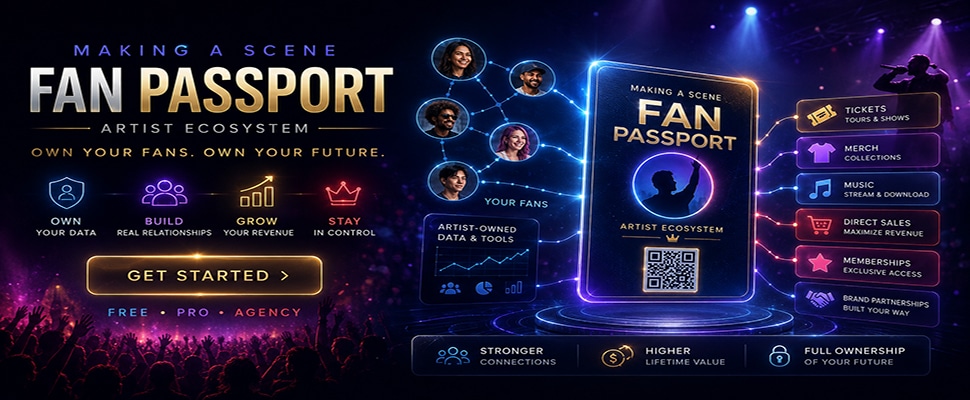
This is the business problem behind the Making a Scene Artist Fan Passport OS at https://masfanpassport.com/. The idea is not that software magically creates rights or that putting information in a database makes it legally true. The idea is that an independent artist should have an authoritative place where the business relationships surrounding a song can remain connected instead of being scattered among a distributor dashboard, a publisher portal, three spreadsheets, two Dropbox folders and an email account whose password nobody remembers.
The current Pro system publicly describes advanced contributor records for songwriters, composers, lyricists, publishers, administrators, master owners, performers, producers, engineers and other contributors. It includes composition and master ownership worksheets, agreement and approval tracking, licensing-authority information, a Rights Catalog intended to show what the artist owns and controls, a Rights Map, and licensing policies capable of distinguishing issues involving the master, composition, performance, voice and likeness, derivatives, stems, remixing and AI.
That information becomes useful because it turns a vague belief that a song is “cleared” into something the artist can actually examine. If another writer controls a share, the record can show that relationship. If a sample creates a restriction, that restriction can remain attached to the song. If an AI-related use requires another contributor’s approval, the system can identify that condition rather than allowing somebody to discover it after a buyer has already been promised delivery.
Software cannot make a false ownership claim true. It cannot repair a contract the artist never signed, remove an uncleared sample or transform an assumption into permission. What it can do is make the information visible enough for the artist to understand where authority exists and where another human being needs to become involved.
That is what a Source of Truth is supposed to do. It is not the source of the rights themselves; the contracts, copyrights and other legal relationships create those rights. It is the place where the artist can see how those relationships connect to the song.
Once you see the difference, rights management stops looking like clerical punishment and starts looking like commercial infrastructure.
Fingerprints Are Useful When They Carry the Map
Audio fingerprints and provenance systems can strengthen that infrastructure as long as nobody assigns them magical powers. A fingerprint can help identify an audio asset and connect it back to the authoritative record describing that asset. That becomes more valuable as one song develops multiple commercial versions over its life.
A master may eventually have an instrumental, clean version, alternate mix, sync edit or other legitimate derivative prepared for a buyer. The important business question is whether those files remain connected to the same underlying rights information so the artist does not end up treating each new WAV as an orphan that wandered into the catalog without parents.
A fingerprint can help maintain that lineage. It does not create the ownership, negotiate the license or make somebody obey a contract. It simply gives the business a stronger way to identify the asset and find the information connected to it.
That may sound less glamorous than some of the promises made around blockchain, AI and provenance over the years, but useful technology often becomes more impressive when we stop asking it to perform miracles. A good identifier does not need to save the music industry. It needs to help the right record find the right information at the right moment.
That is enough to make it valuable.
Clean Rights Can Make a Song Easier to Buy
Artists are usually taught to think about paperwork as protection from something bad. A contract protects you from a dispute, a split sheet protects you from confusion, and an agreement protects you if somebody changes their story. All of that is true, but clean rights can also help something good happen faster.
Imagine a legitimate music buyer looking at two independent tracks that could both work for a project. The first artist believes she controls everything but cannot immediately confirm the publishing shares. The producer agreement is in an old email account, the guest vocalist may have signed something, and nobody is sure whether one writer ever transferred administration to a publisher.
The second artist knows the master ownership, songwriting splits, publisher relationships and contributor agreements. One particular use needs a separate approval, but that condition is visible and the artist knows exactly whom to contact.
There is no law saying the second song wins. Music is still music, and buyers choose based on creative needs before somebody’s organizational skills earn a trophy. If both tracks work equally well, though, it is not hard to understand why a buyer might prefer the one that does not require a month of detective work before legal can approve the transaction.
Rights certainty reduces friction.
For an independent artist, reduced friction can become a competitive advantage because your catalog does not have to be the largest one in the room to be the easiest legitimate one to license.
AI Licensing Belongs in the Revenue Stack, Not on a Throne
The emergence of licensed AI does not mean every artist should immediately restructure the business around training revenue. We do not yet know how large the long-term opportunity will become for most independent catalogs, how the economics will be divided, which models will survive or how many artists will choose to participate.
We do know the market is moving toward negotiated licensing in at least part of the industry. BMG’s August 2026 Suno alliance adds another major rights company to arrangements already involving companies such as Warner and Universal. In a neighboring part of the technology market, Universal announced an August 19, 2026 partnership with Hook that allows licensed fan creation using official UMG recordings while emphasizing rightsholder controls and compensation. Hook is not presented by Universal as simply another generative-music training arrangement, which makes it a useful reminder that technology-assisted music creation is already branching into several different commercial models.
That is exactly why AI belongs inside an artist’s broader revenue stack rather than sitting on top of it wearing a crown. A sustainable independent career still needs several ways for money to reach the artist because no single market behaves reliably forever. Shows can feed direct fan relationships, those relationships can support merchandise and direct sales, strong songs can create publishing and sync opportunities, and a useful catalog can continue producing value through licenses and other legitimate uses.
If AI licensing becomes another revenue layer, wonderful. If a particular deal pays too little, asks for too much or violates the artist’s values, the artist should be able to walk away without collapsing the entire business.
That is what independence actually buys you: choices.
Do Not Rebuild the Major-Label Problem in Your Own Catalog
There is a temptation among independent artists to watch every development at the major labels and assume that whatever those companies do must eventually become the template. The majors have enormous resources and influence, so they absolutely deserve attention. That does not mean independent artists need to inherit their historical complications.
The AFM lawsuit exists because an older agreement is being asked to answer a new technology question. The union believes the new-use language already creates an obligation. The labels argue it does not operate the way the union says and that AI terms belong in the bargaining process for a successor agreement. The court is now being asked to interpret language created before the present commercial AI market existed.
Independent artists making recordings in 2026 have a luxury nobody had when many older masters were created: we already know these technologies exist.
That means AI-related questions can begin entering agreements now instead of waiting twenty years for somebody to discover there is money attached to them. Songwriter splits can be preserved while the writers are still collaborating. Producer relationships can be connected to the actual recordings. Performer permissions can be documented. Special restrictions involving voice or digital replicas can be identified where they genuinely apply.
The major companies may have half a century of contractual history to unravel.
Your next record is still in the control room.
Use the advantage.
The Platform Can Be Useful Without Becoming the Business
None of this argument requires independent artists to retreat from technology. AI companies can be useful. Distributors can be useful. Streaming platforms, sync agents, publishers, direct-to-fan services and licensing companies can all create opportunities an artist would have great difficulty building alone.
Making a Scene has never needed platforms to become villains in order to argue for artist independence. A doorway can be extremely useful without becoming the house.
The danger appears when all the important pieces of the career live somewhere the artist does not control. If the catalog history exists only inside a licensing company, the fan relationships exist only on a social platform, the transaction records exist only in somebody else’s dashboard and the rights information lives inside a distributor account, the artist has built a business that becomes remarkably fragile whenever one outside company changes direction.
AI should be approached with the same discipline. Use a service when it solves a real problem. License music when the economics make sense. Participate in responsible systems when the artist understands the use and accepts the terms. Decline when the deal asks for too much.
The important part is that the underlying catalog information, rights relationships, agreements and business memory remain with the artist. Then a platform can change without taking the artist’s entire understanding of the career with it.
That is the practical meaning behind using every useful doorway while owning the house.
Tomorrow’s Money May Be Hiding in Yesterday’s Paperwork
There is something almost perfectly absurd about the place artificial intelligence has brought the music business. We have computers that can analyze enormous datasets and generate convincing audio from a sentence. Investors are pouring extraordinary amounts of money into AI companies, major rights holders are negotiating model licenses, lawmakers are debating digital replicas, and technologists are building products that would have sounded like science fiction when many existing recordings were made.
Then the deal reaches the accounting department and somebody asks what the drummer’s contract says.
That is not a failure of innovation. It is a reminder that music never became data simply because technology learned how to process it.
Inside the WAV file are performances. Underneath the recording is a composition. Around the performances are people, and around those people are agreements defining who controls what, who participates in which income and what somebody may or may not authorize later.
The AFM believes its Sound Recording Labor Agreement already gives covered musicians a right to compensation from the AI uses at issue in its lawsuit. Universal, Warner Records and Atlantic disagree with that interpretation, and Judge Ramos has not resolved the dispute. Whatever the court eventually decides will matter greatly to the parties and could influence how the industry thinks about older agreements confronted by new technology.
Independent artists do not have to wait for that ruling to understand the larger message.
A modern catalog can be built so the music and the business information grow together. The master can remain connected to the composition, the contributors, agreements, permissions and licensing history that give the file its commercial meaning. New revenue opportunities can then be examined against real information instead of assumptions, whether the opportunity comes from a film supervisor, a game developer, a direct fan product, an advertising campaign or an AI company that has finally learned the radical business concept of asking permission before using somebody’s work.
That does not make the artist’s career more complicated. The complication was already there. It makes the complication visible enough to manage.
Ownership is the beginning of independence, not the end of it. Real control means knowing what you own, understanding what other people own, knowing what you have permission to license, recognizing where another approval is required, preserving the agreements you make and keeping that business memory somewhere that remains under your control.
If licensed AI becomes a meaningful source of revenue, artists with that infrastructure will be able to evaluate the opportunity instead of reconstructing their history under deadline. If a particular AI deal deserves a no, they will know why they are saying it. If the next important technology is something nobody has invented yet, the same infrastructure will still help because the underlying business problem will remain remarkably familiar.
There will still be humans inside the WAV file. There will still be a song underneath it. There will still be agreements connecting people to rights and rights to money.
The smartest thing independent artists can do in the AI era may therefore be surprisingly old-fashioned. Make great records, own what you reasonably can, document the people who helped create them, preserve the agreements, know where the money is supposed to go and build a direct business infrastructure that does not disappear when somebody else changes the rules.
The machines can handle the futuristic part. We should finally get serious about remembering who played on the record.
 |  Spotify |  Deezer |  Breaker |
 Pocket Cast |  Radio Public |  Stitcher |  TuneIn |
 IHeart Radio |  Mixcloud |  PlayerFM |  Amazon |
 Jiosaavn |  Gaana |  Vurbl |  Audius |
 Reason.Fm | |||
Find our Podcasts on these outlets
Subscribe to Our Newsletter
Discover more from Making A Scene!
Subscribe to get the latest posts sent to your email.


