
The Grammys Leave CBS for Disney: The Money, Media Power, and Politics Behind Music’s Biggest Move




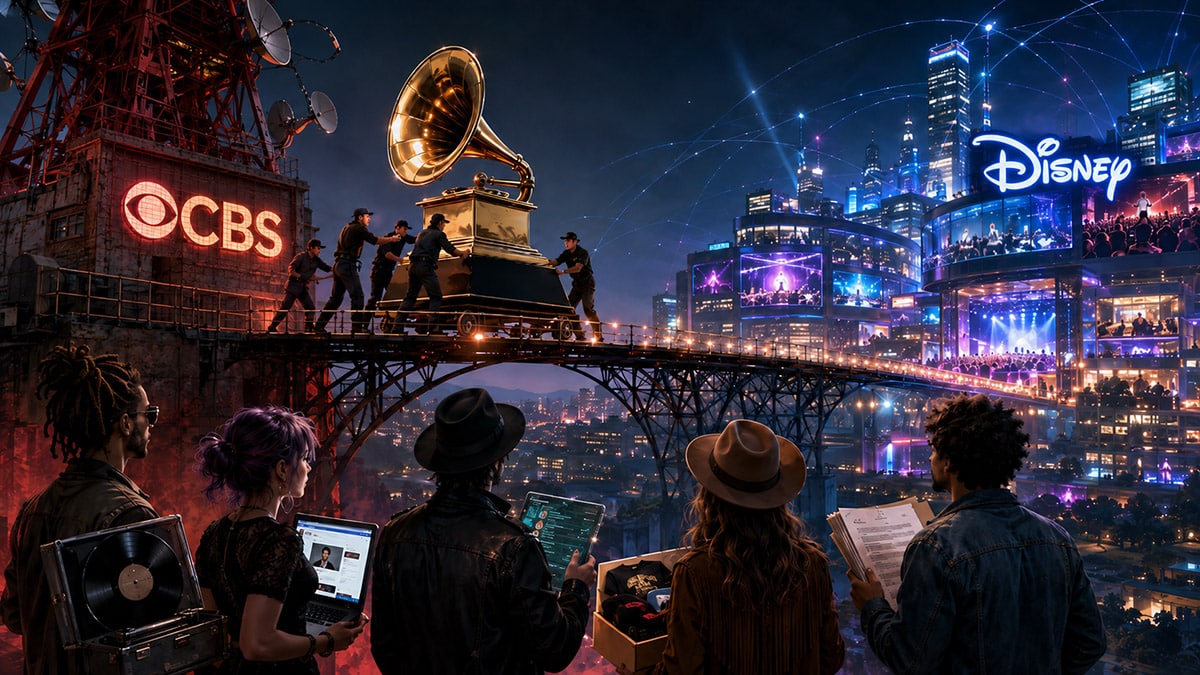
Making a Scene Presents – The Grammys Leave CBS for Disney: The Money, Media Power, and Politics Behind Music’s Biggest Move
Listen to the Podcast Discussion
For more than half a century, the Grammy Awards and CBS seemed permanently attached. The golden gramophone showed up on CBS every winter like an old relative who never needed directions to the house. Hosts changed, musical styles changed, television changed, and musicians went from selling records to chasing fifteen-second video trends. Yet the Grammys stayed put.
That long marriage has now ended.
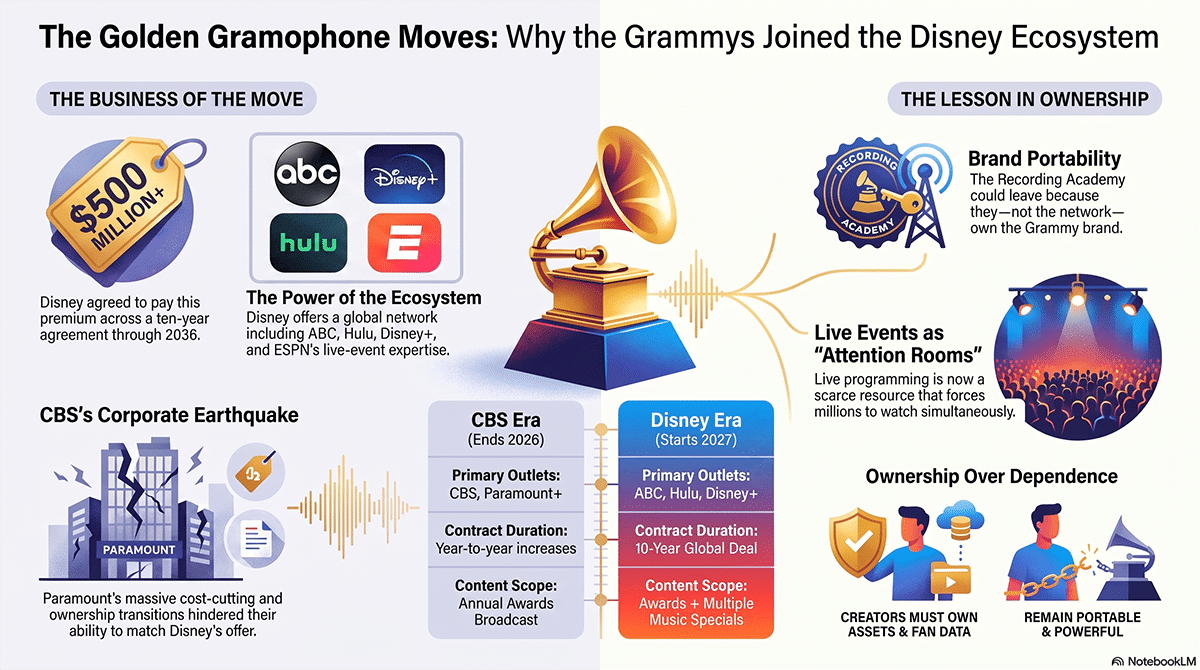
Beginning in 2027, the Grammy Awards will air on ABC and stream live on Disney+ and Hulu. All three services are owned by The Walt Disney Company. The agreement runs for ten years, through 2036, and includes more than the annual awards broadcast. The Recording Academy will also create Grammy-branded specials and other programming for Disney’s platforms. The first Disney-era ceremony is scheduled for February 7, 2027, from Crypto.com Arena in Los Angeles. It will be the first Grammy ceremony shown on ABC since 1972.
The change is important because this is not simply a television show changing channels. It is a major music organization changing its distribution system, its streaming partner, its advertising partner, and part of its public identity. It is also a useful lesson for independent musicians because it shows what happens when a valuable brand owns its name, controls its rights, and remains able to leave a platform that no longer offers the strongest deal.
The Grammys could move because CBS did not own the Grammys. The Recording Academy did.
That may be the most important part of the whole story.
The End of a Fifty-Year Television Marriage
CBS began carrying the Grammy Awards in 1973. The network became so closely connected to the ceremony that many viewers probably assumed CBS had some deeper ownership interest in it. In reality, CBS was the broadcast partner. The Grammy Awards and the Grammy brand remained under the control of the Recording Academy, whose public home is https://www.grammy.com.
CBS broadcast the final ceremony under the old arrangement on February 1, 2026. That broadcast was also available through Paramount+, the streaming service at https://www.paramountplus.com. After that ceremony, the long CBS run was over. The Grammys had become one of the rare television institutions to survive disco, MTV, compact discs, Napster, iTunes, Spotify, TikTok, and several generations of network executives carrying charts that always seem to point toward “engagement.”
Leaving after more than fifty years may feel dramatic, but long relationships in the entertainment business last only as long as the agreement still works for both sides. Television networks do not keep awards shows because of warm memories. They keep them because the shows attract viewers, advertisers, subscriptions, cultural attention, or some useful combination of all four.
The Recording Academy was not deciding where to hold a family reunion. It was licensing one of music’s most recognizable media properties.
Disney wanted that property badly enough to win it.
The Simplest Economic Reason: Disney Brought the Money
The cleanest explanation for the move is also the least mysterious. Disney offered a major long-term financial package and a larger collection of outlets on which the Recording Academy could place its content.
The Wall Street Journal reported that Disney agreed to pay more than $500 million across the ten-year agreement. The Journal also reported that CBS’s existing fee increased each year and was scheduled to reach $50 million for the 2026 broadcast. Disney’s package therefore represented a premium over the CBS arrangement, although the deals cannot be compared only by dividing one large number by ten. Disney is also receiving additional Grammy-branded programs and a broader relationship with the Recording Academy.
That detail matters. Disney did not merely buy the right to show three or four hours of awards once a year. The official announcement said the Recording Academy would produce multiple music specials and additional programs for Disney’s platforms around the world. This gives Disney more material to distribute, promote, package, sponsor, clip, stream, and use to keep viewers inside its larger entertainment system.
From the Recording Academy’s side, the arrangement offers guaranteed income and access to a much larger collection of promotional tools. From Disney’s side, it provides a famous live event that can support television advertising, streaming subscriptions, sponsorships, digital clips, international promotion, and other music programming.
It is a much bigger machine than one network broadcast.
That is the first real economic reason for the move. Disney was not just offering a different channel. It was offering an ecosystem.
Independent artists should recognize that word immediately. An ecosystem can create enormous value when its different parts work together. It can also become a very comfortable cage when somebody else owns every door.
Live Programming Has Become Television’s Scarce Resource
Traditional television has lost much of its power to force millions of people to watch the same thing at the same time. Viewers now choose among broadcast channels, cable networks, streaming services, social platforms, podcasts, video games, short-form clips, and whatever strange rabbit hole the recommendation system opens at two in the morning.
A scripted television series can be watched later. A movie can be paused. An old comedy can sit in a streaming library for years waiting for somebody to rediscover it. A major live event is different. It creates a shared moment, and shared moments are becoming harder to manufacture.
That makes live programming extremely valuable.
Disney’s own advertising material describes live programming as difficult to skip and capable of bringing large audiences together. The company promotes live sports, the Academy Awards, the CMA Awards, New Year’s Eve programming, music festivals, reality shows, and other events as important parts of its advertising business.
The Grammys fit neatly into that strategy. Viewers may see winners online within minutes, but the real commercial value comes from creating a night when audiences are watching performances, reacting on social media, discussing clothes, arguing about winners, and sharing clips at the same time.
That activity creates several kinds of inventory. Disney can sell traditional commercials during the ABC broadcast. It can sell streaming advertising through Hulu and ad-supported Disney+ plans. It can sell sponsorships around red-carpet coverage, performances, interviews, online clips, and special programs. It can promote its own films, television shows, streaming products, music properties, and live events to an audience already gathered around entertainment.
In plain English, Disney is buying a very large room full of attention.
Attention is one of the most valuable products in modern media, especially when the audience arrives voluntarily and stays for several hours. No network executive has to explain that twice.
Disney Is Building a Live-Event Fortress
The timing of the deal also tells us something about Disney’s larger plan. In 2027, ABC is scheduled to present the Grammys, the Academy Awards, and Super Bowl LXI. Disney highlighted that combination in its official announcement because it gives the company three giant live events in a single year.
The Grammys also join a company that already has deep connections to music and entertainment. ABC carries the CMA Awards and “Dick Clark’s New Year’s Rockin’ Eve.” Disney controls major television, film, sports, streaming, advertising, and consumer-product operations. ESPN gives it enormous experience in handling live broadcasts, selling sponsorships, creating shoulder programming, and keeping fans engaged before and after the main event.
This does not mean Mickey Mouse will be presenting Best Metal Performance, although we live in unusual times and should probably never rule anything out. It means Disney can treat the Grammys as one part of a year-round live-event strategy instead of an isolated awards program.
A performance introduced on ABC can become a clip promoted through Disney’s digital channels. A Grammy special can live on Hulu. Family-friendly music programming can appear on Disney+. Artists can appear on ABC news, talk, and entertainment shows. Advertising packages can stretch across television, streaming, digital video, social media, and live events.
CBS and Paramount also owned multiple platforms, including CBS, Paramount+, MTV, BET, and other entertainment properties. They were not operating with a small toolbox. Disney, however, was prepared to offer the Recording Academy a ten-year global package at a time when Paramount was dealing with major financial pressure and a complicated ownership transition.
That brings us to the other side of the economic story.
CBS Was Living Through a Corporate Earthquake
The Recording Academy announced the Disney agreement on October 30, 2024. Several months earlier, in July 2024, Paramount Global and Skydance Media had announced a proposed merger that would change the ownership and direction of CBS’s parent company.
The proposed transaction valued the combined business at about $28 billion. Skydance’s investor group planned to invest billions of dollars to buy National Amusements, provide cash or shares to Paramount investors, reduce debt, and add new capital. Paramount’s official announcement repeatedly spoke about improving profitability, streamlining the organization, transforming its technology, and investing in faster-growing digital platforms.
At the same time, Paramount was cutting costs. In August 2024, the company announced plans to reduce its United States workforce by 15%, affecting roughly 2,000 jobs, as part of an effort to cut about $500 million in annual costs. Paramount Television Studios was also closed, with its projects moved to CBS Studios.
This was not the ideal moment for CBS to become sentimental about a long-running rights deal. Paramount was preparing for a merger, reducing expenses, reorganizing its operations, and trying to improve the financial performance of Paramount+.
According to The Wall Street Journal, CBS and the Recording Academy were unable to reach a new agreement. Disney stepped in with the winning package.
That does not mean CBS suddenly stopped valuing the Grammys. It means every rights package has a price. A company cutting hundreds of millions of dollars in costs may decide that matching or beating a competitor’s long-term offer is not the best use of its money.
The television business is full of beloved traditions right up until the spreadsheet arrives.
Ratings Were Strong, but They Were Not Guaranteed
The Grammys had shown that they could still attract a large audience. The 2024 CBS broadcast drew about 17.09 million viewers, according to Nielsen figures reported by The Hollywood Reporter. That was a major improvement from the lower ratings seen during the pandemic years.
The audience then declined to about 15.4 million in 2025 and approximately 14.4 million for the final CBS broadcast in 2026. Those are still large audiences in the modern television world, but the two-year decline showed why a network would think carefully before promising ever-higher rights payments for another decade.
Awards shows also carry heavy production costs. They require large venues, complex staging, security, union crews, music clearances, rehearsals, celebrity coordination, live broadcast equipment, and the occasional emergency caused by a performer deciding at the last minute that the planned version needs fourteen more dancers and a small indoor volcano.
The rights fee is only part of the bill.
CBS had to decide whether future advertising, streaming value, and promotional benefits justified the cost. Disney could make a different calculation because it could spread the event across ABC, Hulu, Disney+, international outlets, advertising products, and additional Grammy programs.
The same content can be more valuable to one company than another. That does not mean one side is foolish. It means the buyers have different machines.
The Political Reason Is Not What the Internet Wants It to Be
Now we get to the political side of the story, and this is where facts need to be separated from dramatic online theories.
There is no verified public evidence that the Recording Academy left CBS because CBS was too conservative, too liberal, too friendly toward one political party, too hostile toward another political party, or upset about political comments made during Grammy broadcasts. There is also no verified evidence that Disney won the deal by promising a particular political direction for the ceremony.
The agreement was announced on October 30, 2024. It had clearly been negotiated before many later political controversies involving CBS, Paramount, Disney, federal regulators, late-night television, and the second Trump administration. Events that happened in 2025 or 2026 cannot simply be dragged backward through time and declared the cause of a deal signed in 2024.
Time does not work that way, despite the best efforts of cable news.
The documented reasons point toward money, distribution, live programming, global reach, additional content, and the corporate uncertainty surrounding Paramount. Disney and the Recording Academy publicly described the agreement as part of the Academy’s growth and Disney’s live-event strategy.
There is, however, a political story here. It is simply larger and more interesting than party labels.
It is the politics of ownership, cultural power, corporate control, public policy, and who gets to operate the biggest microphone in music.
Media Ownership Is Political Even When Nobody Mentions an Election
Politics is not limited to candidates standing behind podiums. Politics is also the process through which powerful organizations decide whose voices are heard, which issues receive attention, which communities are represented, and which ideas are treated as acceptable.
A network partner does not select Grammy nominees or vote for Grammy winners. Those decisions remain part of the Recording Academy’s awards process. Yet the media company controls many important parts of the public presentation. It sells the advertising. It promotes the broadcast. It decides how the event appears across its platforms. It manages standards for a live television program. It distributes clips, packages interviews, builds promotional campaigns, and places the ceremony inside a larger corporate schedule.
That is cultural power.
Moving the Grammys from CBS and Paramount+ to ABC, Hulu, and Disney+ changes the corporate system surrounding the awards. It changes which advertising operation sells the audience. It changes which streaming platforms receive the traffic. It changes which entertainment properties can be promoted during the broadcast. It changes which company builds years of viewing data around Grammy-related content.
None of that proves a partisan motive. It does show why a broadcast-rights agreement is political in the broad meaning of the word. A major cultural institution has chosen a new corporate partner to help carry its message for the next decade.
Independent artists should pay attention because the same kind of power struggle happens on a smaller scale every day. A musician may create the song, build the audience, and attract the attention, while a platform controls the recommendation system, customer information, advertising tools, and access to the fan.
The artist provides the culture. The platform often keeps the map of the people who showed up.
The Recording Academy Is Also a Lobbying Organization
The Grammy Awards are the Recording Academy’s most visible public event, but the Academy is not only an awards organization. It also works in Washington and state capitals on copyright, artificial intelligence, ticketing, royalties, free expression, and other policies affecting music creators.
The Academy describes advocacy as one of its central purposes. It says it works for creator rights and pro-music policies at national, state, and local levels. Its members have supported legislation involving music licensing, small copyright claims, ticket bots, venue relief, artificial intelligence, voice and likeness rights, and the use of lyrics in court.
The Disney deal announcement itself mentioned the Academy’s public-policy work. It pointed to pro-creator laws supported by Academy members, the addition of thousands of women voting members, and the expansion of the Academy’s global mission. Those details were not accidentally placed in the announcement. The Recording Academy wanted the industry to view the Disney agreement as part of a larger organizational transformation, not simply as a bigger television check.
A wider distribution system can strengthen that advocacy mission. A Grammy broadcast seen across network television and two major streaming services gives the Academy a larger stage from which it can talk about creator rights. Additional Grammy programming gives it more opportunities to discuss artificial intelligence, copyright, music education, health services, diversity, touring, and the economic problems facing working musicians.
That does not automatically make Disney a perfect champion for independent artists. Disney is a giant corporation that negotiates aggressively to protect its own intellectual property and business interests. The Recording Academy also represents a wide membership with competing views, commercial interests, and political beliefs.
Still, the Academy gains a very large communications partner at a time when laws involving AI training, digital replicas, ticketing, streaming royalties, and creator rights are being debated. That is politically useful, even when the agreement is not politically partisan.
Artificial Intelligence Raises the Stakes
The political importance of the Grammys is likely to grow as artificial intelligence changes music creation and distribution.
The Recording Academy has supported protections against unauthorized AI copies of an artist’s voice, image, and likeness. In 2024, its advocacy work focused heavily on proposals such as the NO FAKES Act and state laws protecting performers from unauthorized digital replicas. The Academy also supported Tennessee’s ELVIS Act and other measures involving AI-generated uses of performers.
These are not abstract debates for famous singers who already own several houses. AI systems can imitate voices, generate songs, create fake endorsements, flood streaming services, and weaken the connection between a human artist and the work carrying that artist’s identity.
Independent artists face the greatest danger because they often lack lawyers, investigators, industry contacts, and the money needed to fight unauthorized use. A fake recording may spread widely before the artist even learns it exists. By the time somebody replies to the support ticket, the fake song may already have its own dance challenge.
The Grammy platform gives the Recording Academy a public stage for arguing that human creativity should be protected. Disney’s reach across ABC, Hulu, Disney+, and other media outlets may expand that message.
However, artists should not assume that any large media agreement will protect them automatically. Laws, contracts, metadata, registrations, split sheets, master ownership records, publishing information, and written permissions remain essential. A television speech about creator rights feels good. A properly documented catalog is what gives the artist something enforceable after the applause ends.
Disney Gains Cultural Legitimacy
Disney is also buying something that cannot be measured only through advertising sales. It is buying cultural legitimacy in music.
The company already owns powerful entertainment brands, but the Grammys bring a different kind of authority. The awards are presented by a membership organization made up of performers, songwriters, producers, engineers, and other professionals. Whatever criticism the Grammys receive—and they receive plenty—the award still carries major cultural and commercial weight.
A Grammy nomination can affect an artist’s booking fees, licensing opportunities, press coverage, collaborations, and career story. A win can become part of an artist’s biography for the rest of that artist’s life. The trophy is not merely a television prop. It is a business asset.
By becoming the home of the Grammys, Disney places itself closer to that system of recognition. It gains a stronger position in conversations about music history, excellence, representation, and the future of creative work.
That is a form of political capital. Disney gets to stand beside the institution that decides which recordings receive the industry’s most famous awards. The company does not control the voting, but it controls the building where much of the public conversation takes place.
CBS enjoyed that position for more than fifty years. Starting in 2027, Disney will have it.
The Deal Also Reflects a Global Power Shift
The official agreement is described as a global deal. That wording matters because the recorded-music business is no longer centered only on United States radio, American record stores, and a few major television networks.
Latin music, K-pop, Afrobeats, regional Mexican music, electronic music, and other global scenes now move rapidly across streaming platforms and social networks. Artists can build international audiences before many American television executives learn how to pronounce their names.
Disney operates international entertainment and streaming businesses that can help the Recording Academy promote Grammy content across borders. The Academy has also described the expansion of its global mission as a major goal.
The political question becomes whose idea of music excellence receives global promotion. Awards categories, eligibility rules, language, genre definitions, and representation can become deeply political when an American organization presents itself as a worldwide authority.
A larger platform creates greater reach, but it also brings greater responsibility. If the Grammys want to become more global, they must do more than fly in a few international stars for a television performance. They must listen to creators in different regions, understand local music economies, and avoid treating the rest of the world as a colorful decoration around the American market.
Independent artists should see both the opportunity and the warning. Global distribution can build an audience quickly, but global platforms can also place musicians into categories, playlists, and business systems they do not control.
Reach is powerful. Ownership is stronger.
The Grammys Owned the Brand, So the Grammys Could Leave
The Making a Scene lesson begins with a simple fact. The Recording Academy controlled the Grammy brand and licensed it to CBS. When another company offered a more attractive agreement, the Academy could move the property.
Imagine how different the story would be if CBS owned the Grammy name, controlled the audience records, held the program archive, owned the trademarks, and had permanent rights to the format. The Recording Academy might have created the cultural value while lacking the power to take that value somewhere else.
That is exactly the position in which many independent musicians place themselves.
They build followers on social platforms but cannot export the relationship. They build listeners on streaming services but receive little or no information about who those listeners are. They sell tickets through companies that keep the customer records. They run crowdfunding campaigns through platforms that can change fees or rules. They create years of content inside accounts they do not control.
Then one day the artist wants to move, and the platform politely explains that the fans are staying behind.
The Grammy move shows the business value of portability. The Recording Academy could negotiate with Disney because the central asset—the Grammy brand—remained portable. It could change distribution partners without abandoning the identity of the event.
Independent artists need the same kind of freedom. They should own their master recordings, maintain accurate publishing records, control their websites, collect fan email addresses with permission, keep customer information where legally allowed, and store useful audience data in systems they can export.
Social media should introduce fans to the artist. It should not become the artist’s only home.
Streaming should help people discover the music. It should not become the only place where the artist has an audience.
A platform partnership is useful. Platform dependence is expensive.
What Disney’s Deal Says About Fan Data
Disney will not measure the success of the Grammys only through the number of households watching ABC. It can also study streaming behavior, advertising response, subscription activity, digital engagement, and interest in related content across its platforms.
That information helps Disney understand what viewers watch before the ceremony, when they arrive, how long they stay, what devices they use, and which other programs may interest them. The exact data available and how it may be used will depend on each service’s systems, user agreements, privacy policies, and advertising products. The larger point is that digital distribution creates a much richer business picture than a single television rating.
The artist performing on the show may receive attention but will not automatically receive the audience data generated by that performance.
That is the old music-business problem wearing a new streaming jacket.
A musician can appear before millions of viewers and still leave without permission to contact one of them. The network knows who watched. The streaming company knows who clicked. The advertiser knows which campaign ran. The social platform knows who shared the clip. The artist may know only that the follower count went up.
Attention without connection can disappear quickly.
Artists should prepare their own destination before any major media event. That destination should include a professional website, an email signup, direct music and merchandise sales, show information, memberships, licensing contacts, and a clear invitation for fans to stay connected.
The television appearance creates the spark. The artist-owned system must catch it.
Web3 Cannot Replace Ownership, but It Can Support It
Web3 technology is often presented as though adding a blockchain to something automatically turns it into freedom. It does not. A bad contract stored on a blockchain is still a bad contract, only now it is a bad contract with impressive technical documentation.
Used carefully, however, decentralized tools can support artist ownership. They can help document rights, verify editions, manage access to fan communities, track certain licenses, or give supporters portable proof of purchases and memberships.
The key word is portable.
The Grammy Awards retained the ability to move because the event was not permanently trapped inside CBS. Artists should judge every technology partnership by the same standard. Can the artist export the data? Can the artist move the catalog? Can the artist contact supporters directly with permission? Can the artist continue operating if the platform closes, changes ownership, raises prices, or suddenly decides the artist has violated a rule written by a committee of invisible robots?
Technology should increase the artist’s leverage. It should not simply create a newer gatekeeper with better graphics.
Disney Won the Distribution Deal, but Artists Must Win Their Own
The Grammy move is a giant corporate transaction involving hundreds of millions of dollars, major networks, streaming services, advertising systems, global audiences, and one of the most recognizable brands in music.
Yet the basic lesson is surprisingly small.
Own the thing that creates the value.
The Recording Academy owned the Grammy name and the awards program. Because it owned the central asset, it could compare partners, negotiate terms, accept a new offer, and carry the brand into another media system.
Independent musicians may not have a ten-year offer from Disney waiting in the inbox. Most would settle for a booking agent returning an email before the next geological era. Still, the same principle applies.
Own the masters whenever possible. Understand the publishing. Keep the metadata clean. Store signed agreements. Register copyrights. Collect fan information with clear consent. Maintain a website that can survive changes in social media. Build several direct revenue streams through live shows, merchandise, direct sales, memberships, teaching, production, licensing, publishing, and fan support.
Use large platforms, but do not let those platforms become the business itself.
CBS gave the Grammys enormous exposure for more than fifty years. The partnership had real value. The Recording Academy did not need to pretend CBS was evil to decide that Disney offered a better next chapter.
Artists can use that same clear-eyed approach. A streaming service can be helpful without being permanent. A social platform can be valuable without owning the fan relationship. A distributor can be useful without becoming the keeper of every business record. A new technology company can offer exciting tools without receiving control over the artist’s identity.
Partnership is not surrender.
The Real Politics Comes Down to Control
The economic reason for the Grammy move is well supported. Disney offered a major ten-year financial and distribution package that included ABC, Hulu, Disney+, global reach, and additional Grammy programming. CBS’s parent company was cutting costs and moving through a major ownership transition. The companies did not reach a new agreement, and Disney won the rights.
The partisan political reason is not supported by public evidence. There is no confirmed basis for claiming that the Recording Academy changed networks because of Democrats, Republicans, Donald Trump, cultural complaints about the ceremony, or political speeches made by artists.
The broader political reason is much clearer. The agreement concerns ownership of cultural distribution, corporate power, creator advocacy, global influence, and control over one of music’s largest public stages.
Disney receives the audience, advertising opportunities, streaming engagement, and cultural prestige. The Recording Academy receives money, reach, new programming, and a stronger system for promoting both the awards and its wider mission.
The artists provide the reason people care.
That last part should never be forgotten.
The entire structure depends on songs, recordings, performances, producers, engineers, writers, musicians, and fans. Without them, there is no awards show, no rights fee, no streaming special, no advertising package, and no executive announcement filled with words like “ecosystem,” “transformation,” and “global engagement.”
The Grammys are changing platforms because the Grammy brand has value and the Recording Academy retained enough control to negotiate around that value.
That is not only a television story. It is a blueprint for every independent musician trying to build a lasting career.
Create the value. Own the assets. Know the audience. Keep the relationship portable. Negotiate from strength.
Even a fifty-year partnership can end when the economics change. The people who own what matters are the ones who get to decide where the story goes next.
 |  Spotify |  Deezer |  Breaker |
 Pocket Cast |  Radio Public |  Stitcher |  TuneIn |
 IHeart Radio |  Mixcloud |  PlayerFM |  Amazon |
 Jiosaavn |  Gaana |  Vurbl |  Audius |
 Reason.Fm | |||
Find our Podcasts on these outlets
Subscribe to Our Newsletter
Discover more from Making A Scene!
Subscribe to get the latest posts sent to your email.


