
September 1 Is a Warning: Build an Exit Package for Every Music Platform





Making a Scene Presents – September 1 Is a Warning: Build an Exit Package for Every Music Platform
Listen to the Podcast Discussion
There are certain phrases no musician wants to see in the subject line of an email from a company holding an important piece of their career. “Important changes to your account” is one. “Service transition” is another. “We’re evolving” usually means somebody in a conference room has made a decision that is about to create several hours of work for people who were not invited to the conference room. Then there is the granddaddy of them all: “sunsetting.”
Corporate language is wonderfully peaceful. Nothing ever closes, gets killed or breaks. Services are “realigned,” products “evolve,” businesses “transition” and features “sunset,” as though your stems, royalty records and release metadata are peacefully retiring to a beach house in Florida.
That is roughly the situation Songtradr users are facing now. Songtradr’s official help center says its Marketplace will close on September 1, 2026. The company first published closure guidance dated June 1, then expanded its transition information later in June to explain how certain distribution functions and account information are moving to MassiveMusic for Rightsholders while Songtradr points artists toward Bandcamp for direct-to-fan activity. Songtradr itself is not disappearing, and neither is the larger Songtradr group. What is disappearing is the open Marketplace that many independent artists used as part licensing service, part distribution system, part catalog manager and, whether they planned it or not, part filing cabinet. Songtradr’s current transition guidance
That distinction matters because this is not really a story about Songtradr going away. It is a story about what happens when a useful outside platform quietly becomes part of the machinery of an artist’s business and then that machinery changes.
An artist may have spent years uploading songs, entering ownership information, organizing releases, creating playlists, distributing records, monitoring royalties and preparing music for licensing. Everything works, so the system starts to feel permanent. Then one morning an email arrives explaining that the company is taking a different path, and suddenly a much more interesting question appears: if that platform disappeared tomorrow, how much of the artist’s music business could be rebuilt without logging into it?
For a surprising number of musicians, the answer would involve some sweating, several forgotten passwords and an external hard drive called something like STUDIO-PC-OLD-DO-NOT-DELETE. That is the real warning hidden inside September 1.
Songtradr Is the Example, Not the Villain
It would be easy to turn this into a story about another technology company abandoning independent musicians, but that would miss the useful lesson. Companies change direction. They merge divisions, buy other companies, sell other companies, replace software, change pricing, drop products and follow the parts of the business where they believe their future lives. Songtradr has been doing exactly that on a large scale. In 2025 it announced that several of its business-to-business music operations, including businesses such as 7digital and Big Sync Music, were being brought together under the MassiveMusic brand. Songtradr had acquired MassiveMusic in 2021 and Bandcamp from Epic Games in 2023.
Now another part of that strategy is becoming visible to individual artists. Songtradr says the open Marketplace will close on September 1 and that licensing will move toward a more curated, “high-touch” model through its creative agencies. Future placements will be invite-only rather than operating through the same open Marketplace model. Songtradr says it has already sent an initial group of invitations and may invite more music later.
Meanwhile, Songtradr is directing artists toward Bandcamp for fan engagement and direct sales. That makes sense within the company’s portfolio because Bandcamp is built around direct artist-to-fan commerce rather than being a replacement for every function Songtradr Marketplace once performed. Bandcamp’s current artist page describes customizable storefronts, direct communication with fans, sales history, digital music, physical merchandise and live listening events. Bandcamp says artist accounts are free, it takes a 15 percent revenue share on digital music and 10 percent on merchandise before payment-processing costs, and artists receive an average of 82 percent of a transaction. Bandcamp for Artists
Distribution is a different lane. Songtradr’s newer transition guidance says active releases are being moved automatically to MassiveMusic for Rightsholders, where migrated users will find their releases, royalty history and tax information. Songtradr also identifies The Source as the long-time distribution partner helping power that system. MassiveMusic
So Bandcamp is not becoming “the new Songtradr,” and MassiveMusic is not receiving every object that ever lived inside a Songtradr account. That difference is exactly where this story gets interesting.
The Things That Do Not Move Are the Story
Songtradr says active releases, royalties and analytics are being migrated for users on the MassiveMusic transition path. What does not automatically move includes unreleased music in the Songtradr library, such as demos and stems. Artist bios and additional artist links are not transferring, and custom playlists are not transferring either. Most importantly, Songtradr’s current help page says it does not offer a bulk export option for music files or metadata. Users are told to use the File Share feature to retrieve music they need before Marketplace access ends after September 1.
Read that again from the viewpoint of somebody who has been using the service for years. The crisis is not necessarily the live album already sitting on Spotify. The dangerous part may be the three alternate versions, two instrumentals, a pile of demos, an old licensing playlist, a songwriter note, a profile description and some obscure piece of metadata that everybody assumed would always be there because it had always been there.
Songtradr is giving warning. It is publishing support material. It is migrating important parts of the business for users on the MassiveMusic path. That is far better than discovering one morning that the server simply returns an error message. But the moment still exposes something independent musicians do all the time: we mistake access for ownership.
A file visible in a dashboard feels like a file we possess. Metadata we can look up whenever we want feels like metadata we have safely stored. A royalty report that can be downloaded next Thursday feels almost the same as a royalty report already sitting inside our accounting records. An instrumental inside a licensing platform feels almost the same as an instrumental in our own catalog archive. Almost is doing a lot of work in those sentences.
Platforms Have Quietly Become Our Filing Cabinets
Most musicians do not wake up one morning and decide, “I think I’ll let seven unrelated corporations become the permanent archive of my career.” It happens slowly. A distributor starts as the service that puts an album on streaming platforms. A sync marketplace is where somebody uploads music for film and television opportunities. A ticketing company sells admission to shows. A membership platform handles monthly supporters. A cloud production tool makes collaboration easier. An online store sells shirts. An email company sends the newsletter. A payment processor takes the money. An AI service makes an edit, analyzes a mix, creates an image, organizes metadata or helps prepare promotional material.
Every one of those tools can be useful. That is why people use them. The trouble begins when convenience quietly becomes memory.
Three years later, the distributor contains the only easy copy of the release metadata. The sync platform is where the artist looks up which instrumental belongs to which master. The ticketing company has the best record of which cities bought the tickets. The membership platform contains the history of the most loyal supporters. The email provider knows who unsubscribed. The payment dashboard has the cleanest record of direct transactions. The cloud production system contains a session nobody has opened anywhere else since 2024.
Nobody planned this architecture. It grew like cables behind a recording console. One day everything was neat. Then somebody added one more useful thing, and now disconnecting the wrong cable could shut down Cleveland.
The important line is not “never use platforms.” That would be ridiculous. A working musician without outside services would spend most of the day rebuilding things other companies already do better. The useful rule is much simpler: using a platform is not dependency. Being unable to leave it is dependency.
Every Platform Needs an Exit Package
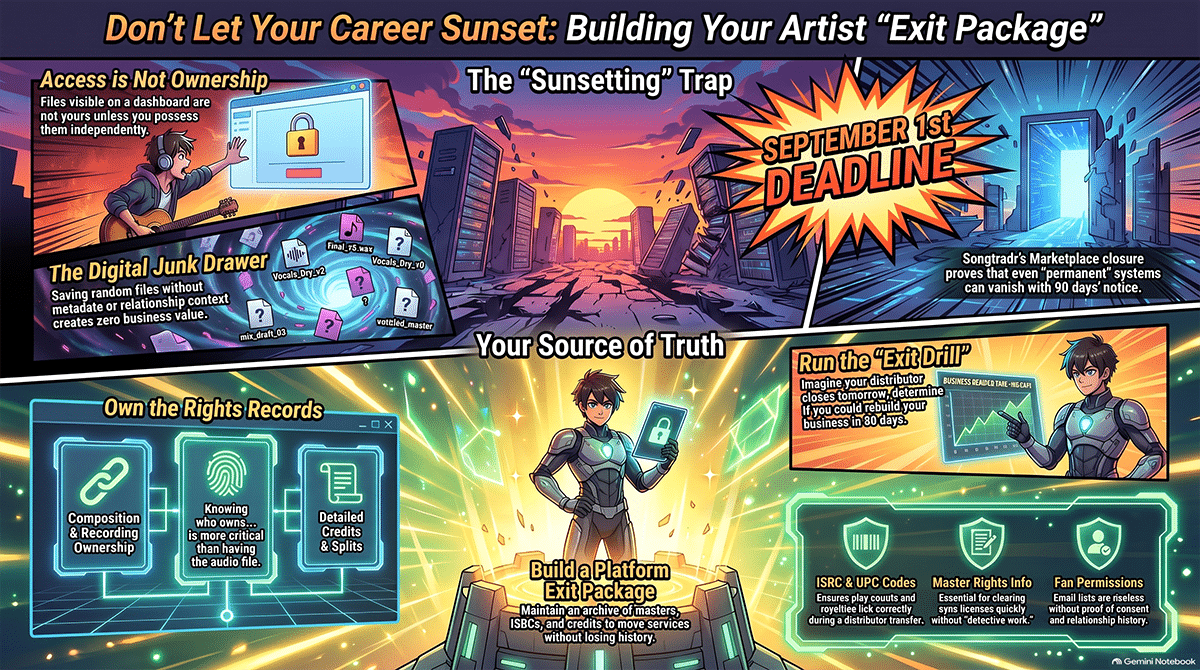
That is why independent artists should begin thinking in terms of a Platform Exit Package. An Exit Package is not something you create in a panic after a shutdown announcement. It is the artist-controlled record of whatever would be needed to move a part of the business somewhere else without losing its history, meaning or ability to make money.
Think about distribution. An artist should already possess the actual approved master recordings, final artwork, release metadata, credits, original release dates, ownership information and identifiers associated with each release. That information should not need to be reverse-engineered from Spotify or pulled out of a distributor’s dashboard the afternoon before an account closes.
Those identifiers matter. The International Federation of the Phonographic Industry’s ISRC handbook is very clear that an unchanged recording keeps the same ISRC even if ownership or licensing changes. Songtradr’s own distributor-transfer instructions similarly tell artists that matching audio, release information, ISRCs, UPCs and other metadata improves the chance that stores will correctly link a transferred release. Songtradr also warns that linking and preservation of play data are ultimately controlled by the stores and therefore cannot be guaranteed.
That is why changing distributors should not be treated like deleting an old Facebook post and uploading another one. A badly handled transfer can create duplicates or other catalog problems. If a move becomes necessary, the artist should follow the new distributor’s instructions carefully and make sure the replacement release is working before tearing down the old one where appropriate.
Now imagine the Exit Package for a sync service. The artist should not discover during a shutdown that the only organized instrumental master was uploaded four years ago, the songwriter split exists only as information entered into a form and nobody remembers whether the track contains the sample everybody discussed in the studio. The important thing is not simply having more files. It is knowing what those files are and how they relate to the business.
A Backup Is Not the Same Thing as Business Continuity
Musicians understand backups, at least in theory. In practice, the history of recorded music contains an impressive number of important files stored on one drive sitting next to a beverage. But even a perfect backup does not automatically create business continuity.
Imagine a hard drive containing two thousand audio files. Nothing has been lost. Technically, this is wonderful news. Unfortunately, the files are named FINAL.wav, FINAL_NEW.wav, FINAL2.wav, FINAL_REAL.wav, FINAL_REAL_2.wav, MASTER_USE_THIS.wav and the immortal classic USETHISONE_FINAL_MASTER_v8.wav. Musicians have been naming files as if their future selves will possess supernatural powers of recall for a very long time.
A backup answers one question: do I still have the file? Business continuity answers much harder questions. What is the file? Is this the approved master? Which composition does it contain? Who owns the recording? Who wrote the song? Was the instrumental derived from this version or an earlier mix? Is this the one that was sent to the music supervisor? Was a license issued? Does that license still restrict anything? Which ISRC identifies this recording? Was the clean version created from the final master? Who approved the split?
The sound file matters, but the context is what turns the sound file back into a usable business asset. That is why a giant folder called MUSIC BUSINESS IMPORTANT STUFF can be comforting while still being one bad afternoon away from becoming an archaeological site.
The Artist Needs a Source of Truth
The answer is not more random folders. It is an artist-controlled Source of Truth. The phrase sounds technical, but the idea is almost embarrassingly simple. For every important part of the artist’s business, there should be one place where the artist can identify the authoritative record and understand how it connects to everything else.
A song is a perfect example. The artist may have a master recording on one drive, an instrumental on another, songwriter information in a PRO account, publishing information somewhere else, an ISRC in a distributor, licensing information inside a sync platform and an agreement sitting in email. Every individual fact may be correct, but the business does not really have one song record. It has a scavenger hunt.
That becomes dangerous because a commercially useful song is more than audio. The U.S. Copyright Office explains that a musical work and the sound recording of that work are separate copyright-protected works and may be owned and licensed separately. For audiovisual uses, its educational materials explain that use of the composition generally requires a synchronization license while use of a specific existing sound recording generally requires the corresponding master-use permission. U.S. Copyright Office guidance for musicians
That means the identity of a song has layers. There is the composition. There is the recording. There may be several recordings and several approved mixes. There are writers, publishers, performers, producers and other contributors. There are identifiers. There may be samples, licenses, restrictions or prior uses. There may be clean versions, instrumentals, television mixes, short edits and stems.
If those relationships live only inside one sync platform, the artist has not really created a catalog system. The artist has rented access to somebody else’s catalog system. The whole purpose of a Source of Truth is to reverse that relationship. The outside platform should receive a working copy of the information it needs, while the artist remains the authority on the underlying business record.
This Is the Idea Behind the Making a Scene Artist Ecosystem
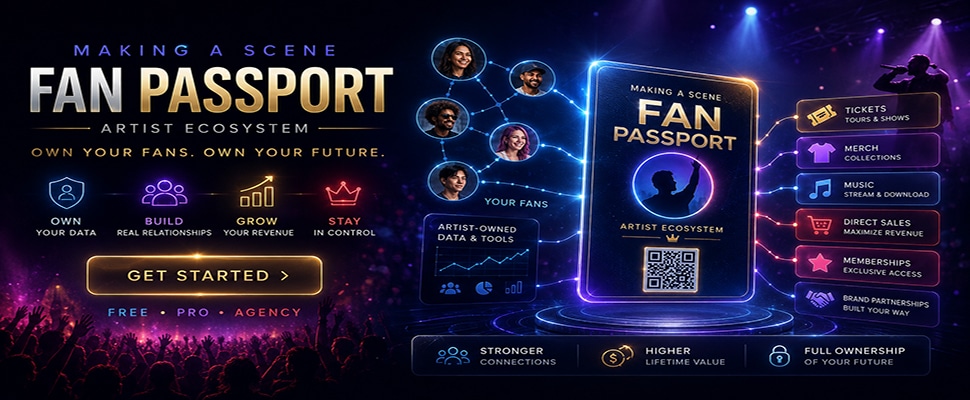
That philosophy is also the reason we have been building the Making a Scene Artist Ecosystem and Fan Passport around artist-controlled business records rather than simply building another place for musicians to upload things. The important part is not the brand name. The important part is the architecture.
The current Making a Scene Fan Passport site describes basic song, catalog and rights records in the Free Core system, along with an Artist Data Vault and export tools. In Pro, the public feature set includes more detailed contributor records, composition and master ownership worksheets, rights and licensing-authority tracking, registration-readiness information and a Rights Catalog described as the authoritative record of what an artist owns, controls and can approve. The same public system also ties fan records to consent information and supports fan-data exports based on permission rather than pretending every email address that ever touched a ticket transaction automatically belongs on a marketing list. Making a Scene Artist Fan Passport OS
That is the Source of Truth idea in practice. The artist maintains the authoritative business record, then outside systems perform jobs for the artist. A distributor can distribute, a sync marketplace can expose approved music to buyers, a ticketing company can sell tickets, a store can sell merchandise, an email company can deliver campaigns and an AI tool can perform analysis. None of those services has to become the only place where the artist can understand the business.
That difference may sound small until a platform announces a September 1 deadline. Then it becomes the whole game.
Data Without Relationships Is Just a Digital Junk Drawer
One of the mistakes people make when talking about “owning your data” is imagining that possession alone creates value. It does not. A spreadsheet containing an ISRC is useful. A royalty statement is useful. A master recording is useful. A license agreement is useful. A fan export may be useful. But the real business intelligence appears when those pieces are connected.
The ISRC identifies this recording. This recording came from this session. This instrumental came from the same approved master. This license authorized this use. This royalty statement reports income connected to this release. This songwriter agreement explains this split. This fan permission allows this kind of communication. This ticket purchase happened at this show. This customer later bought a shirt. This city produced enough repeat activity to justify another date.
Business memory is relational. That is why the solution is not simply downloading every CSV file a platform offers and throwing them into a directory. You have saved the evidence, which is good, but you have not necessarily saved the knowledge.
The artist who can connect the pieces can answer useful questions about which songs actually make licensing money, which markets sell tickets, which fans buy directly, which releases continue earning after their first year, which songs have all the rights information needed for fast clearance, which tracks are missing instrumentals and which agreements still matter. That knowledge belongs inside the artist’s business, not merely inside whichever dashboard happens to be displaying it today.
Follow the Money Out the Door
Financial history deserves special attention because money dashboards have a strange psychological effect. Once the balance hits zero, we tend to feel finished with them. Accountants are less sentimental.
Songtradr’s current support material is particularly interesting because its help center now contains more than one transition path. Its MassiveMusic FAQ says that for accounts being migrated, full account balances along with associated payment and tax information will transfer to MassiveMusic for Rightsholders. It also says migrated users will find royalty history and tax information in the new dashboard. Another Songtradr collection, still available in the help center, gives “final payout” instructions telling users to request a balance withdrawal by September 1 and says balances left there afterward would have to be recovered manually as unclaimed property. Songtradr also states that cancelling before a MassiveMusic migration prevents releases, data and earnings from being migrated.
Those instructions should not be mashed together into one universal rule. They appear to describe different account situations and transition paths. An artist affected by the closure should follow the instructions attached to that specific account and contact Songtradr if the account status is unclear.
What should be universal is preserving the financial history. Songtradr’s Revenue Platform currently allows users to view past transactions and download CSV data covering licensing, monetization and distribution payments. That is exactly the sort of information worth retaining independently even when the money itself has already reached the bank.
Historical statements can matter when preparing taxes, reconciling royalties, checking whether payments match an agreement, valuing a catalog or simply figuring out which part of the business is actually profitable. The artist may eventually change accountants, managers, distributors or licensing companies. The records still need to tell the story.
A dashboard should be a window into the accounting history. It should not be the accounting history. If the only proof that somebody once owed you money exists behind somebody else’s login page, that is a very fragile filing system.
Rights Records May Matter More Than the WAV File
Musicians naturally worry about losing masters because the audio feels like the thing. Lose the master and everybody understands the disaster immediately. Rights information can disappear more quietly.
Suppose the artist still has the perfect 24-bit WAV file but cannot quickly establish who owns the master recording. The song has two writers, one has a publisher, one used an administrator for a while and the drummer once said there might be a sample in the bridge, although nobody remembers whether that part survived the final mix. That is not the kind of mystery a licensing buyer gets excited about solving.
The Copyright Office’s distinction between the composition and sound recording becomes painfully practical here. A buyer using the existing recording in film, television, advertising, games or another audiovisual production may need authorization covering both sides. There is no magic value stored inside the WAV file that automatically explains those rights.
Good rights records let an artist say what is actually known. Who controls the master? Who controls the composition? Are all writers identified? Is there a publisher or administrator? Are there samples or interpolations that require additional clearance? Are there restrictions from an earlier agreement? Is the artist able to approve this use, or does somebody else have to sign off?
Those answers may not always be simple, and they should never be guessed simply because a supervisor needs an answer by Friday. But an organized artist has a fighting chance of getting to the correct answer quickly. That is why an Exit Package for a licensing platform needs to preserve the business identity of each song, not merely the sound of it.
Contracts Keep Working After Dashboards Stop
Licensing history adds another layer because old agreements have the irritating habit of continuing to matter after the interface used to create them has disappeared. Terms vary widely. A license may cover a particular media use, territory, period of time or other conditions. Another deal may be broader. Some terms may be exclusive, and some may not. There is no responsible way to summarize every license with one rule, which is exactly why the artist needs the actual agreement.
Songtradr says it is moving toward invite-only licensing and that music chosen for the new model will be brought into that process under a Master Services Agreement. Its help page says previously cleared and actively licensed music is unaffected through the Marketplace closing, but the page does not provide enough detail to justify inventing broad claims about every obligation after September 1. Existing agreements should therefore be preserved and read individually.
That should be normal practice even when nobody is closing anything. An artist should be able to understand where a song has been used, which agreement authorized the use and whether any continuing terms remain relevant. If a contract requires legal interpretation, that is the moment to call an attorney rather than asking a dashboard to explain itself.
Contracts have a remarkable resistance to corporate sunsets. Apparently nobody told them they were supposed to evolve.
Distribution Needs an Exit Strategy Before You Need to Exit
Distribution is one of the easiest places for musicians to become dependent because the system works invisibly when everything is going well. Upload a release, wait a few days and it appears across streaming services. Royalties eventually come back through the distributor. After a while it begins to feel as though Spotify, Apple Music and the distributor collectively “have the album.”
They do, but that is not the same as the artist having a complete release archive. Spotify’s own artist guidance tells musicians preparing a release to provide a high-quality lossless audio file, metadata such as album title, credits and release date and cover art through a distributor. Those are exactly the assets the artist should already possess independently. Spotify for Artists release guidance
The ISRC is particularly important because it identifies a specific recording. IFPI guidance says an unchanged recording retains its ISRC. If the actual recording changes, such as through a new recording or certain types of new versions, a different identifier may be needed.
That does not mean an artist should casually move releases between distributors because “I have the ISRC, so nothing can go wrong.” Songtradr’s own migration instructions warn that store linking is not guaranteed and recommend matching the audio and metadata closely when transferring existing releases.
The bigger lesson is easier than the technical migration process. You should understand how you would move distribution before something forces you to move it. If the original master, artwork, credits, release date and identifiers are sitting in an artist-controlled Source of Truth, a distributor change is an operational project. If all of that information has to be discovered while a countdown clock is running, it becomes an emergency.
The Recording Studio Has the Same Problem
This problem does not stop when the music reaches distribution. Modern recording increasingly depends on subscriptions, cloud storage, remote collaboration, software instruments, online mastering, stem tools, browser-based production and AI-assisted systems. Those tools are capable of things that would have looked like science fiction in a project studio twenty years ago, but they can also create wonderfully complicated dependencies.
A session may open correctly only because a particular plugin is installed. A cloud project may contain edits that were never exported locally. A virtual instrument patch may depend on a subscription. An engineer may have the only copy of the raw tracks. An online tool may have generated stems that everybody assumed somebody else downloaded.
That does not mean artists should record everything to a cassette machine and bury it behind the rehearsal room. It means portability should be considered while the project is alive. Can the important raw tracks be exported? Are approved mixes available outside the system? Can MIDI information be preserved when it matters? Are stems available? Are notes needed to rebuild a sound? Does a proprietary effect make a session impossible to reproduce elsewhere? What happens when the subscription ends?
Those are not questions for the day the company announces a closure. The best time to discover that a cloud production environment cannot export one important part of an album is before recording half the album inside it.
AI Makes the Exit Problem Stranger
AI pushes this issue into even more interesting territory because the output may not contain enough information to reconstruct the process that created it. An artist might use AI-assisted software to analyze a mix, separate stems, suggest metadata, transcribe lyrics, help create artwork, organize promotional writing, analyze song structure or generate another business asset. Generative systems add another layer because a result may depend on source material, a prompt, model behavior, settings and repeated iterations.
The first rule is not to make assumptions about what happens to uploaded material. AI services have different terms, privacy practices, retention policies and training rules, and those rules can change. An artist should read the current documentation for the service actually being used rather than relying on somebody’s angry social-media screenshot from two product versions ago.
The second rule is that the final output may not be the complete business record. If an AI system helps create artwork, for example, the artist may want to preserve the approved output along with enough information to know how that asset was created and which source material was used. If an AI system creates analysis that later informs a licensing description, there may be value in preserving the approved result rather than assuming the same analysis can always be regenerated.
The same architecture applies here as everywhere else. AI can be a useful tool, but it should not become a permanent single point of failure. AI should reduce the work required to operate an independent music business. It should not create a new form of digital archaeology.
Fan Relationships Are More Complicated Than Exporting Email Addresses
The idea of artist-owned fan relationships is central to the Making a Scene philosophy, but ownership language can become sloppy when people start talking about personal information. An artist does not magically “own” every email address that appears in a ticket transaction, storefront, social network or membership service. What can be exported, retained and used depends on the platform’s terms, the kind of relationship involved, the permissions collected and the law that applies.
That matters because the useful business asset is not merely an address. It is an authorized relationship. In the United States, commercial email is governed in part by the CAN-SPAM Act. The Federal Trade Commission explains that recipients must be given a way to stop future commercial email and that businesses remain responsible for complying with those rules even when another company sends messages on their behalf. Text messaging can involve a different and often stricter consent framework, especially where automated telemarketing messages are concerned. FTC CAN-SPAM compliance guidance
That is why a good fan-data system remembers more than a name and email address. It remembers the relationship. Did the person follow the artist, buy something, join a list, ask for text messages, unsubscribe, withdraw permission, attend a show or become a member?
The exact rules vary by situation and jurisdiction, and artists with serious privacy or compliance questions should get qualified advice. The business principle is simpler: permission needs to travel with the contact record. A fan export without that context can become another junk drawer.
Ticketing Companies Can Become Memory Banks Too
Live music produces some of the most valuable business intelligence an independent artist can collect. Which cities repeatedly draw people? Which fans come back? What ticket prices work? Which shows convert casual listeners into buyers? Where did people discover the event? Did a particular market sell fifty tickets once or twenty-five tickets three times?
A ticketing platform may know a lot of that. Again, the answer is not to grab every customer record and dump it into a newsletter database. Privacy rules, consent and platform terms still matter.
The useful question is what legally and practically portable information the artist should preserve about their own business. Maybe the answer is transaction-level reporting rather than a marketing list. Maybe the artist has direct consent from certain fans and can maintain those relationships. Maybe some data must remain with the ticketing provider. The details vary, but the architecture does not.
If changing ticket systems means losing the artist’s entire understanding of five years of live business, then the ticketing system quietly became the memory of the touring operation. That should have been the artist’s memory.
Sometimes the Missing Asset Is a Human Being
Business continuity also fails in wonderfully old-fashioned ways. The account is still there. The files are still there. The money is still there. Nobody knows how to get in.
Maybe a former manager created the account. Maybe the original drummer registered the domain. Maybe a booking agent used their email address. Maybe two-factor authentication goes to an old phone. Maybe the producer who created the cloud account retired. Maybe the label relationship ended and nobody documented who controlled what.
This can turn an ordinary account problem into a small detective novel. The solution is not to keep passwords in a spreadsheet called passwords.xlsx, especially if that spreadsheet is sitting in the same cloud account whose password everybody forgot.
Current guidance from the U.S. Cybersecurity and Infrastructure Security Agency recommends strong unique passwords, a reputable password manager and multifactor authentication. CISA also recommends using stronger, phishing-resistant MFA options where available. CISA Secure Our World guidance
For a band or small music company, continuity also means knowing who controls the account, which business email owns it, where recovery methods go and how access is transferred when somebody leaves. A career should not depend on one person remembering something forever. If the bass player’s old AOL address is the final key to fifteen years of catalog history, there may be room to improve the system.
Try the Platform Exit Drill Before There Is Smoke
One of the easiest ways to expose these weak spots is to run a Platform Exit Drill. Nothing actually has to close. Pick an important service and imagine that an email arrived this morning saying it will disappear in ninety days. Then walk through what would happen.
Do not treat the exercise as a checklist nailed to the rehearsal room wall. Treat it as a story. The distributor is closing. Could the releases be recreated somewhere else? The licensing marketplace is ending. Are the instrumentals and rights records safe? The ticketing company is changing systems. What historical information matters? The email provider is being replaced. Do consent, unsubscribes and suppression records move correctly? The cloud production service is shutting down. Are the sessions usable elsewhere?
If those answers are easy, wonderful. Close the imaginary emergency and go make music. If answering them requires three days of detective work, fourteen emails, a retired manager, a drummer who now lives in Arizona and one external hard drive that makes a clicking noise when plugged in, the drill has done its job. You found the weakness before a real deadline found it for you.
Decentralization Without the Fog Machine
This is also where the word decentralization becomes useful again. For a while, decentralization in the music business became wrapped in so much Web3 language that ordinary musicians could be forgiven for assuming it required a token, a wallet, a Discord server and a white paper containing at least one glowing geometric shape.
It does not have to begin there. Decentralization can start with a far simpler rule: do not allow one outside company to become the sole keeper of an essential part of your career. Your master should not exist only inside a distributor. Your licensing records should not exist only inside a sync marketplace. Your sessions should not exist only inside a cloud production service. Your fan permissions should not exist only inside somebody else’s marketing system. Your financial history should not exist only inside a payment dashboard.
That is decentralization in a form a working musician can use before load-in. Web3 technologies may eventually offer useful tools for provenance, portable identity, rights records, permissions and transactions. There are places where blockchains or other decentralized systems can create real value. There are also many situations where a boring database, a sensible export, open file formats, redundant backups and good business discipline will solve the problem better.
Use the tool that solves the problem. Technology should serve the artist. The artist should not have to join a religion every time somebody invents a new database.
Your Revenue Stack Needs an Infrastructure Stack
Independent artists have become much better at thinking about diversified revenue. Streaming should not be the only income source. Shows matter. Merchandise matters. Direct music sales matter. Sync licensing matters. Publishing matters. Memberships and fan support matter. Production work, session work, teaching and other services may matter.
That creates a revenue stack. But there is another stack underneath it that gets far less attention: the infrastructure stack. Where is the accounting history behind those revenues? Where are the rights records? Where are the customer permissions? Where are the masters? Where are the agreements? Where are the identifiers? Where are the transactions? Where is the knowledge required to keep operating if one provider disappears?
A business can look diversified from the outside while remaining surprisingly fragile underneath. An artist might earn money from five different sources but route every critical part of the operation through one account. That is not as independent as it first appears. Real independence means the revenue can move and the infrastructure can move.
The Exit Package Should Exist on Day One
The biggest change I would like independent artists to make is not technical. It is a change in the questions we ask when we adopt technology.
For years the question has been, “What can this platform do for me?” That is still a perfectly good question, but it needs a partner: what happens to my business if it stops doing it? Those questions belong together.
When an artist signs up for a distributor, sync service, store, ticket company, cloud studio or AI platform, it is worth understanding what information will go into the service, what can come back out, which files need to be preserved elsewhere and what would be required to replace that service.
Nobody is predicting doom. This is ordinary business planning. A restaurant owner does not keep the only copy of the menu inside the cash register. A photographer does not assume the social network is the permanent archive of every original image. A recording studio would be reckless to treat one client-delivery portal as the only copy of every session. Musicians deserve the same standard.
The Exit Package is not evidence that you distrust the company. It is evidence that you understand your own company.
September 1 Is the Alarm Clock
That brings us back to Songtradr. September 1, 2026 is not the day the music industry ends. Songtradr is not disappearing. Active releases on the MassiveMusic transition path are being moved. Bandcamp remains available for direct-to-fan selling and engagement. Songtradr’s licensing operation is shifting toward a more curated model.
What disappears is the assumption that the current Marketplace interface will always be there. Somewhere right now, an artist’s only convenient copy of an instrumental is sitting inside a licensing platform. Somebody’s organized royalty history exists only inside a distributor. Another band has fan activity scattered across ticketing systems. A producer has sessions in a cloud service. A songwriter has licensing information buried inside a marketplace account. A touring band has years of business memory spread across inboxes, laptops, dashboards, old phones, spreadsheets and external drives.
The point is not to panic and spend the weekend downloading the entire internet. The point is to change the architecture.
Use platforms aggressively. Take advantage of good distribution. Use direct-to-fan stores. Work with licensing companies. Sell tickets. Build memberships. Use AI. Use cloud tools. Use social networks for discovery. Use whatever helps you reach fans, save time and create more revenue. Just do not make any one of those companies the sole keeper of your career.
The platform can hold a working copy. The artist should hold the business memory.
That is what an artist-controlled Source of Truth really means. It is also what decentralization looks like when you turn off the Web3 fog machine and ask one brutally practical question: if this company changes direction tomorrow, can I keep making money?
A service can close. A company can be acquired. A product can change. A dashboard can vanish. The artist’s catalog, rights history, fan relationships, financial records, creative assets and ability to continue doing business should remain.
An Exit Package is not something artists build because they expect every technology company to fail. They build it because, eventually, something will change. That is the difference between using platforms to build an independent music business and accidentally allowing the platforms to become the business.
 |  Spotify |  Deezer |  Breaker |
 Pocket Cast |  Radio Public |  Stitcher |  TuneIn |
 IHeart Radio |  Mixcloud |  PlayerFM |  Amazon |
 Jiosaavn |  Gaana |  Vurbl |  Audius |
 Reason.Fm | |||
Find our Podcasts on these outlets
Subscribe to Our Newsletter
Discover more from Making A Scene!
Subscribe to get the latest posts sent to your email.


