

The Music Industry Has Been Collecting Royalties. But Does It Know What Songs Are Actually Being Played?




Making a Scene Presents – The Music Industry Has Been Collecting Royalties. But Does It Know What Songs Are Actually Being Played?
Listen to the Podcast Discussion
New research from Britain’s grassroots music venues raises troubling questions about how live-performance royalties are measured, who gets paid, and whether the next generation of music technology could finally give independent songwriters a more accurate accounting.
There’s Music Coming From the Stage. Is There Money Finding Its Way Back?
Imagine you’re sitting in a little music club on a Friday night. The place holds maybe a hundred people, the bartender is having trouble keeping up, and a three-piece blues band is absolutely tearing the roof off. The guitarist has been playing professionally for twenty years, the bass player has a day job because apparently being able to play bass doesn’t impress the electric company, and the drummer is holding everything together with the sort of musical magic that deserves considerably more money than the contents of the tip jar.
The band plays fourteen songs. Ten are originals written by the musicians onstage, three are obscure blues covers, and one is a rearranged version of an old soul classic that sounds almost nothing like the recording that made it famous. The audience loves it, the venue sells drinks, and the musicians walk away with their agreed payment and perhaps a few merchandise sales.
Somewhere in the background, however, another financial transaction is supposed to be taking place. The venue’s music licensing arrangements help support a system intended to compensate the people who wrote the compositions being performed. That money moves through performance-rights organizations, which attempt to determine which songwriters and publishers are entitled to payment.
But there’s a rather important question buried in that process. How does the organization distributing the money actually know what the band played?
For decades, the music business has built complicated systems for collecting royalties, licensing music, administering copyrights, and identifying rights holders. Those systems have become increasingly sophisticated, particularly when dealing with streaming services, radio, and other places where music can be tracked digitally. Yet the musical activity happening inside small clubs, neighborhood bars, grassroots theaters, and other independent performance spaces can be considerably harder to document.
A new British investigation is raising questions about just how incomplete that picture might be. And while the research is being conducted across the Atlantic, the implications reach directly into the working lives of American independent musicians.
This story is about something much larger than a new piece of technology. It’s about whether the music industry has built a financial system capable of recognizing the people who actually create the music that keeps its smallest venues alive.
A British Experiment Finds a Surprisingly Large Gap
On October 15, 2026, Britain’s Music Venue Trust and music-recognition technology company Audoo announced the results of an initial investigation into music performed inside grassroots venues.
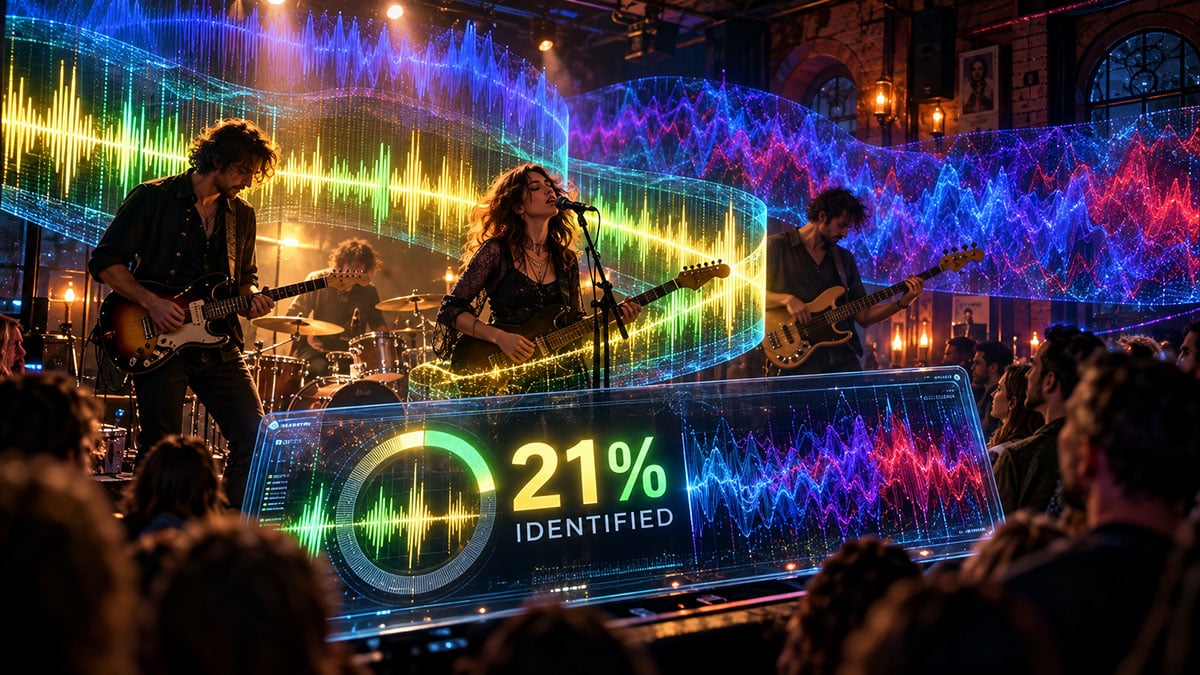
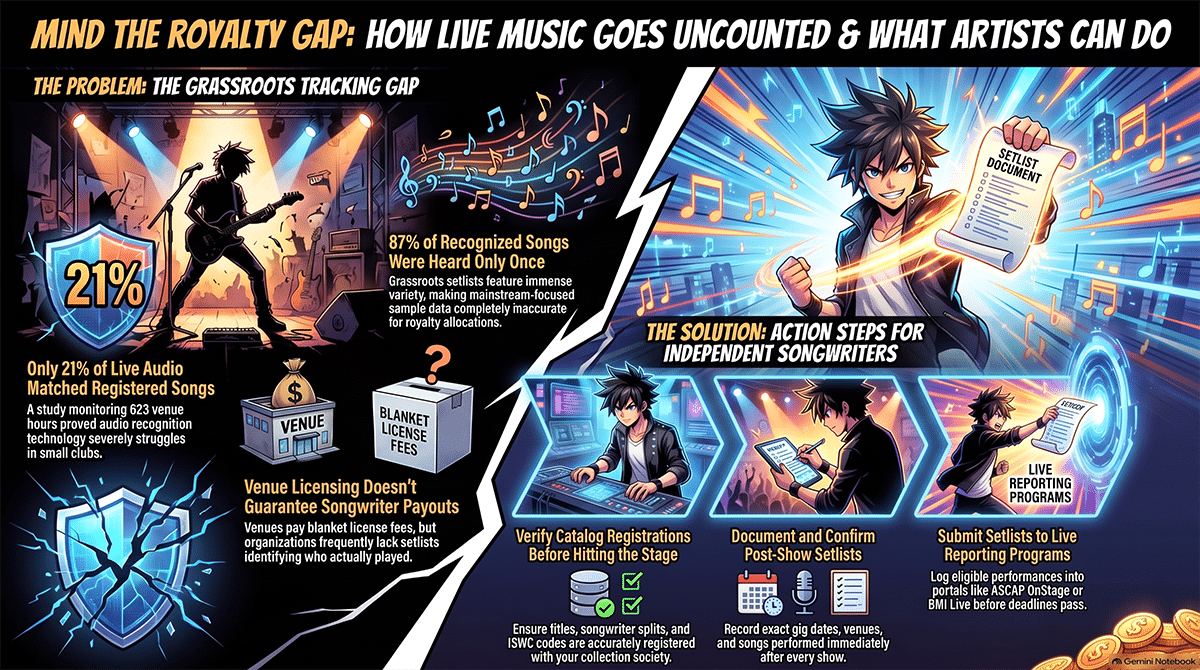
The organizations monitored 623 hours of live-performance audio during August and September 2026 using Audoo’s audio-recognition technology. Of those 623 hours, the system matched 134 hours, approximately 21%, to known songs or musical works. During the same investigation, it identified 2,238 individual live performances.
That is a remarkable result, although not necessarily for the reason suggested by some of the more dramatic headlines. The experiment was not simply asking whether computers could recognize music. It was investigating whether the musical repertoire being performed in smaller venues corresponded with the information available to the systems that help administer performance royalties.
Music Venue Trust has argued for years that the music performed in grassroots venues is not necessarily represented accurately by the assumptions used in music licensing. In particular, the organization has challenged what it describes as the assumption that all music performed in such venues belongs to registered repertoire covered by the conventional licensing framework.
The initial results appear broadly consistent with Music Venue Trust’s longstanding estimate that registered repertoire represents between 20% and 34% of the music performed in grassroots venues. But those numbers require careful examination before anyone starts accusing the royalty system of losing nearly four-fifths of the money.
The pilot measured audio recognition, not unpaid royalties. An hour of monitored performance audio is not automatically an hour of copyrighted musical compositions, and failure to recognize a song does not prove that it is unregistered. Musicians talk between songs, audiences cheer, performers improvise, and even sophisticated recognition systems sometimes fail when a familiar composition receives a radically different arrangement.
A song that cannot be identified by one recognition system might still be properly registered with a collection society. A song that the system recognizes might have incomplete ownership information. These are separate questions, and the difference between them matters enormously when real money is involved.
Nevertheless, the pilot exposes an uncomfortable possibility. If a recognition system connected directly to a venue’s mixing console can identify only a limited portion of the material it hears, how complete is the information used by royalty administrators when they don’t have direct performance records in the first place?
The answer is not yet known, which is precisely why the organizations are expanding the investigation.
According to the October 15 announcement published by Record of the Day, Music Venue Trust and Audoo are launching a larger study involving more than 100 grassroots venues between October and December 2026. They expect to publish the expanded findings in January 2027.
That larger investigation could provide a much clearer picture of the relationship between music performed in grassroots venues, compositions that can be identified, and the repertoire represented by established collection systems.
For independent musicians, this is a study worth following closely. It could eventually influence discussions about how venues are licensed, how repertoire is measured, and how performance royalties reach the people who actually wrote the music.
The Most Interesting Discovery Wasn’t the 21%
Buried inside the announcement is another finding that may be even more important for understanding the independent music economy.
During September, Audoo’s technology recognized 1,190 different songs performed live. Approximately 87% of those songs were heard only once during the monitored period.
Think about what that means. Instead of hearing the same familiar hits repeated night after night, the researchers encountered an enormous variety of compositions, most of which appeared only once in the measured sample. That is a very different musical landscape from the one reflected in commercial radio playlists, mainstream streaming charts, or large concert tours.
The research also identified 10,943 recorded tracks by 6,248 artists during September. No single artist was heard in more than sixteen of the sixty-four venues providing data that month.
This is what the grassroots music world actually looks like. It is made up of thousands of performers, songwriters, bands, DJs, and local music communities whose combined activity creates a remarkable amount of musical diversity.
Some of those musicians have recorded albums that never reached a national chart. Others perform original compositions that exist only in live arrangements. A touring blues band might play a song from an independently released album that sold a few hundred copies, while a jazz ensemble across town performs a composition that has never been commercially recorded.
The music matters to the people hearing it, and the performances may create royalty-generating uses of the compositions. Yet the works are unlikely to appear prominently in datasets built around mainstream music consumption.
This is where royalty administration becomes complicated. Some royalty systems rely on direct reporting of actual performances, while others use surveys, representative samples, or other allocation methods for particular categories of music use. Those approaches are not identical across countries or collection organizations, and they are often responses to the considerable expense of collecting detailed information from millions of musical performances.
The practical problem is that a sample based on popular music may not represent what is happening in a small independent venue. If a system needs to estimate usage, the choice of data can influence which works receive credit.
The British pilot does not prove that any specific songwriter was underpaid because of those methods. What it does demonstrate is that the repertoire inside the monitored grassroots venues was exceptionally diverse. That makes the accuracy and representativeness of usage information a serious question rather than a minor accounting detail.
For years, independent musicians have been told that their audiences are too small to matter to the larger music business. The industry has frequently treated niche music, regional scenes, and original material performed in small rooms as an economic afterthought.
The Audoo pilot offers a different way of looking at that world. Instead of asking how closely grassroots music resembles the mainstream, it measures the extraordinary variety of what is actually being performed.
That variety is precisely what makes independent music valuable. It also makes the music harder to account for using systems designed around the biggest commercial recordings.
Collecting the Money Is Only Half the Job
To understand why this investigation matters, we need to clear up one of the most confusing parts of the music business. There is a difference between collecting money for the public performance of music and figuring out who is entitled to receive that money.
In the United States, performing rights organizations such as ASCAP, BMI, and SESAC license public performances of musical compositions and distribute royalties under their respective policies. Another organization, Global Music Rights, also operates in this area, representing a more selective roster.
A venue that uses copyrighted music generally needs appropriate public-performance licensing. Depending on its circumstances, the venue may need coverage from multiple organizations because different songwriters and publishers are represented by different entities.
The license allows covered music to be performed under the applicable terms. But the payment made by the venue does not, by itself, tell the licensing organization which songs were played on any particular night.
Imagine a restaurant that hosts live musicians four nights a week. Over the course of a year, dozens of performers might play hundreds of different compositions. Some evenings feature cover bands, others feature original singer-songwriters, and still others feature jazz improvisation or traditional music.
The venue may have fulfilled its licensing obligations, but that does not automatically create a complete list of every composition performed. Someone still needs the performance information, and the administrators need a way to connect each work to its registered writers and publishers.
The situation becomes more difficult when a musician performs an original song that has never been registered with the relevant organization. The composition can be protected by copyright even without registration with a performing rights organization, but royalty administration generally depends on having sufficient information to identify the work and the appropriate rights holders.
A songwriter who has carefully registered compositions and maintained accurate ownership information is in a much stronger position than one who assumes that releasing an album through a distributor somehow takes care of every royalty obligation.
It doesn’t.
Digital distributors, record labels, music publishers, performing rights organizations, and mechanical royalty administrators serve different functions. Some services combine several functions, but membership or registration with one organization does not automatically guarantee that every other part of the royalty system has the information it needs.
This is where independent musicians frequently encounter an administrative maze. They may own their masters, control their publishing, write their own songs, perform those songs in public, and still leave potential royalties unclaimed simply because the relevant performance was never reported or the composition information was incomplete.
The money involved in any individual performance may be modest, and payment is never guaranteed merely because a setlist was submitted. But a musician who performs repeatedly over many years has a reason to care about every legitimate source of income.
The working music business is built on accumulating revenue from many activities, not waiting for one miraculous payday. Ignoring performance royalties because an individual check might be small is rather like a store owner refusing to count sales below twenty dollars.
Nobody running a serious business would consider that sound financial management.
America Already Has Tools for Reporting Live Music. Are Artists Using Them?
Before anyone assumes the British findings prove something about American royalty administration, an important distinction needs to be made. The United States has its own organizations, reporting procedures, distribution methods, and licensing arrangements.
The Audoo pilot did not study American venues. It did not measure the recognition rates of ASCAP, BMI, or SESAC, and it does not establish that American collection organizations have the same gaps identified in the British experiment.
What it does raise is a question that American songwriters should already be asking: Are my live performances being properly documented, and have I submitted the information needed for the organizations representing my compositions to evaluate those performances for royalties?
ASCAP has a program called ASCAP OnStage, which allows eligible members to report live performances of their registered musical works. The program exists in part because not every performance is captured through the organization’s other information-gathering methods.
BMI offers a similar program called BMI Live. Performing songwriters can submit eligible concerts, including performances in smaller venues, by providing information such as the performance date, location, and songs performed. BMI explains that its program is available to performing songwriters, including both headlining and opening acts, subject to its eligibility and verification rules.
BMI also provides reporting deadlines and quarterly payment schedules. Its published guidance explains that members may enter performance information for prior periods within the program’s submission windows, making it particularly important for touring musicians to keep records rather than trying to reconstruct an entire tour months later.
SESAC has its own live-performance reporting procedures through its member systems, although its membership and administration model differ from the open membership practices associated with ASCAP and BMI.
The existence of these reporting programs is significant because they offer artists ways to contribute performance information directly to the royalty system. They also reveal that royalty organizations recognize the difficulty of identifying every live performance through venue reporting, surveys, and other data sources alone.
In April 2025, ASCAP addressed this issue in comments submitted to the U.S. Copyright Office. The organization explained that obtaining setlists from managers, promoters, and venues can be difficult and that it sometimes must gather concert information from other sources. ASCAP specifically pointed to OnStage as a way for members to report performances that were not otherwise captured in its surveys.
The U.S. Copyright Office has also examined concerns about live-performance reporting. In its analysis of issues involving performing rights organizations, it noted interest in making setlist reporting more consistent and easier to use.
That doesn’t mean every American songwriter is being shortchanged. It means even established royalty organizations acknowledge that collecting accurate information about live music is a difficult and ongoing administrative challenge.
And for the independent musician who finishes a three-hour performance, loads equipment into a van, drives home, and gets up the next morning to go to work, that administrative burden is very real.
The songwriter may be more concerned about whether the venue will rebook the band than whether every song has been entered into a reporting system. Unfortunately, the royalty system doesn’t necessarily know what happened merely because the audience enjoyed the performance.
This is why developing a habit of documenting performances can be one of the simplest financial improvements an independent artist makes.
The Cover Song Problem Nobody Wants to Explain
There’s another wrinkle in this story that deserves attention, particularly because cover songs remain an important part of live music.
When a band performs someone else’s composition in a venue covered by appropriate licensing, the public-performance royalty is connected to the underlying composition and its rights holders. Playing the song does not make the performing band the songwriter, and a dramatically rearranged version does not automatically give the band ownership of the original musical work.
This distinction sounds obvious until you look at how independent bands actually perform. A blues-rock group might turn a traditional-sounding three-minute song into a twelve-minute showcase, complete with guitar solos, audience participation, and an extended ending that probably wasn’t discussed with the original songwriter.
From the audience’s perspective, the performance feels entirely new. From the standpoint of composition ownership, the original writer’s rights generally remain relevant, although authorized derivative arrangements can introduce additional considerations.
Now imagine trying to identify that composition through automated audio recognition. The melody may be buried beneath improvisation, the rhythm may be completely different, and the arrangement may bear little resemblance to the recording used as a reference.
Audoo’s pilot demonstrated that live recognition can handle at least some unusual arrangements. The researchers reported identifying Britney Spears songs performed as heavy metal, as well as tribute-band performances involving hundreds of songs. One recognized performance even involved the complete sequence of tracks from My Chemical Romance’s The Black Parade.
Those examples suggest that recognition technology has become considerably more capable than simply comparing a venue’s audio to an identical commercial recording. Still, successfully recognizing some difficult arrangements does not mean every interpretation will be identified.
There is an additional challenge when the performed work has never been recorded. A folk songwriter may debut a new composition at a small club before entering a studio or distributing the song anywhere. There may be no commercial audio reference available for a recognition system to compare against.
That creates an interesting conflict between musical creativity and administrative technology. The more original and spontaneous the performance, the less likely it may be to resemble material already known to a recognition database.
The financial system should not unintentionally penalize originality simply because familiar songs are easier for machines to identify. If anything, a fair system needs methods that recognize the limitations of automated matching and allow musicians to supply the missing information.
For independent performers, this reinforces the value of keeping accurate setlists that identify original compositions and covers, including the relevant writers wherever possible. It also means that automated recognition should be treated as supporting evidence rather than the final authority on what happened during a performance.

What Audoo Is Actually Building
Audoo’s technology is interesting because it approaches the problem from the venue itself, rather than waiting for someone to assemble the paperwork after the performance.
The company has developed devices called Audio Meters that identify music being performed or played in commercial environments. Its live-recognition system can receive an audio signal directly from a venue’s mixing console, allowing the technology to analyze a relatively clean feed instead of relying entirely on sound captured from the audience area.
According to Audoo’s description of its live-monitoring technology, the system is designed to recognize live performances and cover songs, producing usage information that could support more accurate royalty administration.
For a small music venue, the potential attraction is straightforward. Instead of asking the owner, bartender, sound engineer, or performing artist to reconstruct what happened onstage, the system could help produce a record of music usage automatically.
That could make reporting more complete, particularly in venues where performers change frequently and there is no dedicated administrative staff.
For royalty organizations, verified usage information could provide another source of evidence when determining which compositions have been performed. For songwriters, it could reduce the chance that a performance goes undocumented simply because nobody submitted a setlist.
However, there’s an important financial distinction. The technology identifies music; it doesn’t automatically determine ownership, confirm licensing eligibility, or guarantee that a particular songwriter will receive payment.
Recognition is only one part of the process. The identified composition still needs to be connected to reliable information about its writers, publishers, ownership shares, and the relevant territories in which rights are administered.
A system that correctly identifies a composition but attaches it to the wrong ownership record could create a different kind of royalty problem. That may be easier to investigate than a completely unidentified performance, but it is still a problem that needs solving.
The technology also raises practical questions about operating costs, the collection of audio information, the terms under which venues participate, and the rights of performers whose music is being analyzed.
Audoo has published information about its approach to privacy and security, but independent venues and artists should still understand what information a particular installation collects, what is retained, who can access the results, and how that information may be used.
A monitoring system intended to improve royalty payments should not quietly become a mechanism that gives unrelated companies unrestricted access to performers’ recordings or commercially valuable audience information.
The goal should be accurate accounting without sacrificing the artist’s control over their music and business.
Artificial Intelligence Can Help. But It Needs to Know What It’s Looking For.
This is where the story begins connecting with a much larger change happening across the music industry.
Artificial intelligence and advanced audio-analysis systems are making it possible to examine music usage at a level of detail that would once have required enormous amounts of manual work. Audio recognition, pattern matching, database reconciliation, and automated reporting could eventually make live-performance accounting much more efficient.
Yet artificial intelligence is only useful when the information surrounding the music is reliable.
Consider an independent artist who writes a song called “Long Road Home.” The songwriter registers the composition with a performing rights organization, records it for an album, and releases that recording through a distributor. The track has one set of identifiers and metadata as a sound recording, while the underlying composition has its own registration details.
Now imagine the artist performs the song live at twenty different venues. On some nights, the band plays an acoustic arrangement. On others, the guitarist stretches the solo and the song lasts several minutes longer than the studio recording.
An intelligent reporting system might recognize the composition despite those differences. It could then match the performance to the songwriter’s registered work, connect it with the relevant venue and date, and prepare information for royalty reporting.
That sounds straightforward until the songwriter’s catalog contains inconsistent titles, missing ownership splits, duplicate registrations, or different spellings of the writer’s name.
A system can be remarkably good at recognizing patterns and still struggle when the underlying records disagree. Modern computing has not yet developed a magical ability to turn contradictory business paperwork into an unquestionably correct royalty statement.
The artist therefore needs more than audio recognition. The artist needs reliable composition records that can be used by different services without losing the identity of the work.
This is why identifiers such as the International Standard Musical Work Code, or ISWC, and the International Standard Recording Code, or ISRC, matter. The ISWC is associated with a musical work, while the ISRC identifies a particular sound recording. They serve different purposes and should not be confused with one another.
An artist can have several recordings of the same composition, each with its own ISRC, while the underlying composition remains the same musical work. A live performance of that composition does not automatically create a new master recording or a new ownership arrangement.
Good music-business software should understand those distinctions. It should help artists maintain a reliable connection between the composition, its recordings, its writers, its publishing information, and the performances in which it appears.
Artificial intelligence could then help identify missing information, detect inconsistencies, organize evidence, and prepare reporting records for the appropriate organization. But the final ownership information should come from verified rights records and the people legally authorized to make those claims.
Technology should reduce the work required to maintain accurate information, not create new copyright disputes through confident but incorrect guesses.
The Next Battle May Be Over Who Owns the Performance Data
There is an interesting business question hiding behind the excitement over automated royalty tracking. If technology can identify exactly which compositions are being performed at a particular venue, who should own and control the resulting information?
The answer isn’t necessarily simple. Venue operators, technology providers, collection societies, songwriters, and performers can all have legitimate interests in different parts of the reporting process.
A venue needs information about its licensing obligations and the music used on its premises. A songwriter needs accurate usage records supporting any legitimate royalty claim. A collection organization needs sufficient evidence to distribute licensing revenue under its policies.
A technology company developing the system also needs a business model that allows it to maintain its infrastructure and improve recognition accuracy.
Those interests can coexist, but only if the agreements governing the data are clear.
The danger is that independent musicians could find themselves inside another system where their creative activity generates valuable information that they cannot easily access. We’ve already seen how streaming platforms and social media companies can build powerful businesses around data generated by artists and their audiences, while giving creators only limited information about the people interacting with their work.
Live-performance data should not repeat that mistake.
An artist should be able to retain their own accurate records of what they performed, where they performed it, and which compositions belong to them. They should also be able to compare relevant third-party usage reports against their own records when those reports are made available.
That does not mean a songwriter automatically owns every piece of technical data collected by a venue’s monitoring equipment. Rights of access, ownership, and permitted use would depend on contracts and applicable law.
It does mean artists have a powerful reason to insist on transparency, portability, and access to the information needed to administer their own music businesses.
If a future system detects a performance of an independent songwriter’s composition, that discovery should not disappear inside an inaccessible database. There should be a practical way for the appropriate rights holder to identify the work, verify the claim, and resolve mistakes.
A useful system should make the artist more independent. It should not replace one gatekeeper with another gatekeeper that happens to own better microphones.
What This Could Mean for the Economics of Small Venues
Although the royalty implications are important, Music Venue Trust’s involvement introduces another dimension. This investigation is also about the financial pressures facing the venues that provide working musicians with places to perform.
Small venues operate on difficult margins. Rent, insurance, staffing, utilities, equipment maintenance, artist payments, and the endless cost of keeping a room open all compete for the same limited revenue.
Music licensing is one of those expenses, and venue operators have a legitimate interest in understanding how licensing fees are calculated and whether the applicable arrangements appropriately reflect their use of music.
Music Venue Trust has questioned the assumptions behind certain grassroots licensing practices in Britain. Its argument is not simply that venues should pay less money. The underlying issue is whether a licensing system based on assumptions about registered repertoire accurately describes the music being used.
That is a meaningful question, although it should not be confused with proof that a particular venue has been overcharged.
Music licensing arrangements depend on legal rights, repertoire coverage, agreed tariffs, and the terms of the applicable licenses. A recognition rate of 21% does not automatically imply that the licensing fee should be reduced by 79%, any more than it proves that 79% of songwriters went unpaid.
The larger study may help clarify how much of the monitored music is identifiable registered repertoire, how much falls outside that category, and what limits remain in the recognition process.
For songwriters, the stakes are equally important. If improved measurement demonstrates that independent compositions are being performed more frequently than existing data suggests, that could support more accurate royalty allocation.
At the same time, any changes to licensing costs need to be evaluated alongside their effects on the money available for distribution. Reducing venue expenses does not automatically increase songwriter income, and increasing royalty accuracy does not necessarily require increasing the total amount venues pay.
The real objective should be a system in which venues understand the charges, songwriters receive appropriate compensation, and the administrative cost of tracking the music does not consume an unreasonable share of the available money.
There is no reason independent venues and independent songwriters should be treated as natural enemies. They depend on one another, and both have an interest in keeping grassroots music economically sustainable.
Unfortunately, music-business policy sometimes seems determined to put the people doing the actual work on opposite sides of the table while everybody else sends invoices.
Better information offers a chance to change that conversation.
Why This Matters to the Working Musician Making a Living One Show at a Time
When industry reports discuss royalties, they often focus on enormously valuable catalogs, international superstar tours, or the financial arrangements of major publishers. Those stories matter, but they rarely describe the daily business of the musician playing forty, eighty, or a hundred small shows each year.
For that musician, live music is usually part of a larger financial puzzle.
A performance may generate a guarantee from the venue, merchandise sales, tips, new followers, email signups, future bookings, and potential performance royalties attached to eligible compositions. The artist may also sell physical recordings, promote memberships, or introduce fans to music available through their own website.
Each of those activities represents a different relationship with the audience or a different use of the artist’s work.
The challenge is maintaining enough information to understand where money is being earned and whether every legitimate revenue opportunity has been addressed.
Consider a songwriter who performs eighty shows in a year, with ten original compositions appearing in each set. That produces eight hundred individual performances of the songwriter’s own compositions. It does not mean eight hundred separate royalty payments, and it would be misleading to attach a universal dollar value to those performances.
Eligibility, venue licensing, reporting, distribution rules, and available revenue all affect the outcome. Even among performances that qualify, payment rates may change between periods or organizations.
But the example illustrates why complete records matter. Eight hundred performances are a meaningful body of activity, and they deserve to be documented properly rather than remembered vaguely after the tour.
If the musician keeps accurate records, those performances become part of an organized business history. The artist can submit eligible information to the appropriate performing rights organization, track reporting status, and investigate discrepancies when necessary.
The same records can also help with tour planning and understanding which compositions are being performed most often. Over time, the songwriter may identify songs that are particularly effective at converting casual listeners into fans, encouraging merchandise purchases, or generating interest from other performers.
That information has value beyond royalty payments. It can influence recording decisions, setlist development, marketing, licensing efforts, and decisions about where the band should perform next.
The connection between live music and accurate data is becoming increasingly important because an independent artist’s catalog is not just a collection of recordings. It is a portfolio of compositions, performances, recordings, rights, and business opportunities that need to be administered.
The better those assets are documented, the easier they become to manage without surrendering control to a company that promises to handle everything in exchange for a significant share of the revenue.
How the Making a Scene Artist Ecosystem Fits Into This Future
For Making a Scene, the most interesting part of the British investigation is not the prospect of putting another listening device inside a club. It’s the possibility of building a connected music-business system where an artist can document a performance once and use that information throughout the rest of the business.
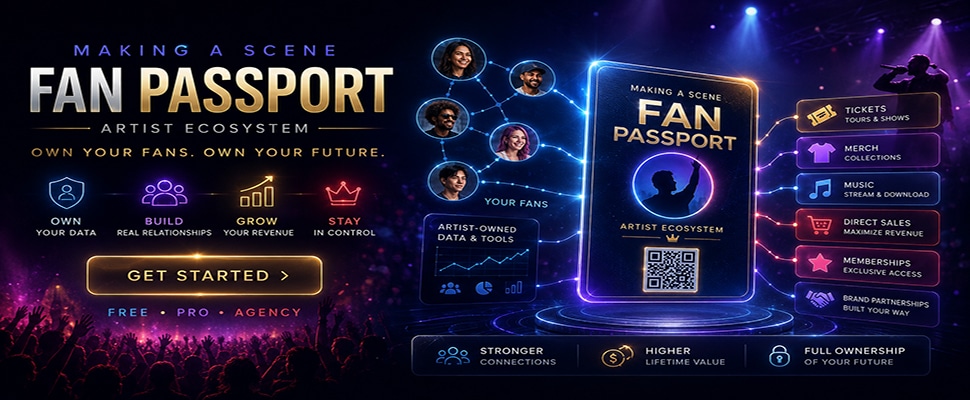
That is precisely the kind of infrastructure the Making a Scene Artist Ecosystem and Fan Passport project is intended to support.
The Artist Ecosystem already places substantial emphasis on maintaining a central Artist Source of Truth, organizing the musician’s catalog and business information, and connecting that information with touring, fan engagement, and revenue workflows.
The logical next step would be to connect performance documentation more directly with the authoritative records for each composition.
Imagine an artist preparing for a Saturday night show. The Artist Ecosystem already has the scheduled event, the venue information, the artist’s touring profile, and the catalog of compositions associated with the act.
As part of show preparation, the musician could assemble a setlist using the established composition records. Instead of repeatedly entering song titles, writer names, publishing information, and other details, the system could draw from verified records already maintained by the artist.
After the performance, the artist could confirm which songs were actually played, adjust the order, and document any last-minute changes. The completed setlist would then become part of the historical record for that show.
From there, a future royalty-reporting workflow could prepare the relevant information for ASCAP OnStage, BMI Live, or another appropriate organization. Where an official integration is available and authorized, some of that reporting might eventually be automated. Where no such connection exists, the system could generate an accurate report that the songwriter uses to complete the official submission.
That distinction matters. Preparing a report is not the same as filing an accepted royalty claim, and the software should never mark a performance as submitted or paid simply because it created a setlist document.
An effective system would preserve the artist’s control over the process while reducing the amount of repetitive administrative work required to complete it.
The same approach could create another useful connection with Fan Passport. A show already has a date, venue, and audience relationship. Fan Passport is designed to connect real-world interactions with an ongoing artist-controlled relationship, including consented fan engagement, merchandise activity, and other direct-to-fan opportunities.
The performance record would provide valuable business context for those interactions. An artist could evaluate the financial results of a particular show while also understanding how many fans were added to their own community and which merchandise or direct-support opportunities worked best.
The royalty information would remain a separate accounting category, because a composition royalty is not the same as ticket income or a merchandise sale. But the artist would finally have a more complete picture of the economic activity surrounding a single performance.
Building an AI-Assisted Live Royalty Intelligence System
Looking further ahead, the British study suggests a promising future capability for the Artist Ecosystem: an AI-assisted system that helps artists document, verify, and reconcile live performances.
Such a system would not need to begin with expensive proprietary hardware. The first practical version could be built around information the artist already controls, including the scheduled show, the planned setlist, registered composition data, and a post-show confirmation workflow.
An AI assistant could identify incomplete song registrations, inconsistent titles, missing songwriter information, and events without confirmed setlists. It could remind an artist about upcoming reporting deadlines and prepare the necessary records for review.
This alone could save independent musicians considerable administrative effort. A touring songwriter should not have to remember which of twelve similar song titles was used during registration or search through six different services every time a performance needs to be reported.
As audio-recognition technology improves, it may eventually become possible to add optional performance verification. With proper permission, a musician might analyze an authorized board recording or use a compatible third-party recognition service to compare detected compositions against the reported setlist.
The technology could flag possible omissions or mismatches for human review. A songwriter could then correct the record before submitting an official report.
There would be important safeguards. The system should not presume that an unidentified segment represents an unregistered song, should not create ownership claims automatically, and should not upload protected recordings to outside services without appropriate authorization.
Nor should it require every independent venue to install monitoring equipment before artists can benefit from improved administration.
For the working musician, simplicity would be the most important design principle. The process should feel like confirming what happened at last night’s show, not completing a graduate-level examination in copyright administration.
Over time, the system could help artists maintain an organized record of live performance activity that supports royalty reporting, tour analysis, and other legitimate business needs.
This is also where modern Web3 concepts can become useful without turning every musical performance into a speculative digital token.
An artist-controlled, tamper-evident record could help document when a performance report was created, who confirmed it, and whether the information was changed afterward. Cryptographic signatures and verifiable records could support trustworthy documentation shared between authorized systems.
None of that requires placing audio recordings or private business data on a public blockchain. In many cases, secure conventional databases with appropriate audit records would be simpler and more practical. Where decentralized verification provides a clear advantage, it should be optional and designed around the artist’s ownership and privacy.
The point is not to chase whatever technology happens to be fashionable this month. It’s to make sure the artist can prove what happened, maintain control over the underlying records, and use those records to support legitimate income.
A Better System Must Work for the Smallest Artist
There is one issue the music technology business frequently overlooks when developing new tools: independent musicians have limited budgets and even more limited time.
A system designed for major tours, large publishers, or enterprise royalty administrators may be impressive, but that doesn’t automatically make it useful to a songwriter playing a neighborhood bar for a modest guarantee.
The economics of grassroots royalty tracking have to work at grassroots scale.
If a musician spends an hour documenting a performance to recover only a small amount of additional revenue, the process may not make financial sense. And if a technology company charges substantial monthly fees for tools that mostly serve royalty accounting, the cost could exceed the money an artist reasonably expects to collect.
That is why automation needs to concentrate on reducing work rather than creating an entirely new category of subscriptions.
The ideal approach would use information the artist already maintains for touring and catalog management. A setlist created for the band should also be useful for royalty reporting. A show already entered into the booking system should not need to be typed again into another piece of software.
The same principle applies to ownership information. If songwriter credits and splits are verified in the central catalog, those records should be reused wherever they are needed instead of copied manually into competing databases.
That kind of integration can create meaningful savings even when the direct performance royalties from an individual show are relatively small.
It also creates a more useful business infrastructure for the artist. Catalog information can support licensing and publishing administration, touring records can support financial analysis, and properly consented fan relationships can create opportunities for future ticket sales, merchandise, and direct support.
A royalty-reporting system becomes much more valuable when it is part of an artist-owned business operation rather than another disconnected service demanding attention.
For Making a Scene, that remains the larger goal: helping independent musicians develop the infrastructure necessary to earn a sustainable living from their work without surrendering the rights, data, and relationships that make their businesses valuable.
What Independent Songwriters Should Be Doing Right Now
While researchers conduct their larger investigation, American independent musicians don’t need to wait until January 2027 to improve the way they handle live-performance income.
The most important starting point is understanding exactly which compositions belong to the songwriter and whether those works have been properly registered with the appropriate performing rights organization.
An artist who has released several albums over a decade should be able to identify the compositions, their credited writers, agreed ownership shares, and the organization responsible for administering the relevant performance rights.
If some of those details are missing or contradictory, correcting them deserves attention before another year of performances produces additional records that are difficult to match.
The next concern is documenting actual performances. Musicians already create setlists because they need to know what they’re going to play. Turning those setlists into reliable business records requires relatively little additional work if the habit is established.
An accurate record should identify the venue, date, artist, compositions performed, and other information required by the relevant reporting program. Recording how an event was billed and whether the act performed as a headliner or support artist can also be useful because certain systems consider those distinctions.
After the show, the musician should confirm that the setlist reflects what actually happened rather than assuming the planned sequence was followed perfectly. Anybody who has played a live show knows how quickly a carefully prepared setlist can disappear when an audience starts requesting songs.
For BMI writers, the BMI Live program provides specific instructions and deadlines. ASCAP writers should review the current requirements of ASCAP OnStage. Songwriters represented by SESAC or another society should follow that organization’s applicable reporting procedures.
Artists should also pay attention to performances outside the United States. International royalties involve the applicable foreign societies, reciprocal arrangements, and reporting requirements that may differ substantially from domestic procedures.
The artist’s distributor is not a substitute for this work. Neither is a registration with The Mechanical Licensing Collective, which administers a different category of royalties connected with eligible digital mechanical uses of compositions in the United States.
An independent songwriter who controls both recordings and publishing should understand these separate rights rather than assume one registration takes care of everything.
Finally, artists should examine their royalty statements and maintain records of submissions. A submitted claim is not a guarantee of payment, but having accurate documentation provides a starting point for questions about missing information, delayed processing, or possible errors.
This is not glamorous work, and nobody is going to sell out an arena because they organized their composition database. But it is the kind of routine business discipline that helps musicians keep more of the income their work is capable of generating.
The January 2027 Report Could Change the Conversation
The expanded Music Venue Trust and Audoo investigation deserves attention because it may produce more useful evidence about the musical activity taking place inside grassroots venues.
The first pilot established that the recognition system matched 134 hours out of 623 monitored hours and detected a remarkably diverse range of compositions and recordings. What remains unclear is how much of the unmatched material represents unregistered compositions, difficult-to-recognize arrangements, speech, improvisation, or other material that cannot be classified reliably.
The next investigation will need to provide more detail about those differences if its findings are going to support meaningful discussions about licensing and royalty distribution.
It would also be useful to understand how recognition performance changes between different types of music, different venues, and different live sound conditions.
A system that performs well with familiar rock songs but struggles with jazz improvisation, folk music, or newly written independent material could create a new imbalance if its results were treated as complete.
Researchers also need to distinguish between identifying a song and confirming that the correct rights holders can be located. Recognition rates alone cannot establish whether royalty distributions are accurate.
Ultimately, the most valuable evidence would connect verified music usage with registered work information and the policies used to distribute licensing revenue. That could reveal where current methods perform well and where better reporting might improve results.
Whether the January 2027 report delivers that level of detail remains to be seen.
There is also no guarantee that collection societies will adopt Audoo’s technology or alter their existing distribution methods because of this investigation. Any proposed changes would need to address reliability, financial consequences, administrative costs, applicable legal rules, and the interests of both music users and rights holders.
But even if the research does not lead to immediate changes, it is forcing an important question into the open.
Are the systems used to administer grassroots music capable of representing the extraordinary diversity of music being performed in those venues?
That is a question worth asking, even when the answer may be inconvenient for established business models.
The Music Industry Middle Class Needs More Than Better Royalty Collection
At Making a Scene, we have spent years arguing that a sustainable independent music industry requires more than better streaming payouts or occasional opportunities to get noticed by a major company.
Working musicians need control over their copyrights, their recordings, their business information, and their relationships with the people who support their music.
They also need the financial infrastructure that allows those assets to generate income reliably.
The British study reminds us that even the most basic economic activity in music—the public performance of a song—can involve considerable uncertainty when the information needed to administer rights is incomplete.
That uncertainty becomes especially important for the independent songwriter, whose work may be valuable to a local audience without ever becoming visible to the mainstream music business.
An artist playing original music to sixty devoted fans in a small club is participating in the music economy just as surely as a superstar performing in front of sixty thousand people. The scale is different, the revenue is different, and the business model is different, but the songwriter’s rights do not disappear because the room is smaller.
Better technology may help collection organizations recognize more of that activity. Better administrative systems may make it easier for venues and performers to report what actually happened. Better artist-owned software may ensure musicians have reliable records before the information reaches a royalty administrator.
All of these improvements have value, but none should be confused with a complete solution to the challenges facing independent artists.
Performance royalties will remain only one part of a musician’s income. Direct ticket sales, merchandise, recordings, licensing, publishing, memberships, fan support, and other artist-controlled revenue opportunities will continue to matter.
The larger opportunity comes from connecting those activities into a sustainable business that the musician actually owns and understands.
For a songwriter, that means recognizing a composition as more than something to perform or upload to a streaming service. It is an intellectual property asset that can generate different kinds of income over time, provided the creator maintains the rights and information needed to administer it.
For a touring musician, it means understanding that the documentation created around a live show can serve several purposes. Accurate performance records can support royalty reporting, while other carefully maintained show records can help the artist improve bookings, manage expenses, and strengthen direct relationships with fans.
For the companies building the next generation of music technology, it means recognizing that a successful system must make independent musicians more capable, not merely make their activity easier for somebody else to monetize.
The Music Venue Trust and Audoo investigation is still in its early stages, and its most important conclusions have yet to be established. We should resist turning a promising pilot into proof of missing royalties or a verdict against every existing collection society.
At the same time, we shouldn’t overlook what the researchers have already made visible. The music played inside grassroots venues is varied, unpredictable, and often far removed from the familiar material that dominates mainstream commercial measurements.
That diversity is not an inconvenience to be engineered out of the system. It is one of the reasons independent music matters.
If the next generation of recognition technology, AI-assisted administration, and artist-controlled business tools can help document that creativity more accurately, it could become an important improvement in how grassroots music is valued and compensated.
The objective should not be a world where musicians must satisfy an algorithm before their work counts. It should be a world where the songwriter who plays an original song in a small club has a practical, affordable way to document the performance and pursue whatever compensation the applicable licensing system provides.
That would be a meaningful step toward the music industry middle class we’ve been working to build, because real independence requires more than owning the music. It requires having the information, tools, and financial relationships necessary to make that ownership work.
And if we can finally give independent musicians an accurate accounting of what happens onstage, perhaps the next conversation can be about making sure the business built around that music works just as hard as the musicians do.
 |  Spotify |  Deezer |  Breaker |
 Pocket Cast |  Radio Public |  Stitcher |  TuneIn |
 IHeart Radio |  Mixcloud |  PlayerFM |  Amazon |
 Jiosaavn |  Gaana |  Vurbl |  Audius |
 Reason.Fm | |||
Find our Podcasts on these outlets
Subscribe to Our Newsletter
Discover more from Making A Scene!
Subscribe to get the latest posts sent to your email.


