
Five Things You Can Sell and the One Thing You Should Keep




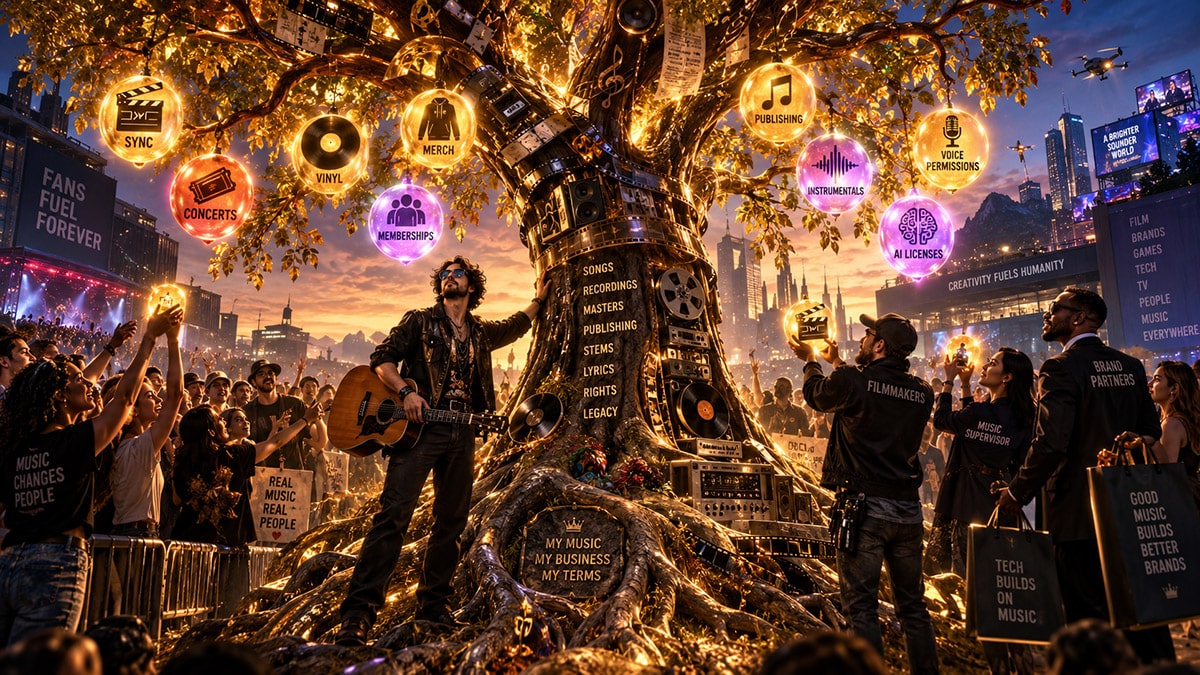
Making a Scene Presents – Five Things You Can Sell and the One Thing You Should Keep
Listen to the Podcast Discussion
There is a habit in the music business that we probably should have questioned a long time ago. An artist spends months writing a song, recording it, paying musicians, fixing vocals, choosing mixes, mastering the final recording, building an audience around it and eventually creating something with real economic value. Then, almost immediately, the industry teaches that artist to think about who can take control of it, distribute it, own a piece of it or put it inside somebody else’s business. Somewhere along the way, we skipped a much more useful question: what exactly did the artist create, and how many different ways can those assets make money without the artist surrendering the machinery that makes future income possible?
Take one finished song and imagine putting it on a table. At first glance, it looks like one thing because that is how we experience music. We press play, hear three or four minutes of sound and call the whole experience “the song.” From a business point of view, though, that finished recording may contain a master recording, an underlying composition, lyrics, an identifiable voice, an artist identity, instrumental mixes, stems, alternate versions, sync edits, artwork, metadata and a growing relationship with people who care about the artist. In the age of artificial intelligence, there may also be permissions connected to training, generation, digital replicas, interactive fan experiences and uses nobody at the original recording session could have predicted.
Once you see the song this way, the economics start to change. The artist is no longer standing in front of a single product that needs to be sold once and then forgotten. The artist is standing in front of a collection of assets, permissions and relationships that can create many different transactions over time. Some of those transactions involve selling a physical or digital product, while others involve licensing a particular use, sharing a defined revenue stream or allowing limited access to something the artist still controls when the deal is finished.
That distinction may be one of the most important ideas an independent artist can learn. Monetizing an asset does not automatically require surrendering ownership of the asset, and earning money from a right does not mean that right has to disappear from the artist’s business forever. If we are serious about building a music-industry middle class instead of a lottery in which a few people become superstars while everybody else waits for streaming pennies, then artists have to become much better at understanding what they own, what they can license and what they should be very careful about giving away.
Stop Calling Everything “The Rights”
Musicians often say, “I own my rights,” as though that sentence settles the matter. It sounds impressive, but from a business standpoint it is about as specific as saying, “I own some stuff.” The first useful question is always which rights, because the music inside one finished recording may involve several different legal and contractual interests that do not necessarily belong to the same person.
The U.S. Copyright Office explains that a musical composition and a sound recording are separate copyright-protected works. The composition is the underlying song, which may include music and lyrics, while the sound recording is the particular recorded performance captured in the master. Those two copyrights can have different owners, different contracts and different income streams, which means an artist can own one without owning the other. The Copyright Office offers a useful musician-focused explanation at https://www.copyright.gov/engage/musicians/, and any independent artist who has never really understood the distinction should spend some time there before signing anything more complicated than a birthday card.
This separation matters because one person may write the song while another company owns the master recording. A songwriter can own part of the composition with several co-writers, while a label may control the finished recording. A publishing company may administer or own a portion of the song. A producer may have contractual points or approval rights. Featured musicians may have contractual interests even though they do not own the copyright in the master, and samples may introduce still more layers of permission that have to be considered before the recording can be freely licensed.
The phrase “my song” therefore works beautifully in the studio but becomes dangerously vague in a contract. It is perfectly natural for an artist to say, “I just finished my song,” because nobody wants to stop a recording session and announce that they have completed “a sound recording embodying a separately protected musical composition.” Once money enters the conversation, however, those distinctions matter because the artist cannot intelligently monetize an asset without knowing exactly what it is and who has authority to approve its use.
This is not legal trivia. It is basic business plumbing, and ignoring it because copyright feels boring is like refusing to learn where the electrical panel is until smoke starts coming out of the wall. The independent artist does not need to become an intellectual-property attorney, but the artist does need enough understanding to know when a deal involves the master, the composition, the artist’s identity, fan data, an AI permission or some combination of all of them.
The Master Can Work More Than Once
The master is the finished sound recording, meaning the particular recorded performance people hear when they play that version of the song. For an independent artist who controls the master, that recording can become far more than something uploaded to streaming services on release day. It can potentially be licensed for film, television, advertising, games, branded content, trailers, compilations and new technology products, depending on the terms of each deal and whatever other rights may also be involved.
The critical point is that licensing the master is not necessarily the same thing as selling ownership of the master. One way to think about the difference is to imagine owning a building. You can rent one apartment to somebody for a defined period without handing over the deed to the whole property, and when the lease ends you still own the building and can rent the apartment again. Music licensing is obviously more complicated than apartment rental, but the basic economic idea is similar because permission to use something can be separated from permanent ownership of the thing itself.
That distinction matters enormously over the life of a recording. A film producer may license the master for one project, while an advertising agency may want it years later for a completely different use. A video game company may need the recording in another territory, and a technology company may eventually ask for permission to use it in some new interactive product. If the artist still controls the master, those can be separate negotiations rather than one opportunity disappearing because somebody acquired the underlying asset years earlier.
Of course, the fact that a document is called a license does not automatically make it a good agreement. A license can be narrow and specific, or it can be so broad that it locks up the recording for years, covers every territory on Earth and perhaps several nearby planets, allows unlimited sublicensing and reaches technologies that have not been invented yet. This is where artists get into trouble when they focus entirely on the amount of the check and never ask what the other side is actually buying.
The better business conversation begins with the scope of the permission. An artist should understand what is being licensed, how long the permission lasts, where it applies, whether it is exclusive, whether the licensee can sublicense the recording, whether the artist can make similar deals elsewhere and what happens when the agreement ends. Those questions may feel less exciting than hearing that somebody wants your song, but the answers determine whether the recording remains a productive asset or becomes something another company effectively controls.
The Composition Is a Different Business Asset
Underneath the master sits the composition, which is the underlying musical work made up of the melody, harmony, rhythm and lyrics that make the song recognizable. The composition can earn money separately from the sound recording, and that separation is one of the foundations of the music publishing business. Depending on the use, the composition may generate income through performance, mechanical reproduction, synchronization, licensing and other forms of exploitation, while the master generates its own separate income stream.
For an artist who writes and records original material, this can create two different economic assets inside one release. A television show that wants to use the original recording may need permissions involving both the master and the composition, while another artist could record a completely new version of the same composition without using the original master at all. Different rights are being used in those situations, which means different owners may need to approve them and different payments may be involved.
This is also why songwriter splits should be handled before money begins arriving. If three people wrote the song, the ownership shares should not be left to memory, vague text messages or the ancient music-business agreement known as “we’ll figure it out later.” Once a sync opportunity, publishing deal or meaningful royalty check appears, everybody suddenly develops a remarkably detailed memory of who wrote which line at two o’clock in the morning six months earlier.
The artist also needs to understand the difference between ownership and administration. A publisher or publishing administrator can provide valuable services, collect income, register works and open doors that an artist might not reach alone. Working with a partner is not automatically a surrender of independence, because a good partner can expand the earning power of an asset. What matters is understanding whether the partner is administering the composition, owning part of it, controlling certain rights or holding an exclusive position that changes what the songwriter can do next.
This is where the larger principle begins to take shape. The goal is not to hoard everything and refuse to work with anybody, because that would be a strange way to run a music business. The goal is to understand when the artist is hiring help, granting permission, sharing revenue or permanently transferring ownership, because those are very different economic choices even when the contracts occasionally use enough legal fog to make them look similar.
Alternate Versions Are Not Leftovers
When a master is finished, many artists treat everything except the final stereo mix as studio debris. The session gets archived, the alternate mixes disappear onto a hard drive and everybody moves on to the next release. That may be one of the easiest opportunities to improve the commercial usefulness of a song, because a recording surrounded by properly prepared versions can solve far more problems for potential licensees than one lonely stereo master.
A finished track can produce an instrumental version, a clean version, a vocal-up mix, a vocal-down mix, isolated vocals, alternate mixes and useful stems for drums, bass, rhythm instruments, lead instruments and background vocals. It can also produce shorter edits such as 60-second, 30-second, 15-second, 10-second and 5-second versions, along with button endings that resolve cleanly instead of forcing an editor to chop the end of the track like someone trying to cut a sandwich with garden shears.
These versions matter because different media projects need different things. A television editor may love the song but need the lead vocal removed beneath dialogue. A commercial may have exactly 30 seconds to make its point. A trailer editor may want the rhythm section separated from the vocal. A sports production may need five seconds of impact before an announcer speaks, while a game developer may need stems that can be rearranged dynamically as the player moves through different scenes.
None of those alternate files magically becomes independent intellectual property just because somebody muted the lead vocal. An instrumental derived from the original recording remains connected to the master, and stems do not wake up one morning as legally unrelated little audio orphans. Ownership, contributor agreements, samples and other restrictions still follow the underlying recording, which is why proper documentation matters just as much for the alternate assets as it does for the main master.
What changes is the usefulness of the song. If an artist can only deliver one mastered stereo file, there is only one answer when a buyer asks for something different. If the artist can quickly provide a clean instrumental, a 30-second edit, a vocal stem or a button ending, the song becomes easier to place because the artist can solve more practical problems without scrambling to reopen a five-year-old session on software that no longer works.
This is why the revenue package should be created when the master is completed, while the files are still organized and everybody remembers what happened in the room. Preparing versions at the end of the recording process turns one song into a larger licensing inventory, and it costs far less than trying to reconstruct those assets years later when somebody suddenly wants them by tomorrow morning.
Your Voice Is Not Just Another Copyright
The artist’s voice introduces a different kind of asset, especially now that artificial intelligence can reproduce or imitate recognizable vocal characteristics. It is tempting to say that an artist “owns their voice,” but that phrase can create more confusion than clarity because voice, likeness, identity, copyright and trademark do not all operate under the same legal rules.
A sound recording is protected by copyright, but the person’s identity inside that recording can involve different areas of law. Rights of publicity, contract rights, trademark principles and state laws can affect the use of a name, image, likeness or voice, and those protections can vary depending on where the artist lives and how the material is being used. The U.S. Copyright Office has explored this issue extensively in its work on digital replicas, which is available through https://www.copyright.gov/ai/, because realistic synthetic copies of a person’s voice or appearance raise problems that ordinary copyright law does not neatly solve.
For an independent artist, the practical lesson is not that identity can never be monetized. Quite the opposite may be true, because an artist’s voice, image and persona can become valuable commercial assets. The important distinction is between authorizing one defined use and surrendering broad control over future uses that the artist may not yet understand.
Imagine a company wants to create an interactive product that uses a recognizable digital version of an artist’s voice. The first question should not automatically be how much the company will pay for “the voice,” because that makes the transaction sound like the artist is selling a permanent object. The better questions involve the scope of the permission, including what product will use the voice, how long the permission lasts, whether the company can create new recordings, whether sublicensing is allowed, whether the artist approves each use and what happens to the model or digital replica when the agreement ends.
That kind of narrow permission can preserve future choices. An artist might agree to one advertising campaign while rejecting another, approve an interactive fan experience while refusing political use, or allow one commercial voice model for a defined period without giving a technology company unlimited rights to generate whatever it wants forever. The ability to make those distinctions is where control becomes economically valuable.
This is also exactly where artists should resist the temptation to treat social-media advice as legal counsel. A two-minute video about “owning your likeness” cannot explain how state publicity law, contracts, collective bargaining rules, federal proposals and digital-replica policy interact in a specific agreement. The business concept is simple enough to understand, but the contract should still be reviewed by someone qualified when the stakes are real.

AI Is Becoming Another Permission Market
Artificial intelligence is forcing the music business to confront these questions because AI systems can potentially touch several different assets at the same time. A company might want access to the master, the composition, lyrics, vocal identity, performance characteristics or catalog metadata, and those permissions may involve different owners. That makes the old habit of throwing everything into one bucket called “rights” especially dangerous.
Warner Music Group, at https://www.wmg.com, has spent the last several years exploring licensed AI models built around permission rather than simply treating creative works as free raw material. Its public agreements with AI companies have emphasized authorization, artist choice and new revenue opportunities, although the exact economics vary by deal and are not always publicly disclosed. The important business development is not that Warner has somehow solved the entire AI debate, because it has not, but that one of the largest music companies in the world is actively building structures where authorized creation can become a separate commercial category.
That distinction is worth examining because it points toward something independent artists should understand early. AI may create a new permission layer around music, but that does not mean the artist has to hand over permanent ownership of the underlying music in order to participate. A system can theoretically license access to specific recordings, compositions, voices or identity elements for specific uses while the rightsholder retains the ability to approve other uses later.
The danger is that the phrase “AI license” can hide an enormous amount of detail. Permission to use a recording to train one model is not necessarily the same thing as permission to create an artist-specific generator. Permission to use a composition is not the same thing as permission to make a synthetic copy of the artist’s voice, and permission to produce an interactive fan product does not automatically mean the company should receive an unrestricted license to every future technology.
The artist therefore needs to understand the actual transaction rather than the marketing language surrounding it. A company can call something artist-friendly, ethical, licensed, opt-in or revolutionary, but none of those words answers the question of what happens to the artist’s assets when the agreement ends. The contract still has to explain the scope, duration, payment, accounting, attribution, sublicensing, termination and continued use of anything learned or created during the license.
That may sound tedious, but this is where future income is protected. If artists learn to treat AI permissions as specific commercial rights instead of one giant permanent checkbox, the arrival of AI could create new ways to monetize music without repeating the worst habits of the old recording business.
Suno, Believe and TuneCore Show Where This May Be Going
The direction became more visible in September 2026 when Suno, at https://suno.com, announced a strategic partnership with Believe and TuneCore involving participating independent repertoire. Believe, at https://www.believe.com, and TuneCore, at https://www.tunecore.com, described a framework in which participating artists and labels can choose whether to opt into licensed music products being developed with Suno, with compensation attached to authorized participation.
The details matter because these programs are still developing, and it would be irresponsible to write about them as though every independent musician already has a predictable AI royalty statement waiting in the mailbox. Payment formulas, individual deal terms and the economics of future artist-specific products are not all publicly known, which means nobody should invent numbers simply because the idea sounds exciting.
What does matter is the structure. The emerging model appears to separate permission from ownership, because participating rightsholders can potentially authorize particular AI uses without automatically selling the underlying master or composition. That is much closer to the business architecture independent artists need to understand, because the transaction can theoretically create new revenue while leaving the core asset available for other uses.
Suno’s September 2026 announcements also pointed toward future artist-specific experiences that would be opt-in, which suggests that identity and permission may become separate commercial layers inside AI music products. Again, these are developing products rather than proven long-term income streams, but they illustrate the larger shift away from the idea that technological innovation requires creators to surrender everything first and argue about compensation later.
Independent artists should still approach these offers with the same skepticism they would bring to any contract. Opt-in does not mean good deal, and voluntary does not mean fair. An artist can willingly agree to something that is far broader than necessary, which is why the real test is whether the permission is clearly defined, economically worthwhile and limited enough that future opportunities remain available.
IDX Separates Financing From Ownership
Artificial intelligence is not the only place where this separation between monetization and ownership is appearing. Ideal Exchange, known as IDX and available at https://idealidx.com, is developing a marketplace built around another important idea: creators may be able to raise capital by sharing defined project revenue while retaining ownership and creative control over the underlying masters and intellectual property.
As of September 11, 2026, IDX is still an emerging model rather than a long-established financial marketplace, so it should be treated as an example of a developing structure rather than proof that every artist should immediately finance a record this way. What makes the model interesting is the distinction it draws between ownership of the asset and participation in the money that asset may generate.
Imagine an artist needs capital to record, manufacture and market a new project. Traditional options might include paying personally, borrowing money, signing with a label or giving another company some ownership interest in the project. A properly structured revenue-participation arrangement creates another possibility because supporters can potentially receive an agreed share of defined revenue without automatically becoming owners of the master itself.
That difference sounds small until you think about what happens five or ten years later. If the artist still owns the master, the recording remains part of the artist’s long-term catalog and can continue generating income after the original financing arrangement has run its course, depending on the terms of the deal. If the master was transferred as part of the financing, future opportunities may belong partly or entirely to somebody else.
None of this eliminates risk, and securities law is not something musicians should improvise in the parking lot after rehearsal. IDX makes clear that its offerings involve regulated securities structures and investment risk, which is important because promising people a share of future revenue can trigger legal requirements that go far beyond ordinary crowdfunding. An artist should not announce on Instagram that everyone who sends $500 will own two percent of the next album and assume a Venmo receipt has magically become a compliant investment offering.
Still, the business concept is valuable because it shows how money can be separated from ownership. An artist can potentially share a defined economic interest in a project without automatically surrendering the productive asset itself, and that idea fits directly into a broader independent strategy built around keeping control of the machinery while allowing other people to participate in specific transactions.
Music Habitat Applies the Same Thinking to Live Music
A similar idea is appearing in live music through Music Habitat at https://musichabitat.com. As of September 11, 2026, the company is preparing a New Orleans launch scheduled for September 25, which means its broader model should still be viewed as emerging rather than proven at scale.
Music Habitat says it intends to connect artists, venues and fans while allowing participants to retain more direct revenue and customer relationships. Its published artist information describes a model in which artists keep a large share of revenue from bookings, tickets, tips and merchandise handled through the system, while its venue materials emphasize direct patron relationships rather than forcing every piece of audience information to remain locked inside an outside ticketing company.
Whether Music Habitat ultimately delivers on those promises at scale remains to be seen, and that uncertainty is exactly why independent artists should distinguish between a company’s stated model and a proven outcome. A launch announcement is not the same thing as years of operating data, and a revenue-share promise is not the same thing as a complete understanding of fees, policies and long-term customer ownership.
What makes the platform interesting for this article is the direction of travel. Suno and Believe are experimenting with opt-in AI permissions, IDX is separating project financing from permanent IP ownership and Music Habitat is describing a live ecosystem where transactions can happen without automatically surrendering the customer relationship to an intermediary. These are very different businesses, but all of them are circling the same question: how much of the underlying asset or relationship does the creator really need to give away in order to get paid?
That question should become part of every independent artist’s business vocabulary. Instead of assuming that access to distribution, financing, technology or ticketing requires surrendering control, artists can begin asking whether the same commercial objective can be reached through narrower permissions, defined revenue shares or service relationships that leave the core asset intact.
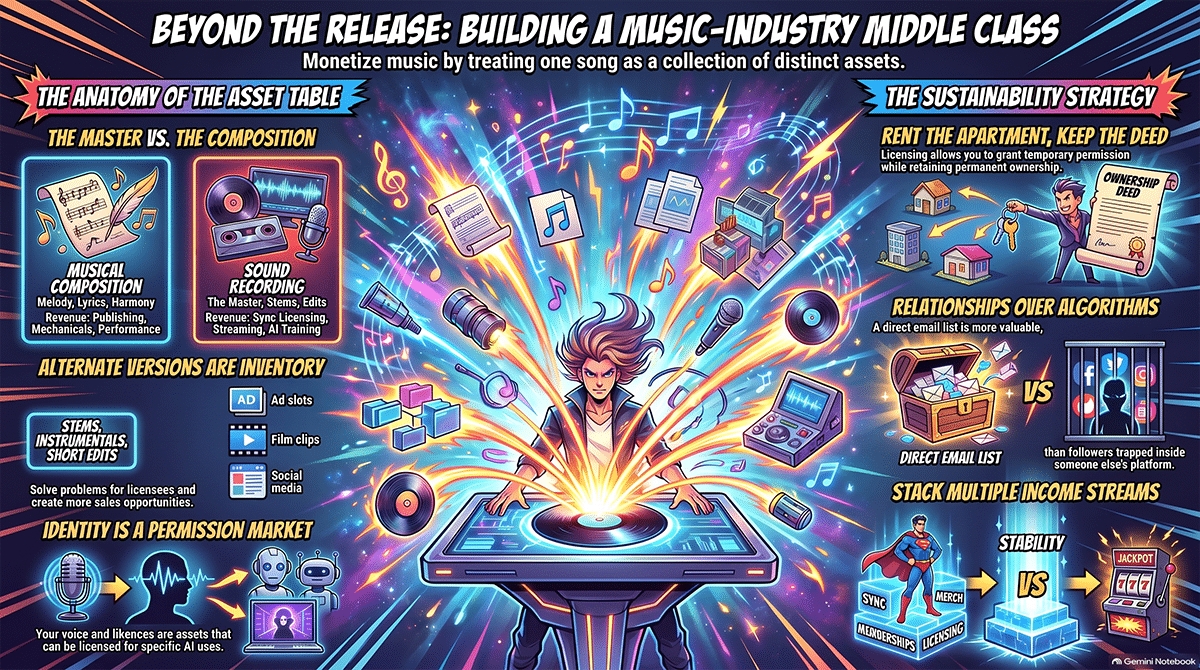
The One Thing Worth Protecting Is the Asset Base
This brings us to the one thing in the title, and it is broader than any single copyright. The thing an independent artist should be extremely reluctant to surrender is control of the asset base that makes future transactions possible.
That asset base can include the master, the composition, control over future uses of the artist’s voice and identity, access to stems and production files, the ability to approve new licenses, documented metadata and the direct relationship with fans. These pieces do not all have the same legal status, but together they form the infrastructure of an independent music business.
This is why the article is not simply telling artists to “keep your master.” Retaining the master can be enormously valuable, but an artist who owns the master while losing access to the audience, failing to document the composition, giving away permanent identity rights and discarding the production assets has not exactly built an ideal fortress of independence.
The goal is to preserve the ability to make future decisions. If the artist controls the productive assets, the artist can evaluate new opportunities as they appear rather than discovering that an old agreement already decided the answer. Control creates options, and options become more valuable as technology and markets change.
Fans Are Relationships, Not Property
The fan relationship deserves special attention because artists sometimes use ownership language carelessly in this area. Nobody owns a fan, and a person who buys a record does not become part of the artist’s intellectual-property portfolio simply because they entered an email address at checkout.
What the artist can build is a direct, consent-based relationship with that person. An email list, membership program, direct sales history or artist-controlled customer system can allow the artist to communicate with supporters without asking an outside algorithm for permission each time. Those relationships still have to respect privacy law, consent, platform rules and the fan’s ability to leave, but they are far more useful to an independent business than anonymous follower counts trapped inside somebody else’s platform.
This distinction matters because the modern music business has become very good at confusing audience access with audience ownership. An artist may have 100,000 followers on a social platform and still have no reliable way to contact most of those people if the algorithm changes, the account is suspended or the platform disappears. The artist has visibility inside somebody else’s system, but the platform controls the connection.
A smaller group of fans who have deliberately joined the artist’s email list, purchased directly, attended shows, bought merchandise or joined a membership may be more commercially valuable because the relationship is portable and ongoing. The artist can release a song and communicate directly, announce a tour and communicate directly, launch merchandise and communicate directly without performing the monthly ritual of posting something clever and hoping the algorithm grants an audience with the audience.
That is why the Making a Scene philosophy treats platforms as doors rather than the house. Spotify, YouTube, TikTok, Bandcamp, Patreon, TuneCore, ticketing services, licensing companies and AI platforms can all solve real problems, and there is no prize for refusing to use useful tools simply because somebody else built them. The strategic mistake happens when the tool becomes the only place where the artist’s customer relationships, business history and future earning power live.
One Song Can Open Many Doors
The easiest way to understand this model is to follow one hypothetical independent artist through the life of a single release. Imagine an artist named Maya who writes a song with another songwriter and documents the split before the recording is released. They know who owns the composition, Maya knows who owns the master, and the basic paperwork is handled while everyone still remembers who contributed what.
When the recording is finished, Maya does not stop with the stereo master. She keeps the instrumental, a clean version, several sync edits and useful stems, and she makes sure the files are properly named and archived. The metadata is accurate, the performers are documented and the publishing information is organized so that a licensing opportunity does not turn into a forensic investigation of a hard drive labeled FINAL_MASTER_REAL_FINAL_7.
The song is released, and the first income may be ordinary fan activity. Some people stream it, another buys a download, someone buys vinyl, somebody discovers Maya at a show and takes home a shirt, and a group of listeners joins a membership because they want demos, livestreams and early access to tickets. None of those transactions requires Maya to surrender ownership of the song or the master.
Months later, a film producer wants to license the original recording, which can involve both the master and the composition. Later, another client needs the instrumental for a commercial. A television production wants stems because dialogue must sit over the track, and another company wants a 30-second edit for a branded video. The same recording continues to create transactions because Maya prepared useful versions and still controls the underlying asset.
Eventually, a technology company might ask permission to create an interactive experience involving Maya’s voice or catalog. Maya can evaluate that offer on its own terms because she did not give blanket permission to every future use when she signed an unrelated agreement years earlier. She might say yes, negotiate narrower terms or reject the offer entirely.
The important part of this example is not the number of revenue streams. The important part is that the first transaction did not destroy the possibility of the next one. That is the economic difference between monetizing an asset and liquidating it.

The Revenue Package Starts in the Studio
This business model actually begins before the music ever reaches a distributor. The moment the final master is approved is the right time to build the package of assets and information that will surround the recording for the rest of its commercial life.
The artist should know who wrote the song, who owns the composition, who owns the master and whether any producer, musician or outside contributor has contractual rights that affect future uses. The instrumental, stems, clean version and alternate edits should be stored in a way that makes sense. Metadata, publishing information, ISRC information where applicable, performer records and artwork permissions should be documented while the details are still fresh.
This may not feel like creative work, but it is part of turning creativity into a functioning business. A finished stereo master has value, yet a finished master surrounded by reliable ownership information, useful versions, clean documentation and accessible files is far more commercially useful because people can license it without weeks of confusion.
This is also where AI makes old-fashioned organization suddenly look remarkably futuristic. If new markets begin asking artists to license specific pieces of their catalog, isolated vocals, stems, compositions or identity permissions, the artist who knows exactly what exists and who controls it will be in a much stronger position than the artist whose entire rights strategy consists of saying, “I think everything is on that old laptop.”
The Old Business Model Wants the Jackpot
For generations, the music business has taught artists to dream in jackpots. Get discovered, get signed, get the hit, get the giant check and preferably step out of a limousine while someone takes a photograph. There is nothing inherently wrong with a giant check, and if anybody reading this has an especially heavy one that needs carrying, we are willing to discuss reasonable terms.
The problem is that most sustainable middle-class businesses do not survive by waiting for one enormous event. A restaurant does not expect one extraordinary hamburger to finance the company for the next decade. A plumber does not fix one sink and spend six years checking for residual payments. Local businesses survive because transactions repeat, customers return, margins are controlled and revenue comes from several places instead of one miraculous day.
Independent music can work the same way. Live shows can create income, merchandise can create income, direct music sales can create income, publishing can create income, sync can create income, memberships can create income and production or session work can create income. Carefully structured identity licensing, AI permissions or revenue-sharing arrangements may add new categories over time.
This does not mean every artist should attempt every revenue stream simultaneously. That would turn the average musician into a exhausted combination of touring company, clothing warehouse, publishing administrator, financial-services firm and part-time technology lawyer. The point is not maximum complication; the point is reducing dependence on any single company or income source.
A few modest revenue streams controlled reasonably well can create far more stability than complete dependence on one giant royalty pipe. That is particularly important for artists who are not trying to become global celebrities but simply want to build durable creative lives.
What a Music-Industry Middle Class Really Means
When Making a Scene talks about building a music-industry middle class, the goal is not to make every independent musician fabulously wealthy. Celebrity economics makes great headlines, but it is a terrible standard for measuring whether an industry works for ordinary working artists.
A real middle class means musicians who can pay their bills, maintain equipment, pay other musicians, finance the next recording, tour without destroying their finances, handle an unexpected repair, buy health insurance, save some money and survive a slow month without having to abandon the career entirely. That may sound less glamorous than a stadium tour, but it is far more important if we care about having a diverse music culture instead of a handful of superstars floating above an ocean of unpaid creators.
That kind of stability usually comes from a stack of income rather than one magical check. Some months the show money may be stronger, while another month sync income arrives. Merchandise might perform well on tour, memberships may produce recurring support and publishing may continue generating income quietly in the background. A new technology license might add another layer without needing to replace everything else.
The structure works because the productive assets remain available. The catalog can continue to generate opportunities, the fan relationship can continue to deepen and the artist can choose which deals make sense rather than being locked into whatever one company decided years earlier.
Control Gives You the Right to Say Yes More Than Once
This may be the most useful way to think about ownership. Control is valuable because it preserves the artist’s ability to say yes again.
An artist who controls the master can say yes to one film and later consider another use. A songwriter who controls publishing rights can evaluate future opportunities. An artist who has not permanently signed away broad identity permissions can decide whether a voice license fits a particular project. A direct fan relationship can support another tour, another release, another membership and another merchandise launch.
Just as important, control preserves the ability to say no. A brand may be wrong for the artist, an AI permission may be too broad, a sync license may demand exclusivity that blocks better opportunities or a financing arrangement may claim so much revenue that retaining the copyright becomes almost meaningless in practice.
The value of ownership therefore is not simply the ability to monetize something. It is the ability to choose when, how and whether the asset will be monetized, which is a much more powerful form of independence than simply collecting whatever payment appears.
Put the Song Back on the Table
Now return to the finished song sitting on the table. It should look very different from the way it looked at the beginning because it is no longer just a WAV file waiting for distribution.
It may contain a master recording, an underlying composition, lyrics, instrumental versions, stems, sync edits and alternate mixes. It may create commercial value around the artist’s voice and identity. It can generate fan relationships, live opportunities, merchandise sales, memberships and direct purchases, while new technologies may introduce additional permission markets that barely existed when the recording was created.
The goal is not to lock these assets in a vault and refuse to let anybody touch them. Assets only become economically useful when they work, which means they should be licensed, performed, packaged, sold, promoted and connected to real transactions whenever the terms make sense.
What changes is the artist’s understanding of what leaves the building each time a contract is signed. Selling a ticket is not the same thing as selling the venue. Selling a vinyl record is not the same thing as selling the master. Licensing a composition is not the same thing as transferring ownership of the composition, and allowing one defined use of a voice or identity is not necessarily the same thing as granting permanent control over every future use.
That distinction is the business architecture independent music has been missing. The future of a sustainable music economy is unlikely to come from convincing every artist to chase one giant payday and surrender the valuable parts of the business in exchange for access to somebody else’s system.
It is far more likely to come from thousands of artists learning how to operate durable, rights-aware businesses in which one song can create many transactions over many years. Some of those transactions will be small, some may become surprisingly valuable and some experiments will fail entirely, because that is what happens in every real business.
The important thing is that the artist still has something left to work with when the next opportunity appears. If the master, composition, identity permissions, production assets and fan relationships remain under meaningful artist control, the career does not have to depend on one company, one platform, one viral moment or one royalty statement.
That is where the most useful question changes. Instead of asking only how much somebody is willing to pay for an asset today, the independent artist can begin asking how much that asset might earn throughout an entire career if the artist does not unnecessarily give up the ability to use it again.
That is a very different way to think about music. It is also a much better way to build a business, because the artist stops behaving like someone hoping to sell the one valuable thing they created and starts behaving like the owner of a collection of productive assets that can keep working.
That is how one song becomes more than a release, and it is how independent artists begin building something far more important than a lucky break. They begin building a music-industry middle class.
 |  Spotify |  Deezer |  Breaker |
 Pocket Cast |  Radio Public |  Stitcher |  TuneIn |
 IHeart Radio |  Mixcloud |  PlayerFM |  Amazon |
 Jiosaavn |  Gaana |  Vurbl |  Audius |
 Reason.Fm | |||
Find our Podcasts on these outlets
Subscribe to Our Newsletter
Discover more from Making A Scene!
Subscribe to get the latest posts sent to your email.


