

The Labels Aren’t Fighting AI. They’re Buying Into It. So Where Is the Indie Artist’s Equity?




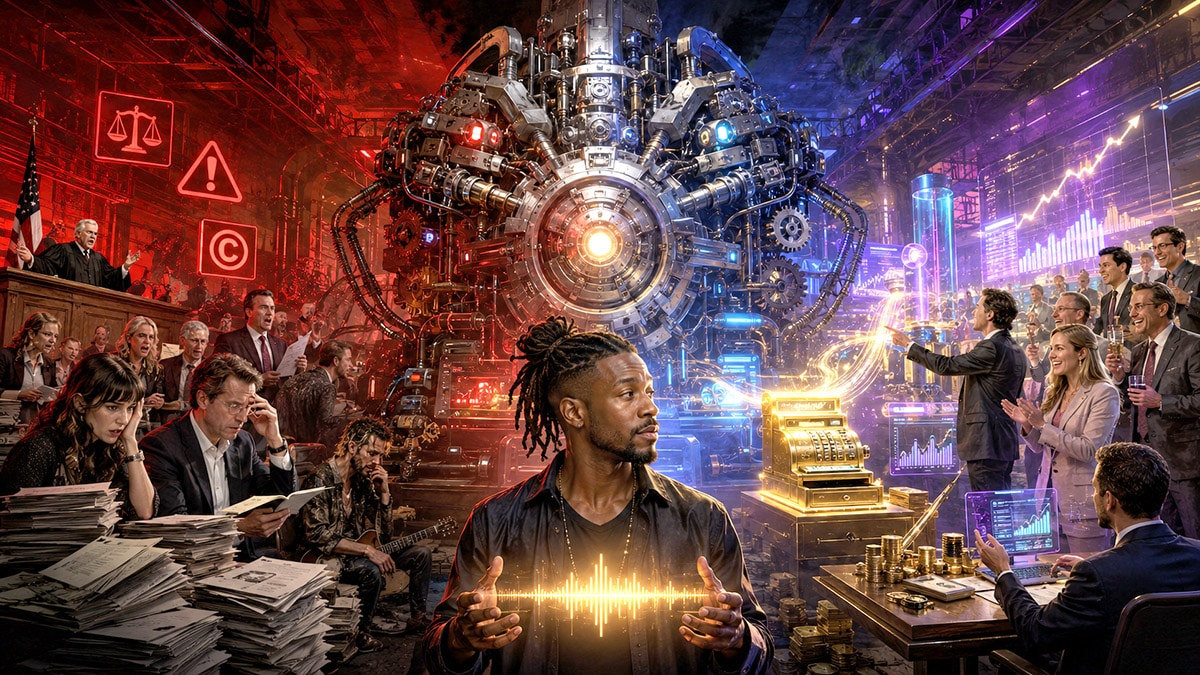
Making a Scene Presents – The Labels Aren’t Fighting AI. They’re Buying Into It. So Where Is the Indie Artist’s Equity?
Listen to the Podcast Discussion
For the last few years, independent musicians have been handed a very simple story about artificial intelligence. AI was the thing coming for your songs, your voice, your recording career, your session work and, if the more dramatic headlines were to be believed, possibly the last decent cup of coffee in the control room. Artists were warned about scraped catalogs, cloned voices, machine-generated recordings and giant technology companies building enormous businesses from human creative work without asking permission first. A lot of those warnings were legitimate, because the questions around copyright, consent, attribution, training data and compensation are real, unresolved and currently being fought over in courtrooms, licensing offices and corporate boardrooms.
What is becoming increasingly obvious, however, is that the music industry’s problem was never simply the existence of artificial intelligence. The real problem was that the established music companies had not yet figured out how to control it, license it and make money from it. Once those pieces begin falling into place, the tone changes remarkably quickly. The scary machine lurking outside the gates starts looking much friendlier when somebody installs a licensing desk, connects a royalty meter and offers the rightsholder a seat at the investment table.
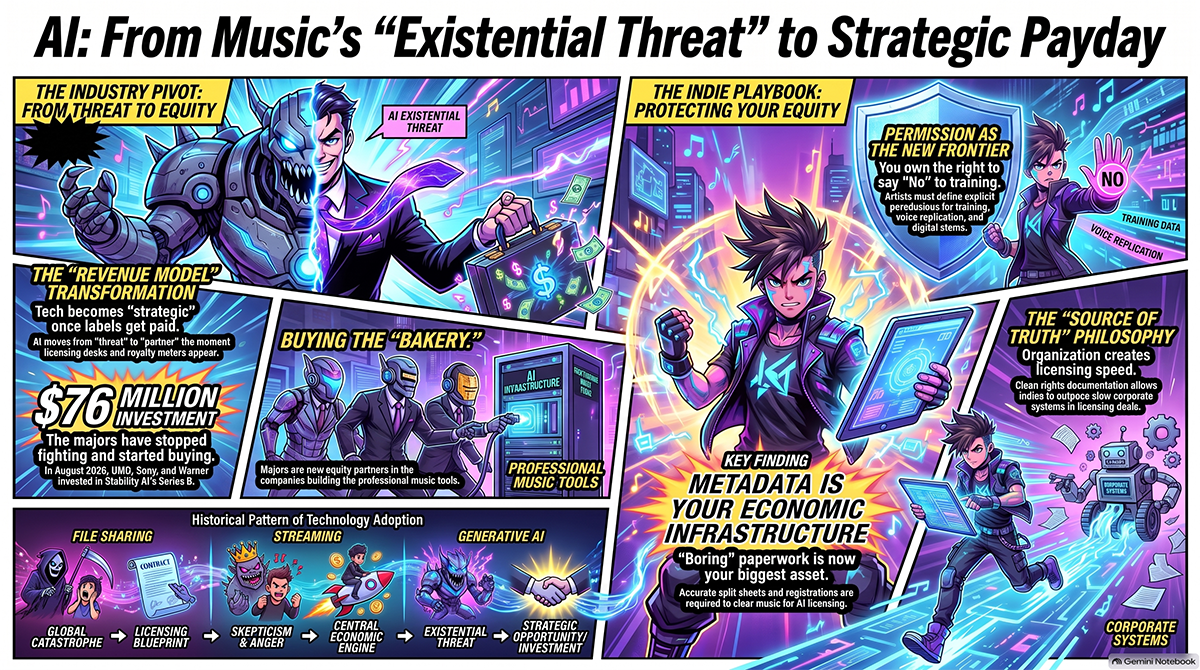
That is why the August 25, 2026 announcement from Stability AI matters so much. Stability AI announced a $76 million Series B funding round with participation from investors including Electronic Arts, AMD Ventures and Pacific Alliance Ventures, but the names that should make musicians stop scrolling are Universal Music Group, Sony Music Group and Warner Music Group. These are not fringe companies experimenting with a side project. They are the three largest music companies in the world, and all three put investment capital into an artificial intelligence company whose audio models are being positioned for professional music creation.
The exact amount invested by each music company has not been publicly disclosed, and neither have the individual ownership stakes. Even so, the symbolism is hard to ignore. For several years, the music business has spent considerable energy warning creators about the dangers of generative AI, while simultaneously negotiating with AI companies, suing some of them, partnering with others and now investing in at least one of them. That does not mean the warnings were fake, but it does mean independent musicians should pay close attention to how quickly a technology can move from “existential threat” to “strategic opportunity” once the people holding large catalogs figure out how to get paid.
The Monster Looks Friendlier With a Revenue Model
The music industry has always had an impressive ability to change its philosophical relationship with technology once a reliable revenue model appears. A new technology that disrupts an existing business is usually described in dark, dramatic terms until somebody works out how to license it. Once that happens, the same technology often reappears wearing a nice suit, carrying a partnership agreement and being introduced at industry conferences as an exciting new opportunity for creators.
Artificial intelligence seems to be following that familiar script. When generative AI companies were operating largely outside established music licensing systems, the public discussion emphasized unauthorized training, copyright violations, cloned voices and threats to human musicians. Those concerns were and remain serious. What has changed is that some AI companies are now entering formal licensing relationships with music rightsholders, and once that happens, the language becomes noticeably warmer.
Suddenly we hear about responsible AI, ethical AI, professional creative tools, artist empowerment and new revenue streams. Those terms are not necessarily dishonest, because licensed AI really is different from a system accused of simply taking copyrighted material without permission. The amusing part is that the machine itself did not wake up one morning and develop better manners. The business model changed.
That distinction matters enormously for independent artists because the large music companies are showing us how they think about AI when money and control are on the table. They are not asking whether artificial intelligence is good or evil in some abstract philosophical sense. They are asking whether the company using the technology has permission, whether the rights can be licensed, whether artists and rightsholders can be compensated and whether the music company itself can participate in the growing value of the technology.
That is a far more useful way for independent musicians to think about AI as well. We do not need to become cheerleaders for every artificial intelligence product, and we do not need to hide under the mixing console every time somebody says machine learning. We need to understand what we own, what the technology needs, what permissions are being requested and what compensation follows when those permissions are granted.
The Industry Has Been Here Before
Anyone who has been around the music business long enough should recognize the basic pattern because this is not the first technology to arrive wearing a black hat before eventually being invited inside. Digital distribution was once discussed primarily as a threat to physical music sales. File sharing was treated as a catastrophe because it created a global distribution system outside the traditional record business. Streaming arrived to enormous skepticism and anger, only to become the central economic engine of the recorded music business once licensing structures matured.
The technologies did not suddenly become morally different when the contracts changed. What changed was who had leverage, who could collect money and how the new system fit into the existing rights structure. Once the major companies had a tollbooth on the new highway, the highway started looking considerably less terrifying.
That history does not mean the labels were wrong to oppose piracy, and it certainly does not mean musicians should accept every new platform that arrives promising disruption. It means artists should learn to distinguish genuine rights concerns from the business incentives surrounding those concerns. A company may sincerely warn that a new technology threatens copyright while simultaneously trying to build a licensing model that turns the same technology into revenue.
There is no contradiction there from a corporate point of view. If the technology uses your assets without permission, it is a threat. If the technology pays for the assets, it becomes a customer. If the company building the technology offers you an ownership stake, it may become an investment.
Once you look at the issue that way, the Stability AI deal starts making perfect sense.
Stability AI Found the Language the Music Industry Understands
Stability AI has positioned its Stable Audio 3.0 models around licensed and permitted training material. The company has said that its audio models were trained using licensed sources, including material obtained through AudioSparx and licensed material from Freesound. That makes provenance part of the product story rather than a legal detail buried in the fine print.
For professional customers, that difference can matter a great deal. A teenager generating a novelty song about a cat running a pizza shop may not spend much time thinking about copyright indemnification, but a film studio, television producer, advertising agency or game company is likely to take a different view. Those businesses have legal departments, insurance requirements and clients who become nervous when somebody explains that nobody is completely sure where the training material came from.
A generative AI system that can demonstrate licensed training therefore has a potential commercial advantage. The cleaner the rights story, the easier it may be for professional customers to use the technology without wondering whether a legal problem is quietly growing behind the scenes. This is where music rights stop being a defensive issue and start becoming part of the product value itself.
Stability AI has also been pushing Stable Audio into the professional production workflow through a DAW plugin. That move matters because it takes generative audio out of the novelty website category and places it alongside the tools musicians already use every day. A system that sits next to compressors, reverbs, virtual instruments and automation lanes is no longer asking to be treated like a curiosity; it is asking to become part of the studio infrastructure.
The major music companies appear to understand that shift. They are not waiting to see whether AI disappears. They are positioning themselves around the versions of AI they can license, influence and perhaps profit from directly.
The Majors Did Not Just Bring the Music
A licensing agreement is one thing, but an investment is another. When a rightsholder licenses music to a technology company, the rightsholder receives compensation according to the terms of that agreement. When the same rightsholder also invests in the technology company, there is the possibility of participating in the increasing value of the company itself.
That distinction is central to this entire story because it shows how many layers of value may exist around the AI economy. The major music companies can control catalogs, license those catalogs, collect money from authorized uses and, in the case of Stability AI, participate as investors in the company building the technology. That is a much more sophisticated economic position than simply receiving a one-time check for the use of music.
The majors are not merely supplying ingredients to the bakery. They have started buying a piece of the bakery, and that should make every independent artist wonder why musicians are so often expected to think only about the price of the flour.
Independent artists may never receive the same investment opportunities as Universal, Sony or Warner, and nobody should pretend that every musician whose track appears in a licensed dataset deserves venture capital equity. The broader lesson is that the technology companies and their investors are thinking about long-term value while artists are often encouraged to focus only on the immediate transaction.
That is exactly the mistake musicians made during earlier technological transitions.
We Learned the Streaming Lesson the Expensive Way
The streaming economy taught musicians to obsess over the value of one stream. Artists spent years arguing about fractions of pennies while streaming companies, distributors, catalog investors and technology platforms built enormous businesses around the infrastructure moving those streams.
The royalty debate was important, but it also narrowed the artist’s view of the business. We became so focused on what happened at the bottom of the revenue chain that we often ignored what was being built above us. Platforms accumulated users, data and market power while the musician’s role was reduced to supplying the content that kept the entire machine running.
Artificial intelligence gives independent artists a chance to avoid repeating that mistake. Instead of asking only how much an AI company will pay to use a recording, musicians should also ask what happens after the recording contributes value to the system. If the model becomes commercially successful, does any additional value flow back to the creators who helped make that model possible?
That question does not automatically lead to equity ownership. It leads to a broader conversation about recurring licensing fees, usage-based compensation, revenue sharing, attribution, reporting and limits on future uses. The central idea is that artists should not assume permanent access to valuable creative work should always be exchanged for one small check.
The technology company is thinking about what its business may be worth five years from now. Independent artists should not negotiate as though the world ends next Thursday.
Licensed AI Needs Its Own Revenue Stack
If licensed artificial intelligence becomes a major commercial market, independent musicians need to treat it as another revenue category rather than a mysterious payment that appears once and disappears forever. Different AI uses may require different rights and create different kinds of economic value.
A developer may want access to finished recordings for training. Another company may need instrumental versions or stems. A fan-creation platform may want permission to generate licensed remixes, while a voice technology company may want explicit rights involving a performer’s vocal identity. These are not the same uses, and they should not automatically be bundled together under one giant agreement labeled AI.
That means the artist should think about the revenue in layers. There may be an initial fee when material enters a model, additional compensation when the model is commercially deployed, or recurring payments tied to usage. Some systems might support subscription pools or revenue sharing, while others may require renewals when new models are developed.
Reporting can also be part of the value because artists need to understand where the music went and what happened after permission was granted. A good licensing relationship should not require the creator to throw a recording into a black box and hope a royalty statement eventually crawls out.
The exact economic structures will evolve because this market is still forming. What should not become the default is the idea that artists permanently surrender broad rights because somebody offered money first.
“Licensed” Is Not the Same Thing as “Fair”
There is another important lesson hiding beneath the growing enthusiasm for licensed AI. The word licensed sounds safe, but it does not tell the artist whether the agreement is actually good.
A license simply means somebody received permission from somebody under a contract. The important questions are who had the authority to grant that permission, how long the permission lasts, whether the rights can be transferred and how much money eventually reaches the creator.
The music industry has a rich history of completely legal agreements that musicians later wished they had read while fully awake. Artificial intelligence is unlikely to end that tradition.
Stability AI has identified licensed AudioSparx material as part of the data used for Stable Audio, and AudioSparx offers music for generative AI training under its own licensing and revenue-sharing terms. That proves a functioning licensed market can exist, but it also reinforces why artists need to read the actual contracts instead of relying on the comforting word licensed in a press release.
One artist could enter a deal that creates meaningful recurring income under reasonable terms, while another could grant very broad rights for a long period and receive very little in return. Both artists could honestly say their music was licensed to AI.
The contract decides whether the artist joined the new economy or simply sold a ticket to it.
One Song Can Contain a Small Legal Village
The licensing problem becomes more complicated because what musicians casually call a song may contain several separate legal and contractual interests. The musical composition and the specific sound recording are separate copyrights, and those rights may be controlled by different people.
Then the human relationships arrive. A producer may have royalty participation, session musicians may have agreements governing their performances and featured vocalists may have interests connected to the use of their voice or identity. A collaboration that worked perfectly well for an ordinary record release can suddenly become much more complicated when somebody wants to use the recording for AI training or digital replication.
Imagine an artist who owns the master but wrote the song with two co-writers. The producer has points, a guest singer performs the hook and the drummer signed a work-for-hire agreement, while the background vocalist never signed anything because everybody was friends and somebody had already ordered dinner. That arrangement might cause no problem when the song is simply distributed through normal channels.
The moment an AI company asks to use the recording in a model, however, the question becomes much more specific. Does the artist have the authority to grant every right being requested, and did every contributor agree to those future uses?
This is where the romantic music-business phrase “we all know what we agreed to” starts becoming considerably less comforting.
The Paperwork Everyone Hates Is Becoming Valuable
Musicians are wonderfully capable of spending an hour deciding whether a tambourine is two decibels too loud and then declaring that there was no time to document who actually owns the song. That habit has always been dangerous, but artificial intelligence is making the consequences more expensive.
If somebody wants to license a recording, the artist needs reliable information about ownership. If somebody allegedly uses the recording without permission, the artist needs much of the same information to establish what rights may have been violated.
That makes split sheets, producer agreements, performer releases, publishing records, copyright registrations, ISRCs, session files, dated masters and reliable metadata part of the economic infrastructure surrounding a song. They are not glamorous, but neither is discovering that nobody can clear the recording when a real licensing opportunity appears.
This is the thinking behind the Making a Scene Source of Truth philosophy. The master recording is the creative centerpiece, but the information surrounding it explains who created the work, who owns it and what can legally be done with it.
When that information is organized, the catalog becomes easier to license and easier to defend. When it lives in a collection of forgotten email threads and filenames like FINALMASTER_v7_REALFINAL_USETHIS.wav, every opportunity becomes a treasure hunt with lawyers.
Tony Justice Shows the Other Side of the Market
While major music companies were investing in licensed artificial intelligence, an independent artist-owned copyright case was moving forward against Suno. Independent country artist Tony Justice, along with 5th Wheel Records and My Heartland Publishing, is pursuing a proposed class action involving allegations about copyright infringement and the development of Suno’s generative music system.
On August 20, 2026, a federal judge refused to dismiss most of the challenged claims. The plaintiffs allege that Suno copied copyrighted music in connection with training, that some outputs can constitute unauthorized derivative works and that the company circumvented technological protections associated with YouTube while obtaining material. Suno disputes the legal theories and allegations against it.
The ruling did not establish that Suno infringed Tony Justice’s music, which is an important distinction. At this stage, the court was deciding whether the challenged claims had been sufficiently pleaded to continue, not deciding who ultimately wins the case.
What makes the lawsuit particularly relevant to independent musicians is that the plaintiffs include artist-owned companies asserting rights in music they control themselves. This is not simply another battle between giant corporations protecting giant catalogs.
An independent copyright is still a copyright.
Indie Ownership Is Real Ownership
There is a strange tendency among musicians to treat copyright as though it only becomes serious when a catalog is worth enough money for a private equity firm to notice. That is not how ownership works.
If an independent artist owns a master recording, that artist owns an asset. If the artist owns the underlying composition, that is another asset. An artist-owned label or publishing company is a legitimate rightsholder even if the corporate office also happens to contain a drum kit and a dog.
The biggest difference between an independent artist and a major label is usually not the existence of the rights. The difference is the amount of money and administrative power available when those rights need to be enforced.
A major company can deploy teams of attorneys, licensing specialists and administrators. An independent musician may have a laptop, a part-time bookkeeper and a lawyer whose hourly rate encourages immediate spiritual growth.
That imbalance makes organization more important for independent musicians. The best time to establish ownership is when the recording is created, while the writers, performers and producers still remember what they agreed to.
Waiting until a dispute begins is an expensive way to discover that everybody remembers the session differently.
Copyright Registration Is Not Just Decoration
Copyright protection generally begins when a qualifying creative work is fixed in tangible form, but registration becomes particularly important when enforcement enters the picture. For U.S. works, registration or preregistration generally plays an important role before an infringement action can proceed in federal court, and timing can affect the remedies available.
That does not mean every artist needs to prepare for litigation every time a single is released. It means copyright registration should be viewed as part of normal business infrastructure rather than as a certificate musicians file only when they have extra time.
Artists also need to understand that the musical composition and sound recording are separate works. A particular AI use may touch the master, the composition or both, and the rights may be controlled by different parties.
This is where the supposedly boring parts of music ownership start becoming very interesting. When somebody wants to pay for a license, suddenly the person who knows exactly what they own looks surprisingly sophisticated.
Fingerprinting Makes Ownership Easier to Track
As generative systems process huge amounts of audio, reliable identification becomes increasingly valuable. An artist should be able to connect a specific recording to authoritative information about the rights surrounding that recording.
Audio fingerprinting and other provenance tools can help create that connection. They do not replace copyright registration, contracts or legal evidence, but they can strengthen the technical trail that follows a recording.
That trail has commercial value when somebody wants to license the work because the buyer can identify exactly which master is being cleared. It also has defensive value when unauthorized use is suspected because the artist has a stronger foundation for investigating what happened.
This is another reason metadata needs to stop being treated like a miserable little form blocking the Upload button. Metadata can become part of licensing, accounting, identification, discovery and enforcement.
The recording is the art. The information surrounding it helps turn the art into a business.
Stop Thinking of the Artist Only as the AI Customer
Most artificial intelligence companies approach musicians from one direction because they want musicians to subscribe to something. Buy credits, generate a track, separate stems, remix a song, create artwork and produce seventeen social posts before breakfast because apparently we have all decided sleep was inefficient.
There can be real value in those tools, but independent musicians should not see themselves only as customers in the AI economy. Artists also own assets artificial intelligence companies may need.
Human-created recordings have value. Compositions have value. Performances have value. Instrumentals, stems, alternate versions and carefully organized catalogs may all have value to companies building models that want clear rights and reliable provenance.
That makes the artist a potential supplier. A customer asks what the technology costs. A supplier asks what their material is worth. That difference may become one of the most important business lessons of the AI era.
The Majors Have Scale, but Indies Can Build Infrastructure
Universal, Sony and Warner have a huge advantage in the licensed AI market because they control enormous catalogs under centralized administration. An AI company looking for properly cleared music can negotiate with several major rightsholders instead of contacting hundreds of thousands of musicians individually.
Independent music has the opposite problem. Our catalogs are scattered across individual artists, small labels, publishers and estates, and the quality of the rights information varies wildly.
That fragmentation makes independent music harder to license at scale. The answer, however, does not have to involve creating another giant company that buys the music and becomes the new gatekeeper.
A better solution is infrastructure that allows artists to maintain ownership while making selected rights searchable and licensable. A network of artist-owned catalogs could connect recordings to reliable ownership records, songwriter information, performer permissions, fingerprints and AI licensing preferences.
A legitimate AI developer could then identify material available for particular uses, determine who needs to approve the transaction and route payments back to the appropriate people. The infrastructure organizes access while the musician keeps ownership.
That is a much more interesting model for building a music industry middle class.
Web3 Could Finally Do Something Useful
Web3 spent several years making itself easy to mock by turning every promising idea into a speculative carnival involving tokens, cartoon animals and somebody explaining decentralization beside a rented sports car. That does not mean all of the underlying technology was useless.
Portable ownership records, cryptographic verification and tamper-resistant permission histories can solve real problems when applied to intellectual property. An artist should be able to maintain a durable record showing who owns a recording, who approved a license, what the license allows and whether the permission is still active.
That information should ideally travel with the asset rather than disappearing when a platform changes ownership or shuts down. If blockchain technology helps solve that problem, use it. If a conventional database does it more efficiently, use the database.
The goal is not to win a technology argument. The goal is to make sure the artist remains connected to the rights and the revenue.
The same rule should apply to artificial intelligence. Use technology when it increases artist control, reduces administrative work or creates income. Ignore the buzzwords when they do none of those things.
The Source of Truth Can Become a Licensing Engine
A strong Source of Truth around a song changes the way an independent catalog can function. Instead of simply storing audio files, the artist maintains assets that can answer real business questions.
The record can identify who owns the master and composition, who performed on the track, what the producer receives and what permissions apply to future uses. AI-related terms can eventually become another layer, allowing the artist to define what is available for training, whether vocals can be used, whether digital replicas are permitted and whether future models require new approval.
That information can be made machine-readable without making the music any less human. A song can still break somebody’s heart while the database knows who gets paid.
There is no reason artists should have to choose between emotional music and competent business administration. The major companies certainly do not.
Independent Artists Can Compete With Speed
Independent artists will never beat the majors at catalog size, but they may be able to compete through speed and control. An artist who controls both the master and publishing and has clean rights information can often make decisions much faster than a corporate system involving several departments.
That advantage already matters in sync licensing. Music supervisors often prefer songs that can be cleared quickly because production schedules have very little patience for mysterious ownership chains.
AI licensing may develop the same preference. A smaller catalog with clean documentation may be easier to work with than a massive collection of recordings tied up in complicated rights questions.
Ownership creates speed, and speed can create revenue. That is the kind of advantage independent artists should build deliberately instead of waiting for someone else to discover it.
Watch How Quickly the Language Changes
If licensed artificial intelligence continues growing, independent musicians should pay attention to the way the industry talks about it. The language will likely become more optimistic as more licensing agreements, partnerships and investments appear.
The same technology that was once discussed primarily as a danger may increasingly be described as empowering, transformative and full of exciting new opportunities for creators. Some of that enthusiasm may be justified because properly licensed AI tools really can create useful new revenue and workflow possibilities.
The funny part will be watching everyone behave as though the transformation occurred because the technology itself suddenly became benevolent. What changed is that the business found ways to participate financially.
This is not unique to music. Businesses tend to dislike disruption when somebody else controls it and become considerably more enthusiastic once they own a piece. Independent musicians should not be angry that the major companies figured this out. We should be angry with ourselves if we fail to learn the lesson.
Do Not Sell Tomorrow for the First Check Today
The early years of a new licensing market are dangerous because nobody knows exactly what the rights will eventually be worth. That uncertainty generally favors the buyer, especially when the seller is thrilled that somebody has finally offered real money.
An artist who has spent years looking at microscopic streaming statements may understandably get excited when an AI company offers a meaningful licensing payment. That excitement is precisely why the agreement deserves careful attention.
A license may cover future models, new products, sublicensing, acquisitions and uses that do not even exist when the artist signs. Those rights may be worth much more later than they appear to be today.
That does not mean broad licenses are always bad. It means the compensation should reflect what is actually being granted, and artists should think about duration, renewals and future uses.
The labels are investing because they believe there is future value in the technology. Independent artists should negotiate like they believe there is future value in their rights.
AI Permissions Are the Next Ownership Frontier
Independent musicians spent decades learning the importance of owning masters. Then more artists began paying attention to publishing, fan relationships and data ownership.
Artificial intelligence adds another category that needs to be controlled deliberately: permission.
Artists need to know what AI systems are allowed to do with recordings, compositions, voices and performances. Those permissions may become valuable assets in their own right.
An artist might allow training but prohibit digital voice replication. Another might license instrumentals while reserving vocals. A particular model could receive permission while future versions require a new agreement.
The exact choices should belong to the rightsholder. That is what ownership means.
The Real Fight Was Never AI Versus Music
The developments of late August 2026 make the emerging structure of the market easier to understand. Universal Music Group, Sony Music Group and Warner Music Group participated in a $76 million investment round in Stability AI, whose audio products are being positioned around licensed training and professional use. At roughly the same time, music publishers connected to major companies continued pursuing litigation against AI developers over alleged unauthorized uses, while Tony Justice and other independent rightsholders kept most of their case against Suno alive.
Those stories only look contradictory if the question is whether the music industry likes artificial intelligence. They make complete sense if the question is whether artificial intelligence operates under terms the music industry can control and monetize.
AI without permission is treated as a threat. AI under a licensing agreement becomes a commercial partner, while AI tied to an investment can become part of the portfolio. The independent artist should not find that shocking. This is exactly how sophisticated rightsholders treat valuable intellectual property. The danger would be learning only the fear part of the lesson while allowing the largest companies to keep the monetization part for themselves.
Do Not Let the Old Music Business Sell You the New One Twice
The most important lesson in this entire shift is not that AI was secretly harmless all along. Unauthorized use, digital replicas and copyright questions remain serious issues, and some forms of automation may absolutely threaten certain kinds of creative work.
The lesson is that the people with ownership and leverage get to experience new technology differently from the people who do not. A company that owns valuable rights can negotiate. A musician who owns rights but cannot document them has less leverage, while an artist who owns little may simply experience the change as something happening around them.
That is why ownership matters more than ever. If an artist owns the masters, controls the publishing, maintains reliable metadata, documents permissions and builds direct fan relationships, artificial intelligence becomes something the artist can negotiate with rather than merely fear.
The AI system might become a customer, a production tool, a licensing market or something else we have not invented yet. The important thing is that the artist remains inside the economic relationship.
The greatest danger is not that artificial intelligence creates a completely new music business. The greater danger is that we rebuild the old music business with newer software, leaving the artist supplying the creativity while somebody else owns the infrastructure, customer relationship, data and appreciating asset.
We have already seen that movie, and the ending was not especially generous to musicians. The robot suit does not make the plot new.
The opportunity now is to build something different while the market is still forming. Independent artists can organize their catalogs, register their rights, maintain clear agreements, fingerprint recordings and establish explicit AI permissions before the technology companies write those permissions for them.
If human-created recordings, compositions, voices and performances help make licensed AI systems commercially valuable, then those human creators deserve a meaningful economic position in the system.
That may come through licensing fees, recurring royalties, revenue sharing, attribution, reporting or other structures that have not yet matured. What should not happen is the familiar arrangement where everyone celebrates the value of human creativity while the human creator receives the smallest piece of the business.
The majors seem to understand that. They spent the early AI era emphasizing the dangers, and now that licensing relationships, commercial partnerships and equity investments are becoming possible, the conversation is starting to sound much more optimistic.
Independent artists should not be surprised when AI suddenly becomes the greatest thing since multitrack recording once enough contracts are signed. We should simply make sure that when everybody starts celebrating the new future, the artists who supplied the music are not standing outside the party wondering why their names are missing from the guest list.
Because the lesson here is not to fear AI, and it is not to worship it either. The lesson is to own what AI needs, understand what that ownership is worth and negotiate from there.
That is not anti-technology. That is just good music business.
 |  Spotify |  Deezer |  Breaker |
 Pocket Cast |  Radio Public |  Stitcher |  TuneIn |
 IHeart Radio |  Mixcloud |  PlayerFM |  Amazon |
 Jiosaavn |  Gaana |  Vurbl |  Audius |
 Reason.Fm | |||
Find our Podcasts on these outlets
Subscribe to Our Newsletter
Discover more from Making A Scene!
Subscribe to get the latest posts sent to your email.


