The Platform Dependency Audit: Could Your Music Business Survive If One Company Disappeared Tomorrow?





Making a Scene Presents – The Platform Dependency Audit: Could Your Music Business Survive If One Company Disappeared Tomorrow?
Listen to the Podcast Discussion
There is a strange little habit in the music business that we have somehow learned to accept as normal. Artists spend years creating music, building audiences, selling tickets, gathering followers, uploading catalogs, collecting customer information, and developing relationships, and then they store enormous pieces of that business inside companies they do not control.
That arrangement can work beautifully right up until it doesn’t. A platform changes its pricing, removes a feature, sells itself, changes its algorithm, modifies its licensing program, restricts an account, changes ownership, decides your favorite feature was apparently not as beloved inside the quarterly earnings meeting as it was inside your business, and suddenly you discover exactly which parts of your career you actually owned.
This is why every independent artist should perform what we might call a platform dependency audit. The idea is simple: identify the outside companies your music business cannot comfortably operate without, and then figure out what would happen if one of them vanished tomorrow.
Not because every platform is evil. Not because the internet is collapsing. Not because you should unplug your computer, move into a cabin, and begin selling hand-carved CDs to passing hikers.
Platforms can be incredibly useful. Some of them are responsible for enormous amounts of discovery, sales, distribution, communication, licensing, ticketing, and creative work. The problem begins when an artist mistakes access to a platform for ownership of a business.
Those are two very different things.
Your Music Business Has a Supply Chain
Most working independent artists now operate something closer to a small digital company than the traditional image of a band simply making records and playing shows. Your recordings may live with one service, your distribution may run through another, your merchandise through another, your email through another, your ticket sales somewhere else, your fan community someplace else, and your social audience scattered across several more companies.
That arrangement is convenient because modern platforms specialize. One company may be excellent at getting music into stores. Another may be good at accepting payments. Another may help people discover your songs. Another may make it easy for fans to buy vinyl. Another may provide sophisticated mailing tools that would have required an entire office staff twenty years ago.
The problem is that convenience quietly creates dependency. When one company becomes the only place where an important piece of information exists, that company has become part of your business infrastructure whether you consciously decided that or not.
That includes things artists often do not think of as infrastructure. Your master files are infrastructure. Your metadata is infrastructure. Your customer records are infrastructure. Your publishing information is infrastructure. Your email permissions are infrastructure. Your sales history is infrastructure. Your licensing records are infrastructure. Even knowing that someone bought three shirts, attended two shows, and purchased your last album is potentially valuable business intelligence.
An artist who has copies of all those things can move. An artist who does not have copies is renting more of the business than they may realize.
The Five-Service Test
Take the outside services that matter most to your career and imagine that one of them sends you a cheerful corporate email tomorrow morning announcing that it is “sunsetting” the product. Silicon Valley has always had a remarkable talent for finding cheerful words for removing things people actually use.
Now imagine what happens next.
Could you recover your music? Could you recover the important metadata attached to that music? Could you obtain a useful record of the transactions that occurred there? Could you obtain the fan information you are permitted to possess and use? Most importantly, could you replace that service without losing your relationship with the people who supported you there?
Those questions measure something more important than whether a platform has a convenient export button. They measure portability.
Portability means that the economic value you created can move with you. Your songs can move. Your records can move. Your customer knowledge can move where legally and contractually allowed. Your permissions can move. Your relationship with your audience can continue.
That is what ownership looks like when the romantic speeches are over and somebody finally opens the spreadsheet.
Bandcamp Shows Why Direct Purchasing Still Matters
Bandcamp, at https://bandcamp.com/, remains one of the strongest current examples of fans willingly buying music and merchandise directly from artists rather than simply consuming music through an all-you-can-eat subscription.
As of August 9, 2026, Bandcamp’s own artist page reports that fans have paid artists $1.78 billion through the platform. It also reports that during the previous year fans purchased 15.7 million digital albums, 11.4 million individual tracks, 1.6 million vinyl records, 850,000 CDs, 250,000 cassettes, and 50,000 T-shirts through Bandcamp. The company says an average of 82% of the money from a purchase goes to the artist, with the remainder covering Bandcamp’s revenue share and payment processing.
Those numbers matter because we have spent the better part of two decades hearing variations of the claim that consumers simply do not buy music anymore. Apparently nobody remembered to inform the people who bought 1.6 million vinyl records on Bandcamp last year.
More importantly, Bandcamp demonstrates that a direct transaction can be much richer than a stream. A purchase tells you that someone cared enough to reach for a wallet. A repeat purchase tells you something more. A physical purchase may tell you where demand exists geographically. A fan voluntarily joining your mailing list can create an ongoing relationship instead of a single anonymous event.
Bandcamp is also unusually useful for this particular discussion because it provides artists with substantial export capabilities. Its current documentation says artists can download a raw sales report as a CSV containing a detailed account of sales and payments, including fields such as item information, transaction data, catalog numbers, UPCs, ISRCs, buyer information and other transaction details where available. Bandcamp also provides a separate tool for exporting the email addresses collected through its mailing-list system.
Bandcamp’s mailing-list documentation is important here because it also illustrates the difference between knowing who bought something and having an ongoing marketing relationship. Bandcamp says that when fans purchase something or follow an artist, they are offered the choice to add their email address to that artist’s mailing list. That permission layer is exactly the kind of thing artists should pay attention to when moving fan information between systems.
This is one reason Bandcamp is useful beyond the immediate sale. The artist has ways to remove useful business information from the platform and incorporate it into a broader artist-owned system.
But even Bandcamp should not become your entire business.
If every fan relationship, every sales record, every product page, every album and every piece of customer knowledge exists only inside Bandcamp, you still have a dependency. A good platform can reduce the risk, but it cannot eliminate the basic fact that somebody else operates the platform.
The Making a Scene philosophy is not “avoid platforms.” It is almost the opposite. Use good platforms aggressively when they help you reach people, make money, or save time, but keep the important pieces of your business portable.
YouTube Just Gave Artists a Free Lesson in Platform Risk
YouTube provides a nearly perfect example of why that matters.
YouTube, at https://www.youtube.com/, launched Creator Music as a way for eligible creators to access music for use in their videos. One part of the system allowed creators to purchase licenses upfront, while other tracks could be available through revenue sharing or other terms.
Now the paid-license portion is being phased out.
According to YouTube’s current Creator Music documentation at https://support.google.com/youtube/answer/11610212?hl=en, August 10, 2026 is the final day creators can purchase and use new paid licenses under the existing system. Existing paid licenses already applied to videos remain valid until they expire, while unused purchased licenses are to be refunded automatically. Creator Music is shifting its focus toward tracks available at no cost and tracks offered under revenue-sharing arrangements.
YouTube’s separate documentation for music rights holders is even more direct. It says paid licenses are being deprecated on August 10 and that rights holders will no longer be able to offer paid Creator Music licenses under the existing framework.
There is nothing inherently sinister about YouTube changing the product. Companies change products constantly. Maybe the new model ultimately works better for creators, rights holders, or YouTube itself.
That is not the important lesson.
The lesson is that an independent artist could have looked at Creator Music a year ago and reasonably considered it part of a licensing strategy. A searchable marketplace where video creators could pay to license songs sounded a lot like the beginning of a useful micro-sync business.
Then the platform changed direction.
The artist did not get a vote.
That does not mean artists should refuse to participate in future YouTube licensing programs. It means they should never confuse a YouTube licensing feature with their licensing business.
Your licensing business should exist independently of YouTube.
You should maintain your own high-quality masters, instrumentals, stems where appropriate, clean versions, alternate mixes, metadata, ownership records, publishing information, writer splits, contact information and licensing terms. You should have a place where a creator, filmmaker, podcaster, advertiser, game developer or music supervisor can discover that you have music available and can contact you.
Then YouTube becomes another doorway into that catalog.
If the doorway closes, the building is still standing.
Build the Catalog Before You Need to Move It
Many artists think they own their catalog because they own the copyright. Legally, that may be true, but operational ownership requires something else.
You need possession of the assets required to operate the copyright.
Imagine discovering that your only high-resolution artwork lives inside a distributor account. Imagine the only copy of an instrumental mix exists inside a sync platform. Imagine your original release spreadsheet disappeared with an old laptop, and now the only place containing the correct ISRC information is somebody else’s dashboard.
Technically, you may still own everything. Practically, you have built an escape room for yourself.
Every release should therefore have an artist-controlled master record somewhere outside the services that distribute, stream, sell or promote it. That record should contain the audio masters, artwork, lyrics, credits, writers, ownership information, publishing details, identifying codes, release dates, alternate mixes and whatever other information is necessary to move the work elsewhere.
This does not have to require some enormous corporate database. A well-organized cloud archive backed up in another location can be far better than a collection of mysterious folders named “FINAL,” “FINAL2,” “FINAL_REAL,” and the industry standard “USE_THIS_ONE.”
The point is that no outside platform should be the only authoritative source for information about your own work.
Metadata Is More Valuable Than It Looks
Metadata sounds boring right up until it is wrong.
Then it becomes extremely exciting in all the wrong ways.
Your song title, artist name, featured performers, writers, publishers, ISRC, UPC, copyright information, ownership shares and release data help identify what the work is and who should be connected to it. If that information lives only inside one distributor or platform, changing providers can become much harder than it needs to be.
The same principle applies outside distribution. Your licensing catalog may contain mood information, tempo, instrumental versions, explicit-content notes, lyrical themes and contact information. Your online store may contain product SKUs and inventory information. Your ticketing system may contain event history. Your customer system may contain location data and purchasing patterns.
The platform dependency audit asks a very simple question about all of this: if the current service disappeared, could you rebuild the business somewhere else using the information you already possess?
If the answer is no, the platform owns part of your operational memory.
That is a dependency worth fixing.
Transaction History Is Part of the Artist’s Intelligence
Artists often concentrate on withdrawing money from a platform while leaving the information that produced the money behind.
That is a mistake.
Transaction history can tell you which products sell, which price points work, which cities produce buyers, which releases convert listeners into purchasers and which fans repeatedly support you. Even when privacy rules or platform terms limit how certain personal information may be used, aggregate transaction history is still incredibly useful for understanding what your business is doing.
This is one reason Bandcamp’s downloadable raw sales report matters. It is not merely a receipt pile. It gives the artist a portable record of what happened inside that storefront.
Imagine selling several thousand dollars of merchandise through a service for three years and then switching companies without exporting the transaction history. You have preserved the money but thrown away the map showing where the money came from.
Businesses normally consider customer and transaction records valuable assets. Musicians should stop pretending those rules magically stop applying when the product contains guitars.
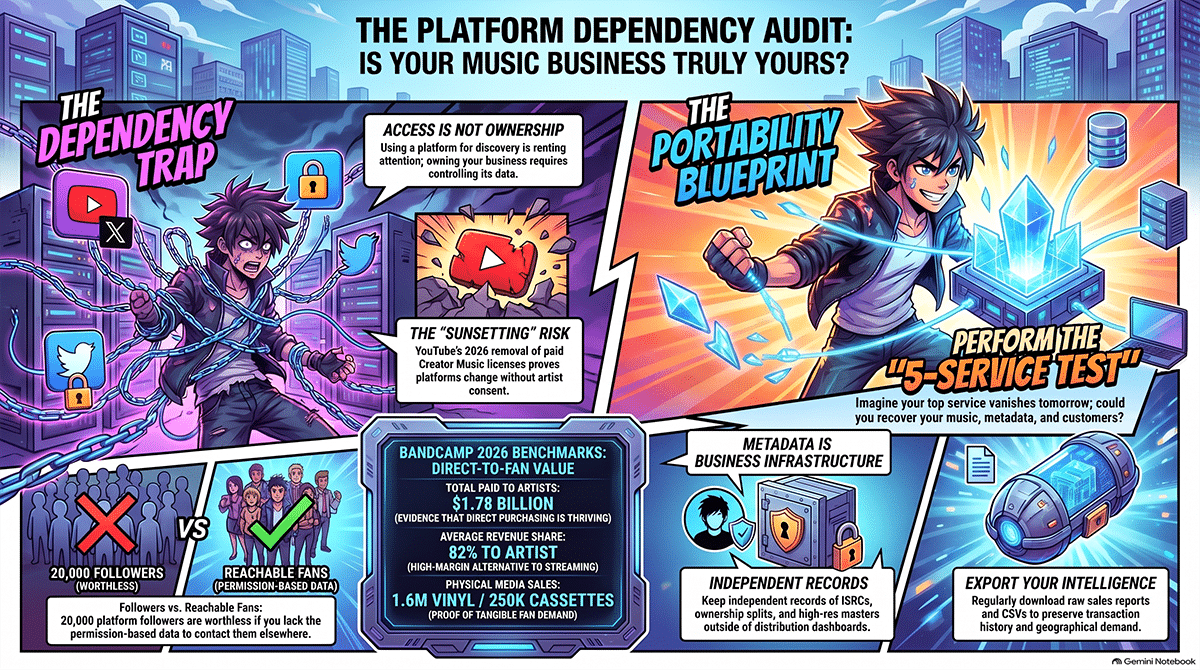
Followers Are Not the Same Thing as Fans You Can Reach
This may be the most important distinction in the entire audit.
A follower is a platform relationship. A permission-based contact can become an artist relationship.
If 20,000 people follow you inside a platform, that number may look impressive. It may even be economically useful while the platform continues delivering your posts, videos, songs or messages to those people.
But ask the uncomfortable question.
If the platform disappeared tomorrow, how many of those 20,000 people could you contact?
That number is much closer to the size of the audience you actually control.
This does not make followers worthless. Far from it. Followers can create discovery, social proof, reach and sales. The mistake is failing to build a bridge from rented attention into an artist-controlled relationship.
That bridge might be a mailing list, an artist account system, a membership, a direct purchase, a fan club, a text relationship established with proper permission, a customer account on your own site or another system where the artist can maintain the relationship independently.
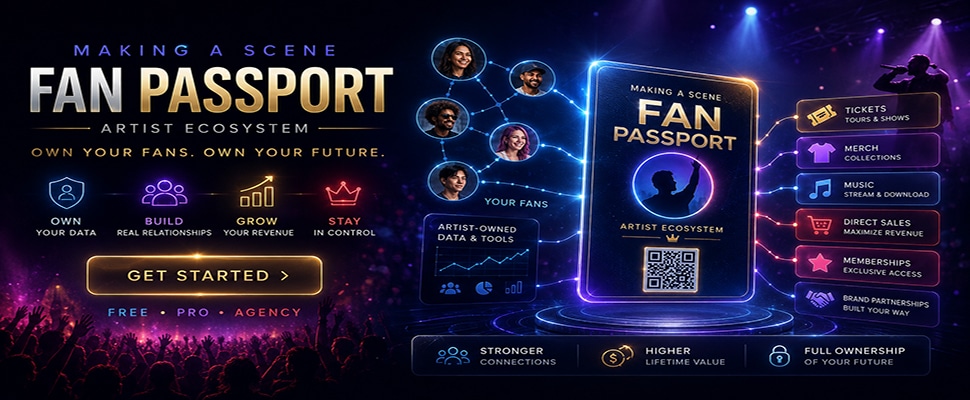
This is exactly where Making a Scene’s Fan Passport system at https://masfanpassport.com/ fits the ownership model.
The purpose of a system like Fan Passport is not to convince an artist to stop using outside platforms. That would defeat the point. The useful role is to provide an artist-controlled layer where fan relationships gathered from shows, QR codes, campaigns, websites and other activity can become permission-based records that the artist can continue using even if a discovery platform changes.
A musician might meet someone at a concert, send that person to a QR signup, allow the fan to follow the artist through Fan Passport, connect the relationship to future shows, releases, offers, rewards or merchandise, and gradually understand whether that person is becoming a casual listener or a real supporter.
Now the artist has created continuity.
The concert venue helped create the relationship. A platform might have helped create the original discovery. A ticket service might have processed the purchase. None of those companies has to remain the permanent owner of the connection between the fan and the artist.
That is the point.
Your Studio Business Has Dependencies Too
This ownership argument applies beyond performers.
The U.S. audio production studio business remains substantial. IBISWorld currently estimates the U.S. Audio Production Studios industry at about $1.7 billion in 2026 and counts 22,009 businesses in the category. It says the number of businesses increased 2.6% from 2025, even while estimated industry revenue was roughly flat to slightly down this year.
Those numbers do not mean every bedroom with an interface has suddenly become Abbey Road. Acoustics remain acoustics, engineering skill remains skill, microphones still stubbornly refuse to care how many followers you have, and some projects genuinely require purpose-built professional rooms.
But technology has allowed more professional audio work to operate outside a few historic recording centers. Remote mixing, mastering, editing, production and even some recording services are now routinely marketed online, including through professional marketplaces such as SoundBetter at https://soundbetter.com/. Current SoundBetter listings include engineers and studios explicitly offering remote mixing, mastering and analog processing services.
That creates another version of the same dependency question.
If your studio gets most of its clients through one marketplace, does the marketplace own your client pipeline?
If all communication stays inside that service, all reviews stay inside that service and every previous customer can only find you through that service, you have created a business that may be profitable but is not especially portable.
A recording engineer should therefore think like an artist. Build the website. Keep an organized customer system where permitted. Maintain project records. Create a direct inquiry process. Build relationships with producers, artists, managers and musicians independently of whichever platform made the introduction.
Use the marketplace to find the customer.
Do not require the marketplace to remain between you and the customer forever unless its terms require it for that transaction.
AI Licensing Is Becoming Real, but Do Not Spend the Check Yet
Artificial intelligence adds another fascinating dependency problem because the licensing market is beginning to develop while the underlying business model is still being invented.
There are now real licensed AI music agreements.
In November 2025, KLAY Vision, at https://klay.vision/, announced separate licensing agreements with Universal Music Group, Universal Music Publishing Group, Sony Music Entertainment, Sony Music Publishing, Warner Music Group and Warner Chappell Music. Sony’s announcement said KLAY’s large music model was being trained entirely on licensed music and that the company was working to expand its framework to independent labels, artists, publishers and songwriters.
Then in June 2026, the National Music Publishers’ Association announced what it described as the first industry-wide AI licensing arrangements for publisher members with Udio, at https://www.udio.com/, and KLAY. The NMPA said its Udio arrangement would value publishing and sound-recording training data equally on the training side, while acknowledging that compensation structures around AI output remain an evolving issue.
This is significant. It demonstrates that licensing copyrighted music for AI systems is not merely a theoretical future business model anymore.
It does not demonstrate that independent artists should begin entering “AI training royalties” into next year’s household budget.
Much of the market is still being negotiated. Public terms are incomplete. Different rights may be controlled by different parties. Compensation structures remain contested. Participation opportunities for independent musicians are still developing, and artists need to understand exactly which rights they are licensing before agreeing to anything.
That makes ownership even more important.
If licensed AI markets expand, who will be in the strongest position to participate?
Probably the rights holders who can quickly prove what they own.
An artist with organized masters, publishing records, split sheets, contributor agreements, metadata, instrumental versions, stems and documented permissions is much easier to license than an artist whose answer to every ownership question begins with, “I think my old bass player’s girlfriend might have that file.”
Catalog hygiene is not clerical busywork anymore. It is becoming business infrastructure.
AI may eventually create meaningful licensing revenue. It may create entirely new forms of interactive music. Some products may succeed wildly while others disappear after the venture capital runs out and everybody involved suddenly discovers an urgent passion for something called “agentic quantum wellness.”
The artist does not need to predict which company wins.
The artist needs to own the assets that the winner may eventually want to license.
Find the Weakest Answer
Once you begin the platform dependency audit, do not try to rebuild your entire business in a weekend.
Find the weakest answer.
Maybe you can export your customer information but you cannot export useful transaction history. Maybe your masters are safe but your metadata is scattered. Maybe your storefront is portable but your fan communication depends entirely on one company’s messaging system. Maybe you have ten thousand followers somewhere but only three hundred email contacts you can actually reach directly.
That weak point deserves attention first.
The goal is not technological perfection. The goal is reducing the possibility that somebody else’s product decision can erase years of your work.
Sometimes the fix is embarrassingly simple. Download the CSV. Back up the masters. Export the contacts that you are permitted to maintain. Copy the metadata into your own catalog record. Store your licensing agreements outside the licensing platform. Create a direct artist website. Add a permission-based fan signup. Put a QR code at the merch table.
Small acts of organization can create enormous amounts of independence.
Build for Failure Before Failure Happens
Technology companies use a concept called redundancy. Important systems are designed so one failure does not destroy everything.
Artists should think the same way.
Your original master should not exist in only one place. Your fan database should not exist only inside a social network. Your accounting history should not exist only inside your payment platform. Your entire licensing business should not depend on one marketplace. Your direct customer relationship should not disappear because a ticketing company changed its API.
This does not mean maintaining five versions of everything and spending every Saturday night performing database administration while your friends are out having suspicious amounts of fun.
It means identifying the assets that would be painful or impossible to recreate and making sure you control a usable copy.
Think of it as career insurance without the delightful experience of talking to an insurance company.
The Artist-Owned Business Is a Hub, Not an Island
There is also a danger in taking the ownership argument too far, because an artist-owned business should not become an island cut off from the rest of the ecosystem. The internet works precisely because networks create value, and discovery platforms can introduce artists to listeners who would never have found them otherwise. Marketplaces can bring buyers into contact with work they were already inclined to support, distribution companies can place catalogs across enormous networks, and ticketing systems can handle transactions at scale. Services like Bandcamp can connect musicians with people actively looking to buy music, while YouTube can place music in front of billions of viewers and creators. The goal, then, is not independence from everyone, but independence from any one company, and that distinction is essential.
An artist who refuses to use platforms in the name of ownership may unintentionally make themselves harder to discover, while an artist who uses every useful platform but still captures the value they create and maintains their own business records is playing a far more sustainable game. Other companies can be used for reach, convenience, specialized technology, marketplaces, and discovery, but underneath all of that the artist should continue building their own hub. That hub is the catalog, the rights records, the website, the customer history, the permission-based fan relationships, the product information, the sales intelligence, and the ability to contact the people who have chosen to stay connected. In this model, platforms become spokes while the artist remains the center.
Bandcamp, YouTube, Studios and AI Are Telling the Same Story
At first glance, developments like Bandcamp sales, changes to YouTube’s Creator Music system, the growth of decentralized audio production businesses, and emerging AI licensing deals may seem unrelated, but they are all pointing in the same direction. Bandcamp demonstrates that direct fan purchasing is still very much alive, with people continuing to spend money on music, physical media, and merchandise when they believe their purchase meaningfully supports the artist. The scale of those transactions makes it impossible to dismiss direct purchasing as nostalgia.
YouTube, on the other hand, shows how even a promising revenue feature from one of the largest technology companies in the world can shift or disappear, as seen in the removal of its paid Creator Music model on August 10, 2026, regardless of how individual rights holders may have planned around it. Meanwhile, the studio world illustrates how digital tools and online marketplaces have reduced dependence on traditional geographic business models, even as high-quality rooms and engineers remain essential, with thousands of audio production businesses now operating in a market where remote collaboration is normal. At the same time, AI licensing is beginning to introduce entirely new uses of music rights, with agreements involving companies like KLAY and announcements from organizations such as the NMPA signaling that licensed AI music is moving from theory into real commercial structures, even if the long-term benefits for independent artists are still uncertain.
Taken together, these developments make the direction of change clear. No artist can control which business model ultimately dominates, but every artist can control whether they are prepared for that change when it arrives.
Build a Business That Can Move
For decades, independent artists have been encouraged to chase access as the primary strategy for success, whether that meant getting signed, getting playlisted, getting booked, getting distributed, getting onto platforms, getting more followers, or getting noticed by someone with influence. While each of these can help, access without ownership leaves the artist permanently dependent on whoever controls the gate. The idea behind building a music industry middle class is different, because it does not require global fame so much as it requires a durable set of revenue-producing relationships.
A relatively small number of real supporters can be more economically meaningful than a massive passive audience if those supporters are actively buying tickets, merchandise, music, memberships, experiences, lessons, or special releases directly from the artist. However, that only works if the artist can maintain the relationship over time. Fan ownership is not about possessing people or reducing them to data points, because fans are not inventory. Instead, it is about owning the infrastructure that allows a fan to voluntarily continue the relationship on their own terms.
In this model, the fan chooses to follow, to share contact information, to make purchases, and to remain part of the community, while the artist ensures that no external platform can accidentally sever that connection due to a change in strategy. Systems like Fan Passport at https://masfanpassport.com/ can support this continuity when tied to live shows, direct offers, QR-based capture, and artist-controlled communication, but the specific tool is less important than the underlying architecture. The artist must become the permanent address, and platforms should function as the pathways that lead people there.
The Real Test of Ownership
The most practical way to understand artist ownership is to treat it less as a philosophy and more as a disaster-recovery question. If your most important platform disappeared tomorrow, you should be able to ask whether you could still release music, still sell something, still license your catalog, still prove ownership of your songs, still identify your best customers, still reach the fans who gave you permission to contact them, still announce a show, and still operate your business. If the answer is yes, then you have built something durable, and if the answer is no, then you have identified exactly what needs to be fixed.
This is not a reason for panic, but rather useful information, because every artist already operates with dependencies. Music creation itself is collaborative, and artists rely on musicians, engineers, venues, distributors, manufacturers, software developers, payment companies, and audiences. Independence has never meant doing everything alone, but instead maintaining enough control that collaboration remains a choice rather than a constraint. That is the difference between using a platform and being trapped by one.
In practice, this means using Bandcamp because people buy music there, using YouTube because people watch videos there, using marketplaces because they bring customers, using AI tools when they genuinely save time or create new value, and exploring AI licensing when rights, consent, and compensation make sense. It also means using systems like Fan Passport or other artist-controlled tools to preserve direct fan relationships, and building studios wherever the creative and economic conditions are right. The goal is to take advantage of every useful technology while ensuring that the most important parts of the business can leave with you if necessary.
The future of independent music is not about finding a single perfect platform that will solve everything, because that platform does not exist. Instead, it is about building an artist-owned business that can connect to many platforms, earn income through many channels, collect useful information with proper permission, and continue operating even when individual companies change direction. Bandcamp will change, YouTube will change, AI companies will change, distributors will change, ticketing systems will change, and software will change, but the artist’s business should be able to adapt without having to start over each time.
That is what ownership looks like in practice. Use platforms for what they do well, and build your business so that you are never forced to rebuild it just because one of them decides to change its mind. And when the next corporate email arrives announcing an “exciting evolution of our creator ecosystem,” you may still roll your eyes, but you will not have to rebuild your career because of it.
 |  Spotify |  Deezer |  Breaker |
 Pocket Cast |  Radio Public |  Stitcher |  TuneIn |
 IHeart Radio |  Mixcloud |  PlayerFM |  Amazon |
 Jiosaavn |  Gaana |  Vurbl |  Audius |
 Reason.Fm | |||
Find our Podcasts on these outlets
Subscribe to Our Newsletter
Discover more from Making A Scene!
Subscribe to get the latest posts sent to your email.


