Fan Data Is the New Currency of the Music Industry—and Why Are Artists Still Broke




Making a Scene Presents – Fan Data Is the New Currency of the Music Industry—and Why Are Artists Still Broke
Listen to the Podcast Discussion
The Gold Rush Nobody Told the Artist About
Every time a fan streams a song, skips a song, saves an album, watches a video, buys a ticket, clicks an advertisement, follows an artist, visits a website, or abandons a shopping cart, something valuable is created.
Data.
That data may reveal where the fan lives, what music they enjoy, which device they use, when they listen, what they buy, how much they spend, which advertisement caught their attention, and what action they are likely to take next.
The modern music industry runs on this information. Streaming services use it to recommend songs. Social networks use it to decide which posts appear in a feed. Advertisers use it to target possible customers. Ticketing companies use it to promote future events. Record labels use it to decide where to spend marketing money.
Everyone appears to understand the value of fan data except the person who created the reason for that data to exist.
The artist.
An independent musician may be told that a song reached 100,000 listeners. That sounds impressive. But can the artist contact those listeners? Can the artist invite them to a show? Can the artist ask which city they live in? Can the artist offer them a signed record? Can the artist tell them about a house concert, membership, crowdfunding campaign, or new shirt?
Usually, the answer is no.
The platform may show the artist a map, a graph, a follower count, or a collection of audience segments. Those insights can be useful, but they are not the same as having a direct, permission-based relationship with an actual human being.
The platform knows the fan. The artist sees the shadow.
That is the quiet power struggle underneath today’s music business. The industry is no longer fighting only over who owns the master recording or publishing rights. It is also fighting over who owns the road between the artist and the audience.
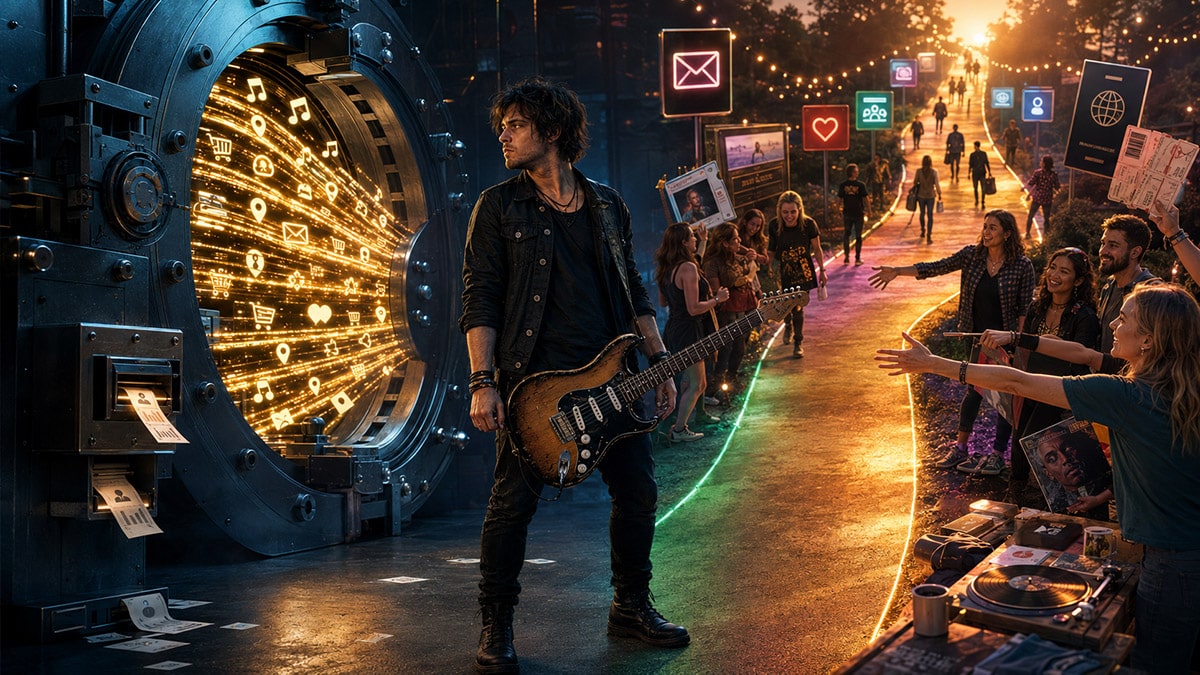
Fan data is the new currency of the music industry. The platforms are building vaults while too many artists are still looking under the couch cushions.
Data Is Not Really Gold—It Is More Powerful Than Gold
Calling data “the new gold” is popular, but the comparison does not go far enough.
Gold can be spent once. Data can be used repeatedly. One piece of accurate information can help shape a tour, launch a release, sell merchandise, fill a venue, find potential members, and decide where advertising money should be spent.
Suppose an artist knows that 200 fans live within 50 miles of Philadelphia. That information can help the artist decide whether to book a show there. If the artist also knows that 65 of those fans previously bought merchandise, the artist can estimate how much inventory to bring. If 30 fans have attended two earlier shows, those people may be interested in a VIP experience. If 12 have asked about vinyl, a limited pressing may have buyers before manufacturing begins.
The same data keeps creating value because it improves the artist’s decisions.
Data also gains value when it is connected to other data. An email address by itself has limited meaning. An email address connected to a city, show history, merchandise purchase, musical preference, birthday, membership status, and communication permission becomes part of a relationship.
That is why platforms collect so much information.
Spotify’s privacy information explains that the service collects usage data, including listening history, searches, playlists, library activity, browsing behavior, and interactions with the service. Meta says it uses collected information to personalize experiences, including advertising. The Meta Pixel can record actions people take on a website, while customer-list tools allow advertisers to upload information such as email addresses to find corresponding users across Meta’s services. These are not side projects. Data helps drive the central machinery of digital discovery and advertising. Spotify Privacy Policy Meta Privacy Policy Meta Pixel information
This does not mean every platform is evil or that every use of data is improper. Spotify recommendations can help a listener discover an artist. Instagram can introduce a band to someone on the other side of the world. YouTube can turn a live performance into a discovery door that never closes.
The problem begins when the artist mistakes access to a platform for ownership of a relationship.
A rented crowd is still a rented crowd.
The Artist Gets a Dashboard Instead of a Relationship
Modern platforms give musicians more information than artists could have imagined a generation ago.
Spotify for Artists shows streams, saves, playlist activity, audience segments, and geographical information. An artist can identify top cities and examine the differences between active listeners, previously active listeners, and programmed listeners. Spotify even describes “super listeners” as a useful audience group for developing deeper fandom.
YouTube Analytics can show new viewers, returning viewers, subscribers, geography, age ranges, viewing behavior, and other audience insights. YouTube notes that some information may be limited, but the available data can still help an artist understand what content is attracting attention.
These dashboards have real value. If an artist sees rising interest in Chicago, that may influence tour planning. If an acoustic video keeps attracting returning viewers, that may suggest what kind of content the audience wants next. If listeners frequently save one song but skip another, that can help the artist study what is connecting.
But there is a boundary.
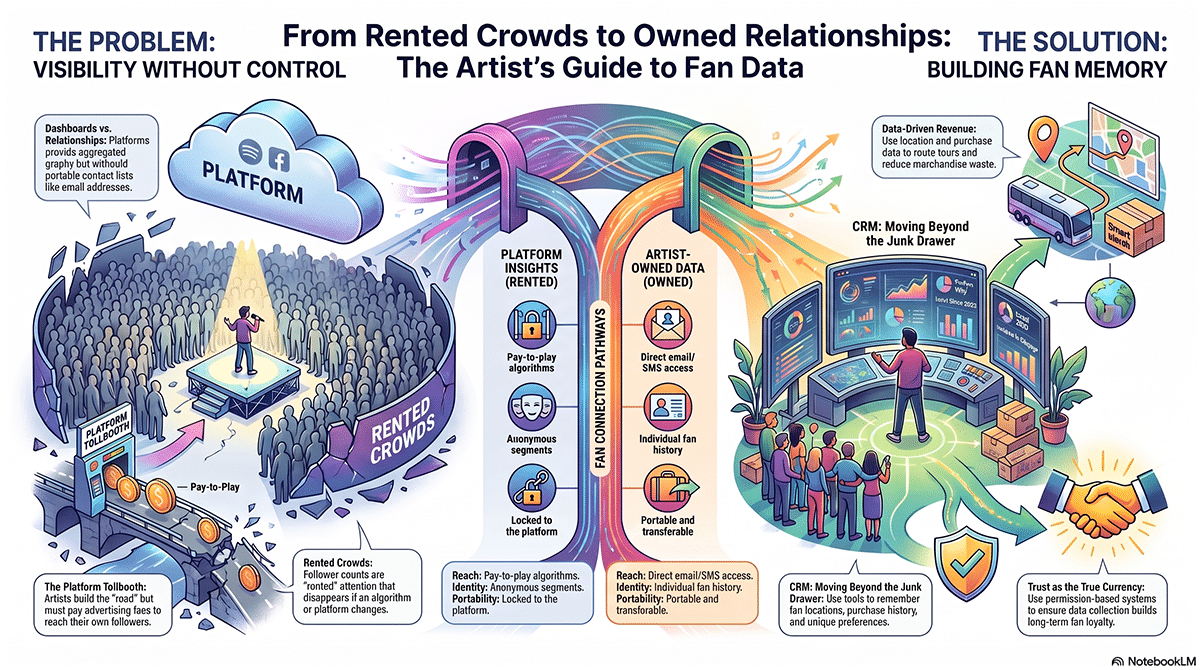
The artist generally receives aggregated insights, not a portable contact list containing the names and email addresses of individual listeners. The platform can continue communicating with those people inside its own system. The artist usually cannot take that audience elsewhere.
A Spotify follower can receive music through Release Radar and other Spotify surfaces, but the artist does not receive that follower’s email address simply because the person clicked Follow. A YouTube subscriber may receive notifications, but the artist cannot export that subscriber list into an independent CRM and send everyone a tour announcement.
The artist has visibility without control.
It is like being allowed to look through the window of a bank vault. You can see that something valuable is inside. You may even receive a report about how much is there. But you cannot take it home.
This distinction becomes painfully clear when a platform changes its algorithm, advertising system, recommendation process, account rules, or reach. An artist may spend years building followers and still be required to pay to reach more of them. If the account is restricted, hacked, suspended, or simply abandoned by fans moving to another platform, much of that relationship disappears with it.
A follower count is not a customer database. A monthly-listener count is not a mailing list. A video view is not permission to contact a person.
These numbers measure attention inside someone else’s property.
Platforms Are Not Hoarding Data by Accident
The word “hoarding” can sound dramatic, but platform control of data is part of the business model.
A social platform becomes valuable to advertisers because it understands its users. It can sort people according to interests, behavior, location, relationships, engagement, purchases, and countless other signals. Advertisers do not need to know the identity of every user. They pay the platform to find the right users for them.
The platform becomes the tollbooth between the business and the audience.
Musicians enter this system with a strange disadvantage. The music helps attract and retain attention, but the artist often has to purchase access to the resulting audience. An artist posts content, encourages discussion, and sends fans to a platform. The platform learns from all that activity. Then, when the artist wants to promote a show or release, the artist may be invited to buy an advertisement.
The artist helped build the road and is still charged the toll.
This is not an argument for abandoning streaming or social media. That would be like refusing to put up a sign because you do not own the highway. Artists need discovery. The mistake is allowing the highway to become the destination.
Spotify, Instagram, TikTok, Facebook, and YouTube should lead somewhere. A fan who discovers an artist should have a clear path into a space the artist can control: an artist-owned website, mailing list, fan membership, direct store, community, or Fan Passport.
The purpose of discovery is not to collect applause from an algorithm. The purpose is to begin a relationship.
What Artist-Owned Fan Data Actually Means
“Own your fan data” is an easy slogan, but the reality needs more care.
The artist does not own the fan. A fan’s personal information does not become the artist’s property in the same way that a guitar, recording, or mailing-list software account does. People have privacy rights, and those rights differ across countries and states.
The better principle is that an artist should control a permission-based system for managing direct fan relationships.
That system should let the artist export and move appropriate information. It should record how the information was collected. It should preserve communication preferences. It should honor unsubscribe requests. It should allow inaccurate records to be corrected and unnecessary records to be removed. It should protect access rather than leaving a spreadsheet in an open folder.
Most importantly, fans should understand what they are agreeing to.
A fan who enters an email address to receive a free song has not automatically agreed to receive text messages. A person who buys a shirt should not silently become part of every marketing campaign the artist may ever run. Different channels and purposes can require different forms of permission.
In the United States, the CAN-SPAM Act does not create a general advance opt-in requirement for commercial email, but it does impose rules including honest header information, nondeceptive subject lines, a working opt-out method, and the prompt honoring of unsubscribe requests. The Federal Trade Commission also makes clear that people retain the right to opt out of marketing messages even when they have a subscription or membership. FTC CAN-SPAM compliance guide
The rules can be stricter elsewhere. The United Kingdom’s Information Commissioner’s Office states that marketing emails and texts to individuals generally require specific consent, with a limited exception sometimes called the soft opt-in for existing customers. Personal-data use must also comply with applicable data-protection law. ICO electronic-mail marketing guidance
An indie artist does not need to become a privacy lawyer. The artist does need to build a system based on respect.
Ask clearly. Collect only what has a purpose. Protect it. Record permission. Make leaving easy.
Trust is what makes fan data valuable. Without trust, the database is just a future apology waiting to happen.
The Difference Between Data and Fan Memory
A mailing list is a beginning, not the finish line.
Many artists have a spreadsheet filled with email addresses. Some of those addresses came from old shows. Some came from a giveaway. Some came from customers. Nobody remembers which is which. The artist sends the same message to everyone and wonders why engagement keeps falling.
That is not a fan relationship system. It is a digital junk drawer.
A useful CRM creates fan memory.
CRM means customer relationship management. The name sounds as if it belongs in a conference room filled with people saying “synergy,” but the idea is simple. A CRM helps an artist remember who people are, what they care about, what they have done, and what the artist should do next.
A working artist CRM might remember that Maria lives in Atlanta, joined the list at a live show, bought a vinyl record, attended twice, prefers email rather than text, and showed interest in a house concert. It might remember that James discovered the artist through a video, downloaded a free acoustic track, and has not bought anything yet. It might remember that Denise has purchased nearly every release and should receive early access rather than another generic “please support me” message.
This information allows the artist to stop treating every fan as a stranger.
HubSpot CRM offers contact management and tools for unifying customer information. HubSpot also incorporates AI features that can help examine records, identify work needing attention, and support more personalized communication. Its free level may be useful for an artist who wants a general-purpose CRM, although advanced automation and marketing features can increase costs as needs grow.
Kit is designed for creators and combines email, subscriber tagging, segmentation, landing pages, automated sequences, and selling tools. It can be a more natural fit for artists whose main need is building an email audience and guiding subscribers through different journeys.
Mailchimp provides email marketing, segmentation, automation, and AI-supported marketing features. Its tools can group contacts according to shared traits or behavior, but artists should compare current plan limits and pricing before committing. The cheapest system at the beginning is not always the cheapest after the audience grows.
Shopify can connect commerce information with customer profiles, segmentation, email, SMS, and automated marketing. It may be useful for artists with a serious merchandise operation, but it can become more system than a new artist needs.
Bandcamp remains one of the more artist-friendly bridges between discovery and direct support. Bandcamp’s artist guide says followers can receive messages on Bandcamp and through email, and fans are invited to opt into an artist mailing list that the artist can export. Bandcamp also supports targeting messages by fan location and level of support. That is much closer to a useful artist relationship than an anonymous stream. Bandcamp Artist Guide
No tool magically creates a business. The tool only remembers and acts upon the information the artist earns through real relationships.
The Artist Fan Passport as a Relationship Layer
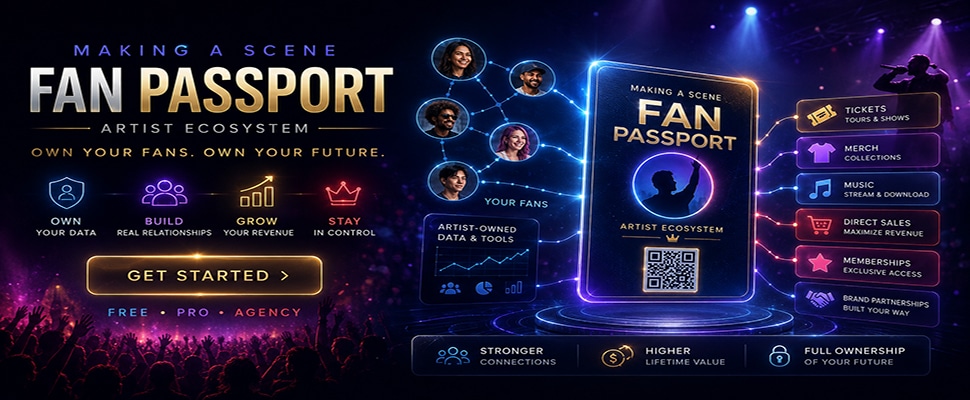
The Making a Scene Artist Fan Passport OS is built around a simple idea: a fan should not become anonymous again every time they interact with an artist.
A fan may first discover a song on a streaming platform. Later, the fan watches a video, attends a show, scans a QR code, buys a shirt, follows the artist, earns a stamp, claims a reward, or joins an email list. In a disconnected system, those events live in different places. The streaming platform has one fragment. The ticket seller has another. The store has another. The mailing service has another. The artist sees pieces but not the person.
The Fan Passport model attempts to connect those moments through permission-based fan identity and memory.
The passport is not supposed to become a creepy surveillance file. It is meant to be a value exchange. The fan chooses to connect. The artist gives the fan something worthwhile: access, recognition, rewards, music, experiences, or a closer relationship. The system remembers the interaction so the artist can serve that person better.
This turns fan capture into fan memory.
If someone scans a show QR code, the artist can learn that the person attended. If that fan later buys merchandise, the artist can understand that the relationship is growing. If the fan earns a reward, the experience becomes part of the story rather than a forgotten transaction.
The data collected through a fan funnel and the data collected through the Fan Passport should feed one consent-aware fan record. The artist should not have three versions of the same person scattered across three databases. Analytics, email campaigns, offers, show planning, rewards, and AI-assisted insights should work from the same source of truth.
That unified record is where a collection of small interactions becomes business intelligence.
Meet Lena, the Artist Who Stops Starting Over
Consider a fictional independent artist named Lena Cross. Lena is a composite example, not a documented case study.
Lena plays blues-rock and Americana. She has 18,000 monthly listeners on Spotify, 9,000 Instagram followers, and several videos with respectable YouTube numbers. From the outside, Lena appears to have a strong fan base.
Her bank account tells a different story.
When Lena announces a show, only a fraction of her social followers see the post. Her streaming dashboard shows listeners in several cities, but she cannot contact those listeners directly. She has an email list, but it contains only 340 people, and she knows almost nothing about them.
Lena has attention, but very little memory.
She decides to change the system.
At every show, Lena places a QR code near the stage and merchandise table. The message is not “Join my mailing list,” because nobody wakes up excited to join another mailing list. The offer is useful: scan to get a live recording from tonight’s show, collect a Fan Passport stamp, and unlock an invitation to a private livestream.
The form asks for an email address, city, communication choice, and permission. It does not ask for a home address, income, favorite breakfast cereal, or the name of the fan’s first pet. Lena collects what she can use and nothing more.
After the show, the CRM tags each person with the date and city. Fans who bought merchandise are connected to that purchase. Fans who claimed the live recording enter a short welcome sequence. The first message delivers the recording. The second tells the story behind the song. The third offers advance access to a limited vinyl release.
Lena is no longer sending the same sales pitch to everyone.
Fans who attended the Atlanta show receive a thank-you message about Atlanta. Fans who expressed interest in vinyl receive the vinyl offer. Fans who attended three events receive an invitation to a small soundcheck experience. People who signed up but have not engaged receive a gentle reintroduction rather than an expensive deluxe bundle.
Nothing here requires Lena to become a data scientist. It requires her to remember the relationship.
Over time, Lena learns that she has 147 engaged fans around Atlanta, 82 near Nashville, and 61 near Charlotte. Instead of routing a tour by guessing where she might draw, she starts with places where direct fan relationships already exist.
Before confirming a venue, Lena sends a simple interest message to the local segment. She is not pretending that an email response guarantees a ticket sale. She is testing demand before accepting the full financial risk.
She also discovers that vinyl buyers are more likely to purchase signed lyric sheets, while repeat show attendees respond more strongly to soundcheck access. Her supporters are not one big pile. They have different interests.
That information changes Lena’s income.
She stops ordering the same amount of merchandise for every city. She creates small product runs based on demonstrated interest. She offers higher-value experiences to people who have shown deeper engagement. She invites casual fans into affordable entry points rather than demanding that everyone buy the largest package.
The data does not create the money by itself. It reduces bad guesses and helps Lena make more relevant offers.
How Fan Data Becomes Revenue
The path from data to income is not mysterious. It follows a chain.
A fan reveals a need, preference, location, behavior, or level of interest. The artist remembers it. The artist makes a relevant offer. The fan decides whether the offer has value. The resulting purchase produces income and creates another piece of relationship history.
Location data can support ticket income. If an artist knows where engaged fans live, the artist can route more intelligently, contact the right people, test demand, and reduce travel into markets that exist only as optimistic dots on a streaming map.
Purchase history can support merchandise income. A fan who bought a shirt may be interested in a new design. A vinyl buyer may want a signed edition. A fan who has never purchased should receive a lower-risk first offer, not be treated like a collector.
Attendance history can support premium experiences. A person who attends repeatedly may value a soundcheck, workshop, listening session, house concert, or small-group event. These offers should create genuine access, not manufacture false scarcity.
Engagement data can support memberships. A fan who regularly opens messages, watches private videos, claims rewards, and attends livestreams may be ready for recurring support. Membership income can help an artist smooth the violent ups and downs between releases and tours.
Preference data can support direct music sales. Some fans want vinyl. Others want high-resolution downloads, CDs, cassettes, stems, alternate mixes, or handwritten lyrics. Streaming treats every listener in roughly the same format. Direct sales allow the artist to respond to what different fans value.
Relationship history can even strengthen licensing and booking decisions. A venue, promoter, sponsor, or licensing partner may be more interested in an artist who can demonstrate real audience engagement than one who can only point at a follower count. The artist must present information responsibly and in aggregate, without exposing personal fan records.
Data can also help with publishing and release strategy. If fans keep responding to acoustic performances, behind-the-song content, or a particular style, that information can guide what the artist releases next. It should inform creativity, not dictate it. The audience gets a vote, not the master key to the studio.
The goal is not to squeeze more money from every fan. The goal is to stop offering the wrong thing to the wrong person at the wrong time.
AI Turns a Database Into a Working Assistant
A CRM can remember thousands of interactions. AI can help the artist find patterns inside them.
This is where the current generation of tools becomes especially important for independent musicians. A small artist team may not have a marketing analyst, tour planner, merchandise manager, email specialist, and data engineer. AI can help perform parts of those jobs without pretending to replace human judgment.
AI can summarize campaign results. It can identify cities with rising engagement. It can group fans by purchase patterns, attendance, interests, or level of activity. It can flag duplicate records. It can suggest which supporters may be ready for a membership invitation and which need a simple thank-you.
AI can also help draft different messages for different groups. The artist might ask for one announcement for fans near an upcoming show, another for vinyl buyers, and another for new subscribers who have never purchased.
The artist should still edit the writing. Nobody joins an artist community to receive romantic poetry from a database robot.
More importantly, artists must be careful with personal information. A fan database should not be casually pasted into a general AI chatbot. The safer approach is to use approved CRM integrations, private systems, minimized datasets, or de-identified information. Names, phone numbers, addresses, purchase records, and private notes should be protected.
AI does not need to know that Sarah Jones at a specific street address bought a shirt. It may only need an anonymous customer number, city, product category, date, and transaction value to identify a pattern.
The rule is simple: give AI the minimum information required to do the job.
AI is most valuable when it helps the artist ask better questions. Which cities show enough direct engagement to support a show? Which fans have become inactive? Which product sells after live events? Which signup source produces buyers rather than empty addresses? Which supporters deserve recognition? Which campaign created unsubscribes?
Those questions turn data into decisions.
First-Party Data Is Not a License to Become the Villain
There is a danger in telling artists to collect data. Some may copy the worst habits of the platforms they criticize.
Artist-owned does not automatically mean fan-friendly.
A musician can misuse information just as easily as a large corporation can. The scale may be smaller, but the broken trust feels personal. Fans often share information because they believe they are entering a closer relationship with the artist. Abusing that access can do more damage than a generic advertisement ever could.
A respectful artist should explain what the fan receives, what information is being collected, how it will be used, and how the fan can change their mind. Email and text permissions should be handled separately when appropriate. Sensitive information should not be collected without a real need. Access should be limited to people who require it.
The artist should also have a plan for deletion, export, correction, backups, and security. If a band member leaves, that person should not retain permanent access to the fan database. If a laptop is stolen, the entire audience should not be sitting in an unprotected spreadsheet on the desktop.
Permission is not paperwork attached to the relationship. Permission is part of the relationship.
The artists who handle data responsibly will build something platforms struggle to manufacture: real trust.
Stop Measuring the Crowd and Start Remembering the People
The old music industry encouraged artists to chase gatekeepers. The newer platform industry encourages them to chase numbers.
Followers. Views. Streams. Likes. Impressions. Monthly listeners.
These measurements are not useless, but they are incomplete. They tell an artist how much activity occurred inside a particular system. They do not automatically tell the artist whether a sustainable business is being built.
A better set of questions begins with relationships.
How many people have given the artist permission to communicate directly? How many fan records include a useful location? How many supporters attended more than once? How many made a first purchase? How many moved from a small purchase to a larger one? How many joined a membership? How many went inactive? How many were thanked without being sold anything?
These questions point toward a music industry middle class.
A middle class is not created by one viral moment. It is created when enough artists can build dependable income from a reasonable number of real supporters. That income may come from shows, merchandise, memberships, direct music sales, publishing, licensing, workshops, commissions, crowdfunding, and special experiences.
Fan data helps connect those income sources.
Without fan memory, every campaign begins at zero. Every release is another desperate attempt to wake the algorithm. Every tour is a gamble. Every product order is a guess.
With fan memory, the artist builds upon the last interaction.
That is the compounding power of an owned ecosystem.
The New Artist Business Has a Front Door
An artist does not need to leave the platforms. The artist needs to give them a job.
Spotify is a discovery door. YouTube is a discovery door. Instagram is a discovery door. TikTok is a discovery door. Even an interview, playlist, radio spin, or music review is a discovery door.
Every door should lead toward an artist-controlled home.
That home begins with the artist’s website, but it cannot end with a static biography and a row of social links. The website should help fans take meaningful actions. They should be able to join, follow, buy, attend, collect, respond, and support.
The CRM provides memory behind that front door. The Fan Passport can connect live and digital interactions. Email and SMS provide direct communication when used with permission. Commerce systems record purchases. AI helps identify patterns. The artist uses those patterns to create better offers and experiences.
This is not about trapping fans inside another platform. It is about creating a portable, respectful relationship that does not disappear when one company changes direction.
The artist should be able to change an email provider without losing the audience. The artist should be able to move a website without starting over. The artist should be able to export appropriate records and consent history. No single vendor should become the artist’s next digital landlord.
Portability matters because independence is not defined by which software the artist uses. It is defined by whether the artist can leave.
The Real Currency Is Trust
Fan data can help an artist earn more money, but the data itself is not the final currency.
Trust is.
A fan shares an email address because they expect something worthwhile. A fan shares a city because they want to hear about nearby shows. A fan allows an attendance record because the passport offers recognition or rewards. A fan shares a preference because they expect the artist to listen.
Every piece of information is a small loan of trust.
The artist earns interest by using it well.
Send relevant messages. Remember the fan’s history. Do not flood the inbox. Do not sell the list. Do not turn every conversation into a checkout page. Provide music, stories, access, gratitude, and community alongside offers.
When fans feel respected, data becomes more accurate. When data becomes more accurate, offers become more relevant. When offers become more relevant, income becomes more sustainable. When income becomes more sustainable, the artist gains more time and freedom to create.
That is the cycle we should be building.
The platforms have spent years learning what fans watch, hear, click, skip, and buy. They have treated those signals like gold because they understand that knowledge creates power.
Independent artists can now build their own version of that intelligence, but it should not copy the coldest parts of the platform economy. It should be smaller, more transparent, more human, and more useful to the fan.
The future music industry middle class will not be built by waiting for a platform to become generous. It will be built by artists who understand that discovery is only the beginning, permission is the bridge, fan memory is the system, and trust is the asset that makes everything else possible.
The platforms already know the value of your audience.
It is time the artist did too.
 |  Spotify |  Deezer |  Breaker |
 Pocket Cast |  Radio Public |  Stitcher |  TuneIn |
 IHeart Radio |  Mixcloud |  PlayerFM |  Amazon |
 Jiosaavn |  Gaana |  Vurbl |  Audius |
 Reason.Fm | |||
Find our Podcasts on these outlets
Subscribe to Our Newsletter
Discover more from Making A Scene!
Subscribe to get the latest posts sent to your email.


