
The Digital Campfire: How AI Can Create Community Instead of Content




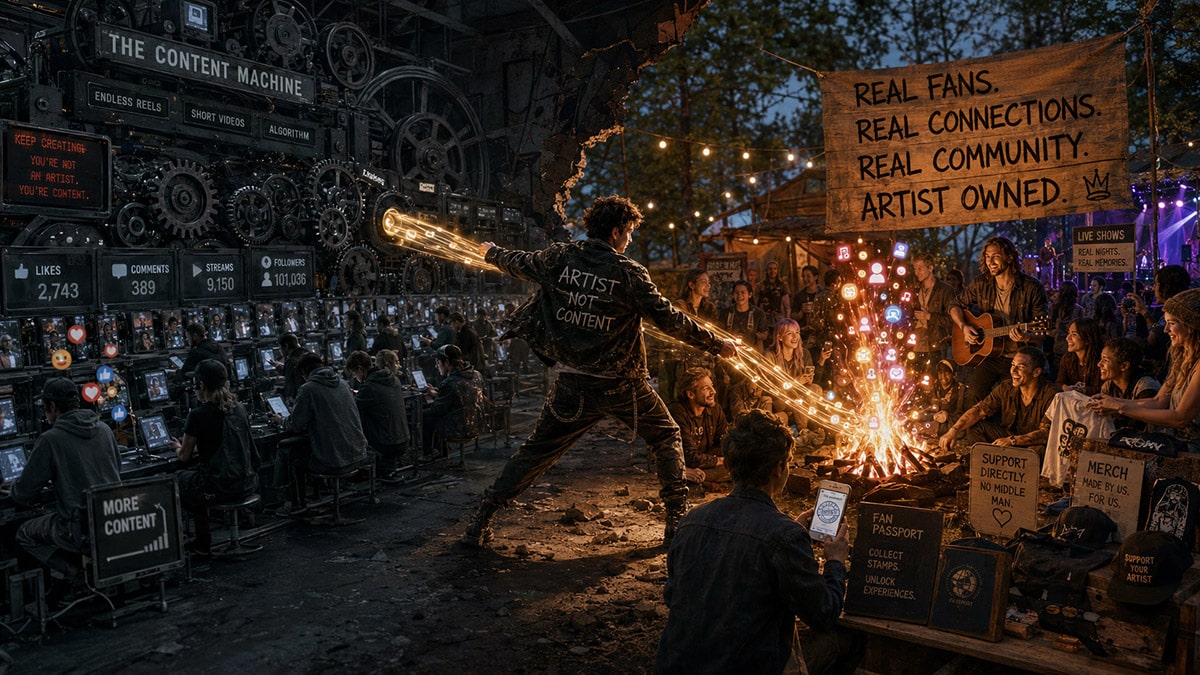
Making a Scene Presents – The Digital Campfire: How AI Can Create Community Instead of Content
Listen to the Podcast Discussion
Somewhere along the way, independent artists were handed a job they never asked for.
They were told to become content creators.
Not songwriters. Not performers. Not recording artists. Not community builders. Not storytellers. Content creators.
That phrase may sound harmless, but it changed the way artists think about their own careers. It turned the song into a post. It turned the fan into a metric. It turned the live show into a clip. It turned the artist’s life into raw material for a platform that always wants more.
Post more. Film more. Share more. React faster. Go live. Make reels. Make shorts. Use the trend. Feed the algorithm. Do it again tomorrow.
And if it does not work, the answer is always the same.
Create more content.
But here is the problem. Fans do not wake up in the morning hoping their favorite artist gives them more content. They want connection. They want meaning. They want a reason to care. They want to feel like they found something real in a digital world full of noise.
That is where AI needs to grow up.
The best use of AI for artists is not creating more posts. It is creating more conversations. It is helping artists notice who is already listening, who is already showing up, who lives near each other, who shares the same interests, and who might become part of something bigger than a follow.
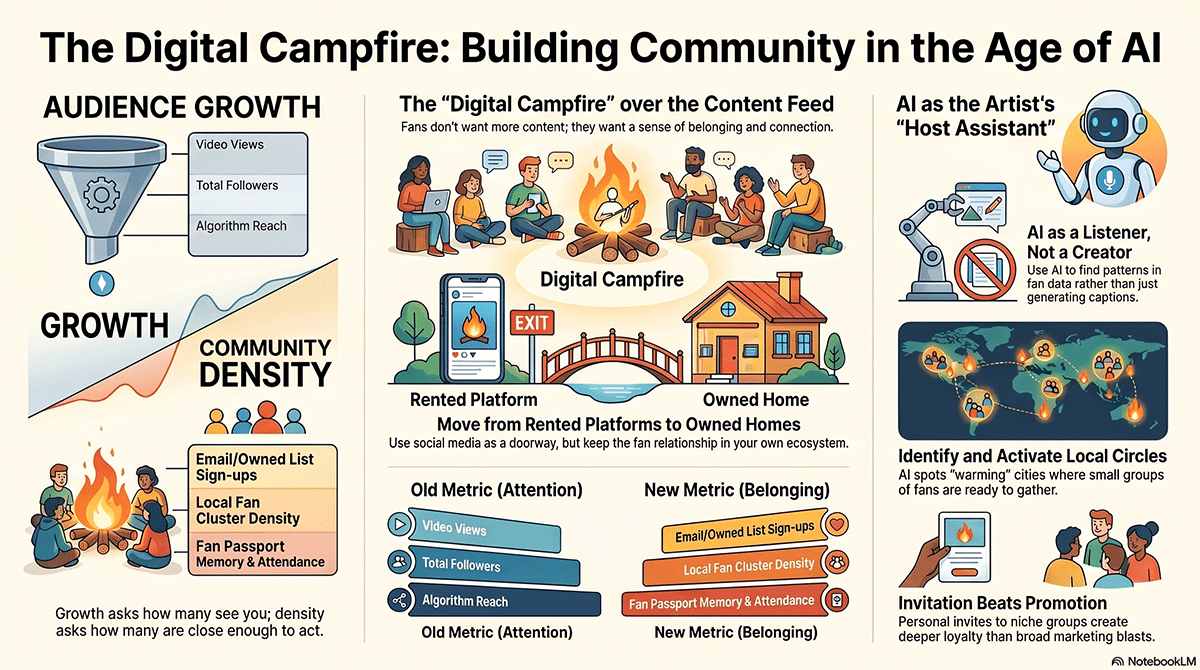
The future is not just audience growth.
The future is community density.
Fans Are Not Metrics
The music business loves numbers because numbers feel clean. Followers. Views. Likes. Saves. Streams. Monthly listeners. Comments. Shares. Watch time. Reach. Impressions.
Those numbers can be useful. They can show motion. They can tell an artist when something is connecting. But they can also lie.
An artist can have a video hit 50,000 views and still sell three tickets. A song can land on a playlist and still produce no direct fan relationship. A post can get hundreds of likes from people who will never open an email, buy a shirt, come to a show, or tell a friend.
That does not mean those people are bad fans. It means the system is built around passing attention, not lasting connection.
The platforms are very good at creating motion. They are not always good at creating memory.
That is the real problem for independent artists. A fan can discover you on Instagram, hear you on Spotify, watch you on YouTube, follow you on TikTok, and still never enter your world. They may like the song. They may enjoy the clip. They may even say, “This artist is great.” But unless there is a clear path into an artist-owned relationship, that fan stays inside the platform’s world.
And the platform owns the room.
The artist gets a little attention. The platform keeps the data.
That is not a business model. That is renting a corner of somebody else’s machine.
The Content Machine Is Exhausting Artists
The content machine has trained artists to confuse activity with progress.
If you posted today, you feel productive. If you missed a day, you feel guilty. If a clip performs well, you feel hopeful. If it dies, you feel invisible. If the algorithm rewards you, you feel chosen. If it ignores you, you wonder what you did wrong.
That is a terrible way to build a creative life.
Artists are already doing enough. They are writing songs, rehearsing, recording, mixing, booking shows, loading gear, driving long miles, answering messages, designing merch, updating websites, sending emails, making flyers, chasing payments, and trying to keep their lives together.
Now they are also expected to become full-time media companies.
This is where AI can either make things worse or make things better.
If artists use ChatGPT, Claude, Gemini, or Perplexity only to pump out more captions, hooks, scripts, and posts, then AI just becomes a faster shovel for feeding the same machine.
That is not freedom.
That is automation with a nicer interface.
But if AI helps artists listen better, organize better, follow up better, and bring fans together, then it becomes something more useful. It becomes a tool for community.
That is the shift artists need.
The Digital Campfire
Music has always been a campfire.
Long before there were platforms, dashboards, analytics, or algorithms, music gave people a reason to gather. People gathered in churches, clubs, basements, parking lots, living rooms, festivals, record stores, coffeehouses, bars, theaters, and backyards. The music was the spark, but the community was the heat.
A song does not only say, “Listen to me.”
A great song says, “Come closer.”
That is what the digital campfire should be. It should be the place where fans gather around the artist’s music and begin to recognize each other. It should be where a fan realizes they are not alone in loving a lyric, a groove, a story, a mood, or a mission. It should be where the artist stops shouting into a feed and starts hosting a real circle.
The artist is still the center, but the artist is not the only voice in the room. The fans begin to talk. They begin to share. They begin to show up. They begin to bring friends. They begin to build a scene around the music.
That is not soft marketing.
That is the foundation of a real independent music business.
Community Density Beats Audience Size
Audience growth asks a simple question.
How many people can we reach?
Community density asks a better one.
How many real fans are close enough, connected enough, and motivated enough to do something together?
That one question changes the whole strategy.
An artist with 100,000 passive followers may still struggle to fill a room. An artist with 300 deeply connected fans in a few key cities may be able to sell tickets, move merch, organize house concerts, launch a membership, and fund the next record.
The old model worships reach.
The new model values relationship.
Community density is about finding the heat. It asks where fans are gathering, what they care about, how they want to participate, and whether they are close enough to each other to create motion.
A fan in Atlanta who loves the live shows matters. A fan in Philadelphia who buys every shirt matters. A fan in Chicago who opens every email matters. A fan in Asheville who says they would attend a listening party matters. One fan matters. But when those fans start connecting with each other, something bigger starts to happen.
That is when an audience becomes a community.
AI Should Help Artists Notice The People Already Leaning In
Most artists are sitting on more fan signals than they realize.
The problem is that those signals are scattered everywhere.
One fan comments on Instagram. Another opens every email. Another buys merch. Another scans a QR code at a show. Another follows on Bandsintown. Another replies to a newsletter. Another saves a song. Another asks when the artist is coming to their city. Another signs up for a house concert list. Another joins a Patreon. Another buys a ticket but never says anything online.
To the artist, all of this can feel like random noise.
AI can help turn that noise into a map.
Instead of asking AI to write another “new single out now” post, the artist can ask better questions. Which cities are showing the most fan activity? Which fans seem interested in live shows? Which fans respond to behind-the-scenes posts? Which fans buy merch? Which fans are opening emails but not buying tickets yet? Which fans might want to meet other fans? Which fans are already acting like part of the community?
That is where AI becomes useful.
It helps the artist see the people who are already leaning in.
And once the artist sees them, the artist can invite them closer.
Build Rooms, Not Just Posts
A post is not a community.
A post is a spark. It may catch. It may not. It may get seen. It may disappear.
A room is different.
A room has memory. A room has people. A room has a feeling. A room gives fans a reason to return.
That room can take many forms. It can be a Discord server for fans who want to talk in real time. It can be a Circle community built around memberships, events, and deeper conversations. It can be a Mighty Networks space for courses, groups, events, and paid community. It can be a Substack newsletter where fans reply and gather around the artist’s stories. It can be an email list inside Mailchimp or Kit. It can be a simple private page on the artist’s own website.
The tool matters, but the purpose matters more.
The point is not to create another place where the artist must perform endlessly. The point is to create a place where the fan relationship can deepen.
That is why the artist-owned ecosystem matters so much.
Social media can be the doorway. Streaming can be the listening room. Video can be the discovery engine. But the artist’s own website, email list, Fan Passport, merch store, ticket path, and community layer should be the home.
The platforms can introduce the fan.
The artist-owned ecosystem should keep the relationship.
The Fan Passport Becomes The Memory Of The Community
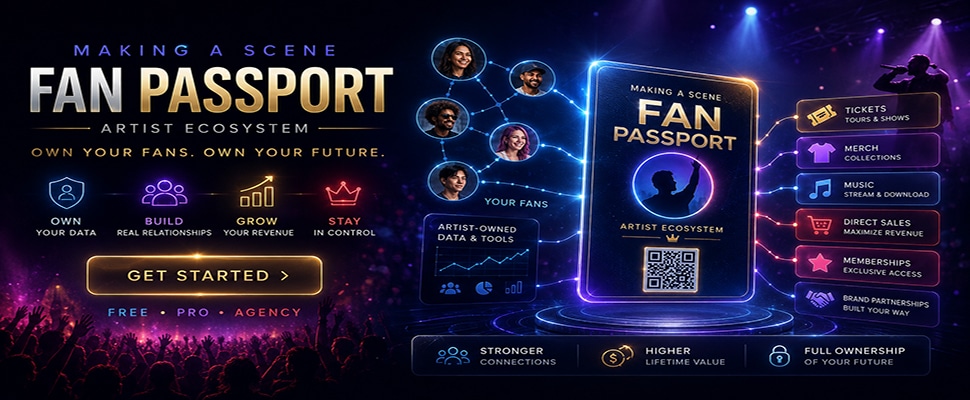
This is where the Making A Scene Artist Ecosystem and Fan Passport become more than technology. They become part of the artist’s business foundation.
The Fan Passport is not just an app idea. It is a way to give the artist memory.
A fan who scans a QR code at a show should not vanish after the encore. A fan who buys merch should not be treated like a stranger next month. A fan who attends three shows should not be hidden in the same flat list as someone who clicked one link. A fan who brings friends should be recognized. A fan who supports a release should be remembered.
That is what community needs.
Memory.
The Fan Passport can help artists build that memory through follows, stamps, rewards, show alerts, QR scans, direct fan activity, and artist-owned fan relationships. It gives fans a reason to participate and gives artists a way to understand participation without being trapped inside a platform’s private data wall.
That is a big deal.
Because the artist should not have to beg a platform to reach the people who already asked to hear from them.
Fan Data Is Not Fuel. It Is Trust.
There is a right way and a wrong way to use fan data.
The wrong way is to treat fans like leads. Scrape everything. Track everything. Push people into funnels they never asked for. Pretend every automated message is personal. Use AI to fake intimacy. Create fake urgency. Create fake conversation. Act like a tech company that happens to sell music.
That is not the future independent artists should want.
The right way is based on consent.
Tell fans what they are joining. Tell them why the Fan Passport exists. Tell them that scanning a QR code helps the artist send better show alerts, rewards, local invitations, and community updates. Let fans choose what they want. Let them update their preferences. Let them leave.
That kind of respect builds stronger community.
When fans know the artist is using data to serve them better, not manipulate them harder, the relationship gets stronger. The fan does not feel hunted. They feel included.
That is the difference.
AI Can Introduce Fans To Each Other
One of the most powerful things AI can do for artists is also one of the simplest.
It can help fans meet.
Think about that for a second. Most artist marketing is built around the artist talking to fans. But some of the strongest communities form when fans begin talking to each other.
That is when the artist’s world becomes bigger than promotion.
Imagine an artist has twenty fans around Philadelphia who always open emails about acoustic shows. They comment on lyric videos. They answer a survey saying they would attend a listening party. A few bought vinyl. A few scanned a QR code at the merch table.
Now imagine another group in Asheville keeps responding to studio posts. They want behind-the-scenes stories. They like hearing how songs are made. A third group in Chicago buys merch fast, clicks tour announcements, and wants a full-band show.
Without AI, those patterns may stay buried.
With AI, the artist can see the circles forming.
The artist can say, “There is enough interest in Philadelphia for a listening night.” Or, “Asheville fans seem to want a studio-story event.” Or, “Chicago may be ready for a limited merch drop and a pre-show hang.”
That is not guessing.
That is listening.
Invitation Is Stronger Than Promotion
Most artists promote because they think they have to.
And yes, promotion matters. Fans need to know when the song is out, when the show is happening, where to buy the ticket, and how to support the work.
But community is built through invitation.
Promotion says, “Here is something I want you to buy.”
Invitation says, “Here is something I want you to be part of.”
That difference changes the energy.
Instead of blasting everyone with the same message, the artist can speak to a smaller group with more care. “I noticed there are a bunch of you around Philly who seem to love the stripped-down songs. I’m thinking about doing a small listening night. Would you want to come?”
That feels different because it is different.
It tells the fan they are not just another impression. They are part of a real decision.
A fan who feels included is more likely to reply. A fan who replies is more likely to attend. A fan who attends is more likely to remember. A fan who remembers is more likely to come back.
That is how community compounds.
Use Simple Tools To Start The Conversation
Artists do not need a complicated system to begin.
They can start with a simple form using Typeform or Tally. Ask fans where they live. Ask what kind of events they would attend. Ask which songs mean the most to them. Ask if they would come to a small meetup, listening party, house concert, pre-show hang, or online Q&A. Ask if they want to meet other fans.
Then use AI to help organize the answers.
Not to replace judgment. Not to make cold decisions. Just to help the artist see what is there.
Maybe fifty people answer. Maybe only twelve answer. That is fine. Those twelve people are raising their hands. That matters.
The artist can then follow up through email, the Fan Passport, a community space, or a direct message. The key is to not let the signal die.
A fan who raises their hand is giving the artist an opening.
The artist should honor it.
Local Fan Groups Are The New Street Teams
Local fan groups may become one of the most important tools in the independent artist playbook.
That may sound old-school, but it is not. It is just smart.
Music still happens in places. Venues are local. Festivals are local. Record stores are local. House concerts are local. Coffee shops are local. Street teams are local. Sponsors are local. Even when discovery happens online, the money often happens when real people gather in real places.
AI can help artists find where those places are warming up.
An artist may have followers across the country, but only a handful of cities may show real action. Email opens, ticket clicks, merch orders, QR scans, Fan Passport activity, survey answers, comments, and repeat show attendance can all point to local heat.
Tools like Bandsintown for Artists can help with concert promotion and tour alerts. Eventbrite can help organize ticketed events. Meetup can help create local gatherings around shared interests.
But the tool is not the win.
The win is realizing that forty active fans in one city are not just a number. They are a possible room.
They might become a presale group. A house concert circle. A listening party. A local fan club. A street team. A launch crew. A merch drop audience. A reason to book the city again.
That is what artists need to look for.
Not just where people clicked.
Where people might gather.
Small Gatherings Can Build Bigger Careers
The music business loves big moments. Big numbers. Big stages. Big playlists. Big press. Big spikes.
But many real careers are built through small rooms.
A pre-show coffee hang with fifteen fans can matter. A private listening party with twenty fans can matter. A house concert with thirty people can matter. A local merch night can matter. A songwriting Q&A can matter. A vinyl listening session can matter.
These events may not look impressive on a public dashboard, but they create something far more valuable.
Memory.
A fan may forget a post. They may not forget the night they met the artist, met other fans, heard the story behind a song, bought a limited shirt, got a Fan Passport stamp, and felt like part of the beginning of something.
That kind of memory turns into loyalty.
And loyalty turns into revenue without the artist having to beg.
A Real-World Example Of Community Density
Let’s make this simple.
Imagine an indie artist with 2,000 scattered followers. They have some listeners on streaming platforms, a few hundred people on an email list, some social followers, and a small merch store. Nothing looks huge. Nothing looks like a breakthrough.
Under the old model, that artist might feel behind.
They might think, “I need more followers.” So they post more. They chase more trends. They spend hours making clips. Some work. Most disappear. The artist stays tired.
Now imagine the artist changes the goal.
Instead of chasing a bigger audience, they try to build denser community.
They send a simple survey. They invite fans into the Fan Passport. They add QR codes at shows and merch tables. They ask fans what city they are in, what songs they care about, what kinds of gatherings they would attend, and whether they want local show alerts.
Then they use AI to organize the answers.
They discover sixty active fans across three cities. Twenty near Philadelphia. Twenty near Asheville. Twenty near Chicago.
That does not sound massive.
But it is real.
These fans open emails. Some bought merch. Some scanned QR codes. Some say they would attend small events. Some want listening parties. Some want pre-show hangs. Some want local alerts.
That is not a giant audience.
That is a foundation.
Sixty Fans Can Become Three Circles
The artist now has a choice.
They can ignore those sixty fans because the number is not big enough to brag about.
Or they can build with them.
They invite the Philadelphia fans to a small acoustic listening night. They invite the Asheville fans to a studio-story event before the next show. They invite the Chicago fans to a pre-show meetup with a limited merch drop.
Each fan who attends gets a Fan Passport stamp. Each fan who brings a friend gets recognized. Each fan who buys merch gets thanked. Each fan who joins the local group gets future alerts.
Now something starts to happen.
Fans meet each other. They talk. They share photos. They bring friends. They become part of the artist’s story. The next time the artist comes through town, the room is warmer before the first note is played.
That is community density.
And it is much more useful than chasing passive reach.
Community Creates Direct Revenue
This is not just feel-good language.
Community creates money.
A small ticketed listening party can create revenue. A house concert can create revenue. A limited local shirt can create revenue. A direct merch store through Shopify can create revenue. A membership through Patreon can create recurring support. A direct support page through Ko-fi can help fans fund the work.
But none of those tools work well without relationship.
A fan does not buy because a button exists. They buy because the thing means something. They do not join a membership because an artist has a Patreon page. They join because they feel close to the story. They do not come to a meetup because it is another date on a calendar. They come because they want to be in the room.
That is why community is not separate from revenue.
Community is the reason revenue feels natural.
When fans feel like they belong, support becomes part of participation.
AI Should Be The Host Assistant
The best role for AI in this system is not fake artist.
It is host assistant.
A good host notices who came into the room. A good host remembers who was there before. A good host introduces people who might get along. A good host follows up after the night is over. A good host knows when the room needs a question, a thank-you, or a new invitation.
AI can help with that.
It can help write a welcome message for fans who joined through a show QR code. It can help group fans by city. It can help summarize survey answers. It can help draft follow-up emails. It can help suggest community questions. It can help remind the artist to thank people who supported the last event.
Automation tools like Zapier and Make can help connect the pieces. A form response can tag a fan by city. A merch purchase can trigger a thank-you. A show scan can create a Fan Passport action. A local survey response can tell the artist when enough people in one city are interested in a meetup.
This is not about replacing the artist.
It is about helping the artist follow through.
And follow-through is where loyalty grows.
Do Not Let AI Fake The Relationship
Artists need to be careful here.
AI can help build community, but it can also create fake intimacy if used badly.
Fans do not want to be tricked. They do not want fake personal messages. They do not want automated warmth that feels hollow. They do not want to be pushed into groups, tagged without consent, or treated like data points in a sales machine.
The artist should never use AI to pretend.
Use AI to organize. Use AI to notice. Use AI to draft. Use AI to remind. Use AI to reduce the boring work.
But keep the relationship honest.
If a message is automated, it should still be truthful. If a fan is invited into a group, they should understand why. If data is collected, the artist should explain how it helps create better experiences. If fans are asked to share a city or interest, they should know it is so the artist can send better local invitations, not spam them forever.
Trust is the real currency.
Do not spend it cheaply.
The Artist Is Still The Fire
This is the part that matters most.
AI is not the fire.
The artist is.
The artist’s songs are the spark. The artist’s story is the reason people gather. The artist’s voice is what gives the community shape. The artist’s choices create the culture.
AI can help gather signals, but it cannot decide what the artist stands for. It can help write a draft, but it cannot care. It can help find patterns, but it cannot replace the feeling of being in a room where the music matters.
The artist still has to show up.
The artist still has to say thank you.
The artist still has to make the invitation real.
The artist still has to build something worth belonging to.
That is the work. And it is better work than feeding the content machine until there is nothing left.
Measure What Matters
If artists keep measuring the wrong things, they will keep making the wrong choices.
So the new community-driven artist business needs better questions.
How many fans joined the artist-owned list? How many scanned the QR code? How many joined the Fan Passport? How many replied to the email? How many attended twice? How many brought friends? Which cities are warming up? Which songs create conversation? Which merch items create identity? Which fans want local meetups? Which small groups are ready for a show?
Those are relationship metrics.
They matter because they point toward action.
A thousand passive likes may feel good. Twenty fans in one city who want a listening party can become a real event. Fifty people who join a local show alert list can become a stronger tour stop. Ten fans who bring friends can change the energy of a room.
The goal is not to ignore reach.
The goal is to stop worshiping it.
Reach opens the door.
Relationship builds the house.
From Attention To Belonging
The music industry is moving from an attention economy to a belonging economy.
The attention economy wants artists to keep feeding the platforms. The belonging economy asks artists to build something fans can actually join.
That shift is important because attention is fragile. It comes and goes. It rises and falls. It depends on systems the artist does not control.
Belonging is stronger.
When fans feel like they belong, they do not need to be convinced every time. They return. They open the email. They check the tour dates. They buy the shirt. They bring the friend. They join the membership. They support the next project because they feel part of it.
That is how independent artists build power.
Not by waiting for a label. Not by begging a playlist. Not by worshiping an algorithm. Not by turning themselves into exhausted content factories.
By building a scene.
The Making A Scene Philosophy In Practice
This is the Making A Scene philosophy in its most practical form.
Use the platforms, but do not live and die by them. Let social media be a doorway. Let streaming be a discovery path. Let video be a spark. But bring fans back into something the artist owns.
Build the email list. Build the website. Build the Fan Passport connection. Build the merch path. Build the ticket path. Build the local fan groups. Build the community layer. Build the memory.
Then use AI to make that ecosystem smarter.
Let AI help find the fans who are already leaning in. Let AI help identify city clusters. Let AI help suggest meetups. Let AI help organize responses. Let AI help draft the first version of a message. Let AI help the artist follow through.
But keep the heart human.
That is the balance.
The artist brings the spark. AI helps gather the wood. The Fan Passport remembers who came to the fire. The artist-owned ecosystem keeps the circle alive after the platform scrolls on. The fans bring the heat.
That is the digital campfire.
And for independent artists trying to build a real career, it may be one of the most important business models hiding in plain sight.
 |  Spotify |  Deezer |  Breaker |
 Pocket Cast |  Radio Public |  Stitcher |  TuneIn |
 IHeart Radio |  Mixcloud |  PlayerFM |  Amazon |
 Jiosaavn |  Gaana |  Vurbl |  Audius |
 Reason.Fm | |||
Find our Podcasts on these outlets
Subscribe to Our Newsletter
Share this:
- Share on Pinterest (Opens in new window) Pinterest
- Email a link to a friend (Opens in new window) Email
- Share on X (Opens in new window) X
- Share on LinkedIn (Opens in new window) LinkedIn
- Share on Facebook (Opens in new window) Facebook
- Share on Tumblr (Opens in new window) Tumblr
- Share on Reddit (Opens in new window) Reddit
- Share on Telegram (Opens in new window) Telegram
- Print (Opens in new window) Print
- Share on WhatsApp (Opens in new window) WhatsApp
- Share on Mastodon (Opens in new window) Mastodon
Related
Discover more from Making A Scene!
Subscribe to get the latest posts sent to your email.


